Ski Art: Sverre Morken (1945– )
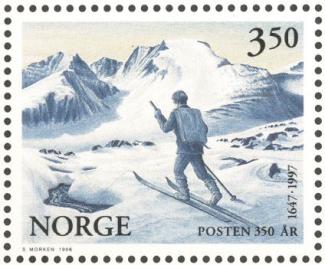
Sverre Morken was Norway’s premier engraver of postage stamps and bank notes. Over the years accolades mounted up and he won prizes, ending with a gold medal from King Haakon V in 2018, the year he retired.
Morken began his career as a merchant seaman, traveling as far as Australia and India. He then attended the SHKS – the Statens h ndverks -og Kunstindustriskole (National Crafts and Industrial Arts School) in Oslo, where he came under the influence of master engravers. He found summer work with the Norway Bank Printing Works and that set him up for his life’s passion. He engraved his last postage stamp in 2014.
In 1996, Morken was chosen to engrave the first of eight stamps commemorating the 350th anniversary of the Norwegian postal service. In 1647, Norway, then under Danish control, copied the Danes’ postal organization founded in 1620. The organization relied on men that were designated ‘post farmers.’ They carried the mail over a certain designated route and passed the mail on to the next one. In Norway, post farmers received no pay but were exempt from military service and other civilian requirements such as road mending. They were allowed to charge for any private mail they delivered.
Morken’s 1647 carrier is the lone skier out in the deep and untrammeled snow of mountain Norway, perhaps on the route between Christiania and Nidaros (Oslo and Trondheim). This route was so important that dignitaries proposed it for regular mail service as early as 1535. To assure winter service, only men who could ski were considered for positions. This winter service spread over the whole country over the next two hundred years. An aristocrat in exile after the French Revolution, the Sieur Jacques-Louis de Bougrenet de la Tocnaye, traveled through Norway about 1800, and wrote home that “the post is carried in winter by a man who, mounted on large snow boards, can go great distances with a singular speed and with no troubles even among difficult snow, where men and horses could not go.”
The Sieur concluded: “A time will come, without doubt, where the other peoples of Europe will make good use of this instrument, so useful and so cheap.”