Short Turns: Salt Lake's Olympic Future
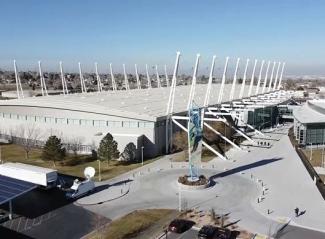
The IOC’s new selection process gives Utah a step up for more curtain calls.
In July 2024, the International Olympic Committee (IOC) awarded the 2034 Winter Games to Salt Lake City. It now appears that Utah will join a select group of regions, all with permanent Olympic facilities, that will rotate hosting the Winter Games in perpetuity.
Photo top: The Utah Olympic Oval is an indoor speed-skating oval located 14 miles southwest of Salt Lake City. The Oval was built for the 2002 Winter Olympics and is expected to reprise that role for the 2034 Games. Above: The 2034 Olympic logo sparked immediate backlash, with criticism that the logo is difficult to read, along with complaints that Salt Lake City was replaced with Utah in the branding. Officials say the logo may be updated later. Photo courtesy Utah Olympic Legacy Foundation
The IOC acknowledges that climate change will sharply limit the number of cities able to provide snow cover in
decades to come and that governments now balk at the 10-figure costs of hosting the Olympics. The solution may be to award the Winter Games only to cities or regions with facilities already in place from previous Olympics and with more-or-less–reliable winter conditions.
 Two years ago, for the first time, the IOC simultaneously awarded hosts for the next two Winter Games: the French Alps in 2030, followed by Utah four years later. If the IOC does begin to rotate the Winter Games among a small group of host cities, Salt Lake City becomes a prime candidate for future bids.
During a press conference in Milan a few days before the 2026 Winter Games, IOC president Kirsty Coventry said that a rotation scheme “is definitely something we will work at.” She emphasized that any changes to the selection process “can’t just be for the next couple of years. We really have to look far down into the future.”
There’s little debate that the IOC’s traditional bid process is outdated, especially for the Winter Games, with its reliance on snow and cold temperatures. Numbers back that up. Seven cities initially expressed interest in hosting the recent 2026 Milan-Cortina Games, but after voluntary withdrawals, in 2019 the process came down to only two candidates: Milan-Cortina and Stockholm-Åre. In acknowledgment of a changing process, the 2026 Games were the first to be awarded to dual hosts, which helped distribute the costs between Cortina and Milan.
In 2019 the IOC also began to transition away from its traditional competitive bidding process to a new direct-bid format, which was approved by the 134th IOC Session that year. The new format strives for a more collaborative process: The IOC identifies a potential host city, requests that a bid be submitted and works as a partner in the process.
To reduce costs for the hosts, the direct-bid process focuses on cities that have previously hosted Games. That focus seems to be working. A reported 85 percent of the venues for the 2026 Winter Games were already in place or were temporary facilities, greatly reducing the stress of solving the longstanding problem of how to use Olympic venues after the three-week event has left town.
In Milan, an IOC executive board member singled out Utah as a “great model” for a new rotating-host format. Aiding Utah’s case is that after the 2002 Winter Games, the Salt Lake Organizing Committee established the Utah Olympic Legacy Foundation with a $72 million endowment for maintaining and operating the local Olympic venues.
It’s worked. Venues built for 2002 continue to see regular use and upgrades. Barring any significant problems, Snowbasin will host all Alpine racing; Deer Valley will host moguls and aerials; Park City will get halfpipe and slopestyle; Utah Olympic Park will host ski jumping; Soldier Hollow Nordic Center will host cross-country and biathlon; and big-air competitions will be held near downtown Salt Lake City (perhaps in a new baseball stadium).
Beyond skiing, the Olympic Oval has hosted World Cup and world championship speed-skating events. The Utah Olympic Park in Park City is in rotation for World Cup and world championship luge, bobsled and skeleton events. Since 2002, more than 90 World Cup and world championship events have been held in the state, according to the Utah Sports Commission.
Using a small pool of locations to host mega-athletic events is not a new system. Until 2018, the National Football League (NFL) had an open bidding process for its Super Bowl. Then it transitioned to a direct-selection model, in which the league identifies a city that meets its requirements and requests a bid be submitted. Miami, New Orleans and Los Angeles alone have hosted 50 percent of all Super Bowls. The NFL has a similar, but opposite, weather dilemma as the one faced by the IOC for Winter Games. It primarily selects warm-weather cities to host its annual extravaganza, almost always avoiding the winter chill for the February classic.
With its reliable snowfall, easy access to an international airport and modern Olympic venues already in place, there’s a good chance that Salt Lake City will be the first venue ever to host the Winter Games three times—and, perhaps, beyond.
Snapshots in Time
1950 DON'T BE AFRAID
This is not a scare article. It is rather facing a few facts about our sport in the hope that even one accident will be prevented. Skiing is not a dangerous sport. It is simply and purely what we as individuals wish to make of it. The accident ratio is low, but it is increasing with the number of new skiers. There is an issue here. We should try not to dodge it. — C.M. Dole, “How Dangerous Is Skiing” (SKI, February 1, 1950)
1975 SKI THE FRIENDLY SKIES
With the help of the University of Colorado business research division, United Airlines looked for reasons for its ski boom. The most important factor, its study showed, is that the average skier who goes to resorts in the Rockies is in a professional or technical job that protects him or her from salary cuts and unemployment. The typical male who skis in the Rockies, according to the survey, is 35 years old and earns $35,000 a year. The airline’s study also reveals that the proportion of women and single skiers is increasing. —“Ski Notes: Amid Hopes for a Boom Season, the Show Blows In” (New York Times, November 11, 1975)
1990 DON’T BE SURPRISED
When you go into a shop to have your bindings serviced this season, don’t be surprised if the shop changes the release settings. This season, for the first time, binding manufacturers have instructed ski shops to test all bindings that they service or install, including new ones, using procedures that comply with the new ASTM (American Society for Testing and Materials) standards for shop practices. The shops are not required by law to do this testing (all ASTM standards are voluntary), but the requirements imposed on them by the binding manufacturers and some insurance companies should make these procedures the rule before the end of the season.—Carl Ettlinger, “This Year, Ski Shops Will Test All Bindings, New and Used. Here’s Why” (Skiing, March 1990)
2009 LIFTING SKIERS’ SPIRITS
This season, two new and dramatic conveyances have opened at ski areas in North America. In Wyoming, Jackson Hole Mountain Resort’s new $31 million tram replaces the one that was laced to the peak in 1966. At Whistler Blackcomb, in British Columbia, the $42 million Peak 2 Peak gondola stretches 2.7 miles horizontally from one mountainside to the other. Both lifts came with shocking price tags. Both were impressive feats of engineering. Both are red. But while the new Whistler-Blackcomb gondola is spectacular, some locals questioned its necessity. In Jackson, when the old tram was shut down, people said the mountain had lost its soul.—Helen Olsson, “Sleek New Rides Up the Slopes” (New York Times, January 29, 2009)
2026 VONN AVOIDS LOSING HER LEG
In an Instagram video, Lindsey Vonn, 41, said that she nearly had her left leg amputated following her terrifying crash at the 2026 Winter Olympics. Vonn said that Dr. Thomas Hackett, a Vail, Colorado–based surgeon, performed a complicated operation that allowed her to keep the appendage. “Dr. Tom Hackett saved my leg from being amputated,” Vonn said. “He did what is called a fasciotomy, he cut my leg open both sides of my leg—basically filleted it open—and let it breathe and he saved me.” Vonn clipped a gate shortly after she started the Olympic downhill race. She suffered a complex tibia fracture and a fracture to the femoral head in her left leg. Vonn said that the traumatic injury sparked a more serious medical condition called compartment syndrome. —Frederick Dreier, “Lindsey Vonn Narrowly Avoided a Leg Amputation After Her Olympic Crash” (Outside.com, February 23, 2026)