Reviews: ISHA Award Winning Books
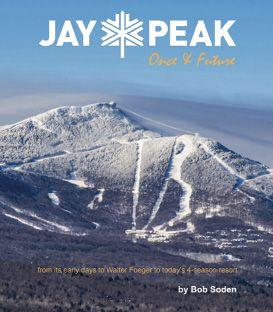
Jay Peak, Once and Future
From Its Early Days to Walter Foeger to Today’s 4-Season Resort
By Bob Soden
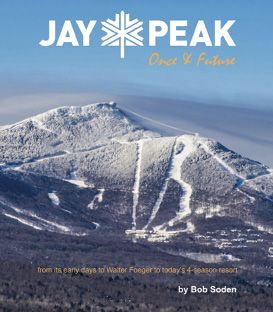 Bob Soden, who has spent a lifetime skiing and teaching skiing at Jay Peak, Vermont, has created this weighty, 324-page full-color history of his home mountain.
Jay Peak is a unique ski area, at least among North America’s Eastern resorts. It claims average annual snowfall comparable to the major Colorado resorts (at the end of January 2026, Jay had more than four times Vail’s season-total snow this winter). It boasts a truly bilateral Canadian/New England culture. And Jay was for decades the headquarters of Natur Teknik, Walter Foeger’s direct-to-parallel ski teaching formula that challenged Arlberg orthodoxy.
To do the resort justice, Soden has created a unique book. Readers of this magazine will recognize Soden as a frequent contributor, a longtime ISHA board member and a member of its awards committee. As a historian, he values context, and the book is formatted accordingly. His detailed history begins in 1910, with the establishment by James P. Taylor of the Green Mountain Club. Each chapter contains a useful context box listing significant world events for that year. The best feature is the inclusion, on every full-color page, of original-source documents reproduced at legible scale. Browsing through the newspaper clippings, contemporary maps and photos, and financial and legal documents brings the story alive, as do the dozens of spectacular full-page panoramas. The result is a gorgeous book full of visual and intellectual surprises.
Foeger wasn’t the sole creator of direct-to-parallel ski teaching. Emile Allais published the original French direct-parallel system in 1937. By the time Foeger established the Jay Peak ski school in 1956, many Swiss and French instructors were skipping stem turns entirely in a noble effort to streamline the learning process. But Foeger built Natur Teknik into a practical system that was formally adopted at a dozen ski schools across the region. As the resort’s general manager, Foeger also supervised trail and lift construction.
Following his return to Austria in 1973, the resort missed his strong leadership. A series of owners came and went, culminating in the resort’s purchase, in 2008, by Ariel Quiros. What followed was the biggest financial scandal in Vermont history. It took almost two decades to sort out the mess, but the mountain remained open, and the snow continued to fall throughout. —Seth Masia 
Jay Peak, Once and Future: From Its Early Days to Walter Foeger to Today’s 4-Season Resort, by Bob Soden, Marquis, Montmagny, Quebec (2025), hardcover, 324 pages. $99 USD
Aspen Journey: Past to Present
By Susan Dalton
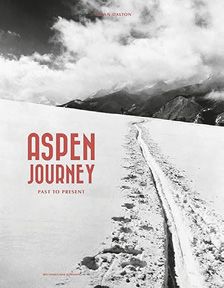 This coffee table-size book stands out among the many published about Aspen over the past half-century. Susan Dalton comprehensively surveys the town’s history, from the days of the original Ute inhabitants and the ensuing mining boom and bust years, to the ski area’s 10th Mountain Division roots and, finally, Aspen’s emergence as a skiing and cultural mecca.
Every page brims with a multitude of beautifully rendered old documents, photographs, panoramas, posters and maps. A cleverly illustrated, four-page fold-out timeline near the book’s front also clearly presents the arc of Aspen’s history. A bonus: Tissue pockets that hold fine copies of old postcards are tipped in throughout the volume.
Great documentation and stories carry us through the early years of skiing and town development, from Olympian Bill Fiske in 1936 to Walter and Elizabeth Paepcke and Friedl Pfeifer in the mid-1940s. The Paepckes saw Aspen’s remoteness not as a negative, but as a means of lending the area a certain cachet, which aligned with their ideas of promoting an annual cultural festival and other summer events to offset its winter activities.
Aspen Mountain opened in 1947 with what was then the world’s longest chairlift. Under the partnership of Pfeifer and Paepcke, the Aspen Skiing Corporation was formed. Pfeifer developed neighboring Buttermilk Mountain in 1958. The development of the third and fourth mountains, Snowmass and Aspen Highlands (by Whip Jones), soon followed.
This handsome tome will, without a doubt, grace many a library and living room of Aspen aficionados and other ski-history fans, laying out the resort’s rich history, as it were, on a platter. Other books by Dalton include Telluride: A Silver Past, A Golden Future and Durango: A Silver Past, A Golden Future. — Bob Soden
Aspen Journey: Past to Present, by Susan Dalton. Published by Red Tambourine Publishing, LLC, Telluride, Colorado (2023), hardcover, 164 pages. $85 USD
A Town Built by Ski Bums
The Story of Carrabassett Valley, Maine
By Virginia M. Wright
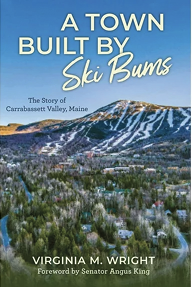 Veteran journalist Virginia Wright tells the intriguing story of a town with a difference at the base of Sugarloaf, the second-largest ski resort east of the Mississippi. The mountain also claims the second-longest vertical drop (2,820 feet/860 meters) in New England.
What sets Carrabassett Valley apart from most ski towns are its origins and makeup. The ski area arrived first, in 1963. A decade later, in 1972, a couple dozen local ski bums bought some 1960s A-frame houses and decided it would be in the interest of their pocketbooks to set up a municipality that didn’t do things in the usual fashion. They got approval to combine two unincorporated towns remaining from the area’s lumber heritage at the foot of the ski area, then based the new town’s economy on outdoor recreation and creative investment. It helped that these young dreamers were both well-heeled and well-educated.
Carrabassett Valley doesn’t fit the usual conception of a New England ski town with vintage homes and a white, steepled church. Instead, the town now boasts 2,100 homes and owns a first-class Trent Jones Jr., golf course, 2,000-acre ski touring and mountain biking park, airport, riverside rail trail, advanced fitness center and modern library, among other facilities. Yet residents don’t pay high taxes. The town’s directors have ensured that the mill rate has never exceeded $8.40.
In fact, Carrabassett Valley has managed its affairs so well that the town has been able to come to the rescue of the ski resort on more than one occasion when bridge loans were needed.
This book provides a well-researched, well-written and comprehensive history. The author was a senior writer at Down East magazine for 10 years and has written other books, including Red’s Eats: World’s Best Lobster Shack, The Wild Blueberry Book and Route 1: Maine. –B.S.
A Town Built by Ski Bums: The Story of Carrabassett Valley, Maine, by Virginia M. Wright. DownEastBooks, Essex, Connecticut (2024), hardcover, 266 pages. $29.95 USD
2025 ISHA Award Winners
Award winners will be honored April 10, 2026, at Snowbird, Utah, as part of Skiing History Week.
Lifetime Achievement Award: Junior Bounous
At 100 years old and still skiing, Bounous is known as a “Pioneer of the American Ski Industry.”
Ullr Awards
Presented for a single outstanding contribution or several contributions to skiing’s historical record in published book form.
- Kandahar 1924–2024: The Original Ski Racing Club, by Adam Ruck
- Orte der Erinnerung im Skisport (Memorable Places in Skiing), by Dr. Markwart Herzog and Annette
Hofmann - American Birkebeiner: The Nation’s Greatest Ski Marathon, by Jerome Poling and the Wisconsin
Historical Society Press - Shishapangma, Skiing the Highline: The Account of the First American Descent from an 8,000-Meter Peak, by Michael Marolt
Skade Awards
Presented for an outstanding work on regional ski history or a book focused in part on ski history.
- Ski Club Lodge Pioneers 1950-1960: Advocates, Architects and Aficionados, by Donald Johnston
- A Town Built By Ski Bums: The Story of Carrabassett Valley, Maine, by Virginia M. Wright and the Carrabassett Valley History Committee
- Aspen Journey: Past to Present, by Susan Dalton
- Jay Peak, Once and Future: From Its Early Days to Walter Foeger to Today’s 4-Season resort,
by Bob Soden
Film Awards
- Big Mountain Soul: Ski Africa, Directors Brendan Russo and Cameron Sale; Producers, J.M. Correia and J.M. O’Conner
- Bill Healy: A Man Who Loved a Mountain, Mt. Bachelor Sports Education Foundation
- Mountains Not for Profit, Teton Gravity Research and Indy Pass
- Advice for Girls, Addy Jacobsend and Sara Beam Robbins
- We’ll Still Be There: The Story of Gold Miner’s Daughter, Alex Mager
- First Tracks: Michigan’s Skiing Legacy, Steve Kershner, Mickey MacWilliams, Mike Panich and Matthew Zabransky