Anja Pärson
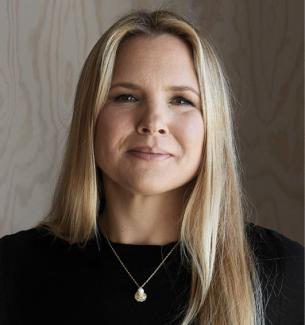
Swedish star Anja Pärson became Alpine’s first five-discipline world champion.
Toward the end of Anja Pärson’s 14 seasons on the World Cup, it was no secret that her girlfriend’s daughter sometimes joined her on tour. Emmi wasn’t the only toddler on the circuit. Sarah Schleper had her son, Lasse Gaxiola, and Daniela Ceccarelli had her daughter, Lara Colturi (who now races for Albania).
“Everybody liked to have them around,” Pärson says of the children. But when the media pushed Pärson to come out, she reminded reporters that they rarely probed men about their sexuality. And she was focused on racing. Publicly stated or not, “we were open with our relationship on the tour for five years,” Pärson says.
Finally, after Pärson retired from racing in March 2012, when her girlfriend, Filippa Rådin, was pregnant with their son, Elvis, they felt ready to share their story. But then they couldn’t find an appropriate forum. One day,
Pärson’s producer friend suggested a 90-minute block on one of Sweden’s most popular and longstanding radio shows, Sommar i P1, where celebrities told their own stories.
So on June 23, 2012, the six-time Olympic medalist, seven-time world champion and two-time World Cup overall winner revealed how, in 2005, she visited Rådin’s stylish clothing store in Umea and fell in love.
The episode, Pärson says, “blew up. We didn’t get one negative comment. We were really nervous, because it was not just me that came out. My wife had just ended a marriage with her husband. The most proud moment is that we gave so much comfort to people to follow their heart—everyone from gays to straights. Today, people still give us letters telling us they got the courage after my show to take that step. It’s been amazing.”
As she told the Associated Press in 2019, “I live as I want.”
Perhaps surprisingly, Rådin, a fashion designer, wasn’t much of a skier. On one of their first dates, Pärson took her to the slopes. “She broke her knee and wrist, and spent the next eight weeks on crutches,” Pärson says. Yet on August 2, 2014, they were married in Umea, about 220 miles southeast of Tärnaby, where Pärson grew up. (Tärnaby also produced Ingemar Stenmark and Stig Strand, who tied each other for the 1983 World Cup slalom title.)
Nine months later, Pärson gave birth to their son, Maximilian. The family of now five lives in Umea, where the two women run a company called “She Like,” promoting products they deem cool—from lamps and cars to strollers–to boost sales and exposure.
These days during World Cup races Pärson is usually out doing something with her kids, but she still watches replays. “I mean, you never get it out of your blood,” she admits.
At the 2014 Sochi Winter Olympics, Pärson did Alpine commentary even though Russia had passed a law in 2013 that made it a crime to publicly acknowledge being gay. Pärson went anyway—telling CNN, “I didn’t feel like Russia should choose the way I live”—and criticized the International Olympic Committee for not standing up for human rights. In Russia, she says, “I tried not to go too much wandering about but, for sure, they knew. I had my wife and son there.”
She skipped the next two Winter Games but returned at age 44 to do commentary at the 2026 Milano-Cortina Olympics for the Swedish network STV.
The Road to Victory
Pärson’s parents put Anja on skis as soon as she could walk. Too small to ride the T-bar alone, she had to ask strangers for help. She was only supposed to go halfway up. “I told people to just spread their legs, then I will get small and fly back [down],” she says. At age seven, she began racing. It wasn’t long before her older sister, Frida, was bragging about her.
Frida spent a year abroad in Vail, Colorado, where she ran the 4 x 400 track relay at Battle Mountain High School with Schleper, who would go on to ski in seven Olympics. Schleper recalls, “Frida told me, ‘My sister’s a ski racer. You might meet her someday.’”
At the 1997 Alpine Junior World Championships in France, Pärson won the giant slalom—her first of four junior world championship titles. Schleper finished 12th in that same GS and realized, “‘Wow! Her sister is really fast!’”
In December 1998, in just her fifth World Cup start, the 17-year-old Pärson shot out of 15th place after the first run of a slalom at Mammoth Mountain, California, to capture the first of her 42 World Cup victories. She became the third World Cup victor from Tärnaby, Sweden, (pop. 468) after Stenmark and Strand.
“It was a shock for everyone,” she says. She admits she wasn’t prepared for the attention of winning at age 17. “I tell kids today, ‘Take your time,’ because I wish I didn’t win that race,” she adds.
In 1999, two months after that World Cup victory, Pärson DNF’ed in both the slalom and GS in her world championship debut in Vail. The teenager quickly tallied 13 more World Cup podiums but wouldn’t win another World Cup race for two years.
Skiing wasn’t the problem; it was the other demands. “It took me two years to understand that to be a legend, you have to embrace everything—media, sponsor stuff,” says Pärson. “I was also homesick a lot.” The turning point came when she finally acknowledged that her duffle bag would be her home for maybe 15 years. “I said, ‘Just focus on where my bag is; that’s my home. Accept it,’” she explains.
While Pärson was grappling with all that, another teenager was seizing glory: Croatia’s Janica Kostelić, who would become her toughest competitor.
Intense Rivals and Supporters
“She had so much attitude at the beginning,” says Pärson of Kostelić. “I think I also had attitude.”
Technically, the two were very different. “Anja was so strong. She was lifting a lot. Her angles were exceptional,” says Ales Sopotnik, one of Pärson’s full-time ski techs. “She created so much power out of the turn. She used all the forces. She was just like a ballerina.”
In contrast, Sopotnik says, “Kostelić always looked like she will be cruising. She was such a light touch on the skis. I remember when Janica was 15, 16, sometimes skiing three days of training on the same slalom course with [her brother] Ivica—huge ruts, over the knee, like, ‘What the hell are they even doing?’ But she got so balanced.”
Heading into the 2001 Alpine World Ski Championships in St. Anton, Austria, Kostelić, undefeated in seven races, was the prohibitive favorite in slalom. But 19-year-old Pärson won the slalom gold to become the youngest medalist at those championships. (She also took bronze in GS.)
Soon Pärson and Kostelić were always the last racers at the start house for the second run of slalom and GS. They were always at the same doping controls, the same press conferences.
“Everywhere we went, it was us two,” Pärson says, “so even if we were rivals fighting for the same spot, we always found each other. Also, we both had our dads as coaches and that’s positive in a way, but also, as a young woman growing up, it’s horrible to have your dad around. I think we found life situations where we could find comfort in each other.
“I have half my career to thank her for,” Pärson adds. “She made me a better skier. She made me take risks. She made me work harder, because I knew when we came back the next year, I had to be better to beat her.”
In 2002, Pärson’s Olympic debut, she and Kostelić shared two podiums in Salt Lake City. When Pärson earned the slalom bronze, Kostelić clinched gold. When Pärson claimed GS silver, Kostelić won again to claim her third Olympic gold in eight days.
They became so dominant that at the end of 2003, Kostelić captured her second World Cup overall globe. In 2004, Kostelić had thyroid surgery and Pärson won the overall title. In 2005, Pärson became the back-to-back overall winner—with three points separating her from the runner-up Kostelić that year—thanks, in part, to Schleper.
In the penultimate race of the 2005 World Cup finals in Lenzerheide, Switzerland, Schleper led after the first run of slalom. “It was a really big deal because I’d never won a first run before,” Schleper says. “I didn’t even realize what was going on with the overall [race]. I was oblivious. At the top, Janica came over and was like, ‘Oh, is this your first time running last?’ trying to get in my head a little bit. I was like, ‘What?’ I was never in the position for people to play mind games with me.”
Kostelić skied well and took the lead, but Schleper was nearly a half-second faster, winning the only World Cup race of her career and denying Kostelić 20 crucial points between first and second place.
A Gold in Torino
Pärson and Kostelić competed together in one more Winter Olympics: Torino in 2006. Pärson had become a five-event skier and would be the triple medalist this time—taking home the only Olympic gold of her career (in slalom) and two bronze medals (in downhill and combined).
But Pärson hurt her left leg the week before the Winter Games and hurt it again warming up before the slalom. She could barely stand. As Sopotnik was preparing the skis, he saw Pärson’s physiotherapist sweating. He told Sopotnik, “We need to keep that knee warm all day because there’s been damage. We cannot let it cool down.”
Meanwhile, the conditions were changing. Sopotnik always slipped the course on dull edges so he’d know exactly how sharp to make Pärson’s skis, but a fog was rolling in and on the first seven or so gates, his dull skis were gripping like crazy, so he raced up to detune Pärson’s edges. When he went back to the top, the police wouldn’t let him into the start area. Pärson had bib 1. Everyone was screaming, yet she had the fastest first run.
Kostelić’s father set the second run and the top was super-cranky. “So I’m on one knee, I have pressure, the fog, a difficult run and I thought, ‘Just bring it on. Bring me more.’ I’m just going to fight through it,” Pärson says.
She won. Kostelić placed fourth. One month later, Kostelić beat Pärson to win her third overall crystal globe. She then retired.
Pärson would race for another six seasons and make history in 2007 by winning three world championship gold medals (in downhill, super-G and combined). Thanks to her previous world titles in GS (2003 and 2005) and slalom (2001), she also became the first racer to own world titles in all five Alpine disciplines. What’s more, she completed the task on home snow in Åre, Sweden.
But it had been a sketchy season. Pärson had had seven DNFs before the world championships. “I was struggling with my skis and boots,” she explains. “People were really questioning how I was, but I was determined to win downhill in Sweden and prove everyone wrong that I couldn’t be a downhiller.” Downhill was her third race of the championships, and her third straight gold.
Vancouver Strong
Her final Olympics in Vancouver, in 2010, marked another inflection point. Pärson entered every event and trained with Lindsey Vonn days before the downhill. She says, “I watched her form. I felt like, this is the moment where I can beat her.” But the downhill training was rescheduled and ultimately split in two parts, which meant no one could hit their race speed at a critical jump.
During the race, Pärson was in the top three at all the intermediate splits and risked everything at the bottom. When she hit the final jump, she flew nearly 60 meters and landed on her back, losing all her equipment and sliding face-down through the finish. “When I landed, that was the victory: to know I escaped death,” she says. “[Yet] I never hesitated to try to find a way to get back.” She was entered in four more Olympic races—including the combined the next day.
The next morning, she says, was “brutal. I couldn’t walk. I had nerve damage in my leg and over 40 degrees fever (104 degrees Fahrenheit) because of all the bleeding in my body, the bruises.” She could barely even get her boots on.
Her coach, Mikael Junglind, skied into his position on the combined course with no idea whether Pärson would start. “The German coach said to me, ‘She’s not skiing today. It’s impossible,’” Junglind recalls.
But Pärson refused to give up. “The stars aligned so I could win one more medal [bronze in combined] but from then on, I could only basically ski on my right leg in my last three races.”
From Ski Races to Cinnamon Buns
Two years later, on March 15, 2012, Pärson retired—14 years to the day from her first World Cup start. “I was ready,” she says. “A couple months later, we had our son, Elvis, so I felt like, no, I’m not going to try to be a two-time mom on the tour. Maybe I could have done a few more years only downhill, but everybody that knows me knows that I can’t do anything halfway. That’s not my style.”
Now that she has three children, she said her boys, 13 and 10, barely know of her achievements. “I was really determined to become someone else when I stopped skiing and not be defined so much about who I was as a racer,” she says. Beyond racing, she continues to be a vocal supporter of gay rights. For the kids, her fame now comes from media coverage of made-for-television events. “My kids know me more from Champion of Champions”—an athletic competition among Sweden’s top sports people that she won in 2024. She also placed second in Sweden’s version of Dancing with the Stars in 2017.
But maybe, one day, if she does take out her medals, she would tell them, “The Vancouver bronze shows I was a racer who never gave up. I was always fighting hard, always trying to accomplish my dreams. The four world championships medals [from 2007] show how tough I could be mentally and proved I could be strong in all four disciplines. Of course, the Olympic gold is in the history books.”
And if the boys aren’t impressed, Pärson has another extraordinary talent. “She makes the best cinnamon buns,” says coach Junglind. “They’re in a league of their own. I say to her kids, ‘Your mom is better making cinnamon buns than skiing—almost.’” 
Frequent contributor Aimee Berg profiled Winter X Game star Aleisha Cline in the November-December 2025 issue.