Holiday Mountain, New York
How one local saved the Borscht Belt’s last ski area.
For nearly 70 years, every southern tourist, every comic, every singer, every song-and-dance man in the Catskills has driven past a ski lift counterweight inscribed with “16 Tons,” just outside of Monticello, New York.
Though no longer in use, the weight remains along Route 17, the main artery linking New York City, 85 miles south, to the so-called Borscht Belt resort area (see Skiing History, “The Sour Cream Sierras,” May-June 2020). The otherwise mundane concrete block paid homage to the 1946 Merle Travis coal-mining song Sixteen Tons, popularized by Tennessee Ernie Ford in 1955.
The counterweight has been free advertising for a 440-vertical-foot municipal ski area called Holiday Mountain, situated between the Neversink River at its base and a divided four-lane highway up top. Although the lettering has since faded, this beloved ski hill, the last dedicated ski area in the southern Catskills according to the Facebook group Catskill Skiing History, is undergoing a multi-year renovation driven by a local entrepreneur who is also a lifelong skier and ski patroller.
Holiday Goes Private
The hill’s riverside terrain opened for skiing in November 1949, with three electric tows, rolling slopes, expert trails and a “Swiss Ski School” to bring authentic Alpine techniques to New York skiers. The original iteration of Holiday, developed by local businessmen Don Hammond, a department store owner, and Manny Bogner, a lumber dealer, also offered a warming hut and ski shop—but it was abandoned after a few years due to a lack of snow, according to Remembering the Sullivan County Catskills, by local historian John Conway.
In December 1957, when the town of Thompson parks commission purchased the property from local resident Maude A. Crawford for $5,000, the ski area reopened with two rope tows and a 900-foot platter-pull lift with an uphill capacity of 900 skiers per hour, according to the Conway book.
Holiday wasn’t as challenging as, say, Stowe’s Nosedive terrain, but in 1957 the New York Times gushed that the ski area will “more than suffice for the run-of-the-mill sports lover who wants to test his legs as well as enjoy the sport with a minimum risk of injury.” Trails and slopes sported holiday-related names, including Easter Parade, Birthday Schuss and Christmas Bowl. Forty years later, as losses mounted and local taxpayers grew tired of deficits ranging upward of $250,000 per year, town leaders decided to bail out of the ski business.
The ski area was purchased from the town in 2000 by Craig Passante, son of the late owner of the nearby Villa Roma Resort (which still offers skiing and snow tubing to guests). The younger Passante, a Hofstra University graduate with a degree in marketing and an honorary doctorate in hospitality, tried to pump new life into the aging facility by adding a family-activities park, motocross course and special events.
The adjacent Neversink River, known for world-class fly fishing, was a blessing for snowmaking but flooded the 1950s-era base lodge in April 2005. In summer 2011, Hurricane Irene and Tropical Storm Lee caused more damage, according to the Sullivan County Democrat (June 13, 2023). What’s more, low snowfall totals during those years did little to help Passante turn the struggling ski hill around.
Determined to prevent the land from being sold for a housing development, Monticello native Michael Taylor, a longtime ski patroller at nearby Plattekill Mountain and great-grandson of original landowner Maude Crawford, purchased the teetering ski area in May 2023.
No Holiday
“This ski area was about to drop dead,” wrote Stuart Winchester of The Storm Skiing Journal and Podcast in November 2024. “Then Mike Taylor bought it. … He has resources. He has energy. He has manpower. And he’s going to transform this dysfunctional junkpile of a ski area into something modern, something nice, something that will last. And everyone knows it wouldn’t be happening without him.”
Tayor, 58, is a successful businessman, the CEO of his family’s propane and heating-oil business in the New York Tri-State area. Still, preventing the ski area from becoming another entry in the directory of lost ski areas was no holiday.
Overcoming the reluctance of banks to loan to a modest ski area, Taylor spent $10 million in renovations, encountering enough bumps along the way to fill a World Cup mogul run. However, he remains dedicated and optimistic about Holiday’s future. “We’re 85 miles from 12 million people,” Taylor told the Sullivan County Democrat shortly after purchasing the area. “We can’t fail.”
Taylor and his team, often improvising on the fly, had to contend with snowmaking pumps and guns that clogged with river grass; a pump-house fire that caused $500,000 in damage; extensive soil erosion caused by the motorcross operation; a scarcity of chairlift parts; the cancellation of local after-school ski programs and the costly landscaping of the adjacent Bridgeville Cemetery, which dates back to the late 1700s. To add to the financial challenges of running a diminutive ski area, a fire damaged the attic of its new snowtubing lodge one week before opening this season, delaying the launch of this popular kids’ activity.
From Molehill to Mountain
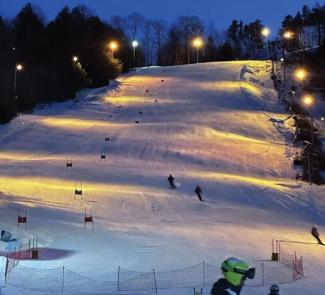
Today, it’s hard to imagine a small ski area—with just 40 skiable acres, a stingy 55-inch average annual snowfall and a 1,600-foot summit—doing so much with so little. This season the mountain opened with nine trails, anchored by a refurbished quad and triple chair. Other amenities include an 11-lane lighted snow-tubing park and a ropetow and conveyor lift overlooking the cemetery. An upgraded snowmaking system, including 200 new guns and towers and eight miles of snowmaking pipe, strive to compensate for the area’s typically modest snowfall. A true community ski area, Holiday is closed on Mondays. One benefit of its tiny footprint, Holiday is able to offer night skiing across all of its terrain—a staple amenity for a family area.
There’s also Mambo Night, a new trail that honors the Cuban-themed dance parties once held at now-defunct Catskill resorts, and Hackledam, named after a former tanning and lumbering community that existed nearby in the late 1800s. The double black, winch-groomed trail is said to be one of the steepest in the Catskills. “We’ve really rebuilt this ski area from the ground up,” says Taylor.
Fond Memories
News about Holiday’s resurrection was greeted by the region’s skiers like a powder forecast. Jeff McBride, 66, now of Las Vegas, Nevada, and a grandson of Don Hammond, lived within sight of the mountain and started skiing there at age four. “I loved skiing Holiday nearly every day of the season,” he says, “practicing Daffies, back scratchers and side-tucks almost daily for annual freestyle skiing contests.
McBride, who became a professional magician and has several entries in the Guinness Book of World Records, especially remembers drinking hot Dr Pepper with lemon in the base lodge. (Apparently “hot Doc” was a thing back then, according to the web channel Tasting History with Max Miller.)
Catskill skiing historian and native Barry Levinson, 65, who now resides in Gypsum, Colorado, recalls that as a kid, “I kinda hated this little rinky-dink 440-foot hill with a highway on top and a gravel pit on the bottom that did not look like the pictures I saw in SKI, Skiing and Powder magazines.” However, “now, with age and perhaps wisdom and a sense of nostalgia I look back on it and feel lucky to have had that hill in my backyard. Holiday Mountain [was] neither a holiday nor a mountain, but it was ours.”
Future Plans
The conversion of Route 17 to Interstate I-86 has been a long-term state project, with major upgrades planned to bring the section passing Holiday Mountain up to Interstate standards, according to the New York State Department of Transportation. Still several years away, this will reduce commuter congestion during weekday peak hours and mitigate weekend vacation traffic, hopefully leading to more ticket sales for Holiday.
Today Taylor is singularly focused on his mission, as determined as ever to answer the question of “How do we get kids off their phones and out recreating again?” As he told Storm Skiing, “You can’t make me happier than to see busloads of kids improving their skills and enjoying something they’re going to do for the rest of their lives.” 
Jeff Blumenfeld grew up skiing at Holiday Mountain. A resident of Boulder, Colorado, Blumenfeld is vice president of ISHA and past president of the North American Snowsports Journalists Association. He chairs the Rocky Mountain chapter of the Explorers Club and has covered the adventure field in ExpeditionNews.com for 32 years.