Ski posters: The art of marketing
 It was a busy day at Swann Galleries in late February, as 326 vintage posters, including 80 ski and winter ones, were offered for sale at a live auction. With Swann president Nicholas Lowry presiding, the day featured an intense, fast-paced mixture of real-time bidding on Swann’s app and website, absentee bidding, phone bidding and the traditional paddle-waving by in-person bidders.
The annual winter vintage poster sale has become a high point for serious collectors, who on this day vied for ownership of an array of ski-poster art from the turn of the 19th century to the early 1970s. Many of the best examples were created in Switzerland and France, but there was also a solid showing by some of America’s finest poster artists.
The market for vintage ski posters remains strong, and over the past 25 years, Swann has emerged as the leading auction house for them in the U.S., if not the world. (International Skiing History Association founder Mason Beekley helped create the market for ski posters in the late 1990s; see sidebar below.)
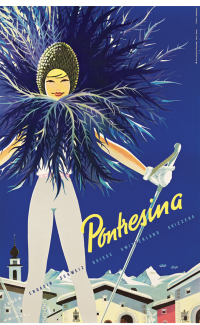
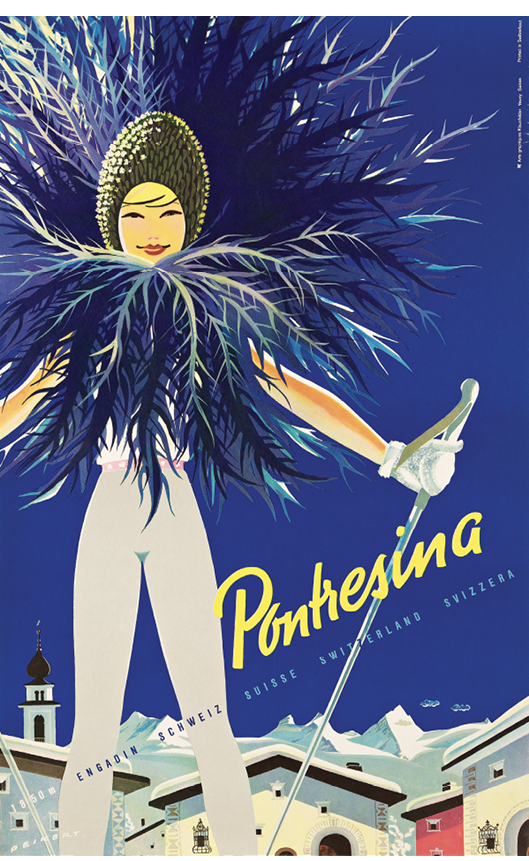
Many great European poster designers were represented at the auction, including four examples by the influential artist Martin Peikert. Lot 234, St. Moritz, a stylized depiction of a tram at St. Moritz from 1955, went for $3,556 (all prices listed include the buyer’s premium), shy of its $4,000 top estimate. Another Peikert, Pontresina from 1959 (shown above), depicts a female skier in a campy headdress. It sold for $889, something of a bargain for this artist.
Two posters by Swiss painter Emil Cardinaux were offered. Palace Hotel/St. Moritz from 1920 shows highly fashionable, slightly bored winter guests at the edge of the ice-covered Lake St. Moritz as a skater glides by. Despite an estimated price between $7,000 and $10,000, the poster sold for $6,604.
The other Cardinaux, Winter in St. Moritz (1918), garnered praise from Lowry: “It’s rarer than the Palace Hotel, and I think it’s one of his great posters, more like a lithographic painting. It’s peaceful, serene and colorful. That horse-drawn sled is evocative of an entire Alpine way of life.” When the gavel fell, it sold for $16,510, above its $15,000 low estimate.
Lowry had many more favorites in this auction, including Lots 238 and 239. “We call these guys the Herberts,” he joked of the two lots, one by Herbert Matter and the other by Herbert Bayer. Lot 238, by Swiss artist Matter in 1936, was another poster promoting the village of Pontresina. It’s a bold photomontage of a skier wearing oversize glacier goggles, as another skier descends a steep piste in the background. The resort is just a few miles from glamorous St. Moritz, but here Matter shows that Pontresina is the antithesis of its swank neighbor, offering a rugged Alpine setting at the edge of the Morteratsch Glacier. Arguably one of that era’s best examples of photomontage—at the time an arresting and groundbreaking technique—the poster, said Lowry, is the “highest level of avant-garde design being used to advertise a ski resort.” The image, he added, has only appeared at auction three times since 1995. It soared past its upper estimate of $6,000, selling for $10,795.
The counterpart was Lot 239, Mont Tremblant/Prov Quebec, created in 1939 by Herbert Bayer. The Austrian-born Bayer, regarded as one of the most influential graphic designers of the 20th century, was trained as an architect and attended the Bauhaus in Weimar. He taught advertising and typography and later became a pioneer of photomontage, integrating photographs into graphic compositions; he emigrated to the U.S. in 1938. “This poster evokes so many of the same design techniques as Matter’s Pontresina,” Lowry said. “It was made in 1939, a few years later, and it’s so rare and so wonderful.”
Bayer’s tinted photomontage depicts an athletic, red-cheeked female skier in a fashionable sweater and pants, her hair perfectly coiffed, a comb subtly sticking out of her right pocket. She’s wearing ski goggles against a backdrop of a bright blue sky, against which a few snowflakes fall. A yellow leaf emblazoned with a blue skier has a subtle Canadian design, set against the arresting photo of the skier’s face. It sold just under the asking price at $4,826.
Another Lowry favorite was Superbagnères-Luchon from 1929, for a resort in the French Pyrenees. The poster was created by Leonetto Cappiello, whom Lowry described as “an A-plus artist and poster designer who was ubiquitous in the 1920s and 1930s. He was a French artist and worked for one of the major French printers. He did over 500 posters, and this was the only ski poster he ever did.”
Three stylishly dressed skiers—two women and a man—are captured on a ski run where they’ve stopped to talk, with the center woman’s scarf gracefully trailing behind her in the wind. In the snowy background stands the Grand Hotel, a Belle Époque building that still exists today. With a final price of $4,572, it slightly topped its high estimate.
Early Favorite
Then there was Lot 264, Eric de Coulon’s Sports d’Hiver/Alpes & Jura, which was printed in 1932. “This was a favorite of mine in my early days in the industry, so we’re talking about more than 30 years ago,” Lowry said. “That’s when I did not know a lot about posters, but this was one of the first images that really caught my eye and held it.”
Indeed, it’s an unusual composition: a bird’s-eye view of nine skiers arrayed off-center, racing down a slope. The artist was sparing with details—there are just hints of faces, swaths of color and a few patterns on the clothing to suggest the fashions of the day. What you really feel is motion—and competition—as they race downhill en masse. What you see when you look more closely are even more patterns—of their ski tracks and of the dramatic shadows cast by strong Alpine sunlight.
“The graphics are mesmerizing,” Lowry noted. “The crosshatching of the patterns, the ski trails and the shadows, the coloring, everything about it. When you’re skiing, there’s this blue shadow that’s cast. It’s hard enough to capture that in painting, but in lithography, it’s even harder. It’s been a favorite ski poster of mine for multiple decades.” It was only the third time that Swann had offered it in the past 20 years.
American Art
The roster of American posters began with a nod to the recent Winter Olympics with Lot 272, artist Witold Gordon’s III Winter Olympics, Lake Placid, USA from 1932. The poster shows a ski jumper in flight, with a map of the United States behind him that pinpoints Lake Placid, with the five interlocking Olympic rings located below.
There were four Dartmouth Winter Carnival posters in the sale, and Lowry singled out the earliest one, Dartmouth Carnival/Jottunheimer Eiskörneval, from 1935, which shows an ice skater and the ghostly outline of a Viking in the background. “This is the first time we’ve ever had this,” he said. “It’s not a great image, but people collect for different reasons. Any completists are going to be very excited to get their hands on this one.”
Dorothy Waugh’s National and State Parks: Skiing, Skating, Sliding, Sleighing (circa 1934) demanded viewers’ attention for its era. Waugh’s arresting graphic style was avant-garde, and her work was the subject of a recent exhibition at Poster House in New York City, “Blazing a Trail: Dorothy Waugh’s National Parks Posters.” She created 17 travel posters between 1934 and 1936 for various federal agencies. Her work for the National Park Service is considered pioneering for the use of graphic art by a federal agency to promote use of public lands. This one sold for $1,524.
There were eight posters by the master graphic artist Sascha Maurer, including some of his classic posters for Flexible Flier/Splitkein Skis. Yet his poster Hannes Schneider Ski School/North Conway, New Hampshire, appears less often at auction. The poster shows the legs of a snowplowing skier—dramatically cropped at the waist—in the foreground, with the V of his skis cleverly framing the graphic lettering of the ski school. Cranmore’s famous Skimobile lift runs up the top right corner of the poster, with several clusters of ski classes shown on the slopes. This poster sold for $1,651, above its $1,500 high estimate.
Some of the more unusual posters in the auction included Lot 279, Spring Skiing New Hampshire, by artist S. Underhill, undated. With rich hues of red and blue, the poster shows two skiers from behind, with a fit, shirtless young man pointing with his ski pole to the headwall of Tuckerman Ravine. “It captures spring skiing at its best,” Lowry said.
Lot 298 featured Vermont/Mount Mansfield, circa 1940, designer unknown. Showing a New England skier in a peaked cap screaming down the slope, it was for Underhill Ski Bowl, a now-defunct ski area that existed between 1937 and 1981. “This is one of the rarest American ski posters, because it’s for a resort that does not exist anymore,” Lowry stated, and it sold for $850, above its high estimate of $750.
Then there was Lot 302, a group of five “Lange Girl” posters, considered risqué when the campaign launched in 1970. While these posters may have become popular on teenage skiers’ bedroom walls, they are “infrequently seen on the market,” said Lowry. So it was no surprise that they posted well above their $1,500 upper estimate, selling for $2,413.
There were just a handful of unsold lots, including Lot 230, Winter in der Schweiz, by Eric Hermes from 1936, showing a deeply tanned skier in a chair smoking and drinking coffee, with no bidders broaching the estimate of $4,000 to $6,000. The same fate befell the John Ryland Scotford, Jr. poster of a ski racer for Dartmouth Winter Carnival, from 1940, and the Dwight Clark Shepler Sun Valley/Union Pacific, circa 1940. Predicted to sell between $10,000 to $15,000, it failed to find a buyer. That said, Lowry reported that this was one of Swann’s better-performing winter vintage poster auctions in the past 15 years. 
ISHA Founder Mason Beekley Inspired
Swann’s Annual Ski-Poster Auction
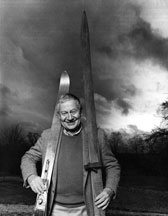 Mason Beekley (1927-2001) had many influences on the art world and the sport of skiing. These two life passions intersected with Beekley’s indirect creation of a mainstream market for vintage ski posters, which eventually led to the establishment of Swann Galleries’ annual poster auction, according to Swann president Nicholas Lowry.
Nicholas Lowry, president of Swann Galleries and director of its poster department, credits International Skiing History Association founder Mason Beekley with almost singlehandedly developing a market for vintage ski posters.
“We always sold ski posters as part of the sale of travel posters,” says Lowry. “We began holding two poster auctions a year in 1997, and that’s when we started breaking out the ski posters. It grew in those years largely because of Mason Beekley, who cornered and created the modern ski-poster market, in my opinion.”
Growing up in Connecticut, Beekley was an avid skier as a young boy. As a student at Princeton, he began to collect books. He started buying ski-related art, books and collectibles in 1949 and went on to found ISHA in 1991 with the mission to honor and preserve the history of snowsports. Beekley expanded his collection steadily until his death in 2001, eventually amassing one of the largest collections of ski art, literature and printed material in the world.
“Beekley fed the market at Christies East,” Lowry recalls, noting that the international London-based, fine-art auction house, which once held winter poster auctions, has now bowed out of the poster business. “He fed our market by buying and buying. He created a market out of what had been a niche,” Lowry adds. “And there are now a lot more people collecting than there used to be.”—E.P.