Ski Art: Leonetto Cappiello (1875–1942)
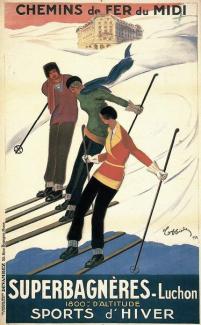
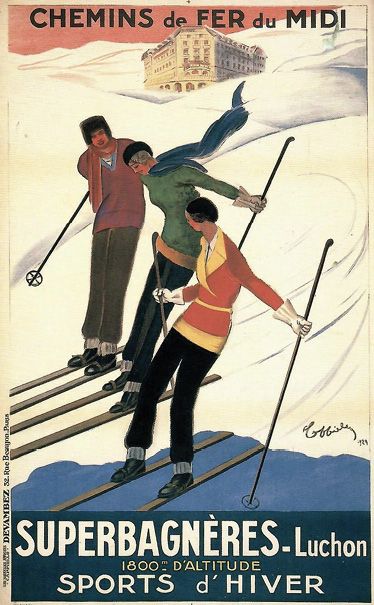 Leonetto Cappiello has been called the “father of modern advertising” because he broke the norms of poster art. Early advertising tended to look like a painting and was sometimes too cluttered. Cappiello, however, was not afraid to leave the white slope open in this ski poster, increasing the aspect of speed.
With no formal art training, Cappiello had his first exhibition in 1892. Based on the ski technique illustrated here, he apparently had no ski instruction, either. (Today, some of his paintings are displayed in the Museo Civico Giovanni Fattori in Livorno, Italy, where he was born.) He then began to work mostly as a caricaturist for the most popular humor magazines in France; Le Rire, Le Sourire, L’Assiette au Beurre and Femina. In 1896 his first collection of caricatures was published.
From 1900 on, Cappiello painted posters that revolutionized advertising. In an era when Parisian walls were plastered with posters advertising just about everything, Cappiello realized that he had to distinguish his work from all the others. “Speed” was one of the new ingredients of modernization; after all, wasn’t citius—fastest—the first of the three goals of the modern Olympics, initially held in 1896 (altius and fortius, highest and strongest, were the other two)?
The 1929 illustration promotes Superbagnères-Luchon in the French Pyrenees. Speed is symbolized by the flying scarf and the swirl of the ski tracks on vast, open snowfields. And how to reach Superbagnères? Look at the top to see very clearly the Chemins de Fer du Midi, the railway line that brought guests to the palatial hotel.
For those interested in the mechanics of the poster business, there’s an imprint for Devambez on the bottom left. Monsieur Devambez was what can be best described as an agent for poster artists. He put Cappiello in touch with big-name businesses like Campari, Pirelli tires, the Casino de Paris and others, who hired the artist to create advertising posters for them. It was a successful arrangement.
This 1929 ski poster was influential enough to be followed in 1932 by a similarly designed one for the same resort—only this time there was one figure, not three. It was by the lesser-known artist R. Sonderer.