British Columbia's Powder Highway
Superb Skiing Meets Killer Marketing
In the summer of 1998, Canadian marketing whiz Dave Nicholls was vacationing on the west coast of Vancouver Island when he saw a road marker that would dramatically change the image of a small group of ski resorts in the British Columbian Rockies. “There was a sign between Tofino and Ucluelet that simply said ‘The Surfer’s Highway’ that spoke to what surfing on Vancouver Island was really all about,” he recalls. That glancing roadside gaze eventually struck marketing gold.
At that time, in his role as marketing director at Island Lake Lodge, a cat-skiing operation in southeastern B.C., Nicholls had a problem to solve. “We were getting a reputation as a place that was always sold out when, in fact, we needed to fill up the shoulder weeks in early and late winter,” he explains.
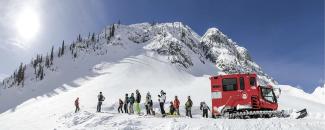
Nicholls thought he could fill up those lagging off-season reservations by offering package tours with Fernie Alpine Resort, the region’s largest destination resort, and Powder Cowboy, another cat operation. “Since you’d need a car to connect all three destinations, I went to the other two partners to create the concept of a ‘Powder Highway,’ from what I’d seen in Tofino,” he says. It clicked for skiers.
Chris Elder, former marketing manager at Fernie, says, “Prior to the Powder Highway, the resort and cat operations were doing their own thing.” That instantly changed, though initial efforts—and budgets—were almost laughably low key. “Island Lake Lodge parked one of its snowcats at the base of our mountain and we had a bunch of T-shirts and stickers made up,” Elder says. “It was very small scale in the beginning.”
With minimal inaugural promotion, the idea of a Powder Highway seeped into the collective skiing consciousness of an athletic, hard-core demographic. These were powder addicts looking for the next great adventure beyond the burgeoning mega-resorts. Indeed, the Powder Highway conjures up two alluring concepts simultaneously. It combines the dream of skiing deep, reliable snow while driving from one destination to another in the great ski-bum tradition of the road trip (or ski safari).
Nicholls emphasizes that “‘the highway’ is the key,” as skiers “follow storms from one destination to the next.” Once the initial group of three gained proof of concept through the marketing hook’s early success, it took the idea to Kootenay Rockies Tourism, the destination marketing organization for southwestern B.C.
Widespread Buy-In
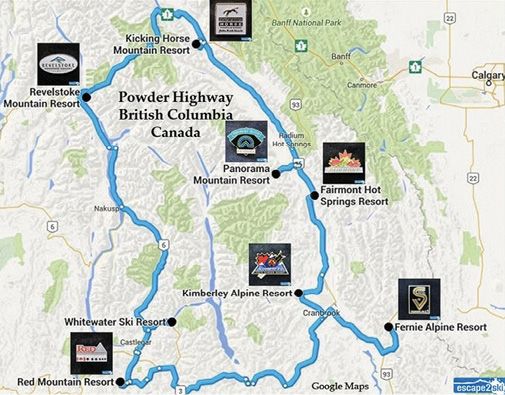
The tourism association was eventually able to get buy-in from other ski resorts within the region: Kicking Horse Mountain Resort, Kimberley Alpine Resort, Panorama Mountain Resort, Revelstoke Mountain Resort, Whitewater Mountain Resort and Red Mountain Resort, along with more than a dozen heli, backcountry and cat-skiing operations. What once entailed a relatively short stretch of Highway 93 between Fernie and Kimberley was expanded into a 700-mile circle that includes the Trans-Canada Highway, the Crowsnest Highway (Highway 3) and highways 6, 97 and 93.
 Nicholls reminisces, “The Powder Highway succeeds because it can change from day to day, year to year. It started very small, but once the word got out it was organic growth at its very best. Powder and Freeskier magazines, among others, immediately took the bait. Even the New York Times Sunday travel section covered the circuit way back in 2014.”
The magic in the name is that in two words it defines a skier’s promised land without being brand specific and therefore conspicuously commercial. “It’s more than a highway. [It’s] deep snow, funky towns, delicious meals, craft beers and new friends,” says Nicholls. “It’s all of those things—a state of mind, really. And that’s what makes it entirely unique, I think, in the ski-vacation world.”
Matt Mosteller, senior vice president for Resorts of the Canadian Rockies, says that getting cultural buy-in from locals in towns like Fernie, Kimberley, Rossland and Revelstoke ensured that the Powder Highway wasn’t merely seen as a marketing gimmick. “We’d have informal meetings where members of the international media could hear stories from pioneers and old-timers about how the love of snow attracted ski bums from pretty much all over the world: eastern and western Canada, a few draft dodgers from the United States and, later, thousands of itinerant Kiwis and Australians, many of whom would later settle down and become Canadian citizens.”
Perfect Timing
As with most marketing gems, timing is key to their success. Awareness of the highway happened at a time when the resorts and nearby towns were developing rapidly. During this era, Fernie doubled its skiable acreage. Kimberley Resort and Kicking Horse both upgraded their lift infrastructure and added more ski-in/ski-out accommodations.
In Revelstoke, an entirely new mountain resort was grafted onto a small community hill overshadowed by a massive snowcat skiing tenure. The new hotels, bars and restaurants were of two types: ski-in/ski-out properties within a hundred feet of a lift and in-town places participating in a tourism-driven economic revival for towns previously supported by mining, forestry and agriculture.
It didn’t take long for the concept to take hold. Indeed, if the story of B.C. skiing in the 1990s was the dramatic rise of Whistler Blackcomb, in the early 2000s the pendulum swung back as skiers sought deep powder, authenticity andsmall-town vibes along the way.
The highway concept was as much about the towns as the skiing. The Powder Highway connected diverse, unique towns several hours from each other, close to ski resorts that were just starting to surface on the radar of ski filmmakers and youth-oriented publications like Powder, Freeze, Skiing and Freekkier.
And while the remote location of the route’s four mountain ranges might seem daunting, there are different ways to access at least some parts of the highway. The easiest is to fly into Rocky Mountain International Airport in Cranbrook, B.C., and rent a winter-equipped vehicle. Alternatively, it might be more convenient to fly into larger airports in Kelowna, B.C., or Calgary, Alberta, or, if coming from the U.S., airports in Spokane, Washington or Kalispell, Montana.
Hot-Tub Marketing
Additional proof of concept came with the filming of Hot Tub Time Machine at Fernie Alpine Resort in 2010. The plot revolves around four middle-aged men who are whisked from the drudgery of their current mundane lives back to a mythical ski town in 1986 via a magical hot tub. Movie director Steve Pink immediately saw Fernie as a location, essentially confirming the small-town gestalt of the Powder Highway. “He had this eureka moment,” Mosteller recalls. “He told me, ‘Everyone here has a powerful connection with flakes. There are snowflakes and flaky people. The flakes bond, and pack together and solidify, much like a community.’”
Deep into the shoot, Fernie again proved its worth. “Pink was concerned because he needed several hundred extras to shoot one of the movie’s pivotal scenes,” Mosteller says. “We decided to hold a retro ’80s-style ski party, and over a thousand locals turned out for it.”
Mosteller believes that the Powder Highway had a significant effect on the mindset of the serious powder- and adventure-seeker. “At a time when skiers felt that the condo experience was becoming increasingly cookie-cutter, the Powder Highway offered a real opportunity for self-styled customized exploration in a place where real stories were still being created.”
Adds Mosteller, “Like Hot Tub Time Machine, the Powder Highway takes you back to a kind of golden age of skiing adventure. Yet it’s no Hollywood fantasy—it’s as real as the snow that falls each winter.” 
Vancouver-based Steven Threndyle covered the origins of Japow in the November-December 2025 issue.