The many lives of Sherman Adams
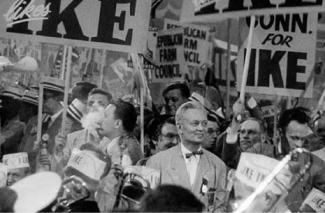
Bantam-weight Adams was a political heavy and “a damned lumberjack.”
It was the Roaring Twenties, and Sherman Adams, fresh out of Dartmouth College, took a job with the Parker Young Company, a furniture factory with its own lumbering operation. He supervised teams of lumbermen much older, far stronger and more seasoned than him. Standing just five feet, seven inches, Adams pitched in to earn their respect. First on the job in the morning and last to leave at night, he felled trees, moved logs and ripped up stumps with indefatigable, infectious energy. He became, in his own words, “just a damned lumberjack.” Across the camp his reputation grew. Within three years he was appointed assistant manager of Parker Young and moved to its headquarters in Lincoln, New Hampshire.
Photo top: At the Republican Convention in 1953, Adams helped to nominate Dwight Eisenhower, who brought Adams to Washington as White House chief of staff.
Born on January 8, 1899, in East Dover, Vermont, Adams was the first child of Clyde and Winnie Adams. The couple divorced when Adams was still an infant, and he rarely saw his father again. Instead, young Sherman was raised by his mother and her brother, Edwin, in Providence, Rhode Island. A church choirboy and a classical music–loving piano player, Adams worked as a farmhand from the age of 10 and absorbed Uncle Ed’s fierce work ethic.
The family moved back to Vermont, where he attended Hope High School. On graduating in 1916, according to family legend, Adams walked into Dartmouth’s admissions office and said, “I’d like to go to school here.” After a short stint in the military during World War I, he graduated in 1920 as an economics major with a double minor in math and German.
A Political Star Rises
Slowly, steadily, Adams rose to prominence. His excellence in managing the logging business gave him entry into the paper industry and after that came banking connections. Soon after his marriage to Rachel White in 1933, Adams was selected to serve on influential boards of banks and railroads. In 1938, when a Category 3 hurricane caused carnage across New England, he used his skills as a woodsman and crew boss to organize a massive salvage operation and recover the spruce felled by the storm.
Afterward, Adams, a father of four (three girls and a boy), earned admiration from people on both sides of the political spectrum and with it a widening power base. Running as a Republican, he won election to the New Hampshire state legislature in 1940, beginning a legislative career that was forward thinking and inclusive. He was assigned to the labor committee, where he strengthened employer liability laws in favor of workers.
Adams not only won re-election in 1942, but also was elected speaker of the house for the 1943–44 session. In 1944 he won election to Congress by a 4-1 margin over his Democratic opponent. Then, beginning in 1948, Adams served two terms as governor of New Hampshire.
I Like Ike
In 1952 Adams served as a delegate to the Republican national convention, where he was central in delivering the New Hampshire delegation to Eisenhower and was subsequently named the candidate’s campaign manager. After the landslide victory over Adlai Stevenson, Eisenhower named Adams his chief of staff and he became the president’s domestic-policy troubleshooter, chief facilitator and gatekeeper.
Adams was reputedly at his most ferocious as gatekeeper, deciding whose pet projects would not waste Eisenhower’s precious time and energy. His simple “no” to any idea killed it instantly, earning him the nickname “the Abominable No Man.”
Democrats and Republicans alike deeply respected Adams’s adroit dealmaking skills and his dedication to civil rights advancements. When Eisenhower suffered a heart attack in 1955, Adams took firm control, running everything smoothly until the president’s return. But from time to time, Adams said “no” to powerful congressmen who didn’t forget or forgive.
Eisenhower was re-elected in 1956, again winning over Adlai Stevenson. Indeed, the president was cruising while his chief of staff handled four balls in the air with just two hands to catch them. Adams continued to set the same example of ethics and diligence in Washington that he did in Concord, never letting anyone beat him to the office in the morning. And just as in Concord, he hated laziness and excuses. Though Adams was dynamo in Washington, the humble Granite Stater never lost his humanity nor his drive. “I sleep better knowing that little fellow is in that office,” Eisenhower often gushed to the press, including United Press International.
Ironically, given his squeaky-clean reputation, a minor scandal destroyed Adams’s political career in 1958.
Bernard Goldfine was a Boston-based entrepreneur who owned textile mills in four New England states. He made a hobby of “collecting” politicians and was a longtime campaign contributor to a handful of Republican senators, as well as the Democratic governor of Massachusetts. Like Adams, he had started with nothing and made his first fortune trading woolen goods during World War I. They became good friends and over several years exchanged personal gifts, including an expensive vicuña coat. Unfortunately, Goldfine neglected to file tax returns after World War II. He also was investigated by the Federal Trade Commission for mislabeling and overcharging for textiles he sold to the government.
Naively, Adams made phone calls inquiring about the status of the investigation and, allegedly, even set up a meeting between Goldfine and investigators. The nationally syndicated journalist Drew Pearson broke the story of Adams’s intervention in the Goldfine investigation. Further reporting by veteran Jack Anderson amplified the scandal, and the headlines were merciless. Another Republican politician, Senator Frederick G. Payne of Maine, who had accepted a substantial loan from Goldfine, was badly defeated for reelection in September 1958. Maine had been a Republican bastion, thought safe. Now it appeared a frightening bellwether.
According to political historian Michael Birkner, a professor at Gettysburg College, Adams had alienated enough people in Congress that “he had relatively few defenders when he got in trouble for the Goldfine business.”
Spooked by the possibility of a wipeout in the 1958 mid-term election, Eisenhower reluctantly asked Adams to resign.
Reborn in New Hampshire
Adams returned home to Lincoln, New Hampshire, in late 1958, weighing his options.
The logging industry, previously the beating heart of the state’s economy, was suffocating under the combined stresses of new regulations and modern technology, likely never to fully return to the prominence it previously enjoyed. But Adams saw the opportunity to pivot to recreation, tourism and conservation. His wife made the logical connection, saying “There must be a place to ski up in those woods somewhere. What are you going to do about it?” In fact, skiing was in the early phase of what became its boom years.
No one knew the back side of the White Mountains better than Sherman Adams. After apparently passing on getting involved with Sawyer River Skiway, he settled on Loon Mountain. Adams was soon back in his old routine as walking boss, zooming through the trees mapping ski runs on Loon Mountain, overseeing construction and even dynamiting stumps. After a dynamite blast pelted him with trunk debris, he worked in a neck brace for several weeks.
Construction was in full swing by 1965, and Loon opened in December 1966.
“Adams could not have built Loon without major investments from his friends in politics and beyond in New Hampshire,” says Birkner. “He had some money thanks to a sweetheart deal he got for [a publishing transaction] but not enough to build a big ski resort.”
Loon soon rocketed to popularity. It was easy to get to; the new I-93 was a straight shot from Boston. Plus skiing was wholesome family fun, low impact and inexpensive. Adams made sure that every guest was treated as well as any president or royalty. An instant classic, the ski area was hailed as strong a winter-sports venue as Cannon, Attitash or Waterville Valley. From Maine to Maryland, from Cape Cod to Canada and everywhere in between, Loon was added to most everyone’s skiing bucket list.
His Legacy
Adams would go on to serve as Loon’s president and general manager for nearly two decades. He remained deeply involved in the day-to-day operations of the resort until he passed away in the fall of 1986 at the age of 87.
He would also successfully lobby for Mount Pleasant in New Hampshire’s Presidential Range to be renamed in 1972 to Mount Eisenhower, and Adams is honored with the summit building on Mount Washington being named after him.
His life is still celebrated at Loon during Founder’s Day festivities. Diminutive Sherman Adams leaves a legacy that stands as tall as the trees of the White Mountain forest and as strong as the Presidentials themselves. 
Attorney Jay Flemma is an award-winning writer and a credentialed golf and ski journalist. He explored the history of skiing in Bariloche, Argentina, in the July-August 2025 issue.