Resorts: Mt Van Hoevenberg is back on track
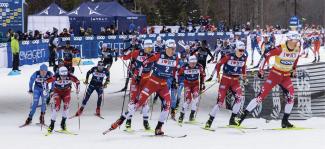
Building upon its Olympic legacy, this over-achieving neighbor of Lake Placid has made a world-class comeback.
Jessie Diggins bid adieu to her storied cross-country ski career in March 2026 on home turf—at the Cross-Country World Cup Finals at Lake Placid’s Mt. Van Hoevenberg, in New York’s Adirondack Mountains. After her final three races, she collected her fourth overall World Cup Crystal Globe, as well as her fourth distance title. Then she completed “One Last Lap” around the Mt. Van Hoevenberg cross-country stadium with over 600 young cross-country skiers from around the world.
Photo top: As host of the 2026 Cross-Country World Cup Finals in March, the Mt. Van Hoevenberg Nordic complex confirmed its renaissance as an elite venue 94 years after its christening. Credit Griffin Smith/Olympic Regional Development Authority
“That was so incredibly special,” said Diggins through tears after her final race. “All the people out there chanting, my family out there, the team … I’m just going to miss everyone so much.”
The finals, the first cross-country World Cup competition held in the U.S. east of Wisconsin, attracted more than 35,000 fans. But it was not the first international cross-country event hosted at Mt. Van Hoevenberg.
The 1980 Olympic cross-country races were held on the trails that thread through the forest around the mountain. Those trails remain. But after a $60 million overhaul, a fully
rebooted venue opened for the 2021–2022 season, along with the massive Mountain Pass Lodge, which rivals any swanky Alpine ski-resort base lodge in terms of comforts and amenities—and boasts the world’s most powerful snowmaking system for Nordic skiing.
When it re-opened, Kris Cheney Seymour, then the New York Olympic Regional Development Authority’s events manager, told the Adirondack Daily Enterprise that Mt. Van Hoevenberg was now “one of the best Nordic venues on the planet.” Athletes agree. As do spectators: The World Cup trails snake up the mountain with lots of places for them to cheer.
“At the top, it was packed with people, and it was really cool,” said Johannes Høsflot Klæbo, who in February at
Milan-Cortina became the first athlete to win six Olympic gold medals at a single Winter Games. He went on to win the 10-kilometer race at the Lake Placid Finals. “The Americans really know how to make noise and how to make a good atmosphere.”
Historic Roots
Lake Placid has been a popular winter tourist destination since 1904. That year, Melvil Dewey—the New York State librarian and creator of the Dewey Decimal System, and founder of the Lake Placid Club in 1895—kept the club open through the winter for the first time, ordering 40 pairs of skis from Norway. Adventurous club members “skied, skated, tobogganed and snowshoed, the women’s petticoats sweeping the drifts,” wrote Mary MacKenzie in a history of Lake Placid and North Elba.
The club never closed again in winter and over the next 15 years constructed facilities for skating, ski jumping, tobogganing and even ice tennis. Skiing was held on Lake Placid’s golf courses, with instructors like Jackrabbit Johannsen on hand to help club members master the sport. By the 1920s, Lake Placid was hosting major winter sports competitions, such as the International College Winter Sports Games, known as College Week, and in 1921, the National Cross-Country Ski Championships.
With Lake Placid established as a winter sports destination, Godfrey Dewey (son of Melvil) convinced the International Olympic Committee to let Lake Placid host the third Winter Games. To prepare for the 1932 Olympics, organizers built a bobsleigh track about eight miles southeast of Lake Placid, on the slopes of what was then called South Mountain. They then renamed the 2,936-foot-tall peak after Henry Van Hoevenberg, who had built the original Adirondack Loj (Dewey was a nut for phonetic spelling) on the backside of South Mountain in 1880. But for the 1932 Games, the cross-country ski races were held on trails around the village.
In the 1960s, as people became more aware of physical fitness, John Caldwell’s The Cross Country Ski Book (1964) helped popularize cross-country skiing in the U.S. Nordic touring centers began opening in snowy climes. And in Lake Placid, 1960 Olympian and local Joe Pete Wilson surveyed the land around the bob run for a cross-country trail network. With the goal of hosting a second Winter Olympics, two other locals, Ron MacKenzie (a 1936 Olympic bobsledder) and J. Vernon Lamb, Jr., then laid out a 15-kilometer Nordic trail network with enough elevation change to meet international standards. In 1974, Lake Placid won a second bid to host the Winter Olympics in 1980.
1980 Olympics Come to Mt. Van Hoevenberg
Between the 1932 and 1980 Games, the Olympic program had expanded greatly—with sports like luge, biathlon and women’s cross-country skiing. To accommodate these events, the Lake Placid organizing committee built new facilities, including a separate refrigerated track for luge, a reconstructed bob run and a biathlon range at Mt. Van Hoevenberg.
For the cross-country and biathlon races, the committee brought in two veterans, Chummy Broomhall and Al Merrill, to overhaul the trail network. A 1948 and 1952 Olympian in cross-country, Broomhall had served as the technical advisor and chief of race for the Nordic events at the 1960 Olympics in California. He oversaw the improvement of the existing network and designed 40 kilometers of new trails at Mt. Van Hoevenberg, with separate race trails and stadiums for biathlon and cross-country.
Merrill, who had served as the U.S. Nordic team director in the 1960s, helped with the design. Among other trails, they created a 16.3-kilometer loop for the men’s 50-kilometer race—rather than the customary (at that time) 25-kilometer loop. The trails were considered the most challenging Olympic racecourses at the time, with 535 feet of climbing on one trail alone (Porter Mountain). Alison Bradley (then Alison Owen-Spencer), competing in her second Olympics, remembers that the courses “tested your skiing skills, not just your max, or your VO2 max, the way some courses can with really steep hills.”
As the 1980 Games approached, the only thing missing was snow. Cold temperatures allowed organizers to stockpile machine-made snow, which they used to cover 25 kilometers of trail with a 10-inch base. Most of the snow was made on site, but some was trucked in from the Olympic jumping complex and Whiteface Mountain, where the Olympic Alpine races would be held, and dumped in a massive pile. “It was huge, a big pyramid of snow,” remembers Jim Galanes, who competed in all four men’s races at the 1980 Olympics (15km, 30km and 50km, plus the relay). “They had to use dynamite to blow it up because it consolidated and froze.”
Expectations were high for the U.S. team. A 20-year-old Bill Koch had brought home a silver medal in the 30 kilometers at the previous Games in Innsbruck and was back for his second Olympics. Bradley had an outside chance of winning a medal in the women’s races, and the men were considered contenders in the relay. “There was a lot of pressure from the press and from expectations on the U.S. team, because of Kochie, because of a lot of hype around Nordic skiing at that time,” she remembers. “My results had been really good, like I had been top five in [races]. They rightfully thought that we might be in the top five.”
Bradley felt particularly good after the 1980 Olympic trials at Mont-Sainte-Anne in Quebec. But then she fell ill and suffered from a cold throughout the Games. In both the women’s 5-kilometer and 10-kilometer races, she finished 22nd, just under a minute behind the Soviet Union’s Raisa Smetanina in the former and just over two minutes behind East Germany’s Barbara Petzold in the latter. “I still raced, but I felt like an old lady out there, and it definitely was not the experience in the races that I could have had if I had had the same body and everything that I’d had at Mont-Sainte-Anne two weeks before,” Bradley says.
The U.S. men also fell short of expectations, with Koch scoring his best finish in the men’s 50 kilometer (13th). Galanes was in fifth or sixth place near the end of that race but then bonked. “We didn’t know about nutrition and fueling for a long race back then,” he says.
In the men’s relay, Koch put the U.S. in third, with Tim Caldwell skiing the second leg, Galanes the third and Stan Dunklee the anchor leg. But on a tough wax day, they fell to eighth. “Bill, Tim and I were pretty close in those days,” says Galanes. “We all had higher expectations for how we would perform there.”
The U.S. men would go on to have some of their best World Cup races in the following years. Koch won three World Cup races in 1982 and a bronze medal at world championships that same year.
Olympic Legacy
Following the 1980 Games, the New York state legislature created the Olympic Regional Development Authority to care for the facilities, including those at Mt. Van Hoevenberg. The touring center continued to host big events through 2000, including the World Masters Cross-Country Ski Championships in 1986 and 1998 and the cross-country races of the 2000 Winter Goodwill Games. In the 1980s and ’90s, Mt. Van Hoevenberg’s trails also served as training ground for local Olympians-to-be, including Billy Demong, who won Olympic gold in Nordic combined at the 2010 Olympics; biathlon world champion Lowell Bailey; and Tim Burke, four-time Olympian and biathlon world championship silver medalist.
In 2000, a new combined sliding track was built at Mt. Van Hoevenberg for luge, bobsled and skeleton, and the track again hosted world-class competitions, including the International Bobsleigh and Skeleton Federation World Cups and world championships. But at the touring center, the ghosts of the 1980 Olympics could still be felt on the trail network. The trails had been built for interval starts (one skier leaving the start every 30 seconds or a minute) and classic skiing, not the skate technique, which requires wider trails. New race formats—sprints and mass starts—also needed wider trails, as well as larger start/finish stadiums.
Trying to stage a modern race there was like “trying to put a square peg in a round hole,” says Allan Serrano, sport and trail manager at Mt. Van Hoevenberg. “It was a different world of racing back then.”
The most-recent redesign put the 55,000-square-foot Mountain Pass Lodge between the sliding track and the Nordic venue, with a wide-open stadium directly in front of the lodge. The biathlon shooting range, once part of its own trail network, was brought into the new stadium area so the two sports could use the same venue. The World Cup Trails (as they’re called), designed by Cheney Seymour with Serrano consulting, can be linked into 10 loops, one to five kilometers in length, that are homologated to FIS standards (in terms of width and elevation profile). After competing in a 10-kilometer classic, sprint and 20-kilometer mass start, Diggins called the courses “really legit.”
Behind the scenes, the new design included permanent wax cabins and an “extremely robust snow production system,” says Serrano, with a hydrant every 80 feet and 270 snowmaking heads. Recently, they started storing snow to spread on trails when cold temperatures aren’t cooperating. And it’s one of the first venues to have a complete fiber-optic network to help broadcast competitions. “The TV production teams absolutely love us,” says Serrano.
The Mountain Pass Lodge is a masterpiece, with room to host spectators and trail users in a cavernous seating area with large windows overlooking the stadium. The lodge also has private rooms for teams to gather and prepare for competition and separate rooms for timekeepers and the jury—a drastic upgrade from the cramped 1980 lodge.
Mt. Van Hoevenberg also has a host of new opportunities for summer training and recreation, including paved roller-ski trails, an indoor climbing wall, a mountain coaster ride, an indoor start track for bobsled and skeleton Olympians and Olympic hopefuls (visitors can give bobsled and skeleton a try on the outdoor sliding track) and trails for mountain biking, hiking and trail running.
In 2023, Mt. Van Hoevenberg resumed welcoming the world, with the FISU World University Games as its first major event. Since then, the bobsled and skeleton world championships, a luge World Cup, an International Biathlon Union cup and a mountain biking World Cup have all come to Mt. Van Hoevenberg. Last spring’s cross-country World Cup Finals were the latest on this list.
“It is absolutely world class, best in show,” said Diggins. “They have the ice house here. They have a push track; they have a climbing gym. I mean, if you want to go bouldering after the race, you can absolutely do that.”
Mostly, the four-time overall World Cup winner appreciated the thousands of fans who trekked to Lake Placid for her final races. “This crowd,” she said, gesturing to the thousands standing five deep around the sprint course, “they cheer for everyone, and by name! Listen to the cowbells. It’s so cool.” 
Contributor Peggy Shinn wrote about the first U.S. women’s Olympic cross-country ski team in the September-October 2025 issue.