Short Turns: Homegrown roots of adaptive skiing.
Born from a grassroots effort to aid wounded World War II vets, the adaptive movement showcases the remarkable healing powers of skiing.
At the World Para Surfing Championships in Huntington Beach, California, in 2023, when Alana Nichols scored the first perfect 10 on her way to winning the event, it was, metaphorically, a high-water mark in the progression of adaptive skiing in the U.S.
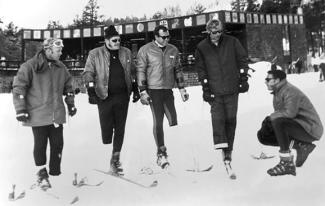
Photo above: Jim Winthers (kneeling), a 10th Mountain veteran and pioneer in formalizing adaptive skiing techniques, holds a clinic with other adaptive traiblazers (left to right) Corbin Cherry, Doug Pringle, Dan McPherson and Dave Rayder.
In 2000, Nichols, then 17, had attempted a backflip on her snowboard in Colorado’s San Juan Mountains, landed on a rock and became paralyzed from the waist down. It was the kind of accident that could happen to any boarder or skier who happens to fall in the wrong place the wrong way.
By the time Nichols, a native of Farmington, New Mexico, was 32, she was a four-time Paralympic athlete in wheelchair basketball and Alpine skiing. And she was the first American woman to win gold medals in both the summer and winter Paralympic Games. It was further evidence of the power of a movement that started in the Alps after World War II.
Origin Story
Not surprisingly, adaptive skiing traces its origins to World War II in Europe, which produced a large number of wounded soldiers, many with skiing backgrounds. Austrian veteran Franz Wendel, who lost a leg in combat, is credited with modifying his crutches with two small skis on the ends, effectively inventing the three-track—or outrigger—technique. In 1942, Wendel is said to have been the first handicapped skier to compete in a race.
Wendel was followed by Sepp “Peppi” Zwicknagel, another Austrian veteran, who lost both legs to a hand grenade. He became a ski instructor at Kitzbühel and founded a division of the Austrian Ski Association for disabled skiers. By 1947, annual handicapped races were being held in Austria, in large part thanks to Wendel and Zwicknagel.
American Jim Winthers, of the 10th Mountain Division, was an early supporter of adaptive skiing. As director of Donner Ski Ranch in northern California in the early 1950s, he reunited with two friends who had lost legs in the war. Using the adaptive methods he had observed in Europe, Winthers championed the technique for one-legged skiing in the United States.
American Olympic medalist Gretchen Fraser was another early supporter. During and after World War II, she worked as a nurse and ski instructor, teaching amputees and veterans in Sun Valley. Fraser and her husband, Don, helped with the
Flying Outriggers Ski Club at Mt. Hood, one of the first
amputee ski groups in the U.S.
In 1955 Winthers and Jim Graham, who’d lost a leg to cancer, reasoned that the most effective way to advance adaptive skiing was to train instructors in it. The duo collaborated on refining teaching methodologies, developing specialized gear and hosting weeklong clinics for instructors. Graham and adaptive pioneer Dan McPherson became the first two
certified ski instructors with disabilities in the U.S.
The National Amputee Skiers Association, founded in 1967 with three chapters, was eventually renamed the National Handicapped Sports and Recreation Association (NHSRA) and today is known as Move United. It marked the beginning of an ongoing effort to destigmatize the descriptions of those with physical and mental challenges, especially in the names of organizations.
Ben Allen was another Winthers protégée. While attending Tufts University School of Medicine in 1970, he and Fran Rebstad created the first amputee ski program in the East at Haystack Mountain, Vermont: Haystack Chapter of the National Inconvenienced Sportsmen’s Association.
In Aspen, in 1969, ski instructor Jean Eymere, blinded by diabetes, decided he wanted to ski again. Fellow instructors and friends helped him achieve that goal so successfully that the ski school invited a group from the Colorado School for the Deaf and the Blind to try the process. A program grew from there.
Christened BOLD (Blind Outdoor Leisure Development), the project was led by a board that included Aspen Skiing Corporation President D.R.C. Brown and Aspen Highlands owner Whip Jones, with advisors such as Jean-Claude Killy, Spider Sabich, Anderl Molterer and Stein Eriksen.
Further testimony to the growing support of—and need for—adaptive skiing was the flourishing of competitions, including major international events. The first World Para Alpine Skiing Championships were held in Le Grand-Bornand, France, in 1974. Two years later the Paralympic Winter Games debuted in Örnsköldsvik Sweden, with nearly 200 athletes from 16 countries, including 78 skiers competing in Alpine events.
The International Ski and Snowboard Federation (FIS) eventually pitched in. The first FIS-sanctioned para-Alpine World Cup race was held in Breckenridge in 1999, with the first World Cup titles awarded in the spring of 2000. The International Paralympic Committee previously governed the sport but transferred oversight to FIS in 2022 to align para snowsports with FIS’s traditional duties.
During and after the Vietnam War, U.S. military hospitals continued the military’s use of skiing as a vital part of rehabilitation programs. Doug Pringle, who lost a leg serving in Vietnam, took advantage of these rehab programs and became a three-time slalom winner at the National Handicapped Ski Championships in the 1970s. Pringle served as the education director for NHSRA and helped found the organization’s first 25 chapters.
One of his most important accomplishments was developing the first adaptive ski instructor certification program. When the Professional Ski Instructors of America (PSIA) declined to institute an adaptive certification, Pringle created the adaptive instructor certification manual. PSIA eventually adopted NHSRA’s certification program, and Pringle later served on the PSIA board.
Perhaps subtly influenced by the growing grassroots movement of adaptive skiing, the widely overlooked discrimination against use of public lands by the physically challenged ended with the passage of the Americans with Disabilities Act of 1990. The landmark act made it mandatory for anyone leasing public lands, including many ski areas, to make their facilities accessible to everyone. 
Snapshots in Time
1965 Delayed Start of an Icon Just south of Grand Teton National Park, and about 15 miles north of this small ranching community, a group of prosperous wintersports enthusiasts has invested more than $2 million to build Jackson Hole, one of the largest new ski resorts in the West. And from the looks of things, at least another $2 million will be spent to complete this year-round sports center and resort. It appeared that construction crews would win the resort’s new critical battle and complete the two-and-one-half-mile tramway, said to be the nation’s longest. However, the tramway, which will rise 4,135 feet on its climb to the top of Rendezvous Peak, has been beset by construction difficulties. The Jackson Hole Ski Corporation now expects the tramway’s two 63-passenger cabins to be taking skiers up and down the mountain by late January or mid-February. —“Millions Poured into Jackson Hole” (New York Times, December 12, 1965)
1975 Pre–Epic Pass Epic Pass It makes a very agreeable kind of sense to think of Summit County, Colorado, as a huge, almost endlessly varied interconnected ski circus. The nodes of this grand network are A-Basin, Keystone, Breckenridge and Copper. No, the ski runs themselves do not connect. The connections are in the minds of the area marketing directors, who decided shrewdly that since there is no way legal way to tether skiers to a single hill, an advertisable virtue could be made of their tendency to wander. Hence, “Ski the Summit,” a corporate con whose working parts are a ski-anywhere lift ticket and an efficient shuttle-bus system that not only is free (really) but runs early and often (honest). —John Skow, “Ski the Summit” (SKI, October 1975)
1990 Not Dying to Lose Skiing Privileges As a 21-year-old male I find that relatively dangerous extreme skiing provides me with a natural high. I’ll slip under boundary lines and schuss past warning signs without hesitation. But in “How Safe Is Skiing?” the photograph of the sign reading “Going beyond this point may result in death and/or loss of skiing privileges” struck me. Now, I might ski past the sign if there was a chance of death or a loss of skiing privileges. But the thought of dying and losing my privileges would certainly make me reconsider. —Scott Gaffney, Ithaca, New York “Stiff Penalty” (Letters, Skiing, February 1990)
2000 No Change in Attitude Change doesn’t go over big at Vermont’s cooperatively owned Mad River Glen. At a recent meeting of the area’s 1,500 shareholders, an infidel foolishly proposed the ban on snowboarding be lifted. From the back of the emotionally charged room came an immediate response: “Get the rope!” Then there was the dicey issue of upgrading the area’s 1948 single chairlift. When the suggestion was made to replace the current grease-dripping sheave assemblies with ones that wouldn’t ruin ski clothing, at least one shareholder felt that grease drippings was part of the “Mad River experience.” —Paul McMorris, “And Who Needs Metal Edges, Anyway” (Skiing, February 2000)
2026 Numbers Head Downhill U.S. ski areas recorded an estimated 52.6 million skier visits in the 2025–26 season, down roughly 14 percent and 9 million visits year over year, according to preliminary data from the National Ski Areas Association (NSAA). The season ranked 32nd out of 48 on record, with poor snow conditions across the West driving the decline. “Few seasons demonstrate as clearly as this one how dependent our industry remains on regional weather patterns,” said NSAA president and CEO Michael Reitzell. — “U.S. Skier Visits Drop 14% Amid Weak Western Snowfall” (Ski Area Management, May 5, 2026)