Viva Sarah Schleper!
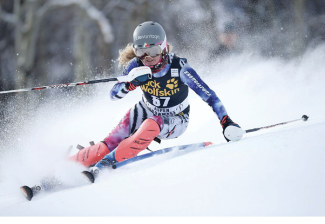
The one-time American slalom star makes a run at Olympic history, hoping to compete for Mexico with her son at the February Games.
Six-time Olympian Sarah Schleper (four for the U.S., two for Mexico) has always blazed her own trail and now hopes to become the first mother to compete in the same Winter Olympics as her son at the 2026 Milan Cortina Games.
Photo top: Raised in Vail, Colorado, Schleper retired from the US Ski Team in 2011. She first raced for Team Mexico at the 2015 FIS Alpine World Championships in Vail.
After skiing in six Olympics, Vail-based Sarah Schleper still has a goal on her bucket list. With a Winter Games career that started in 1998, Schleper now hopes to race alongside her son, Lasse Gaxiola. If it happens, both would race under the Mexican flag, as Schleper has done since 2015. They would be the first mother and son to compete in the same Winter Olympics. However, Lasse, 17, must initially compete for Mexico’s one male skier spot, and the outcome probably won’t be announced until just prior to the start of the Milano Cortina Olympics in early February.
Balancing work, motherhood and training is itself an Olympic feat. For one thing, Schleper’s own athletic career is far from her first priority. In addition to supporting Lasse’s ski racing, she and her husband, Federico Gaxiola, who is the head coach of Mexico’s national ski team, support daughter Resi’s competitive figure skating. Then there’s the lack of training. “I don’t get coached that much because I don’t train very much, and when I’m training, it’s usually at my camps, where I’m the coach,” Schleper explains.
She does enjoy the side benefits of working as a U-12 coach for Ski and Snowboard Club Vail, which helps offset Lasse’s training costs. Adds Schleper, “Skiing with those U-12s really pushes my limits, because they want to jump cliffs, they want to go in the terrain park, they want to ski fast. So, in a way, that helps me.” It’s all part of a life journey that has seen the 46-year-young Schleper max out and extend the limits of possibility.
Round One
Schleper grew up in Vail, where she was on skis by age two. At age 11 she joined Ski and Snowboard Club Vail, and she and her younger brother, Johnny, used Buzz’s Boards, their father’s ski and snowboard shop, as their home base. Free-spirited Schleper was more into the social aspect of the sport, however, prompting her father to move her into the boys’ ski group.
At 12 she traveled solo to one of Erich Sailer’s ski camps in Europe and discovered her love of racing. Schleper excelled, going to Sailer’s U.S camps every summer in Montana and Oregon. Racing stoked her competitive fire without quelling her zest for fun. Best friend and teammate Sunny Corrigan marveled at Schleper’s ability to shift modes. As she recalls, “One minute we were running around Aspen, getting into trouble, and then, boom, she’s winning a race by seconds.”
Soon Schleper was on the U.S Ski Team’s radar. Before she was old enough to race FIS, she foreran a course at the 1994 FIS Alpine Ski World Cup Finals in Vail, sharing the slope with her idol, Vreni Schneider. Less than two years later, also at Vail, Schleper made her World Cup debut at age 16. She advanced among a wealth of talented peers, including Caroline Lalive and Jonna Mendes, all coached by Georg Capaul. After winning slalom silver at the Alpine Junior World Ski Championships in 1997, Schleper moved on to the World Cup full time in 1998. That same season she also made her Olympic debut.
On the World Cup, Schleper was a quick study. In December 2000 she reached the podium in slalom with a second place in Sestriere, Italy, and soon after scored a third place in giant slalom (GS) in Semmering, Austria. With coach Trevor Wagner’s help on tactics and line, she notched her sole World Cup win, in the slalom at Lenzerheide, Switzerland, in March 2005.
The Motherhood Twist
In 2006, just over a week after she competed in the Olympic GS in Torino, Italy, Schleper tore several ligaments in her knee and missed the remainder of the season—and the entire following season. While rehabbing, she met Gaxiola, who is from Mexico. The couple married and had their first child, Lasse, in 2008, causing her to miss that season as well. She returned for the 2008–09 season, starting her first World Cup race in Sölden, Austria, after a two-and-a-half-year break.
Family—Schleper’s in-laws as well as Buzz and her stepmom, Lynne—pitched in with childcare at home, while Gaxiola traveled along to take care of Lasse on the road. When he blew out his knee, Gaxiola stayed home with Lasse, and Schleper quit breast-feeding cold turkey. Her coaches may not have understood all she was going through to make it work, but they welcomed her. “They were willing to take on me and my whole family, and my teammates were incredible,” she says. Those teammates even helped care for Lasse.
By the end of that season Schleper had regained her speed and started working her way back up the ranks. Ultimately, she scored several top 10s, finishing as high as fifth in a 2009 slalom.
After 15 years on the U.S. Ski Team, Schleper retired in 2011, at age 32. Overall, she had earned 108 World Cup scoring results, four podiums, one victory and six U.S. championship titles. She made her final run (and 186th World Cup start) in a dress, carrying Lasse, at the slalom in Lienz, Austria. That same day, 16-year-old Mikaela Shiffrin nabbed her first podium.
Round Two
Racing for Mexico began as a seed planted in 2009 by Prince Huburtus von Hohenlohe, at the time the country’s one-man ski team. The process of getting citizenship took Schleper more than five years. “You have to live in Mexico for two years straight, you have to speak fluent Spanish,” she explains. “It’s not easy.” She finally succeeded in 2015, making her international debut as a Mexican athlete right at home, at the 2015 FIS Alpine World Ski Championships in Vail.
By then Schleper had her second child, Resi, named for her U.S. Ski Team bestie, Resi Stiegler. She raced in her first Olympics for Mexico in 2018, on a barely healed blown-out ACL. Along the way, Schleper had never stopped skiing and racing, coaching for Erich Sailer’s summer camps at Mt. Hood and on the European glaciers in the fall. The Gaxiola family spent two winters living in Kronplatz, in the heart of Italy’s South Tyrol. There the kids learned German, while Lasse ski raced and Resi pursued her passion for figure skating. Last winter in Saalbach, Austria, Schleper raced in her 11th Alpine World Ski Championships and her sixth for Mexico.
Challenges and Rewards
Racing for Mexico comes with complete freedom but also lacks the many benefits of U.S. Ski Team backing. Gone are the full funding, tech support and quiver of equipment. Though Schleper is grateful for the assistance both she and Lasse enjoy from Rossignol, it is at a much different level than during her first go-round. She used skis passed down from Tessa Worley for eight years, and securing new ones is another challenge. With ski prep in her own hands, she credits her strong late-season results to scoring some premier HWK wax at the world championships in Saalbach.
While extending her own career, Schleper is also helping to build future skiers for Mexico. Among them is 16-year-old Ella Drai, also from Vail. Drai was born in the U.S. to a Mexican mother and French father. She has passports from all three countries and registered for FIS under the banner of Team Mexico. Drai’s mother, Jenny, helped Schleper start the Mexico Ski Team Foundation, a 501(c)3 that helps raise money for the team. The federation covers plane tickets and—thanks to a long partnership with Kappa—stylish Olympic uniforms, but not much else.
Competitors get some funding from Olympic Solidarity, an IOC program that distributes money from broadcast rights to support athlete development in smaller National Governing Bodies. Lasse and Drai were eligible for a FIS-sponsored Small Nations Camp in South America last summer. Von Hohenlohe (who was born in Mexico but raised in Europe) has already found a house for the team at the official Mexican training center in Dobbiaco.
Still a Free Spirit
In her hometown, Schleper has always been beloved as much for her loose style and friendly, open persona as for her results. “I’m a bit of a hippie,” she admits. Among her early career highlights was a picture of Schleper and Corrigan skiing topless (with black bars across their chests) on the cover of Vail’s Daily Trail newspaper. The picture then ended up in Skiing’s September 2000 issue. (Their fathers staged their own “topless” cover shot—complete with black bars—for the paper’s April Fool’s Day edition.)
Now Schleper directs her youthful enthusiasm toward the U-12 girls she coaches, modeling her style after her formative coaches, including Sailer, who passed away in August 2025. “I wouldn’t have been anywhere without him,” she says. “He was great and just simple and kind.” She also credits him with encouraging her to believe that age is just a number.
Another formative coach was Capaul, who guided her through the U.S. Ski Team ranks. Says Schleper, “He taught me so much about racing and making a life out of it. I think he liked that I was a free spirit.”
On the World Cup, though they initially butted heads, she credits the late Trevor Wagner for elevating her game with his fun, creative coaching style and sense of line. “We were both kind of rebellious in certain ways, and that, in the end, was a bond,” she admits. In more recent years, she adds, Vail’s Yoda-like Crawford Pierce helped modernize her technique. All these influences have led Schleper to be more intuitive and less authoritarian in her own coaching, emphasizing both fun and competitiveness. “I’ve developed myself as a coach, just incorporating the athlete a lot more,” she explains.
Corrigan, now a ski patroller at Vail, recalls when Schleper brought the U-12 group to see her one day in the patrol shack atop Vail, hoping Corrigan could help them work through some girl drama. “These girls—they just idolize her,” says Corrigan.
As both coach and teammate, Schleper has inspired Drai to think about pursuing ski racing past high school. That may include a run at the 2030 Olympics for France. “She’s a really good role model for that,” says Drai. “Even if it is more complicated, age doesn’t matter if you’re doing what you love.”
A Family Affair
Gaxiola and his family play a critical role in Schleper’s journey. “They’re a really tight-knit family, and I think that’s part of the Mexican culture that she’s really drawn to,” notes Corrigan. “These family bonds are really strong, and I think that’s super important.” Schleper also credits her father for his major role in her career. “He was a huge motivating factor for me and also provided me with super opportunities,” she says.
Von Hohenlohe—the self-described “sportsman, globetrotter and bon vivant” who competed in his last of six Olympics at age 55—has also been key. “Hubertus has been a huge source of inspiration,” says Schleper. “He is the most magical teammate.” Holding it all together is Gaxiola, who when not selling real estate in Vail coaches the Mexican team. “I always tell him he is my favorite roommate ever,” Schleper says.
Age Adjusted
One thing Schleper has left behind: her signature roar in the starting gate, a technique she used to both quell her nerves and summon confidence. “When you’re younger, you want that nervous feeling to go away so badly,” she explains. Now she appreciates that adrenaline. “I stopped doing [the roar] because I didn’t need it anymore.”
Training, too, has changed, with less time in the weight room and more time for activities that emphasize looseness and mobility, like tai chi and yoga. Schleper sought out icy water for dips before cold plunging became popular for recovery and also spends more time in the pool since using it to recover from her ACL injury in 2017. The trainer she’s worked with since age 16 now focuses more on massage and functional strength.
Of her downhill racing skills, Schleper says, “I’m decent. I’m a great skier, and people don’t get scared when I come down.” She discovered that despite fearing jumps early in her career, she’s actually a good jumper. Schleper has raced super-G on the Cortina track but never downhill, and she hoped to do so in her final Olympics. “I always thought that was the coolest downhill, and I watched it every year on TV.” She was unable to lower her FIS points enough for the Downhill, however, so will compete in GS and Super G”
Will this be her goodbye to the Games? “Federico says never say never,” Schleper says, while admitting she does not want to maintain her current level of competition. “I like
skiing and I like racing, but it is emotionally stressful because
I put pressure on myself to perform.”
She does, however, want to continue coaching and inspiring older females and mothers to keep racing. After all, it comes with unforgettable moments.
At the 2025 U.S. Alpine National Championships in Vail, where Schleper finished the GS ahead of current national team athletes less than half her age, the first person she saw after crossing the finish was Lasse. “He was beaming. He was so proud of me, and that was incredible.” 
Frequent contributor and two-time Olympian Edie Thys Morgan explored the success of older World-Cup women racers in the September-October 2025 issue.