Ski Art: Paul Edmund Graf (1866-1903)
Paul Graf, a talented Swedish artist, was only 37 years old when he died from complications of diabetes. He studied at Stockholm’s Royal Academy of Fine Arts and in Paris under the widely respected Léon Bonnat, who had become a professor at the École des Beaux-Arts in 1882.
Graf was the son of the Portuguese consul general in Stockholm. He was able to travel extensively to Germany, France, North Africa—especially Tunis—and the U.S. He is best known for his paintings of town life in the Belgian city of Bruges.
His technique was also well suited for characterizations of the people of Dalarna, Sweden, and its countryside. Dalarna maintains its hold on Swedish imagination as the most authentic of the country’s regions; it also factored in the national founding of Sweden’s royal kingdom under
Gustavus Adolphus.
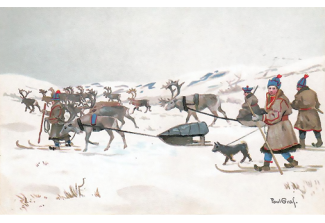
It is not known when Graf painted Lappar På Flyttning (Lapps on the Move), with their herd of reindeer. The work
conveys the starkness of northern Lapland, with its rolling snow-covered hills. Graf also gets the details precisely right in his depiction of Lapps—now known as Sami—with their ski boot toes turned up, all dressed alike in winter clothing with colorful embroidery, and and with sky-blue, down-filled four-cornered hats.
The painting complements Graf’s På spårsnö (Snow Tracks), which was exhibited in 1900. Graf’s works can be found in museums and art galleries: at the Skagens Museum at the northern tip of Denmark and in France at the Musée du Touquet-Paris-Plage, as well as in Gothenburg, Norrköping, and Karlshamn in Sweden. — E. John B. Allen
Known for its authenticity, the work of Paul Graf depicts the reality of the herding life in northern Lapland, down to details of the winter gear and clothing.