Oregon's Skyliners Ski Club
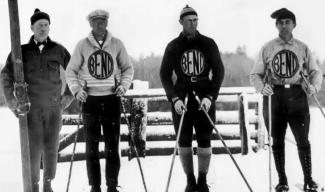
The club’s four Scandinavian founders had a hunch in the late 1920s that they could help transform Bend into a winter recreational hub. They were right.
For 59 years, the Skyliners Ski Club near Bend, Oregon, was an egalitarian organization that included members from all walks of life, from mill workers to the town’s elite. It established two ski venues and produced national and World Cup champions.
Photo top: Motivated by a failed mountain rescue in the late 1920s, (left to right) Chris Kostol, Nels Skjersaa,
Nils Wulfsberg and Emil Nordeen, all recent Scandinavian immigrants, established the Skyliners Ski Club to promote sports participation and mountain safety. The club went on to develop top athletes and launch several successful ski venues in central Oregon.
The club was born out of a mountain rescue effort in early September 1927. During Labor Day weekend, two young men went missing during a blizzard as they attempted to climb Middle and North Sister in the central Oregon Cascades. The rescue team of experienced mountaineers included volunteers from Eugene and Bend. From Bend came four Scandinavian immigrants: Chris Kostol, Nels Skjersaa and Nils Wulfsberg, all from Norway, along with Swede Emil Nordeen. The search teams returned at dusk to a base at Frog Camp. There, while sitting at a campfire, the four men from Bend envisioned an organization that would promote climbing and winter sports and mountain safety. Sadly, the two young climbers were not found, but in December, a ski and outdoor club coalesced.
The founders, the so-called Four Musketeers, had each grown up in friluftsliv—Norwegian for “the open-air life.” Experienced skiers and outdoorsmen like many of their peers, the four Scandinavians worked well-paying jobs at the Shevlin-Hixon and Brooks-Scanlon lumber companies in Bend, then the two largest pine mills in the world. They held a contest to name the new club. Paul Hosmer, editor of the Deschutes Pine Echoes, a monthly newsletter from Brooks-Scanlon, won a two-dollar prize for suggesting the name Skyliners Ski Club.
Wulfsberg, an Oslo University graduate, realized a ski club could boost Bend’s winter economy. “If Bend becomes a center for winter sports, with annual ski carnivals, with contests attracting attention over all Oregon and neighboring states, with winter resorts in the close neighborhood, it will mean that the name of Bend will be brought before large crowds on the days of contests and before tourists throughout the winter,” he told the Deschutes media in the late 1920s. The Bend Chamber of Commerce came on board with the idea.
The McKenzie and Tumalo Winter Playgrounds
The club needed a ski venue and found a suitable site on the old McKenzie Pass, eight miles west of the town of Sisters. Believing it to be National Forest land, the club began cutting trails in late 1928. They soon learned, however, that the property was instead owned by Louis W. Hill, chairman of the board of the Great Northern Railway.
Brooks-Scanlon executive Herbert E. Allen wrote to Hill, asking permission to use the land for winter activities. Hill wired back his approval and offered the group “a free lease on the property with the right to improve it in any way they saw fit for the purposes of encouraging winter sports in Central Oregon.”
The Skyliners named the site the McKenzie Winter Playground. They built a 45-meter ski jump, a 900-foot toboggan run and a lodge. From 1928 to 1935 the club hosted cross-country ski meets and jumping tournaments. In 1930, it hosted a winter carnival that attracted 2,000 participants and spectators from all over the Pacific Northwest.
By 1936, Alpine skiing was growing popular. The club wanted a longer slope—both for skiing downhill and for a larger jump—and moved the operation nine miles west of Bend on Skyliners Road, adjacent to Tumalo Creek. That year members built a lodge, a slalom hill, cross-country trails and an ice rink. The lodge, funded by the Works Progress Administration and the Civilian Conservation Corps, was built in a rustic national park architectural style and still stands today.
In 1938, Olaf Skjersaa inaugurated the 60-meter ski jump by flying 180 feet. The facility at Tumalo Creek was heavily used from 1938 to 1958, with a pause (1941–1947) for World War II. With the opening of the Mt. Bachelor ski area in December 1958, the Skyliners moved their activities to that mountain.
Developing Top Athletes
Born and raised in Wenatchee, Washington, Frank Cammack won the Nordic combined at the 1957 U.S. National Championships. A junior at the University of Idaho, he was then named to the U.S. team for the 1958 Nordic World Championships in Finland. But during training for the worlds, he broke his neck while jumping at a meet in Ornskoldsvik, Sweden, thus ending his competitive career.
In November 1962, during his first week of a new job at Brooks-Scanlon, Cammack was invited to a meeting of the Skyliners Ski Club. The group wanted to bring over an Austrian coach but needed $2,500 to do so—funds the club didn’t have. Instead, Cammack offered to start coaching immediately.
Cliff Blann, general manager at Mt. Bachelor, set aside a run where the team could train. Some of the kids cut willow saplings from along the Deschutes River to set up as slalom and giant slalom gates. Later, Blann would find bamboo poles for the team to use.
Cammack’s philosophy was to make his kids into all-around skiers and build a sense of team community. He had them run gates but also encouraged plenty of free skiing, which was a somewhat radical approach at that time. Cammack paired the younger ones, at 11 and 12 years old, with more experienced skiers aged 16 and 17.
The Skyliners team became known for its cohesion. Other teams had fancy jackets and the Skyliners parents wanted the same for their kids. After talking it over, the club decided they were winning races without uniforms.
Cammack’s skiers went on to succeed at the regional and national levels. The group included Sherry Blann, Karen Skjersaa, Kiki Cutter, Mike Lafferty and Mark Ford.
Cammack received support from his employer, Brooks-Scanlon, which gave him time off to attend races. After each race, which sometimes took place over a four-day weekend, the mill’s general manager would ask for a report on how the kids raced and pay for Cammack’s expenses.
“It was the best 10 years of my life when I compare it to my competitive career,” said Cammack in a previous interview. “I received more satisfaction from coaching than competing.” He noted that his coaching enabled many of the young Skyliners to secure skiing scholarships. “Some would have never gone to college unless they received a scholarship,” he added.
The top star of Cammack’s team was Cutter, who became the first American to win a World Cup event, a slalom race in Oslo, Norway, on February 25, 1968. “She had the focus,” said Cammack. Although Cutter competed on the World Cup circuit for less than three years, her five career victories was the U.S. Ski Team record for 11 years, until it was surpassed by Phil Mahre in 1979.
In 1986, the Skyliners Ski Club was integrated into the Mt. Bachelor Sports Education Foundation. Today, the foundation’s 800 athletes compete in five programs: Alpine, Nordic, snowboard, freeride and cycling. 
Contributor Tim Gibbons previously wrote about the 1972 U.S. Olympic Biathlon Relay Team in the November-December issue.