Short Turns: Long Routes in the Laurentians
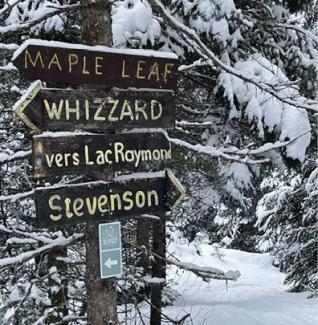
A trio of multiday trips known as Les Routes Blanches revives interest in Quebec’s century-old ski trails.
Some of North America’s earliest ski trails have gained new prominence, thanks to a project that launched to the public in late 2024. Known as Les Routes Blanches, it was conceived to celebrate and conserve a network of Nordic backcountry ski trails in Quebec’s southern Laurentian mountains.
Adventurous skiers can pick from three multiday itineraries: The 28-mile east route connects four small towns—Val-David, Val-Morin, Sainte Adèle and Prevost—over three or five days of skiing, with overnights at inns along or near the trail and luggage transport by a private service for an extra fee. The north route, based at Mont Tremblant, includes two days of skiing on expert-level backcountry trails near the ski resort, with lodging in an A-frame cabin.
The west route begins in Morin-Heights and covers 32 miles over three days, with accommodations in a yurt one night and a well-appointed cabin the next (and luggage transport, if desired). Other than the Tremblant tour, which requires guiding, skiers can complete any route on their own or with a guide.
The impetus for Les Routes Blanches was two-fold. As interest in backcountry skiing has grown, skiers started to discover more of the Laurentians’ heritage trails—some of them maintained, others not so much. Meanwhile as more people have moved to the area, some of the routes, which cross a patchwork of private and public lands, have been lost to development or to new property owners who simply don’t want skiers crossing part of their land, says James Jackson, board president of SOPAIR (Société de Plein Air des Pays-d’en-Haut), which oversees Les Routes Blanches. The nonprofit group was formed in 2014 to preserve access to and maintain green spaces in the region, working with 10 local municipalities.
The leadership of SOPAIR believes in a use-it-or-lose-it approach—promoting the idea that drawing skiers to enjoy the trails is critical to their long-term survival. “What we’d like to get to is that landowners want the trail on their land,” says Jackson. “And developers understand that access to trails is a selling point.”
Legacy Trails
As early as the turn of the 20th century, skiers headed to these mountains by train from Montreal to enjoy the then-novelty of sliding on snow along trails through field and forest. (The first rope tow in North America wasn’t installed until 1932, near Shawbridge, another Laurentian town, so until then, all skiing was self-powered).
In 1905, four members of the nascent Montreal ski club rode the train to Ste-Agathe, then skied 34 kilometers to Shawbridge, according to a display in the Laurentian Ski Museum. In 1911, Swiss immigrant Emile Cochand arrived in the area to establish Canada’s first ski school. He laid out a number of touring trails.
After World War I, Laurentian lodge owners began to sense the potential for winter tourism, and some opted to stay open year-round. More ski trails were mapped out, and in 1927, trains aimed specifically at skiers were added to the railway schedule. The Laurentians had become a ski destination, not only for Montrealers but for some Americans, too. Tourism spiked during Prohibition, when Americans discovered that a day on the trails could end with an alcoholic beverage or two.
Following the stock market crash of 1929, a Norwegian immigrant named Herman Smith-Johannsen moved to Shawbridge from Montreal, becoming one of the region’s most avid skiers and a prolific designer of backcountry ski trails and, eventually, Alpine ski slopes. Widely known by his nickname, “Jackrabbit,” Johannsen promoted the idea of a ski trail that would approximately parallel the train line and allow skiing between towns, so a skier could return to the starting point via rail. He recruited volunteers to help clear what became the Maple Leaf Trail. It opened in 1933, running north from Shawbridge for about 80 miles.
In the early 1920s, Gault Kerr Gillespie and his siblings skied to school. During the 1930s, he extended their school trail to become the Gillespie Trail, then collaborated with Johannsen to build dozens of miles of other trails. Decades later, Eddy Fortier built many cross-country ski trails near Sainte-Adèle and avidly promoted the sport.
Sections of the Maple Leaf Trail still exist, as do other trails from the era. But aside from local skiers, awareness of the trails nosedived, especially after the Laurentian Autoroute was finished as far as St. Jerome in 1959 and access to ski centers switched from the rails to the road.
Drive to Revive
The seeds of Les Routes Blanches go back to the early 2010s, when Jean-François Girard, an outdoors guide based near Montreal, discovered the old ski trails during trips to the area. “I got lost a couple of times, but I was intrigued by these trails,” he recalls. Local ski clubs maintained some of them, but details about the routes was hard to find, and there was no larger group coordinating their use.
Sensing the potential to map out longer itineraries, Girard started researching the trails and their history. After learning about the town-to-town skiing enabled by the Maple Leaf Trail, he was inspired to revive a similar tradition for today’s skiers. “I wanted it to become something accessible to the larger public,” he says.
He found an eventual partner in SOPAIR, which helped get funding to map itineraries, find lodging partners and coordinate among the various towns and local outdoors clubs for trail maintenance. It took about three years to get Les Routes Blanches off the ground.
Girard also realized the importance of raising awareness to conserve access. “It was my way to make more value for these trails,” he says of his initial efforts, explaining that if the trails remained a locals’ secret, they’d be more vulnerable to the threats of encroaching development.
An Unqualified Success
Following its second winter of operation, Les Routes Blanches has been a hit among Nordic skiers from Canada, the U.S. and even farther afield. The trails wind through stands of eastern white pine and cedar, beech trees and birches, and across snow-covered frozen lakes. Climbs and descents range from gently rolling to short, steep and nerve-wracking. Some sections are so narrow that it can be difficult to discern the correct route, as other narrow openings in the trees seem just as probable a way forward.
The proper equipment is key: Instead of traditional cross-country skis, the ideal set-up includes wider, steel-edged Nordic skis and sturdier touring boots offering more support than a light cross-country boot provides. Alpine touring gear, on the other hand, would be overkill.
Though civilization is never too far away, many sections of Les Routes Blanches provide wilderness-like immersion. But with comfortable, warm beds each night—and gourmet meals on the east route —the ski experience feels more European than typical multiday ski routes in North America that rely on rustic hut systems.
Municipalities and landowners have recognized that the ski trails can serve as an economic engine. During municipal elections last fall, three new mayors were elected, all of them trails advocates, says Jackson. “The publicity has been fantastic,” he adds. “It’s been a huge help to us when we are negotiating with landowners about a trail to say, ‘This is part of our culture and our economy. You can be a part of the heritage of this area as the birthplace of skiing.’”
Claudine Longet Dies at 84
Claudine Longet, a French-born singer and actress, died at age 84 on May 14. She was perhaps best known for fatally shooting her boyfriend, the U.S. Olympic skier and pro racer Spider Sabich.
After an amicable separation from her husband, singer Andy Williams, Longet moved in with Sabich in his Aspen home in the early 1970s. She fatally shot him in 1976 in their bathroom and was charged with reckless manslaughter. She was 24. Longet later testified in court that the gun accidently discharged when Sabich was showing her the firearm.
Her trial for reckless manslaughter became a media circus. Mistakes by local investigators led to some evidence being ruled inadmissible. A ballistics expert for the prosecution testified that the gun was fired from four to six feet away. Nonetheless, a jury convicted Longet of negligent homicide, a lesser charge. She was sentenced to 30 days in jail.
Sabich, 31 at the time of his death, finished fifth in the slalom at the 1968 Grenoble Winter Games. He was said to be one of the skiers who inspired the fictional character David Chappellet, Robert Redford’s dashing ski champion in the 1969 film Downhill Racer.
Snapshots in Time
1969 (Nearly) Endless Winter
“Time? What’s that? Here the snow comes early and often forgets it has a melting point. Brother! It’s still winter and probably will be until July.” The speaker, an unshaven young attorney from Providence, R.I., slung his skis over a shoulder and started the long trek up toward Tuckerman Ravine. And he wasn’t alone. About 1,500 skiing diehards were in the ravine today despite a threat of rain. They romped in snow depths that, in some places, were 30 feet, schussing, weaving and wedeling as if it were midwinter. At a time of year when most skiers are blasting golf balls, sailing or rooting for the Mets or Yankees, the ravine hypnotizes the sport’s jet set. — Michael Strauss (New York Times, May 23, 1969)
1977 Ultimate Speed Trap
Steve McKinney, who set a world speed skiing mark in 1974, recaptured the record September 25 when he shot through a 100-meter speed trap at 195.972 kph (121.771 mph) at Portillo, Chile. The record was set on a specially prepared half-mile track with a slope of up to 45 degrees on Portillo’s Roca Jack, a broad, steep treeless mountain that was the site of the 1966 World Championship downhill. — “McKinney Sets World Speed Mark” (Skiing, December 1977)
1989 A Quick Revolution
A stroll among the ski racks at a base lodge today offers evidence of a quiet, but strong, revolution in the sport. Skis are standing taller than they did a few seasons ago. Kip Pitou, who distributes Austrian-made Kästle skis, speaks for the majority of manufacturers when he says, “We’ve seen our orders move up two sizes over the past three years. Slope grooming has encouraged faster skiing, and a longer ski puts more edge in the snow and is therefore less jittery at higher speeds.” —
Jackson Hogen, “The Shift to Longer Skis” (Snow Country, January 1989)
1997 Details Matter
Just a quick comment regarding the cover of your May-June 1997 issue. The helicopter parked in a high Alpine meadow simply reinforces just how expensive our sport can be. It’s a small point, but if we’re going to change perceptions about the cost of skiing, we have to pay attention to these little details. — Greg Sweeter, Executive Director, Ski Maine, “Beauty Defiled” (Letters, SKI, September 1997)
2018 Raising the Bar
On Saturday morning, Big Sky Resort unveiled Ramcharger 8, the first 8-person chairlift in North America. Big Sky Resort said Ramcharger 8 is the most technologically advanced chairlift in the world. It’s equipped with loading carpet, an LED jumbo screen, locking restraint bar and a blue bubble weather screen. “It is raising the bar for the rest of North American skiing,” said Boyne Resorts President Stephen Kircher. Ramcharger has been in the works since March 2018 when Boyne Resorts, the company that owns Big Sky Resort, contracted with Doppelmayr USA, based in Salt Lake City, to start building the lift.— “Big Sky Resort Debuts First 8-person Chairlift in North America” (MTN News, December 17, 2018)