Classics: Putzi Goes Skiing
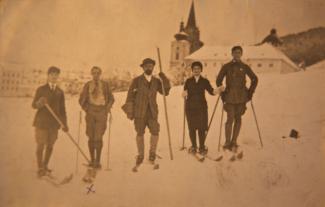
A beginner earns her turns in 1913.
Translated by Jimmy Petterson
Photo top: Paul Preuss (left) with early Alpine guru Matthias Zdarsky (center left) at Mariazell, Austria, around 1910. Arnold Lunn described Zdarsky as the father of Alpine skiing. Petterson family collection.
Translator's introduction: Paul Preuss was an Austrian mountain climber, skier and Alpinist of the highest repute in the early 1900s. Many consider him the father of free climbing. Famed mountaineer Reinhold Messner has described Preuss as a role model and wrote his biography in German (The Philosopher of Free Climbing: The History of Paul Preuss, 1996). Preuss is also the subject of books by Severino Casara and, most recently, by David Smart (Paul Preuss: Lord of the Abyss, 2019).
Preuss opposed the use of pitons or any artificial aids, and his views were often published in the Deutsche Alpenzeitung. He accomplished 300 free-solo ascents and 150 first ascents before falling to his death, at age 27, in October 1913.
Also an accomplished skier, Preuss pioneered touring routes throughout the Alps in Austria, Switzerland and Italy. He is credited with first ski ascents/descents on the Dreiherrnspitze in 1912 and the Gran Paradiso in 1913.
This tongue-in-cheek essay about a young girl’s new interest in learning how to ski was printed in the Deutsche Alpenzeitung, a prominent German magazine dedicated to Alpine sports and natural history, in March 1913. It’s a timeless reminder that skiing has its social hazards.
Putzi decided to become a skier! She accompanied us on our summer and autumn hikes, but as the stormy, hard winter approached, she noticed that she was being neglected. We, her friends, marched out on Saturday evenings, or before dawn on Sundays, into a private world of joy and happiness, and left her alone at home.
Putzi wouldn’t tolerate neglect. She was determined to ski and wrote to her mother asking permission. “Skiing is much less dangerous than climbing, where one can break one’s neck, while here, the worst that can happen is a broken leg and besides which, it is terribly healthy and good for the body.”
Three sad Sundays went fruitlessly by, but by the fourth Sunday, mom had weakened, her resistance broken.
In the meantime, Christmas was upon us, and with the branches of the pines now laden with fresh snow, Putzi prepared for her first ski trip. We are intelligent and wise, so we set out into the remote mountains to celebrate Christmas in the solitude of the Alpine valleys, far from the noisy city and below the storm-swept summits.
Eight days later: “So, Putzi, how was it??”
“Oh, very nice, unique, fantastic, poetic! So many people were out there . . . and those Norwegians, those erect-walking Norwegians!!! How handsome they are! Are they all like that? So tall, slim and blond! And their cute names—I can’t remember them—but they’re all sensational, and how they skied! And it was so much fun, every evening we danced.”
“And did you also ski?”
“But naturally, and how! Awfully much, every day at least three hours! You know, we always had to walk so far to the practice hill, and my friend Mitzi always took forever to get dressed, and once she forgot her skis in the hotel, and . . .”
“So, what all have you learned?”
“Oh, everything, absolutely everything, I’ve even been jumping—don’t laugh—really jumping! You know, the one Norwegian who was so funny, he could hardly speak a word of German, but I understood him anyway. When he said that I had more talent than Mitzi, he spoke so cute, sort of like an Englishman. He let us jump over a small mogul, and I jumped half a meter!”
“Can you also already snowplow and turn?”
“Oh, perfectly. I already know how to make christies and telemark turns.” As she spoke, she gave an indoor demonstration of some mysterious dance-like motion with her arms and legs. She performed her puzzling ritual with such exuberance that the vase was knocked off the table.
“And to stop, you spread your legs so far apart, that you no longer know if they belong to you or the skier beside you. There were horribly many girls in the ski class, almost more than men, but at the dances, they all spent the evening sitting.”
“And what else happened? Did you already go on a tour?”
“Of course. You must go on a nice tour with me soon, but only with climbing skins under our feet; otherwise I always slide backwards and fall down.”
And so it happened! One day, I invited Putzi to join our group of friends on a tour. As I began to organize the trip, I began to see how faithless friends could be! The excuses and cancellations on the telephone were painful to my ears. “What? You don’t want to go because Putzi is going? Can’t you imagine her skiing?”
“Oh, sure, but only lying on the ground,” was one answer.
“Exactly because I can imagine her skiing is why I don’t want to come along,” was another reply.
“I’ll meet you on the train on the return trip, but I’m going to make a difficult tour,” wrote a third friend.
“Take Putzi on the Schneekogel? No, as much as I like her, it will be springtime before one gets back down, and all the snow in the valley will have melted in the meantime.”
Only one of my friends came along. He was a doctor and fancied himself a specialist in adolescent psychology, so he participated from a professional sense of duty.
On the train, Putzi was queried about what she had learned on her ski course. She carried her skis so well on the train platform. She only hit one lady in front of her in the back. Also one poor man behind her was whacked with a few heavy blows to the face (“If one could only know that somebody was also standing behind one!”) and the glass pane of the door was the victim of a vicious assault as she entered the train. (“So stupid, why isn’t the door open?”)
Then she placed her ski poles in the overhead rack in such a way that the sharp tips were hanging, as if on display in the middle of the aisle, and every person who passed was hit in the eyes by them. (“They should be careful!”) In addition, she critiqued the clothes, equipment and appearance of the other passengers.
“Look, Paul, that fat guy back there, he certainly can’t ski. If he falls, he must need a crane to get back up, and he would leave grease spots on the snow!”
On arrival, Putzi grabbed her skis, I took her poles and rucksack, and a stranger carried her handkerchief and a purple silk shawl out of the train. There remained for Putzi to take care of only her train ticket, which she wanted to hand in herself at the gate to prove her maturity and independence. Now we could seriously face the challenge of climbing a mountain. Poor Putzi! I really felt sorry for her as she so suddenly was forced to discover the bitter seriousness of life in general and of skiing specifically.
Tough and stubborn, she swallowed her suffering as she trudged miserably upwards. In spite of the skins, the route up was rather steep, especially if the “dumb back foot continually crosses the front ski.” But with energy and ambition, she continued to follow us. When we turned around sympathetically after a particularly steep section, she gave a peculiar, strained grin and said, “Oh, thank you, it’s going great.”
One hour later: “It sure is steep, but I feel wonderful!” Fifteen minutes later: “How much further is it? I still feel fine.” Fifteen minutes later: “Has Mitzi also already been up here? Yes? Oh, I feel terrific!” Fifteen minutes later: “Are all mountains always so high? No, no, I’m not tired at all! I’m only hungry! I feel fabulous!”
Fortunately, we were already standing in front of the hut. Otherwise, Putzi would have explained still three more times at regular 15-minute intervals how incomparably fantastic she felt and finally would have collapsed with exhaustion.
Putzi stepped into the hut and said, “Paul, do I look okay? May I have a little warm water to wash my hands? But not too hot, or they’ll get red! And I’d like to order a hot tea—no, nothing to eat. I’m not hungry, only thirsty!”
We stayed two hours longer than planned, because Putzi, although she never would have admitted it, was visibly tired. The trip up was so long “that the ski run down must be endless!”
We began the preparation for our descent by waxing our skis. “But my God, please don’t wax mine! They were not waxed at my ski course, and they still always went terribly fast. It always seemed as if I’d been shot from a cannon!”
The descent began. How did Putzi ski? Actually, I have difficulty answering that because I only always saw her lying in the snow. “But you don’t have to wait. I’ll catch up—how silly, whenever you watch, I fall down!” She dug herself out of the snow. “Should I have made a telemark turn or a christie there?” The train was long gone and night was upon us as we reached the valley.
Two days later on the telephone: “Hello, Paul. It’s Putzi. Paul, Mitzi doesn’t believe that I skied almost as well as you and Fritz, and that I skied down very quickly. Can’t you tell her?! By the way, I wanted to say that I forgot my comb in the hut, and I can’t find my mittens anywhere, and you still have my purse, which I gave you to hold. I’ve been looking for it for four hours today! But Sunday, we’re going again, aren’t we? It was so nice!”
We went out again on the next Sunday and the following one, and many more. Putzi has along the way forgotten 14 combs, lost 11 pairs of mittens and left her skis accidentally at home on five occasions. She’s also missed numerous trains, but generally only in the morning on the way to the mountain because she always gets in the wrong train. Her return trips have been quite successful, as there is only one track leaving the ski area.
As she has gained experience, she naturally has begun to lose the ability to discern danger so that today she skis the wildest slopes with more guts than brains. But she really has learned to enjoy and appreciate the snow, the mountains and even the cold, foggy gray of a winter morning. In addition, she has also achieved her initial goal: She really does now ski better than Mitzi. Mitzi, on the other hand, has in the meantime gotten married. The winner, therefore, remains questionable. 
Translator Jimmy Petterson is a great-nephew of Paul Preuss. His book Skiing Around the World, Volume II won an ISHA Baldur Award in 2021.