Alta Unearths its Silver Boom Secrets
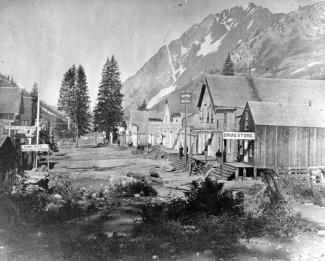
A utility project unexpectedly reveals a comprehensive historical record.
Before it became a ski area, Alta, Utah, was once a raucous Western mining town, buried time and again under devastating avalanches. Now, after 150 years, a significant part of its mining history has surfaced through a surprising archaeological treasure trove.
Photo top: Alta's main drag in 1873. A fire destroyed much of the town in 1878, followed by a devastating avalanche in 1885. Utah Historical Society.
In August 2025, Alta Ski Lift Company crews were using a backhoe to dig a trench for new snowmaking reservoir pipes in an established pipe-and-cable corridor. The workers dug in a spot between the Albion and Wildcat base areas, now home to a long rope tow across the flats. The area lay above what was known as Water Street during the silver-mining boom.
The backhoe crew unexpectedly hit the jackpot, unearthing animal bones, melted shot glasses, bullets, a leather hat and a fully intact bottle of alcohol—each offering up tales of Alta’s past. It was just the start of a more thorough excavation.
Eventually, at least six historic building foundations and 2,000 artifacts were exposed. Some items originated in Japan, China, Scotland, Britain and several South American countries, reflecting the diverse demographics of the 1864 silver rush.
Because Alta is a collection of independently owned businesses operating on land administered by the Uinta-Wasatch-Cache National Forest, the site was examined by the U.S. Forest Service, the Utah public archaeologist and the state’s historic preservation office, which required an archaeological excavation. Within just a few days, about 30 volunteers arrived, many coming through the Utah Cultural Site Stewardship Program. The dig lasted three weeks.
“In an ideal circumstance, with a discovery of this magnitude we’d have taken a long time,” says Chris Merritt, the state historic preservation officer. “But because this was mid-August, we knew snow season was coming. We wanted the trench filled before the first snow to protect folks, and it was the best way to protect the archaeology, too.”
Many ski areas, including nearby Park City, flourished around former silver-mining towns, but a discovery of this type is uncommon. “Rarely does a situation come along where you actually get to excavate the history of a ski town and put it all into context and connect the past to the modern day,” notes Lexi Dowdall, Alta’s communications manager.
Some artifacts will be housed in Salt Lake City’s new Museum of Utah, scheduled to open in summer 2026, while others will be displayed in Alta’s expanded Albion Day Lodge. Plans are in the works for a second dig this summer, open to archaeology students and the public.
Booze and Bullets
Utah was settled in 1847 by Brigham Young and members of the Church of Jesus Christ of Latter-Day Saints, as a religious territory called Deseret. “Brigham Young prohibited mining,” says Merritt. “He worried it would breed greed that would lure people out of the church or bring people from outside the church and change Deseret.” Both fears proved justified.
In July 1862, during the Civil War, the U.S. government, wary of secession, sent the 3rd California Infantry Regiment to the Utah Territory in a show of force, followed by the 2nd Regiment, California Cavalry. Among the troops were former miners. By 1864, some of the soldiers had reached the end of their three-year enlistments and went exploring in the mountains. They’re credited with the first discovery of silver in Little Cottonwood Canyon that year. The mining town that sprung up was right in character of the Wild West, and the Mormon name for the cliffs that mark the entrance to the town of Alta—Hellgate—spoke to that fact.
A number of bullets and casings were found at the Alta dig site, including a spent bullet from an 1864 Colt revolver like one owned by Wild Bill Hickok and a bullet and casing from a Colt .45 Peacemaker like the one Butch Cassidy turned over to Utah governor Heber Manning Wells in 1899.
While Deseret had breweries and a distillery, drinking became taboo in the state over time (Utah passed its own prohibition law in 1917). Thus, the one artifact that immediately gained attention was the intact bottle of alcohol. “To me, when we heard about the juxtaposition between the squeaky-clean impression of Salt Lake back then against the rough-and-tumble Alta mining town, it added a layer of complexity,” says Isaac Winter, master distiller at High West Distillery, Utah’s first legal distillery, when it was founded in 2006, since 1870. The bottle is a mix of hand-blown and machined glass, corked so carefully it would hold up for 150 years underground. “That takes some love and some passion,” adds Winter. “And it solidifies that alcohol is something that’s central to community life even at the edge of civilization.”
Finding an undamaged bottle containing liquid is also rare in surface excavations. In most instances, a discovery like that is found on or near sunken ships, where underwater conditions preserve bottles intact. High West has been working to “plate” the remnant of alcohol, analyzing it in hopes of recreating it for sampling. Several tests have confirmed that it contains ethyl esters, commonly found in hard ciders.
Foundations and Fires
By 1873, Alta’s temporary summer mining population peaked at 5,000 to 8,000 residents, making it one of the 20 largest towns in Utah.
Maps from the mid-1910s show overlapping mining claims covering every inch of the Albion Basin. Independent miners, and later a consolidated company, chased silver, gold, copper and lead. Between 1867 and 1914, they pulled $20 million (more than $600 million in today’s dollars) of mineral wealth from the ground. This made Alta one of the richest mining districts in the American West.
It was also among the deadliest of settlements. Foundations exposed by the excavation showed evidence of the infamous avalanche-caused fire of 1885. The avalanche crashed into a boarding house full of sleeping miners, killing many of them. It also overturned kerosene lamps, igniting a fire that destroyed part of the town. The dig turned up a barrel from the same depth as the boarding-house floor boards that contained melted broken glass.
“We have a lot of articles and oral histories, but what’s so cool is that the archaeology backs that up. Here in Alta, that history is frozen in time,” says Ian Wright, the state’s public
archaeologist at the time of the dig. In a presentation, he shared photos showing the burnt foundations.
Pig’s Feet, a Miner’s Hat and a Chinese Laundry
Merritt, who specializes in historical-era archaeology, was thrilled to be able to connect artifacts with maps, newspaper articles and old photographs, which all work together to complete Alta’s story.
He notes the plentiful farm-animal bones, which tell us that residents of Alta were raising much of their own food for butchering on site and importing more. In particular, pig’s feet bones were abundant in the dig and correlate with newspaper clippings from the Fritz House Hotel (1874), which advertised German imports and pickled pigs’ feet.
“Evidence of this one hotel operated by this very colorful character [Prussian officer Fritz Adolphy] makes the story of Alta much more human,” Merritt says. “That’s the power of good history and archaeology. It gives us an opportunity to dive into Alta’s history and make 1876 relevant to 2026.”
The 1910 U.S. Census shows 13 nationalities in Alta, including American, Austrian, Irish, Swedish, Finnish, Greek, Russian, English, Danish, Japanese and Chinese. A streak of lye, a washtub wringer and a piece of bamboo-decorated pottery speak to the presence of the last group. Sam Tai Laundry and Sam Gee Laundry both feature in old photographs, so bamboo-style porcelain ware and a Chinese medicine bottle found in the trench along what was once Walker Street connect to the Chinese presence in town.
A leather hat preserved by Anne Lawlor, anthropology collections manager at the Utah Museum of Natural History, shines a light on the miners and their tools. Lawlor determined that the hat had been pierced by a candle on a spike, called a Sticking Tommy. The brim was worn turned up for improved visibility when working underground. She referred to photographs from Alta and Park City mines to support these facts.
Jake Yoder, an archaeology student at Weber State University in Ogden who volunteered on the dig, notes that the find reflects the mundane reality of Alta’s first residents. “There’s so much history of a town like that that gets left out from historical records: day-to-day life, marginalized communities, groups not represented in the journals or literature,” Yoder says. “Archaeology is a lens to go look at everyday peoples’ lives in a town on a not-too-special street—and to examine the forgotten parts of history.”
Founding as a Ski Town
In 1935, Alta’s beloved Norwegian founder, Alf Engen, skied over Catherine’s Pass on assignment with the Forest Service to assess the location for a ski area. Engen stayed with the Jacobsen brothers in their miner’s cabin in Albion Basin. No other miners remained in Alta. Engen noted that the hills were so denuded from mining activity that trees would have to be replanted if there could ever be hope of stopping Alta’s avalanches. He was then assigned to lead a Civilian Conservation Corps tree-planting crew.
At the same time, George Watson had amassed surface rights to 700 acres, including 85 Alta mining claims, but couldn’t afford the property taxes. He traded his land to the Forest Service for one dollar in exchange for tax relief, declared himself the town’s mayor and worked with Engen to promote “Romantic Alta.” If Watson caught someone referring to the town by any other term, he fined them two bits on the spot.
Timbers from mining shafts, towers repurposed from a mining tramway and mountain clearcuts pieced together Alta’s early lifts and runs. Today, sites at the ski area still reflect its mining history, including the mid-mountain Watson Shelter skier-services hub and the expert Watson Line run, while the original Collins lift was named for prospector Charles H. Collins, who hit it big on Peru Hill, near the current Peruvian Lodge.
And so the story comes full circle. Alta’s mining history, which has always been deeply integrated with the ski area, has unexpectedly risen to the surface. 
Bianca Dumas is a freelance writer based in Utah.