Pioneers: Ornulf Johnsen: Head of the Class
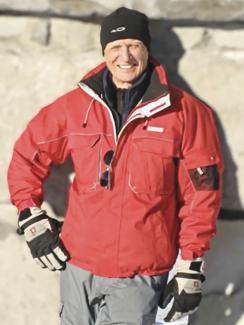
Whistler’s first ski-school director and master innovator at Grouse Mountain, Johnsen helped teach western Canada how to ski. .
Ornulf Johnsen, who stood 6 feet, 5 inches and skied with 54-inch poles, lived a big life and cast an even bigger shadow. One of the most influential and innovative ski-school directors during Canadian skiing’s boom years (the 1960s and ’70s), Johnsen was inducted into the Canadian Ski Hall of Fame in 2024.
Photo top courtesy Canadian Ski Hall of Fame
Born in Bergen, Norway, in 1934, Johnsen said skiing was what all the kids did growing up, as expected as breathing. “It was just part of life,” he told Pique magazine in 2009. “After you finished breastfeeding, it was like, ‘Here’s your baby bottle, here are your skis.’ ... When you live in Norway, when winter is a major part of your life, the only way you’ll go out and play is either on skates or on skis.”
As a young man, teaching skiing was his passport to travel the world. He eventually landed in Chile but was then recruited to be the first ski-school director at Whistler in 1965, the resort’s inaugural year. A later contract dispute ended his stay there at one season. He intended to return to Norway, but Whistler founder Franz Wilhelmsen set up a meeting between Johnsen and Grouse Mountain president John Hoegg.
Having a natural inclination toward the business side of skiing, Johnsen recognized the potential of a ski resort located less than 10 miles from a thriving Vancouver. When Hoegg asked Johnsen to join him at Grouse Mountain, he was all in.
He started there in 1966 as the owner, by contract, of its ski school. He would stay under that unusual format until 1987, when he sold the school back to Grouse.
Johnsen and his team are credited for all kinds of Canadian ski-school firsts, innovations that were soon copied by other resorts. For example, eight years into his tenure, Johnsen took a big risk by moving away from traditional European teaching methods and fully adopting the Headway Graduated Length Method (GLM) learning system.
Headway dispensed with the beginner snowplow/stem maneuvers and went directly to a parallel-focused learning system, starting skiers on three-foot skis and progressing them to four- and then five-foot lengths.
Ski lengths, of course, are measured in centimeters, but Canada wouldn’t adopt the metric system until the mid-1970s. “The ‘feet’ ski progression was intentional. Ornulf marketed the sport using easy-to-understand, non-skier jargon in order to make students feel at ease,” says Rob Wallace, who was a longtime employee under Johnsen and later succeeded him as Grouse Mountain’s director of skiing. During its heyday, more than 50,000 new skiers participated in the Headway system at Grouse.
Other bold ideas included video cameras to record each student’s progress on snow—back in 1968 when video equipment was still in its cumbersome infancy. Then there was the SyberVision simulator, which enabled students to take part in special mind-body training, a new concept in the 1980s. Additionally, Johnsen instituted Max4 lessons, which guaranteed no more than four students per instructor.
Perhaps Johnsen’s biggest legacy was his dedication to community outreach programs. The ski school partnered with Vancouver-area public and private schools to provide low-cost lessons to thousands of children. Charter buses picked up the kids from school and whisked them to the ski area. They were equipped with gear and provided an hour-long group lesson, then let loose on the mountain. At its peak, more than 100 schools participated in this program.
According to Wallace, however, Johnsen’s greatest achievement was combining his teaching skills with an accounting background to operate a profitable ski school. Over his two-decade tenure, Johnsen’s school taught more than a million lessons and generated more than $40 million in revenue.
As part of the ski-school team, Wallace soon learned that Johnsen was a tireless promoter. “At a time when most ski schools were fast asleep in the summer, Ornulf was busy doing things like computerizing his admin office and producing and buying TV and radio ad space for the upcoming season,” says Wallace.
Johnsen hired prestigious Vancouver advertising agencies to spin out catchy messages that were conveyed via radio, television, billboards and brochures. His constant pitch was that anyone can learn to ski. When Johnsen went to Lions Gate Hospital with a medical issue, he had signed up a whole group of nurses in the Headway program before he left.
“It was insane,” says Gerda Koch, who worked at Grouse for 14 years. “One day, one of the ski-school supervisors was stopped for a speeding ticket on his way to the mountain. Shortly thereafter, a group from the North Vancouver RCMP [Royal Canadian Mounted Police] detachment signed up for lessons.”
Johnsen’s ski school offered beginners and novices an enticing guarantee, perhaps the industry’s first such policy: You could take as many lessons as you needed to master The Cut, Grouse’s popular beginner slope—clearly visible from downtown Vancouver. Better yet, The Cut became even more visible after night skiing was introduced in the early 1970s, making it a living advertisement for much of the day and night from the Vancouver streets.
Johnsen’s innovative approach extended to his staff. As Koch, who was an instructor and supervisor, recalls, “The industry couldn’t supply enough instructors to meet our needs, so we developed our own rookie camp weekend courses on the permanent snowfields on the flanks of Mount Baker.” The courses helped staff the ski school. Prospective instructors had to be fit enough to climb back up after each run, she adds.
One of Johnsen’s defining traits, notes Koch, was that he “always pushed forward and tried new ideas.” Admittedly, that caused occasional anxiety in the ranks. “Most of the time, the programs were sold before anybody knew how to teach them,” Koch says. “He pushed us to learn, and he taught us how to run a ski-school business.”
She continues, “He was generous in supplying computers, film equipment and video cameras before any other ski school did and made them useful to the ever-growing business.”
What truly drove Johnsen, notes Wallace, was his dedication to customer service, which engendered customer loyalty. “We did a lot of surveys, but he was only interested in two questions: ‘Did the program meet, exceed or fall below your expectations?’ and ‘Would you recommend your program to a friend?’” says Wallace.
After selling the school back to Grouse Mountain, Johnsen ended up where he’d started, teaching lessons on a much-changed Whistler Mountain. He was a member of the ski school well into his senior years. Johnsen, now 92, continued to ski throughout his 80s before retiring for good and moving to the Fraser Valley, not far from where the original rookie camps were held on the slopes of Mount Baker. 
Vancouver-based Steven Threndyle covered the origins of the Powder Highway in the May-June 2026 issue.