Letters: Fatal Crash Led to Safety Rules
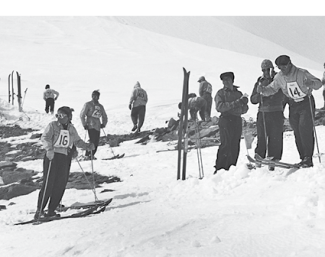
Edie Thys Morgan’s article, “Evolution of On-Course Safety” (March-April 2025), brings up memories of Sigurd Hall, a Norwegian immigrant who was killed in the 1940 Silver Skis race on Mount Rainier. It was reportedly this country’s first death to occur in a sanctioned ski race.
Photo top: Sigurd Hall (#16) waits his turn to start in the 1940 Silver Skis race on Mt. Rainier.
Born in Norway in 1910, Hall immigrated to the U.S. in 1929, settling in Seattle. He became one of the Northwest’s outstanding racers (as a cross-country skier and, later, as a four-way competitor) and mountaineers (doing first ski ascents of local peaks). He hoped to participate in the 1940 Olympics, but the Games were canceled because of World War II.
First run in 1934, the Silver Skis race was one of the country’s most prominent competitions. After a three-hour hike from Paradise Lodge to Camp Muir, skiers raced more than three miles in a virtually uncontrolled downhill, finishing near the lodge. The course was half a mile wide in places, allowing racers to pick their own route. A local paper called it the “Kandahar of the Northwest.”
Approximately 100 men and women competed in the 1940 race in April. Hall, skiing in a dense fog, veered off course a half-mile from the start, hit a rock and died instantly. His death was a major national issue for the racing community. A commission of the Pacific Northwestern Ski Association (PNSA) held hearings into Hall’s death, and the American Ski Annual contained several articles about his fatal crash later that year.
The commission made a number of recommendations for future races, including a mandatory safety evaluation of pre-race weather conditions, a minimum number of gate flags on course, the marking of extreme hazards and the ability to postpone or cancel the race. The hope was that the PNSA would codify the safety recommendations at its next meeting, but that never happened. The parameters of several of the commission’s suggestions, however, eventually led to improved safety regulations by various racing associations nationwide.
The high point of Hall’s racing career came just one month before his death, when he finished third in the National Four-Way Skiing Championships, behind Alf Engen and his brother, Sverre. 
John W. Lundin
Seattle, Washington