Commentary: The Uses of History
Who we are is who we were.
 I want to take a moment to thank all ISHA members for their stewardship of our sport’s past. People with an interest in history are a very small minority of the population—for instance, less than two percent of college degrees in the United States are awarded in the subject. Yet we do something very valuable: We keep alive the knowledge of who we are.
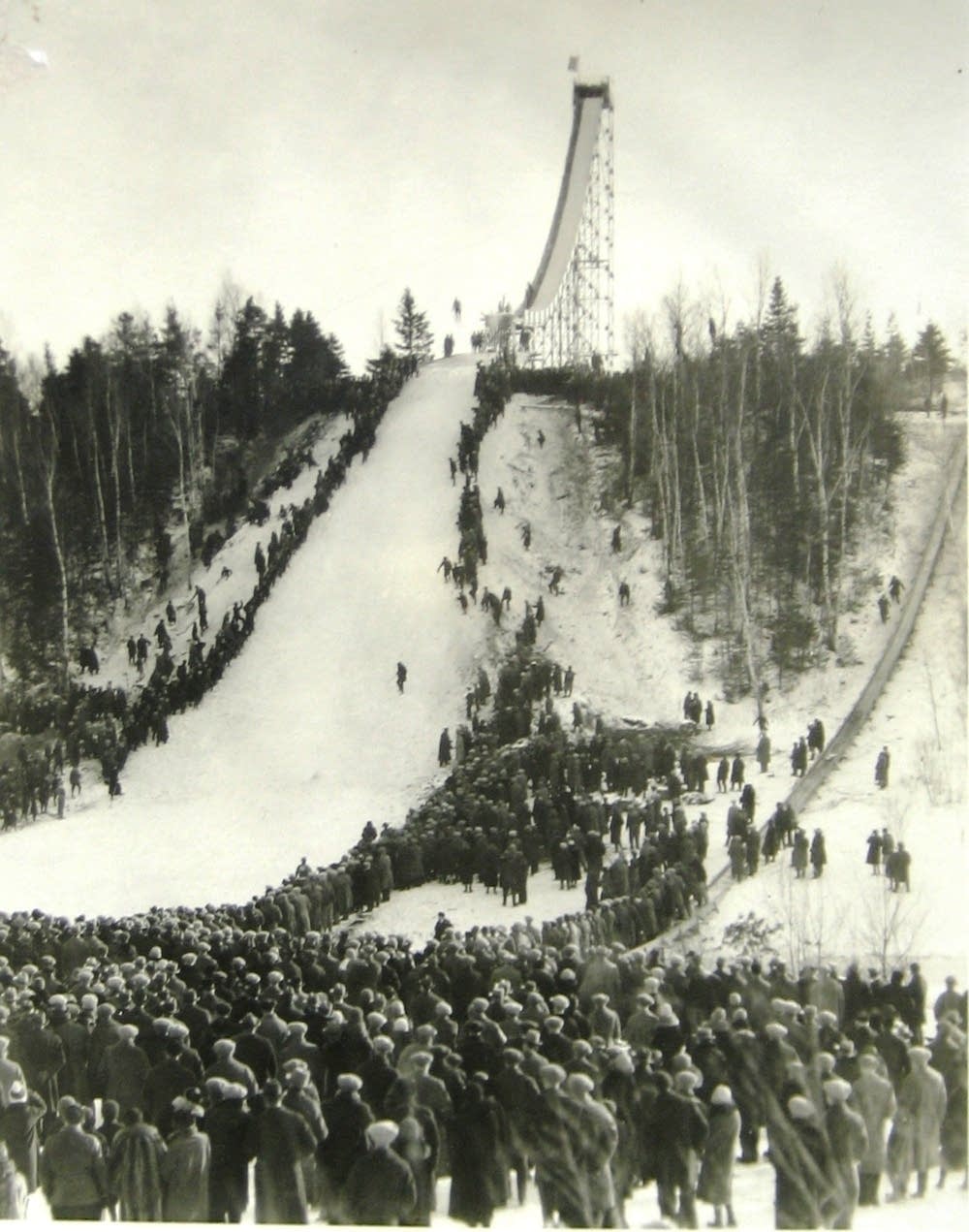
Photo: Norwegian ski clubs in America drew vast crowds to jumping contests, like this 1906 meet at Chester Bowl Park in Duluth, Minnesota. CBIC photo.
We live in a culture that has largely chosen to ignore the lessons of history. We have been repealing and suppressing the safeguards established during and after the Great Depression and World War II. About 56 percent of Americans cannot identify the nations their country fought in that war, and 52 percent cannot identify our World War II allies.
Recent data suggest that only 14 percent of U.S. students from kindergarten through grade 12 are grade-level proficient in history. Part of the reason, of course, is the continual bickering between a political movement that wants history to be taught as hagiography and the opposing team that wants all our warts remembered. Faced with lobbying by both sides, school authorities simply minimize social studies resources—and kids graduate in ignorance.
Ignorance of history can be tragic, and not just because we continually repeat past mistakes. Just as a person can have no identity without memory, a group without memory can have little purpose. Ask the question, “Who are we?” and the answer depends on how we got here.
Who are we as a skiing culture? What does our history tell us?
Let’s start with the knowledge that the founders of our sport were immigrants. The first wave of skiers in North America were Norwegians and Swedes fleeing starvation and religious wars, peaking around 1885. During the 19th century, more than 10 percent of all Norwegians then alive sailed to North America. They settled in snow country from Maine to Vancouver and launched numerous ski clubs. These functioned as Norwegian-speaking social clubs, but they also turned ski jumping into an immensely popular spectator sport. English-speaking neighbors clamored to get in and were welcomed.
The second wave of immigration began around 1930 and crested after the Nazi party came to power. Thousands fled fascist rule in Germany, Austria and Italy; immigrants also came from Czechoslovakia, Hungary, Poland, France and even neutral Switzerland. The world’s first downhill racing champion, the Swiss skier Walter Prager, was barred from the Nazi-run 1936 Winter Olympics so he accepted an offer to coach the Dartmouth ski team and emigrated that year.
Like Prager, many of Europe’s best skiers served in the U.S. Army, especially in the 10th Mountain Division, which recruited skiers, foresters and outdoorsmen of all kinds. They taught their culture to the “flatland” troops, many of them Southerners, who found their way to Colorado’s Camp Hale, where the 10th trained.
During the postwar years those veterans, driven by love of the mountains and forests, founded ski resorts, ski manufacturers and environmental movements.
In that sense, skiing culture was essentially cosmopolitan, democratic and environmentally progressive. The culture hasn’t been uniformly inclusive all of the time, but in general we ultimately welcome anyone who wants to learn and knows how to have fun. That is who we are. We should do what is necessary to preserve our inclusive culture, our winters, our forests and mountains.
One way to do this is by voting; please participate in elections and continue your stewardship. 
Seth Masia is president of ISHA and editor of this magazine.