A Double Standard
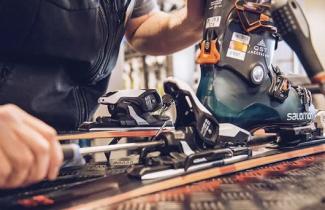
Where ski binding settings matter, ski racers are off the charts.
The gulf between the world of Alpine ski racing and the recreational ski market has never been wider or deeper. The gap is mathematically obvious in the matter of binding release/retention settings. Since the late 1970s, we have had an industry-wide standard for determining any skier’s appropriate setting, based on a universal scale of release/retention values.
Prior to the adoption of this method by the International Standards Organization (ISO), every binding manufacturer had its own proprietary scale and published decidedly fuzzy recommendations. Marker, for example, advised skiers to set their bindings in the “Golden Zone,” and Salomon’s technical advice was served up in sermons from the “Salomon Angel.” But once the new standards went into effect, every skier on the hill, from cautious beginner to risk-taking expert, would use bindings set at a number determined by weight, height, age, boot-sole length and skier type.
There remained but one problem to solve: skiers who were strong both physically and technically could walk right out of their “correctly” set bindings. This created an arguably more perilous situation for competitors. As a result, coaches couldn’t just stand by like neutral observers when a youngster’s well-being was at obvious risk, so, of course, they cranked up the bindings’ release values and continue to do so. The separation between a civilian’s set-up and a competitor’s kit begins at a relatively young age and only gets wider as the skier grows bigger and skis faster. Faster is the operative word. Energy
(applied to the binding) equals mass times velocity squared; but speed is not an objective factor in the settings chart.
Once untethered to a standardized methodology, how does a coach or technician know how far to deviate from the norm? Jim Schaffner spent most of his 40-year ski career developing junior racers. His frustration with a clearly dysfunctional status quo inspired him to create his own binding-setting chart, based on his own data. But whether grounded in a systematic approach or not, binding-release settings for racers remain biased towards retention.
The ISO settings for the general skiing public are designed around the tibia’s resistance to twisting and forward bending, so the binding will release well before the bone fails. The athlete-specific binding settings driven by performance on the race course are calculated to improve a competitor’s chance of skiing through a momentary crisis without triggering a release. If higher settings contribute to effectively inhibiting release, it’s a risk most racers are willing to accept.
Dr. Irv Scher is a biomechanical engineer who has measured and studied ski-binding behavior since his post-graduate days as a research assistant to Dan Mote, a professor at the University of California, Berkeley. He’s now into his fifth nonconsecutive two-year term as chairman of the American Society for Testing and Materials (ASTM) Committee F27 on Snow and Water Sports, a post he first held in 2014. Scher has a thorough understanding of the science behind the ISO release/retention recommendations, as well as an acute awareness of their limitations.
“The ISO binding-adjustment protocols deliberately prioritized the needs of the recreational skier and in doing so achieved an 87 percent decrease in reported lower leg [tibia and fibula] fractures, which speaks to the effectiveness of the standard,” Scher observes. He admits that this leaves the competition sphere to sort out special needs on its own, which is why the status quo sounds like a free-for-all compared to the precision of the ISO method.
Yet when one considers the extremity of the conditions competitive racers (and freeskiers) routinely endure, the current “system” actually works quite well. But this begs the question, can we do better? I asked Scher if we’ve reached the limits of what present-day science can do, or if it might be possible to expand the envelope of protection a binding provides.
The answer is a qualified “yes, if… .” The biggest “if” is obtaining the massive funding required for any new technology to be industrialized. If we set aside this hurdle for a moment, several possible paths forward emerge. The most obvious is to create a binding technology specific to the needs of the race community. Scher and his assistants have spent a career researching load cells between the skis and bindings, measuring all of the actual forces and torques both laterally at the toe and vertically at the heel.
One of the unanticipated outcomes of the torque measurement analysis was that one can’t always predict the skier’s retention requirement based on weight or gender, criteria instrumental in determining a skier’s setting on the ISO chart. While the recommended setting works for most skiers in most cases, the retention torques needed by aggressive, fast skiers on hard snow may be greater than those recommended by the ISO protocol. Nonetheless, these data could be helpful in determining the design criteria for a competition-specific binding design, one sensitive to vertical and lateral loads, and capable of interpreting the powerful vibrations generated at high speeds on hard surfaces.
The Electric Option Is Unplugged
Data-hungry scientists like Scher would love to see an electronic binding come to market that would measure forces and torques contributing to knee injuries. “By monitoring all vertical forces, both at the toe and heel, and lateral forces at the toe, we can estimate the combination of force and torque that puts the knee in danger and release the system when pre-set thresholds are reached,” he muses. “A true ACL injury inhibitor would be very hard for many, including ski-area operators and ski patrollers, to turn down. But what manufacturer has the will and the coin to make it?”
One could be forgiven for thinking that an electronic binding belongs in the same imaginary future as the flying car, given the technology’s vulnerability to cold and wet. But there have, in fact, been at least two electronic designs that made it as far as prototype development. Marker applied for a patent on an electronic binding in 1972. Later, Salomon considered introducing one. “We had an electronic binding design we were willing to share with the other brands,” says Dave Bertoni, who served as head of Salomon’s binding division in the 1990s. “That idea died in the cradle due to the typical internecine squabbling and an abandoned assault on the norms.”
Bertoni’s comment brings up an uncomfortable fact about standardization in general: existing requirements may block certain innovations from ever being presented. For example, he references a Salomon prototype toe-piece design that released asymmetrically; established standards mandated symmetrical release values, effectively aborting the project.
When Outside the Norm Is Normal
The most horrific crash in recent memory ended the career of one of the greatest-ever ski racers, the fearless Lindsey Vonn. Yes, she was racing with only one ACL, but it’s hard to see how this played any part in her accident or injury. It’s also hard to tell from the crash footage I’ve seen if her bindings didn’t release in part because of Vonn’s body position relative to her feet, with one ski possibly blocking the other from moving laterally. Would her bindings have released had they been set according to the ISO standard? It’s a moot point, as there’s no way on God’s green earth Vonn would have stepped into a starting gate with a made-for-civilians set-up. She raced to win, regardless of the sacrifices the ultimate goal required.
Vonn’s performance requirements and the trade-offs they entail have absolutely zero intersection with the needs and preferences of the recreational skier, male or female. But that doesn’t change the fact that a certain percentage of skilled skiers find it necessary to increase their release/retention settings in order to avoid inadvertent releases. Once a skier grows accustomed to using a higher setting, he or she is unlikely to reduce the setting when getting older, as the ISO standard mandates.
Those of us who came of age in the early freestyle era remember when every mogul run and aerial stunt looked like a hare-brained experiment to test the boundaries of binding design. The Alpine ski-binding market then offered skiers many more designs than are available in today’s shriveled field; yet inventive competitors found a way to disarm every one of them.
For example, the whole concept of the Allsop binding system was a fixed point of rotation (specifically, a fixed post aligned with the skier’s tibia). This might have worked well except that the wily pros who adopted them would add a second post farther forward, essentially defeating the whole idea. The multi-axis Besser plate binding worked with any boot, an important consideration when soles were not yet standardized. The release system worked so well, however, that it proved very hard to keep skier and skis attached during tricks and inverted aerials; thus, athletes substituted washers for springs—problem solved!
While competition-level skiers have always followed their own guidelines, the rift between the two worlds has never been deeper or wider. Accelerating the divide between civilians and competitors has been the explosion of freestyle events like slopestyle, halfpipe and big air. I can’t imagine how it’s possible for these phenomenal athletes to stay in their equipment when rotating fast enough to complete five—five!—full rotations.
Jonny Moseley is someone who knows what it’s like to create trailblazing new maneuvers and what it takes to keep from twisting right out of your skis as you launch skyward. I asked him what settings he used in competition and what he now uses for freeskiing. “When I was mogul skiing on Markers, I would use their race model, which went up to 24,” he says. “I’d usually run a 17 or 18 in competition. Now I’m often on a [Marker] Griffon, set around 12.”
I then asked him to identify the toughest conditions for bindings to stay attached—aside from pulling the ski off. It turns out they are basically three-fold: Says Moseley, “The most common problem is the athletes are so strong, they can just twist right out, even at very high settings. As athletes get stronger deeper into the season, we would routinely give the toe and heel an extra half-turn before every comp.” The other two situations involve landings. “The shock on a very hard landing is brutal,” Moseley says, “and in soft snow the ski can sink and bend like a taco, and when it recoils, the binding can’t hold onto the boot.”
He guestimates most freeride competitors today set their bindings on 15 or thereabouts, depending on their strength and style. The transition from citizen settings to higher-than-recommended begins at a tender age. “You’d be surprised how young skiers can outski their recommended setting,” he adds. “The transition to higher settings can happen as young as seven.”
Happy Landings
The standard-setting institutions, which often operate in blissful disregard of business realities, are not, in fact, above putting a thumb on the scale of standards development. Witness the relative speed with which the GripWalk boot sole was adopted as the de facto norm, despite the chaos of incompatibility it introduced.
Whatever the flaws of the standard ISO-sanctioned method for determining optimal release/retention settings, it works for the vast majority of recreational skiers. The fact that a relatively small sliver of exceptional athletes must find their own optimal settings to perform at a surreal level doesn’t mean the existing norms need to change. Standardized norms by themselves don’t prevent R&D departments from dreaming up better solutions. What is required to advance the status quo is a re-commitment to new binding technology that takes full advantage of what transpires at the ski/skier interface.
Creating the best possible binding for the world-class skier won’t be easy, and it won’t be cheap. That is why, all things considered, the status quo is unlikely to change. In an ideal world, the expertise represented among both elite coaches and the academic community would unite to develop a better understanding of ski-injury dynamics and the technology available to improve skier safety for all abilities and aspirations. 
Longtime contributor Jackson Hogen participated in standards development as part of his career at Salomon from 1978 to 1987. He wrote about gear tariffs in the September-October 2025 issue.