USST Looks Ahead--and Back
The U.S. Alpine Ski Team reboots after the 2026 Olympics
with key leadership changes, including some familiar faces.
Before the snow melted on the 2026 Olympic season, highlighted by the Milan Cortina Games in February, the U.S. Alpine Ski Team made significant leadership changes going into the next “quad,” as the Olympic cycles are known.
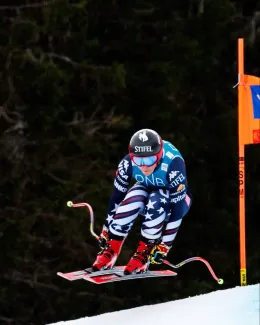
Photo top: Breezy Johnson won two FIS World Championship gold medals in 2025 and Olympic gold in 2026. Atomic photo.
The 2026 Games were a mixed bag for U.S. skiing. The women’s team enjoyed tremendous success, bringing home gold medals in downhill and slalom, and silver in team combined, while the men’s team scored one medal—Ryan Cochran-Siegle’s repeat silver in super G. For the men, the 2026 Games join the forgettable list of 2022 (Beijing, one silver) and 1988 (Calgary, no medals either gender).
Beyond the Olympics, the women also had a historic season, winning the Nations Cup (a measure of success across all disciplines) for the first time in more than 40 years (1982). Again, it was a vastly different story on the men’s side. Cochran-Siegle’s second place in the Beaver Creek downhill was the men’s only podium performance all season. In the Nations Cup the American men finished seventh—behind Brazil’s one-man team of Lucas Pinheiro Braathen.
The Reboot
As a first step, in March the team filled the role of Alpine director, a position vacant since the abrupt departure of Patrick Riml in February 2024. The organization looked to a familiar face, Sasha Rearick, who had previously spent nearly two decades with the team in roles ranging from conditioning coach to men’s head coach. Most recently Rearick had been with APEX2100, an international ski academy based in Tignes, France. During his time leading that program, the academy exploded, producing seven Olympic qualifiers and four world junior championship medalists, and helping multiple athletes advance to the World Cup.
Upon his return to the U.S. team, Rearick focused on restructuring and hiring throughout the system. “I hired 64 people in two months,” he explains, adding that the elite men’s side got a complete overhaul of the budgeting system and team structure. “The one goal was to hire people who are going to be here for a while,” he says, describing the turnover of the past five to six years on the men’s team as turmoil. “I really wanted to stabilize that.”
The first major hire was men’s tech head coach Paul Epstein, who led a team of independent, multinational athletes at Global Racing for 13 years. In the past decade Global helped 20 different athletes from 10 countries achieve World Cup points and return to or qualify for national teams. “Paul’s bringing an intensity that’s needed,” says Rearick. “He sets an expectation very clearly, and he holds athletes accountable.”
Indicative of Epstein’s resourceful approach, Global Racing standout Sam Maes, who races for Belgium, was welcomed into the U.S. Alpine Ski Team’s training program as part of a partnership arrangement. Maes is ranked top 30 in both slalom and giant slalom and brings pace and personality. As Rearick explains, “We’re trying to get our team to be a slalom and GS team. So having a great teammate who’s doing those things, who really wants to be part of the American-team culture is fantastic. We’re stoked to have Sam as part of our family.”
Déjà Vu
Atop all the new hires is another familiar face whose U.S. team roots go back to 1997. For the role of men’s Alpine head coach, Rearick hired Phil McNichol, the man who first hired him at the U.S. Alpine Ski Team in 2002. McNichol led the men’s team from 2002 to 2008, an era that saw success from multiple stars. The McNichol era saw Bode Miller’s two Overall World Cup titles and pair of Olympic silvers (2002), plus Ted Ligety’s Olympic gold (2006). Seven additional athletes gained podium finishes under McNichol’s watch. Moreover, the men’s team twice finished second in the Nations Cup standings (2005 and 2006).
McNichol most recently worked as a consultant overseeing U.S. Ski and Snowboarding’s coaches education system and developing a formal mentorship program. When hired in mid-May he hit the ground running, folding comfortably back in with both Rearick and head speed coach John McBride. McBride’s U.S. Alpine Ski Team coaching roots run even deeper than McNichol’s or Rearick’s. His first stint with the team started in 1995, when he presided over an American downhiller dynasty that included Bode Miller’s two overall and two super G globes, and Daron Rahlves’ 12 World Cup victories. McBride later ushered in the next generation of talent, including Steve Nyman, Bryce Bennett, Travis Ganong and Jared Goldberg. He returned to the U.S. team before the 2025–26 season.
Getting the band back together brings comfort among staff and athletes. The veteran coaches share an appreciation for the importance of team culture, which has taken a hit in recent years amid the turnover of staff and programming. Thus, Rearick and McNichol are working hard to rebuild trust and consistency. “Trust is everything,” emphasizes McNichol.
Rebuilding Confidence
“In general, the men’s team was gun shy,” Rearick explains. “There was not this belief that they belong. In order to believe you belong there, you have to have a little bit of fun. You have to take joy in what you’re doing. As a staff, we’ve talked a lot about what we are doing to build that belief and spark that energy.”
Building a culture of confidence involves refreshing the environment for veterans like River Radamus and Ryan Cochran-Siegle so they can challenge the podium regularly, as well as instituting a systematic progression that allows younger athletes to emerge. Changes include developing a strong regional network at home that feeds into a dedicated Europa Cup program, where athletes are fully prepared for battle on the World Cup.
McNichol—who famously instituted the flame shirts worn by team members when any one of them reached the podium—is known for advancing team cohesion through hard work and respect. Holding the line on those values, he believes, frees people from wasting energy on unnecessary drama. “People don’t really understand where culture comes from. It comes from the process,” he explains.
He reels off common slogans: Do the right things, and the right things will happen. Work hard, and it will pay off. Focus on the little things, and bigger things will come. He adds, “I love shirts. I love symbols. I love rituals. I think those are great, but they have to be connected to actionable behavior.”
Rearick estimates that systemic change takes five years to reach fruition. If that is the case, we’ll need to look beyond the 2030 Games in the French Alps to see if the mettle makes medals—perhaps to the 2034 Games on home turf in Utah.
With the Women, History (Finally) Repeats Itself
The women’s team has a markedly different vibe. A dozen women competed in the 2026 World Cup Finals, earning starts by finishing the season within a discipline’s top 25. During the season, five athletes reached the podium, including Lindsey Vonn and Mikaela Shiffrin, who scored two and nine wins, respectively. Meanwhile, Shiffrin notably brought her World Cup victory tally to 110—an unfathomable number for mortal racers and their coaches. Additionally, 16 athletes contributed points to secure the Nations Cup over powerhouse Austria.
Vonn continues to recover from her devastating injury in the 2026 Olympic downhill, but this winter boasts a roster of talent across all disciplines to back up reigning Olympic and World downhill champion Breezy Johnson and Olympic slalom and World Cup overall champion Shiffrin.
The philosophy may indeed be, “If it ain’t broke, don’t fix it.” Rearick points out that periods of success on any team historically coincide with stability in program and staffing. For example, the program that has enjoyed the most sustained success, with multiple athletes achieving podiums, is women’s speed. For the majority of the past two and a half decades, Alex Hodelmoser has led that team.
“Team Shiffrin,” which operates independently, joined the U.S. speed group for training in South America last summer and Shiffrin said that she has more to give in super G. While noting that she may have already found top speed in her slalom, she adds that she has more room to grow in giant slalom and looks forward to that challenge, too. 
Two-time U.S. Olympian Edie Thys Morgan wrote about the expanded use of snow farming to supplement natural snowfall in the September-October 2026 issue.
Breakthrough for Paula Moltzan
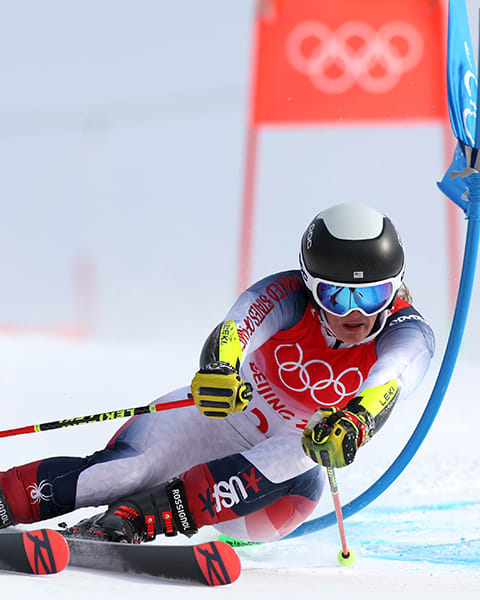 While Shiffrin rewrites the records, Paula Moltzan quietly concluded her best season, scoring five podiums and Olympic bronze in the team combined and finishing the World Cup season ranked fifth in slalom and sixth in GS. Then, in October, she won her first World Cup race, the opening GS at Sölden.
Photo: Paula Moltzan. Team USA photo.
The victory validated her decision to become the first World Cup woman (and first U.S. Alpine Ski Team athlete) to ski on Van Deer skis and boots. Van Deer is the gear brand launched by Austrian superstar Marcel Hirscher with the backing of Red Bull. The move gives Moltzan access to Red Bull’s facility in Salzburg, with its training, testing and recovery resources.
“I’ve never had access to something like that, especially while in Europe,” she says.
Moltzan is no stranger to the role of pioneer, having already forged an unlikely return to the sport. Due to poor results, the 2015 World Junior slalom champion wasn’t invited back to the national team in 2016. Instead she raced on the NCAA circuit for the University of Vermont. In 2018 she independently battled her way onto the World Cup series and back to the U.S. Alpine Ski Team.
At the time, Shiffrin was the lone tech star, and Moltzan bridged the gap for younger talent to populate what is now a robust tech team, with eight women scoring World Cup points last season.
Moltzan, now credited with helping to rebuild the winning culture on the women’s tech team, also forged new territory last season with sponsor Northeastern Reproductive Medicine, bringing women’s fertility—a concern among female athletes as they push perceived age barriers— into the spotlight.
She says, “There’s so much more you can leave in a sport than results, and so it’s just finding the avenues that best represent your brand and how you want to leave it.”—E.T.M.