Technology: Salomon's Pilot ski-binding system
The first integrated ski/binding system was a dead end.
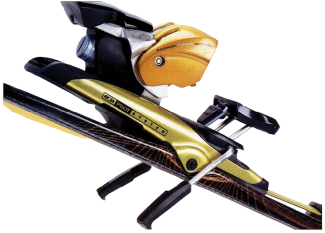
Photo top: The Pilot freed the ski to arc freely, but sacrificed edging precision and limited purchase options for the consumer. It lost sales traction quickly after its launch in early 2000.
In the early 1970s, America’s personal injury attorneys discovered Alpine skiing. By 1978—the year injured skier James Sunday won a landmark $1.5 million lawsuit against Stratton Mountain—resorts and binding manufacturers faced soaring costs for liability insurance.
Binding market-share leader Salomon/North America faced 400 to 600 new lawsuits each year. To deal with this crisis, binding manufacturers participated in a worldwide project to write performance standards, on the theory that a binding that met those standards should be defensible in court. Part of the standards-development process was to train ski-shop mechanics to mount and test bindings according to each brand’s standard. Binding certification was the linchpin program; it required binding mechanics to attend a four-hour live training session in order for their shop to be covered by Salomon’s indemnity insurance. Salomon’s risk-management executive, Joe Campisi, designed the training program and hired me as one of several regional technical reps who would train those mechanics.
As part of my own training, I spent three weeks working in the binding division in Annecy, France, absorbing Salomon’s history and design philosophy. My portfolio included familiarity with the brand’s patent assets, which is where I came across a blueprint for an integrated boot/binding system. If memory serves, the binding-release mechanisms were housed in the boot sole of a prototype SX90 Equipe—which went into production, albeit without its binding bits, in 1979. As far as I know, the concept was never industrialized, but it signaled the R&D department’s intent to innovate in the as-yet-unexploited field of product integration.
Salomon introduced its line of skis in 1989, which opened a new avenue for integration: Instead of being part of the boot, the binding would be part of the ski. There were two rationales. First, ski performance could be improved by letting the binding system “float” above the ski top, allowing the ski to flex freely into its fully circular carving arc instead of suffering a binding-induced flat spot in the middle. Second, Salomon could capture the margin on two sales in one transaction.
After more than two decades of incubation, the concept of product integration finally sprang to life in fall 2000 in the form of a ski/binding combo called Pilot.
Upsetting the Status Quo
Prior to the Pilot system’s arrival, any and all skis could be mounted with any Alpine binding that met ISO/ASTM standards. The Pilot binding, however, was specific to the ski it was mounted on. Instead of being screwed into the top of the ski, it attached via a pair of pivot pins that emerged from the sidewalls; no other binding could possibly be substituted.
From a design standpoint, the Pilot was brilliant, solving the problem of a typical binding’s effect on ski flex with a solution that was both palpable on snow and stunningly distinctive at the point of sale. But the elegance of the solution masked a serious commercial flaw: It reinforced the impression that Salomon bindings were best used on Salomon skis, at a time when Salomon’s success in bindings hinged on their use with all ski brands.
At the time of Pilot’s debut, Dave Bertoni was transitioning from his role as marketing chief of Salomon’s binding division to a parallel role in boot development, granting him a unique perspective on Pilot’s prospects. “I wasn’t part of the Pilot project, but I knew exactly how many bindings we sold that were not paired with a Salomon ski,” he recalls. “It was a huge number of bindings we risked trading for the relatively small number that would be paired with a Pilot ski. I had my hands full trying to get our Alpine boot division out of the shadow of rear-entry [design], so it wasn’t an issue I was in any position to influence.”
While it’s hard to quantify just how many lost binding sales were directly attributable to Pilot’s premiere, there’s no doubt that support for Salomon’s high-end rental bindings, for use on demo skis, which were once widely distributed across the majority of ski brands, had been declining since Salomon introduced its own ski line. The arrival of the Pilot series further diluted whatever lingering brand loyalty remained among the folks who sold other ski brands.
Not that this had the slightest effect on how Pilot was received by Salomon dealers, who knew the company was riding a hot streak ignited the previous year by the arrival of X-Scream, one of the most popular skis of all time. Salomon boots were also on the rebound, and the French powerhouse was selling mass quantities of bindings to recreational skiers. Salomon dealers were ready to embrace Pilot on sight, and initial orders reflected this enthusiasm. Because every ski sale included a binding sale, the average selling price, and margin per transaction, skyrocketed.
But all the hoopla about innovation and promising first-year sales to dealers couldn’t disguise the fact that sell-through to skiers fell off. Unsold inventory dragged down year-two and -three sales, and the various Pilot series-—which by then included models made for women and intermediate skiers—soon lost their luster.
One reason that Pilot’s popularity fizzled was the lack of any direct competition in the integrated-system space. It was simply too innovative to form the nucleus of a new category. Salomon’s binding competitors had no answer to Pilot; no other functionally integrated systems materialized in part because no other binding brands were working in sufficiently close collaboration with a ski partner.
Pilot’s ultimate legacy was a seismic market shift that pushed its competitors into commercial alliances to compete in the growing arena of ski/binding systems. Atomic was the first ski brand to collaborate on an integrated ski/binding system when it partnered with Device shortly after Pilot’s debut. The Atomic/Device binding used a long, flexible track that could be mounted atop any flat ski; the toe and heel units were fixed longitudinally only by a single screw at the track’s center.
The commercial success of the Pilot was already on the wane in only its second year on the market. What happened to derail the best-laid plans of a brand renowned for its success at introducing new concepts? Simply put, Pilot failed to meet the most basic of criteria: it had to ski at least as well as its already popular stablemate the X-Scream when mounted with any universally applicable (or à la carte) bindings. But it didn’t.
The Pilot version lacked the original X-Scream’s precise and powerful feel on edge, and its energetic rebound. The best skiers on the mountain never traded in their X-Screams for Pilots, ensuring the latter’s eventual demise.
In Retrospect
Twenty years later, the question still lingers: Why would Salomon go ahead with a Pilot project it knew was flawed, risking a blow to its market penetration and reputation for can’t-miss innovations? Because Salomon’s decision-makers knew there was something even more important to be won than a few market-share points: the advantage of being first to a major market shift.
“One of the unintended consequences of introducing Pilot when we did,” notes Mike Adams, then the president of Salomon’s North American operations, “was it set off a race for ski companies to find a binding partner. We saw the ski/binding system as the next critical trend, and we wanted to be the first to market.”
Per Adams’s forecast, à la carte binding sales would continue to decline, while system ski/binding sets would increase until the two families are now roughly the same size in U.S. market sales. Also, as predicted, every major ski company now has a binding partner. The legacy of a binding design meant to minimize its effects on ski flex turned out to be its huge impact on the way conventional bindings would be packaged and sold. 
Frequent contributor Jackson Hogen worked for Salomon’s North American subsidiary from 1978 to 1987. He wrote about the double standard of binding settings for elite racers versus recreational skiers in the September-October 2026 issue.