Resorts: The Amazing Apennines
Italy’s lesser-known ski resorts provide challenges—and lessons in history.
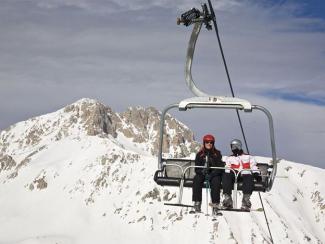
Photo top: With a modest footprint of traditional slopes, Campo Imperatore is better known for its long off-piste trails and dramatic ski-touring options in the shadow of Corno Grande, the highest peak in the Apennines range. Jimmy Petterson photo.
“It’s official,” the Italian weather website MeteoWeb.eu declared on March 15, 2015. “Capracotta and Pescocostanzo, Italy, are the snowiest places in the world! The data is scary.”
The site had reported a snowfall of 256 centimeters (101 inches) for Capracotta in an astoundingly short period, 18 hours, while 240 centimeters (94 inches) of fluff inundated Pescocostanzo. Meanwhile, Weather.com’s senior meteorologist, Tom Moore, wrote, “That would be maintaining a rate of around 5 inches [13 centimeters] of snow per hour for 18 hours.” And the Wasatch Weather Weenies blog, based in Utah’s Wasatch Mountains—one of the snowiest locations on earth—exclaimed, “This sort of thing is what the Wasatch Weather Weenies live for!”
The news went viral: The 24-hour snowfall record had been obliterated. The previous high was 230 centimeters [91 inches) at Mount Ibuki in Japan in 1927.
Capracotta isn’t usually this lucky. Average annual snowfall is just 32 centimeters—barely a foot—though the area got a two-meter dump in April 2025, bringing the season’s total to 250 centimeters (8.2 feet).
In this age of climate change, we have become used to the upheaval of normal weather patterns, but we are more accustomed to reading about record droughts and high temperatures. The news from Italy was certainly a refreshing change.
The first question that comes to mind, of course, is where the hell are Capracotta and Pescocostanzo? The natural guess is that these villages lie somewhere in the Alps, but that conjecture is wrong.
In fact, both villages are situated 145 kilometers (90 miles) due east of Rome, as the corvo flies. Via mountain roads,
the distance is 212 kilometers, a drive that takes about
2.5 hours. Comparing this to North American terrain, like the Lake Tahoe resorts, the region gets moist air right off the ocean—the Mediterranean coast is less than 80 kilometers (50 miles) upwind.
Clues Revealed
The Apennine Mountains stretch north to south, forming the spine of the entire Italian peninsula, and hold 30 ski areas. The residents of Florence and Rome know this—these ski areas are much closer than those in the Alps—but most skiers beyond Italy’s borders have not yet been clued in.
The range stretches for 1,500 kilometers, from close to Genoa in the north all the way to Sicily, beyond the boot of mainland Italy. It includes a grouping of eight ski resorts between Florence and Bologna, the main cluster of 17 ski centers in the central range near Rome, two ski areas on Mt. Etna and a handful of small resorts in between.
Among the northern resorts, Corno alle Scale lies just 86 kilometers (53 miles) by road from the Bologna airport. Alberto Tomba trained here, and the driving route passes close to Riva Ridge and Monte Belvedere, the sites of battlegrounds involving the U.S. Army’s 10th Mountain Division in World War II.
The most historic of the Apennine ski areas is Campo Imperatore, in the shadow of Gran Sasso. Its summit, Corno Grande, at 2,912 meters (9,554 feet) is the highest in the Apennines. The original cable car was commissioned in 1933 by Mussolini and opened in 1934. That lift hauls visitors to a plateau at 2,130 meters, where two chairlifts and a handful of pistes provide 320 vertical meters of gentle intermediate skiing.
Gran Sasso makes up for that meager offering of conventional pistes by being home to many long off-piste descents and interesting ski-touring itineraries. The mountain is a huge massif, with Corno Grande the highest of its peaks. The upper section of the massif, from 2,200 meters to the top, is the randonnée domain, and the lower mountain, with 1,000 vertical meters of steep off-piste skiing, is strictly for hardcore freeriders.
I was interested in these off-piste routes, and on a recent visit asked a gentleman getting out of the cable car if he knew the area well. Lorenzo Lentini, from Rome, was not an expert on freeriding, but he turned out to be quite a history buff. He pointed to a building adjacent to the cable-car station and explained that it was rather rich in historical significance.
Mussolini’s Influence
Mussolini was a great believer in sport, and he ordered construction not only of the cable car but also of the stately mountaintop Hotel Campo Imperatore, the building Lentini showed me. After his overthrow in July 1943, Mussolini was imprisoned there, isolated until his spectacular rescue two months later by glider-borne German commandos under Otto Skorzeny. (Never one to miss an opportunity for publicity, Hitler’s propaganda minister, Joseph Goebbels, sent along a camera crew to document the entire proceedings.)
All over New England, one can read the claims of hoteliers that “George Washington slept here,” but high in the Abruzzo Mountains, the Italians have that beat. Here, you can sleep in the same bed where Mussolini slept, dreaming of rescue by Hitler’s special forces. During my visit, I asked hotel director Paolo Pecilli if I could see Mussolini’s makeshift prison; apologizing, he said that the room was occupied.
Decades later, the hotel hosted Pope John Paul II, who visited several times in secret to hike and ski (see obituary in Skiing Heritage, June 2005). Today, the red paint is peeling off the hotel’s exterior walls and the classic Art Deco dining room is empty while the hotel is in the process of being renovated.
Lorenzo invited me to join his group of friends for a ski. We cruised the pistes together for a few hours, but I also wanted to try at least one of the off-piste runs to the bottom. To that end, I needed to find some company.
By the hotel, a man was adjusting the bindings on his wide freeride skis, and I approached him. Fabio Romagnoli was the kind of man I had been hoping to find. He knew the mountain and was just getting ready for a run to the bottom with his friend Pietro. They kindly allowed me to join them. I followed them over to the top of the Monte Scindarella lift, and we dropped down the back side.
All the off-piste routes are steep, and avalanche danger can be high, as they funnel into various narrow valleys that are classic terrain traps. The slopes are long and challenging, and I almost drooled as I imagined skiing them in fresh snow—but I certainly would not want to ski here if the snow was too deep.
The snowless valley unfolded majestically far below us. The sun was not strong on this day, and the snow was very firm. The steepest slopes were trying to soften to a corn-snow layer, but without much success. The day would certainly not be dangerous, but the skiing would clearly be no great pleasure, either.
Once we had negotiated the steep upper slopes, the going actually got more difficult. It had rained recently, and avalanches had taken the entire winter’s bounty into the gullies below. Our narrow path was full of frozen avalanche debris interspersed with high bushes and small trees. When we had finally woven our way through the obstacle course, we had to walk along the road for a while to return to the cable car. It was not my best run of the season, but it allowed me to appreciate the potential of the mountain in the right conditions.
At the bottom, I parted ways with my two guides. Pietro left me with an invitation to return in the summer to go rafting; he operates a rafting company on the nearby Nera River, just below Marmore Falls.
Upon doing a bit of research, I found out that the waterfalls here are manmade, created when the Romans built a canal to divert water over the cliffs in 271 BC. The highest engineered falls in Europe, they are apparently spectacular when in full flow.
Travel is one of the most addictive diseases in the world. Each experience brings closure to some ideas that have rattled around in my brain for months, years or even decades. At the same time, each new excursion exposes me to information and locations that I had previously not known about.
During this journey, I enjoyed skiing one of the oldest resorts in Italy while receiving a lesson in World War II history. I learned that the region can also provide thrills in the summer from the inside of a raft. Perhaps most importantly, as with almost every trip I make, I met kind people and made new friends, the most critical factor in seducing me to return sometime. 
Jimmy Petterson won an ISHA Baldur Award in 2020 for his book Skiing Around the World, volume II. He translated a Paul Preuss essay for the July-August 2026 issue.