Short Turns: Interski heads to Vail
Ski instruction’s biggest global meet-up comes to Vail.
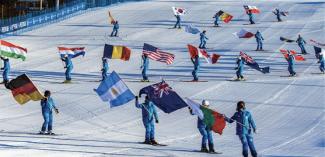
Photo top: Every fourth year, the Interski Congress gathers instructors from around the globe to improve ski instruction—and show off their national styles. Here, the opening ceremony for the 2023 Interski at Levi, Finland.
In April 1968, some 500 ski instructors from 18 countries convened in Aspen, Colorado, for the eighth International Ski Instructors Congress, an opportunity to share educational methods and technique (and raise many a toast, too). It was the group’s first meeting outside of Europe, a prestigious first for Aspen—and the U.S. ski community. And it turned out to be the last in the U.S. until next April (2027), when what is now known as the Interski Congress—or, more commonly, Interski—arrives in Vail, Colorado.
The gathering has grown in size and stature since its beginnings in Zurs, Austria, in 1951, when about 100 instructors from eight countries assembled to dissect topics like wedeln and a new Austrian slalom technique. Initially, Interski met every two years, shifted to every three years for a brief period then transitioned to its current quadrennial format in 1971. Now, up to 1,500 participants from more than 30 nations will gather in Vail April 4–9 to discuss current approaches to ski and snowboard instruction and strive for agreement on best practices at the global level.
The primary U.S. delegation consists of the national
demo teams in Alpine, snowboard, telemark, cross-country and adaptive—a group of 38 instructors selected every four years by the Professional Ski Instructors of America (PSIA) and the American Association of Snowboard Instructors (AASI). Each winter, these elite educators travel throughout the country to train other instructors, in addition to working at their home resorts.
Greg Willis, senior director of skier services in the ski and snowboard school at Vail Mountain, describes Interski as “like our Olympics of snowsports education.” Indeed, the event will have opening and closing ceremonies, as well as exhibitions every evening, when delegations will perform routines choreographed to music on the slopes of Vail’s Golden Peak. The host committee—PSIA/AASI, Vail Resorts, the town of Vail and the Vail Valley Foundation—is also planning large-scale entertainment that, like the evening shows, will be open to the public.
But it’s during the day, during keynote talks, group discussions and on-snow clinics, that Interski’s exchange of knowledge occurs. “It brings together the best of the best in snowsports education from across the world to share ideas,” says Dave Schuiling, director of education and credentialing for PSIA/AASI. “We’re getting perspectives that aren’t just from our own resort or even our country. We are constantly evolving and changing our own practices based on what we learn.”
Each country usually poses a question or issue to be addressed during the congress. For previous Interski presentations, U.S. delegations developed methodologies including the American Teaching System, the Skills Concept and the Learning Connection—now standard tools for U.S. instructors. More recently, the American team has learned, says Schuiling, that it needs to be more specific and more consistent in its technical messaging.
Experiences at Interski have also helped PSIA/AASI define how to talk about and measure people skills, which often create a deeper connection to learning. “It’s set us apart as an association that’s done a lot of work in this space, and a lot of people are learning from us,” Schuiling notes.
Willis credits Interski with helping U.S. instructors develop a more student-centered teaching approach—meeting clients where they’re at rather than adhering to a prescribed lesson plan. He also cites a U.S. presentation on gender equity in snowsports at the last Interski, held in Levi, Finland, for catalyzing some changes in how Vail matches instructors with clients.
Moreover, information sharing and learning continue long after the event, adds Schuiling. “It’s not just a quick come-together every four years,” he notes. “The trickle-down effect is that we raise our game across the board.”
Having Interski back in the U.S. is a boon for instructors from around the country, too; those who have at least a Level 3 certification can buy the Inspire Pass (available through PSIA/AASI) to attend the congress. “It’s really kind of a backstage look at the event without having to be a delegate from a nation,” says Willis.
Meanwhile, Vail, which has hosted international ski events, including the Alpine World Ski Championships (in 1989, 1999 and 2015) and the annual Birds of Prey World Cup speed races, gets to shine again on the global stage. “This was a really cool [event] for us to raise our hands for because it speaks to why we live here,” notes Willis. “It brings everyone together to show that hey, this truly is a profession, and they’re going to see it at the highest level. And I think that’s going to bring a lot of pride to our local teams here.”
When members of Interski’s general assembly visited last spring for a venue preview, their hosts rolled out the red carpet with in-home family dinners, local whiskey tastings and other community-based events. Strategically planned, the hospitality helped assuage some concerns about holding a large international event amid the current U.S. political climate. When the Interski reps left, “they felt like this was going to be a once-in-a-lifetime opportunity, based on our ability to host an event and welcome them into the community,” says Willis.
Even the Nordic skiing clinics will be held on Vail Mountain, accommodating a request by that contingent for more inclusion in the program. Organizers are looking at a spot on the Lionshead side of the resort, as well as at setting up a short track at Golden Peak for the evening shows. It’s also a nice nod to the 2027 Interski theme—All In: Innovate, Include, Inspire.
19th Century Skiing in Southern California
 Research—and a little luck— identifies what might be the oldest photo of skiing in Southern California.
Much has been written about the 19th-century longboard races in the Northern California counties of Plumas, Sierra and Alpine. (See “California’s Longboard Ladies,” Skiing Heritage, December 2008.) The same was not the case for Southern California; there is no evidence that skis were used for sport there in the 19th century. But in both Northern and Southern California, mountain inhabitants did use skis for transportation, communication and work during the long, rugged winters of that era.
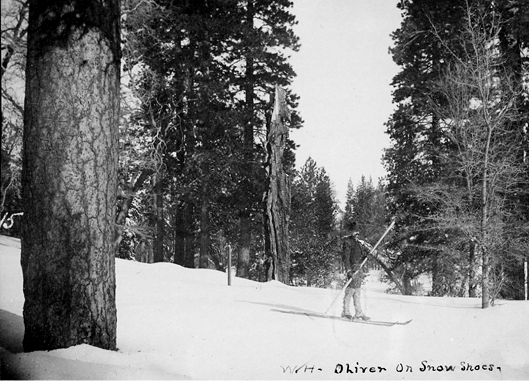
A few years ago, I purchased a small photograph album of cyanotype photographs taken in the San Bernardino Mountains, dated 1893. I had to have this for my collection, the California Ski Library. In the album were three images showing men on skis and snowshoes—the earliest photos I’ve found of people on skis in Southern California. The man on snowshoes is identified by a handwritten note on the photo as H.B Hedges, and one of the men on skis is similarly identified as W.H. Oliver.
The Oliver photo shows a mustached man wearing what seem like ankle-to-knee leather gaiters and wielding a long single staff, which was still being used for skiing during the late 1800s. Some online sleuthing helped me to discover the story behind these photographs and the identity of one of the men.
What appears to be the first account of skiing in Southern California is found in the diary of brothers Joseph and Charles Tyler, who owned the Grass Valley Lumber Mill in the Lake
Arrowhead area, roughly 90 miles northeast of Los Angeles. Joseph kept a diary for 20 years, recording family and business matters. The first entry that mentions snowshoes appears on February 3, 1873: “Huge snow storm. 44 inches deep. I commenced putting up tongue-and-groove in bedroom. Chas and Sol and Quigley making snowshoes.”
Later, on February 28, he noted: “Made door between front room and dining room. Made a pair of snowshoes.” Then on March 3, an entry written 153 years ago sounds like any skier today ripping up the spring slopes. “Lou and I did some snowshoe riding. Also Chas. Had lots of falls and fun.”
That March entry would lend support to the idea that Joseph referred to “Norwegian snowshoes” and not to what we call snowshoes today, since they were “riding” and had lots of falls. The photo of W.H. Oliver (above) also confirms the Norwegian snowshoe theory, as it notes Oliver is “on Snow Shoes,” while he’s standing on long skis.
The Southern California community of San Bernardino exploded with growth in the late 1800s. The Arrowhead Reservoir Company began work on a massive reservoir project. In early 1893, the company built two small tent camps to house workers. It’s one of these camps that is illustrated in my 1893 album.
An August 31, 1900, article in the San Bernardino Weekly Sun reports: “This company had a resident engineer on the ground in the person of Mr. Hedges for eight years, making preliminary surveys and keeping records of rainfall and water flow.”
Aha! I finally found one of my men. — Ingrid Wicken
Snapshots in Time
1938 Rank Amateur Fun
Skiing has become a symbol of speed, coordination and gracefulness. Even the novice thinks he cuts a fine figure the first time he reaches the bottom of the slope without falling. Actually, barring top-notch skiers, few sports give you as good a chance to look awkward. To become a ski expert takes many years even if you have a natural sense of balance. However, the sport is just as much fun for the rank amateur as for the professional. — “Skiing: Winter Fun in the Sun” (Life, January 2, 1938)
1956 Geared Up for the Season
The talk around town is that the 1955–56 winter sports season is one that will be remembered. The boom, it appears, easily surpasses the one of 1947, the year of the blizzard. As a result of that eminently successful 1954–55 season, the demand for ski equipment and clothing has been exceptionally great. Shopkeepers reported that by New Year’s Day they had run out of both. Tour directors announced that requests for trips, ranging from one-day outings to near-by Belleayre Mountain in the Catskills to junkets to the European Alps, had been the most numerous they could remember.— “Ski Gear Boom; Demand for Equipment Outstrips Supply” (New York Times, January 15 1956)
1981 OK by the Hour
A reader wrote to ask how the average person can afford to go skiing without going broke. After seeing our roundup of new equipment and clothing, she figured it would cost at least $500 to get started. We share her concern. For that matter, we wonder how the average person can afford hamburger when beef is $3 a pound. Voices are heard that skiing has priced itself out of the market. The facts seem to contradict this contention. Market studies show that the skiing population continues to grow. A good case can be made that what seems to be a stiff price for a lift ticket—$15 and up—figured on an hourly basis is actually a good buy. — Al Greenberg, “Is Skiing Too Expensive?” (Skiing, Holiday-January 1981)
2014 Imaginary Town; Real Cash Flow
Once again this Christmas, throngs of people are visiting Pine Tree, Vermont. Try to find it on a map, and you’re out of luck. As the setting for the 1954 holiday movie classic, White Christmas, the town lives only inside the Vistavision musical that sings nonstop on laptops and TV sets this time of year, 60 years after it was made. For a movie that’s big on fantasy, there is one theme that’s very real, even today: the savior quality of snow to make the holidays profitable in Vermont. — Molly Walsh, “White Christmas puts Imaginary Vermont Town in Spotlight” (Burlington Free Press, December 18, 2014)
2026 Naked Admiration
Austrian snowboarder Benjamin Karl knew what he would do if he won a gold medal at this year’s Winter Olympics; what he hadn’t planned for was the reaction. After retaining his parallel giant slalom crown in Livigno on Sunday, the 40-year-old celebrated by ripping off his top and baring his chest to the frenzied crowd before flexing his muscles. The celebration was quickly shared across social media. And while Karl was absolutely over-the-moon with his gold medal moment, the reaction was very much planned as a tribute to his hero, Hermann Maier. The skiing legend was one of the reasons that Karl got into the sport, and he would often celebrate his victories by ripping off his top. — Ben Church, “The story behind Benjamin Karl’s viral celebration at the Winter Olympics” (CNN.COM, February 9, 2026)