No Slowing Kelly Brush
Twenty years ago, a tragedy triggered a push for safer ski racing that grew into a movement to empower people with spinal-cord injuries.
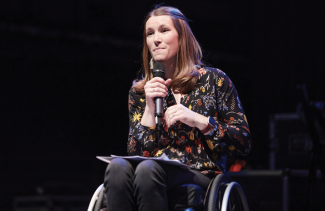
Photo top: Kelly Brush speaking. Kelly Brush Foundation photo.
Last winter a community of skiers gathered in Burlington, Vermont, to commemorate the 20th anniversary of Kelly Brush’s devastating ski accident during a giant slalom race at the Williams College winter carnival. The gathering was no somber occasion, however. It celebrated all that the Kelly Brush Foundation (KBF)—formed in the wake of the accident—has accomplished in the past two decades and offered a look at where it’s headed in the future.
Since the first Kelly Brush charity bike ride in September 2006, KBF has fulfilled one of its missions by changing the culture of ski racing in the U.S., making safety a priority rather than an afterthought. Ski clubs in all 50 states have benefitted from KBF grants that subsidize safety upgrades and equipment, along with education on how to properly use them. The annual bike ride now contributes more than $1 million of the $3 million-plus the organization raises annually.
Those funds not only go towards preventing accidents like Brush’s but also to KBF’s other, closely related mission: “To inspire and empower people with spinal-cord injuries to lead active and engaged lives.” To that end, the foundation awards grants to fund adaptive gear and instruction for at least 23 different sports, host adaptive sports camps and partner with 16 rehab centers to ensure that people with a spinal-cord injury know the opportunities available to them.
Now, KBF is focused on the next 20 years. That involves continuing its work at home and taking ski-racing safety global through a partnership with FIS. Moreover, building on its work in creating opportunities in adaptive sports, KBF leads a movement to make outdoor recreation a reality for all.
Two Missions
On February 18, 2006, Brush, a 19-year-old sophomore at Middlebury College, was racing at the Williams College winter carnival at Jiminy Peak Mountain Resort in Hancock, Mass. She caught an edge and tumbled off the course into an unprotected lift tower. The accident left her with four fractured ribs, a collapsed lung and a severe spinal-cord injury at the T 7-8 level. She spent the next six months rehabilitating and learning to navigate her new life in a wheelchair.
Even from the hospital, Brush’s first thoughts were getting back on the mountain with her teammates. Skiing was an integral part of her life that she refused to surrender. Her parents, Mary and Charlie, have deep skiing pedigrees. Mary Seaton, a U.S. Ski Team athlete, competed in the 1976 Olympics in Innsbruck, Austria. She went on to earn All-American honors racing for the University of Vermont, then competed on the women’s pro tour. Charlie Brush skied for Middlebury (’69) then returned as a coach from 1971-81.
Once in rehab, Brush and her family also envisioned a foundation that strategically looked beyond just preventing similar ski-racing accidents. “We came up with the two missions,” Brush recalls. “Improve safety in ski racing and empower people with spinal-cord injuries to participate in adaptive sports.”
The first step was getting herself back into sport. Her teammates organized the first Kelly Brush Ride that September. The $60,000 raised far exceeded the cost of the monoski that got Brush back on the slopes with her team by Thanksgiving. With the surplus, the Brush family embarked on the safety part of the mission. They reached out to about 40 ski clubs across the country and offered them $1,000 grants along with a letter about Brush’s story and the direction to “improve skier safety.”
Raising the Standard
Every year since, the grant program has provided funds to purchase B-net (six-foot-high plastic fencing anchored into the snow) and other safety equipment or enhancements. The foundation sends posters to clubs every year, reminding them that “ski-racing safety is no accident.” The main goal has been to change the culture of ski racing from a place of just trying to get the race off, to one where safety is a prerequisite. “That’s not where it was when I got hurt,” recalls Brush. “Then, people didn’t know what they needed to make a safe venue.”
From the start, KBF enlisted support for its mission through personal connections in the skiing and ski-racing communities. When Tiger Shaw came on as head of the United States Ski and Snowboard Association in 2014, he embraced KBF. The two organizations partnered to hire a safety consultant, Paul Van Slyke, who traveled nationwide to help resorts and race organizers make safety plans for venues by anticipating potential hazards and educate clubs and parents about what upgrades were needed. Those measures not only include netting but also setting courses and identifying areas of danger where someone might slide off course and hit a tower or other obstacles.
KBF grants have provided more than 80,000 feet of B-net to more than 150 clubs in every state that has Alpine
skiing. Today, “B-net Parties” to line courses with netting are a regular part of every ski-racing series’ venue prep and tear-down. It is exactly the type of protection that would have helped prevent Brush’s injury. These all-hands-on-deck efforts also help embed a culture of safety into the racing community.
In 2018, a U16 Green Mountain Valley School racer suffered a life-threatening laceration on his inner thigh after his ski released. He survived because quick-thinking coaches and volunteers improvised a tourniquet out of a belt. The racer’s family then collaborated with KBF to launch the Stop the Bleed program, which has provided more than 5,000 bleeding-control kits to ski clubs along with in-person training.
Van Slyke’s “Clean Hill Initiative” was one of KBF’s founding principles. It established standards and guidelines to increase safety by eliminating unnecessary tools, equipment and people from active racing and training venues. Perhaps most importantly, having consultants, practices and equipment in place has allowed race organizers to prioritize safety.
Beyond B-Net
For many years, the foundation revolved around the Kelly Brush Ride, sitting dormant for six months between giving out grants from one ride and planning the next. In 2014 KBF was at an inflection point of growth and decided to push ahead. The foundation expanded organically into the “inspire and empower” branch of its dual mission. Since then, the adaptive sports side—supporting athletes’ journeys post injury and getting them back into sports—has grown exponentially.
These efforts include wheelchair sports like basketball, tennis, pickleball, soccer, football, tennis and even rugby. Increasingly they also involve outdoor activities like road and mountain biking, surfing, paddling and water sports and, of course, skiing.
Athletes with disabilities who hope to pursue recreational sports face many challenges, beginning with envisioning a future that includes sport. Then comes the expense of adaptive gear, which frequently runs into the thousands of dollars. Added to that is the need for instruction, transportation to a venue and, for some outdoor sports, accessible trails.
KBF addresses these hurdles through multiple avenues aligned with three strategic pillars. The first is awarding grants to ensure that all people with disabilities have access to at least one piece of adaptive recreation equipment. A basketball power chair—the most requested item—costs $4,500; a handcycle, the second-most requested item, is $7,000. When awarding its “Try It First” grants, the foundation seeks out first-time grantees, often people who are deciding to become active for the first time after injury.
The next pillar is helping potential participants know what sports are available to them and how to access relevant resources. KBF partners with 16 rehab facilities to educate therapists and patients on the positive role that recreation can play in their new lives post rehab. The foundation also organizes camps in single or multiple sports, bringing together people all along the injury and experience spectrum.
“You don’t know what’s possible until you start to see it,” says Brush, “and if you can see it, you can get inspired to do it.” She remembers her first “aha” moment of biking outside on a handcycle, feeling her heart beating fast and thinking, “Oh, this feels like sports, and I can do this again.” She also remembers a powerful visit in rehab from decorated Paralympian Sarah Will, who pulled up in her F-150, got out of it by herself and told Brush and her family about all the things she does while living a full life independently.
The third pillar involves transforming recreational spaces to improve access for adaptive-sports participants. “Equipment is great, but if we don’t have somewhere to use it, it’s not useful,” says Brush. For example, KBF partners with organizations to assess mountain-bike trails, give grants for the work to make them adaptive accessible, then reassesses them. In Vermont, KBF has assessed 188 miles of trails. Those that get approval receive aMTB (adaptive mountain biking) signage from the Vermont Mountain Bike Association. The hope is that this accreditation will grow across the country, and beyond KBF.
Brush uses herself as an example of why transforming spaces matters. “The thing people really want to do is what they had done six months before they got hurt—go and play with their partner or family at the park. That’s the thing that’s going to feel really empowering.”
Thinking Globally
Brush, who toggled between her work as a nurse, as a mother of two girls (ages seven and 10) and the foundation, has put nursing on hold to focus on parenting and KBF. Former board member Wing Pepper assumed full-time duty as executive director in fall 2025 and guides a team of 12 employees.
Amid this work, ski-racing safety remains central to KBF’s mission. While the culture has come a long way at home, there remains a glaring gap outside of the U.S., highlighted by recent ski-racing fatalities during training in Europe and South America. After the death of Italian World Cup skier Matteo Franzoso in September 2025, KBF issued a statement to the FIS, reiterating that safety needs to be a priority and at the same level in training as it is in racing.
The letter led to a partnership between KBF and FIS; they will work together on initiatives and programs to both improve safety and elevate para-sport globally. Brush and Van Slyke have teamed up to lead those efforts for KBF. “A big piece of that is educating coaches, officials and race organizers, as they have been here,” Van Slyke says. “We have been so successful in North America. Now we’re trying to get the same message across in Europe.”
When Brush reflects on the past 20 years, she is equal parts incredulous and validated. “I don’t know if I would have dreamed up all that we’re doing, but we are still really true to who we have always been,” she says. “We came up with the two missions within a couple months after my accident. And it’s spot on to what we’re doing now. I love that.” 
Regular contributor Edie Thys Morgan was a two-time Olympian on the U.S. Ski Team. She profiled Hilary Lindh in the September-October 2026 issue.
Foundation Grants Hard at Work
B-net fencing is designed as a dynamic system that absorbs and distributes a skier’s energy rather than acting as a hard stop. To work properly the system requires at least 60 meters (200 feet) of fence—roughly three 20-meter nets woven together. How much B-net a ski run needs is determined by each run’s homologation plan, which takes into account the hill’s steepness, width, terrain and obstacles, as well as the expected skier speeds.
Grants from KBF allow smaller clubs to make safety a priority and larger clubs to safely utilize more terrain. For example, fencing Training Hill, the premiere competition venue at Vermont’s Burke Mountain Academy (BMA), requires 110 nets. Dippers, Burke’s speed venue, requires 300 of the pricier nets required for super G and downhill courses. Fencing all of BMA’s three competition and training runs simultaneously would require 460 total nets. B-net costs roughly $500 per net, including all the poles and clips. KBF provides matching grants to contribute roughly half that cost.
For most programs, purchasing enough B-nets (which last 5-7 years with proper care) is a big investment that may require multiple years. The full 460 speed and tech nets, if purchased at once, would cost Burke around $250,000. Instead, it relies on help from KBF to replace and build more inventory each year. Willy Booker, BMA’s head of school explains, “We have been successful in getting matching grants from KBF for most of our net over the last eight years and it has made a huge difference!” —ETM