Pioneers: Monty Atwater, the First Avalanchero
The bomb-throwing founder of North American snow science revolutionized the field of avalanche control.
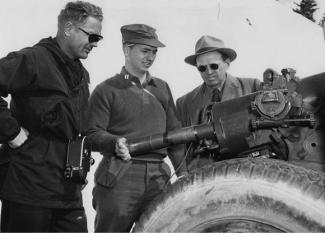
Photo top: Monty Atwater (left) and Forest Service official Felix Koziol (right), watch a National Guard gunner load a 75mm howitzer, at Alta. J. Willard Marriott Library, University of Utah.
Monty Atwater traversed into the Lone Pine avalanche path in Utah’s Little Cottonwood Canyon, one that he considered an “old and personal enemy.” Alta’s staff was stretched thin in those early post-war years, so Atwater had begun bringing along comely “avalanche girls” on his early-morning control routes. He set the explosive in the start zone and backed up to what he thought would be the safety of the trees. This avalanche girl was new and didn’t know quite what to expect.
“I cranked the blasting machine,” wrote Atwater in his 1968 chronicle, The Avalanche Hunters. “The shock wave knocked the girl flat. Lone Pine avalanched with enthusiasm. In fact, it was avalanching among the trees all around us. Packs, skis, wire and human beings drifting downhill. The girl floated by me on a cake of slab. I fished her off it and attached her to my tree.”
Monty was the U.S. Forest Service snow ranger for Alta and Little Cottonwood Canyon from 1946 to 1956 and today is universally hailed as the father of avalanche research and control methods in the Western Hemisphere. He was no traditional scientist, but rather a multitalented mountain man—an irresistible, omnivorously curious, rule-bending pioneer. A different “avalanche girl” would become the third of his four wives.
Atwater was born in Baker City, Oregon, in 1904, during that boomtown’s gold and silver heyday. His father, Maxwell Atwater, was a mining engineer who careened the family from Telluride, Colorado (where Max survived “the white death” that killed two dozen miners in the winter of 1902), to Bolivia and Mexico, Oregon and Montana. His mother, Mary Meigs Atwater, came from rarefied American stock. A suffragette, weaver, author and lecturer, she is considered the grand dame of the handweaving revival in the U.S. Her grandfather, Montgomery C. Meigs, was a brigadier general in the Civil War and present at the death bed of Abraham Lincoln.
The younger Atwater went to prep school in New England and graduated from Harvard in 1926 with a degree in English. He then worked as a football coach, cattle rancher and trapper. In the 1930s he did fieldwork on skis, counting winter elk populations.
He was a natural for the 10th Mountain Division and joined the 87th Regiment at Camp Hale, Colorado, as a commissioned lieutenant. He saw action in 1943 when the 87th participated in the terrifying and confusing invasion of Kiska Island in the Aleutians. Unbeknownst to the thousands of Americans attempting to retake the island, the occupying Japanese had left in submarines just days before. In the ever-present fog, U.S. soldiers shot at each other across ridge lines, with deadly results, before finding out it was friendly fire.
Soon after the war ended, Atwater’s fellow 10th veteran, Sverre Engen, one of the three ski-jumping Engen brothers, encouraged him to come to Utah. (Oldest brother Alf Engen is generally credited with founding the Alta resort, recommending it as a ski area to the Forest Service, in addition to being an architect of modern powder-skiing technique.) Sverre was taking over the ski school at Alta and recommended that Atwater replace him as snow ranger there. He accepted, moved into the snow ranger’s cabin and, though he knew almost nothing about avalanches, began to assemble the first-in-the-West avalanche research station.
Atwater had only a war-surplus anemometer and a thermometer, but over the next decade he scrounged up, invented and fabricated instruments to measure what he came to see as the 10 main factors in avalanche releases: 1. old snow depth; 2. old snow stability; 3. old snow surface; 4. new snow amount; 5. new snow type; 6. new snow density; 7. snowfall intensity—how quickly new snow accumulates, a key revelation at the time; 8. wind speed and direction; 9. temperature; and 10. settlement.
It was important to take these measurements frequently during storms as conditions changed. Monty was a good record keeper, and indefatigable. He would leave his game of hearts at all hours, pipe between his teeth, and trudge through the dark and wind and deepening snow to the weather station to record observations. When the storm lifted, he would compare the data to observed natural avalanches, to the tenderness of start zones while he was ski cutting and, in due course, to the results of his primitive explosives work.
Atwater knew that Swiss villages sometimes used mortars to bring down avalanches harmlessly. And he may have witnessed a training experiment with pack howitzers at Camp Hale, circa winter 1943. The mountain division’s artillery commander decided to see if he could artificially trigger an avalanche on Homestake Peak, to harness the mountain itself as a weapon. So successful was the test —the peak’s whole face released—that some observing top brass were nearly wiped out by the result.
Atwater started drilling holes in cornices and filling them with dynamite wired to a plunger, which he then detonated from a safe distance. The process did bring snow down but was laborious and time consuming, with often limited results. Skiers clamored to ski Alta’s powder, and Atwater wanted to let them at it. But he and the Forest Service—custodian and sponsor of the first truly Alpine ski area in the U.S.—also had a responsibility to preserve them from death by avalanche. The European model of regarding a certain number of annual casualties as inevitable was not acceptable. Before Atwater, that meant closing the ski area, and the canyon road, during times of high risk.
Both Atwater and his staunch ally in the Forest Service, Felix Koziol, understood this access conundrum at the heart of their jobs. To tip the balance in favor of opening up more terrain faster, they cajoled the Utah National Guard into bringing a WWI–era, 75-millimeter French howitzer up the canyon for a test. The results made them giddy: 15 avalanches poured down from as many shots, and the guard agreed to leave the gun and ammo at Alta, starting in 1949.
There was just one caveat, and it was a big one. The gun had to be fired by a National Guardsman, and the gunner often couldn’t get up the canyon road during the critical hours during and after a storm when mitigation was most effective. Atwater decided to forego permission and started firing the cannon himself. It got him into hot water in D.C. but, with Koziol’s backing, forgiveness was eventually granted, along with a rule change that allowed Forest Service snow rangers to shoot the gun “in an emergency.” In Atwater’s mind, “every avalanche shoot is an emergency.”
“We learned something every trip out,” he wrote in The Avalanche Hunters. “It was a time when a gunner could jump up and down in the parking lot screaming, ‘Look at that SOB go!’”
In 1953 Atwater and Koziol co-authored The Avalanche Handbook (published by the Department of Agriculture), which remained the snow-traveler’s bible for years. Parts of the book are obsolete now, but much is still applicable, and Atwater’s flair for writing makes it a good read.
He could write a compelling tale. During off-seasons, Atwater wrote 11 of what today are called young adult novels, adventure stories for young readers. Ski Patrol is a tensely paced thriller set in the frozen north woods. Cattle Dog is a visceral tear-jerker comparable to Old Yeller. The Avalanche Hunters, on which I depended for much of this story, swings between graphic tales of avalanche disasters, nick-of-time rescues, technical snow science and a teenager’s thrill in exploding things. It’s filled with lyricism, too. Atwater writes, for instance, “It was one of those incredibly beautiful winter afternoons when the snow blazes like silver fire and all man’s senses are honed like the edge of a racing ski.” When he describes an avalanche path down the Headwall at Squaw Valley as a “sullen white monster” and “my personal feud with avalanches,” I couldn’t help but think of Moby-Dick.
In 1956, when Squaw Valley was gearing up to host the 1960 Winter Games, Atwater was hired to tackle the daunting avalanche problem there. All of the Alpine racecourses off KT-22 were in avalanche paths. The top terminal of the Squaw One chairlift had been wiped out by slides off the Headwall every other winter for years. During the ramp up to the opening ceremony, Atwater and his crew brought down 137 avalanches along 37 slide paths using 75-millimeter and 105-millimeter military recoilless rifles, hand charges and Bangalore torpedoes—screw-together pipe bombs for blowing up cornices. The Games went off without a slide.
Former Alta mayor Bill Levitt remembered, “We were kind of proud of Monty when he went off to do the Olympics.” But, as it turned out, that was the last Alta would see of him. The FIS Alpine World Ski Championships in Portillo called, and Atwater flew south in 1965. During the previous winter, avalanches had wiped out all five of the resort’s chairlifts and killed five ski patrolmen asleep in their dorm. Portillo rebuilt and, the following winter, using what he described as “pre–WWI German blunderbusses,” Atwater subdued the Chilean snows, leading to a successful championships. Chile’s president, Eduardo Frei Montalva, attended and insisted on meeting Atwater, dubbing him “Señor Boom-Boom.”
Almost from the beginning, Monty suspected that military hardware was not going to be available forever. For one, the army couldn’t promise spare parts for Korean War–era and older guns. Ammo, while it could be stockpiled, was never guaranteed. And political winds blew flukey. (At this writing, seven ski areas on public land still use howitzers on loan from the U.S. Army: Kirkwood, Mammoth, Palisades Tahoe, Telluride, Lee Canyon, Mt. Hood Meadows and Snowbird.)
Restlessly inventive, Atwater sought a non-military alternative. In the summer 1961 he saw a leaflet advertising the “Fireball” pneumatic pitching machine, invented by a reclusive engineer at Douglas Aircraft in Southern California, Frank Parsoneault. The compressed-air gun flung baseballs at Major League batting practices. Atwater got in touch and asked if the machine could throw a two-pound projectile 400 yards. It couldn’t, but Parsoneault was intrigued and improved his eponymous valve, which released the compressed air instantaneously, like an explosion.
Atwater called it “genius,” while admitting, “I’m still not absolutely certain that I understand how the Parsoneault valve works.” The two men tested prototypes in the Mojave Desert, using cement-filled soup cans as projectiles. They went exactly 400 yards—far enough, Atwater figured, to be effective at many avalanche-prone ski areas.
And thus was born the Avalauncher. Improvements over the years resulted in better accuracy and 1,000-plus-yard ranges. The machines also switched from compressed air, which always contains some water vapor, to inert nitrogen gas, which doesn’t condense and freeze in cold temperatures. Quite unlike the big bang of a howitzer firing, the triggered launcher sounds like a kind of metallic chunk-and-whoosh. Also, unlike with a military gun, you can watch the projectile arc toward its target.
Early versions were promoted and sold by Jerry Nunn, the first female ski patroller at Squaw Valley and the first female U.S.F.S. snow ranger (see “The Lady and the Avalauncher,” Skiing Heritage, September 2002). Atwater had picked her as part of his 60-person avalanche safety team for the Olympics. Beginning in 1966 she traveled the Mountain West in her Chevy Impala, the trunk full of explosives, demonstrating what Atwater described as “a mismatch between a pressure cooker and an old-fashioned stove pipe.” Nunn sold something like 30 of them, keeping the project alive.
In 1973, having previously retired from the Forest Service, Atwater took up making the launchers and rounds in his basement in Sausalito. He barely got by, thanks to alimony payments and a financial payout after an Avalauncher accident at Tuckerman Ravine on Mt. Washington injured two Forest Service personnel. (Tragically, there were fatalities, too—in-barrel explosions that killed gunners in Chile and British Columbia. Better ways to safely arm the rounds followed.)
Jerry Nunn again came to the rescue. She introduced Monty to Pete Peters. Though he wasn’t a skier (he ran a kitchen remodeling business), Peters had a brilliant sense for materials and manufacturing. He invested $16,000 of his own money in injection molds to quickly and precisely turn out plastic projectiles, with fuses and tail fins, that were cheaper and more accurate than the metal rounds Monty had been making.
Together they formed Avalanche Control Systems. Atwater died of a heart attack at age 72, in 1976, but Peters kept on, eventually producing over 340,000 tail-fin assemblies and several hundred launchers, many of which are still in use at ski areas in North America, Europe, and New Zealand, as well as at high-elevation mines in Chile and along highways across the western U.S. He sold the launchers at cost (about $1,200 in 1980) and, according to a 2006 Special Service Award given by the American Avalanche Association, made a “similarly thin profit margin on fin/fuse assemblies—$4.20 per fin, including shipping!” Peters retired in the late 1980s. A handful of American and European companies now manufacture similar products, but prices have skyrocketed to tens of thousands of dollars for the launchers and hundreds of dollars per projectile.
Monty Atwater’s devotion to explosives control allows today’s lift-riding skiers to almost never think about avalanche danger. Professional ski patrols using some combination of hand charges, military hardware and Avalaunchers have all but eliminated in-bounds avalanche fatalities. We can thank Monty Atwater for that. “Without mitigation [at the ski areas], you would kill someone every single big storm,” says Simon Trautman, past director of the National Avalanche Center.
As Alta’s former general manager and early-morning gunner Onno Wieringa told me, “Essentially what Monty did is still the essence, and not many things can say that over 70 years. Atwater had it figured out.”
Meanwhile, Alta, where it all started, fired its last recoilless rifle round in 2023. Now the ski area is leading the way in avalanche control by installing RACS—remote avalanche control systems—on the high peaks. At the end of The Avalanche Hunters, Atwater confessed that he “dreamed of coming into the office and pushing a button” to blast avalanche start zones. And now it’s happened. But the RACS can’t cover every start zone and will never completely replace the Avalauncher, Monty’s ubiquitous “glorified pea shooter.” 
Award-winning journalist Peter Shelton wrote about Mt. Bachelor’s Bill Healy in the May-June 2025 issue.