RIP Olympic Nordic Combined
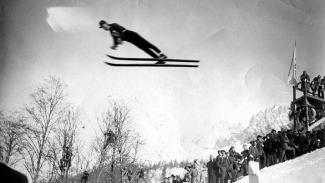
Original Winter Olympic sport eliminated from the 2030 program.

Photo above: The Nordic combined event has been included in every Winter Olympics since Chamonix hosted the first Games in 1924 (shown). Photo: Musee Alpin Chamonix.
Born on the snowy hills of Norway, where competitors climbed, jumped and raced across the countryside, Nordic combined was for decades a pillar of the Winter Olympic Games. Since the first Winter Olympics at Chamonix in 1924, every edition of the Games has crowned at least one Olympic champion in the sport.
That tradition has ended.
In July 2026, the International Olympic Committee (IOC) announced that Nordic combined—the demanding combination of ski jumping and cross-country skiing—would not be included on the program for the Alpes 2030 Olympic Winter Games. The decision stunned athletes and disappointed a close-knit international community that had hoped the Games would finally welcome women’s Nordic combined rather than eliminate the sport altogether.
“It’s like taking the marathon out [of the Summer Games],” says four-time U.S. Winter Olympian Taylor Fletcher. “It’s a staple of the Olympics.”
“For all of us who love combined, this feels like the end of an era,” posted Jens Lurås Oftebro on Instagram; the Norwegian swept all three gold medals in Nordic combined at the 2026 Games. “I still hope this won’t be the last chapter. Combined means far too much to far too many for the story to end here.”
While Nordic combined requires both fearlessness and endurance, rewarding athletes who can master two very different disciplines, the sport has struggled for its entire Olympic tenure to broaden its reach—for both participants and fans. During the last four Winter Olympics, athletes from only five nations won medals. Outside traditional strongholds such as Norway and Germany, participation and public interest—and, therefore, media interest—has remained limited.
The sport also carried an increasingly conspicuous distinction: the only Olympic discipline without a women’s event. Many within the Nordic combined community believed the IOC would correct that omission for 2030. Instead, the committee removed the sport entirely.
“What was really at stake is the universality of Nordic combined overall as a discipline and also its capacity to raise audiences,” IOC Sports Director Pierre Ducrey said after the announcement. “It was really a debate not so much about the parity within the discipline but the low popularity, and their having a high concentration of few countries at the top of the sport.”
Whether the decision marks a temporary absence or the final end of Nordic combined’s historic Olympic run remains to be seen.
Olympic Origins
Nordic combined predates the Winter Olympics by decades. During the mid-19th century, ski competitions in Norway rarely separated jumping from distance skiing. Competitors raced over snowy terrain that naturally included hills, with the best all-around skiers crossing the finish line first.
As competition evolved, ski jumping and cross-country skiing developed into separate sports. Yet the tradition of identifying the finest all-around skier endured. In 1892, when the Holmenkollen Ski Festival debuted in Oslo, Norway, Nordic combined was on the program—a showcase for versatile athletes. Less than a decade later, Nordic combined was included in the Nordic Games, the brainchild of IOC board member Viktor Balck of Sweden. These games brought together competitors from Norway, Sweden, Finland and Denmark in cross-country skiing, ski jumping, Nordic combined and other winter sports. Balck hoped the Olympic movement would eventually embrace a similar winter festival.
The Scandinavian nations initially resisted the proposal of a separate Winter Olympics. As Olympic historian David Miller wrote in Athens to Athens: The Official History of the Olympic Games and the IOC, 1894–2004, the Nordic countries believed, “not without reason, that the more dramatic Alpine events would wrest attention from their own competition.”
The Marquis de Polignac of France, one of the original members of the IOC executive board, suggested a compromise. Countries hosting the Summer Olympics could organize a winter sports festival if facilities were available. Thus, in 1924, Chamonix hosted an International Winter Sports Week—a competition that would later be recognized as the first Olympic Winter Games. (The Scandinavian nations may have hesitated, but they quickly demonstrated their supremacy. Their athletes captured 28 of the 43 medals awarded in Chamonix.) The Nordic Games quietly faded away after 1926.
Nordic combined was one of 16 medal events at those inaugural Winter Games. It consisted of an 18-kilometer cross-country race followed two days later by ski jumping. Norway’s Thorleif Haug won a gold medal in the 18km race, then won the ski jump to claim the gold medal in Nordic combined. Haug won his third gold in the 50-kilometer race, making him one of the first multiple champions in Winter Olympic history (the other was Finland’s Clas Thunberg, who won three gold medals in speed skating).
Since then, Nordic combined has gone through many iterations, though the central challenge has remained unchanged: to fly the farthest and ski the fastest. Until 1952, athletes’ results from the Olympic 18-kilometer cross-country race counted toward Nordic combined. Beginning in 1956, the event received its own dedicated cross-country competition.
The most significant modernization came in 1988, when Norwegian Olympian Gunder Gundersen introduced the pursuit-start scoring system that bears his name. Ski-jumping scores were converted into time differences, allowing the jump leader to start first in the cross-country race while the other competitors chased after, according to their jumping deficit. It made Nordic combined more viewer-friendly: The first skier across the finish line won the whole event.
The sport’s Olympic program evolved further with a team event, which debuted in 1988, and the large-hill competition, added in 2002. More recently, the International Ski and Snowboard Federation (FIS) adopted mass-start formats, sprints and mixed team relays in an effort—ultimately futile—to broaden the sport’s appeal. ’
The absence of a season-long competition for women further complicated the sport’s Olympic future. FIS finally launched a Nordic combined women’s World Cup and world championships in 2020–21, raising hopes that women would make their Olympic debut in 2026. Instead, the IOC declined to add the event, citing insufficient international participation, despite women’s Nordic combined attracting competitors from roughly the same number of nations as the men’s field.
Without women’s events, Nordic combined’s status as the only Olympic sport without gender parity limited both its medal opportunities and its visibility—and certainly helped darken its future with the IOC.
Norwegian Dominance
The first decades of Olympic Nordic combined belonged almost exclusively to Norway. After Haug led a Norwegian podium sweep in 1924 (Norway also swept the 18km cross-country race, with the same athletes), Norwegian skiers continued to dominate through the next four Winter Olympics.
The reasons were hardly mysterious. Nordic combined requires both cross-country trails and ski jumps, facilities most often found in northern and central Europe. Nations with long traditions of Nordic skiing naturally developed the deepest talent pools.
The first break in Norway’s monopoly came after World War II. At the 1948 Winter Games in St. Moritz, Finland’s Heikki Hasu and Martti Huhtala won gold and silver, while Sweden’s Sven Israelsson claimed bronze. Twelve years later, Germany’s Georg Thoma—a postman from the Black Forest—became the first Olympic champion from outside Scandinavia, defeating Norway’s Tormod Knutsen at the Squaw Valley Games.
By the 1990s, Japan had emerged as another power, winning the Olympic team event in 1992. Yet the sport’s international footprint remained remarkably small. Norway and Germany have captured more than half of all Olympic medals awarded in Nordic combined and roughly 70 percent of the gold medals. Of note: Those totals include medals won by East Germany between 1968 and 1980, during what later became known as the height of the GDR’s state-sponsored doping program.
Outside Europe, only Japan and the United States have produced Olympic medalists. And in the last four Winter Olympics, athletes from just five nations—Norway, Germany, Austria, Finland and Japan—have won all the medals in Nordic combined. The IOC cited this concentration of success as a driver in its decision to remove the sport from the 2030 Olympic program.
Iconic Olympic Performances
With its reliance on ski jumps, Nordic combined has never flourished widely in the United States. Instead, the sport has taken root in a few communities—notably Steamboat Springs, Colorado; Park City, Utah; and Lake Placid, New York—where generations of talented young skiers learned to fly before they learned to race.
One of those young skiers was Todd Lodwick, a Steamboat Springs native who, in 1995, became the first U.S. athlete to win a Nordic combined World Cup event, then claimed a junior world championship title the following winter. As Lodwick established himself and showed what was possible, another Steamboat skier, Johnny Spillane, and Billy Demong, from Vermontville, New York, near Lake Placid, were coming into their own. Spillane captured a gold medal at the 2003 world championships, while Demong earned his first world championship podium in 2007. These three Americans (plus Matt Dayton) narrowly missed the Olympic podium in 2002, finishing fourth in the team event. But they believed they were on the cusp of success.
A harbinger of what would come: At the 2009 world championships, Lodwick won two gold medals, while Demong captured the large hill title. The American team might also have won the relay had Demong not misplaced his race bib inside his jump suit, a mishap that led to the team’s disqualification.
One year later, everything came together. At the 2010 Games in Vancouver, Spillane opened the week with a silver medal in the normal hill event—the first Olympic medal ever won by an American in Nordic combined. The U.S. quartet of Spillane, Demong, Lodwick and Brett Camerota followed with silver in the team competition. Then Demong delivered one of the defining performances in U.S. Nordic skiing history, winning the large hill event to become the first American Olympic champion in Nordic combined. Spillane crossed the finish line just behind him for another silver.
Tom Steitz, who coached the U.S. team from 1988 to 2002 and helped lay the foundation for that breakthrough, stood at the finish and struggled to find words for what he had witnessed. “Four medals in a week—unbelievable,” he said at the time.
The momentum carried forward for several seasons. Lodwick, Demong and brothers Bryan and Taylor Fletcher won bronze in the team event at the 2013 world championships, and American men continued to collect occasional World Cup podiums. Yet Vancouver proved to be the high-water mark. Taylor Fletcher’s World Cup podium in 2015 was the last by an American man, and after funding cuts to the U.S. program in 2014, sustaining that success became increasingly difficult.
As the men’s program faded, American women began to emerge as some of the sport’s brightest stars—with the hope that the sport would soon have its Olympic debut.
Tara Geraghty-Moats won the inaugural women’s World Cup overall title in 2020, giving the United States another pioneering milestone. Three years later, the American program entered a partnership with Norway, sharing coaching, training opportunities and sports-science resources—a recognition that the sport’s future depended on strengthening competition beyond its traditional European powers.
The collaboration quickly paid off. Alexa Brabec, of Steamboat Springs, finished fourth in the mass start at the 2025 world championships after winning two silver medals at the 2024 junior world championships. Last winter she became a consistent World Cup podium finisher, ending the season ranked second in the overall standings. Had women’s Nordic combined been included in the 2026 Olympic program, she likely would have entered Milano Cortina as a medal contender.
Her teammate, Annika Malacinski, has become another leading voice for the sport. Her documentary, Annika—Where She Lands, chronicles the campaign for Olympic inclusion. Notably, she has over 36,000 Instagram followers, nine times more than Oftebro, the male Norwegian gold medalist.
Where Does Nordic Combined Go from Here?
Despite its absence from the 2030 Olympic program, Nordic combined has not disappeared. The sport remains on the program for the 2028 Winter Youth Olympic Games, with events for both men and women, and the IOC has left the door open for its return at the 2034 Winter Olympics in Utah.
In the meantime, the sport’s attention turns to the World Cup circuit and the 2027 Nordic World Ski Championships in Falun, Sweden, in February.
“The Olympics happen every four years,” notes Nordic Combined USA spokesperson Stephanie Wilson. “They do not sustain the sport. As long as the athletes, coaches and supporters stay involved, Nordic combined can have a great future.”
Still, many within the sport worry about something larger than the loss of Olympic medals. Nordic combined is a foundational sport. At programs such as Steamboat Springs Winter Sports Club, children begin by learning both ski jumping and cross-country skiing. The thrill of jumping, Taylor Fletcher says, is often what keeps young athletes engaged long enough to discover the rewards of cross-country.
“No kid in their right mind would say they loved cross-country skiing at age five, six or seven,” Fletcher says with a laugh. “At that age, you don’t know how to suffer yet.”
He also sees the sport as an embodiment of the Olympic ideal and the Olympic motto of Citius, Altius, Fortius—Communiter (faster, higher, stronger—together). The victor can soar the farthest and ski the fastest. “Nordic combined is the pursuit of perfection,” Fletcher says. “It’s the original extreme sport.”
Whether that pursuit returns to the Olympic stage in 2034 remains uncertain. But its history will continue to run deep. 
Peggy Shinn has covered eight Olympic Games. She wrote about the program changes in the Alpes 2030 Games in the September-October 2026 issue.