Sixty years ago, Billy Kidd, Jimmie Heuga and Jeannie Saubert validated Bob Beattie’s dream.
By Billy Kidd as told to Seth Masia
Photo above: Billy Kidd had the fastest second run in the 1964 Olympic slalom to score the silver medal behind Pepi Stiegler.
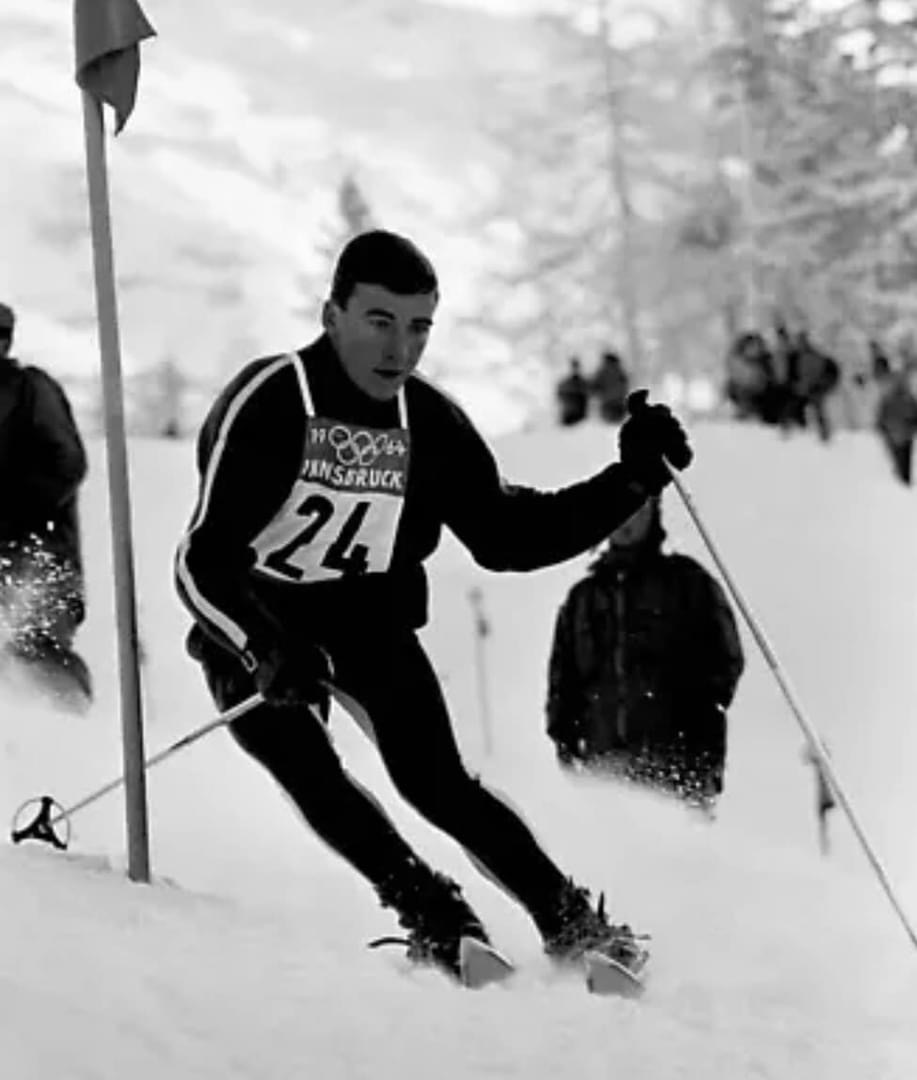
Jimmie Heuga, starting 24th, was third after the first run behind Karl Schranz. He had the second-fastest second run to score bronze.
I first went to Europe in 1961, to Val d’Isère to train for the 1962 World Championships at Chamonix. I was 18, and at Chamoinix I finished eighth in slalom and 15th in GS. For me, finding speed on the race course was a matter of watching the most talented racers carefully, analyzing courses, and figuring out where I could pick up a tenth of a second, here and there.
I got a lot from sequence photography and, especially, from watching Buddy Werner. I could see him plant his pole and turn his skis, not his shoulders, which was the opposite of the old Austrian reverse-shoulder. That meant you could get three turns in 1.5 seconds on 205-centimeter skis.
I was a full-time student, too, and didn’t have time to practice constantly. The key thing was to eliminate mistakes and memorize gates, always. I learned to analyze the course, visualize it, anticipate and react.
Speed also depended a lot on getting my equipment just right, because I couldn’t afford to give away tenths with a ski that was too stiff or with a sloppy boot.
For instance, I had been getting a stronger edge set on ice by canting my boots a bit. I did that by wedging a 10-inch strip of leather strap under the inside edges of the boots, but I knew that it would be more efficient to build that cant angle directly into the boot sole. No one was building a boot that way. Buddy, at age 25, was already importing Heierling boots. It was part of the way he made a living in those days when we couldn’t earn money just skiing, and it was an important relationship for all of us because, with leather boots, we needed new ones about every three to six weeks. So I met Hans Heierling in Val d’Isère and asked if he could build me some canted boots, and I had them in time for the World Championships.
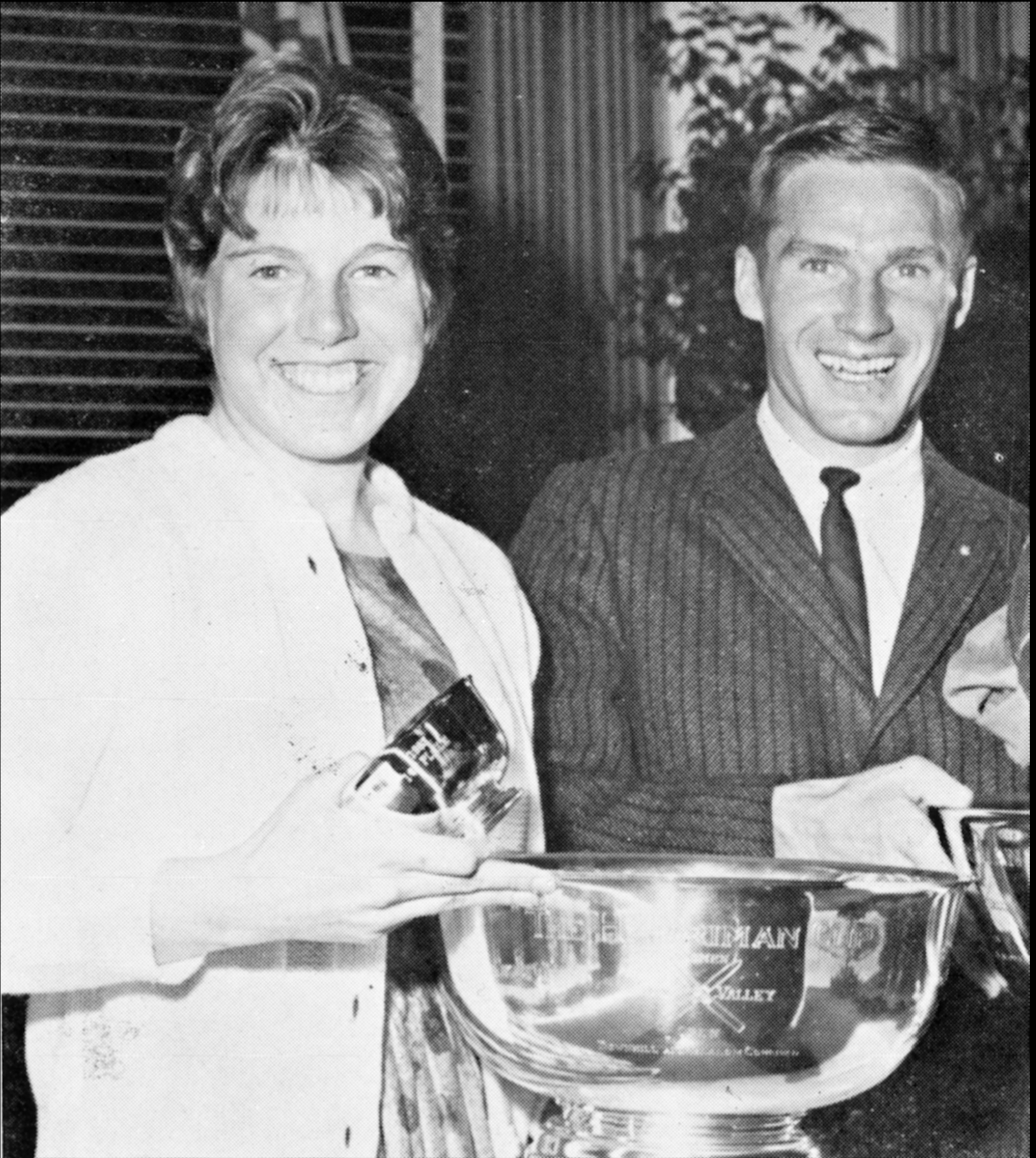
Jean Saubert and Buddy Werner won the 1963 Harriman Cups, and were favorites going into the '64 Olympics.
Also, the team used Marker Simplex bindings. During the winter of 1960–61, I took a backward fall and the toes didn’t release. I skied through the next couple of seasons with a chronically sprained ankle, which required a lot of adjustment in the boot. I mounted up my own skis with Miller bindings, which did release upward at the toe. It took a long time to mount 28 pairs of skis before the World Championships. For the Olympics, I was back on Markers, which we screwed down all the way. With long thongs, the release factor was when the screws pulled out of the skis.
Buddy showed up with the first pair of stretch racing pants. He had contrasting strips of stretch material sewn into the outside seams on each leg. The tighter fit was worth a fifth of a second on the slalom course, which was significant—remember I finished just .14 second behind Pepi Stiegler in 1964.
I loved downhill, but I wasn’t as fast as Buddy and I realized I had no idea about riding a flat ski or aerodynamics. So back home at Stowe I ran the long, flat Toll Road on my slalom skis, which had draggy segmented edges with all those screw heads. I learned to float on a flat ski by minimizing the drag of the screws and edge joints.
At Innsbruck, the first Alpine event on the schedule was the men’s downhill, set for January 30. There’d been very little snow and the Austrian army brought in snow to make a narrow, icy track. There wasn’t much protection to keep racers from crashing into the woods. On the first day of practice, January 25, the top Australian, Ross Milne, came over the crest into the first steep pitch to find a bunch of racers milling around in the middle of the course. He turned to avoid them, went off piste, hit a tree and was killed. There was a lot of talk that he was inexperienced, with the implication that non-Europeans shouldn’t run downhill. Of course, Buddy Werner had been 11th in the 1956 Olympic downhill, when he was just 19, then won the Hahnenkamm downhill in 1959, beating Sailer and Molterer and everyone else. To this day he’s the only American to win the full-length Hahnenkamm, which includes the Mausfalle.
Well, no one wanted to die, but it was downhill and you have to push to win. On race day I drew bib number one. Sixty seconds before the start, I was thinking, “This is not just another downhill. It’s the Olympics. And I could win.” At 30 seconds, I had stage fright. My knees went weak. I needed oxygen. I couldn’t remember the course, except that it was solid ice. At 15 seconds, I wanted to yell, “Wait! I’m not ready!” I tried to breathe, but it felt like there was a leather strap around my chest. Then the starter said, “Go!”
Twelve seconds into the course, I hit a bump and snapped back to reality. All four Americans got down the course okay. We finished in a group, with Ni Orsi, our best glider, 3.4 seconds out in 14th, me 16th, Buddy 17th and Chuck Ferries 20th. The French star François Bonlieu was 15th. Egon Zimmermann won, with Leo Lacroix second. Wolfgang Bartels took bronze, 1.3 seconds back.
This was the last time the Olympic GS was a one-run race. On February 2, we came close in the men’s GS. François Bonlieu started second and set the pace to win gold. Jean-Claude Killy started fifth and finished 2.2 seconds off. Then Jimmie Heuga skied out. So did Buddy. My time held up for seventh. Karl Schranz started 15th and got silver, with Pepi Stiegler bronze. Bill Marolt started near the back of the second seed but finished 12th, just behind Leo Lacroix.
The final Alpine event was the slalom on February 8. For us, of course, this was the climax. Our parents were there. There was a huge crowd, something like 30,000 Austrians.
In the starting gate I’m focused on the shape of the course and the key gate. The key gate is the one leading into the flat—if you blow that you don’t carry speed across the flat. I have a trigger gate, two or three gates above the key gate. That’s where I set up for the key. At Innsbruck the first run was long—78 gates—and the steepest part was at the bottom quarter, with two or three tight turns across the fall line there where it was easy to get sideways across ice, then an opportunity to skate for speed across the final flat.
In the first run, I did well except for getting sideways at about the 15th gate, but I got it back together right away. Pepi Stiegler set the pace. After the first seed I was fifth, after Adolf Mathis, and Buddy was seventh. Chuck Ferries skied out. And then Jimmie, starting 24th, had an absolutely perfect run, just dancing through the gates to finish just a tenth of a second behind Karl Schranz. I think if he’d had cleaner snow, he might have gotten the lead. After that, we thought Jimmie had a great chance to win the gold.
The second run was a shorter, easier course, and the snow was warmer and a bit softer. I had the run of my life and moved into the lead—it turned out to be the fastest time for the second run by a full second. I’m told the crowd was screaming its lungs out for the Americans because they thought Jimmie could win, but I didn’t hear it—I was too focused on my skis. Buddy taught me to listen to my edges: if you can hear them scraping, you’re skidding and losing time.
Then Stiegler skidded in the tight across-the-fall-line turn at the breakover into the steep finish, but he could afford the time and held the lead by just .14 second. Michel Arpin and Luggi Leitner had good runs, but then Jimmie came down and beat them by half a second, moving into third, and that was that. We had silver and bronze medals, behind Pepi. It was the closest race of the week, with just .39 second between first and third.
With the silver medal in slalom, my 16th place in the downhill earned me the FIS bronze medal in combined [combined was not then an Olympic event]. Jeannie Saubert was fourth in the women’s combined.
Jimmie told me he felt bad that he won a medal and Buddy didn’t—he thought it was Buddy’s medal. I understood that. Buddy was our leader and mentor, and he was a hero to the Europeans, too. I felt strongly that this race was a passing of the torch, from Buddy to a group of younger American racers, just as John Kennedy in his inaugural address had described the passing of the torch to a new generation of Americans.
The following winter I did well, winning three races in Europe. But in early 1966 I sprained my ankle again, and then, in August in Portillo for the World Championships, I broke my leg in downhill training. That put me out of action for the first World Cup season. I went back to Boulder and finished my bachelor’s degree in economics. I thought I might go into the ski business. But then I thought, “I missed the gold medal at Innsbruck by just .14 second. I should stay and race until I have that elusive gold medal.” And that’s what I did.
Author Billy Kidd won the combined gold medal at the World Championships in Val Gardena in 1970, along with the bronze medal in slalom. He then retired, turned pr, and won the World Pro Skiing Championship the same year. He recently completed 50 years as director of skiing at Steamboat.
Underfoot, a Quiet Revolution
Out of sight of the press and public, 1964 was a technical revolution.
After the 1960 season, when the French dominated downhill on aluminum Allais Major skis, it was obvious that metal skis offered better glide speed thanks to their high-frequency, low-amplitude vibration, which broke up meltwater surface tension under the base. And so, in 1964, all the Oymnpic medals in downhill and giant slalom were won on aluminum skis. There was a new development in metal skis: both Head and Fischer added thin rubber damping layers to help control low-frequency vibration and prevent chattering on ice. Egon Zimmermann won the downhill on Fischers.
Bob Beattie was a great, inspiring coach, but he wasn’t a technical expert on Alpine skiing—he’d been a football coach and a cross-country skier and coach. He insisted on controlling the U.S. team’s waxing and guessed wrong on both the men’s and women’s downhills. After the women’s race, he told a SKI magazine reporter, “Everyone had Holmenkollen blue and white paraffin. I had a little more white paraffin than we should have. The French had the same as we did. The Austrians apparently called it right: they waxed better.”
This would explain why the American men finished the downhill in a tight group with François Bonlieu. (The fastest Frenchman, silver medalist Leo Lacroix, famously prepared his own gear, to the extent that he later built his own skis.) The U.S. women’s downhill was almost a repeat of the men’s. The winners were Christl Haas, Edith Zimmermann and Trudl Hecher, and Nancy Greene was seventh. The U.S. women were six to eight seconds back, with Starr Walton 14th, then Joan Hannah 15th, Margo Walters 21st and Jeannie Saubert 26th.
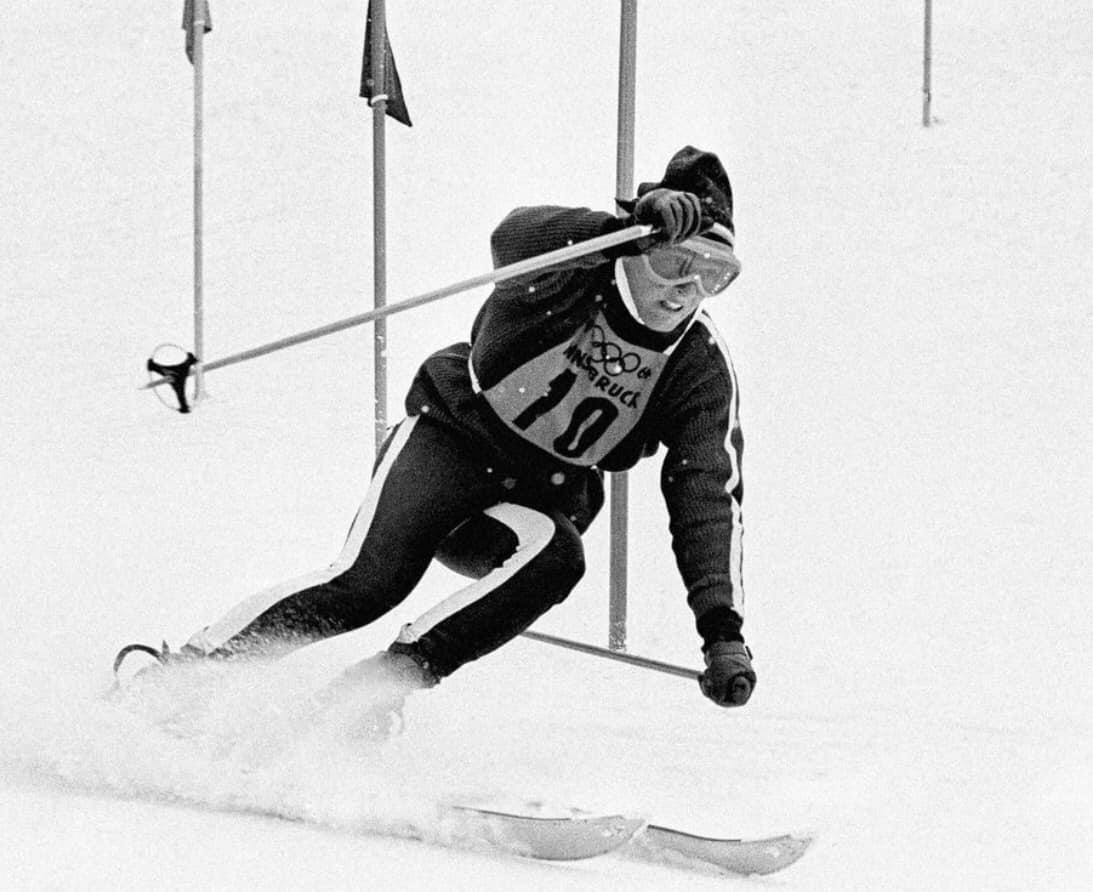
Almost unreported at the time was the impending death of wooden race skis. The Goitschel sisters won their slalom medals on the new RG5, made of polyester resin-soaked fiberglass wrapped around a wooden core at the Dynamic factory. Saubert, skiing on rubber-damped Heads with a new narrow sidecut, was fifth after the first run but just tore up the second run, taking bronze. She beat the fourth-place time by almost three seconds. Two days after that, in the GS, she tied for silver with Christine Goitschel, behind Marielle Goitschel. This time, the French twins rode the metal Allais Major.
All three medals in men’s slalom were won on the Kästle Slalom, a lively ski of ash laminates. But Maurice Whoerlé, the Rossignol design engineer, ran a vibration test on one of the Olympic Kästles, when he was working on the Strato, and believes it was a prototype containing fiberglass.
The French might have put a fiberglass ski on the men’s podium, but in the first run of slalom Jean-Claude Killy missed a gate, and Guy Périllat hooked a gate and crashed. Michel Arpin skied well but finished in fourth, a full second behind Jimmie Heuga.
Another technical breakthrough that was unheralded at the time lay inside the leather boots. Introduced in 1962, the Le Trappeur Elite, used by most of the French Alpine skiers, contained stiff fiberglass reinforcment plates around the ankles—between the leather exterior and the foam cushioning inside. Invisible to others, these plates vastly improved edging power. The Elite’s design was widely imitated by other bootmakers, so that all Swiss, Austrian, Italian, American and Canadian skiers had fiberglass boots—two years before Bob Lange got plastic race boots on snow at the 1966 World Championships.
Those stiffer boots enabled racers to edge more, and up-unweight less, to initiate turns, which led to a smoother, more rhythmic technique in slalom and GS. Technical experts noted the reduction of up-unweighting; it was the beginning of what Georges Joubert would later call avalement. —Seth Masia
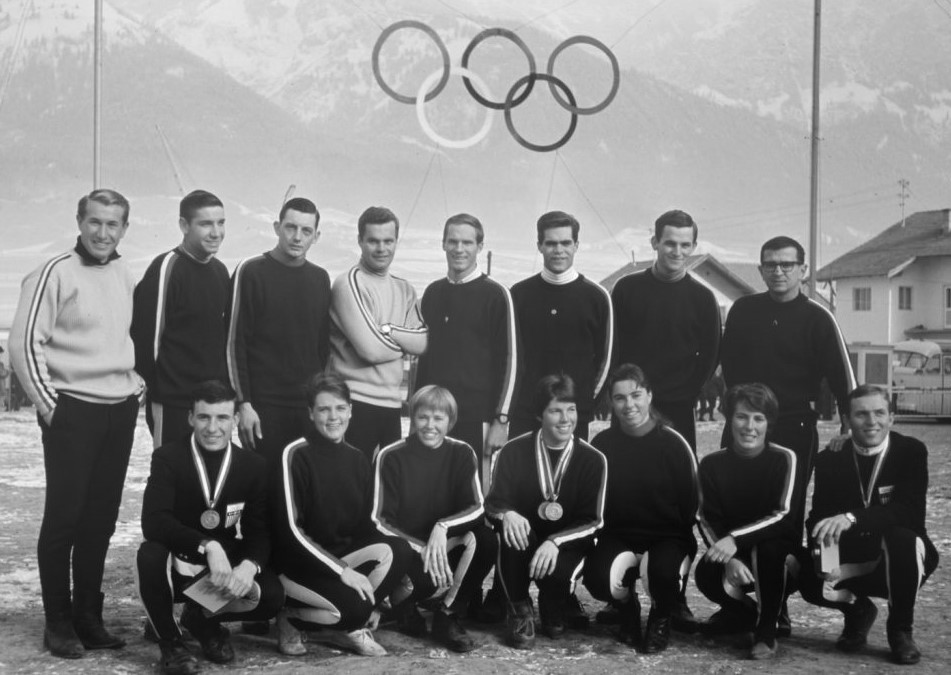
US Alpine Team, 1964: Standing, left to right: Bob Beattie, Ni Orsi, Chuck Ferries, Gordi Eaton, Buddy Werner, Rip McManus, Bill Marolt, Fred Casotti. Front row, Jimmie Heuga, Barbara Ferries, Margo Walters, Jean Saubert, Joan Hannah, Starr Walton, Billy Kidd. Photo: Marriott Library/Marv Melville collection.