Sixty years ago, Billy Kidd, Jimmie Heuga and Jeannie Saubert validated Bob Beattie’s dream.
By Billy Kidd as told to Seth Masia
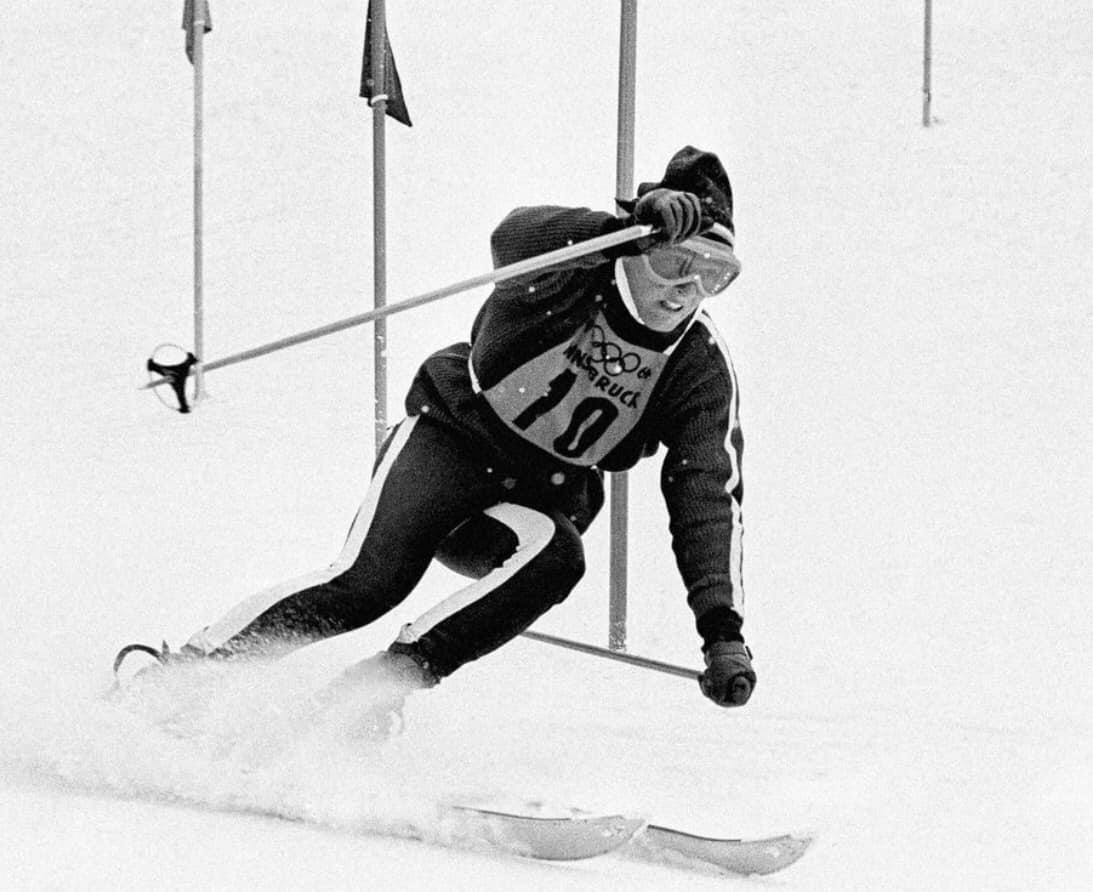
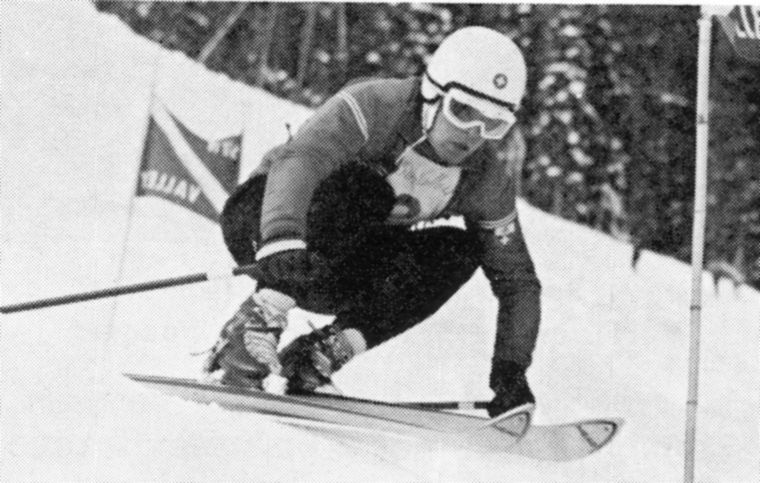
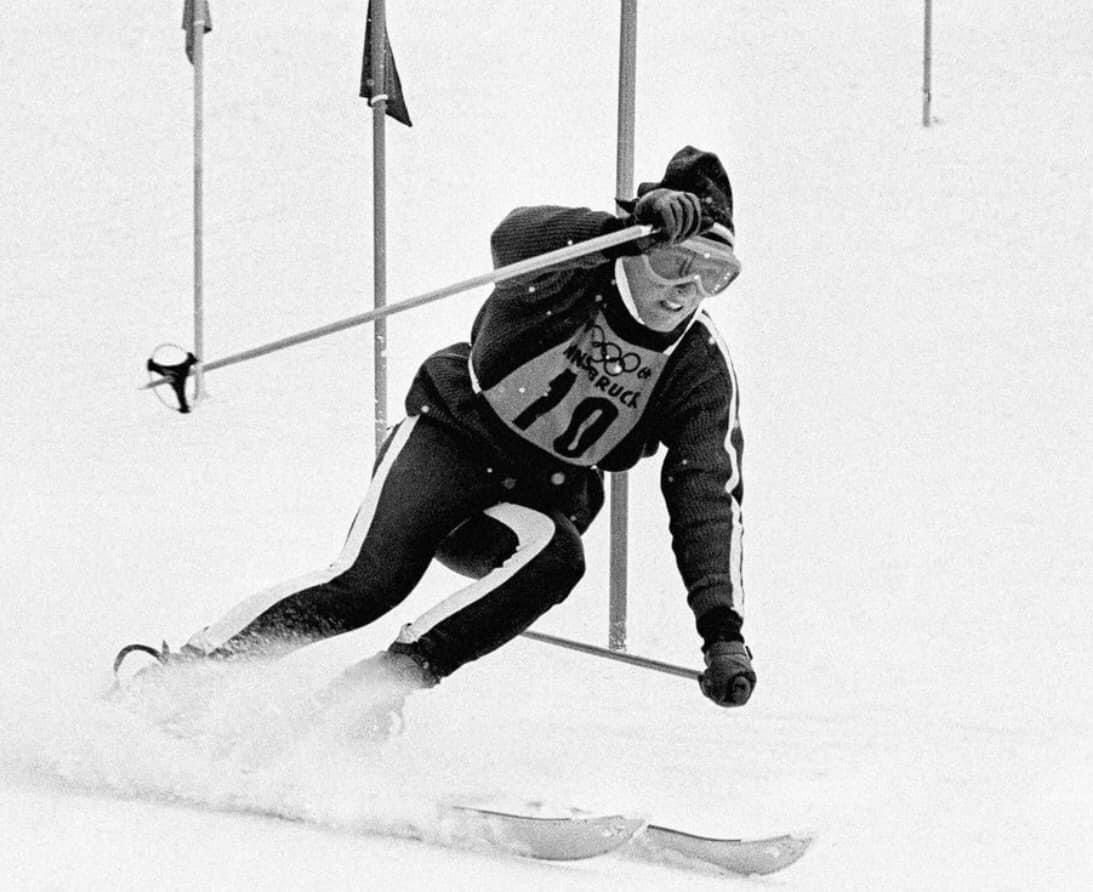
Photo above: Billy Kidd had the fastest second run in the 1964 Olympic slalom to score the silver medal behind Pepi Stiegler.
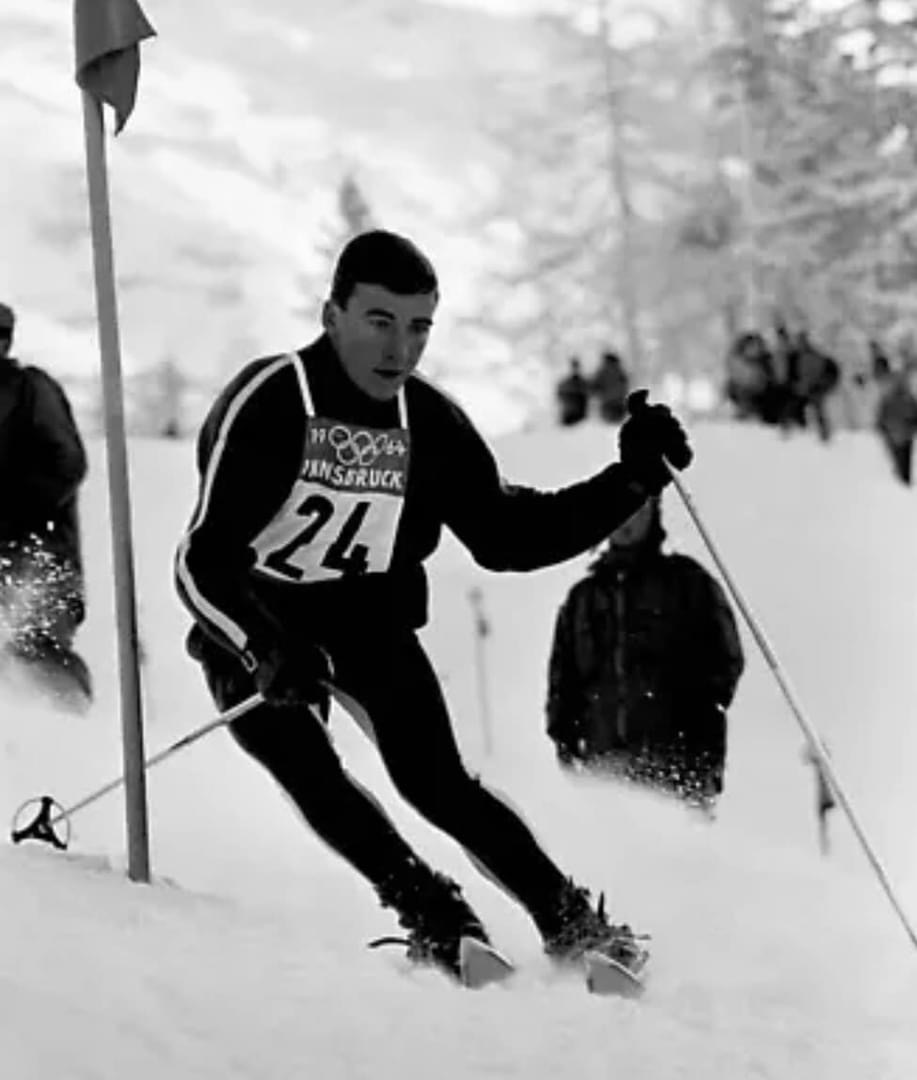
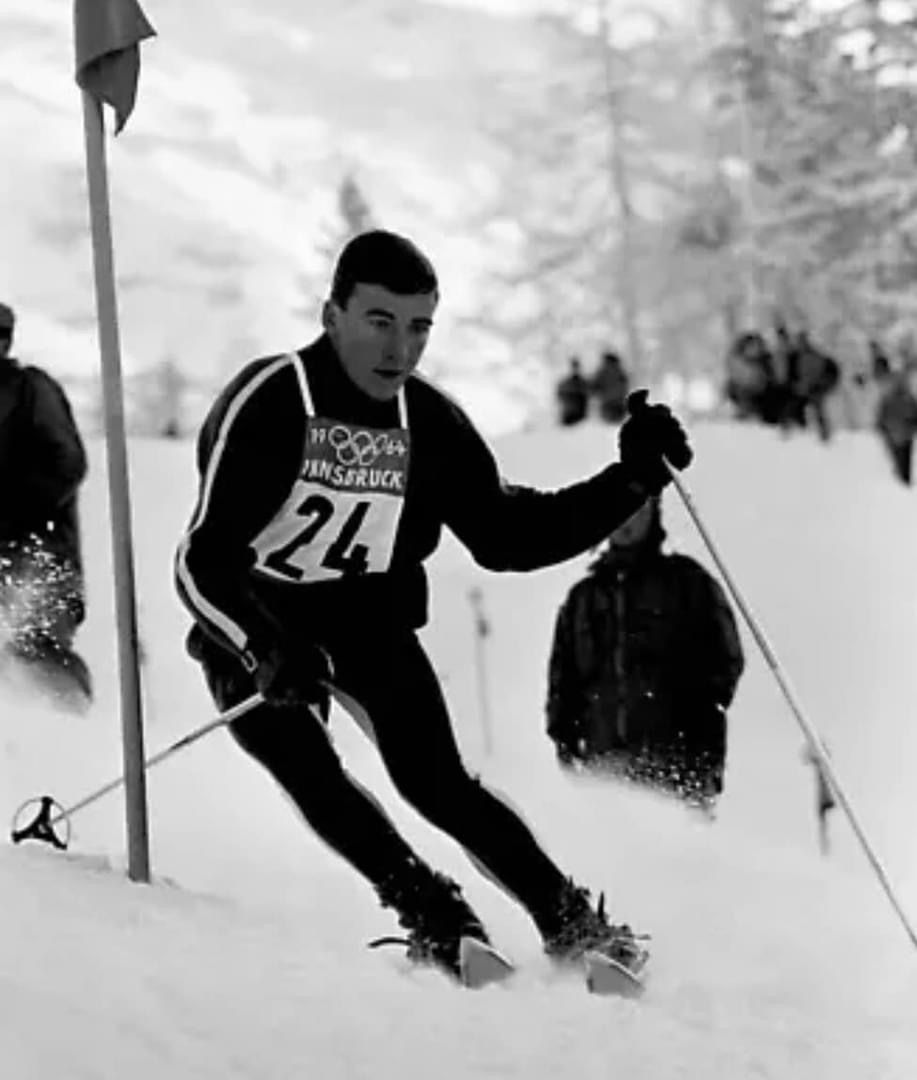
Jimmie Heuga, starting 24th, was third after the first run behind Karl Schranz. He had the second-fastest second run to score bronze.
I first went to Europe in 1961, to Val d’Isère to train for the 1962 World Championships at Chamonix. I was 18, and at Chamoinix I finished eighth in slalom and 15th in GS. For me, finding speed on the race course was a matter of watching the most talented racers carefully, analyzing courses, and figuring out where I could pick up a tenth of a second, here and there.
I got a lot from sequence photography and, especially, from watching Buddy Werner. I could see him plant his pole and turn his skis, not his shoulders, which was the opposite of the old Austrian reverse-shoulder. That meant you could get three turns in 1.5 seconds on 205-centimeter skis.
I was a full-time student, too, and didn’t have time to practice constantly. The key thing was to eliminate mistakes and memorize gates, always. I learned to analyze the course, visualize it, anticipate and react.
Speed also depended a lot on getting my equipment just right, because I couldn’t afford to give away tenths with a ski that was too stiff or with a sloppy boot.
For instance, I had been getting a stronger edge set on ice by canting my boots a bit. I did that by wedging a 10-inch strip of leather strap under the inside edges of the boots, but I knew that it would be more efficient to build that cant angle directly into the boot sole. No one was building a boot that way. Buddy, at age 25, was already importing Heierling boots. It was part of the way he made a living in those days when we couldn’t earn money just skiing, and it was an important relationship for all of us because, with leather boots, we needed new ones about every three to six weeks. So I met Hans Heierling in Val d’Isère and asked if he could build me some canted boots, and I had them in time for the World Championships.
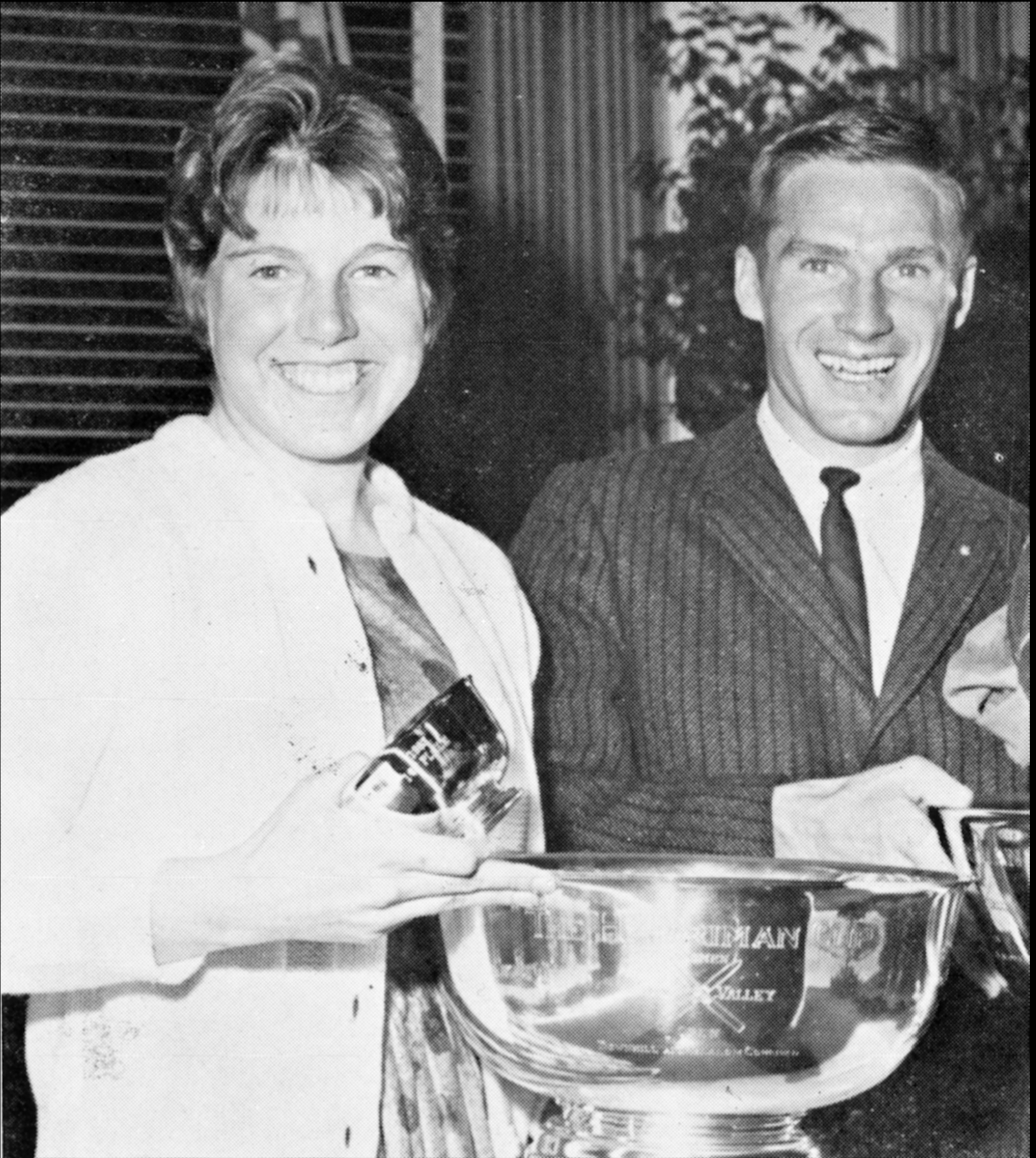
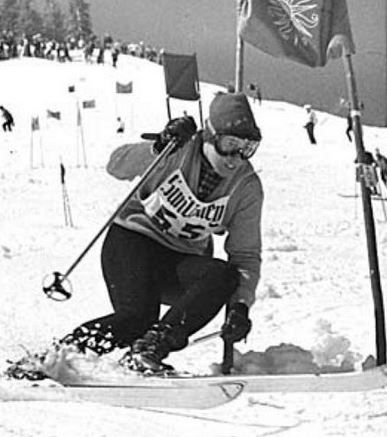
Jean Saubert and Buddy Werner won the 1963 Harriman Cups, and were favorites going into the '64 Olympics.
Also, the team used Marker Simplex bindings. During the winter of 1960–61, I took a backward fall and the toes didn’t release. I skied through the next couple of seasons with a chronically sprained ankle, which required a lot of adjustment in the boot. I mounted up my own skis with Miller bindings, which did release upward at the toe. It took a long time to mount 28 pairs of skis before the World Championships. For the Olympics, I was back on Markers, which we screwed down all the way. With long thongs, the release factor was when the screws pulled out of the skis.
Buddy showed up with the first pair of stretch racing pants. He had contrasting strips of stretch material sewn into the outside seams on each leg. The tighter fit was worth a fifth of a second on the slalom course, which was significant—remember I finished just .14 second behind Pepi Stiegler in 1964.
I loved downhill, but I wasn’t as fast as Buddy and I realized I had no idea about riding a flat ski or aerodynamics. So back home at Stowe I ran the long, flat Toll Road on my slalom skis, which had draggy segmented edges with all those screw heads. I learned to float on a flat ski by minimizing the drag of the screws and edge joints.
At Innsbruck, the first Alpine event on the schedule was the men’s downhill, set for January 30. There’d been very little snow and the Austrian army brought in snow to make a narrow, icy track. There wasn’t much protection to keep racers from crashing into the woods. On the first day of practice, January 25, the top Australian, Ross Milne, came over the crest into the first steep pitch to find a bunch of racers milling around in the middle of the course. He turned to avoid them, went off piste, hit a tree and was killed. There was a lot of talk that he was inexperienced, with the implication that non-Europeans shouldn’t run downhill. Of course, Buddy Werner had been 11th in the 1956 Olympic downhill, when he was just 19, then won the Hahnenkamm downhill in 1959, beating Sailer and Molterer and everyone else. To this day he’s the only American to win the full-length Hahnenkamm, which includes the Mausfalle.
Well, no one wanted to die, but it was downhill and you have to push to win. On race day I drew bib number one. Sixty seconds before the start, I was thinking, “This is not just another downhill. It’s the Olympics. And I could win.” At 30 seconds, I had stage fright. My knees went weak. I needed oxygen. I couldn’t remember the course, except that it was solid ice. At 15 seconds, I wanted to yell, “Wait! I’m not ready!” I tried to breathe, but it felt like there was a leather strap around my chest. Then the starter said, “Go!”
Twelve seconds into the course, I hit a bump and snapped back to reality. All four Americans got down the course okay. We finished in a group, with Ni Orsi, our best glider, 3.4 seconds out in 14th, me 16th, Buddy 17th and Chuck Ferries 20th. The French star François Bonlieu was 15th. Egon Zimmermann won, with Leo Lacroix second. Wolfgang Bartels took bronze, 1.3 seconds back.
This was the last time the Olympic GS was a one-run race. On February 2, we came close in the men’s GS. François Bonlieu started second and set the pace to win gold. Jean-Claude Killy started fifth and finished 2.2 seconds off. Then Jimmie Heuga skied out. So did Buddy. My time held up for seventh. Karl Schranz started 15th and got silver, with Pepi Stiegler bronze. Bill Marolt started near the back of the second seed but finished 12th, just behind Leo Lacroix.
The final Alpine event was the slalom on February 8. For us, of course, this was the climax. Our parents were there. There was a huge crowd, something like 30,000 Austrians.
In the starting gate I’m focused on the shape of the course and the key gate. The key gate is the one leading into the flat—if you blow that you don’t carry speed across the flat. I have a trigger gate, two or three gates above the key gate. That’s where I set up for the key. At Innsbruck the first run was long—78 gates—and the steepest part was at the bottom quarter, with two or three tight turns across the fall line there where it was easy to get sideways across ice, then an opportunity to skate for speed across the final flat.
In the first run, I did well except for getting sideways at about the 15th gate, but I got it back together right away. Pepi Stiegler set the pace. After the first seed I was fifth, after Adolf Mathis, and Buddy was seventh. Chuck Ferries skied out. And then Jimmie, starting 24th, had an absolutely perfect run, just dancing through the gates to finish just a tenth of a second behind Karl Schranz. I think if he’d had cleaner snow, he might have gotten the lead. After that, we thought Jimmie had a great chance to win the gold.
The second run was a shorter, easier course, and the snow was warmer and a bit softer. I had the run of my life and moved into the lead—it turned out to be the fastest time for the second run by a full second. I’m told the crowd was screaming its lungs out for the Americans because they thought Jimmie could win, but I didn’t hear it—I was too focused on my skis. Buddy taught me to listen to my edges: if you can hear them scraping, you’re skidding and losing time.
Then Stiegler skidded in the tight across-the-fall-line turn at the breakover into the steep finish, but he could afford the time and held the lead by just .14 second. Michel Arpin and Luggi Leitner had good runs, but then Jimmie came down and beat them by half a second, moving into third, and that was that. We had silver and bronze medals, behind Pepi. It was the closest race of the week, with just .39 second between first and third.
With the silver medal in slalom, my 16th place in the downhill earned me the FIS bronze medal in combined [combined was not then an Olympic event]. Jeannie Saubert was fourth in the women’s combined.
Jimmie told me he felt bad that he won a medal and Buddy didn’t—he thought it was Buddy’s medal. I understood that. Buddy was our leader and mentor, and he was a hero to the Europeans, too. I felt strongly that this race was a passing of the torch, from Buddy to a group of younger American racers, just as John Kennedy in his inaugural address had described the passing of the torch to a new generation of Americans.
The following winter I did well, winning three races in Europe. But in early 1966 I sprained my ankle again, and then, in August in Portillo for the World Championships, I broke my leg in downhill training. That put me out of action for the first World Cup season. I went back to Boulder and finished my bachelor’s degree in economics. I thought I might go into the ski business. But then I thought, “I missed the gold medal at Innsbruck by just .14 second. I should stay and race until I have that elusive gold medal.” And that’s what I did.
Author Billy Kidd won the combined gold medal at the World Championships in Val Gardena in 1970, along with the bronze medal in slalom. He then retired, turned pr, and won the World Pro Skiing Championship the same year. He recently completed 50 years as director of skiing at Steamboat.
Underfoot, a Quiet Revolution
Out of sight of the press and public, 1964 was a technical revolution.
After the 1960 season, when the French dominated downhill on aluminum Allais Major skis, it was obvious that metal skis offered better glide speed thanks to their high-frequency, low-amplitude vibration, which broke up meltwater surface tension under the base. And so, in 1964, all the Oymnpic medals in downhill and giant slalom were won on aluminum skis. There was a new development in metal skis: both Head and Fischer added thin rubber damping layers to help control low-frequency vibration and prevent chattering on ice. Egon Zimmermann won the downhill on Fischers.
Bob Beattie was a great, inspiring coach, but he wasn’t a technical expert on Alpine skiing—he’d been a football coach and a cross-country skier and coach. He insisted on controlling the U.S. team’s waxing and guessed wrong on both the men’s and women’s downhills. After the women’s race, he told a SKI magazine reporter, “Everyone had Holmenkollen blue and white paraffin. I had a little more white paraffin than we should have. The French had the same as we did. The Austrians apparently called it right: they waxed better.”
This would explain why the American men finished the downhill in a tight group with François Bonlieu. (The fastest Frenchman, silver medalist Leo Lacroix, famously prepared his own gear, to the extent that he later built his own skis.) The U.S. women’s downhill was almost a repeat of the men’s. The winners were Christl Haas, Edith Zimmermann and Trudl Hecher, and Nancy Greene was seventh. The U.S. women were six to eight seconds back, with Starr Walton 14th, then Joan Hannah 15th, Margo Walters 21st and Jeannie Saubert 26th.
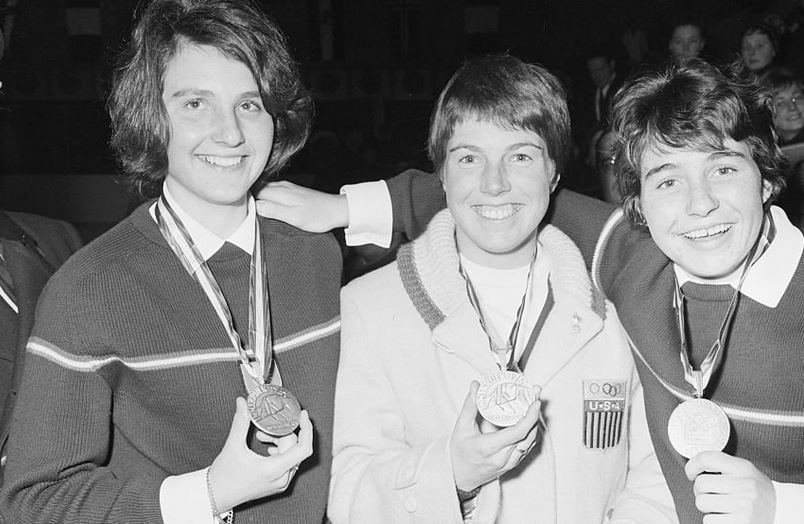
Almost unreported at the time was the impending death of wooden race skis. The Goitschel sisters won their slalom medals on the new RG5, made of polyester resin-soaked fiberglass wrapped around a wooden core at the Dynamic factory. Saubert, skiing on rubber-damped Heads with a new narrow sidecut, was fifth after the first run but just tore up the second run, taking bronze. She beat the fourth-place time by almost three seconds. Two days after that, in the GS, she tied for silver with Christine Goitschel, behind Marielle Goitschel. This time, the French twins rode the metal Allais Major.
All three medals in men’s slalom were won on the Kästle Slalom, a lively ski of ash laminates. But Maurice Whoerlé, the Rossignol design engineer, ran a vibration test on one of the Olympic Kästles, when he was working on the Strato, and believes it was a prototype containing fiberglass.
The French might have put a fiberglass ski on the men’s podium, but in the first run of slalom Jean-Claude Killy missed a gate, and Guy Périllat hooked a gate and crashed. Michel Arpin skied well but finished in fourth, a full second behind Jimmie Heuga.
Another technical breakthrough that was unheralded at the time lay inside the leather boots. Introduced in 1962, the Le Trappeur Elite, used by most of the French Alpine skiers, contained stiff fiberglass reinforcment plates around the ankles—between the leather exterior and the foam cushioning inside. Invisible to others, these plates vastly improved edging power. The Elite’s design was widely imitated by other bootmakers, so that all Swiss, Austrian, Italian, American and Canadian skiers had fiberglass boots—two years before Bob Lange got plastic race boots on snow at the 1966 World Championships.
Those stiffer boots enabled racers to edge more, and up-unweight less, to initiate turns, which led to a smoother, more rhythmic technique in slalom and GS. Technical experts noted the reduction of up-unweighting; it was the beginning of what Georges Joubert would later call avalement. —Seth Masia
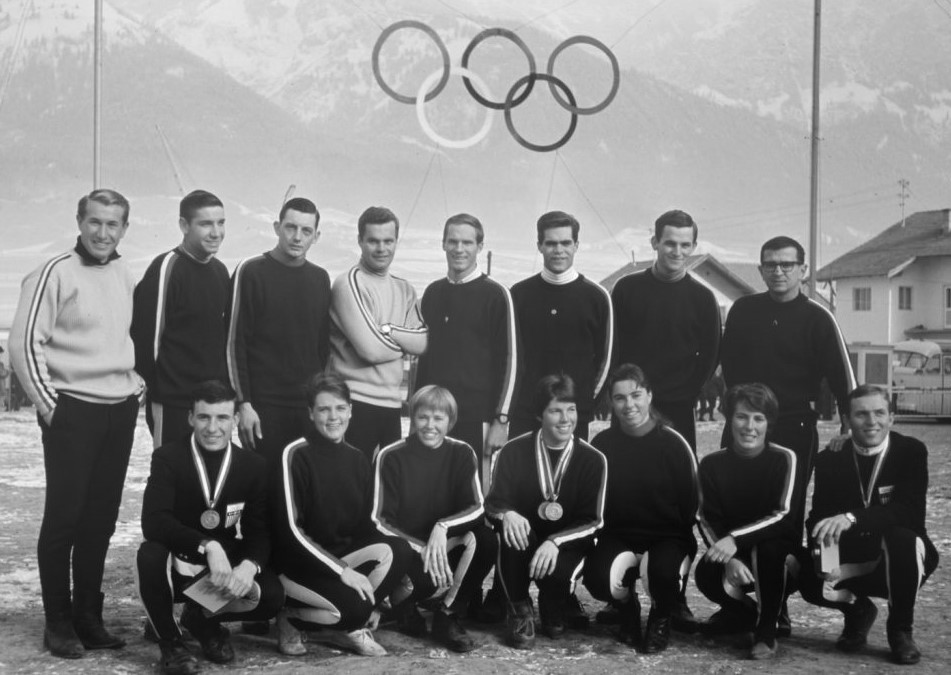
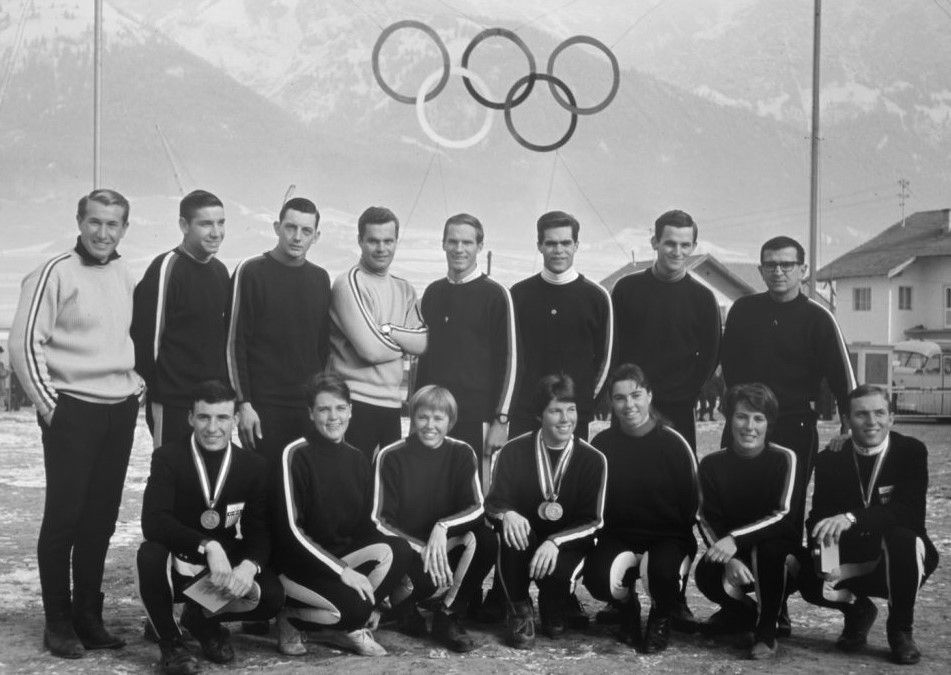
US Alpine Team, 1964: Standing, left to right: Bob Beattie, Ni Orsi, Chuck Ferries, Gordi Eaton, Buddy Werner, Rip McManus, Bill Marolt, Fred Casotti. Front row, Jimmie Heuga, Barbara Ferries, Margo Walters, Jean Saubert, Joan Hannah, Starr Walton, Billy Kidd. Photo: Marriott Library/Marv Melville collection.
Butting Heads with Beattie en route to the Olympic Dream
In Part I of this series (May-June 2023), Howard Head overcame setbacks and pursued his visionary metal ski design. By 1960, he had captured a large part of the recreational market, and metal skis were beginning to dominate downhill racing. Here, Head staff and U.S. racers recall a time of transition and historic achievement.
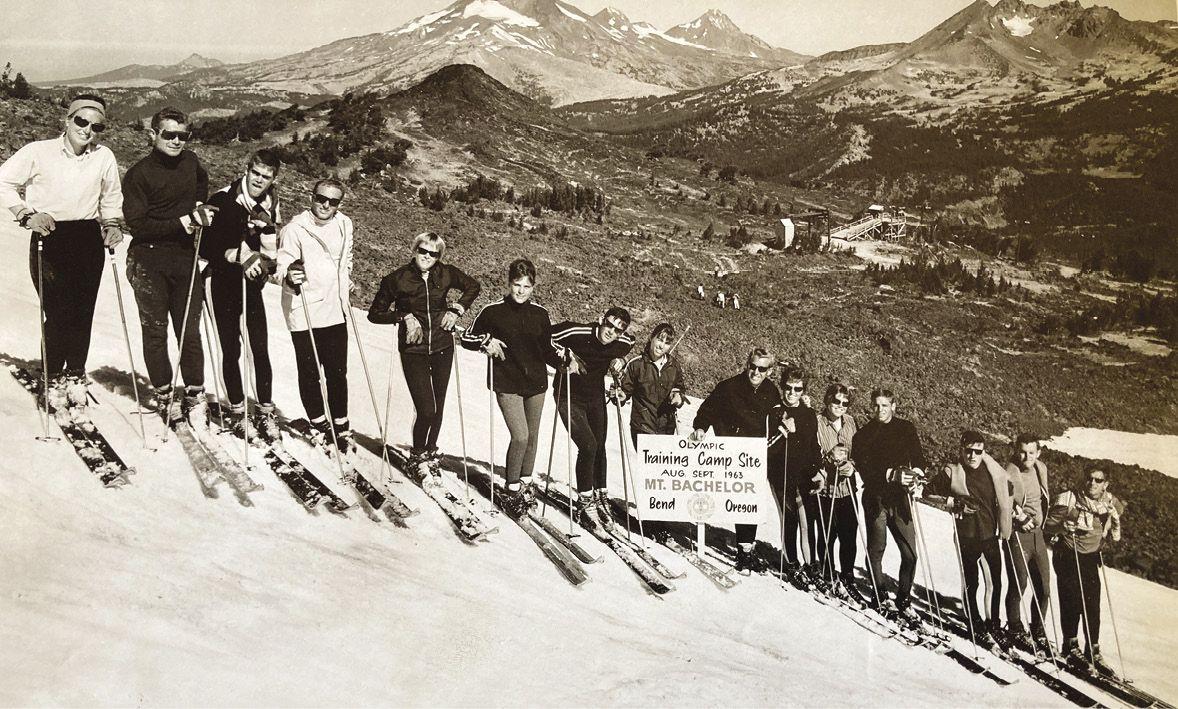
Photo top of page: At the Mt. Bachelor training camp, left to right: Starr Walton, Gordi Eaton, Rip McManus, Billy Kidd, Margo Walters (McDonald), Barbara Ferries (Henderson), Chuck Ferries, Joan Hannah, Bob Beattie, Linda Meyers (Tikalsky), Jean Saubert, Annibale “Ni” Orsi, Jimmie Heuga, Bill Marolt, Buddy Werner. Jim Hosmer photo.
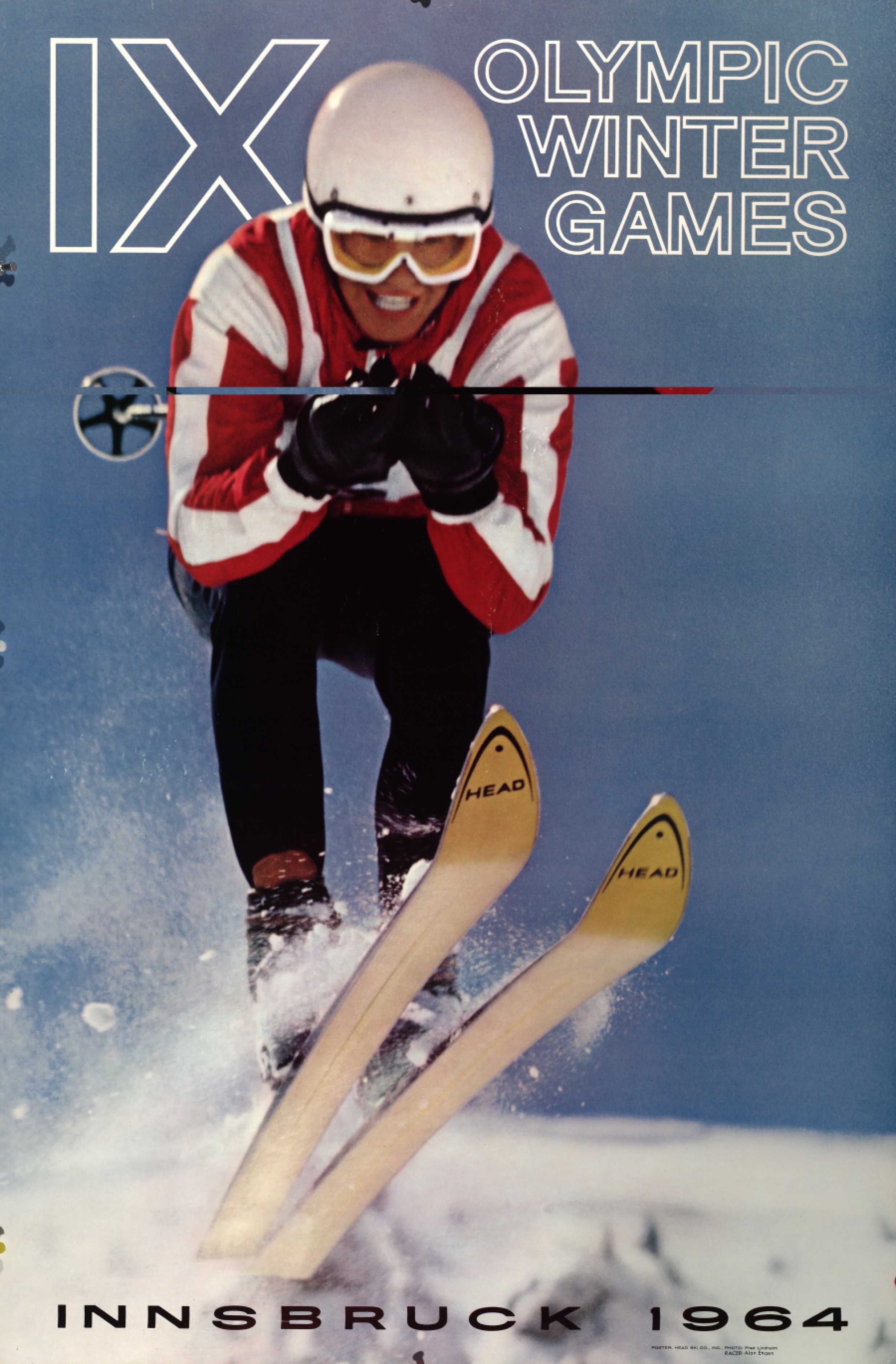
Head Skis launched the Competition model in late 1963. Fred Lindholm photo; skier Alan Engen.
Though American women had been top contenders in Olympic racing, the men had never medaled. In 1961, the National Ski Association picked University of Colorado coach Bob Beattie to renovate the national program. He was authoritative and ambitious, with a background in cross-country skiing and football coaching, but he was not stepping onto a level playing field.
According to U.S. racer Gordi Eaton, “At this time there was a strong emphasis on pro and amateur. We all knew that some European racers were taking money, but we had bought into the Olympic rules.” Tough situation for Beattie, the new strait-laced U.S. coach.
He responded to the challenge by creating a de facto national training center within his program at CU Boulder. He arranged athletic scholarships, access to facilities and support from local families.
Racer (and later coach and administrator) Bill Marolt recalls, “We were going to do it the American way. He had a vision for the program, and it was a game changer.” There were new advantages for the racers, but challenges, too.
For example, Beattie was fixated on physical fitness. As the leaves turned in Boulder, skiers ran the trails of Green Mountain, did the same type of agility drills as football players and hit the weight room.
Ni Orsi: Beats knew that strength was very important to winning.
Barbara Ferries: We did exactly what the boys did, except we were not allowed in the weight room. [Title IX was a decade away.]
Billy Kidd: Beattie knew how to get the most out of his athletes. And one of the things was you get in better shape than anybody else.
Bill Marolt: It was the Exhaustion Method.
1962 winter was a World Championships year. The skiers took incompletes in their classes and headed to Europe, planning to finish schoolwork in the spring. It was an adventure, especially for the women, who felt they were on their own without a coach (though their travel was managed by Fred Neuberger of Middlebury College). Nonetheless, they got good results.
Buddy Werner, winner of the 1959 Hahnenkamm downhill, was the team leader. He helped Chuck Ferries improve and win the 1962 Hahnenkamm slalom and grab second in the combined. Ferries also won the next slalom, at Cortina. His sister, Barbara, took bronze in the World Championship downhill at Chamonix, and Joan Hannah got bronze in giant slalom. Karl Schranz, of Austria, won the downhill and combined on fiberglass skis made by Kneissl.
Back at the Head factory in Timonium, Maryland, a new model was in the works. The Competition sported two layers of aluminum on top with a thin layer of neoprene rubber between them. This structure had a damping effect to reduce chatter. It was Howard Head’s ace-in-the-hole going into 1963.
Head Success in Europe
Jos Minsch at Harriman Cup.
Significant inroads were soon made to the Swiss national team with the help of Walter Haensli, a long-time Head confidant. Swiss skier Josef “Jos” Minsch, on Head skis, won the 1963 pre-Olympic downhill at Innsbruck, upsetting the powerful Austrians. As the European tour and big U.S. events wound down that spring, Werner, on Kästle wooden skis, and Jean Saubert, on Heads, were skiing well.
U.S. Nationals were held that spring at Mt. Aleyska, Alaska. Europeans Minsch, Barbi Henneberger and Willy Favre won some races, but their results did not count toward U.S. titles. Marolt won the downhill. Minsch was fastest in giant slalom but Werner, in second, got that title and also won the combined. Chuck Ferries won the slalom. Saubert took the women’s downhill and GS, Sandy Shellworth the slalom, and Starr Walton the combined. Most skied on wooden Kästle or Kneissl skis.
Jean Saubert at Harriman Cup.
The 1964 U.S. Alpine Olympic ski team was then named—eight men and six women. It was an eclectic group of talented skiers who had earned their spots with key results or were chosen by Beattie. Many excellent racers did not make the cut.
On August 25, 1963, the team met for its first training sessions at Mt. Bachelor, Oregon. The racers stayed at the rustic resort of Elk Lake. It was a fun and challenging situation, and team members had good feelings for each other but mixed feelings about coach Beattie.
Bill Marolt: We had cabins with wood stoves. In the morning, we’d have to build a fire to warm up.
Ni Orsi: We would take the lift up to near the top and then walk up farther to where we trained. No lift. We walked up, skied down and then walked up.
Billy Kidd: Buddy Werner was so gracious and generous, and would help the younger racers.
Barbara Ferries: Linda [Meyers] was the oldest and always the mother, trying to take care of everyone, especially me. Joanie [Hannah] just wanted to race. She had this work ethic—she tried really hard.
Gordi Eaton: Let me say this about Jean Saubert: great lady and a great competitor.
Kidd: Ni was a natural athlete, a champion water-skier. He could do anything and pick stuff up right away.
Starr Walton: Ni was terribly good looking. In Europe, he got in a little trouble because he wouldn’t quite make curfew or was out with girls.
Orsi: Beats was a great coach and tried his best to keep me under control. He even had me move in with him and his wife to make sure I was not destroying my Olympic hopes.
Kidd: I had to tape my ankle like a basketball player—couldn’t run a lot because my ankle would swell up or collapse. But he [Beattie] saw it as I was just not tough enough, not able to keep up, so he didn’t like me that much.
Ferries: There was a bit of tension between some of the girls and Beattie.
Joan Hannah: Beattie was trying to make us all ski the Dyna-Turn. It was his view of how Buddy skied. “Drive those knees!” Problem, he didn’t have the whole picture. We ended up slower.
Walton: Women need women coaches. He was a football coach, a boy’s coach.
Eaton: I loved the guy. It was time for someone to have this exceptional passion and dedication to U.S. skiing and U.S. ski racers year-round!
Marolt: It was a great situation for team building. Everybody jumped in and went as hard as they could go, which was fun.
A crew from Head set up a wax room in Skjersaa’s ski shop at the Mt. Bachelor base. Gordon Butterfield guided strategy and kept notes for the home office. Clay Freeman was a good skier and the racers liked him. The technical savant was Freddy Pieren. According to Head rep Tom Ettinger, “He knew more about how skis work than anyone in the country. Howard always listened to him!”
Kästle set up in an abandoned boat house, while other reps prowled by car from Bend. By the end of the first day, the Head shop had received visits from most of the team and many got filing and waxing help from Pieren and Freeman. Everyone had a common goal: win medals at Innsbruck.
On Tuesday, August 27, Pieren discussed flex patterns. Chuck Ferries opined that men and women need different skis. Tuning work continued. Beattie came by, made a cursory inspection, then left. He returned later to direct the Head team not to work on the racers’ skis; skiers should do it themselves. According to Butterfield’s notes: “Beattie has not been at all friendly. And it is difficult to evaluate if this is his total preoccupation with coaching or actual resentment.”
Reps Warned off Waxing
On Wednesday, Butterfield noted that everyone on the team was testing at least one pair of skis except Werner and Barbara Ferries. Butterfield met with Beattie. It became a dissertation by Beattie on his coaching philosophy, including that ski prep would be a coach/racer domain. The Head crew should not approach team members on the hill, and stay away during dryland training, indoor sessions and meals. Racers could come to the Head shop during their free time to work on their skis and consult with Head techs.
On August 30, Jimmy Heuga took out a pair of Head slalom skis. Werner, Chuck Ferries and Eaton—Kästle stalwarts—did not try the new Head slaloms. Beattie became more amicable.
On Sunday, September 1, Pieren had a chance encounter with assistant coaches Marv Melville and Don Henderson. Both enthusiastically endorsed Head products. Pieren quoted Henderson as saying, “By the time the team gets to Europe, we’ll have them all on Heads.” Butterfield noted in his report, “Relations are now excellent.” But not for everyone.
Walton met with Butterfield and confided she was having problems with Beattie. He advised that she do what he did and talk to the coach, get things out in the open. She was a free spirit, sure about what worked for her. Beattie was regimented, sure that his program was right for everyone. According to Walton, they never did settle their differences.
On September 3, Marolt, impressed by the International Professional Ski Racing Association racers using Heads the previous year, was on GS Comps. He said they were okay, but that he wasn’t skiing his best. Walton moved to a slightly longer slalom ski and reported them good. Her morale improved.
On September 4, Freeman drove Beattie to Bend for an appearance at a Rotary Club meeting. They thanked the locals for their support of the camp. Later that day Pieren and Beattie had a long conversation and needled each other a bit. The result was a more familiar relationship going forward.
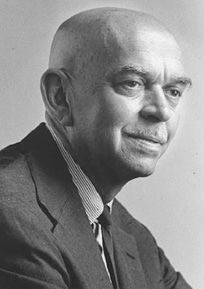
Howard Head was inducted into the US Ski Hall of Fame in 1979.
On September 5, Howard Head arrived on the scene. He had breakfast with Bill Healy, president of Mt. Bachelor, and then went up to the training area. As the racers quit for the day, Head greeted each one personally.
Beattie was there and “had to be nothing but jovial,” Butterfield reported . Then, surprisingly, he invited Head to address the Olympic team at dinner. This was a clear breach of his own rules and a possible sign of advancement for Head.
On the morning of September 6, the Head team said its good-byes and departed Elk Lake. Butterfield tapped out the last few lines of his report near Reno, where they dropped Head at the airport. It was a hot afternoon in the eastern Sierra. “It doesn’t feel the least bit like winter…but our mind’s eyes see visions of victory ceremonies at Innsbruck and of medals going to athletes using products made in the USA.”
Ross Milne Killed
Just under five months later, at Innsbruck, Orsi was preparing for a training run in the downhill when there was a course delay. He was on 220-cm Head Comps with Marker bindings, having switched from Kneissl and Look. Around the start, racers were warming up amid bare ground and rocks. There was so little snow that the Austrian army had hauled the stuff in to build the course. Orsi recalls that it was “very rough, narrow with little or no snow on the edges.”
The delay was for Australian racer Ross Milne, who had encountered people stopped on the course during his run. He veered off into the snowless woods and hit a stump. He died on the way to the hospital. Eaton also had a bad fall in training, tearing a boot upper from the sole and suffering a concussion.
The downhill race, on January 30, followed the opening ceremony by just a day, and Orsi remembers, “I regret not being able to march. Beats had the downhillers stay in their rooms to get a good night’s sleep.” Beattie had picked Orsi, Kidd, Werner and Chuck Ferries to run what Kidd called the “ribbon of ice.” All four finished in the top 20, with Orsi and Kidd leading on Head Comps, in 14th and 16th places. Minsch, on Heads, was just six hundredths off the podium in fourth. Orsi believes the Americans missed the wax but doesn’t remember who was responsible. “Our wax was wrong and cost us dearly,” he says. Austrian Egon Zimmermann won by .74 seconds on metal Fischers.
Racers who did attend the opening ceremony were thrilled. Barbara Ferries recalls, “I was like, ‘Oh my God, look what’s happening.’ We got the uniforms, we marched in the parade. It was very exciting.” Walton says, “That’s pretty cool when you walk in representing your country like that.” She also had American-made Head skis. “I am representing the United States, and if they have a ski that’s worthy, if they’ve come along with a ski that’s good, hell, I’d ski on an American ski.”
Christine Goitschel (left), Jean Saubert and Marielle Gotischel monopolized the slalom and GS medals at Innsbruck.
Walton led the American women in the downhill, placing 14th, with Hannah right behind her, Margo Walters placed 21st and Saubert 26th, all on Heads. Hannah was disappointed.
“Beattie missed the wax. There is nothing worse than feeling slow skis on the flat,” she says. “The wax should have been skied out. We finished in the order we skied on our skis. Jean Saubert carried her skis to the start and was the last of us.”
The men’s giant slalom was on a steep, icy pitch, but with a rhythmical set. Kidd placed seventh on Head Comps, and Marolt, from bib 28 and also on Heads, was 12th. Heuga and Werner, both on wooden Kästles, disqualified.
Medals for Saubert, Kidd, Heuga
In the women’s giant slalom, Saubert, on Heads, tied for second and secured America’s first skiing medal at Innsbruck—the French Goitschel sisters, in first and tied for second, used aluminum Rossignol Allais 60 skis. Barbara Ferries was 20th, also on Heads, and Hannah and Linda Meyers were 26th and 30th. Saubert scored again in the women’s slalom, taking the bronze on Head skis. Meyers was 12th and Hannah 19th. Ferries disqualified. The winner was Marielle Goitschel (on the new Dynamic-built RG5 fiberglass skis).
Billy Kidd en route to slalom silver.
The men’s slalom was the last Alpine event of the Games. Beattie entered Werner, Chuck Ferries, Kidd and Heuga, all on Kästle skis. In a very close race, Kidd and Heuga made history for American men by taking silver and bronze. Werner was eighth, and Ferries, characteristically pushing too hard, disqualified.
Jimmie Heuga took bronze.
All things considered, it was a fine Olympics for the U.S. team. Beattie’s new system essentially worked. The women continued to excel, and the men finally took home some hardware. And Head cracked into the ski racing market. The U.S. box score: two medals for Head and two for Kästle.
Ni Orsi: For the most part we competed against professionals and with such a disadvantage, I think we did extremely well.
Barbara Ferries: The most important thing Bob [Beattie] did for us was that he put us together as a team. We cheered for each other. It was a fabulous time.
Gordi Eaton: Friendships were made, and they still endure. Most of us feel very fortunate to have been involved during this time.
Ferries: The Head skis—that was a big deal for the American team to have those skis.
Starr Walton: I did the best I could do, and for me, at the end of the day, that’s my gold medal.
Howard Head continued to innovate in ski technology, but in 1969 he sold the company. He had raised his $6,000 opening bet into a $16 million jackpot. Ever the restless inventor, he eventually got into another sports racket and rallied a new company, called Prince.
For research help, the author thanks Richard Allen, Abby Blackburn, Christin Cooper, Chip Fisher, Mike Hundert, Leroy Kingland, Brian Linder, Marv Melville, Paul Ryan and all the quoted racers.