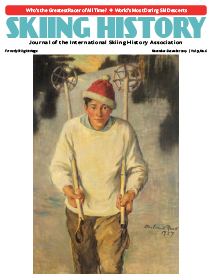
Skiing History Week is ISHA’s annual gathering, presented in partnership with the U.S. Ski and Snowboard Hall of Fame. Higlights include ...
March 26: ISHA Awards Banquet (Sun Valley Inn)
Join ISHA in honoring the year’s best ski history books, films and websites, created by historians from around the world. Plus ISHA’s prestigious Lifetime Achievement Award and a special Stewardship Award!
March 28: U.S. Ski and Snowboard Hall of Fame Induction Gala (Sun Valley Inn)
Eight snowsport pioneers will be honored as members of the Class of 2019 at a red-carpet gala. To read inductee bios, go to skihall.com/class-of-2019.
The jam-packed schedule also includes an ISHA welcome reception, parties, guided mountain tours, a freestyle
reunion, the ISHA Legacy Lecture and a retro ski day.
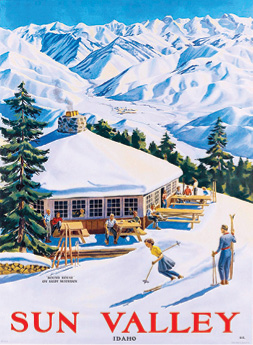
• Discount lodging is available at the Sun Valley Lodge, Sun Valley Inn and Limelight Ketchum Hotel. Space is limited, so book your room soon!
• To book lodging at the discounted rates, you must first purchase tickets online to the ISHA Awards or to any Hall of Fame event (sold separately). Your confirmation email will include hotel codes, links and booking instructions.
• Event ticket-holders can also buy discounted daily lift tickets ($65) Monday-Sunday at Sun Valley with a photo ID.
January 21–26: 80th Hahnenkamm World Cup Race Week
Kitzbühel, Austria
Long considered the Super Bowl of alpine racing for those with an American sports perspective, Hahnenkamm Week is skiing’s ultimate test of guts and glory. Celebrating its 80th year, the race week culminates with the legendary downhill on the Streif, considered the most demanding, and most dangerous, downhill course on the World Cup circuit. Competitions include men’s Super-G, downhill and slalom. The race weekend can also be touted as the world’s biggest après-ski party, with upwards of 85,000 spectators annually streaming into the town of Kitzbühel, population about 8,000.
January 23 –February 2: Sundance Film Festival
Park City, Utah
Perhaps the most recognized film festival outside of Cannes, the Sundance Film Festival takes over Park City, Utah, each winter with daily screenings, panel discussions, filmmaker and audience Q and As, and such. Since 1985, hundreds of films that have launched at the festival have gained mainstream and critical acclaim. A side benefit for cinephiles who also happen to ski: The local slopes tend to be quiet during the festival, which attracts primarily non-mountain types.
February 5–9: 107th Annual Winter Carnival
Steamboat, Colorado
From skijoring down main street to the Lighted Man’s human fireworks show on Howelsen Hill, the oldest continuous Winter Carnival west of the Mississippi is an unapologetic celebration of winter. The event was started in 1914 by the Steamboat Springs Winter Sports Club to help frontier-town residents cope with cabin fever during the rugged northern Colorado winter.
Top exec will step down after five decades at the sport’s governing body.
Gian Franco Kasper, the president of the International Ski Federation (FIS), recently announced that he will step down this spring after 22 years at the helm of the sport’s governing organization. Both an effective and controversial executive, Kasper has held different roles at FIS for nearly 50 years.
Photo at top of page: An effective and controversial leader, Kasper’s reign has been spiked with controversy, often fueled by his off-hand remarks. DPA Picture Alliance / Alamy Stock Photo
Kasper, 75, was named secretary general of the federation in 1975 and took over as president in 1998. He succeeded the late Marc Hodler, who at 80 had headed FIS for nearly 50 years, the longest reign at any international sports organization. Under Hodler, the season-long World Cup competitions and freestyle were introduced, snowboarding competition came under FIS governance, and he exposed the bid-rigging scandal of the 2002 Winter Olympics.
Under Kasper’s reign, the number of ski and snowboarding medaling sports at the Winter Olympic Games has multiplied to more than 50, with many new freestyle events successfully geared to attracting a younger audience.
The FIS began in 1924 as a Scandinavia-based and operated organization. The first two presidents were a Swede and a Norwegian. With Hodler’s election in 1951, the FIS moved its headquarters to Switzerland, where they have remained for almost 70 years. The current headquarters are in Oberhofen, where the influential Marc Hodler Foundation is also located.
Regarding Kasper’s succession, the FIS says that it supports “a timely process for the national ski associations to prepare any applications for candidacies.” The less-than-transparent Hodler-Kasper succession process in 1998 was harshly criticized by former FIS vice-president Bjorn Kjellstrom. The betting now is on another Swiss, Urs Lehmann, 1993 world championships downhill gold medalist, President of the Swiss Ski Federation, a successful business consultant, President of the Laureus Foundation, and husband of Swiss acrobatic ski champion Conny Kissling.
Kasper’s long tenure also has been spiked with ongoing controversy, occasionally fueled by his off-hand remarks. Last year he caused worldwide headlines and brief outrage when in an interview with a Swiss journalist he sarcastically remarked that with authoritarian governments it was easier to overcome environmental obstacles to Olympic site selection. He previously found himself under the spotlight in 2005 after commenting about women ski jumpers that the physical force upon landing “seems not to be appropriate for ladies from a medical point of view.” The FIS did eventually sanction women’s ski jumping, which made its Olympic debut at the 2014 Sochi Winter Games.
This season, Kasper scrapped with athletes and coaches who criticized the expanded 2019-20 alpine schedule for not providing enough time for travel and proper recuperation. Kasper conceded that the alpine World Cup circuit contains “too many races,” and then offered not much more than sympathy.
“I know it’s not easy for the athletes and also for some organizers. We are now at a certain limit, there is no question,” Kasper said at a press event in October. “But FIS is not here to prevent races but to organize races.” He did say that the FIS would look into improving its scheduling process. Without Olympic Games or World Championships this season, the current alpine World Cup schedule runs nonstop from October through March, with 44 men’s events and 41 women’s events at nearly two dozen venues.
Kasper, a former journalist, also has held leadership roles with the International Olympic Committee and the World Anti-Doping Agency, among others. He was elected to another four-year term as FIS President in 2018, but will only make it halfway through. He will officially resign his post at the next FIS Congress in Thailand in May. --Greg Ditrinco
Wear Your Passion on Your Sleeve
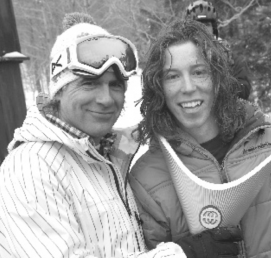
Sun Valley resident Karl Johan has been collecting Demetre sweaters for years, picking them up at garage sales, thrift stores and online.
Karl Johan grew up with an immutable ski uniform: a Demetre sweater. It made sense. He lived in Seattle, near Demetre’s Ballard-based factory. And his family all wore the sweaters whenever they skied. As did most Seattle-based skiers.
The factory and the brand have since shut down (Roffe purchased Demetre in 1987, and itself closed a decade later), but the sweaters still live on in Johan’s memories and closet in Sun Valley.
Karl Johan. Photos: Karen Bossick / Eye On Sun Valley
Marketing director for Sun Valley Culinary Institute, Johan has long collected the sweaters at garage sales, thrift stores, retro clothing stores, online—wherever he can find them. When he nabs one, he cleans it, steams it, and stashes it away. His collection can number more than 50 sweaters at a time. That number decreases whenever he holds a pop-up vintage sweater sale in Sun Valley.
Johan notes that the old-school sweaters hold up remarkably. “The designs and colors are amazing,” he says. And “they look brand new” whenever he still sees them on the slopes. He also enjoys the local angle to his soft-goods obsession, as John and Sally Demetre have long had a home in Sun Valley.
Demetre was founded in 1921 by John’s father as the Standard Knitting Company, which manufactured uniform sweaters out of its factory in Ballard, Washington, which is now a hip waterfront neighborhood of Seattle. During the time Demetre sweaters were being manufactured, Seattle was one of the largest apparel centers in the country and considered a pioneer in outerwear.
In the early 1960s, Demetre saw a business opportunity in the explosive growth of skiing, and expanded into ski sweaters. The company landed early sponsorships with the U.S. and Canadian Olympic ski teams. The U.S. Ski Team wore Demetre sweaters at the 1972 Winter Olympics in Sapporo, Japan. During its heyday, Demetre was tagged “America’s first name in fine ski sweaters,” with an ad from a 1972 issue of Skiing magazine pledging: “One look and you know it’s Demetre.”
As any skier of a certain age can confirm, Demetre sweaters were colorful, comfortable, and tightly woven to provide superior warmth. The construction resulted in a heavy-weight sweater that was virtually indestructible. Not surprisingly, many of the sweaters have survived, now 50 or so years later. And many Demetre fans have kept their favorite sweaters.
Pinterest, Ebay and other websites are full of Demetre sweaters—and memories from skiing’s golden era. One fan blissfully noted of her Demetre sweaters, “I wore them when I was skinny.” —Greg Ditrinco
Sailer in his early days as head of the Buck Hill racing program
Buck Hill Marks 50 With Sailer
In December 2019, Buck Hill—a small Minnesota ski area with a big racing reputation—celebrated 50 years with its legendary coach, Erich Sailer. Since founding the racing team back in 1969, Sailer has churned out an impressive roster of Olympic and World Cup athletes, including Kristina Koznick, David Chodounsky, Tasha Nelson and Lindsey Vonn. Vonn retired in 2019 with four World Cup overall titles, 11 Olympic and FIS World Championship medals, and 82 World Cup victories—a record for women, and just shy of Ingemar Stenmark’s record-setting 86 wins.
Celebrating five decades at the Minnesota ski area in December 2019 with Jacob Olsen and Jessica Stone, daughter of founders Nancy and Chuck Stone.
Thanks to Sailer, Buck Hill is home to one of the country’s most active recreational racing programs, drawing youth and adults from the Twin City suburbs for training, leagues and competitions. An honored member of the U.S. Ski and Snowboard Hall of Fame, the Austrian-born coach pioneered summer ski racing in the United States in 1956 with a camp at Timberline on Oregon’s Mount Hood. By 1967, his camp near Red Lodge, Montana had become the biggest in the country.
Buck Hill was founded in 1954 by Charles “Chuck” Stone Jr. and his future wife, Nancy Campbell. In late 2019, Nancy published Buck Hill: A History. To purchase a copy, email ncstone@aol.com. —Kathleen James
Snapshots in Time
1866 SONDRE NORHEIM’S HEEL
In 1733, a Norwegian military officer, Col. Jens Henrik, wrote the first ski instructions for the military. Those rules contain the first mention of heel bindings, but illustrations of military skiers throughout the 18th century show only toe straps. Despite the increased pressure of jumping and racing competition, begun in 1765 and 1767 respectively, the heel binding didn’t really catch on until Sondre Norheim’s dramatic exhibition at Mordegal a century later. “With legs drawn up, he flew like a bird.” Thus 41-year-old Norheim impressed the crowd at an 1866 jump at Hoydalsmo, near Mordegal in Telemark. Within two years, the Telemark skis—cambered at the waist, broadened at the tip—and Norheim’s new heel bindings astonished the crowd at Christiana. Sport skiing was on its way. —Ted Bays (Nine Thousand Years of Skis: Norwegian Wood to French Plastic)
1936 SISSIES, SPOILSPORTS AND MOTHER-FRIGHTENERS
The first death on the slopes shook up the small skiing fraternity of the day. An emergency meeting was called by the New York Amateur Ski Club, whose founder, Roland Palmedo, appointed Minot “Minnie” Dole chair of a committee to inquire into the causes and handling of ski accidents. The results of their questionnaires was disappointing. Only a hundred replies dribbled in. Of these, roughly half accused the committee of being “sissies, spoilsports, and frighteners of mothers.” —Gretchen Rous Besser, “Samaritans of the Snow” (Collected Papers of the International Ski History Congress, 2002
1959 LISTEN AND LEARN
Have you reached a plateau in your skiing where nothing seems to help you improve? Then “Skiing by Ear Method” may be just what you need! Relax and learn with these 33-1/3 rpm records. $8.95 each. Money-back guarantee! —Advertisement in SKI “Holiday Gift Guide” (December 1959)
1967 WORLD CUP ACCOLADES
The winter of 1967 marked the beginning of a new era in international ski racing. For the first time in the history of the sport, the world’s best racers were rated not on the basis of one or two headline races, but on a systematic accumulation of results over the whole season. The new system proved a smashing success. So much so that the World Cup of Alpine Skiing is to become a permanent annual fixture of the sport, rivaling the Olympics and the FIS World Championships. Initially ignored by international ski officialdom, the World Cup won instant and enthusiastic acceptance by the two groups most important to the success of ski racing: the racers themselves and the press, who report the results to an eager public. —John Fry (SKI, September 1967)
1978 THE BUCK STOPS HERE
Your three-miles-a-day skier is starting to see the wisdom of the East. For the first time, Stratton (Vermont) is drawing vacationing skiers from Washington DC, Texas, Georgia and Puerto Rico. And these are not weekend skiers. “Vail, founded the same year we were, programmed itself as a vacation resort from the beginning,” says Stratton marketing manager Jeff Dickson. “It worked closely with airlines and travel agents and ski clubs to get people to come for a week. The Eastern resorts are waking up. The only way we can support the lifts we’re building is by becoming a vacation destination.” —Morten Lund (SKI, September 1978)
1989 CLAMORING FOR THE BEST
A great perplexity hits me every time I hear skiers talking about lift ticket prices. Late last season, I skied Butternut Basin in the Berkshires. The change from eight years earlier was dramatic: lifts, lodges, trails, parking and food were greatly expanded. And instead of narrow ribbons of icy snow or rock-hard moguls, the trails were white velvet from edge to edge. As good as Colorado. What happened? Butternut has been transformed into the New Skiing, with trail systems that disperse skiers around the hill, massive snowmaking, and squads of grooming machines that work every trail by sunrise into a soft-but-firm surface that spells, “Have a ball.” Yet skiers are having a fit—those lousy lift ticket prices keep rising. —Morten Lund (Snow Country, January 1989)
2000 HIGHER POWER OF POWDER
In the 2000–2001 season, I didn’t finish 13 of the 24 races I entered. I’ve seen people lose their hair or get religion over less. But I knew I was getting better; I knew I had far more control than ever before. It just wasn’t always obvious to everyone else. And explaining myself all the time got old fast. Better to be laconic—the shrug, the smirk. People hear what they want to, anyway. … When fans or young racers ask me the Big Question, I tell them: “Go fast.” It’s the whole deal, the only tip worth taking. —Two-time overall World Cup champion and 11-time Olympic and FIS World Championship medalist Bode Miller (Bode: Go Fast, Be Good, Have Fun)
SKI LIFE
from SNOW COUNTRY / DECEMBER 1988
That’s not what I said; I said “We have six inches of powder under an ice crust.”
Why's It Called That? Mont Tremblant
The Algonquin believed that Quebec’s Mont Tremblant trembled when violated by human exploitation.
The mountain lay in the heart of Weskarini Algonquin territory, and was the home of the Great God, or Manitou. They called it Manitou Ewitchi Saga, the mountain of the great god, or Manitonga Soutana, mountain home of the spirits. In 1652, Weskarini were massacred here by invading Iroquois. Many sought refuge with French Jesuits, and were forced to convert to Catholicism.
The Weskarini believed the mountain trembled when violated by human exploitation. And so the French settlers adopted the name Mont Tremblant (“Trembling” in English). What the Weskarini meant by “trembling” is unclear; one folk-tale recounts violent storms destroying swathes of forest. Seismic activity is common. Several faults run within 50 miles of the mountain and the region has recorded at least one magnitude 6.9 earthquake in the past 250 years, and a couple of 4.5 quakes right in Ste-Agathe during the past 25 years. It’s possible that the Weskarini actually felt the mountain shake. —Seth Masia
Ski Art: Gunnar Hallström (1875–1943)
On the one hand Gunnar Hallström, Swedish painter of national-romantic scenes, was everything a modern environmentalist might honor. He settled on the island of Björko in Lake Malar, about an hour by boat out of Stockholm, and became involved in the preservation of Birka, Sweden’s oldest town, and in the maintenance of the island’s traditional farms. He persuaded the government to buy up the land and put it under protection. Today it is managed by the Riksantikvarieämbetet, the National Heritage Board.
But there is another side to Hallström’s art, first coming to notice in the early years of the 20th century. The frontispiece of Henry Hoek and E. C. Richardson’s 1907 Der Skilauf und seine sportliche Benutzung (Skiing and its Sporting Use) is a reproduction of Hallström’s skier. The original is believed to have been owned by a Munich publishing firm that later had connections with the Nazis. When the Germans were in deep financial trouble following World War I, communities printed their own money, called Notgeld. The town of Furtwangen put Hallström’s Schneeschuhläufer (Ski Runner) on its 10-mark note. That gained him a great deal of attention. In 1921, for example, the German Ski Association’s journal Der Winter called Hallström “well known.”
In the political turmoil of the 1920s and 1930s, Hallström moved to the right in Sweden and became involved in decorating with swastikas one of the lodges to which Hermann Göring fled after the failed 1923 Hitler putsch. He signed his initials in the spaces created by the squared swastika symbol, and he appears to have been involved with the pro-Nazi Swedish Carlberg circle.
Politics aside, the painting illustrated here, used both as the frontispiece to Hoek’s and Richardson’s book and as the formidable image on Furtwangen’s 10-mark note of December 1, 1918 proves his knowledge of skiing as well as his expertise in landscape depiction. —E. John B. Allen
After World War I, a German town used Hallström’s image of a skier on its 10-mark note. He was likely involved with pro-Nazi circles in Sweden. --E. John B. Allen
This article first ran in the January-February issue of Skiing History.
ISHA will honor the Swiss Academic Ski Club and the year’s best ski-history books, films and websites in Sun Valley.
The International Skiing History Association (ISHA) will present more than a dozen awards at its 27th annual banquet, to be held March 26 in Sun Valley, Idaho.
The Swiss Academic Ski Club (SAS) will be honored with ISHA’s prestigious Lifetime Achievement Award for more than 90 years of promoting and preserving the history of the sport. Founded in 1924, its wide-ranging mission includes leading the Swiss alpine and nordic university teams, organizing races and events and publishing Der Schneehase, a highly regarded ski-history compendium. SAS Schneehase president Ivan Wagner will travel to Sun Valley from Zurich to accept the award, which focuses on SAS accomplishments in documenting ski history through 39 deeply researched and illustrated editions of Schneehase since 1924. Schneehase president Ivan Wagner will travel from Zurich to accept the prestigious Lifetime Achievement Award on behalf of SAS.
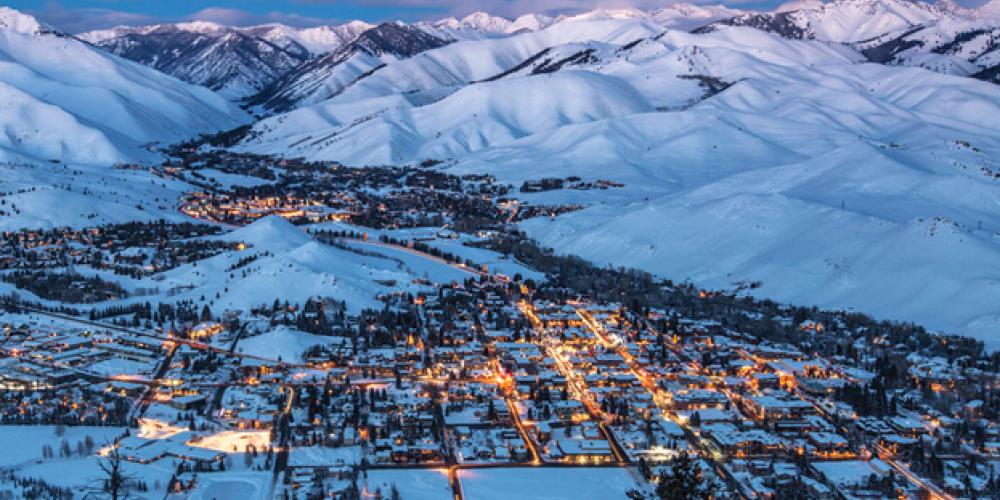
Tickets are on sale now for the ISHA Awards! All ticket holders are eligible for discounted lodging and lift tickets during Skiing History Week in Sun Valley. The jam-packed March 25–28 schedule includes parties, on-mountain events (retro ski day, first tracks, guided tour), history lectures and films, the ISHA Awards (Thursday, March 26) and the U.S. Ski and Snowboard Hall of Fame induction ceremony (Saturday, March 28). For details, go to skiinghistory.org/events.
The evening kicks off at 5:30 pm with a cocktail reception in the Limelight Room at the Sun Valley Inn. Award winners will be on hand to sign and sell books and DVDs. All are welcome; cash bar. The banquet begins at 7 pm for ticket holders only. It’s a lively evening as ISHA Awards chair Rick Moulton and president Seth Masia present entertaining historic video clips and authors offer snippets of insight into their research.
At the banquet, ISHA will also present its Stewardship Award to the Holding family for their decades-long commitment to preserving the history of the Sun Valley ski resort, which they purchased in 1977.
Established in 1993, the ISHA Awards are presented every year to creators of outstanding ski history books, films and DVDs, websites, museum exhibits and other works of creative media. The winners of this year’s ISHA Awards are:
ULLR AWARD
Presented for a single outstanding contribution or several contributions to skiing’s overall historical record in published book form.
Skis in the Art of War by K.B.E.E. Eimeleus. Translation and commentary by William D. Frank, with additional commentary by E. John B. Allen
Skispuren: Internationale Konferenz zur Geschichte des Wintersports (Ski Tracks: International Conference on the History of Winter Sports) by Rudolf Müllner und Christof Thöny, editors. For a review, see the September-October 2019 issue of Skiing History.
Unique and Unknown: The Story of Biathlon in the United States by Arthur Stegen. For a review, see the November-December 2019 issue of Skiing History.
Leisure Cultures and the Making of Modern Ski Resorts, edited by Phillipp Strobl and Aneta Podkalicka. For a review, see the May-June 2019 issue of Skiing History.
SKADE AWARD
Presented for an outstanding work on regional ski history, or for an outstanding work published in book form that is focused in part on ski history.
Heja Persson!: Samisk triumf i Vasaloppet (Sami Triumph in the Vasaloppet) by Isak Lidstrom
Lost Ski Areas of the Berkshires by Jeremy Davis
Honorable Mention: Snowboarding in Southern Vermont: From Burton to the U.S. Open by Brian L. Knight
BALDUR AWARD
A new category of awards presented for books that have not been written as ski histories, but possess valuable historical content.
Ski Inc. 2020 by Chris Diamond with Andy Bigford. For a review, see the November-December 2019 issue of Skiing History.
Alpine Cooking: Recipes and Stories from Europe’s Grand Mountaintops by Meredith Erikson
The Man behind the Maps: Legendary Ski Artist James Niehues by Jason Blevins, with illustrations by Jim Niehues. For a review, see page 30 of this issue.
FILM AWARD
Presented for an outstanding contribution to the historical record of skiing in photographic or film/digital form
North Country, produced by Anthony R. Lahout, written and directed by Nick Martini
Ski Bum: The Warren Miller Story by Patrick Creadon and Christine O’Malley
Honorable Mention: Abandoned by Lio DelPiccolo, Sara Beam Robbins and Grant Robbins. For a review, see the September-October 2019 issue of Skiing History.
CYBER AWARD
Presented for creating a website that contributes substantially to the preservation, distribution and expansion of skiing’s historical record
DrySlopeNews.com by Patrick Thorne
Honorable Mention: From Chimney Corner: An Illustrated History of Slovenian Skiing by Aleš Guček.
MEMBER PROFILE: Klaus Obermeyer
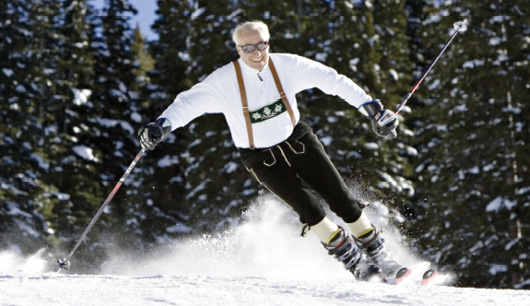
Klaus Obermeyer, who celebrated his 100th birthday on December 2, 2019, embodies skiing’s history in the 20th century. Klaus was raised in Oberstaufen, Bavaria, hard up against the Austrian border and a jumping site since 1908. At age three he nailed his best shoes to a pair of slats from a fruit crate and took himself skiing. From then on, he’s been tinkering to improve ski gear and clothing.
Klaus was seven years old, and skiing on real skis crafted by Marius Eriksen, when Rudolf Lettner patented the segmented steel edge for skis. When he arrived in St. Anton as a teenaged ski instructor, he quickly found a set of Lettner edges and taught himself enough carpentry to install the edges on his own skis. He befriended St. Anton native and Arlberg-Kandahar champion Friedl Pfeifer, who soon departed for America and eventually the 10th Mountain Division.
One of his skiing students offered Klaus an apprenticeship at Maybach, in Friedrichshafen, just 25 miles from home. The company had been founded, in 1909, to build Zeppelin engines. Klaus assembled state-of-the-art engines for trucks, planes and tanks. Then it was to Neuaubing near Munich and a job designing landing gear for Dornier aircraft (not unlike Howard Head’s career drafting parts for the Martin B-26). At night, Klaus attended engineering school for three and a half years.
Klaus rarely talks about this traumatic era. The Dornier factory in Friedrichshafen was heavily bombed, but not the factory in Neuaubing. Klaus says he was desperate to get out of Germany and tried unsuccessfully to ski into Switzerland.
In 1947 Klaus finally made it to America. There he chased down Friedl Pfeifer and began teaching skiing again. That summer he did odd jobs and painted houses. With Warren Miller, he made and sold Bavarian “kugi” ties. But his technical mind saw ways to improve cold-weather comfort for his students. The first problem was terrible leather ski boots. He improved the standard double-boot design with a comfy cushioned rubber innerboot and had it manufactured by Wagner and Rieker (about 40 miles northwest of Friedrichshafen) under his own label Garmisch. It sold for $44.95. With Pfeifer he formulated and sold a high-altitude sunblock cream. Then he imported sweaters and innovative turtlenecks, Carrera goggles and nylon windshirts.
1955 was a breakthrough year. Klaus adapted the down parka (marketed to hunters since 1935 by Eddie Bauer) for skiers, using water- and windproof nylon fabric, and patented the first “flow” material for ski boots (“It was auto grease,” he confided in 1982). In 1967 he set up a production line to manufacture Bob Smith’s double-lens goggle, imported Sanmarco ski boots beginning in 1972, and introduced the first two-prong ski brake, long before major binding companies picked up the idea. Meanwhile, sales of colorful, comfortable skiwear designs by wife Nome grew, becoming the premier American skiwear brand by the early ‘70s.
Klaus still comes to the office daily, still skis, swims and rides his horses. “I really love Skiing History,” he says. “It’s so nice to have a publication that talks about the development of skiing, how it started and grew in America and worldwide. I love to read it, and to see pictures of my old friends!” —Seth Masia
Send It to a Friend
The best way to recruit a new ISHA member is to show them a copy of Skiing History. This is important because, as a nonprofit, we rely on on membership dues and donations to publish our colorful bimonthly journal, continually expand our website as a global resource for skiers and researchers, and present our annual awards.
Here’s an easy way to help us out: If you know someone who’s a likely prospect, we’ll send them a free one-time copy of Skiing History. Submit your request online at https://skiinghistory.org/send-friend-trial-membership. We’ll take it from there!
SKI LIFE
from SKIING / OCTOBER 1966
This article first ran in the January-February issue of Skiing History.
The cover of the November-December 2019 issue of Skiing History—and the accompanying painting of a ski jumper soaring over Salisbury, Connecticut—reminds me of home!
Growing up in northwestern Connecticut, my hero was Roy Sherwood, who competed in the 1956 Cortina Olympics. Roy was the constable on our lake, trying to keep a bunch of delinquents out of trouble. He was a straight shooter and a fair man, and we dedicated the lyrics “Oh Roy, oh Roy, is you the law?” to him. (Long Tall Texan by The Kingsmen, 1963).
In the spring of 1963, I stayed in Aspen at the home of Dave and Sherry Farney, along with cinematographer Dick Barrymore. We were all bagging it on the Farneys’ floor. Future Olympian Cindy Farney was just a toddler. At the time, Aspen was a small town with dirt streets and a few chairlifts. We also skied Vail, then in its first season, and the die was cast: I would get back to Colorado at my earliest excuse (CU, Class of 1969).
As a teen, I revered Buddy Werner, Billy Kidd, Jimmie Heuga and Bob Beattie—names and faces I saw featured in your fall fundraising mailing. As an adult, I was excited to attend a party for business associate and Hall of Famer Chuck Ferries at the home of Barb and Scott Henderson in Nederland, Colorado. Bob, Billy and Jimmie were there.
Having skied since age four, and having had small interactions with some of these greats, Skiing History is my favorite read, month after month.
Jonathan Williams Denver, Colorado
Further on Redford’s Roffe
After reading “The Tale of Redford’s Roffe” in the November-December issue, I thought I’d add a personal touch to Wini Jones’ letter about Roffe’s clothing efforts for the U.S. Ski Team and Redford.
I commuted to work in Seattle with Wini via the Banbridge Island ferry from the late 1970s to the mid-1990s. She was heading into the city to design and manage at Roffe Ski Company, and me to lawyer elsewhere. Back then, I was a 6-foot-tall, 225-pound ex-football player who could not find a ski pant to fit what my future ski tailor later referred to as my “trees.”
Wini took pity in 1985. She invited me to the red-brick Roffe building in downtown Seattle—now pretty much Amazon central. It was snowing hard. Seattle was paralyzed. I walked up a few flights of stairs with Wini to the third floor, an open warehouse-type space with wooden beams. She introduced me to “Sam.” He was mid-70s, me maybe 30.
Sam was handling the tape measure. Clearly, he was a tailor. He and Wini decided on a starting size from which to construct pants for me, the mis-designed client. The result was that Sam Roffe (owner of the company) and Wini (a SKI Magazine “Woman of the Year”) designed, sewed and presented to me a pair of custom-fit, navy blue, over-the boot stretch Gore-Tex ski pants. I wore them well into my three decades at Sun Valley. Today I tuned Wini’s Völkls for Christmas at Whistler. Great magazine!
Who needs powder? A Minnesota resort goes to the mat for its future. By Greg DiTrinco
There is an annoyingly capricious component of the sport of skiing. It’s called snow. Both skiers and resort operators alike have to deal with the seasonal limits of their passion—and their business model. So what if you removed the unpredictability of snow from the sport?
Buck Hill, Minnesota, aims to find out. This mighty mite of a ski area, tucked in a few miles south of the Twin Cities, is perhaps the biggest supporter of a small, but growing segment of the industry: four-season skiing. The resort has installed an all-year skiing surface to create—in theory—an endless winter. Now a few seasons into the radical experiment, “It took a while, but I’m pleased with where we are,” says Dave Solner, Buck Hill’s CEO and co-owner...
Next winter, the U.S. Ski and Snowboard Hall of Fame will induct up to eight new honored members, selected from a ballot of 15 nominees. But the ballot of 15 was chosen from a list of 71 skiers nominated by their friends and family. It took two rounds of voting, by a selection committee of 25 chaired by Jeff Leich of the New England Ski Museum, to break ties. Fewer than 11 percent of those nominated will be chosen by the electorate, numbering about 365 ski-sport veterans. The odds are long, and not likely to improve.
The field wasn’t always this crowded. Long-time ski-show promoter and Hall of Famer Bernie Weichsel recalls that when he was elected chairman in 2009, “We had to beg people to submit nominations. The Hall simply wasn’t very well known.”
Between 1985 and 2008, there were 14 years when the Hall found four or fewer inductees. At that point the selection committee instituted new criteria, and nominations began to grow after 2011, when the Hall partnered with ISHA for a gala event in Sun Valley. By organizing a reunion of professional freestyle skiers, Weichsel boosted attendance at the Hall’s induction banquet to about 600, and drew national attention. Weichsel also promoted the Hall at trade shows and ski resorts. One result: Baby boomers in the ski business began nominating their friends.
During his tenure on the selection committee (beginning around 2005), U.S. Ski Team communications chief Tom Kelly made sure that champion athletes got nominated. That’s a rich source: With the addition of freestyle and snowboarding to the FIS schedule, and new events in alpine and nordic competition, the number of medalists and World Cups has tripled. For instance, at the 1984 Olympics, American skiers won five medals of 87 available (5.7 percent). In 2018, Americans took home 14 medals of 255 awarded (5.4 percent). That’s triple the number of medalists who will eventually find their way into the Hall of Fame. Pro freestylers and prominent snowboarders also build the count of Hall nominees.
According to newly elected Hall chairman David Ingemie, the board of directors wants to limit nominations to people with national, as opposed to regional, influence. Another challenge is that people who are well known for leading large organizations—corporate executives, for instance—tend to pull more votes than innovators, regardless of their universal influence, who worked behind the scenes. For them, the odds are long indeed.
A new coalition of volunteers, ski areas and landowners team up nationwide to restore historic ski trails—and launch a backcountry movement. By Jeremy Davis
The power of the people is gaining traction deep within the hardwood glades of New England, and spreading to the backcountry nationwide. Nonprofit groups, passionate skiers, landowners and ski areas are moving beyond traditional rivalries to band together to reopen historic trails.
New England is full of such remnants of its skiing past. More than 600 rope-tow and lift-served areas have closed in the past 80 years, along with downhill trails unserved by lifts. The Granite Backcountry Alliance (GBA), based in northern New Hampshire, is part of a new movement that’s looking to skiing’s past as a path to its future. The GBA, 400 members strong, recently resuscitated the long-lost Maple Villa Trail, in Intervale, N.H., on the outskirts of North Conway.
Though the unofficial hub of this trail reclamation phenomenon is anchored in the history rich—and therefore opportunity rich—mountains of New England, just about anywhere there are skiers, there are historic trails being rebooted—or at the very least, backcountry skiers banding together to preserve access to popular routes...
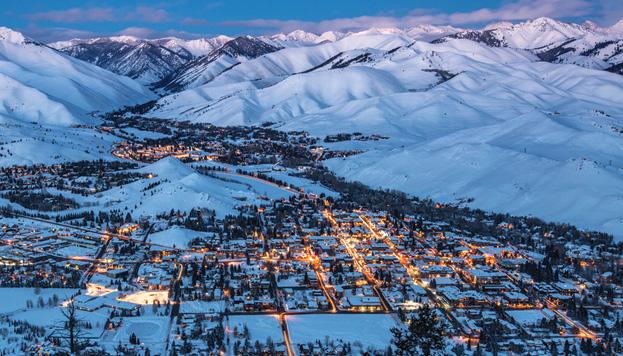
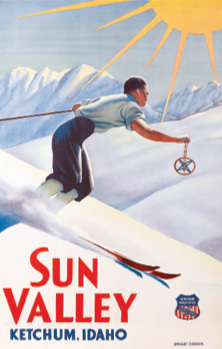 JOIN US FOR SKIING HISTORY WEEK!
 • Discount lodging is available at the Sun Valley Lodge, Sun Valley Inn and Limelight Ketchum Hotel. Space is limited, so book your room soon!


 The mountain lay in the heart of Weskarini Algonquin territory, and was the home of the Great God, or Manitou. They called it Manitou Ewitchi Saga, the mountain of the great god, or Manitonga Soutana, mountain home of the spirits. In 1652, Weskarini were massacred here by invading Iroquois. Many sought refuge with French Jesuits, and were forced to convert to Catholicism.
 On the one hand Gunnar Hallström, Swedish painter of national-romantic scenes, was everything a modern environmentalist might honor. He settled on the island of Björko in Lake Malar, about an hour by boat out of Stockholm, and became involved in the preservation of Birka, Sweden’s oldest town, and in the maintenance of the island’s traditional farms. He persuaded the government to buy up the land and put it under protection. Today it is managed by the Riksantikvarieämbetet, the National Heritage Board.


 Klaus Obermeyer, who celebrated his 100th birthday on December 2, 2019, embodies skiing’s history in the 20th century. Klaus was raised in Oberstaufen, Bavaria, hard up against the Austrian border and a jumping site since 1908. At age three he nailed his best shoes to a pair of slats from a fruit crate and took himself skiing. From then on, he’s been tinkering to improve ski gear and clothing.