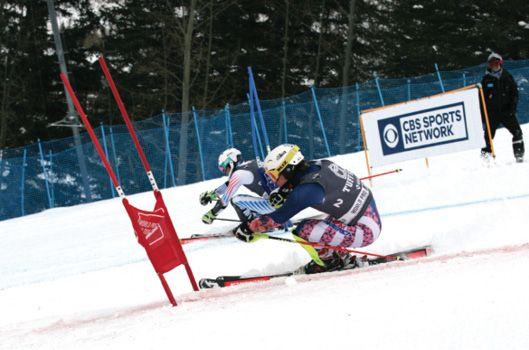
World Pro Ski Tour draws star athletes but suffers short season due to COVID-19.
The World Pro Ski Tour never got to the meat of its season, which would have seen seven-time gold medalist Ted Ligety contending with silver-and-bronze Olympian Andrew Weibrecht for $150,000 in championship prize money.
Before the pro season was canceled, Ligety, at age 35, did break away from the World Cup season to compete in two Pro Tour races at Steamboat’s Howelsen Hill and Eldora. He had trouble learning to time the barn-door starting gates and his best finish was a fourth place at Steamboat—proving, he said, that the Tour was serious competition.
The Tour entered its third season with six events scheduled. A long list of sponsors, led by Tito’s Handmade Vodka, offered $300,000 in prize money. When COVID-19 canceled the final three events, Rob Cone of Killington and Middlebury College, a former NCAA champ and U.S. Ski Team Europa Cup racer, topped the field of 21 racers who finished in the money, winning $30,200 for the truncated season. Michael Ankeny, of Buck Hill and Dartmouth College, a veteran of eight years on the U.S. Ski Team, came second ($12,200). Garrett Driller of Squaw Valley and Montana State, an NCAA All American and U.S. Alpine Championship parallel slalom winner, finished third ($8,350).
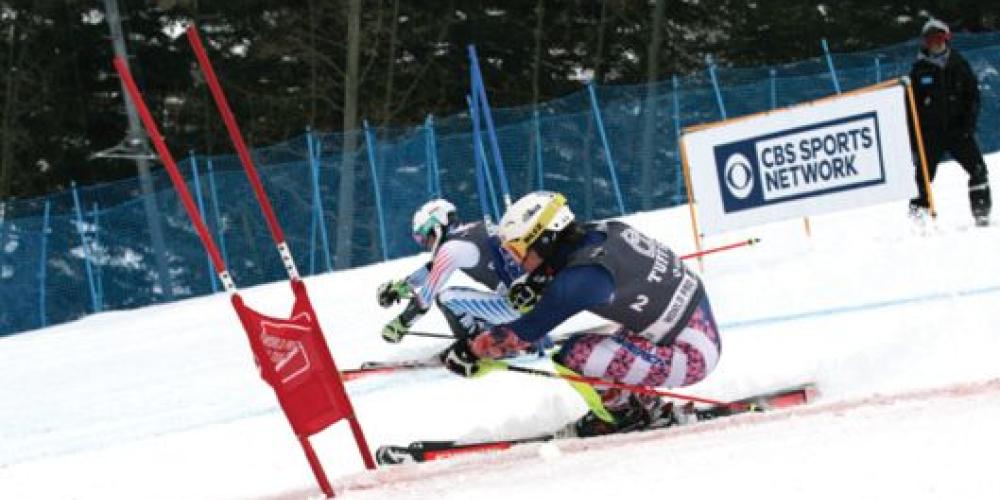
The Tour Finals at Sunday River and the World Pro Championships at Taos were scheduled for April, after the close of the World Cup and national championships. Ligety and Weinbrecht were on the schedule to compete at those races. “To succeed, the tour needs those top athletes,” said tour chief Jon Franklin, who earned his chops managing top skiers for International Marketing Group. Because the Taos championship event would have awarded $150,000 in prize money, the participation of FIS superstars might have upended the full-season leaderboard. All the events were televised by CBS Sports Network (see season highlights at https://worldproskitour.com/multimedia/).
Franklin predicts a longer, richer tour for the 2020-2021 season. “We don’t have a schedule yet because it has to fit around the NorAm and World Cup schedules,” he points out. He hopes to open the season before the Beaver Creek World Cup in November.
Pro skiing has always depended on the star power of World Cup racers, beginning when Bob Beattie’s new World Pro Skiing circuit recruited the likes of Jean-Claude Killy and Billy Kidd. Fifty years ago, in 1970, Kidd won the FIS World Championship combined gold medal, promptly turned pro and then won the WPS championship the same season. He’s still the only skier to pull that one off. —Seth Masia
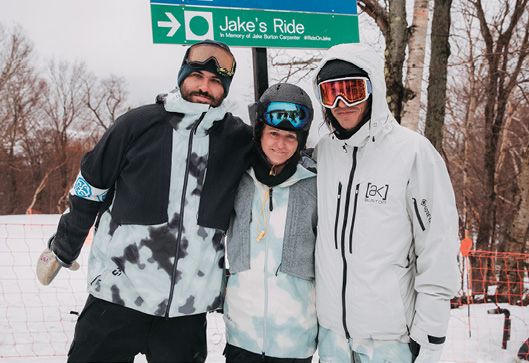
Jake Burton’s wife and business partner, Donna Carpenter,
attended “A Day for Jake” on March 13 at Stowe, Vermont,
with his sons Taylor (left) and Timi (right).
Photo: Jesse Dawson/Burton
A Day for Jake
On March 13, snowboarders around the world took a ceremonial run to honor the late Jake Burton Carpenter —pioneer, innovator and entrepreneur—who died last November of testicular cancer. Though the global “Day for Jake” took some serious hits, most notably from the novel coronavirus and nasty weather, the event still came off at about a dozen resorts, from Avoriaz (France) to Boyne Mountain (Michigan), Big Sky (Montana) and Copper Mountain (Colorado).
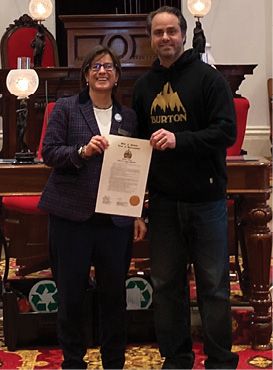
Skiing History editor and Vermont state
Rep. Kathleen James in the statehouse
in Montpelier with Jeff Boliba, a Burton
vice president. A first-term legislator,
James sponsored a resolution honoring
Jake that won unanimous approval from
all 180 of Vermont’s senators and
representatives.
Jake’s wife and business partner, Donna Carpenter, and his sons George, Taylor and Timi, attended the festivities at Stowe, Vermont. A gentle beginner’s trail, Lullaby Lane, was renamed “Jake’s Ride” and Jeff Boliba, Burton’s vice president of global resorts, read a Vermont General Assembly resolution honoring Jake for his role in pioneering and promoting the sport. Just a few days earlier, Boliba had dropped by the statehouse to meet Rep. Kathleen James, a first-term legislator and the editor of Skiing History. James sponsored the resolution, which received unanimous approval from all 180 of Vermont’s Representatives and Senators.
Burton Snowboards then quickly turned its attention to the COVID-19 response, delivering more than 200,000 KN-95 masks to hospitals across Vermont and to Dartmouth-Hitchcock Medical Center, just across the border in New Hampshire. ISHA has launched a digital archive project to document how the ski industry is responding to the pandemic; see page 26.
Looking for Vintage Ski Books?
The word ski is derived from the Old Norse word skið, which means “snow-shoe” and “billet of cleft wood.” It first appeared in print English in 1755, in Volume 12 of The Monthly Review of London, an English periodical.
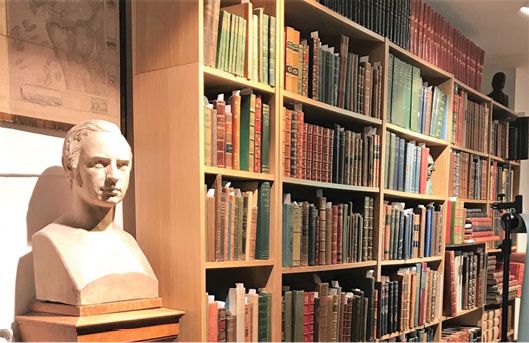
Ruuds Antikvariat,
courtesy M. Michael Brady
With such deep linguistic roots, it’s no surprise Norway is a key source of vintage ski history books. And one of the country’s top shops is Ruuds Antikvariat on Ullevålsveien, a busy north-south artery in Oslo. From the Latin antiquarius, also the root of the word “antique,” Antikvariat means “vintage bookseller” in Norwegian.
The shop was founded in 1972 by Jon Ruud and is now managed by his daughter, Vibeke Ruud. Its glass display cases and shelves include such ski-history classics as Farthest North by polar explorer Fridtjof Nansen (1861–1930), with its many drawings of skiing, then called “snow-shoeing” in English. Another hallmark is Voyage picturesque aux alpes norvégennes (Pictorial Journey Through the Norwegian Alps) of 1821 by Finnish-Swedish military officer and cartographer Wilhelm Maximilian Carpelan (1787–1831), among the first to survey and describe the interior of the country.
Bibliophilism is a cherished part of Scandinavian culture, reflected in the presence of no less than 72 antiquarian and used bookshops in Denmark, Finland, Norway and Sweden. They’re all interconnected in an online network, where you can search more than 1.5 million titles in English, Danish, Norwegian and Swedish (https://www.antikvariat.net/en/?currency=USD). To learn more, go to: https://ilab.org/booksellers/ruuds-antikvariat. —M. Michael Brady
Typo Makes Trump Into X-C Skier
As a leading journal of skiing’s historical record, we feel compelled to correct an error noticed by an eagle-eyed Skiing History correspondent.
Not known as a fitness buff in this COVID-19 time or any other era, U.S. President Donald Trump was recently described (incorrectly) as a Nordic destination skier. On May 9, 2020, Positively Scottish carried the headline “IVANKA TRUMP’S PERSONAL ASSISTANT TESTED POSITIVE FOR CORONAVIRUS, ACCORDING TO A CNN SOURCE.” Included in the text was the startling statement that, “The day after breaking his self-isolation of the White House for a cross-country skiing trip intended to report the country’s willingness to start again, Trump received the news one of his Oval Office waiters tested positive for the virus.” While the route may have been cross-country, ski gear was not involved. —Jonathan Wiesel
Photo: Jeremy Davis
Mount Ascutney Adds T-Bar
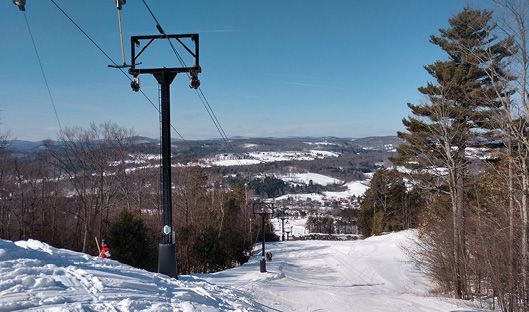
Mount Ascutney, a former major ski resort in southern Vermont, operated from 1946 to 2011. Generations of skiers learned to ski at this family-friendly area and were sad to see it become a “lost” ski area. But it wasn’t lost for long.
Several years after it closed, the nonprofit group Ascutney Outdoors worked hard to reopen a few trails, served by a brand-new rope tow in 2016. This past season featured the opening of a refurbished T-bar, expanding the lift-served vertical to just over 400 feet and 10 trails. The upper slopes, under a conservation easement, are maintained as hike-to terrain for those who earn their turns. The lower slopes also host a tubing facility, and an Outdoor Center serves as a hub for skiers, hikers, mountain bikers and community events.
Purchased from Le Relais, a ski area just outside of Quebec City, the T-bar was donated by Glenn and Shelley Seward in 2017 in preparation for future installation. Over the next two years, a fundraising campaign collected enough money for the T-bar to be installed at the end of 2019 and fired up in February 2020.
Ascutney’s humble beginnings are similar to many Vermont resorts. It was founded in 1946 as a rope-tow area by investors Bob Bishop, Catharine “Kip” Cushman, Robert Hammond, Bob Ely, Dr. Peter Patch and Dick Springer. Over the next six decades, the area went through many ownership changes, experiencing financial setbacks but also expansions, including a large hotel in the mid 1980s and a high-speed quad to the summit in 2000. Mounting fiscal problems led to its closure in 2011, and the ski area assets were sold off bit by bit.
Mount Ascutney is now a shining example of a new paradigm for smaller ski areas throughout New England that had financial difficulties or closed. Strong volunteer support, generous donations, and operating as a nonprofit can help these areas to succeed where prior operating attempts have failed. Loyal skiers have refused to let their favorite mountains fall by the wayside and are doing whatever they can to save special places like Ascutney.
Just ask Glenn Seward: “Those of us who love Ascutney don’t give up easily.” For more information, go to www.ascutneyoutdoors.org. —Jeremy Davis
Snapshots in Time
1959 TAKE IT FROM THE TOP
In the days when the rope tow was the mainstay of ski areas, it was relatively easy and inexpensive to provide separate slopes for each class of skiers. But with the introduction of the chairlift, originally intended to serve only more experienced skiers, the situation changed. Operators found that the attractions of the chairlift tempted beginners to ski way over their heads. To alleviate the problem, they cut novice trails from the top of the mountain over lengthy but gentle routes. This solved one problem, but created others. These novice trails frequently merge with more-advanced trails, or worse, advanced trails branch off novice trails. The answer seems to be a radical increase in trail marking. —John Southworth (SKI, December 1959)
1967 THE GREAT DEBATE: HOW LONG SHOULD YOUR SKIS BE?
There is no question today that the problem of the right ski length for the skier has become more and more vexing. Some people claim the best ski is a two-and-a-half footer for beginners, while others say the ski should be as tall as the beginner. Still others stick with the tried-and-true “hand high over the head” rule for every skier. Experiments and trends of recent years have warmed the air with questions: Both Head and Hart, following the lead of Clif Taylor’s Short-ee skis, have had great success with expensive five-foot skis … and last year, Karl Pfeiifer’s school at Killington introduced the Graduated Length Method that proved to be resoundingly popular at Killington and elsewhere. —Morten Lund, “Golden Rule for Ski Length” (SKI, September 1967)
1968 THE WAY IT’LL BE ON TV
In the four years since Innsbruck, television technology has advanced to the point where you will be able to see the dramatic opening ceremonies for the 1968 Winter Olympics live and in color at 11 o’clock in the morning EST and the Alpine skiing events in prime evening time, soon after they actually take place. And the use of split-screen technique at Grenoble will enable viewers to see the tenths of seconds that determine the gold, silver or bronze medals. For instance, if Jean-Claude Killy has competed his final run and is leading in the slalom, we can show Billy Kidd’s run live, with his time running against the time he needs to beat Killy. … The Winter Olympics will be one of the most challenging undertakings we’ve ever assumed at ABC Sports. —Roone Arledge, Vice President, ABC Sports (SKI, February 1968)
1978 WINTER PARK’S MIDDLE EAST CRISIS
George Haddad and entourage came to Winter Park last January for a celebrity pro-am event in a van bearing Minnesota license plates. When the fun-filled weekend was over, a cadre of red-faced officials and press found themselves the victims of one of the neatest little scams since The Sting.
Attired in authentic flowing robe, burnoose and a pair of vintage leather ski boots, Lebanese “oil sheik” Saleim Abdul Haddad hit the slopes and quickly stole the cameras. Photos were submitted to AP and UPI, and the sheik’s inimitable racing style graced the pages of papers from coast to coast. It wasn’t until an alert reader of a Duluth, Minnesota newspaper noted a striking resemblance between the sheik and George Haddad, fun-loving owner of a local shoe store, that the hoax came to light — and the sand hit the fan. —Ski Life (SKI, October 1978)
1989 PUTTING SKIERS TOGETHER
Mingling is a way of life at the Bark Eater, a 150-year-old farmhouse inn nestled in the Adirondack Mountains of upstate New York. Proprietor Joe Pete Wilson brings skiers together at a china- and linen-covered table for family-style dining every evening, seating guests into conversational groups based on personality. On those nights when the chemistry is right dinner can become a late-night affair, ending in a story-swapping marathon.
Joe Pete figures he has about 200 stories in his head, containing humor that ranges from “clean to dirty.” “We spend quality time with a small number of skiers,” he says. “I’d rather have 10 people and make sure they have a good time than 30 people who come and float away, never to be seen again.” —BOB LAMARCHE (SNOW COUNTRY, FEBRUARY 1989)
SKI ART
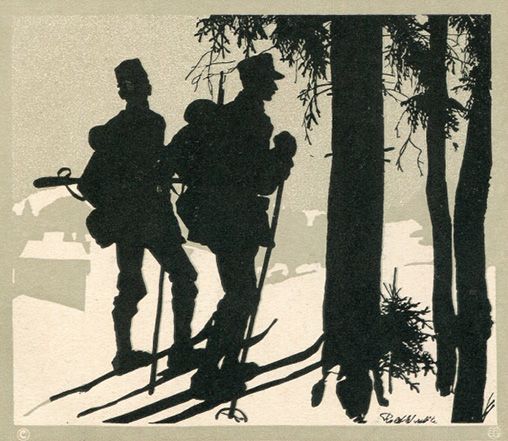
This Winkler silhouette shows World War I ski troops
emerging from the woods.
Rolf Winkler (1884–1942)
The solid shape of any silhouette is what gives the image its power. In the mid-18th century, Louis XV’s finance minister, Étienne de Silhouette, levied a wealth tax on the citizens of France. This brought ignominy upon him; he was mocked and associated with cheapness. In the art world, a quick outline became known as a drawing à la silhouette.
At the time, portraits were painted, and therefore only those who could afford to sit for an artist were portrayed. But some artists had the ability to cut the profile of a person: These “silhouettes” were both quick and cheap and therefore, before photography, increasingly popular with the middle classes. And the cutting was done extremely quickly—for example, if you were visiting a country fair and happened on an artist with scissors in hand. One of the most well-known of these artists used to advertise “three-minute sittings.”
With the development of photography in the mid- to late-19th century, the call for silhouettes declined. However, in the early 20th century, probably inspired by the Arts and Crafts Movement, silhouette artists became extremely popular as they seemed to portray, in a curiously old-fashioned and nostalgic way, a treasured past. Nowhere was this more obvious than during World War I, as displayed here: These troopers are emerging from the woods and heading for the village below, just as they would have done in peaceful years.
Rolf Winkler, born in Vienna in 1884, was a painter, illustrator and silhouette artist. He studied at the Landeskunstschule (State Art School) in Graz, Austria, and later he spent time in Dachau, Germany in a vibrant art colony under the leadership of Ludwig Dill and Adolf Hölzel, landscape painters who were embracing modern trends. Dill was a founding member of the Munich Secession. Winkler settled in Munich in 1905 and over the decades illustrated over 400 books, mostly for juveniles. He also worked for the satiric weekly, Fliegende Blätter (Flying Pages). The illustration here is entitled “Skipatrouille” and was published by Teubner in Leipzig. This extraordinary publishing house specialized in Greek and Roman texts, mathematics and the sciences, and yet here in 1915 is Winkler’s “Ski Patrol,” one of six silhouettes contained in a special folder. Maybe this was their way of supporting the war effort. —E. John B. Allen
At the annual Swann Galleries auction, collectors snapped up vintage ski posters of both classic and unique design.
The annual sale of vintage ski and winter posters at Swann Auction Galleries in New York City on February 13, 2020 featured 30 posters, including a handful of American classics, a celebrated Swiss ski poster, and some striking examples of midcentury graphic design.
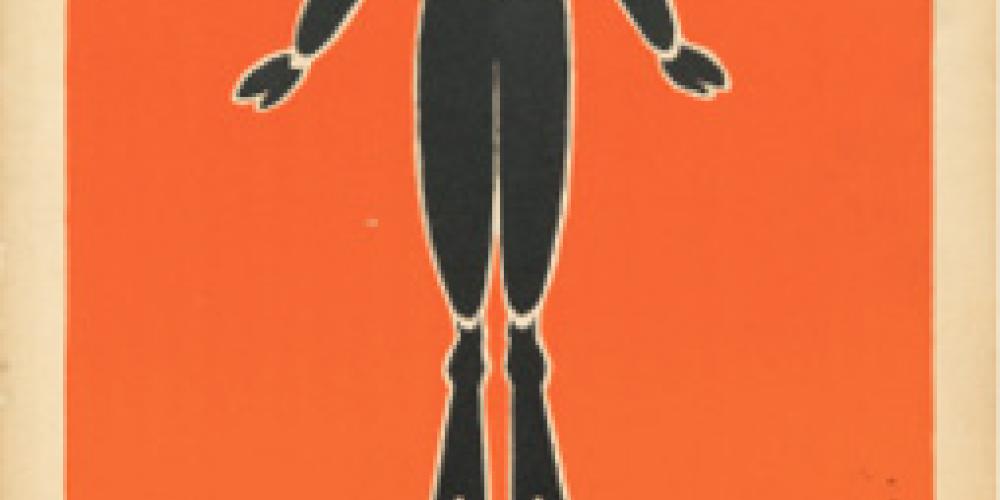
One exceptional example of graphic design on offer was Johan Bull’s window card For Norges Deltagelse | De Olympiske Ski from 1932 (shown above). Measuring just 22 x 14 inches, this was a promotion piece for the Norwegian American Olympic Committee seeking contributions to help send Norwegian athletes to Lake Placid in 1932.
“It’s one of the really unusual pieces we have,” said Nicholas Lowry, president of Swann Auction Galleries, head of the gallery’s poster division and a familiar appraiser on PBS’ Antiques Roadshow. “It mentions the 1924 games in Chamonix and the 1928 games in St. Moritz. The team was preparing for the 1932 games in Lake Placid and that’s followed by a question mark. It’s super simple. “
This powerful and effective image depicts a lone, faceless ski jumper, and the artist reduced his palette to black, orange and white on beige paper stock. Bull, who was born in Oslo, moved to America in 1925 and began contributing cartoons to The New Yorker. The poster soared past its $1,000 top estimate and sold for $1,690 (including the buyer’s premium, which is 25 percent of the hammer price).
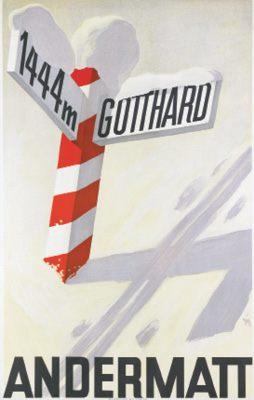
A classic poster on view at Swann work was by the Swiss artist Alex Walter Diggelmann. His Andermatt / Gotthard from 1931 has a simple yet compelling design. It makes plain that this resort at the Gotthard Pass is covered in exceptionally deep snowfall — enough, in fact, to almost hide the road sign. A skier’s tracks go past the sign to drive the point home. Estimated between $1,500 to $2,000, it sold for $1,820.
Another brilliant bit of design was featured in artist José Morell’s España, a 1948 poster celebrating the joys of skiing in the Pyrenees. Published by the Madrid Tourist Office, the estimate was $1,000 to $1,500 and it realized a final price of $1,375.
“We first sold this poster many years ago,” said Lowry. “Talk about suggestive. All you see are the skis, the shadow of the skier and the group of other skiers watching intently. You get the idea that he’s clearly moving fast.”
Knut Yran’s famous image, Norway / The Cradle of Ski-ing, from 1955, sold for $1,430, just shy of its top estimate. It depicts a child in a cradle on the slopes, clasping a pair of ski poles. A pair of skis is sticking upright from the crib, ready for action, with the mountains behind the child. This particular variation has the added text, “Enjoy Your Trip, Go by Ship/ Norwegian American Line,” though Lowry added that “we’ve seen it overprinted with the Pan Am logo before.”
Edwin Hermann Richard Henel was a designer of early German ski posters at the turn of the century but the poster on sale at Swann was done in 1950, just three years before he died. In Garmisch-Partenkirchen / VI. Internationale Wintersportwoche the international winter sports week is suggested by two ski poles, a goalie’s stick, and a photomontage of skating pairs set against a mountain backdrop. This was the first time that the poster has appeared at Swann. The poster was printed just five years after World War II had ended, a time when the ski town was better known as an R&R getaway for the occupation forces of American G.I.s, many of whom learned to ski at this resort. It went for $1,063, a bit lower than its top estimate.
The exuberant female skier in the legendary designer Herbert Leupin’s Switzerland from 1939 is wearing a blouse illustrating the various Swiss winter pastimes, from skiing to ice hockey to skijoring. It sold for $500, less than its $700 low bid.
“That shirt is like a poster in itself,” said Lowry. “It’s priced lower because someone trimmed off the title. But it’s a great image. If someone came to me with a bolt of cloth with that design on it, I’d buy it in a heartbeat.”
A classic Olympic poster was Jack Galliano’s VIII Olympic Winter Games / Squaw Valley, Feb 18—28, 1960, the second of two official posters designed for the Squaw Valley Winter Olympic Games. The first poster was issued before the exact dates of the games were determined. This second poster appeared late in 1959 with the purpose of showing the location of Squaw Valley in relation to a map of the United States and giving the date of the Games. It was eventually printed in five different languages. Estimated between $1,200 and $1,800, it sold for $1,750.
There were three ski posters by the German-born designer Sascha Maurer, best known for his work for New England ski resorts and ski manufacturers.
“I hate to use the words ‘quite common’ with these Maurer posters because it makes them sound cheap,” said Lowry. “They are not rare, but they are among the best American ski posters.”
Maurer’s Ski Stowe Vermont / Ski Capital of the East exceeded its $1,800 top estimate to sell for $2,125. “Maurer designed the Stowe logo, the ‘swoosh’” said Lowry.
Maurer’s Flexible Flyer Splitkein / Smuggler’s Notch was also issued in 1935. It depicts a woman in a single chair on the lift, waving to two skiers below, who have left fresh tracks in the snow. The poster hit its top estimate of $3,000.
“This one appears with different overprintings as well,” said Lowry. “Some of the variations were used by small ski areas, small sporting goods stores and in some cases, even restaurants and hotels.”
An artist named W. Rivers was responsible for the strong silkscreen of Yosemite Ski School, an undated image which sold for $1,750, just shy of its top estimate. Designed for the Badger Pass Ski Area, which opened in 1928, it’s very simple with two colors, red and blue and the white of the paper.
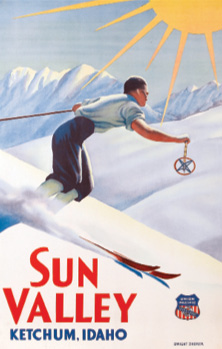
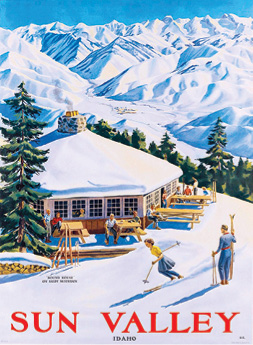
A poster by the famed Dwight Clark Shepler, Sun Valley / Union Pacific, was estimated to sell between $8,000 and $12,000 and finished at $10,625. “Shepler designed some of the Dartmouth Winter Carnival posters and others for Sun Valley,” said Lowry. “It’s a wonderful image, graphic and painterly at the same time.”
While the American posters tended to do very well, the erstwhile star of the auction was Winter inDer Schweiz, a masterpiece by the celebrated Swiss graphic artist Emil Cardinaux from 1921. This was the German version of a poster best known in its French version as Sports d’Hiver. The location is not specified but given the mountains, the lake, the high society fashions and the date, it is almost certainly St. Moritz. A work that verges on painterly, this masterful poster was estimated to sell between $12,000 and $18,000 but it failed to meet its reserve price and went unsold. Such is the way of the auction world. For information on upcoming auctions, go to swanngalleries.com.
A frequent contributor to Skiing History, Everett Potter launched Everett Potter’s Travel Report in 2005. It has become one of the most widely read and respected digital sites in the industry. Explore the site at everettpotter.com. All images courtesy Swann Auction Galleries.
Kalle Bror Emil Aejmelaeus-Äimä (1882–1935) grew up on skis in Finland, when it was still a duchy in the Russian Empire. At age 17 he ran off to fight in the Boer War, on the losing side. He then fought in a South American revolution, became a sea captain and joined the U.S. Army as a cavalry sergeant stationed in Texas. He then worked as a cowboy.
Back in Europe in 1906, he entered the Imperial military academy in St Petersburg, became a Russian cavalry officer stationed near Kiev, earned a degree in archaeology (a cover for spying in Ottoman lands), taught skiing and fencing, and competed in the first modern pentathlon at the 1912 Olympics. That year he wrote Skis in the Art of War, in Russian, hoping to update Russian Army skiing tactics based on the Finnish model. He barely survived cavalry action in the Great War.
After the Bolshevik Revolution, Finland declared independence, and Eimeleus joined the Finnish army to help win a civil war with the local communists. He joined Finland’s right-wing government as head of the War Office, as adjutant to two presidents, and later, as military attaché in London, Moscow and The Hague. The new Soviet Army took skiing seriously, but not seriously enough: In the Winter War of 1939–1940 the Finnish army, 20,000 strong, inflicted half a million casualties on Soviet troops. In response, the Soviet government organized a massive ski mobilization prior to the German invasion in 1941. The Soviet counteroffensive against Nazi Germany during the winter of 1941–1942 owed much of its success to the ski battalions formed during the ski mobilization, and to Skis in the Art of War.
This new translation by William D. Frank, in collaboration with ISHA’s own E. John B. Allen, includes most of the original illustrations, plus essays on the historical context of European military skiing by the two collaborators. The footnotes contain a wealth of historical detail. Frank, a competitive biathlete in the early 1980s, is now a leading authority on the history of biathlon, especially in Russia. Skiing History published his fine history of Russian biathlon in the June 2009 issue. He expanded that work into a doctoral dissertation in history at the University of Washington, and it became his book Everyone to Skis!, which won the ISHA Ullr Award in 2015. —Seth Masia
Skis in the Art of War by K.B.E.E. Eimeleus. Translation and commentary by William D. Frank, with additional commentary by E. John B. Allen. 288 pages. Northern Illinois University/Cornell University Press, $37.95 hardbound; Kindle edition $9.95. Winner: 2019 ISHA Ullr Award.
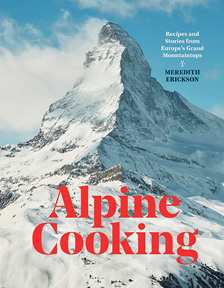
Alpine Cooking
This is a lushly photographed cookbook and travelogue showcasing the regional cuisines of the Alps, including 80 recipes for the elegant, rustic dishes served in the chalets and mountain huts situated among the alpine peaks of Italy, Austria, Switzerland, and France.
In Alpine Cooking, food writer Meredith Erickson travels through Europe’s Alps—by car, on foot, and via funicular—collecting the recipes and stories of the legendary stubes, chalets, and refugios. On the menu is an eclectic mix of mountain dishes: radicchio and speck dumplings, fondue brioche, the best schnitzel recipe, Bombardinos, warming soups, wine cave fonduta, a Chartreuse soufflé, and a host of decadent strudels and confections (Salzburger Nockerl, anyone?) served with a bottle of Riesling plucked from the snow bank beside your dining table.
Organized by country and including logistical tips, detailed maps and narrative interludes discussing alpine art and wine, the Tour de France, high-altitude railways, grand European hotels, and other essential topics, this gorgeous and spectacularly photographed cookbook is a romantic ode to life in the mountains for food lovers, travelers, skiers, hikers, and anyone who feels the pull of the peaks.
Erickson has co-authored The Art of Living According to Joe Beef, Le Pigeon, Olympia Provisions, Kristen Kish Cooking, and Claridge’s: The Cookbook. Among other titles, she has written for The New York Times, Saveur and Condé Nast Traveler.
Alpine Cooking: Recipes and Stories from Europe’s Grand Mountaintops by Meredith Erikson. Published by Ten Speed Press (2019), hardcover, 352 pages; $50 on Amazon. Winner: 2019 ISHA Baldur Award.
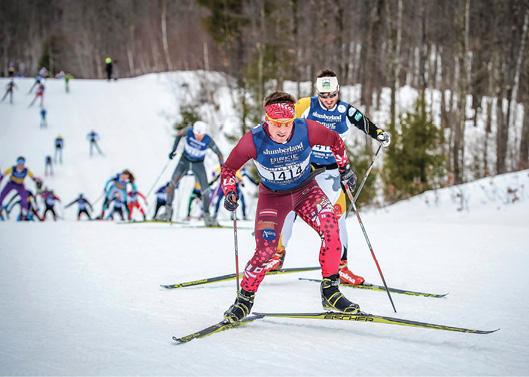
The FIS ban on fluorinated waxes for the 2020–2021 season applies to all ski and snowboard disciplines, but will be especially relevant in nordic competitions, such as the American Birkebeiner. Racers can shave off minutes in a typical 50k race with the advanced wax.
The International Ski Federation (FIS) surprised some ski-race insiders by calling for a ban on the use of all fluorinated ski waxes for next season. The announcement, made at the Federation’s annual fall meeting in Constance, Germany, will catalyze changes in race ski-prep procedures and technology.
“The use of fluorinated ski waxes, which have been shown to have a negative environmental and health impact, were banned for all FIS disciplines from the 2020–2021 season,” according to a FIS press statement released in November 2019. A working group will be formed to establish the new regulations.
The ban originated from the Committee for Competition Equipment, a panel that defines the technical specifications used across the FIS snow sports spectrum: alpine, cross-country skiing, nordic combined, ski jumping, snowboard, freestyle and freeski. The new working group has a rugged road ahead to unite a diverse array of nations and competitive disciplines to agree upon compliance standards.
The Norwegian Ski Federation banned the use of “fluoros” for all racers U16 and under last season, which was used as a test case by FIS to determine if a widespread ban was feasible, according to Ski Racing. Apparently, the answer was yes.
Fluorinated waxes significantly decrease friction and increase glide, and can be used across all ski and snowboard disciplines. As with all bans involving athletic performance or equipment, the success of a prohibition greatly depends on the ability to enforce the ban in the field and reliably test for non-compliance.
The waxes contain perfluoroalkyl and polyfluoroalkyl substances, collectively known as PFAS, which have been linked to a growing list of health concerns. The chemicals are found in drinking water and persistently remain in the food chain. Sometimes called “forever chemicals,” PFAS are resistant to moisture and extremely slow to break down. These are the same qualities that make them so effective in ski waxes.
From pine tar to fluorocarbons, waxing to win has been a constant in ski competitions. Ski waxing, however, long predates alpine skiing. It arose in the early days of Scandinavian ski-sport, from the coincidence that waterproofing wood also helps it to glide on snow. Whether you’re building a ship or a ski, you need to apply a preservative to wood. The earliest known preservative was pine tar, often called pitch.
Waxing evolved along with ski gear. Cross country racer Peter Østbye, born near Lillehammer in 1888, patented Østbyes Klister in 1913. By 1940, a rub-on alpine wax called 1-3-5 was sold under the brand Toko. In 1946, a company was founded under the name of Swix, a blend of the words ski and wax. Swix offered hard and soft waxes to cover a range of snow conditions, providing both glide and durability. Beginning in 1986, Terry Hertel in California and Swix chemists in Norway independently discovered that adding fluorocarbon to wax increased glide by two percent, which can determine the margin of victory in a race. Hertel introduced a commercial version in 1986; Swix followed in 1990, with a fluorocarbon powder that sold for $100 for three grams.
The growing use of fluorinated waxes came with increased scrutiny. Recent studies and subsequent publicity apparently accelerated the push for the ban. In 2016 Congress amended the Toxic Substances Control Act, requiring the U.S. Environmental Protection Agency to control chemicals deemed harmful to human health. As one result, starting in early 2018 the EPA notified all companies using fluorocarbons in their products to document the specific chemicals and amounts used. For ski wax manufacturers and importers this would mean reporting all chemicals – dyes, scents, waxes, hardeners and fluorines, retroactively. Most wax companies couldn’t afford the complex procedures and many immediately stopped selling and making fluorowaxes. Besides, the most common fluorines will be banned in the EU starting in July 2020. It was in this context that FIS imposed the new ban.
Alf Engen was one of the best—and best known—skiers in the United States during the 1930s and 1940s, and won more championships, awards and honors than any other competitor in both nordic and alpine disciplines. Though he is closely associated with Utah, he played a significant role at Sun Valley in the resort’s early years.
Alf Engen and Walter Prager at Sun Valley in 1947, as co-coaches of the 1948 U.S. Olympic ski team.
Alf’s first connection with Sun Valley was in early 1936, when he met Count Felix Schaffgotsch, who was sent by Averell Harriman to find the perfect location for Union Pacific’s new ski resort. Alf was the U.S. Forest Service Recreational Supervisor in Salt Lake City, in charge of locating and planning winter sports areas in Utah, Idaho, Nevada and Wyoming, at a time when New Deal programs were providing substantial assistance to the fledgling ski industry. Engen took Schaffgotsch to inspect Alta and Brighton. Schaffgotsch toured six states in six weeks, rejecting many areas that later become successful ski resorts—either their snow conditions or locations were unacceptable—before concluding the area around Ketchum, Idaho, had the perfect combination of snow, weather and hills.
The Forest Service sent Alf to visit Ketchum in winter 1936, when Sun Valley was being built. He met Harriman, who gave him a tour of the area, beginning a long friendship. In spring 1937, Alf and Sigmund Ruud located a site for and designed a ski jump at Sun Valley so Harriman could hold four-way competitions, and Ruud Mountain became the center for ski jumping and slalom events. Alf and Evelyn spent their honeymoon at Sun Valley in December 1937, at Harriman’s invitation.
Harriman hired Engen as a sports consultant and Superintendent of Recreational Facilities at Sun Valley, which included representing Sun Valley in skiing competitions, a role that brought substantial publicity to the resort. In 1938, Alf directed CCC crews that cut a downhill course on Bald Mountain, designed for the Harriman Cup by Dick Durrance. In 1939, his crews cut ski runs on Baldy and chairlifts were installed there for the 1939–1940 season.
Alf competed for Sun Valley virtually his entire amateur career, from 1937 to 1948. He battled fellow Norwegians in widely publicized jumping tournaments all over the country, including Birger and Sigmund Ruud, Torger Tokle, Reidar Andersen, and Olav and Sigurd Ulland, winning honors and setting several national distance records. Alf perfected his alpine skiing at Sun Valley, and led the country’s transition from nordic to alpine skiing, becoming the national four-way and open slalom-downhill combined champion.
Alf helped to coach the U.S. women’s national ski team at Sun Valley in 1939, who were training for the 1940 F.I.S. and Olympic Games (that were cancelled). U.S. Alpine teams for the 1948 Olympic Games at St. Moritz, Switzerland, were selected at Sun Valley. Alf coached prospective Olympians from the Sun Valley Ski Club before the tryouts, and he and Walter Prager, Dartmouth College’s famous coach from Switzerland, were co-coaches of the 1948 U.S. Olympic Team. Alf assisted Gretchen Fraser in her dominating performance at the 1948 Games, where she won gold and silver medals, the first American to win any Olympic skiing medal.
Alf, Evelyn and their son Alan moved to Utah after the Olympics, where he took over the Alta Ski School from his brother Sverre in 1949, directing it until 1989. Alf was inducted into the U.S. Ski and Snowboard Hall of Fame in 1959, joined by his brothers Sverre (1971), Karre (Corey) (1973), and his son Alan (2004), becoming the only family with four members in the Hall.
Alf loved Sun Valley, calling it in his 1986 oral history a “great mountain … difficult to beat.” —John Lundin
On March 25, John Lundin will deliver the first John Fry Legacy Lecture following ISHA’s opening reception during Skiing History Week 2020. The topic is “Sun Valley’s Early Days: Union Pacific, Averell Harriman and Alf Engen.”
Skiing History Day: Mad River Glen
On February 28, we woke up to a foot of new snow at historic Mad River Glen, Vermont — a perfect way to welcome guests to Skiing History Day 2020. A collaboration between the resort and the International Skiing History Association (ISHA), the event drew more than 100 people for skiing, history talks and artifacts, contests and camaraderie.
Proud members of the Mad River ski school: Steve (Lefty) Rennau, Rick Moulton, Dixi Nohl (former director), Glen Cousins, Leigh Clark, Melinda Moulton, Alan Moats and John Schultz.
The day kicked off with a presentation on Vermont ski pioneer Roland Palmedo and the 1948 founding of Mad River Glen by Rick Moulton (ski historian and filmmaker), Dr. John Allen (Skiing History contributor, author and New England Ski Museum board member), and John Schultz (longtime Mad River Glen skier and a founder of the Green Mountain Valley ski academy). Austrian ski legend Dixi Nohl (see article, page 16) entertained the crowd with memories from the ‘70s, when he ran Mad River’s ski school for some 10 years, joined by several of his instructors.
Trail guides led group mountain tours throughout the day, and all skiers who successfully completed the resurrected “No Stop, No Fall” challenge—a non-stop, no-wipeout descent from the summit—received an elegant antique pin. Rick Hopkins and Luke Prescott, Mad River patrollers for the last 40 decades, skied alongside to verify the successful “No Stop, No Fall” run. Meanwhile, winners of the vintage skiwear contest were awarded a free one-year membership to the Vermont Ski Museum.
Attendees included ISHA director Rick Moulton and his wife, Melinda (event co-producers); representatives from the Vermont Ski Museum and New England Ski Museum; and dozens of ISHA members and Mad River Glen stalwarts. One of the day’s highlights was the revelation that ISHA member Christopher Sweet of North Attleboro, Massachusetts had not skied Mad River in fifty years—he was eleven years old the last time he went up its iconic single chair. Sweet returned for this event and had a stellar day in the deep natural snow, promising to be back soon. —Melinda Moulton (photos by Melinda Moulton and Kim Holtan)
Sun Valley Skier Shares Rare Bibliographic Find
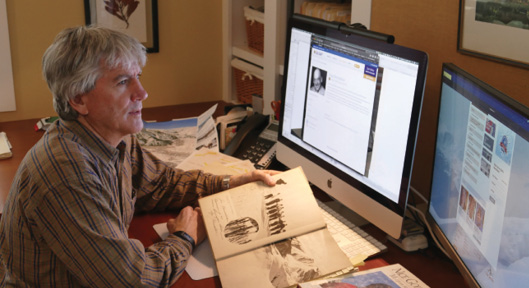
Marc Cormey researches his find.
In 1979, 18-year-old Marc Corney did his best to become a Sun Valley ski bum. He left his Southern California home of Glendora with high hopes of joblessness, raucous nightlife, and endless days of skiing Baldy Mountain. He had some early success but eventually succumbed to responsibility and regular employment. He even went back to school, became an architect, and now has a family. Though a failed ski bum, Marc still skis more than 60 days a year and works as a guest services supervisor. Over the years, he’s developed an appreciation for Sun Valley history and its traditions of mountain camaraderie.
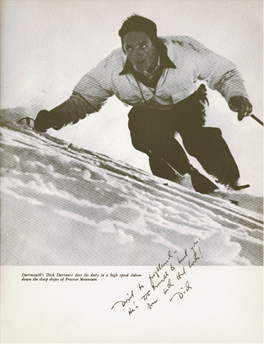
“Don’t be frightened,” joked Dick Durrance of his intense gaze on the printed page.
In a Vermont bookshop, Marc came across something unique. The Sun Valley Ski Book, a 1939 pictorial ski instruction tome by Friedl Pfeifer, is not uncommon among collectors and aficionados, but this copy had buried treasure. Along with Pfeifer’s step-by-step instruction and mountain lifestyle photos, there are hand-written captions from photo subjects and a four-page signature spread. Also tucked in are a few vintage newspaper clippings and a song lyric by poet Christopher La Farge, a friend of Ernest Hemingway.
Marc snapped up the souvenir and with his wife, Jill, put the probable story together. The book most likely belonged to Pfeifer and his wife, and was passed around at parties around the time of their wedding in the spring of 1940. The captions are directed to the Pfeifers and the signatures are those of the inner circle of accomplished skiers in Sun Valley’s magical formative years. Every time Marc and Jill open the book, they know they are holding traces of ski heroes in their hands, and they are pleased to share a look with Skiing History readers. We’ll be posting images at our website soon, for ISHA members only, at skiinghistory.org. —David Butterfield
Snapshots in Time
1924 A PRIZE OF DUBIOUS VALUE
Thor Groswold borrowed money for a train ticket and traveled to Dillon, Colorado to compete in a meet. The jumpers had to be sure to clear the knoll and get onto the landing hill, as they had never removed the stumps and rocks below the takeoff. It was very windy during the meet, and both Thor and then-national champion Lars Haugen were blown over and fell. At the Sunday evening banquet, he was given his prize—a crate of eggs. When he questioned the prize, he was told to stop by the general store, where they bought back the eggs for enough money to pay his train fare home. —Jerry Groswold, “Thor Groswold: One of Skiing’s First Great Salesmen” (Collected Papers of the
International Ski History Congress, 2002)
1936 HEY, SISSIES! YOU’RE SCARING THE MOTHERS!
The first death on the slopes shook up the small skiing fraternity of the day. An emergency meeting was called by the New York Amateur Ski Club, whose founder, Roland Palmedo, appointed Minot “Minnie” Dole chair of a committee to inquire into the causes and handling of ski accidents. The results of their questionnaires were disappointing. Only a hundred replies dribbled in. Of these, roughly half accused the committee of being “sissies, spoilsports, and frighteners of mothers.” —Gretchen Rous Besser, “Samaritans of the Snow” (Collected Papers of the International Ski History Congress, 2002)
1959 IVY LEAGUE ANTI-STYLE
If Dartmouth or Harvard types are your heart’s desire, you must spurn current fashions like a plague. Requirements are a pair of well-worn dungarees (preferably patched and faded) pulled over a bulky union suit. This should be topped by an olive drab Army surplus parka, preferably of genuine Camp Hale vintage. Box-toed boots is overdoing it a little bit, but don’t hesitate to resort to them. —Eleanor Prager, “The Happy Hunting Ground: Ski Resorts Are Heaven for Women” (SKI, October 1959)
1967 NEW GIRL IN TOWN
The series of nestling alpine towns and ski runs that tycoon Bill Janss is going to put into the mountains behind Aspen, Colorado, will make Snowmass the biggest, most sought-after and possibly the most beautiful of all the ski complexes of this country. She will debut this year with only some of her envisioned charms available, but even at that, Snowmass will be the new place to ski this winter. Snowmass will have Stein Eriksen in the role of ski school hero, but the star will be the magnificent, marvelous, enchanting, rolling snowland — terrain previously only reachable by ski plane or over-snow vehicle. This winter, Snowmass will have five double chairs, 3,500 feet of vertical, and 50 miles of trails. —(SKI, September 1967)
1974 SKIER’S CODE OF ETHICS
It is immoral to ski unsafely, and unmannerly to ski impolitely. These two ideas shade into each other. The unmannerly skier is also likely to be the immoral skier who skis out of control. For example, too many skiers do not take seriously the duty of staying clear of skiers below. They feel they have the right to yell “Track!” and to whiz by. They do not have that right! We would like to see the Ski Patrol rescind the ticket of every skier who fails to stay clear or who skis so as to endanger the skier below him. —Ski Safety and Courtesy (SKI Magazine Encyclopedia of Skiing)
1978 11 HOURS IN HELL
At 3:45 pm on April 15, 40 people caught the last tram of the day from High Camp at Squaw Valley. Less than 150 feet from Tower 2, something caused the car to derail from the outside cable, suddenly doubling the inside cable’s load. The tram dropped 75 feet and bounced like a yo-yo. When everything had stopped moving, the car had opened up like a burst tin can, hanging 80 feet in the air. Three were killed almost instantly, and most of the 37 survivors were injured, several seriously. —“11 Hours in Hell” by Dick Dorworth (SKI, September 1978)
1995 TEACH YOUR PARENTS WELL
I was unprepared when my son, Andrew, appeared at my shoulder one day of his eighth year. “Uh, Dad?” he said, scraping his thumbnail across the ski edges I’d just spent half an hour sharpening. “Do you think I could go snowboarding with Wyatt today?” “Snowboarding?” I repeated in a voice that betrayed my disgust. Andrew was born to be a skier! “No,” I said. “Why not?” he inquired. I quickly listed a dozen excellent reasons: Snowboarders have weird hair and pierced noses. They sport tattoos. They wear rude stickers. But after much debate, I gave in, certain that a dozen jarring falls would surely discourage him. They didn’t. —Andrew Slough (SKI, February 1995)
SIA Alumni Breakfast
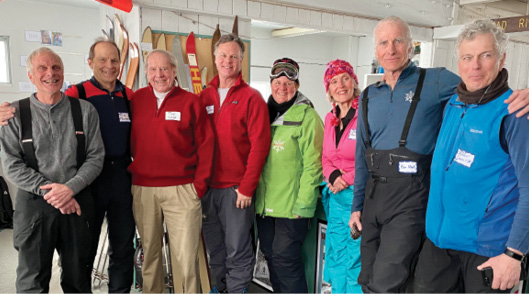
About 30 ski business veterans turned out for the annual alumni breakfast during the annual Outdoor Retailer + Snow Show in Denver on January 31. Here, John Stahler (second from right, Head, Tecnica) entertains Denny Hanson (Hanson, Apex), David Ingemie (SIA, ISHA, U.S. Ski and Snowboard Hall of Fame) and David Scott (Head, Chivers, Lacroix, Nevica). Seth Masia photo.
Ski History Calendar
April 16–26 World Ski and Snowboard Festival 2020
Whistler, B.C.
Claiming to be the largest celebration on snow, the World Ski and Snowboard Festival celebrates Whistler’s mountain culture with ten days of late-spring shenanigans. On the mountain, there are ski and snowboard competitions and demonstrations, including the 18th edition of the Saudan Couloir Ski Race Extreme. Named after the legendary Swiss “Skier of the Impossible” Sylvain Saudan, the competition is touted as the steepest ski race on the planet. Back on flat ground, art, filmmaking, photography, music and other events fill up the village for the festival’s raucous run.
May 4–7 NSAA National Convention and Tradeshow
Omni Amelia Island Plantation Resort, Florida
The National Ski Areas Association brings together the major influencers in the resort industry for its annual post-season convention and industry mixer. Keynote speakers include Afdhel Aziz, the author of Good is the New Cool: Market Like You Give a Damn, which explores how businesses can be a force for positive social impact and attract customers from the new generation of socially aware consumers. Educational sessions will address a wide range of topics, from the influence of digital lodging platforms, such as VRBO, to the growing importance of resort branding in today’s world of ski-area consolidation.
June 24–July 3 Aspen Ideas
Festival Aspen, Colorado
Featuring boldface names from around the world, the Aspen Ideas Festival is one of the nation’s premier public festivals featuring leaders, policy makers and business disruptors who explore ideas that both shape our lives and challenge our times. The festival is public and open to all. Topics have included Redefining Capitalism, Planet in Peril, Finding Beauty and the American Idea.
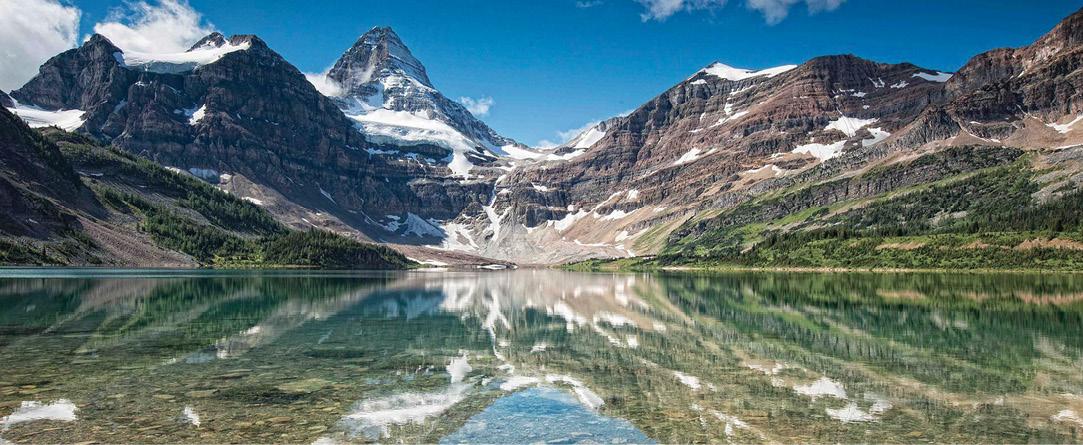
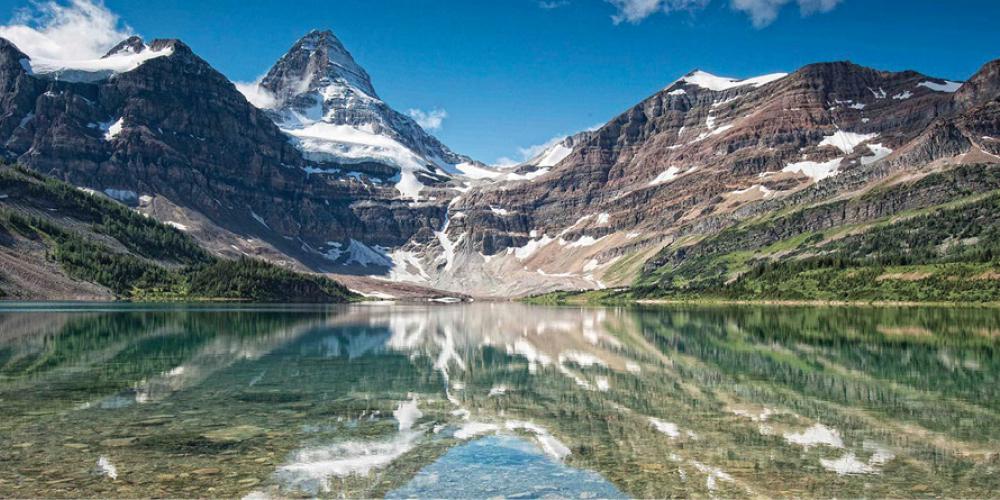
Go to the high places to gain vision and restore your soul.
Author John Fry describes Mount Assiniboine Provincial Park in British Columbia as a place where the “sky and the world merged ... [and] the cluttered house of my consciousness was swept clean.”
Fry at home in Katonah, New York in 2015. This photo was taken by his friend, photographer and cinematographer Paul Ryan.
Brochures luring us to the mountains in summer often portray Sybarites soaking themselves in a hotel hot tub at 7,000 feet, maybe after a lung-stretching day of playing tennis or fat-tire biking. Others may be on a golf course or in an outdoor tent at a music concert. Such are the undeniable and not unworthy satisfactions of visiting in summer the places we ski in winter. But here’s a radical thought that I dare to mention at the risk of announcing the least-fashionable idea of the year: Go to the mountains to improve your soul. Millions of people do so throughout the world.
There is much comfort in high hills,
And a great easing of the heart.
We look upon them, and our nature fills
With loftier images from their life apart.
They set our feet on curves of freedom bent
To snap the circles of our discontent.
So begins a fine, early British book on climbing, extolling the tranquility of mind experienced in high places. Still in my own memory is an astonishingly beautiful hike above treeline, through fields of alpine wildflowers, that I once made from Sunshine to Assiniboine in the Canadian Rockies. As I merged myself into a place where the sky and the world themselves merged, the cluttered house of my consciousness was swept clean.
Going to high places to gain vision and restore the mind is a neglected tradition in America. It wasn’t always so. “Thousands of tired, nerve-shaken, overcivilized people are beginning to find that going to the mountains is going home … and that mountain parks and preservations are fountains of life,” wrote conservation pioneer John Muir in 1898.
Edwin Bernbaum, the author of Sacred Mountains of the World, calculates that a billion of the world’s people revere the mountains, some cultures regarding them as the home of the gods. “Despite the hardship and suffering, even the fear encountered in the mountains, people return to them again and again,” Bernbaum declares, “seeking something they cannot put into words.”
Trekking in a region near Lhotse, reputed to be Shangri-La, Bernbaum tells how he “descended into the mist to the valley floor and camped in a meadow … We heard the clear voices of birds singing to one another. In the woods around us, drops of bluish water gleamed like diamonds on necklaces of hanging moss … [and] we felt the presence of a majestic snow peak that seemed to rule over the valley … When we came to a spring welling out of the base of a mossy rock, I knelt to drink the water out of my hands, and felt the peace and beauty flow into my body.”
Extracting moral grace from nature—a sensitivity heightened in the mountains—was a notion advanced by one of America’s early nature writers, John Burroughs. “In nature…you are touching the hem of the garment with which the infinite is clothed, and virtue goes out from it to you.”
Unhappily, too few Americans seem ready to receive such virtue. [The late] Andrea Mead Lawrence, America’s first double gold medalist in Olympic skiing and now a supervisor of Mono County in the heart of California’s Sierra Nevada, believes our lack of spiritual identification with the mountains is at the root of our acceptance of so much unsightly suburban development there, and it makes her weep. “God did not make the Sierra Nevada as a lot-and-block subdivision, and we shouldn’t treat our mountain valleys that way,” she says. “For those who have spent our lives in the mountains, they are the wellspring of our passion and our caring.”
In his 1890 book on New Hampshire’s White Mountains, Julius Ward—who never found a word in the dictionary he didn’t like—wrote of the “unconscious exhilaration” he felt as the “mountains entered his soul and raised his life to their level.” Returning from a climb of one of the Presidential peaks, Ward compared his experience to that of Moses, “purged of the false, the untrue and the unreal.”
A contemporary parable may be found in Lost Kingdom of the Himalaya, where narrator John Clark accompanies a Hunza villager into the high country. “Together we crept out on the rim of a great mountain buttress, like flies on the shoulder of God. We rounded a curve, and there suddenly was the valley below us and the great rocks above. The villager sat down. ‘What are you doing?’ I asked. ‘Looking at my mountains,’ he murmured. He showed me then the meaning of worship…that our bustling minds must relearn.”
ISHA president John Fry died peacefully on January 24, 2020, while floating in the warm waters off Vieques Island, two days after his 90th birthday. His obituary appears on page 33. John was a beloved member of the ISHA family and the global ski community, and we’ll honor his legacy as a ski writer and editor by reprinting some of his finest and most unique articles in upcoming issues of Skiing History. This essay was published in the Spring 1997 issue of Snow Country, with a nod from Fry to quotations from the book Around the Roof of the World by his friend Nicholas Shoumatoff.
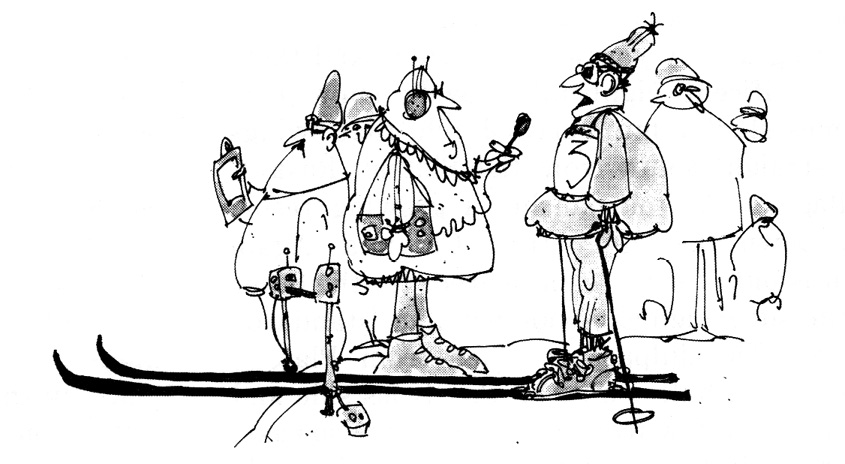
“Yes Bud, I have found a few secrets that help lower my time...”
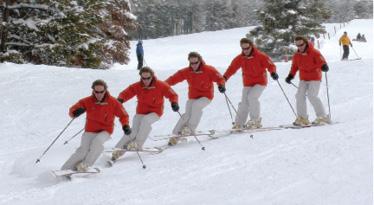
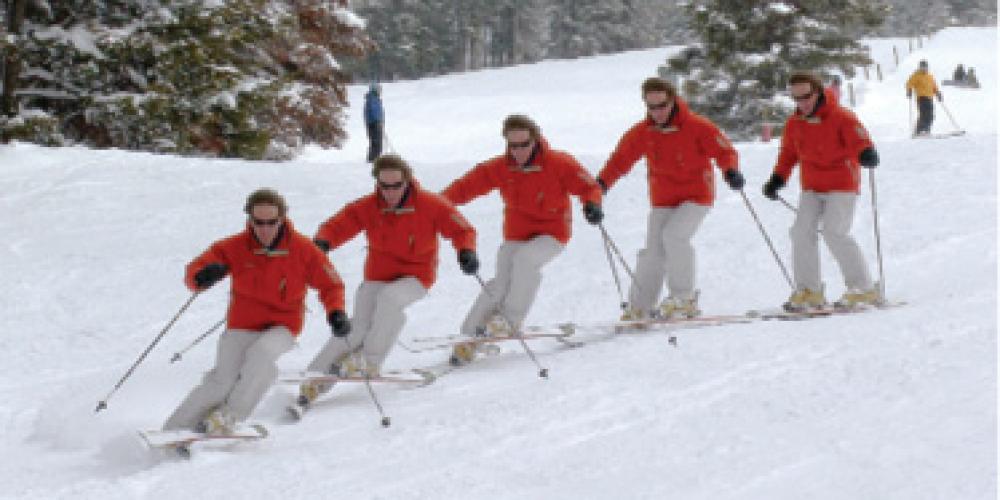
At Christin Cooper’s suggestion, I’d like to provide a picture of a modern use of the Javelin Turn, which I wrote about in the January-February 2020 issue of Skiing History (Timeless Tips). In the article, I described how this tip-crossing tip was promoted by Vermont instructor Art Furrer in 1967, and has been in constant use ever since.
In recent exchanges on the Facebook group “Technical Analysis of Alpine Skiing,” a forum where ski instructors and coaches exchange ideas about their work, Javelin Turns have been suggested as a good approach to addressing specific issues in seven different discussion threads just in the last few months. Clearly, it’s alive and well.
Ron LeMaster
Boulder, Colorado
The First U.S. Ski Journalists
A recent article in Skiing History focused on the big guns of ski reporting during the 1950s to 1980s print journalism heyday (“When Print Was King,” January-February 2020).
The profession of “ski journalist” was invented in the 1930s, when U.S. newspapers—especially in Boston and New York—became important sources of ski news. During that decade, ski columnists such as Frank Elkins of the New York Times and Henry Moore of the Boston Herald competed with “Old Man Winter”—Benjamin Bowker—of the rival Boston Evening Transcript.
These pioneers taught novices about the up-and-coming new sport, offering advice on clothing, equipment, technique, snow conditions and weekend snow-train destinations. Race results were a staple and fashion notes added a social touch.
To take one example, Henry Moore’s column of December 2, 1938 covers the Dartmouth College ski team, where the Sunday snow train is going, that ski tows were “rigging up for the weekend crowd,” and that Caroline French looked very cute in her new ski outfit along with “ace racer” Mary McKean. Sometimes artwork would add a visual touch; illustrator Max Barsis was popular.
A few early women columnists made a mark, too: Gwendoline Keen of the Transcript wrote special features, including one about pine-needle skiing. The much-traveled Christine Reid was informative and popular.
For the ski crowd in the Northeastern United States in the decade before World War II, the Friday-night newspapers provided the right combination of enthusiasm, interest, information and pizzazz that heralded a Saturday and Sunday on skis.
John Allen
Rumney, New Hampshire
Who was in the K2 ad?
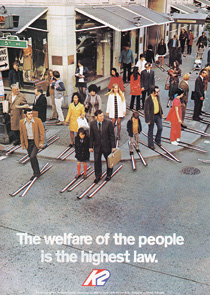
I loved seeing the K2 “Welfare of the People” ad on the back cover of the January-February issue. In the caption, Seth Masia offered “bonus points” to anyone who could name the city. I can!
My uncle, Russ Butterfield, worked for K2 at the time and his twin daughters are deep in the frame on the right. Sandra is holding the books and purse while Lorna is pushing the stroller. Derek Weigle, the baby in the stroller, recently turned 50.
According to Lorna, the photo shoot was held early in the morning on the main street of Vashon, Washington. The signage was composited (or as we say now, “Photo-shopped in”) later by the advertising agency. Most of the people in the ad were K2 employees, plus their family, friends and significant others. Heckler and Bowker’s ads were creative and cutting edge in the 1970s ski industry.
David Butterfield
Sun Valley, Idaho
“Think ecology, Mrs. Frobish.”
SKI November 1973
Correcting the Record
Due to an editing error, a caption on page 23 of the January-February 2020 issue was incorrect. In the article “When Print Was King” by ISHA director Jeff Blumenfeld, chronicling some of the sport’s most influential journalists, British writer Arnie Wilson was the ski correspondent for the Financial Times, not the London Times. Sorry, Arnie! —Kathleen James, Editor
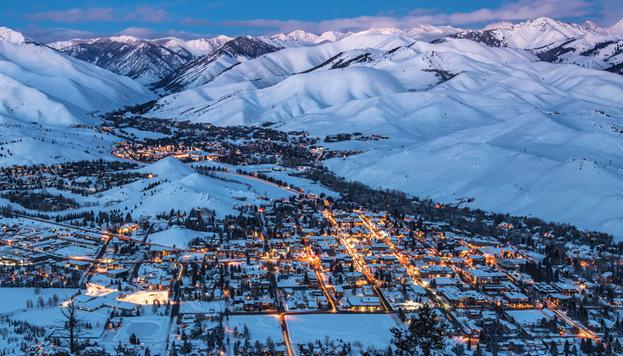
Skiing History Week is ISHA’s annual gathering, presented in partnership with the U.S. Ski and Snowboard Hall of Fame. Higlights include ...
March 26: ISHA Awards Banquet (Sun Valley Inn)
Join ISHA in honoring the year’s best ski history books, films and websites, created by historians from around the world. Plus ISHA’s prestigious Lifetime Achievement Award and a special Stewardship Award!
March 28: U.S. Ski and Snowboard Hall of Fame Induction Gala (Sun Valley Inn)
Eight snowsport pioneers will be honored as members of the Class of 2019 at a red-carpet gala. To read inductee bios, go to skihall.com/class-of-2019.
The jam-packed schedule also includes an ISHA welcome reception, parties, guided mountain tours, a freestyle
reunion, the ISHA Legacy Lecture and a retro ski day.
• Discount lodging is available at the Sun Valley Lodge, Sun Valley Inn and Limelight Ketchum Hotel. Space is limited, so book your room soon!
• To book lodging at the discounted rates, you must first purchase tickets online to the ISHA Awards or to any Hall of Fame event (sold separately). Your confirmation email will include hotel codes, links and booking instructions.
• Event ticket-holders can also buy discounted daily lift tickets ($65) Monday-Sunday at Sun Valley with a photo ID.



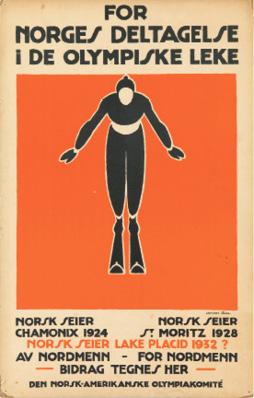
 This powerful and effective image depicts a lone, faceless ski jumper, and the artist reduced his palette to black, orange and white on beige paper stock. Bull, who was born in Oslo, moved to America in 1925 and began contributing cartoons to The New Yorker. The poster soared past its $1,000 top estimate and sold for $1,690 (including the buyer’s premium, which is 25 percent of the hammer price).
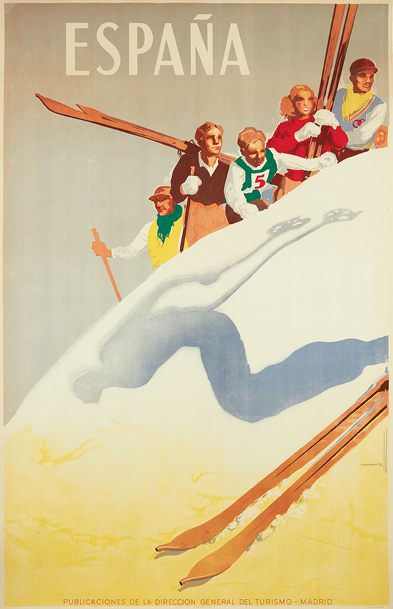 Another brilliant bit of design was featured in artist José Morell’s España, a 1948 poster celebrating the joys of skiing in the Pyrenees. Published by the Madrid Tourist Office, the estimate was $1,000 to $1,500 and it realized a final price of $1,375.
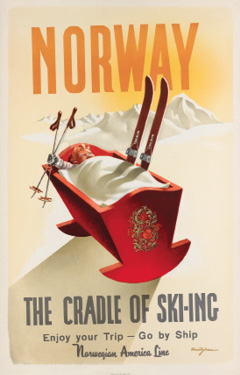 Knut Yran’s famous image, Norway / The Cradle of Ski-ing, from 1955, sold for $1,430, just shy of its top estimate. It depicts a child in a cradle on the slopes, clasping a pair of ski poles. A pair of skis is sticking upright from the crib, ready for action, with the mountains behind the child. This particular variation has the added text, “Enjoy Your Trip, Go by Ship/ Norwegian American Line,” though Lowry added that “we’ve seen it overprinted with the Pan Am logo before.”
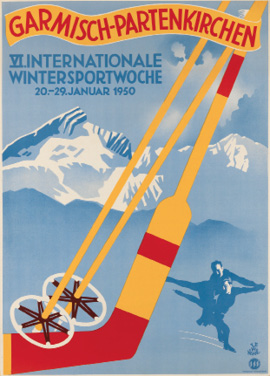 Edwin Hermann Richard Henel was a designer of early German ski posters at the turn of the century but the poster on sale at Swann was done in 1950, just three years before he died. In Garmisch-Partenkirchen / VI. Internationale Wintersportwoche the international winter sports week is suggested by two ski poles, a goalie’s stick, and a photomontage of skating pairs set against a mountain backdrop. This was the first time that the poster has appeared at Swann. The poster was printed just five years after World War II had ended, a time when the ski town was better known as an R&R getaway for the occupation forces of American G.I.s, many of whom learned to ski at this resort. It went for $1,063, a bit lower than its top estimate.
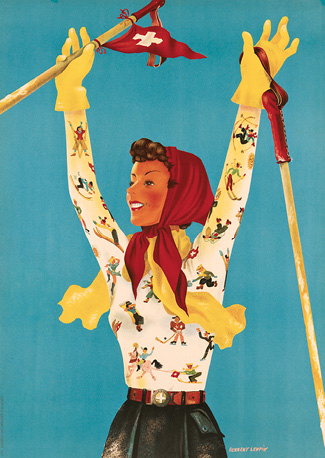 The exuberant female skier in the legendary designer Herbert Leupin’s Switzerland from 1939 is wearing a blouse illustrating the various Swiss winter pastimes, from skiing to ice hockey to skijoring. It sold for $500, less than its $700 low bid.
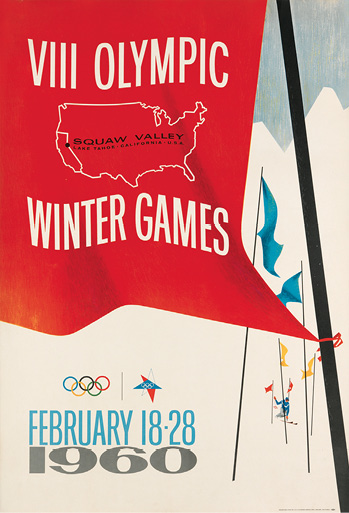 A classic Olympic poster was Jack Galliano’s VIII Olympic Winter Games / Squaw Valley, Feb 18—28, 1960, the second of two official posters designed for the Squaw Valley Winter Olympic Games. The first poster was issued before the exact dates of the games were determined. This second poster appeared late in 1959 with the purpose of showing the location of Squaw Valley in relation to a map of the United States and giving the date of the Games. It was eventually printed in five different languages. Estimated between $1,200 and $1,800, it sold for $1,750.
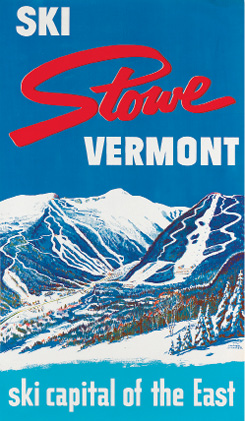 “I hate to use the words ‘quite common’ with these Maurer posters because it makes them sound cheap,” said Lowry. “They are not rare, but they are among the best American ski posters.”
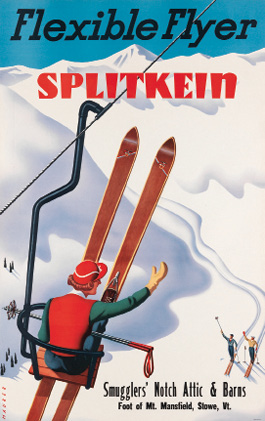 Maurer’s Flexible Flyer Splitkein / Smuggler’s Notch was also issued in 1935. It depicts a woman in a single chair on the lift, waving to two skiers below, who have left fresh tracks in the snow. The poster hit its top estimate of $3,000.
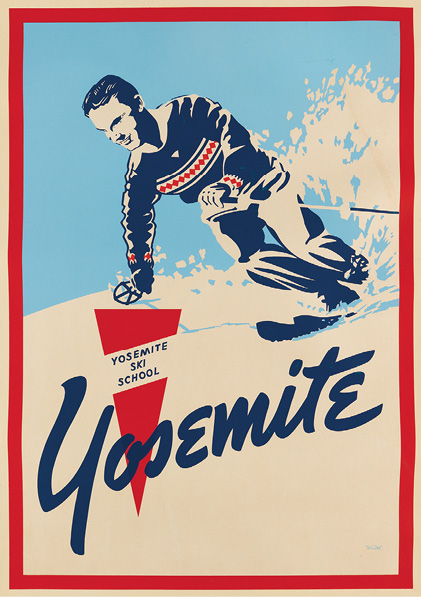 An artist named W. Rivers was responsible for the strong silkscreen of Yosemite Ski School, an undated image which sold for $1,750, just shy of its top estimate. Designed for the Badger Pass Ski Area, which opened in 1928, it’s very simple with two colors, red and blue and the white of the paper.
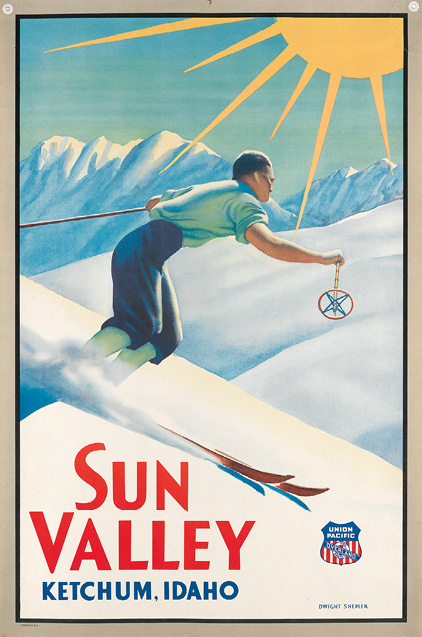 A poster by the famed Dwight Clark Shepler, Sun Valley / Union Pacific, was estimated to sell between $8,000 and $12,000 and finished at $10,625. “Shepler designed some of the Dartmouth Winter Carnival posters and others for Sun Valley,” said Lowry. “It’s a wonderful image, graphic and painterly at the same time.”
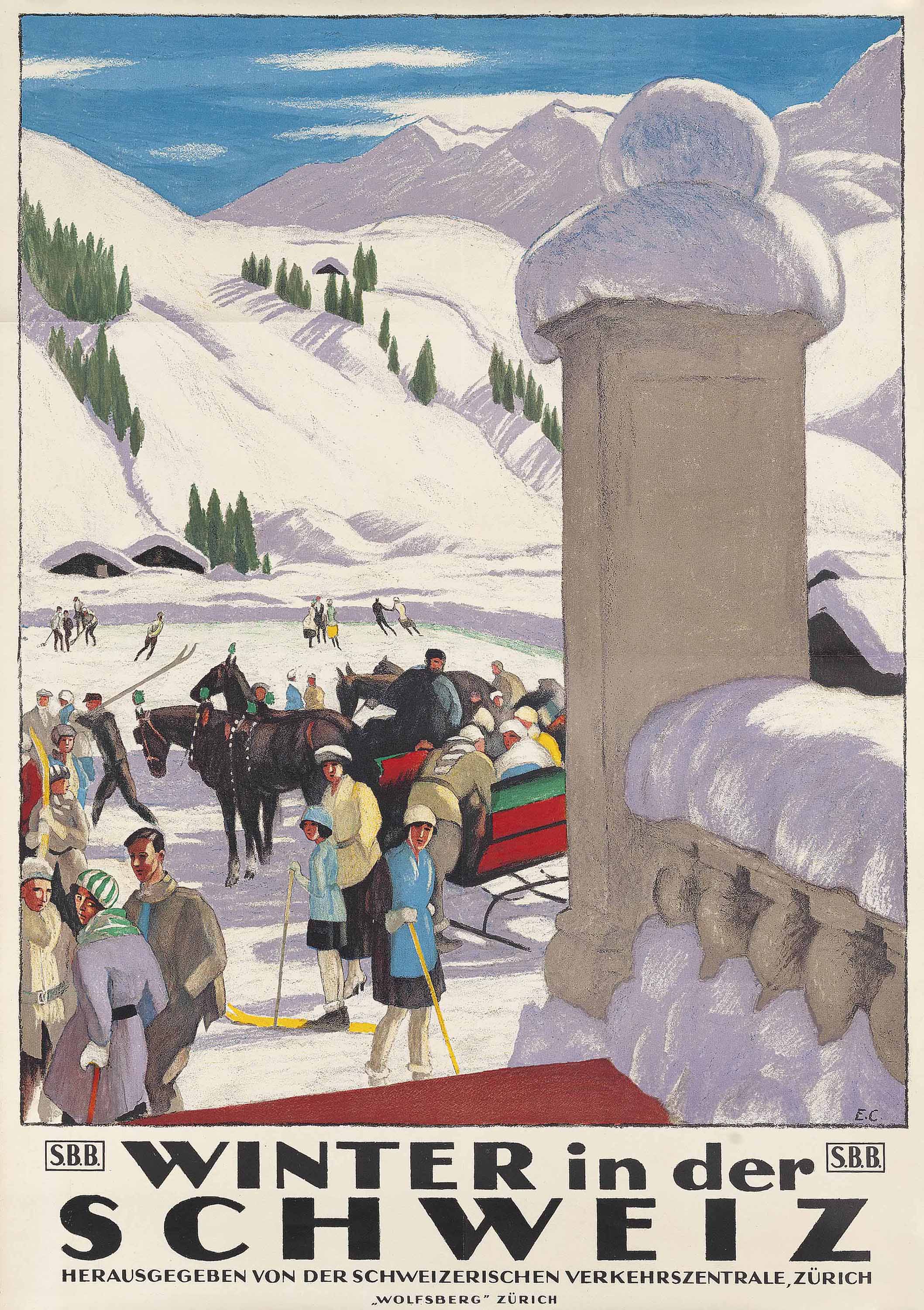 While the American posters tended to do very well, the erstwhile star of the auction was Winter in Der Schweiz, a masterpiece by the celebrated Swiss graphic artist Emil Cardinaux from 1921. This was the German version of a poster best known in its French version as Sports d’Hiver. The location is not specified but given the mountains, the lake, the high society fashions and the date, it is almost certainly St. Moritz. A work that verges on painterly, this masterful poster was estimated to sell between $12,000 and $18,000 but it failed to meet its reserve price and went unsold. Such is the way of the auction world. For information on upcoming auctions, go to swanngalleries.com.



 Alpine Cooking



 About 30 ski business veterans turned out for the annual alumni breakfast during the annual Outdoor Retailer + Snow Show in Denver on January 31. Here, John Stahler (second from right, Head, Tecnica) entertains Denny Hanson (Hanson, Apex), David Ingemie (SIA, ISHA, U.S. Ski and Snowboard Hall of Fame) and David Scott (Head, Chivers, Lacroix, Nevica). Seth Masia photo.




 Who was in the K2 ad?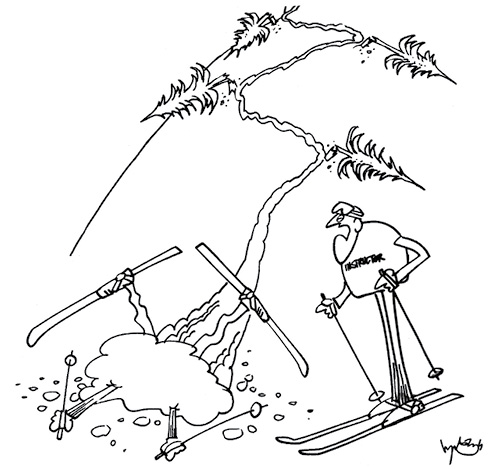


 JOIN US FOR SKIING HISTORY WEEK!
 • Discount lodging is available at the Sun Valley Lodge, Sun Valley Inn and Limelight Ketchum Hotel. Space is limited, so book your room soon!