The cerebral side of ski instruction grew dominant in the mid-1970s. The approach vanished a decade later, but had made its point that mastering technique is only part of the game.
More than three decades ago, skiing was ripe for a change in the way the sport was taught. Amid a new wave of research in psychology and neurology that supported a holistic approach to how people learn, ski instructors were still shouting orders to tense skiers about the placement of their knees and shoulders.
Jean-Claude Killy, it was revealed, had used a form of yoga to help win the 1967 overall World Cup title and his triple gold at the 1968 Olympics in Grenoble, France. Switzerland’s national ski team won seven medals at the 1972 Sapporo Winter Games after employing a Jungian psychotherapist.
Sportswriter and expert skier Denise McCluggage, who’d studied Zen Buddhism, attracted national attention with her concept of Centered Skiing. She urged skiers to control their skis not intellectually from the head, but viscerally from the body’s physical center—a point located just below the navel.
At about the same time, in 1975, Tim Gallwey, the best-selling author of The Inner Game of Tennis, burst onto the ski scene. Skiers, he said, should learn to focus on mental images of how they wanted to ski down a slope and on how a perfect turn should feel. He went on to co-author the best-selling book Inner Skiing.
The nation’s ski schools mostly welcomed the Gallwey influence. Colorado’s Copper Mountain started a dryland program instructing students to feel the motions of skiing before they even put on skis. A rush of workshops and books, such as Ski With Yoga, appeared.
The Hidden Skier claimed a latent talent and unique style of skiing lay within each of us. In Skiing from the Head Down, two psychologists presented skiing as a total mind and body experience.
It wasn’t long before doubts were raised about overemphasizing the inner approach to instruction. Skiing does, after all, involve a technical activity: sliding down snowy slopes at high speeds. A Zen-like inner peace doesn’t address a student’s need to make it down the slopes in one piece.
By the mid-1980s, the Inner Game schools had mostly disappeared. While racers continued to work on the cerebral aspects of skiing, the ski-instruction establishment largely returned to focusing on execution and technique. Nevertheless, the mental approach of the ’70s has left the sport with an enduring legacy: a reminder to instructors that technical expertise is only the beginning of successfully teaching people how to ski.
Excerpted from the October 2008 issue of SKI. John Fry (1930-2020) was editorial director of SKI and Snow Country magazines and longtime president, then chairman, of ISHA. He authored the award-winning book The Story of Modern Skiing. His final book, published posthumously, is Abandon Foolish Scheme: Deathly encounters that you won’t find in bestsellers about dying.
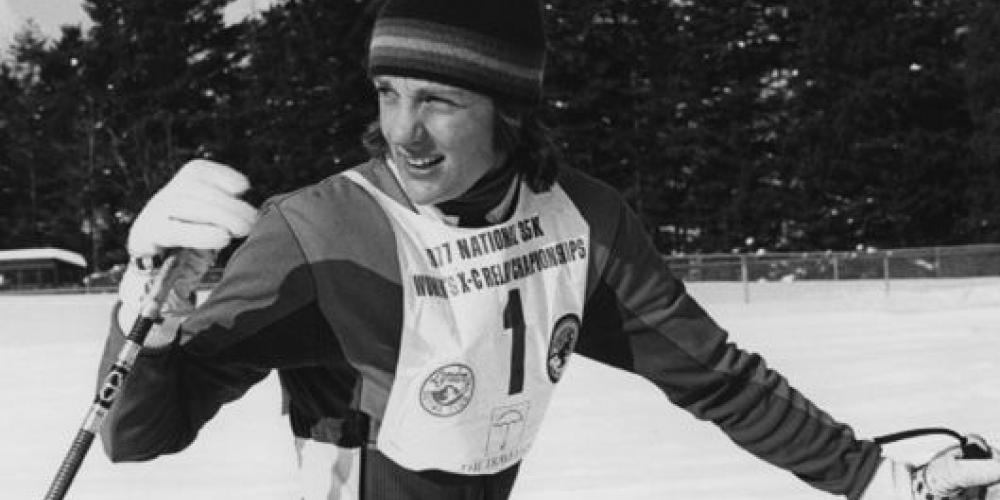
The first American to win a World Cup cross-country race, this pioneer has remained an advocate for women for five decades.
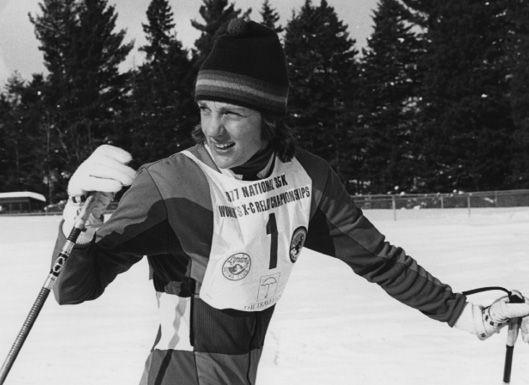
Photo above: Alison at the U.S. Nationals in 1977. Courtesy Alison Owen Bradley.
Trivia question: Who is the first U.S. racer to win a FIS cross-country World Cup?
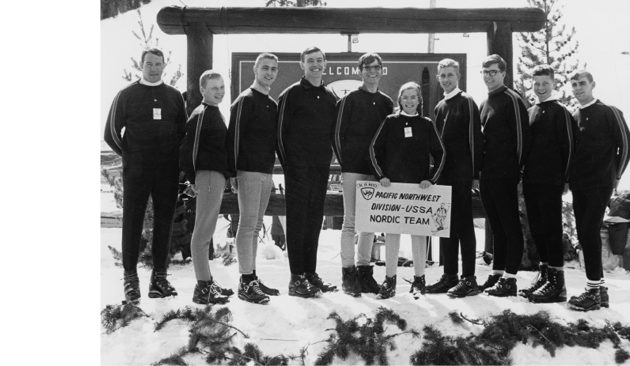
As a member of the Pacific Northwest
Division, Alison bashed the gender
barrier at age 13, at the 1966 Junior
Nationals, Winter Park. AOB.
Kikkan Randall, or maybe Jessie Diggins? Nope. The answer is Alison Bradley (née Owen), who won the first-ever women’s FIS World Cup in December 1978. A member of the U.S. Ski & Snowboard Hall of Fame Class of 2020—to be officially inducted at some point in a post-pandemic world—Bradley is only the second female cross-country skier to be inducted into the Hall of Fame (her former teammate Martha Rockwell was in the HOF Class of 1986).
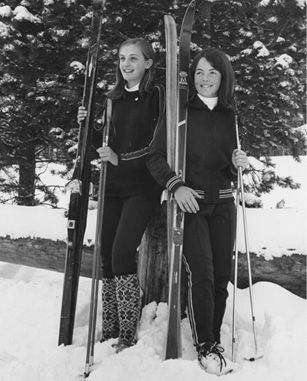
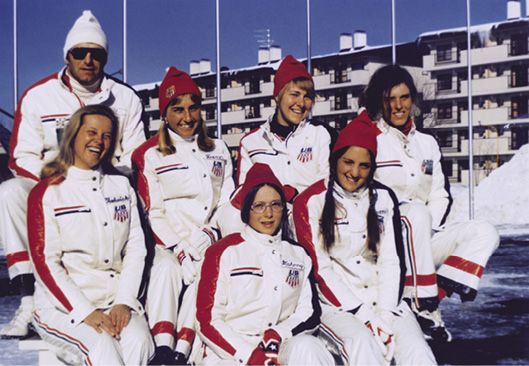
Bradley, with teammate Trudy Owen (no
relation) at the 1968 Winter Park training
camp. AOB.
“Having spent so much of my life devoted to excellence in the sport of cross-country skiing, and then to be recognized and honored for it by the Hall of Fame, is icing on the cake!” Bradley said by phone from her winter home in Bozeman, Montana. She lives with her husband, Phil Bradley, on a small hobby farm near Boise, Idaho, during the summer months.
It’s been a long time coming for Bradley, a pioneer of women’s cross-country skiing in the United States. Since retiring from competition in 1981, Bradley has coached and promoted women’s cross-country skiing. Most recently, Bradley, Randall, and 1984 Olympian Sue Wemyss started U.S. NOW—U.S. Nordic Olympic Women—a group of all the American women who have competed in cross-country skiing at an Olympic Winter Games.
“There are 53 of us, and we’re all still alive,” Bradley, 68, said. “How can we pass on what we learned to upcoming skiers?”
As a way to support current skiers, U.S. NOW has a “grit and grace” award.
First called the Inga Award—named after the unheralded mother of Crown Prince Haakon Haakonsson who was carried to safety by Norwegian Birkebeiners in 1206—Bradley presented it to Rosie Brennan at U.S. NOW’s first reunion in 2019.
“You always see the two Viking guys carrying the prince,” said Bradley, explaining the birth of the award. “You never hear about the boy’s mother. That’s kind of like women’s skiing. It really spoke to me that she would be a good example for us to persevere and be strong.”
Bradley’s aim is that U.S. NOW continues to inspire upcoming generations of female cross-country skiers. “We have a lot of passion for skiing and ski racing, but there hasn’t been a real big way to put ourselves back in,” she said. “Now we have a structure to work within.”
The U.S. women's XC team debuted
at the 1972 Sapporo Olympics. AOB.
The Early Days
Bradley had no female role models when she began cross-country skiing in the mid-1960s. Born in Kalispell, Montana, and raised in Wenatchee, Washington, Bradley was the second of five children in the Owen family, and like her father, she loved the outdoors.
One day, her father saw an ad in the Wenatchee World newspaper for a cross-country ski club. Herb Thomas, a Middlebury graduate and biathlete, had moved back to Wenatchee to work in his family’s apple business and wanted to teach area youth how to cross-country ski. Bradley, the only girl on the team, loved it. The next year, she beat several boys and qualified for a meet in Minnesota. But she was not allowed to compete.
“I couldn’t go because I was a girl,” she recalled, recounting an era in which female athletes were often ridiculed for competing, which was considered unattractive and even dangerous. “I was devastated.”
The next year, when she was 13, Bradley was one of nine Pacific Northwest Division skiers to qualify for the 1966 junior nationals in Winter Park, Colorado. This time, they let her go. But once she arrived, officials were not sure what to do with her. They finally allowed her to compete, but an ambulance was ready in case she succumbed to the effort (she didn’t).
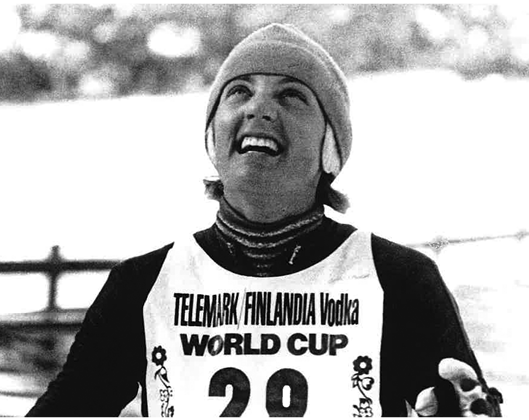
First American, man or woman, to win a
World Cup XC race, eight-time U.S.
champion flashes a victory smiile. AOB.
Bradley does not remember the hoopla (she made laps on alpine skis at Winter Park while the race jury was deciding her fate), nor much about the race itself. For a 13-year-old, it was “just fun to be out of school and to have made the team.”
But Bradley had opened officials’ eyes. The following year, 17 girls qualified to compete at junior nationals, and they had their own race. By 1969, 40 girls participated in junior nationals, and the first senior national cross-country championships for women were held that year. Bradley had shattered her first glass ceiling.
‘First’ World Championships and Olympics
In 1970, the U.S. Ski Team sent its first women’s team to a FIS Nordic World Championship. A junior in high school, Bradley qualified for the team and left school for several weeks to travel behind the Iron Curtain to Czechoslovakia. Again, she remembers little from the 5k race, just that she was wide-eyed at the sights, so different than rural Washington.
American women made their Olympic debut in cross-country skiing at the 1972 Sapporo Winter Games. Galina Kulakova, a 29-year-old Soviet skier, swept the 5k and 10k individual races and anchored the Soviets to the relay gold medal—finishing more than five minutes ahead of the Americans, who crossed the line in last place. Bradley had just graduated from high school the previous spring and finished far back in both races.
Bradley asked U.S. women’s coach Marty Hall if she could just go home and taste success at junior nationals. “He would say, ‘Do you want to be a big fish in a little pond, or do you want to be a little fish in a big pond?’ I was getting eaten by the bigger fish, but it did wake me up to what I was working towards.”
Hall gave Bradley a training journal with Kulakova’s picture on the cover. “Someday you’re going to be right there with her,” he assured her.
But after 1974 world championships, Bradley had had enough. She was only 21 but felt as if her progress had stalled. She earned a scholarship to Alaska Methodist University (now Alaska Pacific University) and moved to Anchorage. She continued to compete domestically. But she was done with racing in Europe.
Then in 1978, the national championships were held in Anchorage. After winning the 7.5k and 20k races and finishing second in the 10k, Bradley found herself on another world championship team. “I’m not going back into that, I’m going to get my education,” she firmly told Jim Mahaffey, AMU’s ski coach.
Mahaffey persuaded her to try international competition again. She was good, he assured her. “Kochie had won an [Olympic] medal, ‘You know, maybe Americans can do well in this sport,’” she recalled thinking.
Physically and mentally more mature, Bradley was finally skiing near the front. In Europe, she finished top 10 in four races, including seventh at Holmekollen. It was like catching a touchdown pass in the Super Bowl.
In December 1978, Bradley made her mark. She had a good feeling at the Gitchi Gami Games in Telemark, Wisconsin—considered as the first FIS Cross-Country World Cup won by an American woman or man, though the FIS classifies it as a “test” event. “I knew in my heart I could win it,” she said. She just had to convince her body to go through the pain of racing. At that moment, Marty Hall walked into the lodge where Bradley was sitting. Hall was no longer the U.S. coach, but he looked across the room and pointed at Bradley. She looked back and thought, “Yes! I’m ready.”
Bradley won the women’s 5k that day and the 10k as well. With a handful of other top 10 finishes that season, she finished the World Cup ranked seventh overall. It was the best result by a U.S. woman until Kikkan Randall finished fifth overall 33 years later, in 2012.
The 1980 Olympic year was the best yet for Bradley. She won the Gitchi Gami Games again and finished on the podium in several World Cup races. In all, she made $35,000 in prize money—unheard of riches in a relatively unknown sport in the United States at that time. But at the 1980 Olympics in Lake Placid, she fell ill and finished 22nd in both races (5k and 10).
A year later, she won the last of her 10 national titles, then retired. “I was so discouraged by how up and down results would be,” she explained. “I could be right in there for some races, then people I had beaten were beating me at the big events. We wondered why our coaches couldn’t get us to peak.” She now recognizes the impact of performance enhancing drugs (PEDs) on the sport. In 1979, five of the six women ahead of Bradley in the World Cup rankings were Soviets and are strongly suspected of PED use.
“In hindsight, I give myself a lot more credit,” she said. “The doping scenario was confusing for racers like us because we had this attitude that we weren’t that good. But we friggin’ were that good!”
After Racing
Bradley moved to McCall, Idaho, after she retired and started a family. Her son, Jess Kiesel, helped the University of Utah ski team win an NCAA title as a freshman in 2003. Daughter Kaelin Kiesel was a two-time All-American and student athlete of the year at Montana State University (class of 2011).
After moving to Sun Valley in the mid-1980s, Bradley coached both Jess and Kaelin with the Sun Valley Ski Education Foundation, where for 14 years she helped several young skiers reach the world junior championships. Coaching at the world juniors, she once again confronted dominating males who weren’t good listeners. She knew more than most about training, ski prep, technique and, unlike her peers, had an impressive World Cup record. But she liked to concentrate on the mental approach to competition, and all the complex factors that lead to speed. “My style was very much about the person,” she said.
Then in the late 1990s, she saw a need for a program to help collegiate women make the national team. She founded WIND—Women In Nordic Development. Several WIND skiers competed in the world championships and made Olympic teams. But balancing the burden of fundraising, coaching, and raising her own kids, Bradley could not keep the WIND blowing for long.
In the mid-2010s, Sadie Maubet Bjornsen called Bradley out of the blue. The U.S. women’s team, led by coach Matt Whitcomb, wanted to learn more about the pioneering skiers who had laid tracks for the current women’s program. “I was in tears when Sadie emailed me,” said Bradley. “Really?! Someone remembers me?”
Bradley, Randall, and Wemyss ran with the idea, founding U.S. NOW. When Rosie Brennan received US NOW’s first award—and $1,000 to go with it—she was shocked. “I’ve had a lot of challenges in my whole career,” said Brennan, who was dropped for the second time from the U.S. Ski Team after she contracted mononucleosis during the 2018 Olympic year. “To be awarded this award from this group of people who have also gone through their own challenges means more than any race could ever mean to me.”
Two years after Randall and Jessie Diggins won America’s first Olympic gold medal in cross-country skiing (Team Sprint) at the 2018 PyeongChang Olympic Winter Games, Bradley was nominated to the U.S. Ski & Snowboard Hall of Fame, and several women on the 2018 U.S. Olympic team, plus Coach Whitcomb, penned a letter in support of her nomination.
“We are thankful for all Alison has done to further our sport, which gave us all something to dream about as young women,” read the letter. “The gold medal this winter has not only been an achievement for our team, but for the larger ‘team’ that Alison truly championed… all of (this) started with a leader who wouldn’t take ‘no’ as an answer.”
The hurdles Bradley-Owens and her colleagues faced in a male-dominated sport—and world—are in sharper focus now, but she’s pragmatic about the quest: Don’t blame the men, who deserve credit for organizing all the sports in the first place, she says, but step up yourself instead. “It’s been a slow change, but it is changing,” she says.
Peggy Shinn is a senior contributor to TeamUSA.org, has covered five Winter Olympic Games and is a regular contributor to
Skiing History.
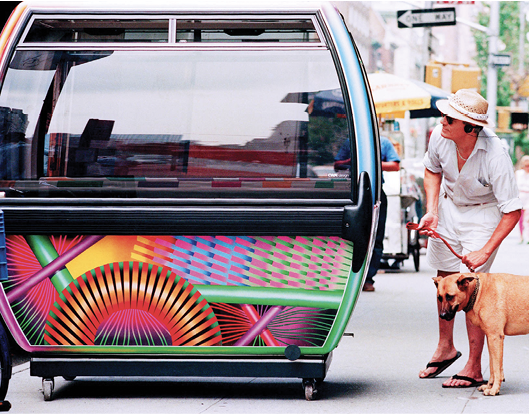
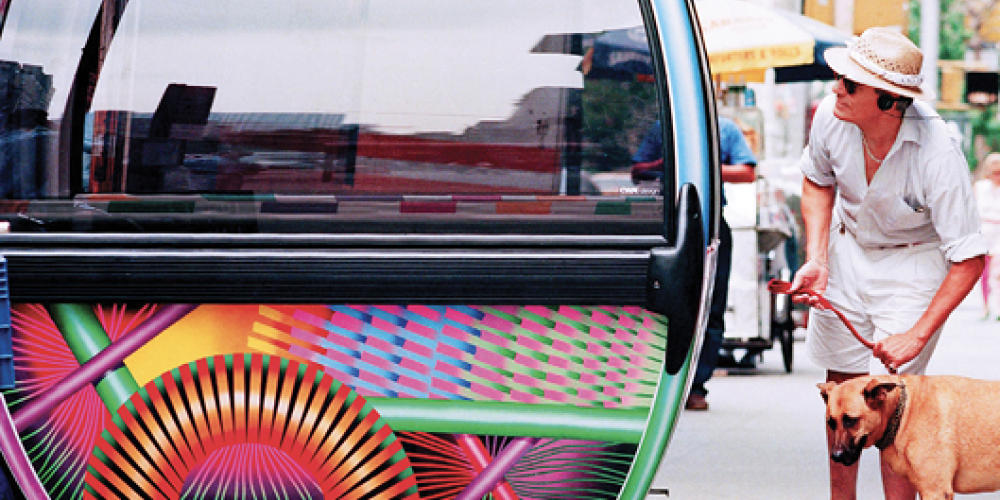
Photo above: At its finest, skiing is both an art and a science—as is effective marketing. In 1993, Killington commissioned six artists to customize 45 cabins as part of the launch of the Vermont resort’s new Skyeship gondola. The public relations score was hauling a cabin to the Whitney Museum in New York City for an evening of celebration and national exposure. A legal kerfuffle ensued when an enterprising illustrator artfully claimed that his work had been exhibited at the Whitney. Mark D. Phillips photo
For skiing’s P.T. Barnums, no news is bad news.
It was about 6 a.m. on a chilly morning in the early 1970’s when then-Sugarbush marketing director Chan Weller and Gary Black Jr. of the Baltimore Sun began a slow hike to the top of the Sugarbush Snowball ski trail to witness an event which may have been a first at any ski area in the East.
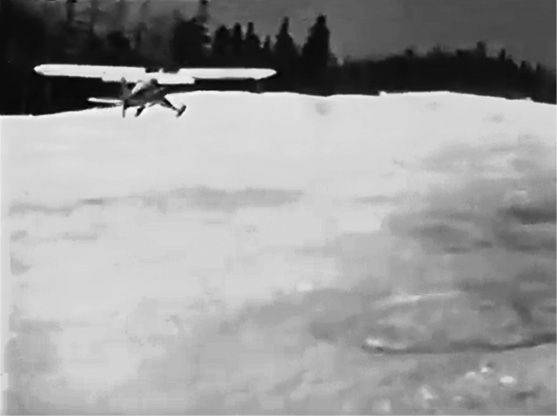
John Macone landing his 1951 Piper Super
Cub on Snowball trail at Sugarbush. The
perpetrators of the early 1970s stunt have
all moved on, but the airplane still flies in
Montana. Chan Weller photo.
After lighting smoke flares, the friends used an old wind-up 16mm film camera to record pilot John Macone, perhaps best known as the top PR executive at the Squaw Valley Olympic Winter Games in 1960, perform one of the most audacious PR capers of all-time: landing a ski-equipped airplane on a ski trail.
After a short flight from nearby Warren-Sugarbush Airport, Macone guided the plane to an uphill landing, bouncing across the moguls. He managed not to bury the prop in a pile of snow, according to Weller’s 2019 account on Sugarbush.com.
Soon, they realized their folly.
“Macone could get busted and his flight ticket pulled. I could lose my job as marketing director at Sugarbush. Black would be the only survivor,” Weller wrote.
“John cranks her up, I get ready to release the rope, Gary rewinds the 16mm and points it at the plane for posterity and we have ‘lift off.’”
The two later chuckled that the Ski Patrol, none the wiser, were puzzled about two straight tracks down the mountain that simply vanished.
It remained a secret until the internet came along, and the clandestine escapade could be shared in all its grainy black and white glory with the world. (See it at https://tinyurl.com/sugarbushstunt)
Channeling Barnum
You’ll find them at Sugarbush and every other ski resort. At X-C touring centers. At gear and apparel manufacturers and at ski shows. Promotional stunts are skiing’s modern-day version of P.T. Barnum, the American showman who in the 1800s sewed a monkey’s torso and head onto a fish and called it a mermaid, and toured the country with a woman he said was George Washington’s 161-year-old wet nurse.
In the ski business, promoters went to extreme lengths to grab attention. The goal was to stage events so outrageous, so over the top, no media outlet could ignore it.
Consider some of the wackiest ski promotions of the mid-20th and early 21st centuries, which, so far, looks to be the golden age of ski stunts.
Bombs Away
At the head of any publicity parade would certainly be Walt Schoenknecht (1919-1987), the entrepreneur who opened Mohawk Mountain in Connecticut in 1947, then ventured north to purchase a 500-acre farm from the man with the perfect name: Reuben Snow. Mount Snow, opened in 1954, went to extraordinary lengths to generate awareness, according to Thad Quimby, writing in the Burlington Free Press (Feb. 12, 2016).
“He put a pool outside in the cold and a skating rink inside. He started a ski club in Florida. He allowed a fountain to run in the winter to create a mound of ice large enough to ski down (and people did ski it). A showman? Maybe. Crazy? That’s fair,” Quimby writes.
“He even commissioned the Atomic Energy Commission to explode an underground nuclear bomb to create a bowl for skiing and add more vertical feet to the resort. Thankfully, calmer heads prevailed, and his request was denied,” according to Quimby.
By the 1970s, publicity stunts were as much a part of skiing as stretch pants and bota bags.
For Pete’s Sake
In an inspired bit of Barnumesque showmanship, in 1977, Crested Butte promoters enlisted Tom Pulaski, then the 20-year-old director of the Gunnison Climbing School and Guide Service, to impersonate the fictional “Crested Butte Pete,” then camp at Crested Butte’s Monument Hill with his Siberian husky mix Charlie.
The plan called for Pete to remain on top from early November until he could ski all the way down, certainly no later than Thanksgiving Day.
He was only supposed to be there for 10 days, but needed to resupply to cover an eight-day delay. On Thanksgiving, a flock of sixth graders brought him a turkey. Meanwhile, thanks to a telephone line in his tent, he conducted radio and TV interviews nationwide, racking up publicity for happy Crested Butte executives. Even Charlie became a star of Colorado TV weather reports.
After 18 days, there was enough snow to make the first triumphant run of the year, all filmed by three TV stations and witnessed by numerous fans, according to Skiing Magazine (February 1978).
Recently contacted in Gunnison, Colorado, where he is a retired woodworker and property manager, Pulaski says he still hears from people annually who remember the stunt.
“The promotion really worked. It was just kooky enough that it caught everybody’s eye,” he tells Skiing History.
Billy Kidd took the first run of the 1977 season
on a ribbon of crushed ice in Central Park for
NBC’s Today Show. Arranged by Steamboat
and the Ski the Rockies Association, the stunt
did make it onto the show, though a heavy rain
persuaded co-anchor Tom Brokaw not to
partake in a planned ski lesson from Kidd.
Tamsin Venn photo
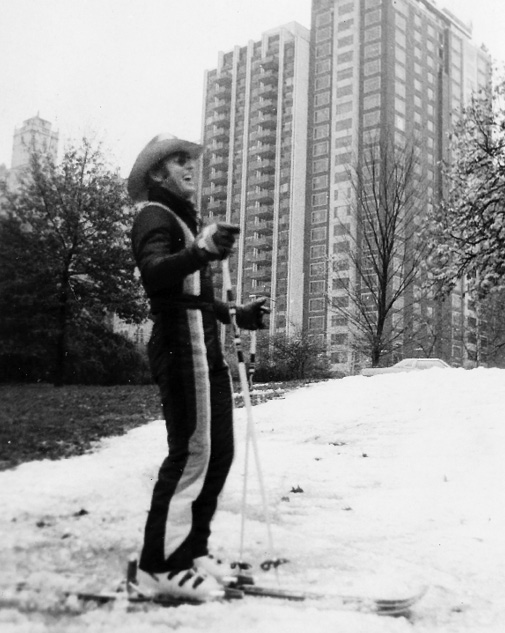
Speaking of first runs, Olympian Billy Kidd took the first run of the 1977-78 season in New York’s Central Park when Steamboat Ski Area and the Ski The Rockies association purchased a truckload of crushed ice and spread it on a tiny hill near Fifth Avenue and 72nd Street, exclusively for the NBC Today Show.
The idea was to give skiing enthusiast Tom Brokaw, co-anchor of the show, lessons in slalom racing. Steamboat flew in 550 pounds of powder, which had congealed into hardpack, then spread it atop 8-1/2 tons of more hardpack ice purchased in Manhattan.
It didn’t rain that day, it poured, adding to the not exactly prime conditions. Promoters asked the ice vendor whether he thought they should go ahead and spread the ice. “Why not?” he said, according to a story about the event in Ski Magazine (February 1982). “You paid for it.”
To his credit, Brokaw showed up in a business suit, apologized and begged off the stunt.
Ski The Rockies promoters were as crushed as the ice. But there was a happy ending: later in the season, Brokaw and a film crew visited Steamboat to ski on the real stuff.
Eye in the Sky
In the early 1990s, war broke out among New England ski resorts regarding who had the most trails. If a trail from top to bottom is defined as Upper Middlebrook and Lower Middlebrook, is that one or two trails? Some resorts increased their trail counts by creative naming, without cutting a single tree. Killington, determined to put an end to the nonsense, hired an independent aerial surveillance company to fly over their competitors’ terrain and count trails.
Former Killington marketing director John Clifford recalls, “We picked the top 10 ski resorts in the Northeast and left the smaller areas alone.”
Some fellow marketers thanked Killington for actually expanding their terrain; others requested that the “Beast of the East” mind its own business. The New York Times and Boston Globe lapped it up when the results were released.
In 1993, Killington created its high-speed heated Skyeship gondola. To add some sizzle, they commissioned six artists to create 45 artsy designs for the exteriors of 139 cabins, calling the result an “art gallery in the sky.” So what better way to launch the new lift than at a private event at New York’s Whitney Museum of American Art? A gondola cabin was trucked to the Whitney to impress otherwise blasé New Yorkers. The event generated enormous exposure for the resort but later resulted in a lawsuit. It seems one of the gondola artists claimed his work was exhibited at the Whitney. Technically yes, for one evening. But the buyer of one of the artist’s other works sued for misrepresentation. Killington was happy about the promotion. The buyer of the artwork, not so much.
Human Snow Globe
How could this possibly fail? To create excitement at the annual Ski Dazzle ski show in Los Angeles in 2002, Greg Murtha, then the marketing director of Sugar Bowl, near Lake Tahoe, created an inflatable 18-foot Human Snow Globe. Visitors could step inside to enjoy a “blizzard” of shredded Styrofoam. Jeep, a corporate sponsor, parked a new car inside. It was a huge hit, although Guinness World Records turned down their submission because the globe didn’t contain water.
The plastic see-through attraction toured California ski and auto shows until Murtha realized that it might not be healthy for visitors to breathe in Styrofoam dust. Later, Sugar Bowl turned the giant plastic globe into a sumo wrestling arena. People lined up to don one-size-fits-all inflated sumo suits and have a go at it.
“It was hysterically funny. People would watch for hours,” says Murtha, who now runs Xplorit, an interactive virtual travel company in Incline Village, Nevada.
“We succeeded in putting a smile on people’s faces as they engaged with our brand. There were a few drunk rounds of faux wrestling, but those stories are best untold.”
What better way to cultivate industry
esprit de corps, and some publicity,
than sponsoring a cow chip throwing
contest? SIA and DuPont thought so
at the 1983 show. Then-SIA president
David Ingemie still has the 2nd place
plaque on his wall to prove it.
How Now Brown Cow
It’s not just ski shows and resorts that resorted to press stunts. The largest ski industry association also succumbed to the siren song of publicity. During a 1983 trade show, DuPont and Ski Industries America (SIA) hosted a cow-chip tossing competition in the Rotunda of the Las Vegas Convention Center. In the same hall where the Beatles performed in 1964, SIA encouraged the industry to bond and create publicity by throwing dried cow excrement, for distance.
“The rules were simple,” said then-SIA president David Ingemie. “Reps competed against retailers in an event well-lubricated by free alcohol.”
Ingemie remembers the cow chips, on arrival, were, “very fresh – right off the ranch.” They had, however, dried into fragile discus-shaped pies. It turned out that mere strength wouldn’t win the contest: throw too hard and the pie disintegrated. Finesse and technique ruled the day.
I was in the room where it happened. After about an hour I looked at Ingemie. He looked at me through a cloud of dry cow chip dust, and we both realized how disgusting the event was becoming. The name of the winner is lost to skiing history.
But Ingemie managed to nail second place and has the plaque to prove it. “To this day, my wife still gives me, er, crap about hanging a cow chip on the wall, but I remember it as one of the funniest events we ever did at the Ski Show.”
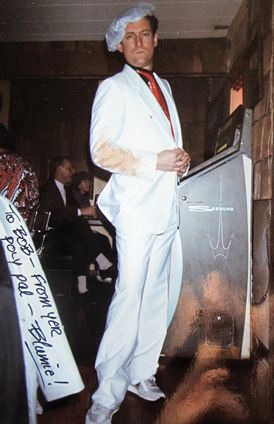
The author in polyester splendor,
Poly Party 1983.
Another legendary SIA Show escapade began in 1982. A boom was on in polyester fleece and Gore-Tex skiwear, so journalist Bob Woodward (not the Washington Post Woodward) and friends thought it would be a hoot to dress for dinner in polyester leisure suits. Woodward dubbed himself The Right Reverend Lester Polyester of the Holy Church of Synthetics, and his flock convened at El Sombrero, a far-off-the-Strip Mexican restaurant. Dozens of reps and retailers dressed like extras in a John Waters movie for an evening of debauchery that is fondly recalled to this day. The Poly Party became a tradition.
“The ’83 party was a ripper as word spread around the SIA Show that good times were to be had at a totally out-of-kilter party which would be the complete opposite of the typical corporate big bash,” Woodward told the trade publication SNEWS.
By 1986 the party drew dozens of staid corporate ski executives channeling their inner Saturday Night Fever. Woodward needed a larger venue. In April 1987 Sports Illustrated reported, “One highlight of the convention was the ‘Polyester Party’ at the El Rancho bowling alley. People who never wear anything but cotton turtlenecks and wool sweaters raided the Vegas boutiques for synthetic shirts and shorts, and prizes were awarded for the flashiest getups.”
Woodward recalls, “The realization that we had created something really big came while waiting for baggage at the Las Vegas airport, and watching a ski show attendee’s bowling ball rolling out onto the conveyor belt.”
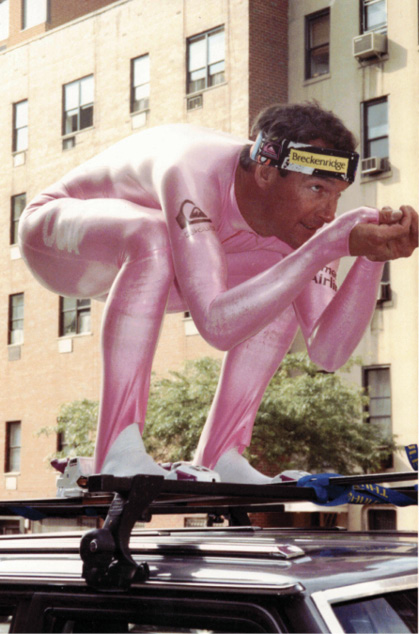
Speed-skiing record holder C.J.
Mueller donned a pink speed suit
and a tuck on a car moving at
non-record-breaking speeds to
promote skiing.
So next time you read about a crazy ski industry stunt involving former speed skiing legend C.J. Mueller strapped on top of a moving car, or click on a viral video of a two-year-old snowboarder at Jiminy Peak, or watch TV coverage of a ski area’s sled dogs hauling along Central Park South, remember these stunts don’t just happen. Behind the scenes is a ski promoter risking a job, just to get you to slide a little more often.
ISHA vice president Jeff Blumenfeld, a resident of Boulder, Colorado, is the president of the North American Snowsports Journalists Association (NASJA.org). He is author of Travel With Purpose: A Field Guide to Voluntourism (Rowman & Littlefield, 2019). Learn more at travelwithpurposebook.com.
Blue sky, green trees, white snow, happy skier. Every ski photographer risks producing cliché images.
Paul Ryan understands. “In today’s world, we are saturated with photographs in the media and online. Sometimes when I go out to shoot, these images pop up and scream at me ‘Someone’s done that! I’ve seen that!’” he says.
Ryan, 83, offers this wisdom gleaned from six decades behind a lens: “Be open for something odd and new, not necessarily strange, but a different vision of the familiar. Perhaps a juxtaposition of disparate elements in the same frame. Wash from your mind all the classic images that linger from the past. Images by others you’ve seen and loved, even images that you see right away—the obvious.”
To that end, when shooting, he strives for “an empty mind, or at least a clean vision,” a reference to the 1970 book Zen Mind, Beginner’s Mind, which he found inspiring early in his career.
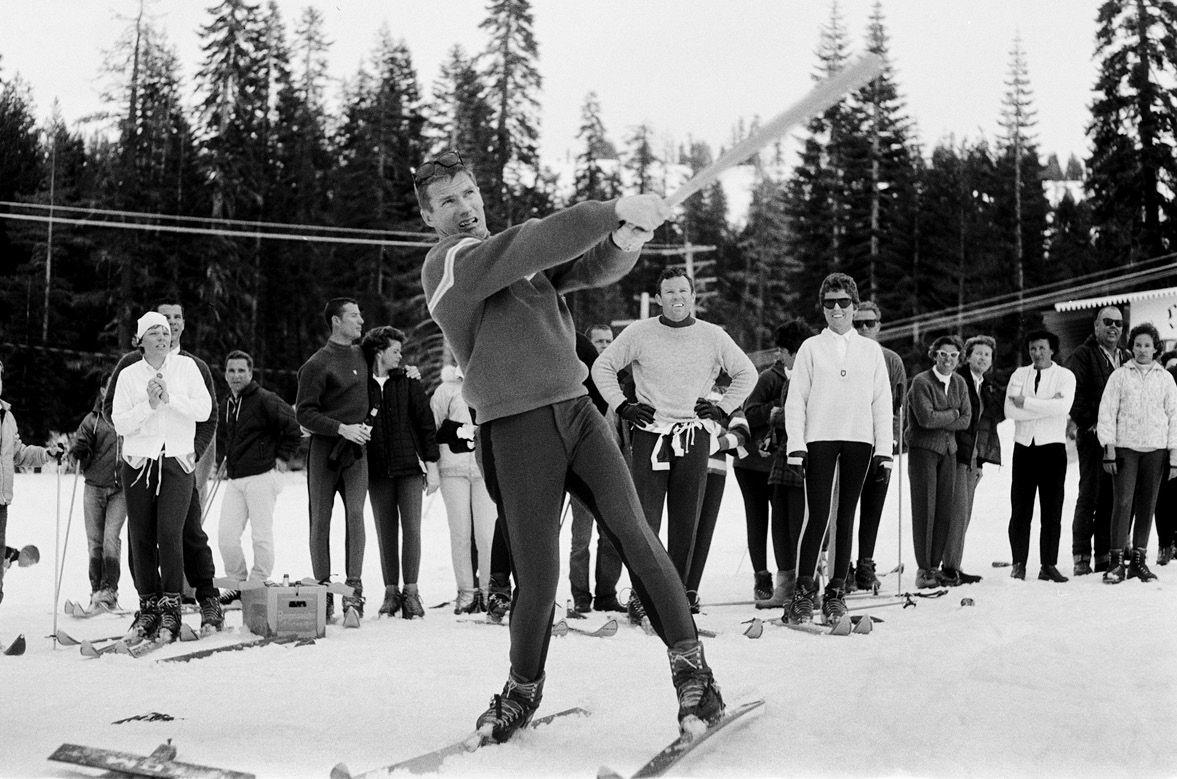
Photo top of page: Ryan started his career as the staff photographer at California’s Sugar Bowl resort. The Silver Belt, the final big race of the season, was held in the late spring. Part of the post-race festivities was a softball game on skis between the racers. “The European racers, unfamiliar with baseball, found the game amusing,” Ryan says. Buddy Werner, a natural athlete and a born competitor, took the softball game—and winning it—seriously. Those are American Olympians Tom Corcoran and Linda Meyers watching the action.
Ryan grew up in Boston and, after taking a BS in engineering, moved to Stowe to pursue what he imagined could be a career in ski racing. An Eastern snow drought in 1960-61 led him to Aspen, and for a few years he spent winters racing and summers in San Francisco, going to film school. He eventually found himself at Sugar Bowl Resort in California for the final race of the season, where general manager Ed Siegel candidly told him that his future wasn’t in ski racing, and hired him as resort photographer.
It was a good fit. John Fry eventually hired Ryan as the staff photographer at SKI magazine for several years. He traveled the world shooting for SKI and other periodicals.
But his professional pursuits expanded beyond skiing. He chronicled the 1960s counterculture in San Francisco. He studied under the greats of the time, including Minor White and Ansel Adams. His photography has been honored in numerous shows, with recent exhibits including “The Sea Ranch, Architecture, Environment, and Idealism” at the San Francisco Museum of Modern Art.
Ryan has easily pivoted between photography and cinematography. His cinema credits include Robert Redford’s “A River Runs Through It” and “The Horse Whisperer.” His documentary work includes “Gimme Shelter,” “Salvador Dali,” and recently a film on George Soros.
He has always found his way back to the mountains. Here are some of his favorite images from a different era. “When on the side of the mountain, I had to pre-visualize the end result, not seeing the film until days later,” Ryan says from his home in Santa Monica, California.
Ryan said that White, one of his early mentors, introduced him to the idea that a compelling photograph is more than a static image—it has an afterlife, of sorts.
“White spoke of ‘Equivalents,’ which is a photographic concept that the photograph mirrors something in ourselves—something that remains in mind after the literal image has faded,” Ryan explains.
To reach that end, Ryan says, the strongest images touch upon a commonality, something universal across the human experience. These images draw the viewer into the frame and into a broader narrative. “The most powerful photos evoke something beyond what was literally in front of the lens. This may come from the implication of what happened just before or of what might happen a moment after,” he says. “What remains is not only the image of the time and place, but a visual residue connected to a broader spectrum of our own experience.”
Of course, in order to achieve White’s concept of “Equivalents,” the photographer does have to first nail the shot. These days, with everyone shooting an endless stream of digital photos at the press of a button, that’s an achievement that’s often underappreciated.
Not by Ryan. “To achieve a high level of visual acuity is demanding,” he notes, “particularly while simultaneously navigating deep powder, an icy mogul field, high speeds or the intensity of race day—all with an array of cameras in check.”
This is the second installment of a two-part photo essay series from Paul Ryan. (See part 1 in the September/October issue.) View this photo essay as a mini-master class in photography, as Ryan explains his approach to his craft and the intriguing backstories to each image. Find more of Ryan’s work at paulryanphotography.com.
Ryan first got to know Billy Kidd during the 1960 season at Stowe. “He was always friendly and curious about photography and actually filmed some of the Megève downhill for me when I was making the Lange film, Ski Racer. This photo was taken at Kidd’s home in Stowe circa 1967. The wall was lined with trophies and his bibs from the 1964 Innsbruck Olympics, where Kidd and Jimmie Heuga became the first American men to win alpine medals. “Ever since 1966, Billy was plagued with recurring ankle injuries,” Ryan recalls. “It was interesting to see a young admirer realizing that even a hero is vulnerable.” Ryan was fascinated throughout his career with catching athletes away from the competition, believing that these moments can tell a story as revealing as the athletic action itself.
One of the many challenges of nailing a great image is “photographing people up close in difficult situations,” Ryan says. Fortunately, Ryan had spent a lot of time with the Canadian team and earned its trust, such as after a nasty downhill tumble by racer Andrée Crepeau, who recalls the crash. “It was on the flats at the bottom of the downhill in Stowe, where I learned that catching an edge is not always reversible. And down I went, face first—real quick.” The resulting image captures both the physical toll of the crash and the indominable spirit of the Canadian’s women’s team. “In photographing emotional situations, it’s always better to be physically close to the people rather than standing farther back with a telephoto lens,” Ryan says.
Great photography is at the intersection of art and science, according to Ryan. Getting the technical aspects right, such as the light, focus and framing, is key. But some of it is just heading into the field and hoping for the best. “Shooting ski action at slower than normal shutter speeds, here 1/8 second, is photographing without the luxury of certainty,” Ryan says. “After a while you get better at anticipating the results, but it’s still guesswork.” Here, at Stowe, the “obscuration of the subject promotes an awareness of the overall graphics in the frame.” Ryan also liked the flame-like gate banner flickering above the racer’s head.
Contrasts help bring a viewer into the frame, seeking out details of the surprising image. “In this case it was the ominous dark tree in the white landscape that attracted me,” Ryan says. “I waited for a bit, assuming a skier would come into the frame. He did and that completed the image.”
In 1970, Ryan made a documentary film on Austrian ski champion Karl Schranz. He filmed for several weeks on the World Cup circuit. “But I was curious to film Karl’s off-season life in his hometown of St. Anton,” Ryan says. He traveled to St. Anton in the summer, after the race season, and talked to locals who knew Schranz since his boyhood. “Karl brought us to meet his mother, who lived in the same small house she had for the last fifty years,” Ryan recalls. “As a widow, she had raised five children.” With photos and medals decorating this modest shrine to her son, Ryan likes the image because it tells as much about Schranz and his upbringing as it does about his mother.
Mammoth was one of the first destinations on Ryan’s unofficial resort itinerary when he headed West as a young racer in the 1960s. “I spent a lot of time there, both skiing and photographing the Mammoth racing program.” The racing operation was a top-notch group, whose roster frequently included members of Mammoth founder Dave McCoy’s family. At the end of a training day, racer Kandi McCoy chats with Dennis Agee, a junior coach at the time, who went on to become the Alpine Director of the U.S. Ski Team. “I liked her shy reaction to a coach’s compliment,” Ryan says.
In 1968, John Fry “had the idea to send me to do a photo story on skiing in the flatlands of the Midwest” for SKI. Ryan ended up at Boyne Mountain, Michigan, with its modest vertical of 500 feet. “For Othmar Schneider, a past Olympic champion and previously at Stowe where I knew him, it must have been confining,” Ryan says. “This image had a feeling of him reaching for something greater—or at least higher.”
John Fry and Mort Lund assigned Ryan to do a photo essay for SKI specifically on the experience of the downhill discipline. “This is the only event where there is a day or more to prepare, inspecting the course and taking a practice run,” Ryan says. “But there is never the sense of totally understanding what it will be like on race day.” At the end of the day prior to the race, there’s one last inspection down the course. Ryan strived to capture the intense preparation and anticipation in this early evening shot of a solitary racer looking down the course. Ryan: “I often find it rewarding to hang around for that extra hour at the end of the day, after the main action has ended. The light is dramatic and interesting things sometimes happen.”
All photographers have favorite assignments. This was one of Ryan’s. “One of my first and most gratifying assignments at SKI was a photo essay on Nancy Greene on the 1967 race circuit. I followed her travels for three weeks, on and off the course,” Ryan says. As well as being a superb racing talent, Ryan learned that Greene was a good friend and dedicated mentor to her teammates. Greene also didn’t let any aspect of her gear go uninspected. “Like many racers of the era, she personally paid exacting attention to the details of her skis,” Ryan says.
For Ryan’s 1969 photo essay, “The Steepness of Stowe” for SKI, he began experimenting with colored gel filters on the lens. “I liked the creative effect and usually made a few photographs this way on most other assignments,” Ryan notes, such as here as part of a story on Roger Staub at Vail (see right). With the analog film of the time, there was no way to know how the gels were working until the film was processed days later.
Digital photography now provides instant feedback (see above). “In contrast, a couple of years ago at the World Cup finals at Aspen I was fascinated with the maze of blue lines left by the multiple course markings. Shooting digitally, I could see the image right away and later, in Photoshop, I was able to exaggerate my impression of the intensity of the blue dye,” Ryan says. “Photography now has evolved to allow for, and even expect, imagery beyond simple representation of reality.”
Beat writers are often accused of writing stories for the audience of other beat writers, bringing nuances into play that can only be picked up on by other pros. The same goes for photographers. Ryan was attracted to the action in this shot for a SKI assignment. The racer is in sharp focus at the 1968 Grenoble Winter Games, with other elements blurred. However, “I liked the patrol sled waiting in the background behind the fencing,” Ryan says. “It quietly portrayed a sense of risk and danger.”
Ryan competed in the Roch Cup slalom in 1962, which became a hinge point in his career. “This was the last of my efforts at ski racing,” Ryan says. “I was decent, but when I was up against world-class racers, I realized I should spend more time at photography.” And for that decision in 1962, skiing’s visual legacy is, indeed, a bit richer.
Bota bags could be having a moment. These holdovers from skiing’s golden age laugh at today’s need for social distancing.
What will skiing, riding and cross-county look like in 2020-2021? Will gondolas be fully loaded? Will six-seat chairs be limited to a maximum of only two to three people from the same family? No one knows for certain, and policies vary between resorts. But one thing is sure: In a time of social distancing, skiers will be reluctant to pass around that pocket flask of
Jägermeister to ward off the chill.
The time is right to bring back the bota bag.
Martini trees were a legendary and beloved feature of Taos Ski Valley dating back to the mid-1950s. What could be more memorable than coming across a hidden glass porrón buried in a tree well containing a perfectly-chilled gin martini?
Better yet, what if you could carry a martini around all day? And instead of breakable glass, carry it in a bota bag—a wineskin sling pouch traditionally made of leather, which presumably imparted some retsina-like flavor to the wine. Modern versions with plastic liners could carry martinis, wine or some other bracing refreshment that could be consumed while skiing or riding. What’s more, you could share some liquid courage with your friends and loved ones from a safe social distance of six feet—or farther—depending upon your aim.
The bota bag has a noble lineage, as Assyrian warriors used animal bladders to carry liquids and as floats to cross bodies of water, as seen in this circa 865 BC bas-relief.
The forerunner of the bota bag was the waterskin dating back some 5,000 years. Normally made of sheep or goat skin, it retained water naturally, perfect for desert crossings until the invention of the canteen. The first images of these bladders are from ancient Assyrians, who used them as floats in approximately 3000 B.C.
Botas have an especially long history in Spain. Traditional models were made from leather and lined with goat bladders, often suspended by a red braided shoulder strap. Tree sap was used to prevent liquids from seeping through. Its modern iteration has a handy cap that contains a nozzle with its own stopper to dispense the liquid, usually wine, sometimes peppermint schnapps, or any preferred adult beverage. (Botas have been known to be filled with Mateus, then after the bottle is emptied, it can be turned into a fine candle holder suitable for a college dorm room.)
Technique was—and remains—critically important when employing a bota, especially to the Basques, who called it a zahato. No less a drinking authority than Ernest Hemingway explains in the 1926 novel The Sun Also Rises: “He was a young fellow and he held the wine bottle at full arms’ length and raised it high up, squeezing the leather bag with his hand so the stream of wine hissed into his mouth. He held the bag out there, the wine making a flat, hard trajectory into his mouth, and he kept on swallowing smoothly and regularly.” Enough said.
Today, thanks to the internet, there are bota tutorials. Greg Morrill’s blog Retro-skiing.com explains, “First hold the spout with one hand and support the bag with the other hand. Now tip your head back with your mouth open, lift the bota toward your mouth, and squeeze the bag to squirt the wine into your mouth.” Morrill continues, “The mark of an expert bota-user was that once he or she started drinking, the bota would be moved to arms-length while still drinking! Just remember you’ll have to increase the pressure as you move the bota.”
There was a time during the bota’s heyday in the mid- to late-20th century when it was common to see skiers enthusiastically swigging from these soft canteens on a lift, or while a group of friends partied mid-mountain, skis stuck in the snow to form backrests. Often when snow surrounded the nozzle, you could swill icy cold wine slush into your mouth.
Few ski products bring back such a flood of warm memories, or in one case, a rush of adrenaline. My cousin Alan Blumenfeld, 74, from Voorhees, New Jersey, remembers serving on ski patrol at the Big Vanilla at Davos ski area north of New York, and watching from a distance as a hapless skier took an egg-beater fall off a small mogul.
He almost made it until a ski tip caught an edge. “When I skied down to the point of his decimation, the entire area surrounding him was a vibrant red! My heart started racing. I marked off the area quickly and immediately started to check him for what might have been extreme bleeding,” Blumenfeld recalls. “Much to my relief I found that he was fine; the bota bag that was hanging off his neck had exploded during the fall. He was soaked in Chianti. It could have been a scene from The Texas Chainsaw Massacre.” In the end, all was well. “The skier had a few bruises,” Blumenfeld says. “But the bota was terminal, and never recovered.”
There was something slightly illicit about the appeal of bota bags. Brian Fairbank, 74, chairman of Fairbank Group based at Jiminy Peak Mountain Resort in western Massachusetts, recalls, “the only time I used one was when I was under drinking age and an older buddy got some red wine to put in it. I can remember hiding it under my parka and skiing off trail to take a swig.”
A full 16 years old at the time, “I remember thinking how cool it was to drink without getting caught—until I got sick. My stomach and head were killing me,” Fairbank remembers. “That was it for me and bota bags.”
Cindy Suh, 50, of Bricktown, New Jersey, learned later in life that her father had an ulterior motive when breaking out the bota bag. “I always thought it was so cool that my dad would let me drink from it when we were on the ski lift. Years later he told me that prior to that I would just cry all the way up the mountain, saying it was too cold to keep skiing. The wine kept me from crying and shivering.”
The martini trees can still be found at Taos, although in this litigious age, they’re tightly monitored, hung from trees in handcarved wooden lockboxes. Meanwhile, bota bags continue to be sold — in both traditional old-school versions and modern styles that use neoprene to encase one-liter sports bottles made of HDPE-recyclable, BPA-free plastic to handle liquids hot or cold. Have times changed.
Could botas, however, once again be ready for prime time? Perhaps in an era of pandemic-induced social distancing, swigging from a shared bottle of Jager will give way to tossing around a bota bag like some colorful Hemingway character … and then simply taking aim.
ISHA vice president Jeff Blumenfeld, a resident of Boulder,
Colorado, is the president of the North American Snowsports Journalists Association (NASJA.org). He is author of Travel with Purpose: A Field Guide to Voluntourism (travelwithpurposebook.com.)
Bota bags could be having a moment. These holdovers from skiing’s golden age laugh at today’s need for social distancing.
What will skiing, riding and cross-county look like in 2020-2021? Will gondolas be fully loaded? Will six-seat chairs be limited to a maximum of only two to three people from the same family? No one knows for certain, and policies vary between resorts. But one thing is sure: In a time of social distancing, skiers will be reluctant to pass around that pocket flask of
Jägermeister to ward off the chill.
The time is right to bring back the bota bag.
Martini trees were a legendary and beloved feature of Taos Ski Valley dating back to the mid-1950s. What could be more memorable than coming across a hidden glass porrón buried in a tree well containing a perfectly-chilled gin martini?
Better yet, what if you could carry a martini around all day? And instead of breakable glass, carry it in a bota bag—a wineskin sling pouch traditionally made of leather, which presumably imparted some retsina-like flavor to the wine. Modern versions with plastic liners could carry martinis, wine or some other bracing refreshment that could be consumed while skiing or riding. What’s more, you could share some liquid courage with your friends and loved ones from a safe social distance of six feet—or farther—depending upon your aim.
The forerunner of the bota bag was the waterskin dating back some 5,000 years. Normally made of sheep or goat skin, it retained water naturally, perfect for desert crossings until the invention of the canteen. The first images of these bladders are from ancient Assyrians, who used them as floats in approximately 3000 B.C...
After a career covering skiing, photographer Paul Ryan has seen it all.
Above: Ryan looks for contrasts when shooting. The dark shadows help visually pop the red-suited racer, next to the red gate, in this image from the 1968 Grenoble Olympic Games. Also, “I liked the sense of launching into the unseen downside of the jump.” Right: Jean-Claude Killy flashes his inimitable style on course in Stowe, Vermont in 1966. The following year, Killy earned the first World Cup overall title, winning 12 of 17 races. Next up: winning the triple crown of alpine skiing, with a sweep of all three Olympic golds at that time (downhill, giant slalom and slalom) at the 1968 Grenoble Winter Games. On skis or off, Killy was as photogenic as they come, says Ryan, who worked extensively with the champ over the years.
"I always was kind of a frustrated ski racer,” admits Paul Ryan, who dabbled in competitive racing in the 1960s. Raised in Newton, Massachusetts, Ryan played hockey for Rensselaer Polytechnic Institute in upstate New York, and after graduation headed north to Stowe, Vermont, to work and follow his racing dreams. In Stowe, racer Marvin Moriarty, of the Moriarty ski hat family, gave Ryan his first camera.
As young ski racers of that generation were likely to do, “a bunch of us decided to abandon career expectations and head out West, eventually landing in Aspen,” he recalls. Ryan and buddies made the racing rounds, competing at various Western resorts, including Mammoth Mountain, where “Dave McCoy let us sleep in the unfinished lodge.”
In the early 1960s, a career beckoned, so Ryan went to graduate film school in San Francisco, but continued to race. He found himself at Sugar Bowl Resort in California for the final race of the season, where he received the career advice of a lifetime. “You are not getting anywhere racing,” Ed Siegel, Sugar Bowl’s general manager told him. “But you’re a pretty good photographer. Come work for us.”
Working a ski camp at Sugar Bowl, California, two-time American Olympic racer Chuck Ferries entertains campers with card tricks. A youngster’s hero-worshipping stare across the frame illustrates Ryan’s “Decisive Moment” philosophy of photography.
He did. “It was my first job getting paid to take pictures,” Ryan says with a laugh. Skiing remained a passion, but he found the time to pursue his craft in San Francisco, and made a name for himself chronicling the 1960s counterculture there. But he had found a home in skiing, and John Fry hired him as the staff photographer at SKI magazine for several years. He traveled the world shooting for SKI and other periodicals.
Ryan’s personal lens was always wider than just the sport of skiing. He studied under the greats of the time, including Minor White and Ansel Adams. His photography has been honored in international shows, with recent exhibits including “The Sea Ranch, Architecture, Environment, and Idealism” at the San Francisco Museum of Modern Art.
Ryan has always moved fluidly between still photography and cinematography. His cinema credits include Robert Redford’s A River Runs Through It and The Horse Whisperer. His documentary work includes Gimme Shelter, Salvador Dali, and recently a film on George Soros.
Ryan has always found his way back to the mountains. This photo essay illuminates an era in skiing’s history and also the progress of photography, which has changed as much as the sport that Ryan covers.
“Photography has evolved enormously since the years when I was very involved in photographing the ski world,” Ryan, now 83, says from his home in Santa Monica, California. “Cameras and iPhones have become very mobile and everyone can take photos of anything.”
A racer studies “the labyrinth of a seemingly random maze of slalom poles” in Aspen. The solitude of the racer attracted Ryan, as did the vertical orientation of racer to poles. The image reminded Ryan that “Billy Kidd always prided himself on being able to memorize every nuance of a slalom course as well as the terrain. He said to me ‘I can memorize the position of 120 poles. Not only the absolute position but the relative distances between the poles.’”
With the new mobile technology, “images are abundant and personal moments are revealed every day,” he notes. Ever the artist, Ryan sees these advancements not as a threat to his craft, but as new tools to use. “Photoshop makes possible the transformation of photographs into our own impressionistic images, and expressions of our thoughts superimposed onto the events in front of the lens,” he says. “It’s a visually exciting time.”
These images here are from a different time, “when on the side of the mountain, I had to pre-visualize the end result, often not seeing the processed film until days later,” Ryan says.
Though the technology has changed, what constitutes a powerful image has not. Ryan says there are two main components to a successful photo: What he calls “the graphics” or the visual structure of the image, and “the human element,” or the emotions that are shown in the photograph.
Great photography combines both to reveal “Cartier-Bresson’s ‘decisive moment’ in time,” Ryan says. The art is in recognizing that instant. “A compelling photograph is not what happened a second before or a second after. It’s a single moment,” Ryan says. “A photographer’s goal is to capture that decisive moment.”
This is Part 1 of a 2 part photo essay series from Paul Ryan, with the second installment in the November/December issue. View this photo essay as a mini-master class in photography, as Ryan explains his approach to his craft and the intriguing backstories to each image.
When shooting point-of-view images while skiing, such as at Mount Tremblant, Que, Ryan slows down, “so the skiing becomes intuitive and all the thought goes into what the shot will look like.” He favors wide-angle lenses when moving, and reverts to a kind of point-and-shoot mode, as “looking through the lens is unwise and restrictive.” After years on skis, the veteran gunslinger admits “I got pretty good shooting from the hip.”
One of Ryan’s first assignments for SKI was a story on St. Moritz, Switzerland. “This scene was probably routine for the Palace Hotel, where we were staying, but the iconic cultural juxtaposition caught my eye immediately,” he says. The curve of the elegantly dressed woman’s hand accenting the flip of her hair and the curve of the tea pot’s spout, with a majestic peak as a backdrop for good measure, add up to a striking narrative.
After filming Jean-Claude Killy, Leo Lacroix and other racers in St. Moritz, Switzerland, for a Lange film, Killy invited Ryan to visit him at his home in Val D’Isère, France, to unwind, which included riding motorcycles together. With Killy, Ryan always had his camera at the ready. Not surprisingly, Killy was as aggressive on a motorcycle as on skis. Wherever Killy went, “crowds would gather,” Ryan says. Word got out that Killy was riding in the foothills, so the locals came to watch. Ryan liked the closeup of a local boy trying the controls with Killy, with the crowds forming a wall in the background.
Ryan was leaving an ISHA gathering at Stowe, when he pulled over on a side road to snap this scenic view of Mount Mansfield. He liked the dark fence line silhouetted against the snow at the bottom of the frame, bracketed by the white snow-covered slopes at the top, with the bare trees in between.
What’s now called a “selfie” has its roots in the professional self-portrait. A self-portrait reveals both a mastery of the artist’s craft and self-image. “Occasionally when skiing an interesting trail, I would just put a wide angle lens on my motor drive Nikon and fire off a few backlit shots of my own shadow while skiing,” Ryan says. “I like that effect.”
Since 1977, the Holding family has transformed this historic Idaho resort while honoring its fabled past.
Carol and Earl Holding
On a February morning in 1977, Sun Valley executive Wally Huffman was summoned to owner Bill Janss’ office. There he met a middle-aged couple, Earl and Carol Holding, and was told to show them around the resort. Two days later, Huffman responded to a disturbance in Upper 5, a dormitory above the Ram Restaurant. There he found the Holdings stuffing mattresses through the windows to fall two stories onto the kitchen loading dock. Huffman called Janss and asked, “What should I do?” Janss replied, “I think you should do whatever Mr. Holding tells you to do.” The Holdings had purchased Sun Valley.
Janss had bought the resort from Union Pacific about 13 years earlier. He was an accomplished skier and had revitalized the mountain, but he was not a hotelier. They were now in a severe drought with minimal snowmaking, few skiers, and little cash flow. A sale was imminent. Corporate giants Disney and Ralston-Purina passed. The Holdings had built up the Little America franchise and owned Sinclair Oil; they knew the hotel business and had working capital. They had driven through Sun Valley only once, that summer, and then Earl saw an article in the Wall Street Journal about Disney’s play on the property. Something clicked. He made some calls, visited the resort again, and within two weeks had a deal. Janss said, “His timing was perfect.” And the mattresses flew out the windows.
(Photo top of page: Sun Valley in 1937.)
The Holdings were not skiers and to the locals, according to Huffman, “a complete unknown.” Unemployment was running at 27.5 percent that dry winter, yet the first reported act by the Holdings was to fire 1,400 employees. Under Janss, anyone with a pulse could get a job that came with a season pass or limited access to the mountain. Poof! The jobs and perks were gone. Not a good start for the new owner of a legendary ski area. Locals were incensed. But in truth it was the Janss Corporation that had to fire the employees as the Holdings had purchased only the assets; many workers were hired right back. There was, however, a new mission and strategy. Carol Holding remembers, “Why would anyone who didn’t know how to ski buy a ski resort? That wasn’t why we bought it—to come here to ski. We bought it to run as a business.”
Averell Harriman: The Visionary. As the chairman of Union Pacific Railroad, Harriman imagined and built a charming alpine village modeled after ski areas in Europe. It was America’s first purpose-built ski resort. In 1964 the UP sold Sun Valley to Bill Janss and Harriman said he felt like he had lost an old friend. Bill Janss: The Ski Racer. He learned to ski in Yosemite and was an Olympic-caliber racer when the Games were cancelled for WW II. As a real estate developer, Janss had projects on the west coast and in Aspen. He opened the Warm Springs side of Baldy and Seattle Ridge, and pioneered snowmaking.
Earl Holding came from a poor Salt Lake City family and even at eight years old was mowing lawns and doing minor landscaping. He had an extraordinary work ethic and kept at it. He served in the Army Air Corps in WWII and then pursued a degree in civil engineering at the University of Utah. One night while studying in the library he was introduced to Carol Orme, an 18-year-old student from Idaho Falls, Idaho. “He was tall, had brown hair, and piercing blue eyes,” she remembers. They were soon inseparable. Earl had saved nearly $10,000 from his landscaping work, and Carol had $400. With that they purchased a fruit orchard at the mouth of Little Cottonwood Canyon. It was the first of many diverse and profitable businesses that would eventually run Earl Holding’s net worth to over $3 billion. With a smile Carol says, “He got my $400 before we were married, but it turned out to be a good investment.”
From the orchard, to the Little America gas station/hotel in Wyoming (with its famous repetitive highway signage featuring a penguin), to Sinclair Oil, to more hotels, the Holdings were hands-on owner/operators. They learned to be self-sufficient and deal with chores and problems themselves. That was the work ethic they brought to Sun Valley and it was not initially well-received.
Earl Holding: The Businessman. When Sun Valley was in financial duress under Janss, Holding stepped in to revitalize it as a more efficient business. He and his family diligently applied themselves to maintaining and upgrading every aspect of the resort. Holding was notoriously meticulous in overseeing operations of the resort. As an engineer he studied the nuts and bolts of ski lifts, snowmaking, and lodge construction. As a hotelier he monitored every aspect of the guest experience from food to carpet to bedding.
“It wasn’t easy when you see bumper stickers that said, ‘Earl is a Four-Letter Word,’” says Carol. “We weren’t very welcome to begin with, but Earl started to turn this into a profitable business, and more people came, and everything got better. I couldn’t ask for more wonderful people than the local people. They really supported us and if it hadn’t been for them, we wouldn’t have made it.”
Earl Holding’s love of growing things is traceable to his landscaping years, the orchard, and his Wyoming and Arizona hotels. He brought that with gusto to Sun Valley. In the first spring he directed the planting of over 7,000 aspens and conifers around the village and golf course. The people doing the work were the newly re-hired employees. They had to learn to break down corporate departments and chip in where required. The Holdings worked right alongside them. Huffman remembers making beds and cleaning rooms, others served food and bussed tables. Hours were long, the work strenuous, and not everyone cottoned to the Holding’s methods, but the new owners never asked anyone to do something they wouldn’t do themselves and eventually found people who supported their style.
The Holdings and their children, Kathleen, Ann, and Steven, all learned to ski. For Earl, it was not recreation; he needed to ski to attend to mountain operations. According to Carol, “His work and his play were one and the same.” Carol and the kids, however, enjoyed the fun and challenge of skiing. Carol set a goal to ski Exhibition, one of Sun Valley’s more intimidating runs, and she did. She also became a dedicated runner and eventually competed in a marathon. But Earl was all about work. His contributions to the resort have been an inspired mix of maintenance, modernization, and masterpieces.
Almost every roof in Sun Valley—previously heated by a steam plant to promote snow melting—had to be redone as a modern cold roof. The Lodge and Inn were remodeled, the golf course redesigned. On the mountain, quad lifts replaced single and double chairs. Three spectacular day lodges were built at the Warm Springs and River Run bases and high on Seattle Ridge. These grand log and rock structures have interior finishes that exceed most resorts and delight guests. Two other mountain lodges, the fabled Roundhouse and the Lookout Restaurant, have also been remodeled. Over the years, a huge automated snowmaking system has been dialed in and a quality snow surface is virtually guaranteed from Thanksgiving to Easter. Expanded skiing acreage came with the development of the Frenchmen’s Bend area, a sheltered bowl with adventurous runs just above Ketchum. Grooming, the ski school, and patrol are all top-notch. And in addition to all the Sun Valley improvements, Holding acquired Snow Basin in Ogden, Utah and was a key player in the 2002 Salt Lake City Olympics.
Holding was relentlessly thorough in both his new projects and day to day management. According to Wally Huffman, he would discuss details and alternatives ad nauseum, far past the point when most felt a decision was nigh. “He had the vision…way beyond the standards of what any of us were used to.” Carol was always there as a sounding board and affirms he was tireless: “He set a very high bar for everyone and he didn’t want to waste any time.” He was driven: “He just always said…give it all you’ve got, and that’s what he’s done.”
Then tragedy struck. Perhaps it was due to his herculean workload or simply a natural life event, but just after Christmas in 2002, Earl suffered a stroke.
It was devastating for the family, staff, and locals whose respect and admiration he had earned. He was 76, and according to his doctors, this was the endgame. Carol recalls a remarkable moment in the ICU when a physician addressed the family: “’We can’t do any more. We suggest you call hospice.’ And Kathleen looked at the doctor and said, ‘You don’t know my Dad.’” And she was right.
Earl recovered, and in time, returned to work, though Carol stepped up and took on more responsibility. She was the driving force behind a new day lodge at Dollar Mountain because she wanted a better facility for children. She told Earl: “If you don’t build me a lodge over there, I’m going to put a tent up.” The lodge was completed in 37 weeks. They then forged ahead on other projects.
What began in 1936 as a lodge in a hayfield with a small, nearby town, is now a world-famous resort mixing the old west with modern amenities. Ketchum and Sun Valley as seen from Baldy today.
A gondola was built connecting River Run plaza to the Roundhouse, serving skiers by day and diners by night. They sculpted the White Cloud Nine golf course with tons and tons of topsoil graded onto a ridge above the valley. The landscaping and views are stunning. The luxurious Sun Valley Club restaurant was added nearby, and it took the golf and Nordic skiing experiences to new heights. They also created a marvelous amphitheater for outdoor events. With sweeping contours that echo the surrounding mountains, structural elements with bold flourishes, and the same elegant travertine marble that adorns the Getty Museum and St. Peters Basilica, the Sun Valley Pavilion is a work of art unto itself.
Earl Holding died in April 2013. Most people connected to the resort and local communities have only gratitude for his vision and contributions. The Holdings have now been stewards of the resort longer than Union Pacific and Bill Janss combined. Yet despite all the improvements, it remains much the same as it was during the formative years of the late 1930s. In addition to what they did, it’s what they didn’t do—radically change or over-develop Harriman’s storybook Austrian village. Today one can walk into Sun Valley feeling the same ambiance skiers experienced over 80 years ago. It’s like stepping into your grandmother’s snow globe.
The Lodge and Inn interiors were recently remodeled again. New service buildings and employee housing have been constructed. There’s a lift and more skiing acreage planned for Seattle Ridge. Additional development at the River Run base may be coming as well.
Sun Valley is one of the last great family owned resorts and Carol feels their children will carry the legacy on: “They all have the work ethic…I think they love Sun Valley like we do and want to keep it like it is…where people can walk the streets and feel like they’re in the country…the soul of Sun Valley, that’s what we want to keep.”
David Butterfield is a filmmaker and writer who grew up in Sun Valley.
Stewards of Skiing History
The Holding family will be honored with a Stewardship Award for the preservation of Sun Valley’s skiing heritage at the 28th annual ISHA Awards banquet on December 10, 2020 in Sun Valley.
It was 1971 and K2 Corp. was just four years old (it was incorporated in 1967). Founder Bill Kirschner and marketing VP Chuck Ferries had just hired a new advertising agency headed by art director Terry Heckler and copywriter Gordon Bowker. No one had seen anything like their K2 ads: no glam skiers, no studio product shots. Instead, to set the brand apart from its European competition, the team went for Americana: barnside advertising, rural filling stations, fast-food franchises and even a goof on Stanley Kubrick’s 1968 film 2001: A Space Odyssey. This one, from the September 1971 issue of SKI Magazine, translates a quote from Cicero, Salus populi supremo lex esto. In the United States, during the Depression era, it was widely used as a motto for local governments and state law schools, but it has a subtly subversive subtext: At the time of the English Civil War it was used by some of the Roundheads (militant Protestants) who overthrew Charles I, and for some had “leveller” connotations (levellers advocated redistribution of wealth, even abolition of private fortunes). That same year, Bowker and two partners opened the first Starbucks café. Bowker named the company and designed its logo. Extra points if you can identify the city. It’s not New York. —Seth Masia
When MAD Magazine put skiing on its cover, millions bought it. Ski editors were influenced too.
By John Fry
MAD, which ceased publication last year, was a seminal, grungy magazine of American culture during the second half of the 20th century. Its intensely illustrated and caustically written pages skewered the media, education, government agencies, politicians, hippies, psychoanalysts, the sexual revolution and even the lifestyles of its own cynical, adolescent-minded readers.
The image most closely associated with the magazine was Alfred E. Neuman, the boy with misaligned eyes and a gap-toothed smile. A skiing Neuman appeared on at least four MAD covers between 1975 and 1980. Publisher William Gaines and MAD’s editors and artists clearly saw frantic humor in putting him and the image of reckless skiing on the magazine’s cover. MAD’s most prolific illustrator was Jack Davis, an enthusiastic skier himself. Davis did the covers on the facing page and on page 25.
Seen through MAD’s eyes, a recreation in which people donned a pair of wooden boards and slid at high speed off a jump—or into a tree—must be as stupidly conceived as the TV shows, movies, health cures, and other sacred cows mocked by MAD. The ski-disaster visual also happened to be funny to the two million-plus newsstand buyers of the magazine.
MAD was part of a golden age of publishing that happened to coincide with the peak newsstand sales of SKI and Skiing magazines. They picked up on MAD’s satirical spirit. In 1966, when I was SKI magazine’s editor-in-chief, I hired the talented young staff of the Harvard Lampoon to create a special eight-page humor section with fake articles. The most memorable joke was a letter from a bogus reader asking the magazine, “What is the cheapest way to engrave my name on my skis?” The answer was, “Change your name to Kaestle.”
In another spoof, SKI staffer Karen Rae wrote about visiting Mount Oniontop, with its glorious 100 feet of vertical, where nine jet flights a day soared over the local airport. “The sun sparkled and the crunch of my boots upon snow scared a volunteer patrolman,” she wrote. The prolific ski journalist Morten Lund wrote about a bus trip to Mt. Nowhere, a “mystical mountain where all the siren songs of ski resort publicity finally ring true.”
The ski magazines also featured full pages of cartoon art by Bob Cram and Bob Bugg. Laugh-inducing cartoons were eventually banished because too many of them made fun of women, or were seen as anti-feminist, even if the Editor and the cartoonist didn’t understand why. Political correctness hadn’t yet penetrated their minds.
At MAD, anything and everything was politically incorrect. For many years the magazine’s offices were located on Manhattan’s Madison Avenue, several blocks north of the SKI Magazine office at 380 Madison. While MAD lampooned the work of the ad agencies on the avenue, SKI was selling Mad Men on the wonders of placing advertising in its pages.
In 2018, Burton’s Deep Thinker free-ride snowboard featured Alfred E. Neuman, the iconic MAD mascot. “If you’re wondering who these people are, they’re from an old humor magazine,” explained one website in a December 2017 review.
John Fry is the author of The Story of Modern Skiing, about the revolution in technique, equipment, resorts and media that revolutionized the sport after World War II. Skiing History and Fry are grateful to ISHA director Bob Soden for preserving the MAD covers, and to E.C. Publications, DC Comics and Warner Media for permission to reproduce them.






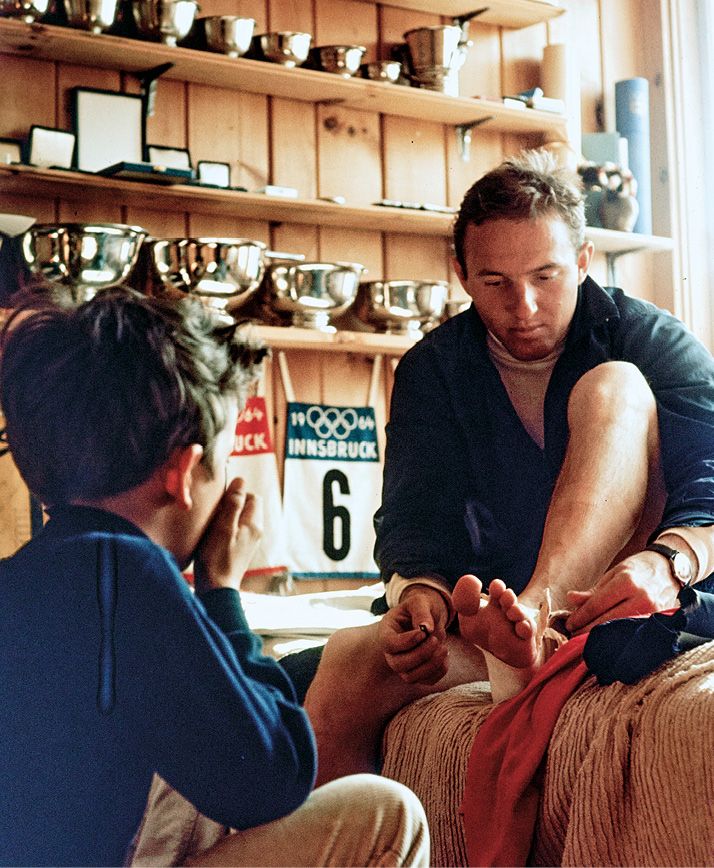 Ryan first got to know Billy Kidd during the 1960 season at Stowe. “He was always friendly and curious about photography and actually filmed some of the Megève downhill for me when I was making the Lange film, Ski Racer. This photo was taken at Kidd’s home in Stowe circa 1967. The wall was lined with trophies and his bibs from the 1964 Innsbruck Olympics, where Kidd and Jimmie Heuga became the first American men to win alpine medals. “Ever since 1966, Billy was plagued with recurring ankle injuries,” Ryan recalls. “It was interesting to see a young admirer realizing that even a hero is vulnerable.” Ryan was fascinated throughout his career with catching athletes away from the competition, believing that these moments can tell a story as revealing as the athletic action itself.
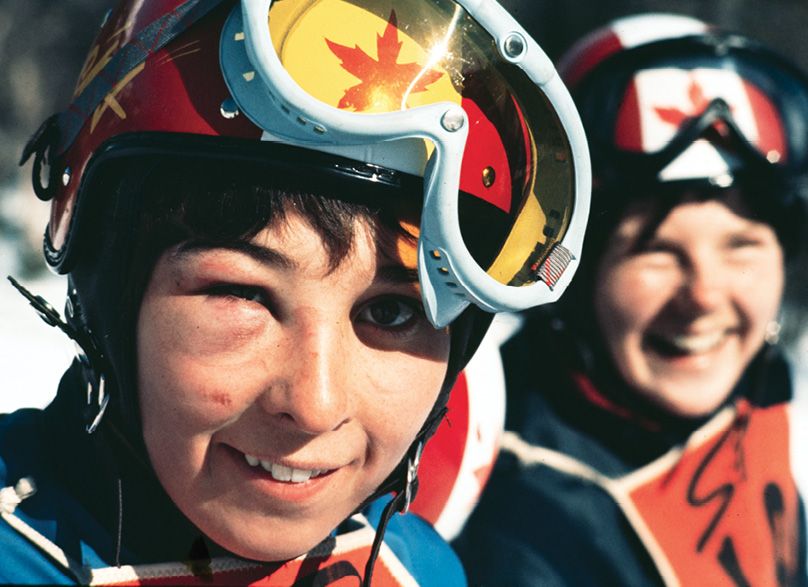 One of the many challenges of nailing a great image is “photographing people up close in difficult situations,” Ryan says. Fortunately, Ryan had spent a lot of time with the Canadian team and earned its trust, such as after a nasty downhill tumble by racer Andrée Crepeau, who recalls the crash. “It was on the flats at the bottom of the downhill in Stowe, where I learned that catching an edge is not always reversible. And down I went, face first—real quick.” The resulting image captures both the physical toll of the crash and the indominable spirit of the Canadian’s women’s team. “In photographing emotional situations, it’s always better to be physically close to the people rather than standing farther back with a telephoto lens,” Ryan says.
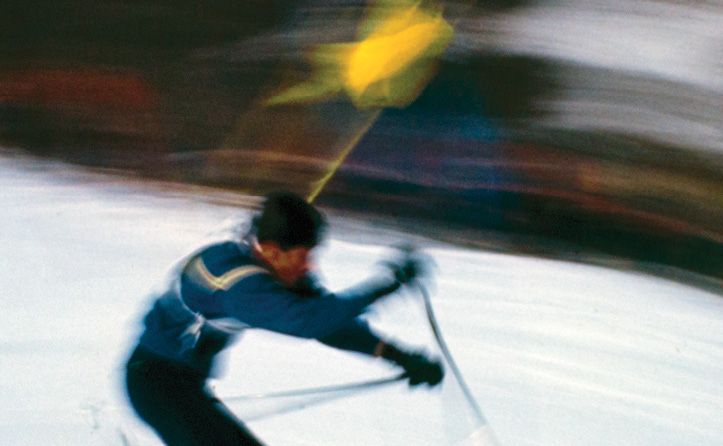 Great photography is at the intersection of art and science, according to Ryan. Getting the technical aspects right, such as the light, focus and framing, is key. But some of it is just heading into the field and hoping for the best. “Shooting ski action at slower than normal shutter speeds, here 1/8 second, is photographing without the luxury of certainty,” Ryan says. “After a while you get better at anticipating the results, but it’s still guesswork.” Here, at Stowe, the “obscuration of the subject promotes an awareness of the overall graphics in the frame.” Ryan also liked the flame-like gate banner flickering above the racer’s head.
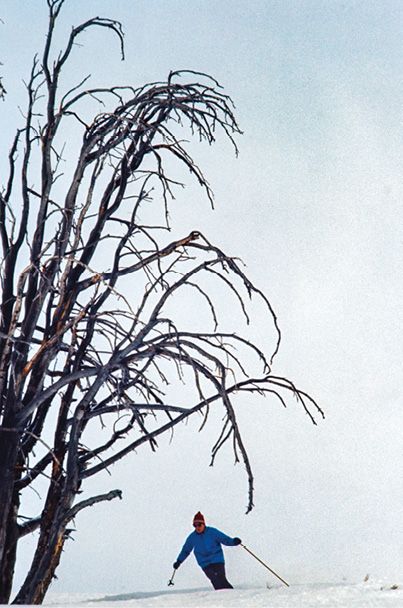 Contrasts help bring a viewer into the frame, seeking out details of the surprising image. “In this case it was the ominous dark tree in the white landscape that attracted me,” Ryan says. “I waited for a bit, assuming a skier would come into the frame. He did and that completed the image.”


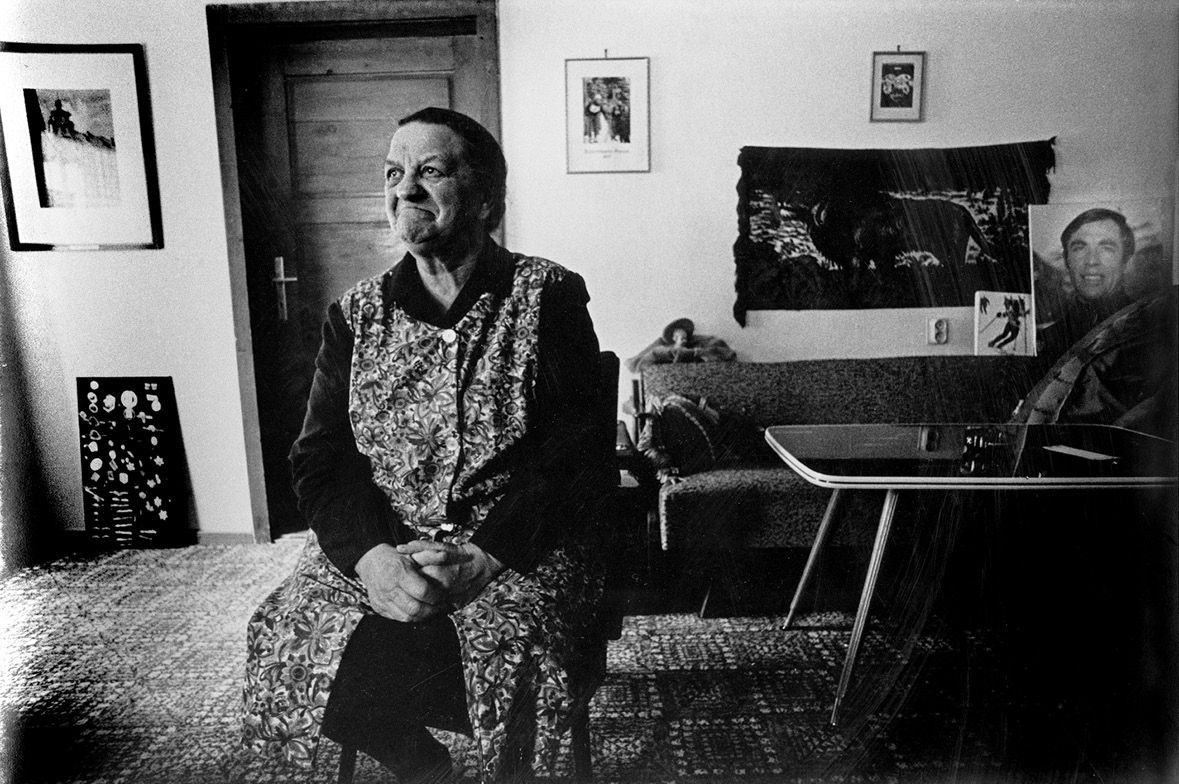 In 1970, Ryan made a documentary film on Austrian ski champion Karl Schranz. He filmed for several weeks on the World Cup circuit. “But I was curious to film Karl’s off-season life in his hometown of St. Anton,” Ryan says. He traveled to St. Anton in the summer, after the race season, and talked to locals who knew Schranz since his boyhood. “Karl brought us to meet his mother, who lived in the same small house she had for the last fifty years,” Ryan recalls. “As a widow, she had raised five children.” With photos and medals decorating this modest shrine to her son, Ryan likes the image because it tells as much about Schranz and his upbringing as it does about his mother.
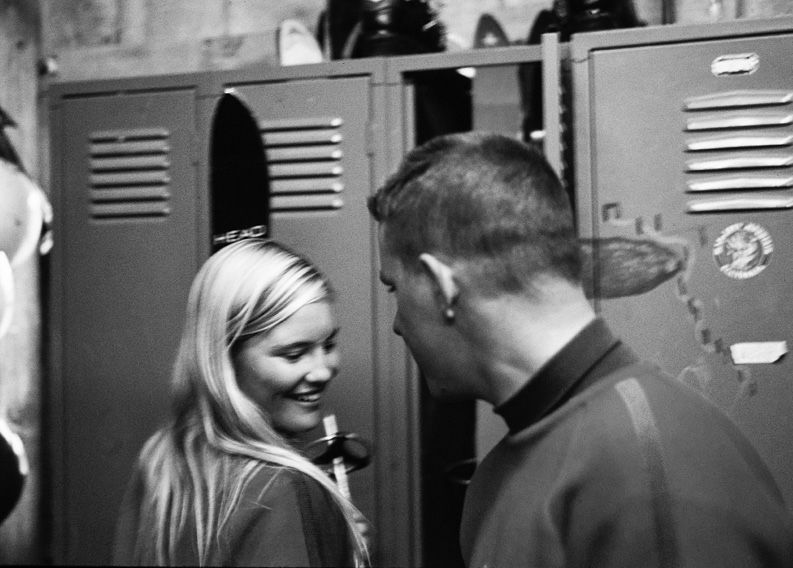 Mammoth was one of the first destinations on Ryan’s unofficial resort itinerary when he headed West as a young racer in the 1960s. “I spent a lot of time there, both skiing and photographing the Mammoth racing program.” The racing operation was a top-notch group, whose roster frequently included members of Mammoth founder Dave McCoy’s family. At the end of a training day, racer Kandi McCoy chats with Dennis Agee, a junior coach at the time, who went on to become the Alpine Director of the U.S. Ski Team. “I liked her shy reaction to a coach’s compliment,” Ryan says.
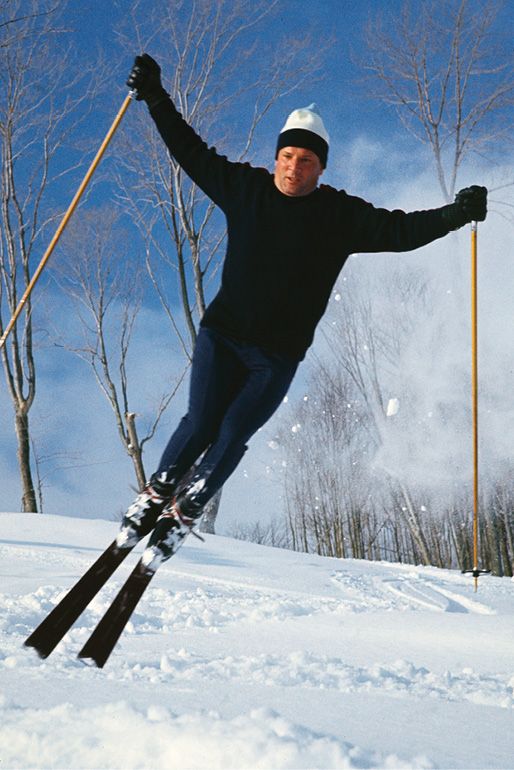 In 1968, John Fry “had the idea to send me to do a photo story on skiing in the flatlands of the Midwest” for SKI. Ryan ended up at Boyne Mountain, Michigan, with its modest vertical of 500 feet. “For Othmar Schneider, a past Olympic champion and previously at Stowe where I knew him, it must have been confining,” Ryan says. “This image had a feeling of him reaching for something greater—or at least higher.”
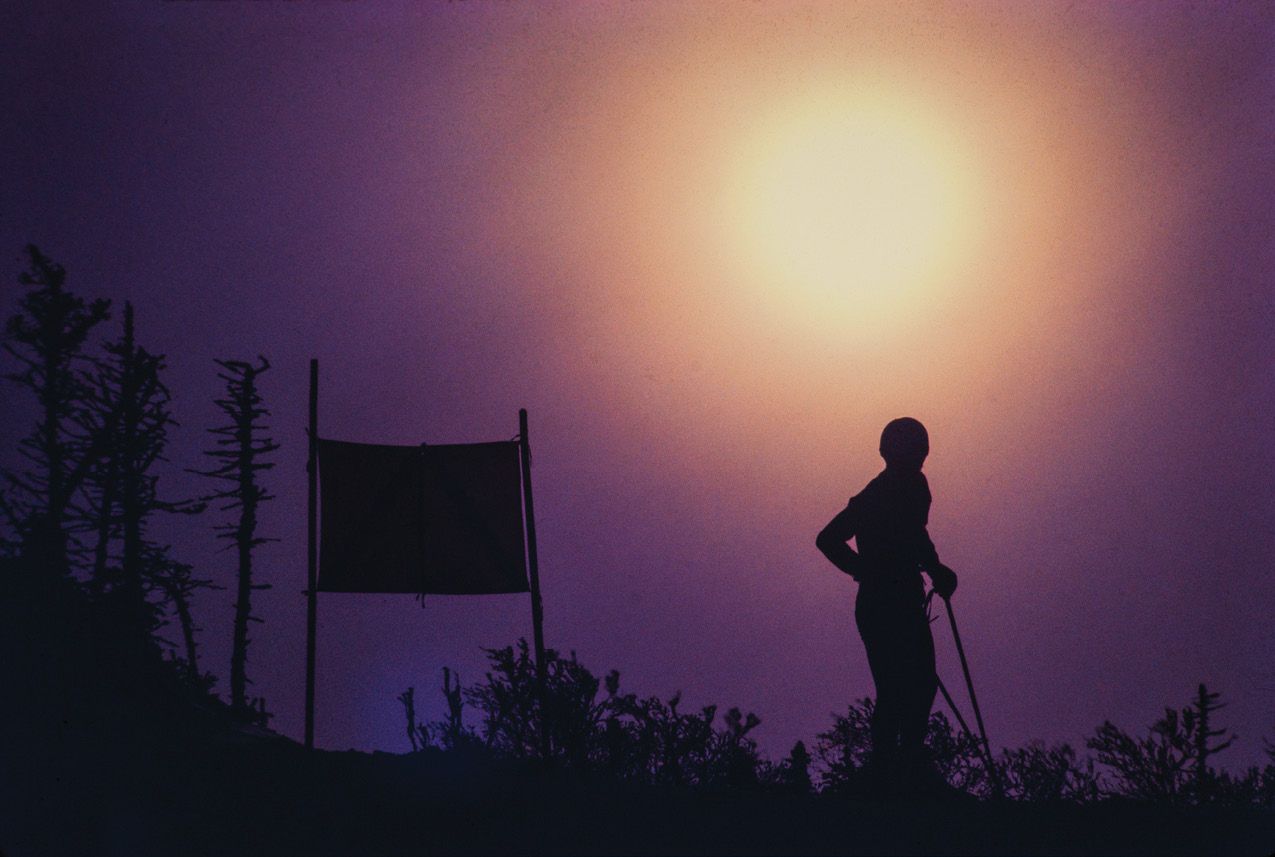 John Fry and Mort Lund assigned Ryan to do a photo essay for SKI specifically on the experience of the downhill discipline. “This is the only event where there is a day or more to prepare, inspecting the course and taking a practice run,” Ryan says. “But there is never the sense of totally understanding what it will be like on race day.” At the end of the day prior to the race, there’s one last inspection down the course. Ryan strived to capture the intense preparation and anticipation in this early evening shot of a solitary racer looking down the course. Ryan: “I often find it rewarding to hang around for that extra hour at the end of the day, after the main action has ended. The light is dramatic and interesting things sometimes happen.”
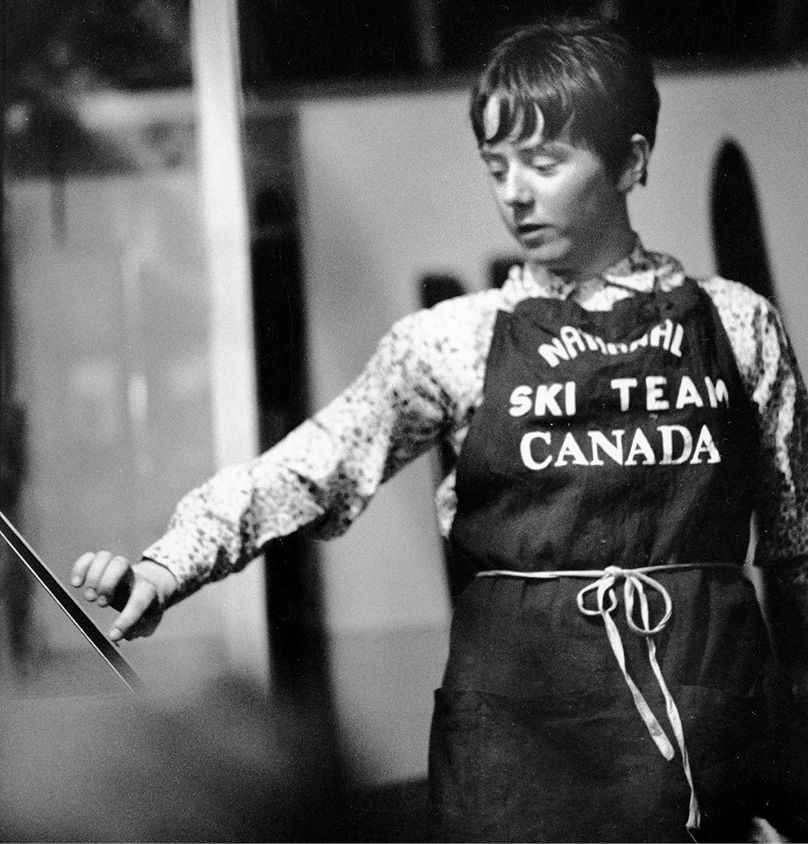 All photographers have favorite assignments. This was one of Ryan’s. “One of my first and most gratifying assignments at SKI was a photo essay on Nancy Greene on the 1967 race circuit. I followed her travels for three weeks, on and off the course,” Ryan says. As well as being a superb racing talent, Ryan learned that Greene was a good friend and dedicated mentor to her teammates. Greene also didn’t let any aspect of her gear go uninspected. “Like many racers of the era, she personally paid exacting attention to the details of her skis,” Ryan says.
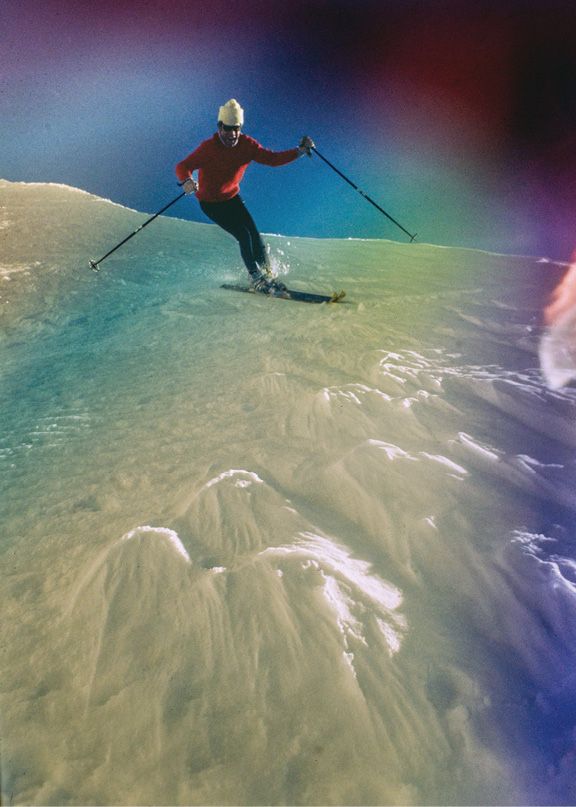 For Ryan’s 1969 photo essay, “The Steepness of Stowe” for SKI, he began experimenting with colored gel filters on the lens. “I liked the creative effect and usually made a few photographs this way on most other assignments,” Ryan notes, such as here as part of a story on Roger Staub at Vail (see right). With the analog film of the time, there was no way to know how the gels were working until the film was processed days later.
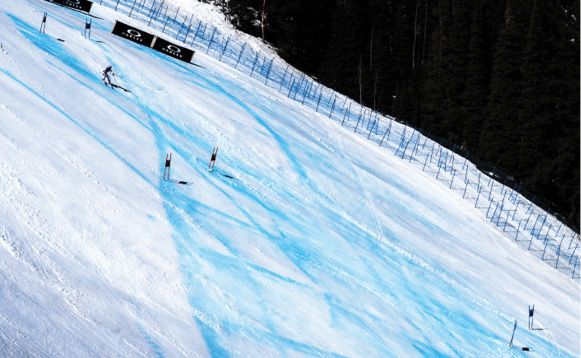 Digital photography now provides instant feedback (see above). “In contrast, a couple of years ago at the World Cup finals at Aspen I was fascinated with the maze of blue lines left by the multiple course markings. Shooting digitally, I could see the image right away and later, in Photoshop, I was able to exaggerate my impression of the intensity of the blue dye,” Ryan says. “Photography now has evolved to allow for, and even expect, imagery beyond simple representation of reality.”
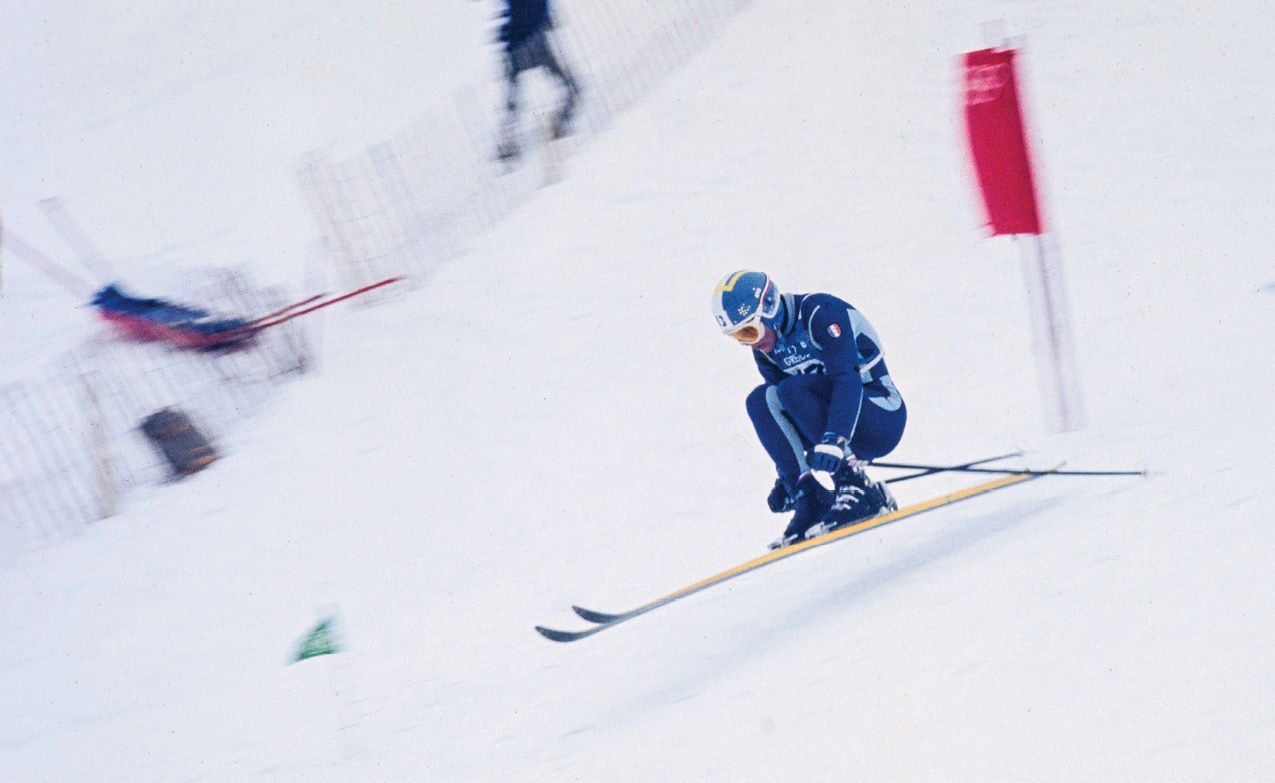 Beat writers are often accused of writing stories for the audience of other beat writers, bringing nuances into play that can only be picked up on by other pros. The same goes for photographers. Ryan was attracted to the action in this shot for a SKI assignment. The racer is in sharp focus at the 1968 Grenoble Winter Games, with other elements blurred. However, “I liked the patrol sled waiting in the background behind the fencing,” Ryan says. “It quietly portrayed a sense of risk and danger.”
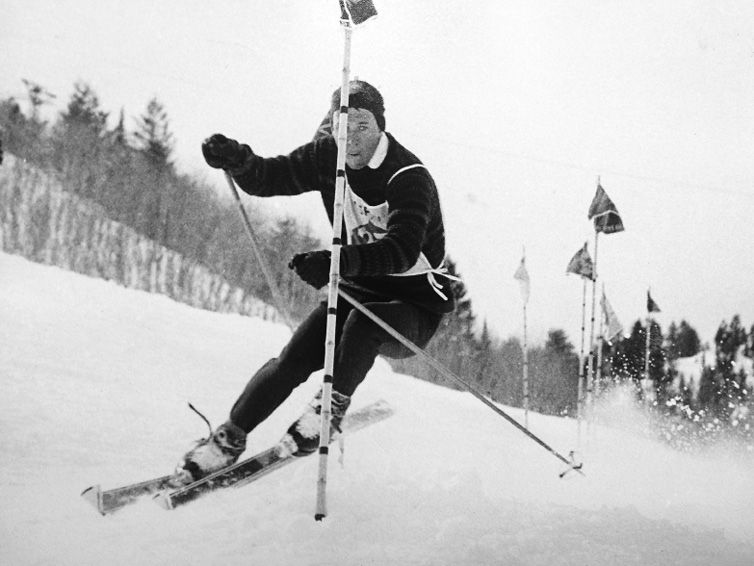 Ryan competed in the Roch Cup slalom in 1962, which became a hinge point in his career. “This was the last of my efforts at ski racing,” Ryan says. “I was decent, but when I was up against world-class racers, I realized I should spend more time at photography.” And for that decision in 1962, skiing’s visual legacy is, indeed, a bit richer.
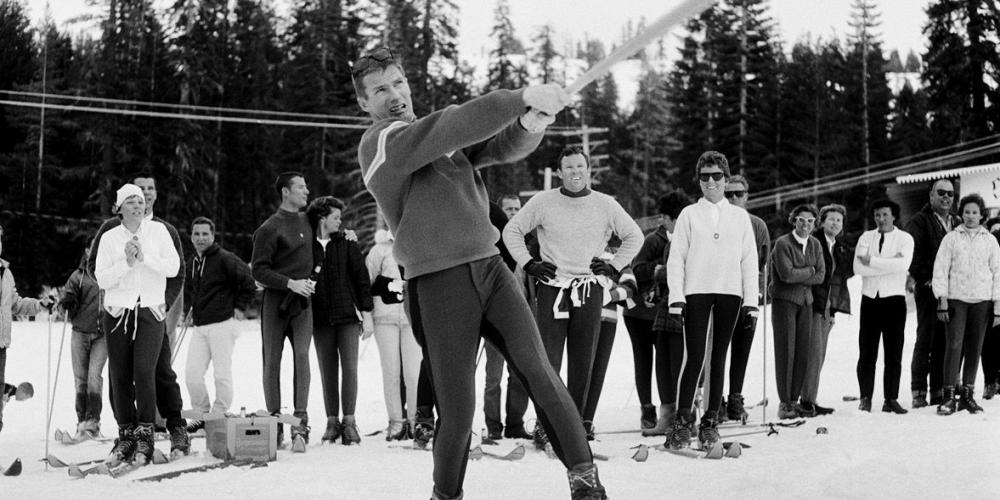
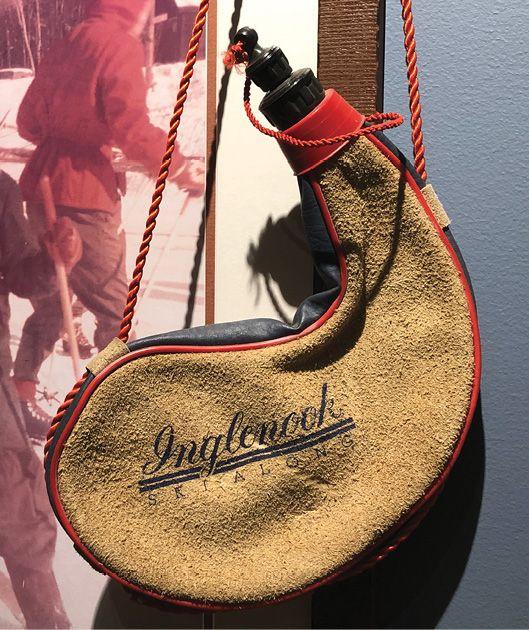
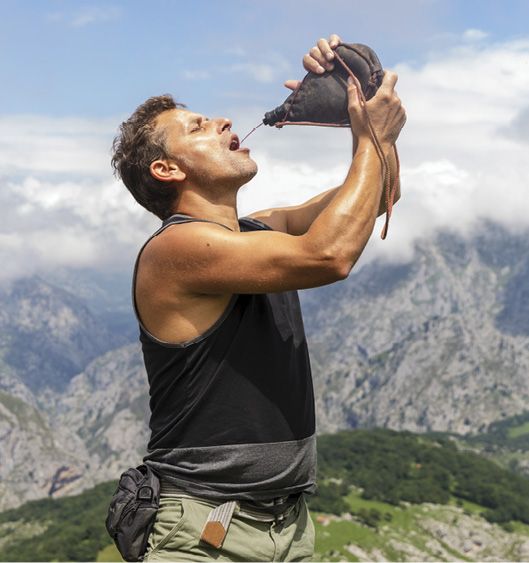 Martini trees were a legendary and beloved feature of Taos Ski Valley dating back to the mid-1950s. What could be more memorable than coming across a hidden glass porrón buried in a tree well containing a perfectly-chilled gin martini?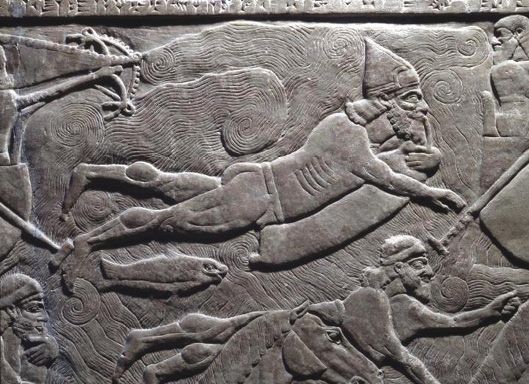


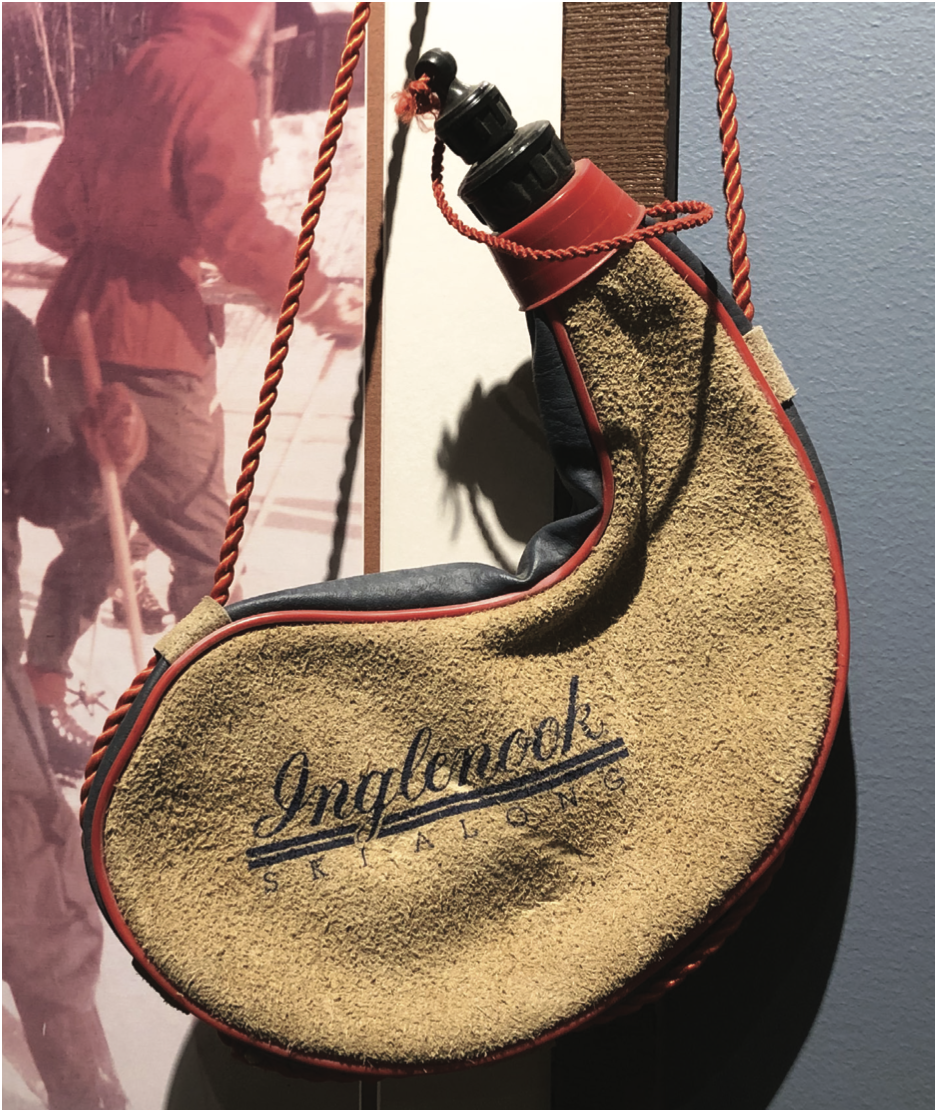
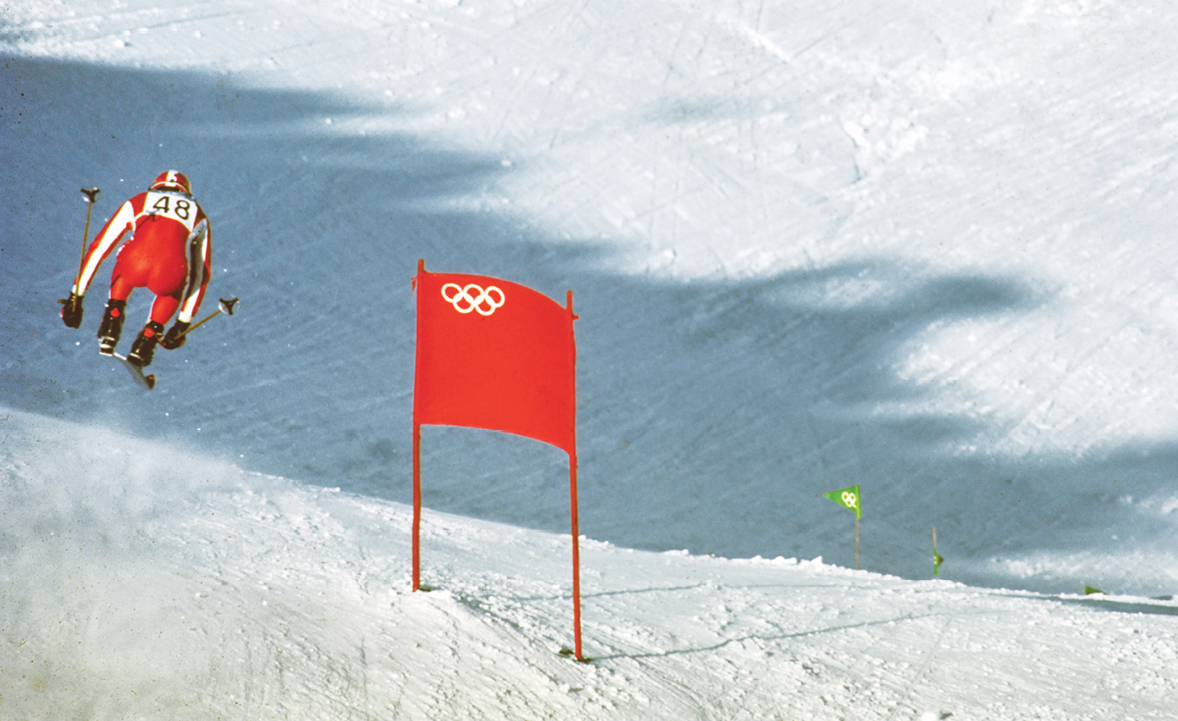
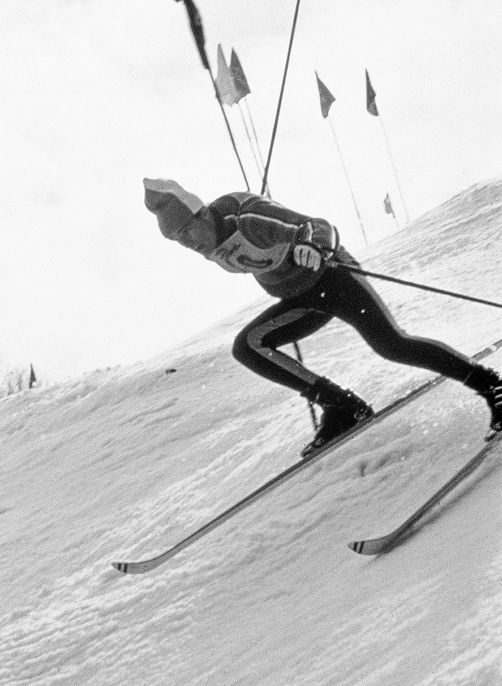 After a career covering skiing, photographer Paul Ryan has seen it all.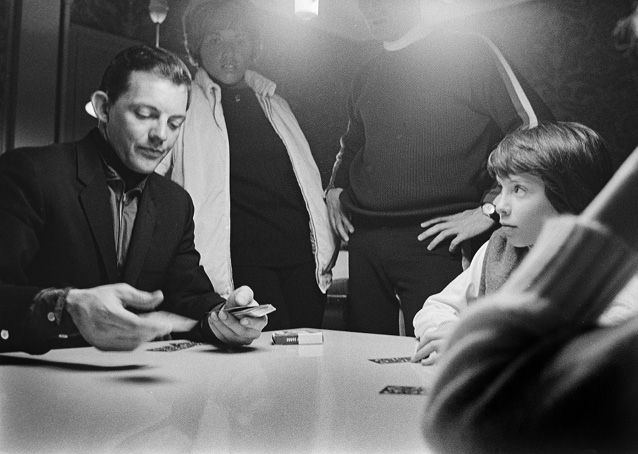
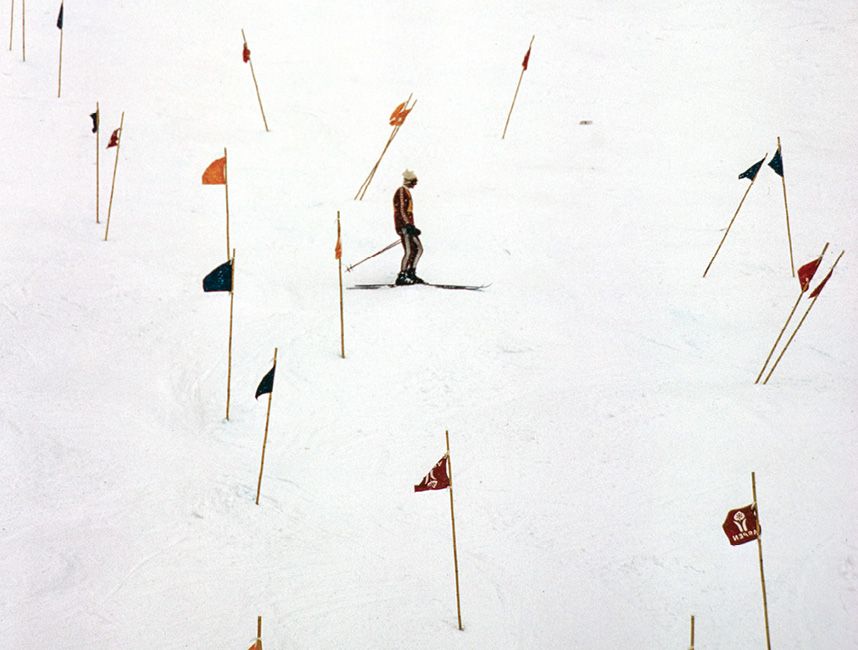

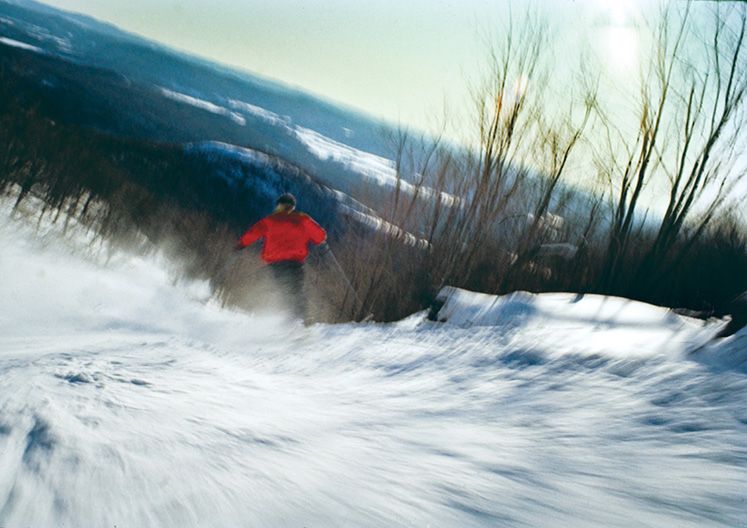


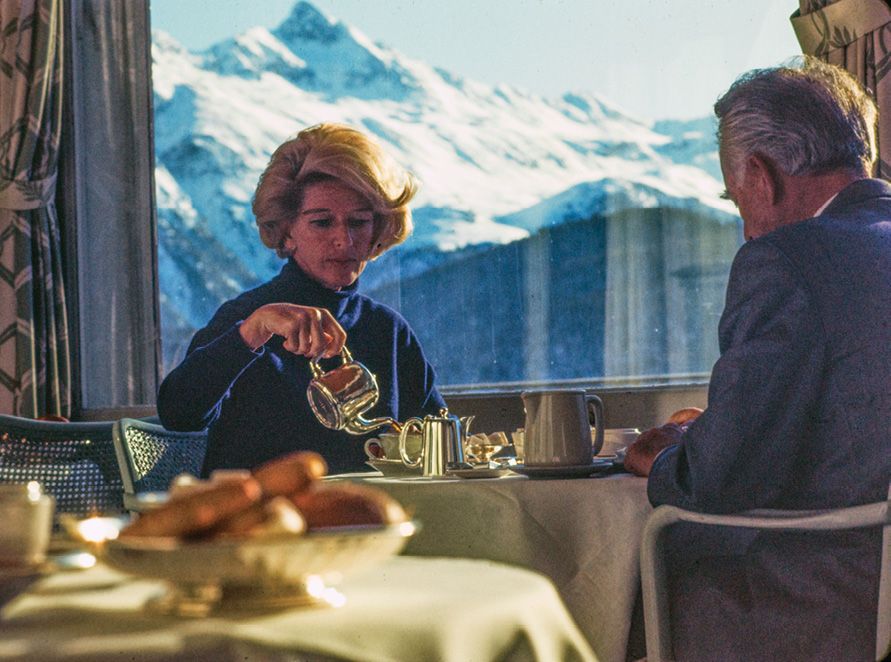


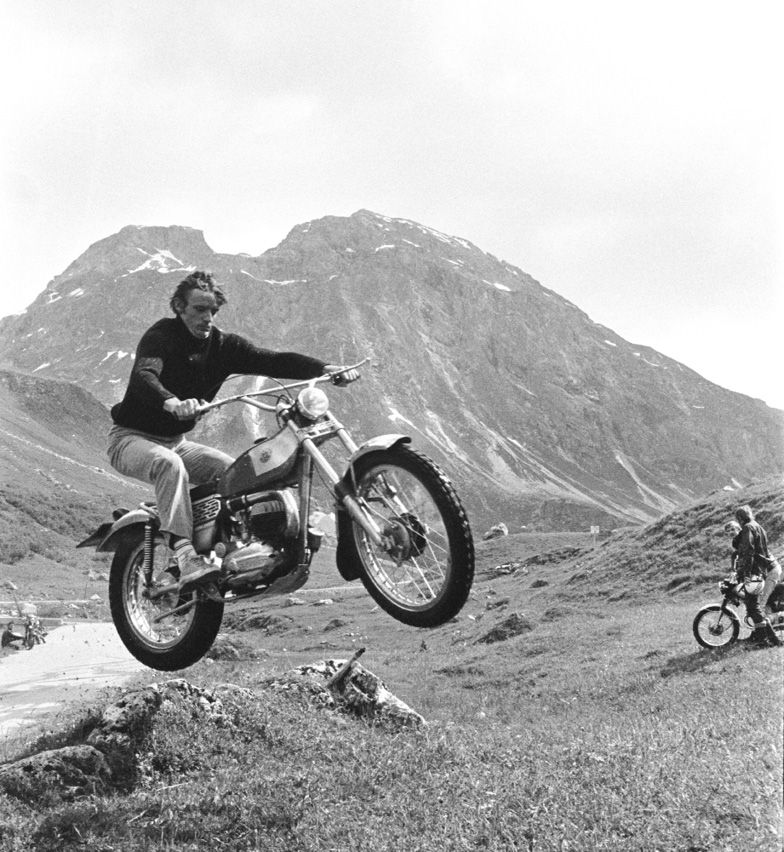
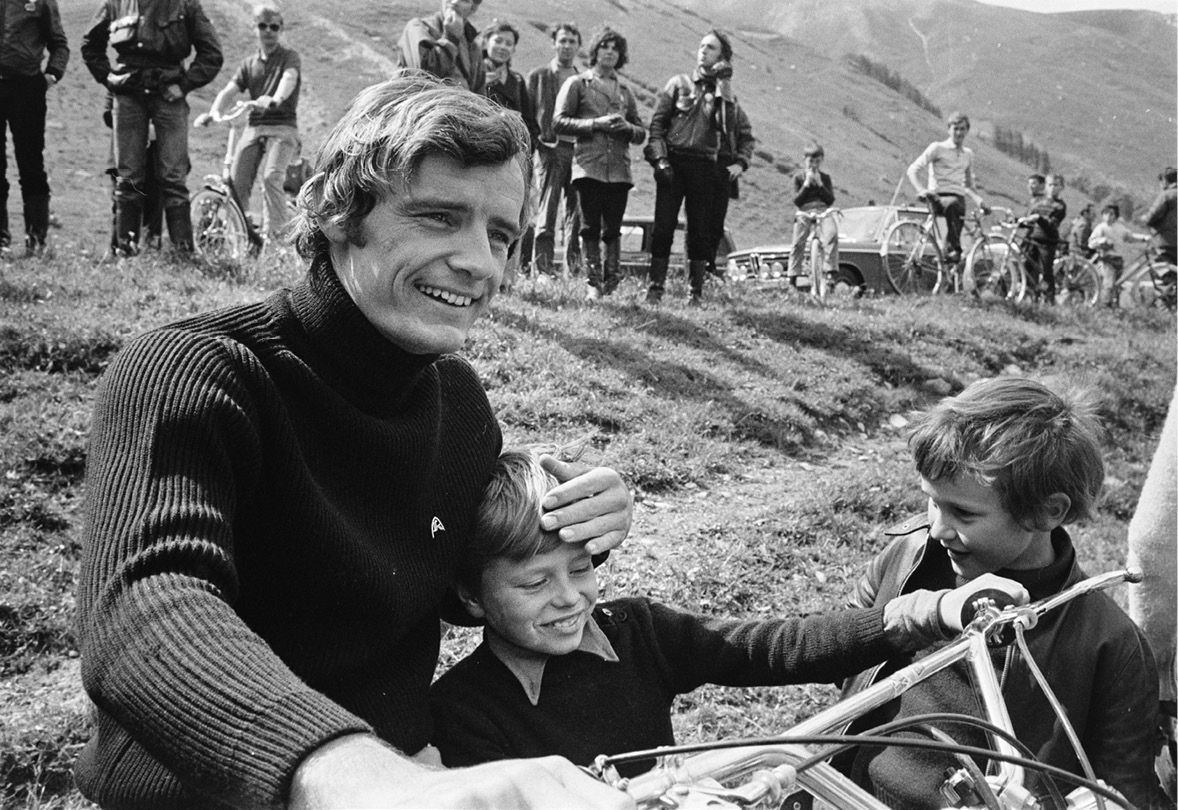


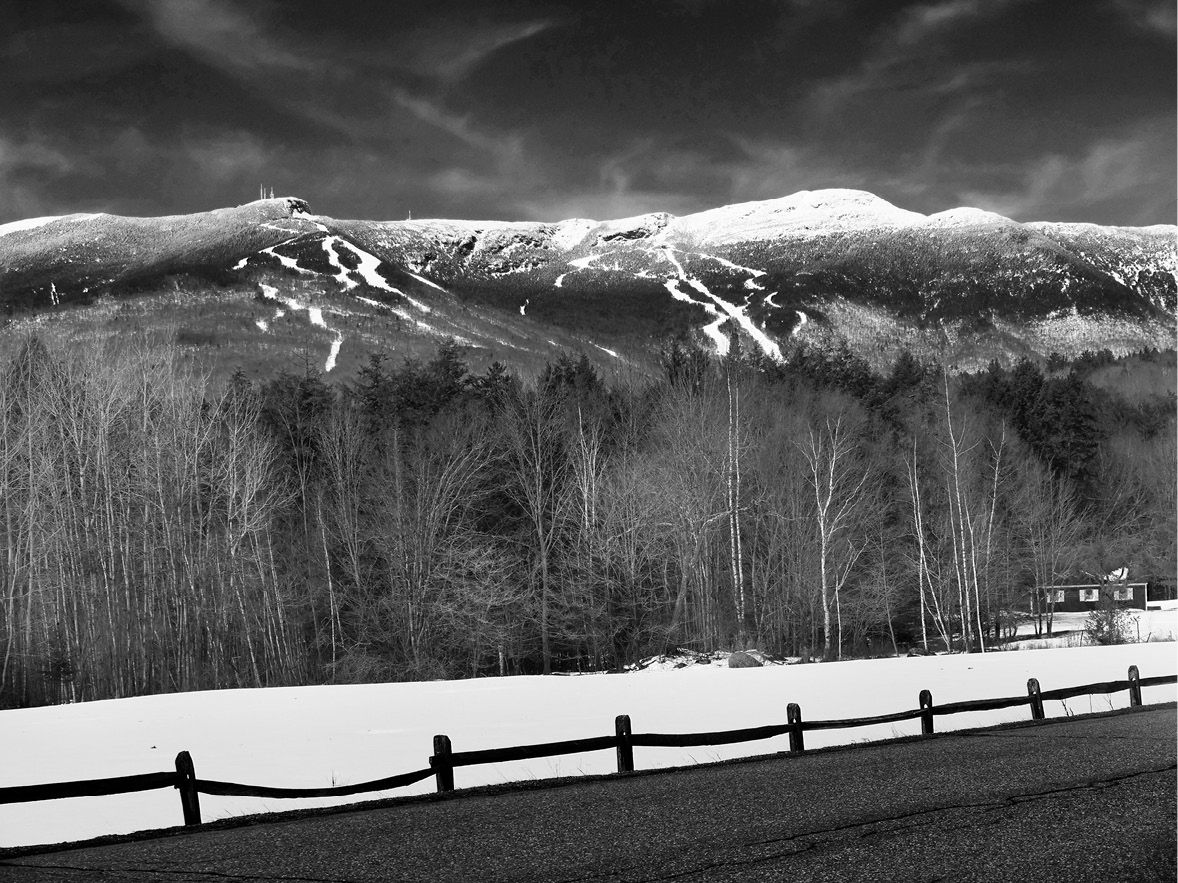

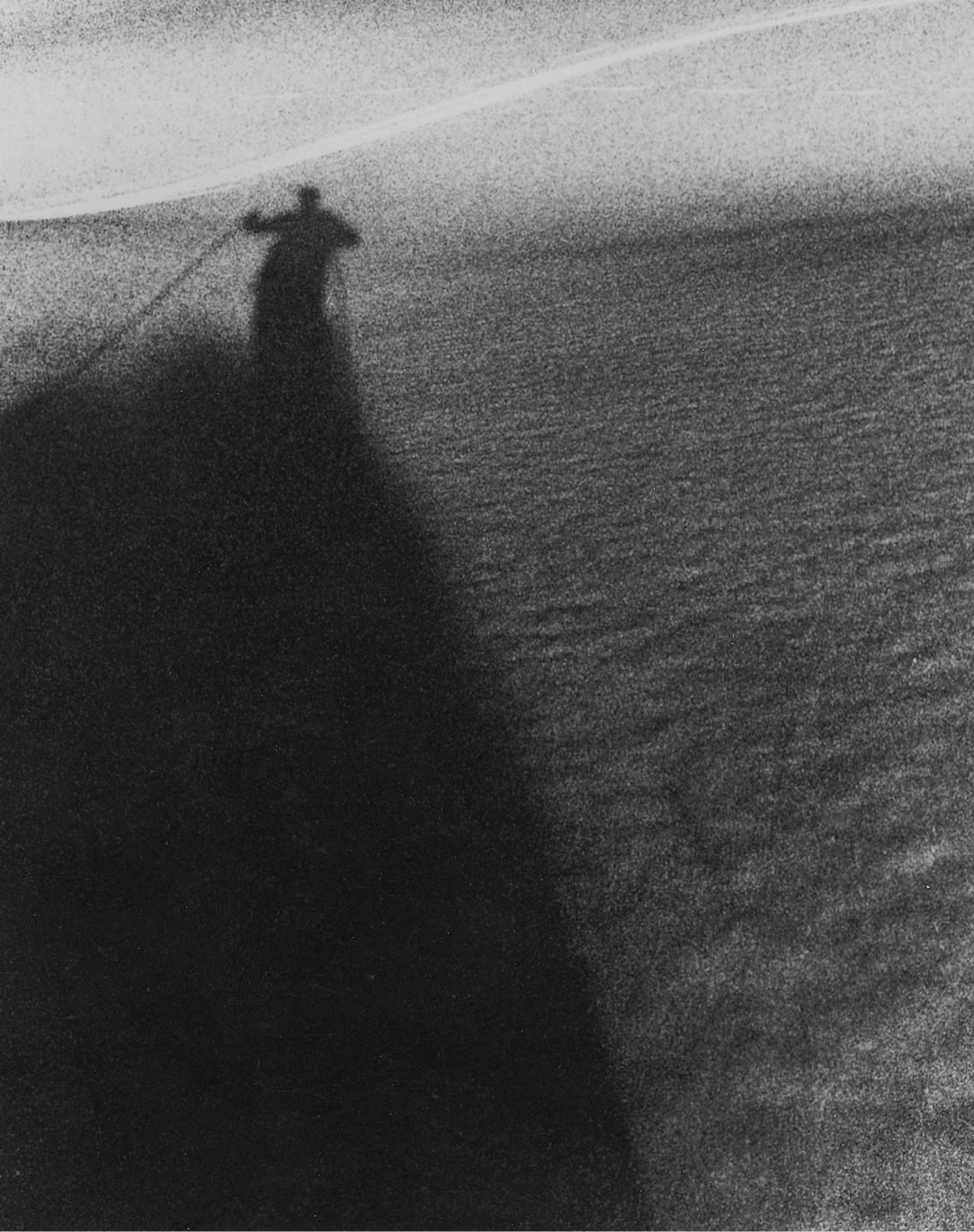
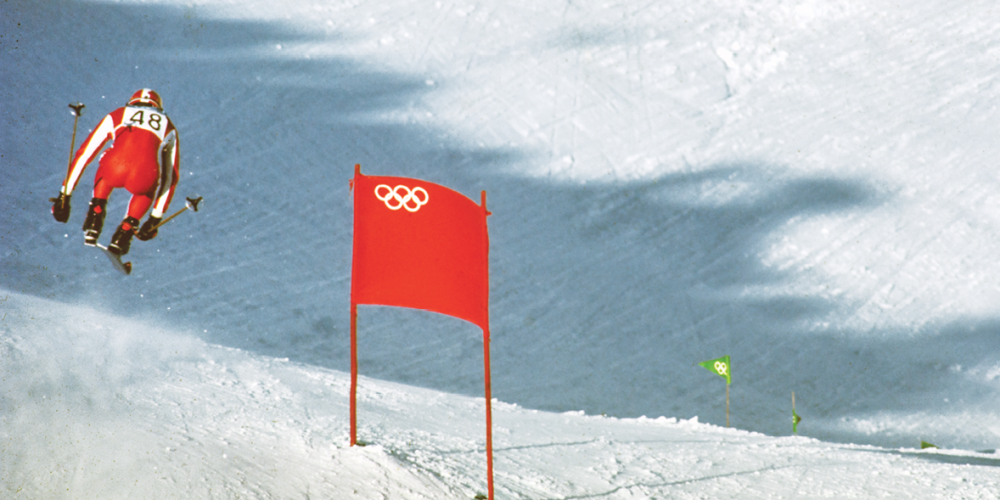
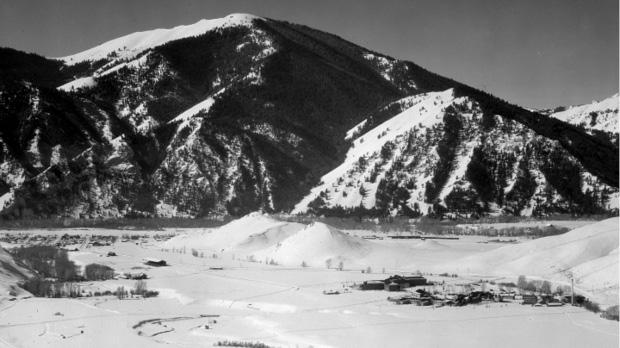
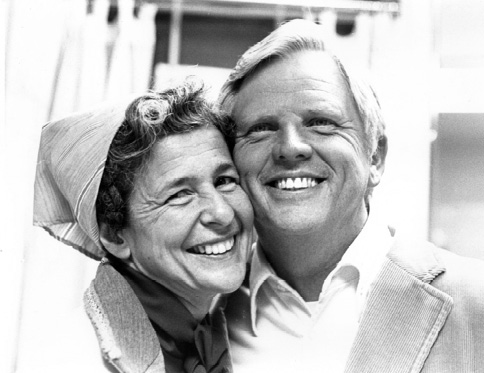
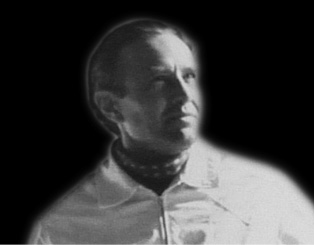
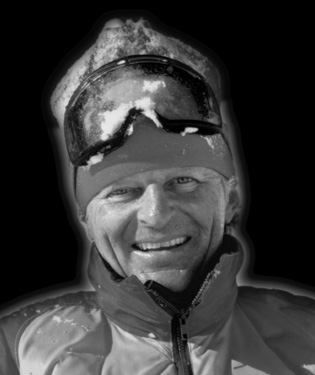
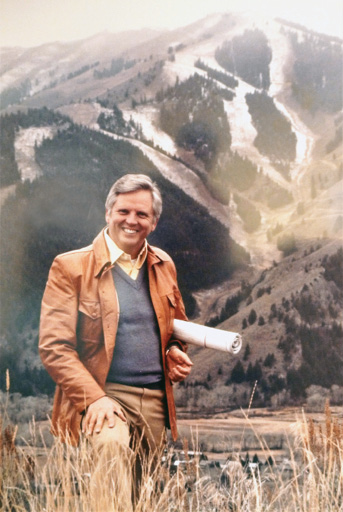
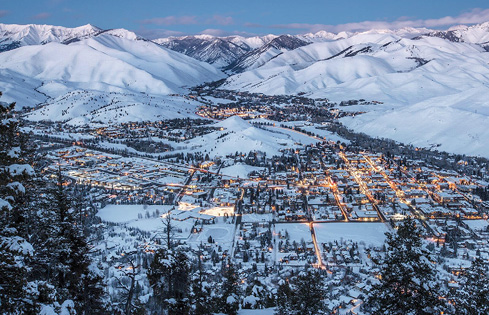

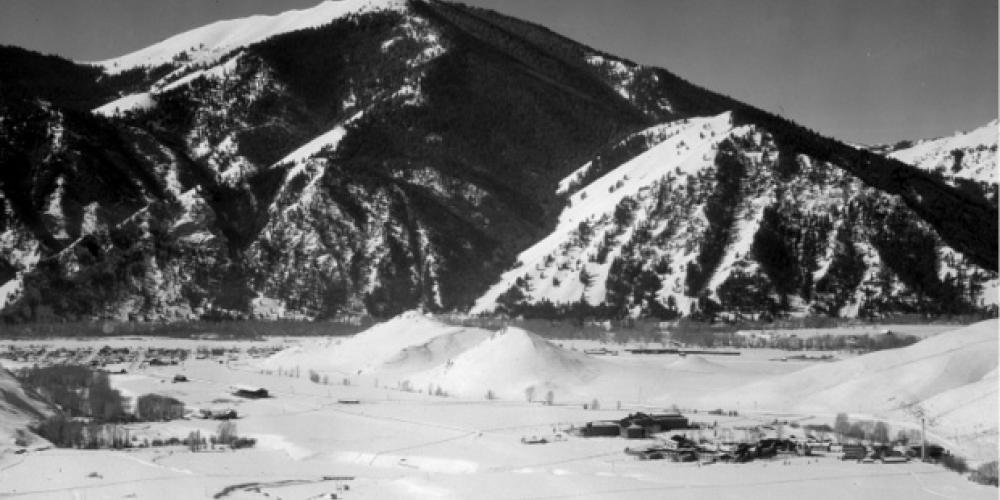
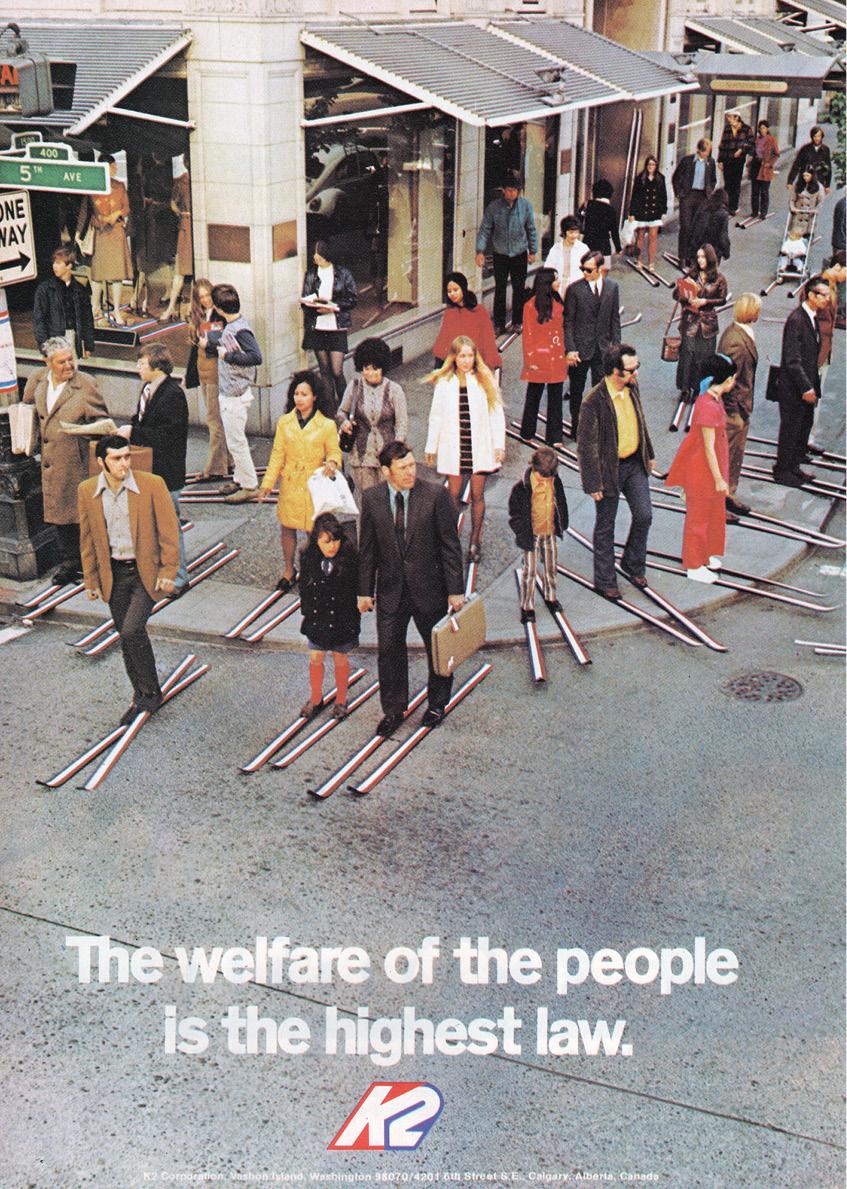
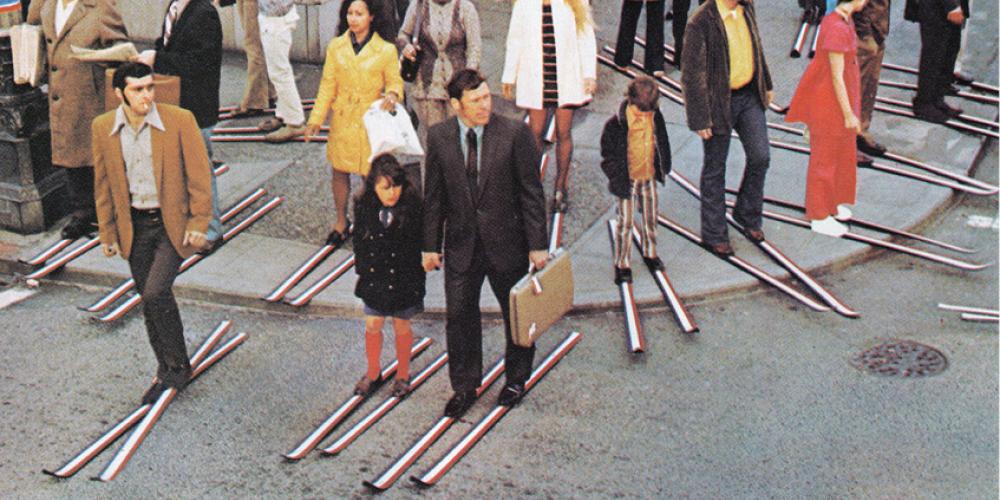


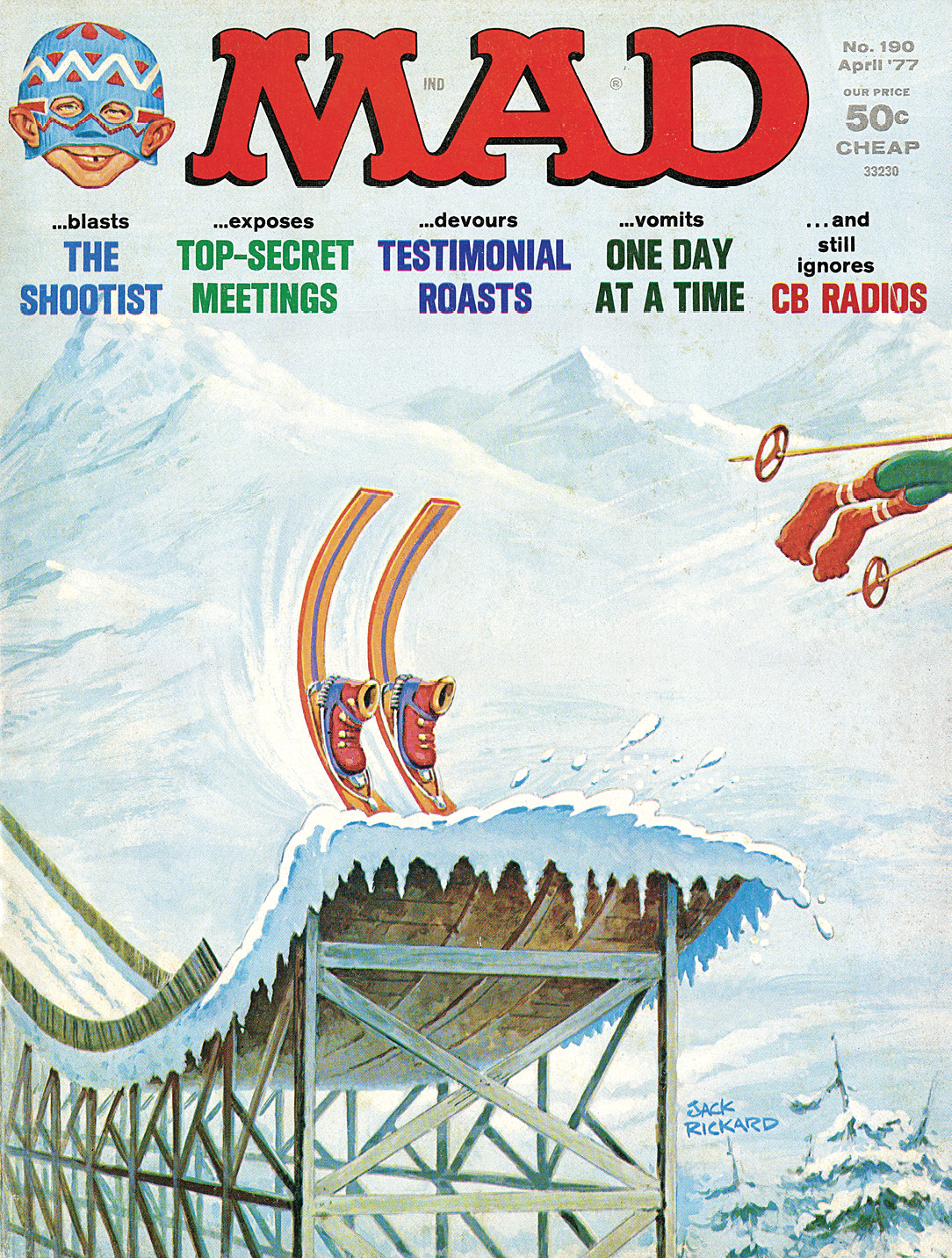
 At MAD, anything and everything was politically incorrect. For many years the magazine’s offices were located on Manhattan’s Madison Avenue, several blocks north of the SKI Magazine office at 380 Madison. While MAD lampooned the work of the ad agencies on the avenue, SKI was selling Mad Men on the wonders of placing advertising in its pages.