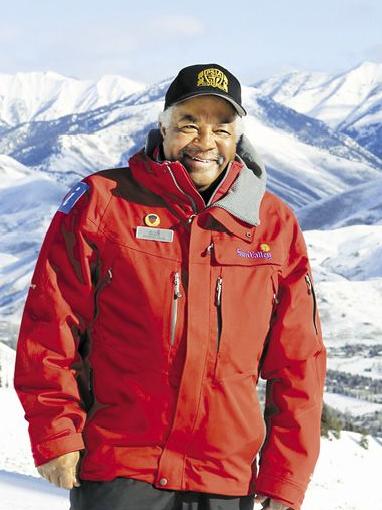
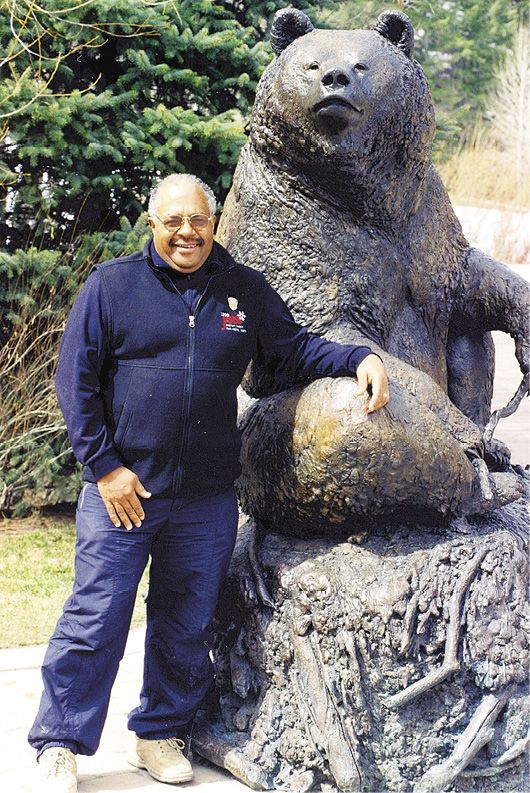
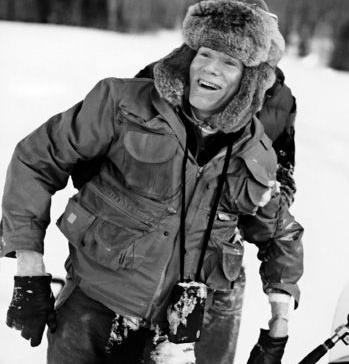
Ed King is well known among Sun Valley locals as the only African-American ski instructor in the history of the resort. Considered by most ski historians as the birthplace and role model of American destination ski resorts, Sun Valley built its ski school around European-trained managers, who seemed to have been uninterested in the diversity of skiing talent on hand in its major market, Seattle.
Photo above by David N. Seelig, courtesy Idaho Mountain Express
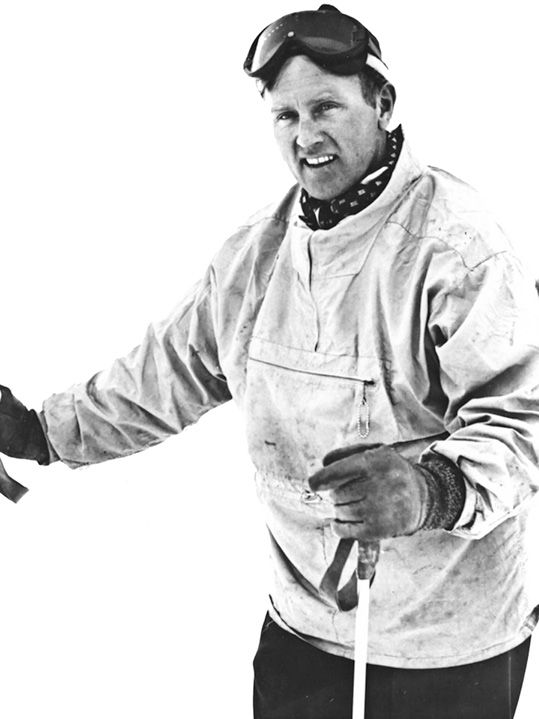
The few years King was a member of the Sun Valley Ski School are a small but significant part of his enormous contribution to American ski instruction and culture. The Seattle native began skiing in 1958 at age 11, after meeting Jim and Hans Anderson and their father, Hercules, in the YMCA swimming program. The Andersons, the best known among the few African-American skiing families in Washington at the time, invited King to Stevens Pass. “I took my first lesson and was hooked,” he recalls. “I told my Mom I was going to be a great skier. She replied, ‘We don’t have that kind of money.’ I replied that I will earn it, which I did.”
King was unintimidated by this Scandinavian sport. He came from a family of pioneers. His mother, Marjorie Pitter King, ran a successful accounting business and was the first African-American woman to hold state office in Washington. His aunt Maxine Hayes, after being denied entry to the nursing program at the University of Washington (UW), got her degree in New York; she then integrated the staff at Seattle’s Providence Hospital and became a professor of nursing at UW and Seattle Pacific University. His aunt Constance Thomas was the first African-American teacher in the Seattle Public Schools.
PTA Ski School, Seattle Ski Club
Seattle’s Parent Teacher Association (PTA) ran its own weekend ski program, and for several years King rode the PTA buses to Snoqualmie Pass. For three years he took lessons from the Japanese-American instructor Fred Hirai, and by the time King was in high school, he was a strong skier—strong enough that ski school director Hal Kihlman took the kid under his wing.
After attending ethnically diverse high schools (Garfield High in Seattle and Los Angeles High), King graduated in 1964 and headed to UW. Needing work to pay tuition, he taught swimming and diving for the Seattle Parks and Recreation Department and became a pool manager. In 1966, against some pushback from the resort owner, Kihlman hired him as a full-time ski instructor. A year later, King became the first Black member of the Seattle Ski Club. “I will never forget when Kihlman, Dan Coughlin and Keith Boender went to bat for me,” King says. “I remember them telling me it was quite a voting session!”
PSIA Certification and Sun Valley
King earned his full Professional Ski Instructors of America (PSIA) certification in 1968, and he may have been the first Black full cert. Kihlman contacted Sun Valley Ski School director Sigi Engl to recommend King as an instructor. Engl agreed to hire him. (Kihlman had neglected to mention King’s skin pigmentation.) Kihlman also introduced King to the late Gordy Butterfield, the rep for Head skis in Sun Valley. Butterfield, beloved in the ski industry and father of the accomplished ski photographer and historian David, invited King to live in his Sun Valley home while he tried out for the ski school.
King recalls the first ski school meeting he attended: “Gordy and I sat along the back wall. Sigi explained how we would be breaking into our clinic groups. It was the ’60s and I remember him saying in a certain room of the inn they would have the Head ski, which was the ‘Black Power’ ski, and in another room they had the [Kneissl] White Star, which was the ‘White Power’ ski. I turned to Gordy and asked, ‘What happened to the Hart Javelin?’ The Javelin was integrated: a white ski with a black stripe down the middle.”
King enjoyed a week of clinics with Don Reinhart, one of the founders of PSIA. He was then told to be available and meet every morning at the bus turn-around, where Engl made all of the teaching assignments. As King relates, “I showed up every day but was never asked to teach. It was difficult watching others with lesser or no experience being chosen. I kept a positive attitude, thanked Gordy for his hospitality and generosity, and returned to the Northwest. Two years later I returned to Sun Valley and again went through the process and again made myself available every day, but I was denied the opportunity to teach. This time it was quite painful, but I did not let it show. I knew I was a good instructor, but I was never given a chance.”
Photo by Dick Dorworth,
courtesy Idaho Mountain
Express
Ski School Founder, Director
Returning to UW, King majored in recreational planning and administration with a minor in art. During his final year, in 1972, he was offered a job at Evergreen State College, in Olympia, Washington, as associate director for leisure education programs. He took the job and graduated from Evergreen, where he worked and played handball with the legendary climber/philosopher/teacher Willy Unsoeld. He also developed programs and workshops in the arts for local communities.
King launched a PSIA-accredited ski school for Evergreen, supporting some students with financial aid through the Federal Work-Study Program. The school leased equipment at special rates from local ski shops, and Crystal’s Col. Ed Link came through with discount lift tickets. Wini Jones at Roffe helped with ski school uniforms and student skiwear. King invited the Grays Harbor YMCA to participate and began running buses from there and from Olympia and Tacoma to Crystal Mountain for lessons on Wednesdays and Sundays.
“Through this program we were able to provide an opportunity for students of African-American, Asian, Native American and Hispanic backgrounds the opportunity to experience skiing,” King says. “The ski program also offered an outdoor educational credit.”
Over the next 25 years, while running arts programs, King worked as an instructor, ski school supervisor, technical director and director. Meanwhile, he launched a successful photography business, built a pottery studio and helped to manage Seattle’s annual Bumbershoot Arts Festival. King was also hired by several corporations for special photography projects.
Sun Valley Redeemed
But he never lost his original dream of teaching skiing in Sun Valley. In 1995 he moved there with Eleanor, his wife since 1969, and let it be known that he wanted to teach skiing. In 1998, ski school director Hans Muehlegger and ex-director Rainer Kolb invited King to join the ski school. King said at the time, “It has been a very positive and enjoyable experience, and I thank Kolb and Muehlegger and all of the ski school for bringing me into the family. It is where I belong.” Muehlegger later hired another Black ski instructor, a British fellow who returned to Europe after one winter. King remains the sole African-American instructor to have worked at Sun Valley.
In 2005 the Kings left Ketchum for Spokane Valley, Washington. For a few years they returned to Sun Valley each winter, and King continued to teach with the Sun Valley Ski School. Then he joined the ski school at Silver Mountain in Kellogg, Idaho, as technical director—it was five hours closer than Sun Valley. But after more than 60 years of skiing, his knees needed some attention. He arranged knee replacement surgery, which was postponed by Covid. While waiting for new knees, King is busy running his photography business.
Of his skiing career, King says, “Sometimes dreams do come true. Many might take this for granted. I do not.” He adds, “If the entire world skied together, it would be a happier place. The happiest place on earth is the ski slope.”
Veteran racer, coach and author Dick Dorworth most recently reviewed Skiing Sun Valley in the July-August 2021 issue of Skiing History.
These on-mountain schools led the way in training and educating American ski racers.
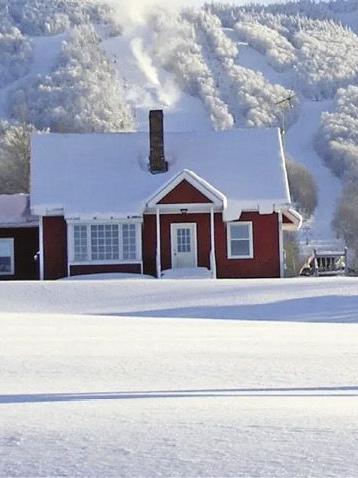
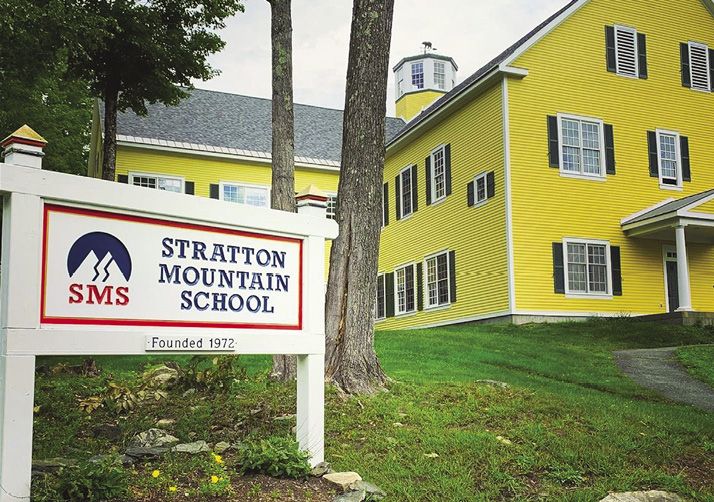
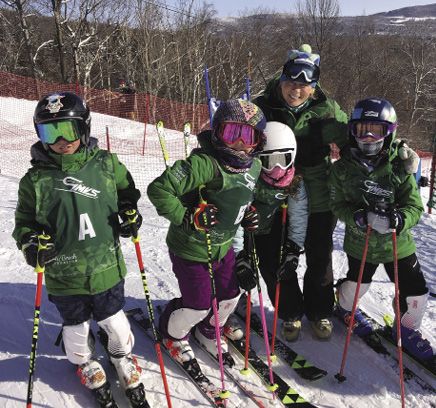
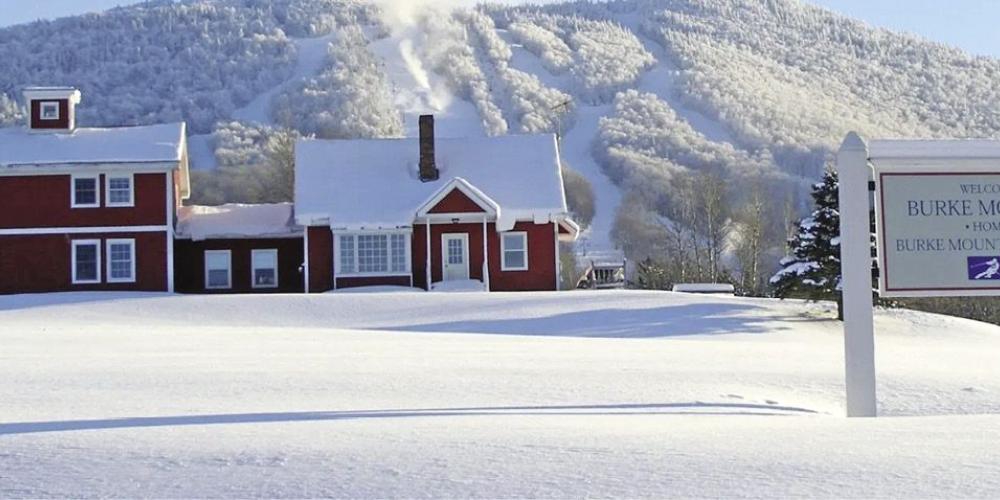
It’s been nearly 53 years since Martha Coughlin conned her parents into letting her take her schoolwork on the road so she could spend the winter at Burke Mountain, Vermont, being coached by Warren Witherell. The success of her concept launched Burke Mountain Academy (BMA), followed, in quick succession, by Stratton Mountain School (SMS) and Green Mountain Valley School (GMVS). Today, skiracing.com lists 27 viable ski academy programs across the country and many more clubs that offer high-level, full-time ski racing programs. Despite competition from newer programs, as these first three ski academies reach their 50th anniversaries, they retain their character and innovative spirit.
In 1969, 14-year-old
Martha Coughlin per-
suaded her high school
and parents to let her
take schoolwork on the
race circuit . . .
Warren Witherell
agreed to coach and
teach. Thus was born
Burke Mountain
Academy (top of page).
In the Beginning: Burke
In the fall of 1969, 14-year-old ski racer Coughlin was determined not to return to Massachusetts after training in ski country over Christmas break. So she called Witherell, an accredited teacher who had recently been lured to Vermont’s Northeast Kingdom by local ski racing families. In addition to coaching Lyndon Institute’s soccer team and St. Johnsbury Academy’s ski team, he trained local kids midweek at his newly created Alpine Training Center (ATC). He agreed that if Coughlin could find a place to live, she could join the ATC program.
After striking a deal with Burke’s mountain manager to work for room and board in the resort’s Frazier House, Coughlin arranged her studies and defended the plan to her parents and her hometown school. “I wore them down,” she recalled.
Coughlin completed her academic and work duties in the morning, then trained with Witherell in the afternoon. At the time, Finn Gunderson, a former English student of Witherell’s, worked at Lyndon Institute and helped coach at the ATC on weekends. The following year, with Coughlin’s success as proof of concept (she had kept up with her studies and qualified for the U.S. Ski Team), Witherell and Gunderson rented Frazier House for 12 winter-term students. At the end of the winter, the students didn’t want to leave and convinced Witherell to start a full-time school. Kids from anywhere could now enjoy the benefits of full-time training and the U.S. talent pipeline expanded dramatically.
Gunderson describes the early 1970s as “an experimental time in education,” particularly in Vermont. He and Witherell designed their own curriculum from scratch. With frequent trips to Vermont’s education department in Montpelier and an impassioned pitch, Witherell earned provisional accreditation for his school. It would have co-ed dorms, and no grades.
Former U.S. Ski Team coach Chris Jones created the physical standards that would become a key part of Burke’s ethos. Says Gunderson, “We were really lucky with some of the first staff we hired.”
The following year, 1971, having bought Frazier House and acquired 25 acres (15 donated by resort owner Doug Kitchel), Burke had 15 full-time students and 13 winter tutorial students. It didn’t hurt that in 1972 Witherell published his seminal book, How the Racers Ski, which showcased Burke racers carving turns. By 1973 there were 43 students and five coaches. BMA bought Moulton House and embarked on a rapid expansion to accommodate its popularity. When Coughlin graduated in 1973 she was racing World Cup, and by 1976 two Burke skiers were on the U.S. Ski Team that went to the Olympics.
Stratton Mountain School
evolved from morning classes
in a church basement into a
full-time school with its first
graduating class in 1974.
Stratton Mountain School
Burke’s success did not go unnoticed. Roughly 140 miles south, at Stratton Mountain, Warren Hellman and Don Tarinelli both had young kids in the weekend junior racing program coached by T.D. McCormick, Hermann Göllner and Paul Reed. When Reed came back from the J2 state championships in 1971 he said, “You should see the Burke girls ski!”
Hellman and Tarinelli responded by starting the Stratton Mountain Winter Tutorial Program, based in their two chalets; the girls stayed at Hellman’s and the boys at the Tarinelli’s. The kids took morning classes in the basement of the Chapel of the Snows, then headed to the mountain, where the coaches had courses ready on the Slalom Glade poma. They soon switched to morning training sessions and got prime space on less crowded slopes in better conditions.
As admissions director, McCormick’s job was to fill the school, and as the Eastern Division’s J3 and J4 chairman, he knew where to find the talent. By tapping into Stratton’s social crowd, he was able to build a recruiting budget. “Peggy Lord would have a ski ball every year, with expensive tickets,” says McCormick. “That started our scholarship program.”
By 1974, SMS, now a full-time school, had its first graduating class. It included Abbi Fisher, who would become the school’s first Olympian in 1976. That same year, the school moved into the Hotel Tyrol. This new home, right at the base of the mountain, accommodated classrooms, dorms, a cafeteria and assembly space. From here, the SMS community could grow.
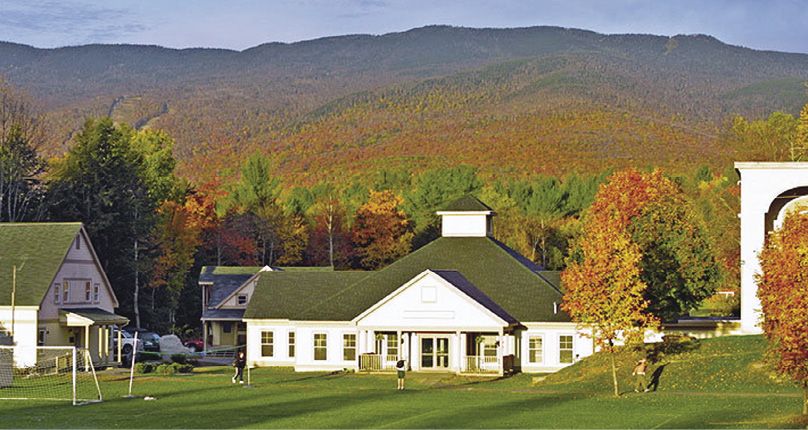
Green Mountain Valley School in Mad
River Valley, Vermont.
Green Mountain Valley School
The successes at Burke and Stratton caught the attention of a trio of passionate ski coaches in the Mad River Valley. Al Hobart, Bill Moore and John Schultz coached kids on weekends and holidays at the three local ski areas—Mad River, Glen Ellen and Sugarbush. “It was partly our competitiveness with Burke and Stratton,” recalls Hobart. “It looked like they were going to attract all the best ski racers in the East.”
In spring 1973, the coaches decided they needed to offer the kids more. They enlisted Moore’s Middlebury classmate Ashley Cadwell, who had a degree in education, and put together a winter tutorial program. Al and his wife, Jane, had room in their house on Bragg Hill in Fayston for four students and a gym, and they rented a nearby chalet to accommodate eight more students. Jane jumped in to help with academics, Schultz’s wife, Annette, took care of feeding the kids, and the Mad River Valley School (known to the kids as “Mad Acad” was born. The next year the Schultzes opened a ski lodge five miles north in Moretown and converted the barn into a dorm and classroom space.
After three years the academy offered full-time enrollment, and houses were rented in Moretown to accommodate the growth. In 1978 a former dairy farm and farmhouse back on Bragg Hill became available. The flat land, created by a glacial moraine, offered an ideal location for a campus with athletic fields and room to grow. Ground was broken in April for three dorms that Jane had nicknamed by their rooflines—pointy Witch’s Hat, rounded Pound Cake and Clark, the plain gable. The new buildings opened on October 1. By 1980 GMVS could also claim its first Olympian: downhiller Doug Powell.
Future GS National Champion Sara
McNealus trains at Stratton Mountain
School in the mid-'70s. Hermann
Gollner photo.
Special Sauce
As the ski academies aggregated top coaches and athletes from across the country, they became development hubs for U.S. skiing, stacking U.S. Ski Team and Olympic rosters through the ’80s and ’90s. They did so, however, while retaining their unique flavors.
Chronically cash-strapped Burke embraced no-frills living and a hard work ethic, featuring double sessions of conditioning and marathon laps on the dilapidated poma. At first Witherell eschewed off-season camps on the basis of both cost and principle, while Gunderson introduced fall sports to instill team spirit and offer kids a well-rounded athletic experience. “Burke kids would play the state champs soccer game in the morning and run cross-country states in the afternoon,” he recalls. Burke’s hard work imperative is reflected in the signature Green Mountain Run, an all-school relay the entire length of Vermont. In keeping with the school’s early, egalitarian “all leaders, no leaders” motto, after winning her1985 GS World Championship, Diann Roffe returned to campus—and also to dish duty. Today, the campus features few visual accolades for famous alumni, even superstar Mikaela Shiffrin.
With Stratton’s deep Austrian connections, it was the first academy to offer pre-season training camps on the European glaciers, a practice that would ultimately become the standard for all full-time ski programs. The school also embraced multiple disciplines, starting with Nordic skiing in 1977. In 1993 SMS added snowboarding, and in 1998 Ross Powers won the school’s first Olympic medal (bronze, then gold in 2002) in that event. SMS added freeskiing to the mix in 2010 and freestyle in 2013. That same year the school established SMS T-2, a cross-country program that evolved into a premier Nordic development program for Olympians like Jessie Diggins, who won gold in 2018, silver and bronze in 2022, and the overall World Cup championship in 2021. The school has also maintained a strong presence in a wide range of off-season sports like lacrosse, cycling, baseball and soccer, in which Kristen Luckenbill won the school’s first summer Olympic medal—gold—in 2004.
Young racers learn their trade
at GMVS.
When GMVS secured Inverness at Glen Ellen (now Sugarbush’s Mt. Ellen) as its dedicated training venue, the program exploited the wide-open terrain to fill a void in Eastern skiing and built a legacy of World Cup speed skiers. Among them were Doug Powell, Doug Lewis, AJ Kitt and Daron Rahlves. Rahlves was among the growing number of Western skiers who sought out grit-building Eastern racing. GMVS counterbalanced the intensity of ski racing with a well-rounded experience that included fall and spring sports as well as theater, championed by 30-year headmaster Dave Gavett. As Hobart explains, “Dave’s view was when you are ski racing you are on stage all by yourself.” GMVS’s annual fall musical remains a focal point of the school experience, connecting students with each other and with the community.
It’s All Academic
At first Gunderson and Witherell needed to work hard to sell the parents on the value of personal responsibility, time management and learning for learning’s sake rather than grades, and colleges on the validity of their education model. Soon enough, however, the ski academies became feeder schools for NCAA skiing powerhouses like Dartmouth, Middlebury and the University of Vermont, and other elite schools in New England. Jane Hobart, who taught nearly every subject at GMVS and also was a college counselor, recalls that “a highlight was the year we got kids into Harvard, Yale and Princeton.”
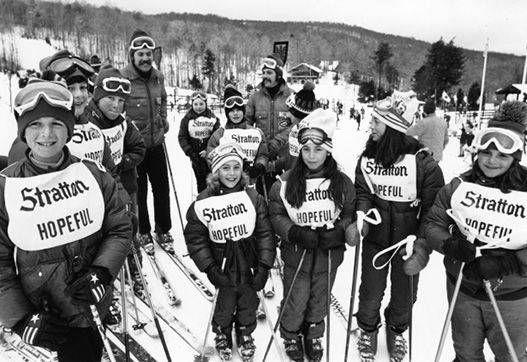
In case young racers forgot their mission
st SMS, their bibs were a reminder.
To keep up with increasing demand, the academies upgraded facilities on hill and off, and experimented with European campuses. Out of necessity, SMS took the first leap into modernization in 1999, when Intrawest’s development at Stratton forced a move from the Hotel Tyrol to a brand-new campus on World Cup Circle. SMS was already the first academy to have separate academic and athletic staffs; the modern dorm, academic and athletic buildings set a new standard for ski academies.
The other schools followed up with multimillion-dollar gyms, tuning rooms and new dorms, as well as specialized staffs to meet increased expectations for academics, athletics and a standard of care. Stratton and GMVS expanded to 144 and 135 students, respectively; Burke, meanwhile, reduced enrollment to 65 (after it ballooned to 105 in the ’90s) and refocused on Alpine racing.
Competition and Cooperation
While more academies emerged throughout New England, and battled fiercely with each other to lure and place top talent in a shrinking number of national team and NCAA roster spots, schools at bigger mountains in the West advanced their snowmaking and programming. The latter could offer longer ski seasons, as well as top-quality facilities and coaching, to meet the growing demand for year-round programming at ever-younger ages. Many of the newcomers could also partner with public and charter schools to offer more affordable alternatives to ski academy tuitions
GMVS alumnus and Super G
World Champion Daron Rahlves.
Ski academy tuitions mirror those of each other and other private college-prep boarding schools. Yearly tuition at BMA cost $5,400 in 1978—the equivalent of $24,000 in today’s dollars. Full board at ski academies in 2022 is more than $60,000, not including off-season and pre-season camps.
All of the academies offer significant need-based financial aid to defray the costs of tuition and travel. Nonetheless, cost control is a top concern throughout the ski racing community, especially at Eastern ski academies.
With students traveling to races much of the winter, ski academies pioneered remote learning, which meant they were prepared academically for Covid-19. The pandemic also fostered an unexpected benefit: collaboration. The Vermont academies worked together closely to advocate for ski racing within the state and to raise the level of Eastern competition.
The People
At the heart of each academy are people with long tenures who ardently believe in this educational model for building character and community, and in ski racing as a vehicle to achieving personal success beyond athletics. Willy Booker and Carson Thurber are the current headmasters—and also alums—of BMA and SMS, respectively. GMVS headmaster Tracy Keller raced for Dartmouth and previously headed Sugar Bowl Academy.
“At Burke, we’re clear that the ultimate gift is the character development and values,” Booker says. “You have to go through the crucible of trying to be excellent at this one thing.”
Anniversary Celebrations
Burke’s 50th anniversary celebration and reunion was postponed twice due to Covid and may happen next summer. Stratton’s year-long celebrations were highlighted by its recent hall of fame inductions in June. GMVS will commemorate its 50th anniversary with a reunion in June 2023.
Olympian Edie Thys Morgan wrote about Montafon, Austria in the May-June issue of Skiing History.
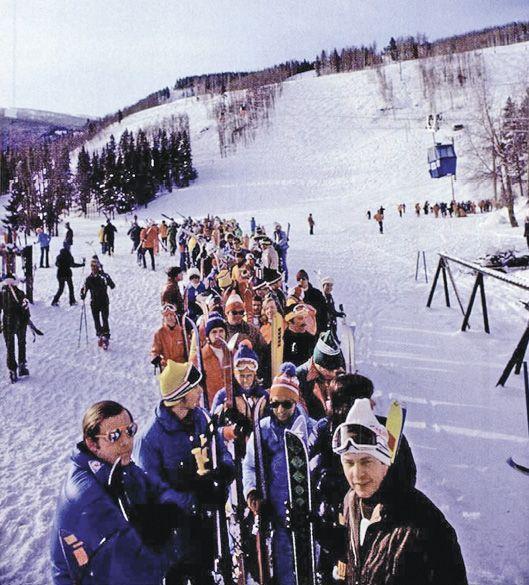
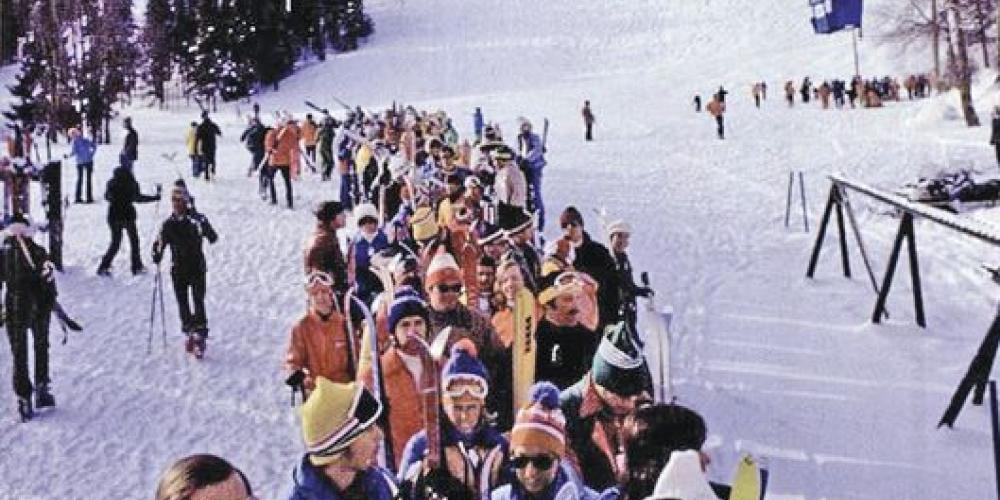
They spent almost an hour in line, yet more and more skiers came, bonding as they waited ... and waited.
Lift lines have been part of the ski experience as long as there have been lifts. Is there such a thing as a line that’s too short?
Beginning after World War II and for the next 40 years, a weekend skier waited in liftline so long that the person next to him had a time to describe where he was born, his best powder day, his favorite music, why he deserved a promotion at the office and … hey, check out those vintage skis over there. Skiers could wait in line for an hour, all for a 12-minute ride up the mountain and the reward of a quick descent.
Snail-paced lift queues—usually exasperating and sometimes bone-freezing—arose from the relentless supply of young baby boomers demanding to ski. Their numbers exceeded the growth of a new ski areas and lifts, even though that growth itself was spectacular. In the 10-year period between 1956 and 1966, more than 580 ski areas with chairlifts and T-bars came into being, many of them previously equipped with ropetows. Yet it wasn’t enough.
The number of U.S. skiers quintupled over the same period. And when a million or more of them arrived at the bottom of the mountain with their kids on a Saturday morning, the place looked like a standing-room only Beatles concert. Waits of 45 minutes and more were common across the country, from Stowe to Boyne to Big Bear.
Some relief arrived with the advent of tripe and quad chairlifts, but the big breakthrough came in the early 1980s with the introduction of the detachable lift. Climbing speeds doubled, and lift-shutdowns from boarding mishaps were sharply reduced. The new chairs and gondolas were line-busters.
In the past five years of the 20th century, North American ski resorts installed 250 high-capacity lifts, collectively capable of carrying more skiers uphill than all of the lifts that existed in the winter of 1965-66 combined.
In the 1950s and 1960s, observed writer Morten Lund, liftlines allowed enough time “to meet a member of the opposite sex, get infatuated, engaged and plan the wedding.”
Today, a Saturday or Sunday liftline scarcely allows time to land an après-ski date. No one wants to regress to slow lifts, but history suggest that long queues once helped develop skiing reputation as an irrepressibly sociable sport.
Excerpted from the March-April 2008 issue of SKI magazine. John Fry (1930-2020) was editorial director of SKI and Snow Country magazines and longtime president, then chairman, of ISHA. He authored the award-winning book The Story of Modern Skiing. His final book, published posthumously, is Abandon Foolish Scheme: Deathly encounters that you won’t find in bestsellers about dying.
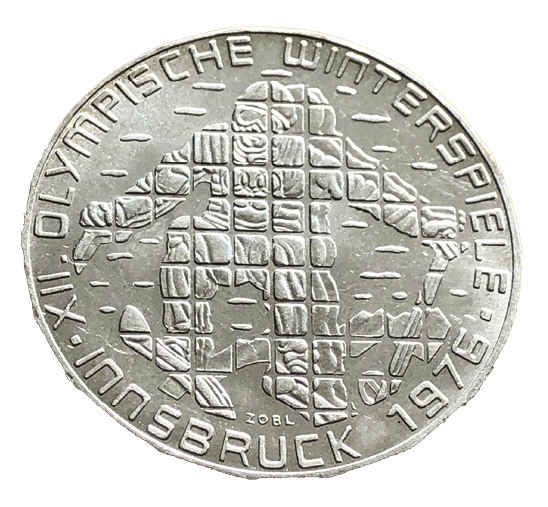
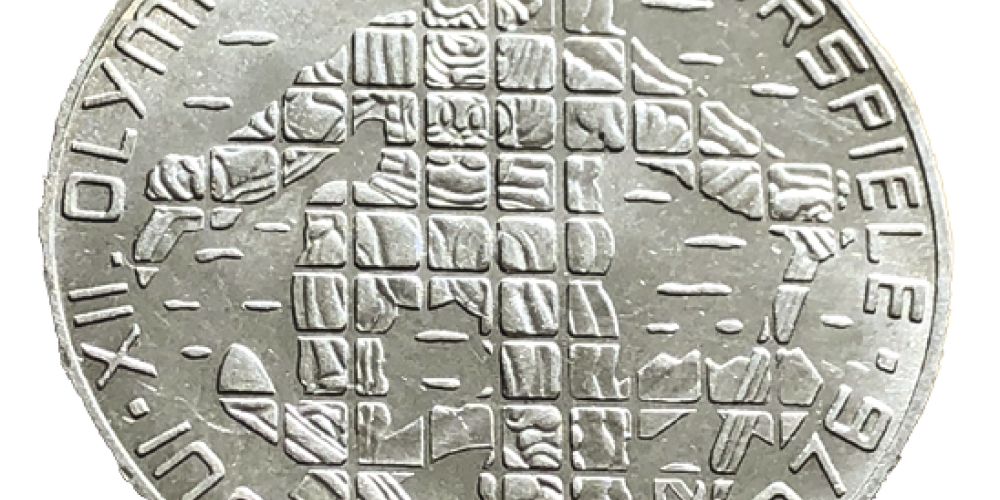
It is unusual to choose a medalist as the subject for this art column. In this case, I’m not talking about an Olympic or World Championship medalist but about an artist who creates medals: Helmut Zobl, the Austrian who designed the 100-schilling coin, illustrated here, in commemoration of the 1976 Winter Olympics in Innsbruck.
Zobl was born in Schwarzach im Pongau, about an hour south of Salzburg, in 1941. His art training began in a Kunstgewerbeschule, the arts and crafts school in Steyr. From 1960 to 1965 he studied at the prestigious Akademie der Bildenden Künste—the Academy of Fine Arts Vienna. In 1961, he took a summer course with Oskar Kokoschka, best known for his expressionistic portraits and avant-garde literature.
Zobl worked as an assistant in Ferdinand Welz’s medaling master school, a department of the Academy of Fine Arts. Welz was renowned for his many schilling coins and commemorative medals, and Zobl followed his master.
In 1970, Zobl started freelancing. The following year he joined the Vienna Secession group and about 20 years later he took membership in the Deutsche Gesellschaft für Medaillenkunst, the German Society for Medal Art. In 1976, he designed the 100-schilling coin for the Olympics. At the time, a 120-schilling ticket, for example, would get you up to Axamer Lizum ski area, 10 kilometers out of Innsbruck, to watch the men’s giant slalom.
Besides the lettering around the edge of the coin—XII Olympische Winterspiele 1976 Innsbruck—the face depicts a skier going full speed. The stylized figure is made more powerful by the well-defined “squares,” which give the skier solidity as he powers down the hill. It presages Franz Klammer’s wild ride in the downhill on the Patscherkofel at Igls, when he beat Bernhard Russi by a third of a second to take the gold medal in those 1976 Winter Games.
The celebrity artist visited Aspen for more than 20 years.
Andy Warhol died in 1987. But his cultural significance remains white hot, as his obession with fame, celebrity and personal branding is more relevant than ever in today’s media–dominated world. Perhaps predictably, Warhol mania is on the rise, with plays staged in London and New York and the airing of the Netflix series The Andy Warhol Diaries, all exploring the man and the myth. What isn’t commonly known about Warhol is that he was enchanted with Aspen, bought property there and visited often enough to be considered a part-time local.
(Photo above: credit Mark Sink)
The man who deified Campbell’s soup cans (to his lasting regret, he claimed) had been coming to Aspen off and on for about 15 years before he even learned to ski. That happened in December of 1981, when he and photographer Christopher Makos decided to take a lesson at Buttermilk. As longtime Aspen instructor Gerry Bohn recalls, “I was a supervisor at the time, and we ran out of instructors, so I gave him a two-hour private.”
Warhol wrote in his diary about the Powder Pandas slope and its T-bar: “We did about two hours of zigzagging and going up the handrail and you just sort of sit on the thing and go up the whole hill and it was really fun.” He also mentioned falling three times, which isn’t bad for a first-time skier.
Denver-based photographer Mark Sink lived part time in Aspen then and worked for Warhol at Interview magazine. He remembers meeting Warhol and Makos at Buttermilk that day. “We just talked at the base,” says Sink. “I asked if he had tried the ‘flying wedge’ down; he thought that was a funny term. He was done for the day, hurt his hand in a fall on the baby hill. His Rolex hurt his wrist, apparently. I remember him talking about Reggie Jackson and other stars in the lift line. His star-spotting was amazing anywhere we went.”
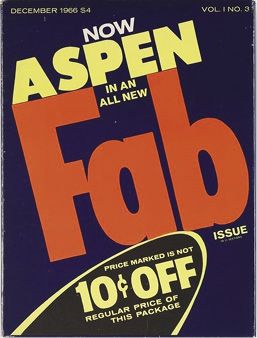
In 1966, Warhol guest-edited
this edition of the Aspen Times
On that same visit, Warhol and Calvin Klein met Paramount heavyweight Barry Diller and his ski instructor for lunch at West Buttermilk. Then Warhol went for dinner with Diller, Italian film producer Marina Cicogna and Diana Ross at Andre’s, where Ross, as Warhol recalled in his diary, was wearing “a cowboy hat and big white shoes” and danced on top of the table. A media star himself, habitually surrounded by celebrities, Warhol was as star-struck as any skier who drove up from Denver for the day.
Warhol first came to Aspen in the mid-1960s at the invitation of locals John and Kimiko Powers, major modern art collectors and some of his biggest patrons. John was running the Aspen Center for Contemporary Art at a time when it was one of the most important avant-garde art communities in the country. Warhol participated in several Colorado exhibitions sponsored by Powers. And in 1966 he guest-edited the third issue of an experimental arts and culture magazine called Aspen (also known as Aspen in a Box), founded by part-time Aspenite Phyllis Johnson, a former editor at Women’s Wear Daily and Advertising Age. Warhol’s issue, like all of them, was bundled in a box, which he had designed to resemble one of his trademark cultural references, a package of Fab laundry detergent.
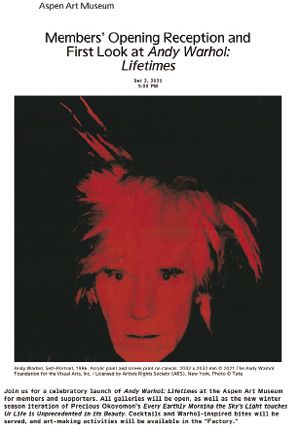
In 2021, the Aspen Art Museum
staged a Warhol retrospective.
Far from just a casual visitor, Warhol during this period bought land just downvalley from Aspen. In the early ’80s he also bought a house in Aspen and devoted a chapter of his book America to the town.
In the summer of 1984, at the star-studded Aspen Tennis Festival fundraiser for the United Cerebral Palsy Research and Educational Foundation, Warhol arrived on the back of a Harley piloted by Jack Nicholson. Warhol offered to do a portrait of the highest bidder at the celebrity auction, and it drew so much interest that he agreed to do four of them at $40,000 each, raising a quick and generous $160,000 for the cause. It would be his last trip to town before his death.
The Powers Art Center near Aspen, which showcases John and Kimiko’s collection, continues to regularly display many of Warhol’s works. And his only major museum retrospective in North America in 2021-22 recently closed at the Aspen Art Museum. The cliché about Aspen is that real locals came for the skiing but stayed for the intriguing people. For Warhol, it was always about the people, and the skiing was mainly a way to meet more of them.
SNAPSHOTS IN TIME
Allais coached what
he knew.
1952 Voice of Experience
No one knew better than Coach Émile Allais what the team was up against. Once the greatest of all racers in Europe, he had lost his front teeth years ago at Chamonix in the French Alps and shared this deficit now with most of his boys who had lost theirs at places like Reno, Aspen and Whitefish, Mont. He not only knew all the tricks but invented most of them himself, including a special racing crouch, ventilated goggles that would not fog up and even a new method of skiing. — Marshall Smith, “Hell on Snow,” on the American downhill team training for the 1952 Oslo Olympic Games (Life Magazine, February 11, 1952)
1970 Timeless Tuning Tip
It’s a great day. Great snow. You feel great. But your new skis seem to have a mind of their own. So you tighten your boots, loosen your bindings, have your poles shortened. But your skiing is still going haywire. Before you pack the whole shebang into the attic, take a look at your ski bottoms. Minor problems there often cause major problems in your technique, even with new, high-priced skis. — Editors, “Sure, Why Not Blame Your Skis?” (Skiing Magazine, February 1970)
1974 View from Texas
The important point to remember about skiing is that until the basic skills are mastered, the sport is not to be enjoyed. —
Suzanne O’Malley, “Who is That, Lying in the Snow in a $200 Ski Outfit?” (Texas Monthly, December 1974)
Killy laments
all-around
racer
1980 Not So Special
With the extreme specialization we see today, a good downhiller cannot be a good slalom skier the way it was when I raced. — Jean-Claude Killy, interview (Powder Magazine, September 1980)
1998 Mountains of Opportunity
Now at least I can get my vacuum cleaner fixed in Ketchum and I certainly couldn’t do that when I moved here 20 years ago. New entrepreneurs are filling up business niches I didn’t even realize existed. Tourism might just be a phase in the economic growth of mountain towns. —“State Rep: In Search of Common Ground,” Wendy Jaquet, interview (Snow Country Magazine, February-March 1998)
2000 Can You Hear Me Now?
I would like to ski in the fantasy land with the three gentlemen who wrote against cell-phone use on the slopes. I am lucky enough to live and work 10 minutes from a great ski area and if I can steal a few hours from work to go skiing, then the cell phone is a small price to pay. It sure beats being stuck at your office desk waiting for that one call that might bring in a huge deal. I would imagine that skiers—real skiers, anyway—will agree that skiing is better than working. I also enjoy calling my friends and telling them what they are missing. — Steven Strauss, Coplay, Pa., “Pro Phone,” Letters (SKI Magazine, May-June 2000)
There was more to Willy Schaeffler than stern disciplinarian.
By PETER MILLER
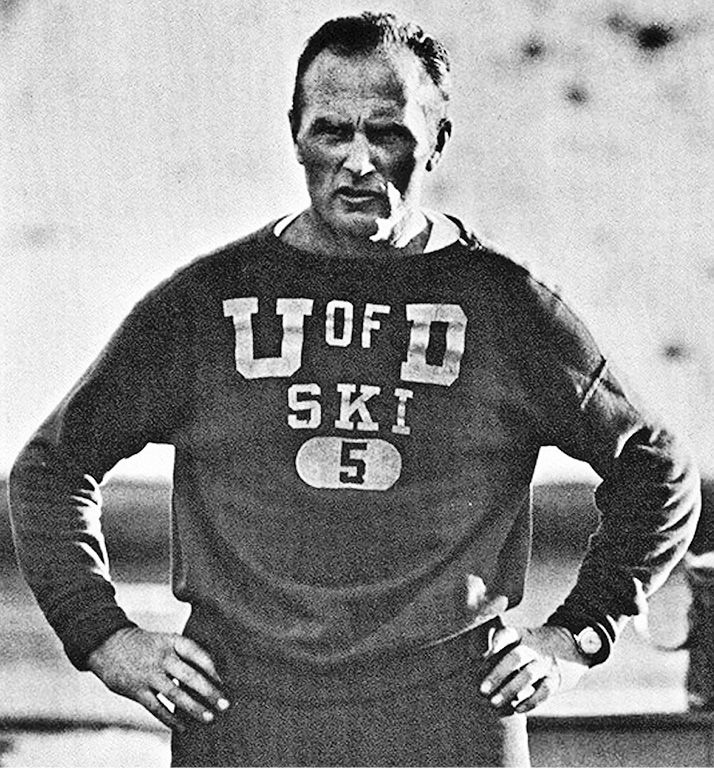
During the 1970-71 World Cup season, the men of the U.S. Alpine squad clashed with their coach, Willy Schaeffler. After Billy Kidd’s departure in February 1970, Spider Sabich was the team’s most successful skier. When he quit in January 1971 to join World Pro Skiing, the proximate cause was money—U.S. Ski Team racers earned none. But Sabich also butted heads with Schaeffler. In his book The 30,000-Mile Ski Race (1972), Peter Miller told both sides of the story.
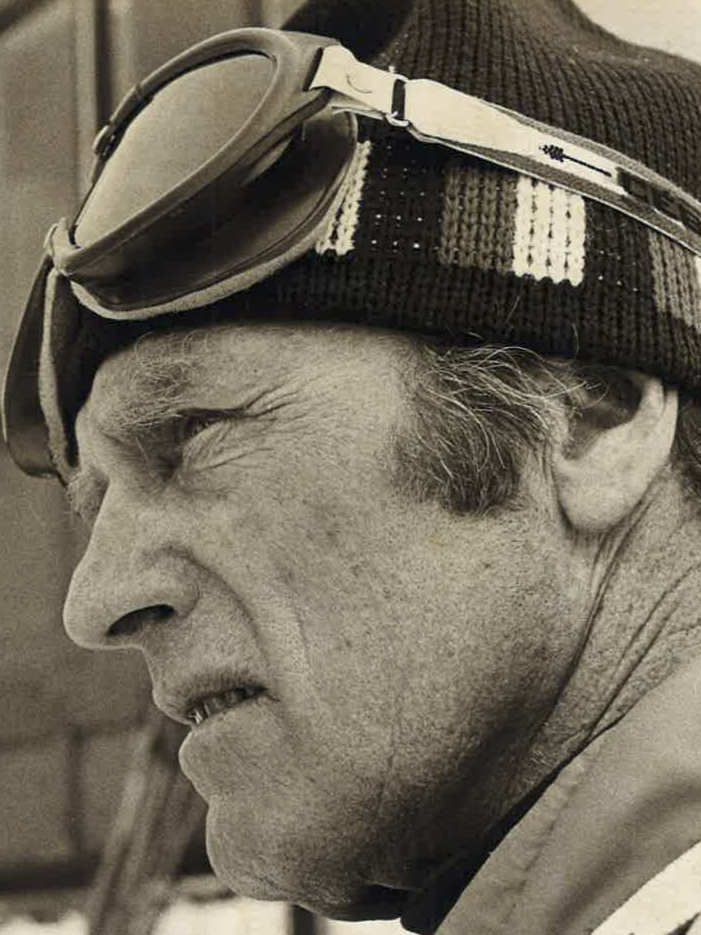
At fifty-four, their head coach, Willy Schaeffler, was a good generation gap older. His hair is grey, thin and combed straight back close to his skull. Part of his face seems to be paralyzed, so that his smile stops in the middle. Willy is a neat dresser and walks erect, almost stiffly. His blue eyes are appraising and sometimes appear quite cold. He spent the first half of his life in Germany, where he was born.
He had told the team earlier, when they were training in Aspen, Colorado, that he was the team hatchet man and that if someone had to be kicked off the team, he would do it, and he would be the scapegoat for all the difficulties. He had also told them that he was going to discipline their minds and bodies, and that although skiing is an individual sport, everyone must work together. He wanted to develop winners.
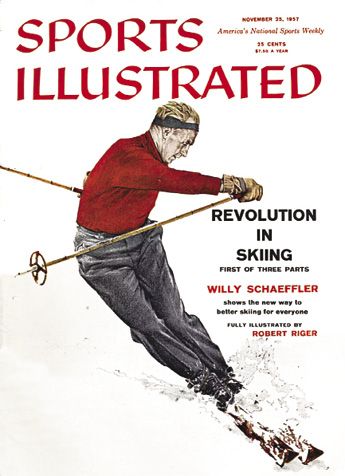
In 1957, Schaeffler wrote a
series of learn-to-ski articles
for Sports Illustrated.
Willy has been a winner all his life. In his twenty-two years as the coach at the University of Denver his ski teams won 100 out of 123 dual meets, and 14 National Collegiate titles. For a while, his archrival was Bob Beattie, who, before he became one of Willy’s predecessors as National Ski Team coach, trained the ski team at the University of Colorado. Willy beat the pants off Bob. Most of the team did not appreciate Willy’s authoritarian attitude toward ski racing. . . .
The two months during which the young racers had lived and trained under their new coach had convinced them he was an autocratic disciplinarian. They called Willy a heavy-handed Kraut. What few of them realized was that Willy, like them, had started his life as an avid skier who disliked authority, discipline, regimentation, and the draft. During World War II, Willy’s rebellion against the political-military establishment in Germany nearly cost him his life half a dozen times.
Willy was raised in Bavaria, not far from Garmisch, where he learned to ski. His father was a Social Democrat, and since Hitler was not very well disposed to political opponents in the mid-thirties, the father was placed on the blacklist. Willy was drafted in 1937, and in a letter to an uncle in Chicago he described some of his training. The letter was censored. Then the government extended his Army duty, two weeks before he was to be discharged. Just as any American youth would do, Willy bitched, loud and clear. The Army brought forth the letter and accused Willy of being a spy. They criticized him for lack of patriotism. As Willy was not in the Party, and his family was blacklisted, they busted him from warrant officer to private and sent him to the Dutch border to what was called a baby concentration camp. For the next year and a half, he dug ditches from 5:00 a.m. until 4:00 in the afternoon. He was twenty-one, the same age as most of the racers he now coaches.
Willy was released in 1938 and started to live a happy period as a test driver for the Ford Motor Company. On weekends and holidays, he was a Garmisch ski instructor. When the war broke out, his presence on the blacklist saved him from being drafted. But the Army reconsidered in 1941 and inducted him into the ranks as part of a penal battalion. The battalion was sent to Poland to build bridges. When the offensive into Russia began, Willy’s penal battalion was offered a chance to rehabilitate itself. The men were given weapons and were used as special patrols and on spearhead missions. Willy was somewhere behind Moscow, as part of a pincer movement, when the temperature dropped to -54 degrees and the Russians began to pull the Germans apart. Willy put on the clothes of dead Russians. He was captured and lined up before a firing squad. He went through a very quick and intense period of concentration, where his life flashed in an instant. They fired and Willy, sure he was dead, fell to the ground. The Russians, drunk on vodka, fell down too, laughing madly over their practical joke. Willy managed to escape and rejoin the Germans. His life on the Russian front was probably saved by his fifth wound, shrapnel in the right lung and upper heart chamber. He was evacuated in a plane, which was shot down behind enemy lines. Willy, one of two survivors, hid in a small compartment for two days before he was rescued. He was transferred from one hospital to another until he arrived in Munich, weighing 130 pounds. It was 1944.
A no-nonsense coach, Schaeffler
led the DU Pioneers to 14 NCAA
titles. University of Denver photo
The military establishment decided that Willy, after he gained twenty pounds, was so well trained in winter warfare that he could rehabilitate himself again by returning to the Russian front. Willy silently refused. At about the same time, American Flying Fortresses blasted Munich. The headquarters building was evacuated before the raid, but Willy and a friend lingered and filled a knapsack with code numbers, passes, stamps, requisition orders. The building was demolished by bombs five minutes after Willy rifled the offices. A day later, Willy and his friend were dug out of a nearby bomb shelter. No one would ever know that the papers were stolen. Willy split for Austria.
He could, with the papers, go anywhere, requisition guns and munitions, food and uniforms. He entered the underground, harassing the German Army with sabotage. His biggest coup was in 1944, when Hitler ordered a last stand at St. Anton. Tanks, cannons and supplies were brought in by train from Germany through the Arlberg Tunnel, and the guns were being dug into the lower slopes of St. Anton—where today there are ski slopes. Willy blew up the tunnel with a box of dynamite and for the rest of the winter, from his hideout on the Valluga mountain, watched German troops struggle over the Arlberg Pass.
After the war Willy fished out a few top Nazis who were hiding in Austria and managed to land his old job at Garmisch, ski instructing American troops. One of his students was General George C. Patton. They became friends and Patton helped Willy, who had been living for two years on forged identifications, to receive official papers and the goodwill of the U.S. military.
Resistance to the Nazis nearly
cost Schaeffler his life, several
times. He emerged with a fierce
will to win. USSSHOF
World War II is history; the emotions of that period are lost on the younger generation. Yet perhaps it is the residue of that period of hardship that has forged this particular generation gap, the difference between the easygoing young American ski racers and the older, German-born, adopted American. Willy developed, in his younger days in Bavaria, as an independent thinker who believed in self-determination and who loved to ski. His beliefs, and they were as strong as are the anti-Vietnam war protests of the youth today, turned him into a rebel against authority, the establishment, draft, right-wingers. He developed his own philosophy, survived against the odds, and became a person who dislikes criticism and who is uncompromising in his beliefs. When he was twenty-one, the average age of the American ski racer, he was, because of his independent, outspoken attitude, digging ditches in a concentration camp. In fact, Willy, a German who sabotaged the war effort of his own country, has all the qualities that the young Americans think are so cool. The difference is that Willy was nearly killed a number of times because he adhered to what he thought was correct. Discipline and physical stamina and the will to win, or survive—that which he hopes to instill in his young American skiers—kept him alive. Money, prestige, security were luxuries he never knew in his youth.
Willy Schaeffler was elected to the U.S. Ski Hall of Fame in 1974. After repeated cardiac surgeries, his heart gave out in 1988. He was 72 years old.
Peter Miller joined Life Magazine as a writer/photographer in 1959 and went on to write and shoot for dozens of national magazines, including Sports Illustrated and, from 1965 to 1988, SKI. He has written ten books. In 1994 he received ISHA’s Lifetime Achievement Award in Journalism.
Sven Coomer recalls the design process leading to Nordica’s groundbreaking boots.
As told to Seth Masia
In 1962, I went to Chamonix to watch the FIS World Championships and got to train with the French team. I also met Hans Heierling, who was meeting with Trappeur to license their Elite boot, in which the French team was having great success. Nordica took a license, too. I wasted no time getting to Davos to see Heierling’s manufacturing operation. I got a job on the trail crew. Every afternoon for two weeks, after avalanche control and snow maintenance, I visited the boot factory, watching every step of the process while they made my first pair of custom leather double-lace boots.
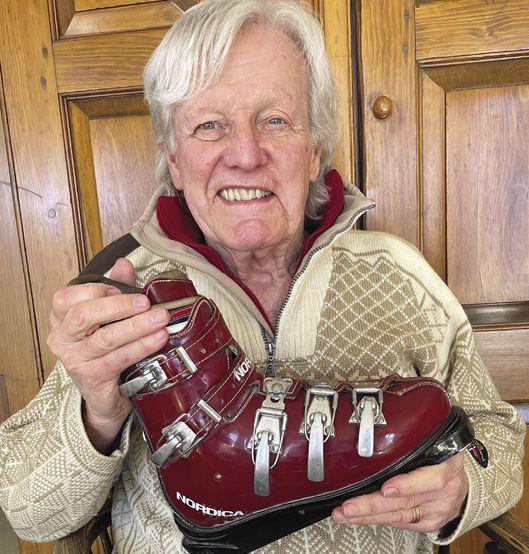
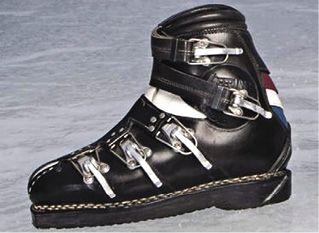
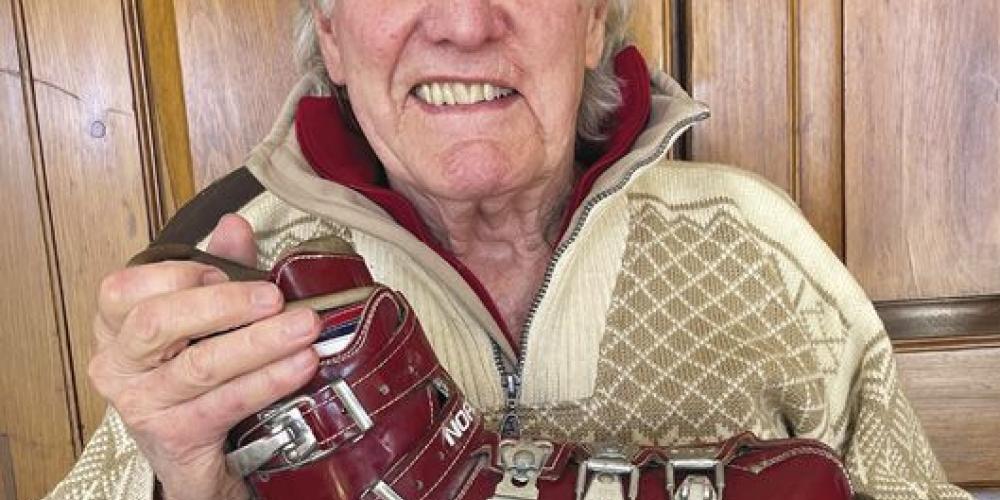
Photo above: Sven today, with the leather Sapporo of 1969. It was the first boot with both a high back and high tongue. Kathy Richland photo.
State of the art in 1963:
Heierling licensed the Le
Trappeur Elite design, as did
Nordica. The design won medals
at the 1964 and 1968 Olympics.
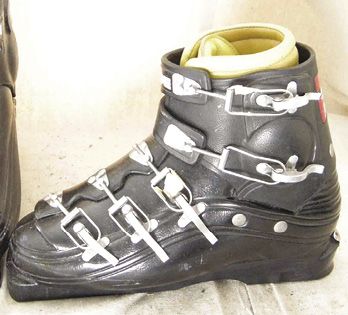
I first saw plastic boots in 1965, when I skied with Vail Ski School Director Morrie Shepard, and he offered me the job as his assistant. Morrie was Bob Lange’s ski instructor, and he was skiing in Lange’s double-lace, pre-production boot (Morrie soon went to work full time for Lange). Instead of working in Vail, I accepted the ski school director’s job at the PSIA
State of the art, 1967. Canadian
coach Dave Jacobs told Bob
Lange to raise the heel and lock
the hinge. The changes didn't
make the boot fit better.
experimental ski school in Solitude, Utah, which sounded much more interesting in the first years of the PSIA [Professional Ski Instructors Association]. After a year at Solitude, I moved on to run ski schools at Mt. Rose and Slide Mountain near Lake Tahoe. In the spring of 1967, Doug Pfeiffer, editor of Skiing magazine, invited me to Mammoth in April and May for the first magazine ski tests. Over six weeks I found that testing equipment, analyzing and problem solving were my true calling. Doug then invited me to New York each summer to write up our ski test reports and compose technical articles on equipment and the emerging techniques of the time.
During the tests in 1967, ‘68 and ‘69, Junior Bounous came to Mammoth to test Rosemount fiberglass boots and asked me to try them. They were very comfortable, with the side-hinge entry-exit door and a collection of fitting pillows to insert in several pockets to adjust the comfort and support. With the mechanical hinging action and very rigid sole, it was a significant contrast to my Nordica leather race boots. When the Canadian team trained at Mammoth, Rod “Yogi” Hebron lent me his Lange plastic race boots. They made my feet numb, as if with Novocain. I couldn’t feel the skis. By comparing the plastics directly to my leather boots, one on each foot, I really noticed that the plastic had the effect of isolating the delicate sensitivity and proprioception and balance feeling of the feet for the skis and snow. That is, the “feeling of leather” was absent.
Leather boots, when well fitted, were stiff and sometimes bruising for a week or two, then felt great. They were good for two weeks of hard skiing and then went soft. We tried reinforcing the leather with layers of fiberglass, with disappointing results. Every brand in the boot business was convinced that plastic would be the final cure for the woes of leather boots. But the first generation of plastic boots, and especially the racing Langes, never grew comfortable. It looked like plastic promised only more durability than leather, and maybe drier feet.
During testing in the spring of 1968, I met Norm McLeod from Beconta, the importer of Nordica boots, Look bindings and Völkl skis. Beconta had kindly supplied me with Nordica boots while I was directing ski schools, and I supplied constructive feedback. We rode Mammoth’s Lift 3 and Norm asked what I thought about plastic boots. “They are interesting,” I told him. “Their impressive durability and shell stability marks them as inevitable. It’s obviously the future, but they still have a long way to go. They are unpredictable. There’s perhaps too much support, and I can’t feel or ski with my feet. They force me to emphasize with my knees, using knee-hooking to start turns. And they hurt!”
We talked for hours about ski boots, and he offered me a job. I joined the company at their San Francisco warehouse early in 1969.
Nordica was playing catch-up to Lange and Rosemount. Lange made a big splash at the 1966 World Championships in Portillo, on the new World Cup circuit in 1967 and at the 1968 Grenoble Olympics. Nordica needed a response. They already had injection-molding machines for the outsoles, but Nordica’s designers were leather-boot artisans and didn’t know how to engineer plastic boots to be truly functional. In 1968 they made a big investment in molds and shot a line of “Astral” thermoplastic shells for introduction in ’69, but these were too narrow and worked no better than existing plastic boots.
I settled in at Beconta with a plan to perfect their leather race boot, then find a way to duplicate that fit and performance in plastic. I fed design ideas to Norm, who airmailed them to Nordica in Montebelluna, Italy. The summary that sealed my relationship with Nordica was about developing integrated high-back boots. Norm told me they were very excited about that and wanted to meet me. Nordica asked me to move to Italy and work in the factory.
Their team of brilliant artisans, led by Piero Martin Iego and Otto Heinz Izzo, made dozens of different custom leather boots and we tried them out with the U.S. and Italian ski teams. Our key discovery was that the high-back should be countered by an equally high tongue, so that the tibia was “centered” with the ankle at its optimum-strength angle.
With racer feedback, I compiled a list of 173 functional design criteria. Then we combined all these ideas into the Sapporo leather slalom boot (see photo, top of page). We got it to racers for the 1969 model year, and we had a number of top slalom skiers in it while everyone else was in Langes. A couple of years later, Fernando Francisco Ochoa won the 1972 Olympic slalom in the Sapporo boot.
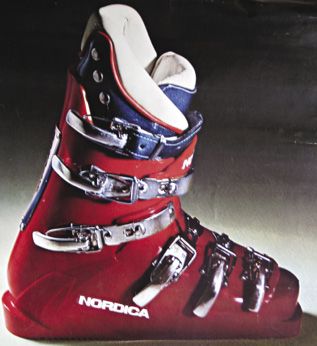
Nordica Olympic (1971) replicated all
the features of the leather Sapporo. The
one-piece plastic shell was replaced by
the two-piece Astral Slalom. Coomer
collection.
Long before that, we pushed ahead to translate the design into plastic. We created a beautifully handcrafted leather inner boot and shaped a shell mold to cradle it accurately. The first result, the Olympic, was a one-piece design (shell and cuff molded as a single unit) based on the final version of Ochoa’s boot. It gave racers tremendous edging power and embodied criteria still used today in all top race boots.
But in 1971–72, Henke had trouble with their plastic boots. The weak plastic cuff straps broke and the warranty costs put Henke out of business. The single mold for the Olympic was difficult to inject and we worried about weakening the cuff straps with voids in the plastic. So the boot was retired prematurely.
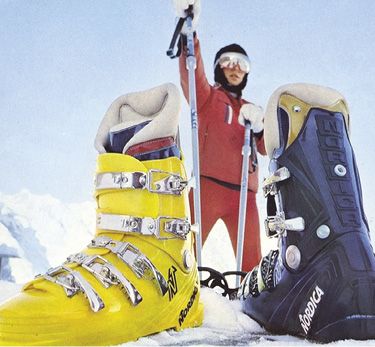
Astral Slalom (1972) -- the "banana
boot." Coomer collection.
We reworked the shell shapes into a two-piece design, where the separate cuff was a much easier item to injection-mold. That hinged-cuff design reached the market in 1971 as the second-generation Astral series. The real innovation was subtle. Where every other high-performance boot on the market had adopted a high-back “spoiler,” the Astral had a spoiler and a high tongue—higher than the spoiler, in fact. The following year we offered the locked-hinge Slalom model. In North America, it was bright yellow and thus became the “banana boot.” It made all the other race boots on the market look obsolete and cemented Nordica’s worldwide market share at 30 percent.
Sven Coomer will be inducted into the U.S. Ski and Snowboard Hall of Fame, Class of 2022, in the spring of 2023.
Belatedly elected to the Hall of Fame, the charismatic skier drove the professionalization of Alpine ski racing.
From the moment he entered the world on January 10, 1945, a ball of energy and gangly limbs, Vladimir Peter Sabich Jr. would be known as Spider. His father, Vlad, a World War II B-25 bomber pilot and California Highway Patrol officer, and his mother, Frances, the local postmistress, were hard-working and pragmatic. They raised their kids in Kyburz, California, nestled along the South Fork of the American River, where the Sierra Nevada foothills rise into the mountains enclosing Lake Tahoe.
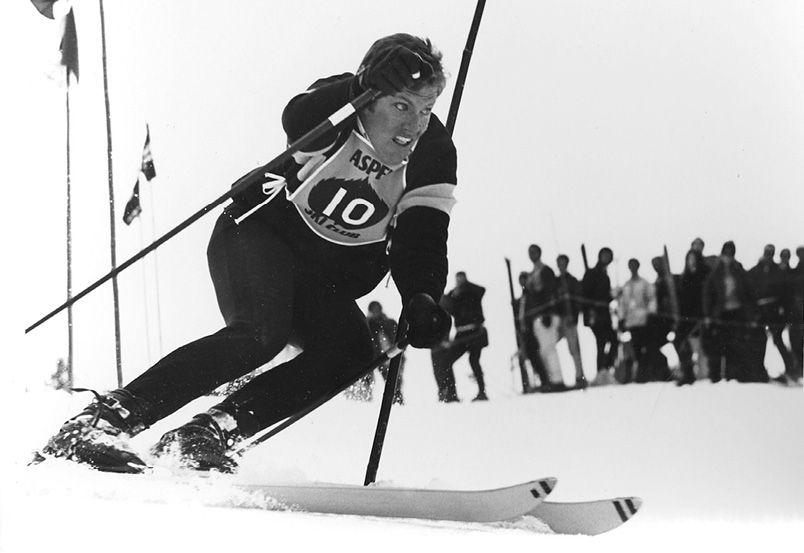
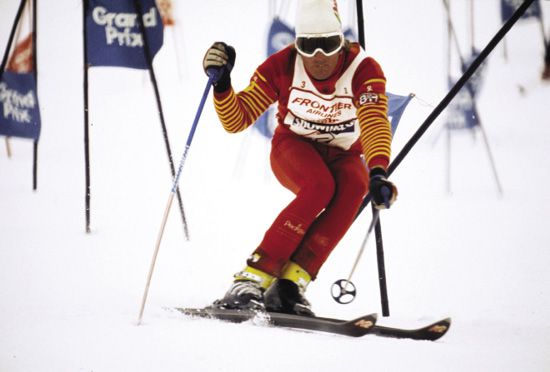
Photo top of page: Spider Sabich in peak form at the Aspen World Cup slalom, 1968. Courtesy John Russell.
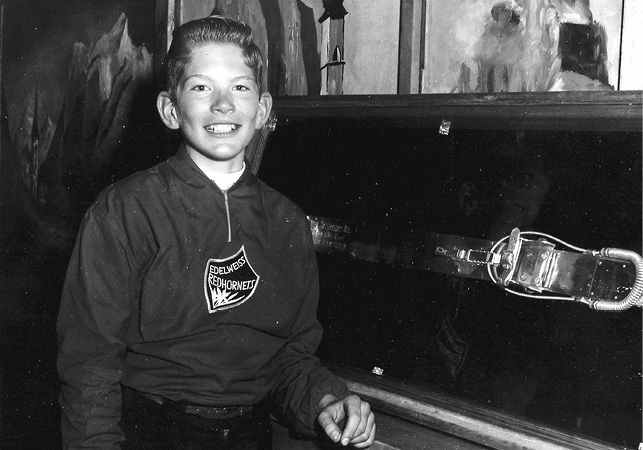
Future alumnus of the Edelweiss Red
Hornets ski team.
Nature served up hunting and fishing in the summer and skiing in the winter. Spider, his older sister Mary and younger brother Steve (known to all as “Pinky”) learned to ski fast as part of Edelweiss Ski Area’s Red Hornets. Dede Brinkman, Spider’s Hornet teammate and lifelong friend, remembers the boy with big ears and a crooked front tooth as determined, focused and kind. By their teens, she says, “he had an aura. There was something magical about him.”
As the team packed into station wagons and racked up trophies throughout California, word of the “Highway 50 Boys” traveled beyond the Sierra. Spider and Pinky caught the attention of Bob Beattie, who offered them skiing scholarships at the University of Colorado. In 1963 Spider arrived in Boulder to study aeronautical engineering and ski. At the time, before the U.S. Ski Team was formed, Beattie’s CU Buffs were the de facto U.S. Men’s Ski Team. Spider and Pinky joined future Olympians Billy Kidd, Moose Barrows, Jimmie Heuga and Jere Elliot.
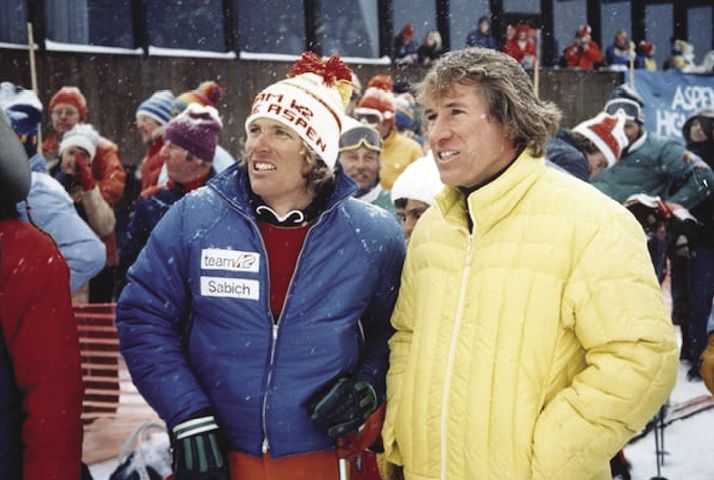
Spider and Billy Kidd watch the
competition finish at a World Cup, 1969.
Beattie brought a hard-nosed, football-coach mentality to the ski team, implementing tough dryland training regimens. Bars were off limits. Instead, the team’s house, complete with swimming pool, became the party, where bands played, beer flowed and teammates bonded for life. Part drill sergeant, part cheerleader, part father, Beattie developed protective relationships with his athletes, no more than with Spider.
World Cup Victory at Heavenly
Over the course of his early career, Spider suffered seven broken legs. But by the spring of 1967, at age 22, he was whole and strong. He made his World Cup debut in the final slalom of the inaugural World Cup season at Jackson Hole, Wyoming, and finished sixth. The following year, he tackled the circuit full time. Teammates remember him for his street sense and maturity, as well as a penchant for fun and mischief.
In medal position after the first run of the 1968 Olympic slalom, Spider ended up fifth. The result matched Kidd’s GS finish as the best American skiing performance at the Games, and—though eclipsed by Jean-Claude Killy’s three gold medals—it heralded a bright future for American skiing.
During the 1968 season, Robert Redford was in Kitzbühel, Austria, researching his role for the 1969 film Downhill Racer. Though the original script based the lead on Olympic medalist Kidd, Redford gravitated to an unheralded, unpretentious and supremely charismatic teammate. “Spider Sabich was largely the inspiration for Dave Chappellet, probably more than any other one athlete,” says Redford. “What I remember most about Spider, and what I wanted to depict, was the way he attacked the race course, which to me reflected a feeling of going for broke.”
Spider on the pro tour, 1974. Courtesy
John Russell.
Spider ended his first full season on the World Cup with a win at Heavenly Valley, 30 miles from Kyburz. A crowd of 5,000 people lined the slope to cheer the hometown hero, who secured the win on a come-from-behind second run. Killy, who finished seventh in that race, won his second overall World Cup title and then retired.
Over the next two seasons on the World Cup, Spider won three more podiums and 11 top-10 results for a career total of 16 finishes in the top 10. Meanwhile, Beattie had moved on to launch the World Pro Skiing Tour (WPS), with Kidd as its star. After winning the FIS World Combined Championship in 1970, Kidd immediately turned pro and won the 1970 WPS championship as well. Spider, who was still competing on the World Cup, grew increasingly restless and unsettled at the hand-to-mouth existence it offered American skiers, while their European counterparts profited richly from sponsors. He finished out the 1970 season and went to Europe with the team the following winter, but his heart wasn’t in it.
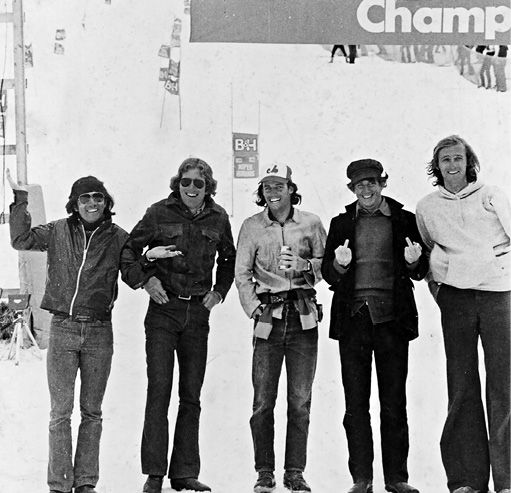
From left: Hank Kashiwa, Sabich,Tyler
and Terry Palmer and Harald Stuefer
chillin' at Aspen Highlands, 1973.
Courtesy Norm Clasen.
Peter Miller, who chronicled the 1970–71 World Cup season in his book The 30,000 Mile Ski Race, summed up the particular challenge for U.S. skiers: “The American racer is a lonely figure on the international circuit. He is an amateur competing against professionals.” Miller also captured the personality conflicts within the team, under the disciplined coaching of Willy Schaeffler. None of it meshed with Spider’s motivations or personality, and he was ripe for change.
To Tyler Palmer, a 20-year-old slalom phenom on the World Cup during the 1970-71 season, Spider was both mentor and friend. In early January, the night before the slalom race in Berchtesgaden, Spider told Palmer he’d be leaving to join Beattie’s WPS. “My stomach hit the floor,” remembers Palmer. “You’re going to be fine,” Spider assured Palmer. “You’ve got everything I’ve got. Don’t hold back.” The next day Palmer, starting 61st, finished fourth. Two weeks later he scored his first World Cup victory.
Spider flew home immediately after Berchtesgaden. “It was such a relief to stop racing as an amateur,” Spider told Sports Illustrated in 1971. “I was fed up with the hypocrisy. Fed up with racing against guys who were making $50,000 a year, guys who had other people to wax their skis, sharpen their edges and who could go home when they got tired. I was nervous trying to compete with what I thought were insufficient weapons. Now I have no worries.”
Going Pro
Spider won his first pro race on February 4, 1971, at Hunter Mountain, New York, pocketing a check for $1,250. “The next thing we know, we’re getting reports Spider is winning every race.” recalls Hank Kashiwa, a U.S. Ski Team racer who joined the WPS in 1972. Spider went on to win seven races, beating Kidd in the final to win the overall tour title and $21,188. In the 1972 season Spider defended his title with nine more wins and broke his own record for prize money, making more than $50,000 ($360,000 today). That same year, the male U.S. Ski Team athletes were reimbursed $200 each for their commitment, the women $80.
Sabich with life-long mentor and friend Bob
Beattie. Courtesy John Russell
WPS brought the relatively unknown sport of ski racing to the American people in an easily understood format and in easily accessible venues—from high-profile Colorado’s Aspen and Vail to tiny Buck Hill, Minnesota, and Beech Mountain, North Carolina. In Beattie’s head-to-head, gladiatorial format, the rules were simple: cross the finish line first and you win. The tour brought the drama, excitement and fun of ski racing up close to viewers and offered them ready access to the athletes and their personalities.
The tour also allowed sponsors and athletes alike to connect with the audience while enabling athletes to maintain their independence and claim cold hard cash. Under amateur rules, U.S. Ski Team members could not directly work with sponsors, but on the pro circuit, skiers could serve as billboards, eager to sell their sponsors’ brands while creating their own. Explains John Demetre, whose sweater designs, especially one based on Spider’s Kyburz High School football jersey, exploded in popularity, “This was showing America Demetre every weekend.”
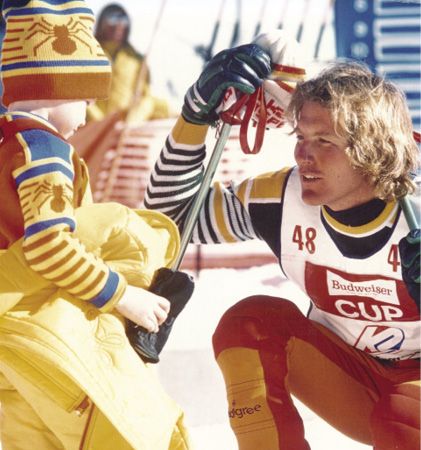
A natural with kids, Sabich made it a
point to connect with young fans.
Courtesy John Russell
Regular TV coverage on ABC and NBC, as well as Beattie’s made-for-TV celebrity pro-ams, ensured attention, sponsors and prize money for WPS. In its first season, prize money totaled $92,500. Over the next four years, the amount had grown to more than $500,000. Spider’s laid-back attitude, approachable personality and contagious joie de vivre made him a marketer’s dream, and he earned more than $150,000 annually from sponsors. Said Gordi Eaton, then racing director at K2, “Having Spider ... you knew he was going to handle the public side of the thing well because he loved people and could sell anything to anyone.”
In tirelessly promoting the tour, Spider took his sponsors along for the ride, none more so than K2. At home, he charmed the brand’s factory workers, retailers and customers, and diligently worked trade shows and press conferences to win the hearts and attention of fans. In Europe, where the American ski companies had previously garnered little credibility, he represented the free-spirited ambition and legitimacy of American skiing, and skis.
Klaus Obermeyer once described Spider as “a man drinking life out of a full cup.” Spider could seamlessly switch from being laser focused on course to being friendly elsewhere, headlining everything from autograph sessions to wet T-shirt contests and sponsor parties. He’d pound a glass of water before bedtime, then be first up in the morning to train. The ambassador of hard work and fun was eminently approachable, especially around kids, for whom he’d get down on his knee to have eye contact while signing autographs.
Explained the late Gaylord Guenin, the WPS PR director, “It was simply Sabich being Sabich. . . . He brought an honest vitality to the sport that can be compared to the vitality Joe Namath brought to football.”
Meanwhile, the restrictions on amateur skiers tightened further, climaxing with the disqualification of Austria’s top skier, Karl Schranz, from the 1972 Sapporo Olympics for “professionalism.” This impelled more top Olympians, enticed by Spider’s success and lifestyle, to travel directly from the Games to join the WPS. Among them were Kashiwa and Palmer. As more World Cup racers joined the ranks and learned the format, Spider rolled on to defend his title and lead ski racing’s revolution.
A Plane, a Porsche and a Pad
Spider embodied everything that Beattie had imagined WPS could provide: American ski racers making a living on their own terms, on their own turf, and using it as a springboard to their professional lives. With his earnings and competing near home, Spider was able to enjoy a lifestyle similar to that of European ski stars. He engineered a home in Aspen’s Starwood neighborhood, near his friend John Denver. The house was neither huge nor showy, but a unique creation featuring California timber, curved stone walls and a waterbed in the living room. He earned his pilot’s license and bought a twin-engine Piper Aztec that he often flew to competitions.
Sabich at his Red Mountain home in
Aspen. Aspen Historical Society, Aspen
Times Collection
“He had the plane, the nice house, the Porsche. We wanted to be like him,” says fellow pro Dan Mooney, while noting that no competitors begrudged Spider his success. They fully understood the work it took and his talent for walking the line between fierce competitor and life of the party. Spider generously mentored incoming athletes, teaching them that making it as a pro meant managing training, travel, equipment, sponsors and one’s own competitive instincts. It meant working hard in the gym and on the hill, in the ski room and the board room, at trade shows, in ski shops and, most importantly, with sponsors.
Whereas amateurs were punished for promoting sponsors, pros were fined for not going to sponsor parties. Terry Palmer recalls Spider teaching him how to drink at tour parties by having one shot, then discreetly throwing subsequent drinks over his shoulder. His message, Palmer recalls, was always clear: “If you’re going to be good, if you’re going to make money at this, if we’re going to have a good tour, you’re going to have to work hard.”
Sponsors and athletes organized themselves into factory teams, bringing together the financial and logistical support of a national team while preserving the monetary incentive for individual success. So compelling was the tour that Killy came out of retirement for the 1972–73 season and joinedWPS, bringing it international attention.
Kashiwa was with Spider when they learned Killy was joining the tour and felt his demeanor change. “I think he wanted to prove that we [on the WPS] were the best skiers in the world,” says Kashiwa. Initially unprepared for the physical challenge of the format, Killy earned $225 total in his first race but retrenched over the Christmas break and roared back, winning five races to Spider’s three. Spider and Killy’s epic battle for the 1973 season title—recounted in the film Spider and the Frenchman and in Killy’s book Comeback—ended when Spider crashed off a bump, badly injuring his neck and shoulder.
Despite losing the title to Killy, and amid the infusion of new stars, Spider graced the cover of GQ magazine in November 1974. Clutching his red, white and blue K2 skis, in his signature Demetre sweater, he remained the face of the American pro tour and the picture of success. As tour director Nappy Neaman once put it, “Every kid wanted to be Spider. Every girl wanted to date Spider.”
As a brand ambassador for Snowmass (the resort’s only front man since Stein Eriksen), Spider deftly navigated all aspects of Aspen’s scene, comfortably mingling with cowboys, ski bums, celebrities and the ultra-rich. In 1972, at a pro-am event in California, he met French singer Claudine Longet. Recently and amicably divorced from Andy Williams, who had facilitated her Hollywood career, Longet and her three children later moved in with Spider. For a time, the couple seemed genuinely in love, but friends recall that her quick temper and possessiveness turned the intensity of the relationship into a liability. This shift coincided with Spider’s competitive decline. “If you’re out of shape by the eighth run, you’re not going to be able to do the things that you’re telling yourself mentally you can do,” he said. “And that breeds inconsistency. And in this game, inconsistency is elimination.”
Last Runs
In 1974, Spider managed two wins and limped through the season to finish fifth in the tour standings. By then his litany of injuries included knee, back and neck problems—on top of the seven early-career broken legs. Publicly he made no excuses, remaining upbeat and optimistic about the future. After missing the entire 1975 season due to injury, Spider knew his ski racing career was coming to its natural end. He and Beattie (as friend and advisor) together plotted the next step, which would likely involve K2 and Snowmass, and possibly ski area development, real estate and TV commentary. With Spider’s talent, education and connections, his next chapter promised to be as exciting as the last, and less stressful.
By March 1976, having qualified for the weekend round of 32 only twice that season, Spider decided to quit two things that were no longer healthy for him: ski racing and Claudine. He told Tyler Palmer as much in their hotel room in Collingwood, Ontario, before the penultimate race of the season. Palmer, upset at the prospect of once again losing his teammate and mentor, also mistrusted Longet. “I told him ‘Just be careful with her,’” Palmer recalls. “That was the last I saw of him.”
Longet and her kids were to move out by April 1. On March 21, Sabich spent his afternoon training at Buttermilk, while Longet, according to toxicology reports that were ultimately disallowed as evidence, spent hers indulging in Aspen’s notorious après ski. After a short visit with Beattie, Spider headed home to change. He planned to meet Beattie later that evening and to fly to the annual ski trade show in Vegas the next day. Instead, Longet shot him to death in his own bathroom, with the gun his dad had bought as a souvenir from the ’68 Olympics. Spider was 31 years old.
While the shooting itself still holds mysteries, the aftermath of the killing, the trial and the events that led to Longet’s sentence—a $250 fine and 30 days at the Pitkin County Jail to be served at a time of her choosing—are well chronicled (see “Spider Sabich: A Tale Larger Than Life,” by Charlie Meyers, in Skiing Heritage, September 2006).
A Long Legacy
Under Chuck Ferries’ supervision, K2 had introduced its first race ski in 1969. Spider’s success helped bring the brand to prominence, and by 1975 it had achieved a 30 percent market share in North America. Iconic, fiercely independent stars like Phil and Steve Mahre, Glen Plake and Bode Miller continued to build the uniquely American brand. Beattie’s WPS thrived, and the popularity of the format inspired a women’s pro tour, started by Jill Wing Heck in 1978. In 1993, Bernhard Knauss became the first pro skier to break the $1 million mark in tour winnings. “Even in the 90s, this name Spider Sabich meant something,” says Knauss. “I realized from the beginning that if I work hard enough and do well it can change my life.”
Missy Greis, Spider's daughter with
Dede Brinkman. Courtesy Dede
Brinkman.
Skier Erik Schlopy revived his own amateur career with the technique and independence he learned through the pro format. When it came to naming his own son, Schlopy was inspired by one person: “Spider Sabich was the coolest racer of all time,” he says. Young Spider Schlopy now races for the Park City ski team. Today, a revived pro tour features both amateur and pro skiers facing off with no eligibility restrictions, and its star, Rob Cone, is a laid-back former U.S. Ski Teamer and collegiate skier who races on his own terms. Meanwhile, at the Spider Sabich Race Arena in Snowmass, people of all ages come to experience the rush of head-to-head racing.
Spider lives on in a more tangible way, too. “In the early summer of 1967,” Dede Brinkman recounts, “he and I spent the night together, and we conceived a child.” At the time, both were otherwise engaged, Dede to her future husband and Spider with his skiing career. The two decided to keep this secret. Dede remained close with Spider, as their lives took both of them from Tahoe to Boulder and, eventually, to Aspen. After her divorce, she lived in Starwood, where their daughter, Missy, had a close connection to Spider.
When Brinkman told her daughter, then age 20, the truth, “there was a lot more about my life that made sense,” says Missy. She now runs a successful coffee business in Salt Lake City, and her own daughter, Grace, recently graduated from UC Berkeley. They share a love of skiing and an appreciation for Spider’s ideals, which Missy describes as “doing what’s right, not what is easy. And making a difference.” While Spider never met his own grandchild, his parents did. Missy recalls Frances Sabich’s words: “It’s just the nicest thing to know there’s a legacy.’”
Regular contributor Edith Thys Morgan spent nine years on the U.S. Ski Team, competing in three World Championships and two Olympics. She last wrote about “What to Expect When You’re Inspecting” in the January-February 2022 issue.
Spider Lives: On Film and in the Hall of Fame
Spider Sabich’s life is commemorated in the new film Spider Lives, which will hold its premiere at 5:30 pm on March 25 during Skiing History Week in Sun Valley. Produced by Christin Cooper, Mike Hundert, Mark Taché, Edith Thys Morgan and Hayden Scott, the 90-minute film earned a 2021 ISHA Film Award. On March 26, Sabich will be inducted into the U.S. Ski & Snowboard Hall of Fame, during its banquet in Sun Valley.
Jess Bell’s lipstick racers dazzled the ski world.
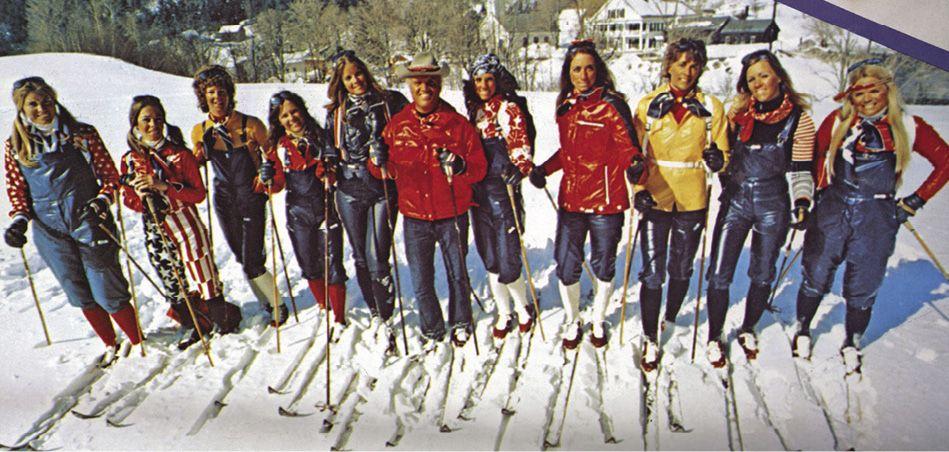
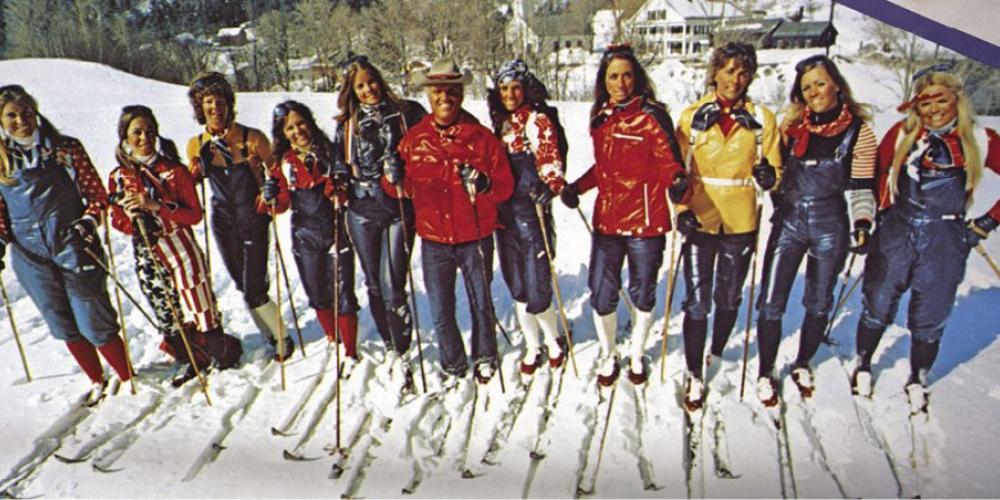
Photo above: Jess Bell (center in hat) often entertained New York fashion editors, providing an opportunity to field test his skin-protective cosmetics. The late team captain Karin S. Allen is third from right in the yellow outfit.
Revlon or Estee Lauder or Helena Rubinstein can have their high-fashion models. Their runways. Their heavily purple–shadowed eyelids and rouged cheekbones. Cleveland businessman Jess A. Bell, Sr., had a different idea when, in 1959, he succeeded his father at Bonne Bell, the family cosmetics business.
As major stores and ski area shops slowly warmed to his line of ski lipsticks, sunscreens and high-altitude creams (an alternative to pasty-white zinc oxide), Bell tossed in the women, called “girls” back then. They would come to be known as the Bonne Bell Ski Team.
To sell cosmetics, Jess Bell promoted
a dewey-cheeked outdoor look, with
creamy tan and snowy teeth.
Reported Anita Verschoth in the November 22, 1971, issue of Sports Illustrated, “Bell’s beauties all look as if they had just dropped in from the wholesome house next door. … The emphasis is on a sort of dewy-cheeked outdoor look, complete with creamy tan and snowy teeth.”
Bonne Bell Cosmetics was founded in 1927 by Bell’s father, Jesse Grover Bell, who had been selling cosmetics door to door in Kansas. After moving to Ohio during the Depression, he made his products on a hot plate in his basement and continued door-to-door sales. The company was named after one of the elder Bell’s daughters.
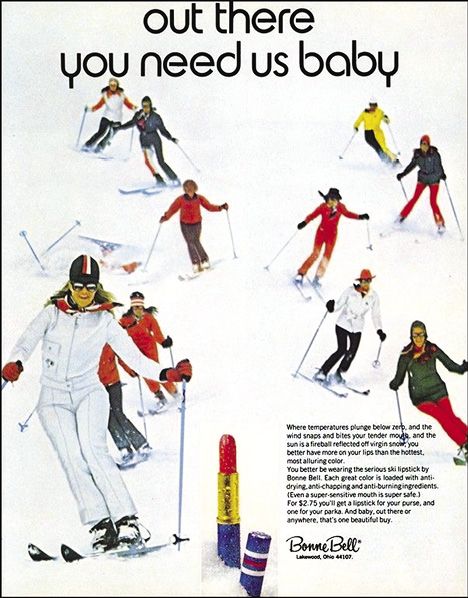
Beginning in the 1950s the company actively pursued the outdoor market, developing sun blocks, heavy-duty moisturizers and lip protectors for skiers, hikers and joggers. While more elegant cosmeticians fought over big-city sales, Bell’s tagline resonated with resort-bound skiers: “Out there you need us, baby.”
In 1973, as its celebrity sales reps were storming ski country, Bonne Bell introduced a lip pomade called Lip Smacker, aimed originally at skiers, then later at pre-teens. According to Women’s Wear Daily, “Lip Smackers achieved cultural icon status as the first flavored lip item on the market.” Lip Smackers started with strawberry, green apple and orange-chocolate flavors. By 1975, the brand made news with a Dr. Pepper flavor.
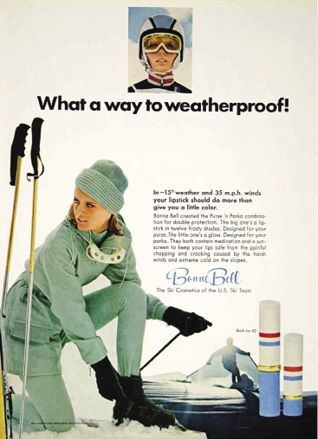
Supermodel Cheryl Tiegs (not a team
member) got an early start pitching
Bonne Bell's "Purse 'n Parka" lipstick
combination.
Jess Bell, a graduate of Valley Forge Military Academy and Baldwin Wallace College, served as a paratrooper in both World War II and the Korean War. He defied the common image of a cosmetics industry giant. A fitness buff, he scaled Kilimanjaro, ran marathons, swam to keep in shape and served on the President’s Council on Physical Fitness and Sports.
His Lakewood, Ohio, offices were smoke-free long before that became common, and he pioneered the idea of an office fitness center. He offered incentives to employees who exercised regularly, lost weight or quit smoking.
Avalanche of Applicants
Georgia Lesnevich Haneke, a photographer and horsewoman from Heber, Utah, was on the Bonne Bell Ski Team from 1971 to 1974. She recalls that the selection process was fierce, with “thousands of applicants.” She asked her stepfather, a classmate of Jess Bell, to provide an introduction.
To promote Bonne Bell sunscreen for
men, Bell hired Billy Kidd, fresh off his
1970 combined world championship.
She flew to Bonne Bell headquarters, and 48 hours later Bell offered her a salary of around $12,000 per year, all expenses paid, and free ski equipment. She credits her acceptance to “good looks and skiing ability.” But it was no walk in the park. Her responsibilities included selling cosmetics, visiting retailers, straightening stock, filling out sales reports, going to ski resorts and pre-running NASTAR courses.
“It was 90 percent hard work, and 10 percent glamour,” she says. “Sure, it was a sales job, but I felt like a mini movie star. You’d walk into a retailer or hotel or ski resort and when the Bonne Bell Ski Team girl arrived, they treated you like royalty. Everyone knew who you were and what you represented.”
The late Karin S. Allen, team captain, told Sports Illustrated in 1971 that being on the team was better than being Miss America.
Allen moved to Woodstock, Georgia, following 40 years with the company in roles that also included international sales training. She passed away in August 2021, shortly after sharing her Bonne Bell experiences with us.
“Jess was brilliant,” she said. “The Bonne Bell Ski Team was made up of surfers as well as skiers, and was a great marketing tool for attracting new customers. The other cosmetics salespeople showed up in mink coats and high heels. Instead, our girls were athletes. There were about 10 of us at any one time, working across the U.S., and we were all skiers.
“Jess used to say, ‘You’re healthy and wholesome, toasty and brown, and you’re killing your skin,’ in reference to girls who went into the mountains or out in extreme weather with no sunscreen protection,” Allen said.
“When I look back on my career, I consider it to be the most amazing job you could ever have. Jess Bell was generous, loyal and supportive. We could not have had more fun in our working lives. There wasn’t a morning when my feet hit the floor and I wasn’t excited to do the job.”
“Sign Me Up”
Nancy Stofer Brehm, a retired schoolteacher in Saugatuck, Michigan, remembers what it was like being around the Bonne Bell Ski Team for five years, pitching the brand on campus. “As a young college student working at Bonne Bell part-time, I felt the members of the team were the epitome of cool,” she says. “I loved skiing as a sport and was envious they were getting to ski around the country. I thought to myself, ‘If this is a job, then sign me up.’”
Team member Bettie Simms Hastings, a retired Indiana horse farm owner now living on a ranch near Telluride, remembers, “It was a great job before skiing became so commercial and corporate. It was all fun. How many people are hired to go to different ski areas and be paid to have fun skiing with people?”
She especially liked her Captain America–like outfits and skiing in films by Willy Bogner, Jr. Another highlight was meeting Robert Redford while traveling through the airport in Denver. “He would look you right in the eye while he talked,” she recalls.
Mission accomplished, the ski team was disbanded in the mid-1970s. According to Karin Allen, the promotion saturated its target market. “We expanded to nearly every ski area in North America,” she said. “Our efforts eventually evolved to focus on international sales and the higher volume U.S. cosmetics retail business, which paid the bills.”
Jess Bell died of heart ailments in 2005, at age 80.
Bonne Bell Cosmetics was sold to Markwins Beauty Brands in 2015. Markwins closed the Bonne Bell headquarters, laying off 91 employees, according to Cleveland’s The Plain Dealer (Jan. 30, 2015). Those nostalgic about the brand’s 90-year run can still find Ten-O-Six astringents, moisturizers, and deep-pore cleansers (now known as Formula 10.0.06) on Amazon and at Walmart. Lip Smacker lip gloss and lip balm is sold on Amazon and in Dollar General stores. Lipsmacker.com invites kids to become “Balm Squad” artists.
Bettie Hastings adds, “The independence we had to do the job, the travel, and meeting people at ski areas, skiing everywhere, and having capital F-U-N. I don’t think sales reps today have the same freedom. Younger friends don’t know about the Bonne Bell Ski Team, but I’m proud to still be called a Bonne Bell girl … especially at my age. It was a wonderful chapter in my life.”
ISHA board member Jeff Blumenfeld, a resident of Boulder, Colo., is president of the North American Snowsports Journalists Association (NASJA.org). He is author of Travel with Purpose: A Field Guide to Voluntourism (Rowman & Littlefield).
Wayne Wong, of Vancouver, British Columbia, at age 19, took third place in the very first International Championships of Exhibition Skiing, held in March 1971 at Waterville Valley, New Hampshire (grand prize was a Corvette). In 1976, Wong endorsed the new 230-horsepower Dodge Aspen R/T—the performance version of the “compact” Aspen introduced that year. The code-name for the development program had been Aspen-Vail, and the Plymouth version was named Volaré (without the accent it means “to fly” in Italian). Wong flew on to stardom, but the Aspen/ Volaré was a lemon. By 1978, quality problems nearly bankrupted Chrysler, and incoming boss Lee Iacocca axed the Aspen in favor of the front-wheel-drive K-Car series,
introduced in 1980. —Seth Masia
In future issues:
Whatever Happened To Down/UP? Remember when instructors told us to get tall to start the turn? Is up-unweighting still a teaching tool? Ron LeMaster explains.
Where Are They Now? American racer Marco Sullivan retired after 15 years on the World Cup circuit—and a record 105 downhills. Edith Thys Morgan catches up with the speed specialist.
True Northland Fires and feuds in St. Paul: The real story behind the world’s best hickory skis.
PLUS
Listen Up! Remember singing “Super Skier” around the ski lodge fireplace? From yodeling odes to “90 Pounds of Rucksack” to the latest streaming jams, music has always been a key part of ski culture. Listen to the classics through ISHA’s multi-media reconstruction of ski-music history.