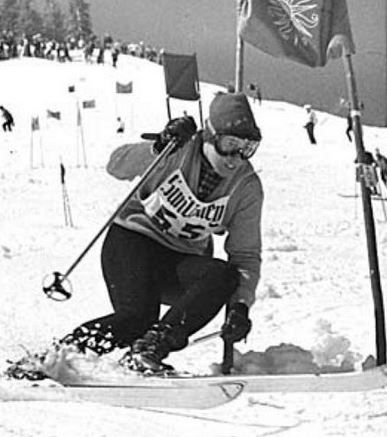
Henke, the Swiss bootmaker, ran this ad in the September 1969 issue of SKI magazine. The skier is Austrian Karl Schranz, taking the last of his four victories at Wengen (1959, 1963, 1966, 1969). Schranz won his first international classic at age 18, in 1957, taking the Arlberg-Kandahar downhill and combined trophies at Chamonix.
He retired in 1972, after being barred from the Sapporo Olympics on the grounds that ads like this one made him a “professional.” The ad mentions neither Schranz nor any specific victory, but it was common knowledge that top skiers were paid by their equipment suppliers—recognizable here are Kneissl skis, Henke boots and Marker bindings.
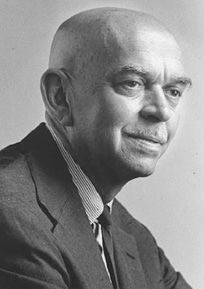
That was enough for International Olympic Committee President Avery Brundage, who called Schranz “a walking billboard.” Brundage had been banning athletes—including swimmer Eleanor Holm and track star Babe Didrikson—for a variety of reasons since becoming president of the Amateur Athletic Union in 1928. In 1948, Life magazine’s Roger Butterfield wrote that “Brundage became celebrated as a tyrant, snob, hypocrite, dictator and stuffed shirt, as well as just about the meanest man in the whole world of sports.”
Brundage retired after the terrorist attack on Israeli athletes at the 1972 Munich Olympics. For his part, Schranz made a half-hearted stab at the World Pro Skiing circuit, then built a hotel in St. Anton. Henke athlete Roland Collombin won the silver medal in downhill at Sapporo, but a year later the company’s plastic buckle straps failed and the brand went under.
Coming in Future Issues
Powder Highway Steve Threndyle explores great skiing along British Columbia’s Powder Highway.
Golden OldiesEverett Potter attends the annual vintage travel-poster auction at Swann Galleries.
Sherman Adams, two-term governor of New Hampshire, found time to make Loon Mountain an East Coast family classic.
How one local saved the Borscht Belt’s last ski area.
For nearly 70 years, every southern tourist, every comic, every singer, every song-and-dance man in the Catskills has driven past a ski lift counterweight inscribed with “16 Tons,” just outside of Monticello, New York.
Though no longer in use, the weight remains along Route 17, the main artery linking New York City, 85 miles south, to the so-called Borscht Belt resort area (see Skiing History, “The Sour Cream Sierras,” May-June 2020). The otherwise mundane concrete block paid homage to the 1946 Merle Travis coal-mining song Sixteen Tons, popularized by Tennessee Ernie Ford in 1955.
The counterweight has been free advertising for a 440-vertical-foot municipal ski area called Holiday Mountain, situated between the Neversink River at its base and a divided four-lane highway up top. Although the lettering has since faded, this beloved ski hill, the last dedicated ski area in the southern Catskills according to the Facebook group Catskill Skiing History, is undergoing a multi-year renovation driven by a local entrepreneur who is also a lifelong skier and ski patroller.
Holiday Goes Private
The hill’s riverside terrain opened for skiing in November 1949, with three electric tows, rolling slopes, expert trails and a “Swiss Ski School” to bring authentic Alpine techniques to New York skiers. The original iteration of Holiday, developed by local businessmen Don Hammond, a department store owner, and Manny Bogner, a lumber dealer, also offered a warming hut and ski shop—but it was abandoned after a few years due to a lack of snow, according to Remembering the Sullivan County Catskills, by local historian John Conway.
In December 1957, when the town of Thompson parks commission purchased the property from local resident Maude A. Crawford for $5,000, the ski area reopened with two rope tows and a 900-foot platter-pull lift with an uphill capacity of 900 skiers per hour, according to the Conway book.
Holiday wasn’t as challenging as, say, Stowe’s Nosedive terrain, but in 1957 the New York Times gushed that the ski area will “more than suffice for the run-of-the-mill sports lover who wants to test his legs as well as enjoy the sport with a minimum risk of injury.” Trails and slopes sported holiday-related names, including Easter Parade, Birthday Schuss and Christmas Bowl. Forty years later, as losses mounted and local taxpayers grew tired of deficits ranging upward of $250,000 per year, town leaders decided to bail out of the ski business.
The ski area was purchased from the town in 2000 by Craig Passante, son of the late owner of the nearby Villa Roma Resort (which still offers skiing and snow tubing to guests). The younger Passante, a Hofstra University graduate with a degree in marketing and an honorary doctorate in hospitality, tried to pump new life into the aging facility by adding a family-activities park, motocross course and special events.
The adjacent Neversink River, known for world-class fly fishing, was a blessing for snowmaking but flooded the 1950s-era base lodge in April 2005. In summer 2011, Hurricane Irene and Tropical Storm Lee caused more damage, according to the Sullivan County Democrat (June 13, 2023). What’s more, low snowfall totals during those years did little to help Passante turn the struggling ski hill around.
Determined to prevent the land from being sold for a housing development, Monticello native Michael Taylor, a longtime ski patroller at nearby Plattekill Mountain and great-grandson of original landowner Maude Crawford, purchased the teetering ski area in May 2023.
No Holiday
“This ski area was about to drop dead,” wrote Stuart Winchester of The Storm Skiing Journal and Podcast in November 2024. “Then Mike Taylor bought it. … He has resources. He has energy. He has manpower. And he’s going to transform this dysfunctional junkpile of a ski area into something modern, something nice, something that will last. And everyone knows it wouldn’t be happening without him.”
Tayor, 58, is a successful businessman, the CEO of his family’s propane and heating-oil business in the New York Tri-State area. Still, preventing the ski area from becoming another entry in the directory of lost ski areas was no holiday.
Overcoming the reluctance of banks to loan to a modest ski area, Taylor spent $10 million in renovations, encountering enough bumps along the way to fill a World Cup mogul run. However, he remains dedicated and optimistic about Holiday’s future. “We’re 85 miles from 12 million people,” Taylor told the Sullivan County Democrat shortly after purchasing the area. “We can’t fail.”
Taylor and his team, often improvising on the fly, had to contend with snowmaking pumps and guns that clogged with river grass; a pump-house fire that caused $500,000 in damage; extensive soil erosion caused by the motorcross operation; a scarcity of chairlift parts; the cancellation of local after-school ski programs and the costly landscaping of the adjacent Bridgeville Cemetery, which dates back to the late 1700s. To add to the financial challenges of running a diminutive ski area, a fire damaged the attic of its new snowtubing lodge one week before opening this season, delaying the launch of this popular kids’ activity.
From Molehill to Mountain
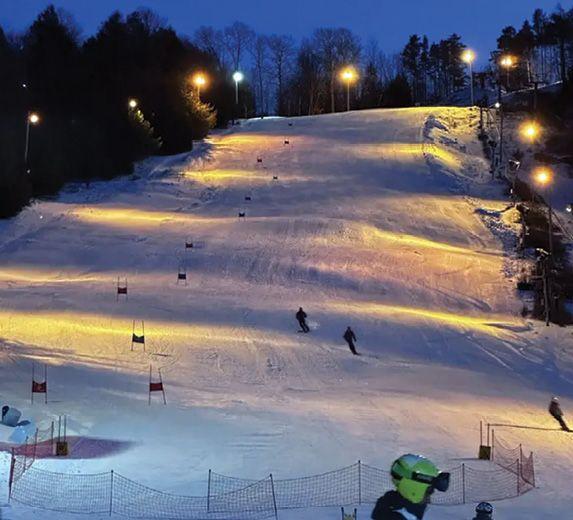
Today, it’s hard to imagine a small ski area—with just 40 skiable acres, a stingy 55-inch average annual snowfall and a 1,600-foot summit—doing so much with so little. This season the mountain opened with nine trails, anchored by a refurbished quad and triple chair. Other amenities include an 11-lane lighted snow-tubing park and a ropetow and conveyor lift overlooking the cemetery. An upgraded snowmaking system, including 200 new guns and towers and eight miles of snowmaking pipe, strive to compensate for the area’s typically modest snowfall. A true community ski area, Holiday is closed on Mondays. One benefit of its tiny footprint, Holiday is able to offer night skiing across all of its terrain—a staple amenity for a family area.
There’s also Mambo Night, a new trail that honors the Cuban-themed dance parties once held at now-defunct Catskill resorts, and Hackledam, named after a former tanning and lumbering community that existed nearby in the late 1800s. The double black, winch-groomed trail is said to be one of the steepest in the Catskills. “We’ve really rebuilt this ski area from the ground up,” says Taylor.
Fond Memories
News about Holiday’s resurrection was greeted by the region’s skiers like a powder forecast. Jeff McBride, 66, now of Las Vegas, Nevada, and a grandson of Don Hammond, lived within sight of the mountain and started skiing there at age four. “I loved skiing Holiday nearly every day of the season,” he says, “practicing Daffies, back scratchers and side-tucks almost daily for annual freestyle skiing contests.
McBride, who became a professional magician and has several entries in the Guinness Book of World Records, especially remembers drinking hot Dr Pepper with lemon in the base lodge. (Apparently “hot Doc” was a thing back then, according to the web channel Tasting History with Max Miller.)
Catskill skiing historian and native Barry Levinson, 65, who now resides in Gypsum, Colorado, recalls that as a kid, “I kinda hated this little rinky-dink 440-foot hill with a highway on top and a gravel pit on the bottom that did not look like the pictures I saw in SKI, Skiing and Powder magazines.” However, “now, with age and perhaps wisdom and a sense of nostalgia I look back on it and feel lucky to have had that hill in my backyard. Holiday Mountain [was] neither a holiday nor a mountain, but it was ours.”
Future Plans
The conversion of Route 17 to Interstate I-86 has been a long-term state project, with major upgrades planned to bring the section passing Holiday Mountain up to Interstate standards, according to the New York State Department of Transportation. Still several years away, this will reduce commuter congestion during weekday peak hours and mitigate weekend vacation traffic, hopefully leading to more ticket sales for Holiday.
Today Taylor is singularly focused on his mission, as determined as ever to answer the question of “How do we get kids off their phones and out recreating again?” As he told Storm Skiing, “You can’t make me happier than to see busloads of kids improving their skills and enjoying something they’re going to do for the rest of their lives.”
Jeff Blumenfeld grew up skiing at Holiday Mountain. A resident of Boulder, Colorado, Blumenfeld is vice president of ISHA and past president of the North American Snowsports Journalists Association. He chairs the Rocky Mountain chapter of the Explorers Club and has covered the adventure field in ExpeditionNews.com for 32 years.
In this day of perpetual social media marketing hooks, “extremes” sell: hottest, tallest, biggest, fastest. Ski resorts are not immune. However, determining a superlative like the longest ski run on the planet is not as simple as it would seem.
This exercise is rife with caveats. Are we talking about vertical feet or length? Lift-served or not? Off-piste or maintained? Perhaps the most mainstream solution is to determine the longest runs by using both vertical and length—further sorted by some sort of lift service. Or perhaps just consider it a skier’s bucket list.
Guinness Book of World Records says that a run at Davos, Switzerland, from the Weissfluhjoch to Parsenn, is “the longest all-downhill ski run in the world” at 7.6 miles in 6,692 vertical feet (12.3 km and 2,034 m). Many may disagree, partly due to the ambiguous “all-downhill” criteria, designed to exclude anything with a hike or another lift ride in the middle. Or a bus ride at the end. And we won’t delve into Guinness’s definition of lift-served.
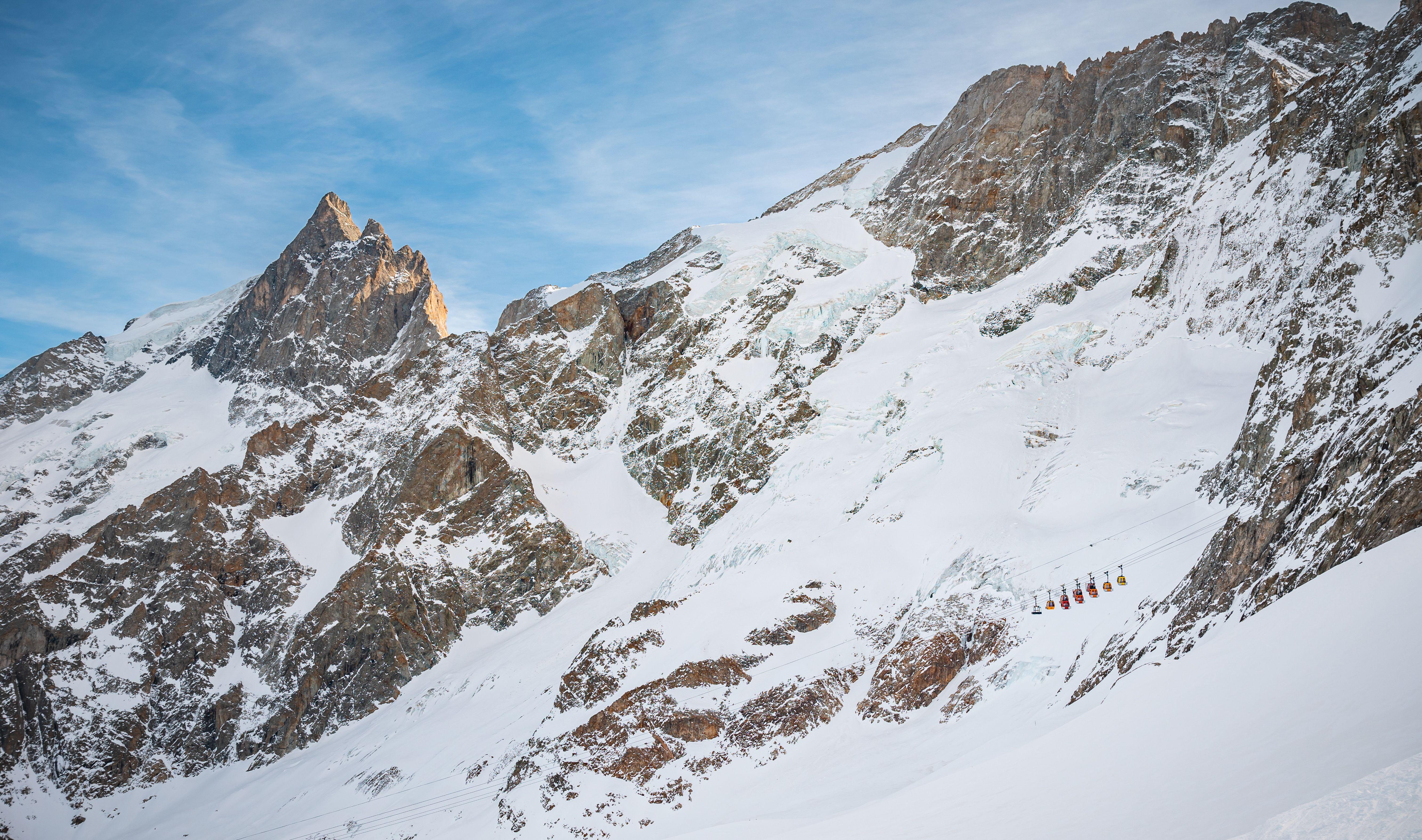
One of the best-known lift-served long runs in the world is Chamonix’s Vallée Blanche, which helps explain why we feel a little mystical about such endless terrain. Its most far-flung route is 13.67 miles (22 km), all of it off-piste and bedecked with chamois, blue-ice caverns, crevasses, lurching seracs and stupefying mountain views. Its full 9,200-foot vertical (2,797 m) goes all the way to the Chamonix valley floor, though
climate change has increasingly made that a rare reward.
Zermatt, Switzerland, features what is marketed as the longest red (intermediate) run in the world. The 13.6-mile (22 km) trail from the Klein Matterhorn to the Italy's Valtournenche measures 7,739 vertical feet (2,353 m) and delivers you to another country. It does require a lift ride in the middle, however.
Alpe d’Huez, France, describes its famous Sarenne route as “Europe’s longest black run.” The nearly 10-mile (6.2 km) descent in 5,872 vertical feet (1,785 m) can be done, according to the resort, “without having to take a lift.”
North America looks to Revelstoke, Canada, for bragging rights. Revelstoke claims the Last Spike as the longest maintained ski run in North America at 8.3 miles (13.4 km). As a plus, the run descends the resort’s full vertical, which at 5,620 feet (1,708 m), is tops on the continent.
A future the size of the terrain? Ian Matteson photo
Netflix Co-Founder Buys North America’s Resort-Acreage King
Powder Mountain, Utah, Tries Again to Be the Resort of the Future
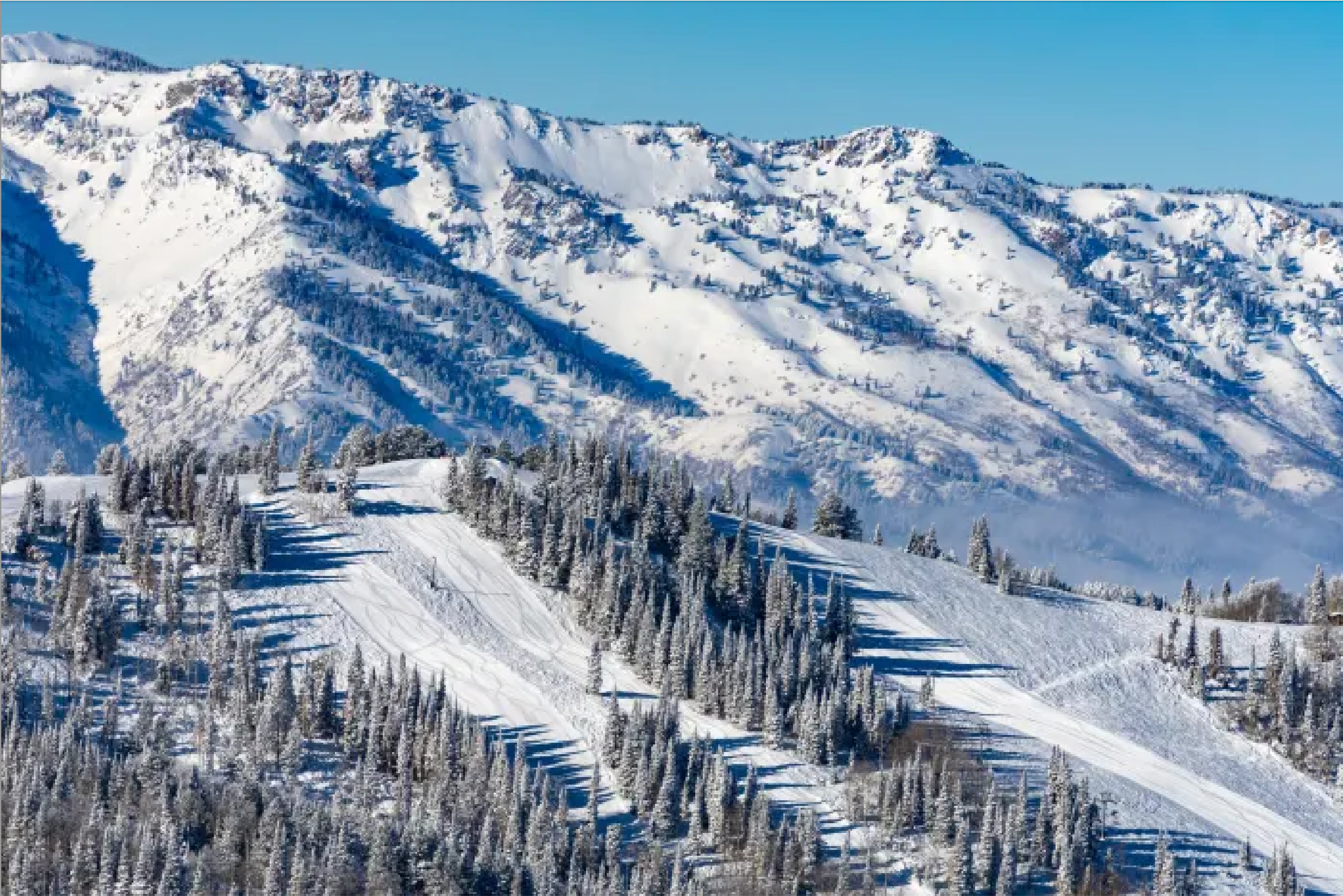
Tech money has joined forces with the largest ski resort (by skiable acres) in North America, in what may have been an inevitable marriage. On September 6, 2023, with a $100 million investment, Netflix co-founder Reed Hastings became the majority owner of Powder Mountain. Hastings had already acquired a minority stake in the Eden, Utah, resort, which covers over 8,464 acres—roughly 16 percent broader than Park City.
Hastings has only started his re-imagining of the resort in what he has termed “Powder Next.” To that end, he recently pulled all available residential lots at Powder off the market. “That’s a big step that you do when you have confidence that it’s going to be a lot more successful in a year,” Hastings told the Salt Lake Tribune. “So we kind of don’t want to sell those lots at current prices.” Hastings said he envisions the reworked resort as being a “premium place in the world for being and doing.”
Perhaps Powder Mountain will go full circle with that vision. It was purchased by a group of Silicon Valley entrepreneurs out of foreclosure for $40 million in 2013. Their vision was to build a future-embracing, eco-friendly resort with 500 homes developed around a hub of education, research and alternative medical facilities. Various challenges ensued, and fewer than 10 percent of the homes were built. Hastings, who stepped down as CEO of Netflix last January and now serves as executive chairman of the company, already had a home at the resort before he bought in. —Greg Ditrinco
Snow King lift: Wooden towers.
Old Time Lift Safety
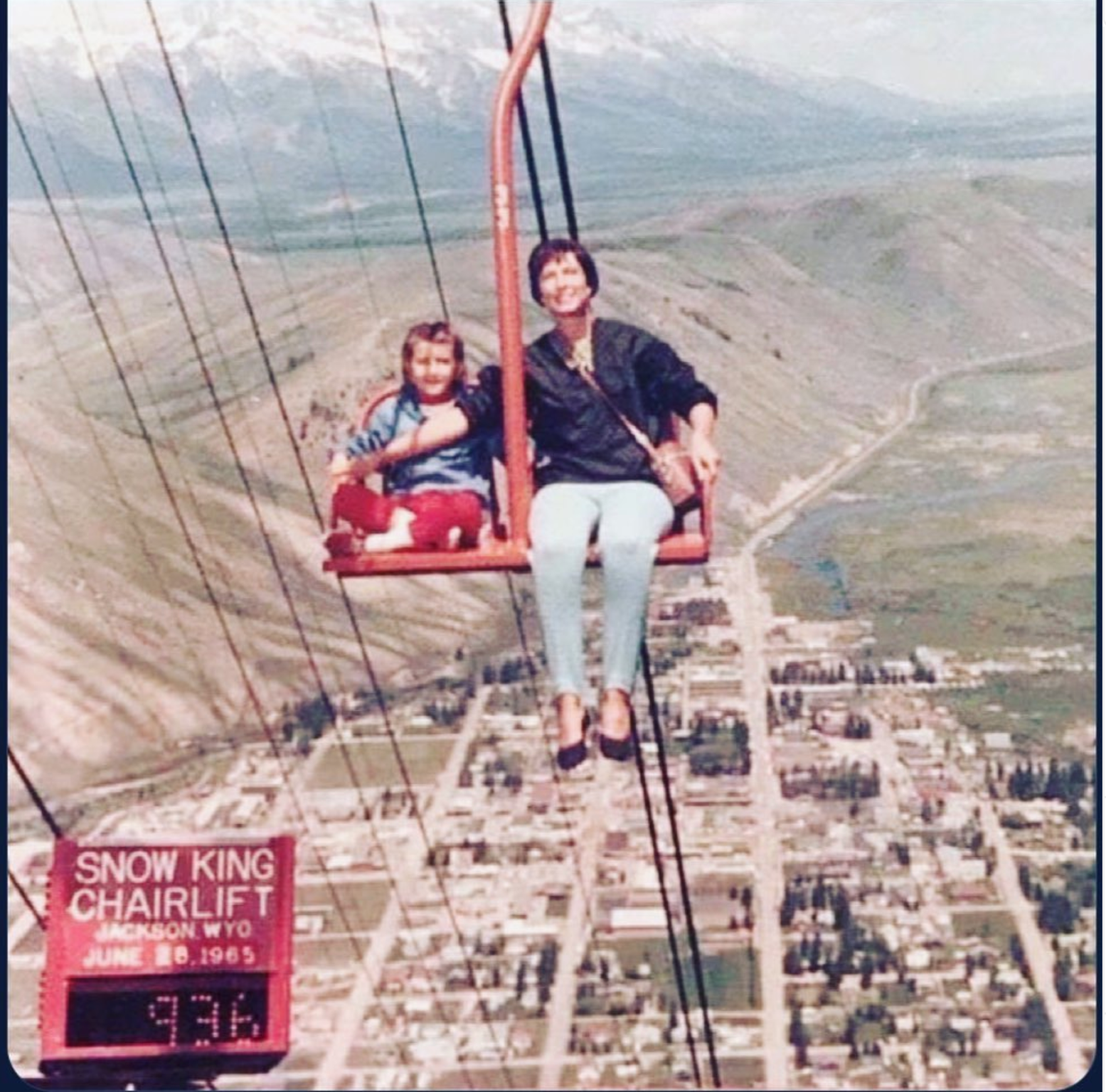
Snow King Mountain Resort, Wyoming, about a dozen miles and several thousand light years in attitude from Jackson Hole Mountain Resort, remembers the good ol’ days. The resort also wisely recognizes that hazy nostalgia might cloud some of the darker aspects of those good ol’ days. For instance, this image, dated June 8, 1965, posted on Snow King’s Instagram feed, is headlined “Safety Standards in the 1960s.” Snow King wisely notes that “We have upgraded a bit since these days!” A Skiing History editor recalls riding that chair. Its towers were made of telephone poles, bolted together into tripods. They creaked.
Snapshots in Time
1924 And So It Began
The Winter sports of the eighth Olympic Games were officially opened today with the customary Olympic ceremonies, presided over by Gaston Vidal, Under Secretary of State for Physical Education. M. Vidal received the oaths of amateurism by the athletes entered for the competition. The teams of all the nations represented, bearing their national flags and emblems, then paraded from the City Hall to the skating rink, where the actual competitions will begin tomorrow. On the arrival at the rink Under Secretary Vidal declared the official opening of the sports. His voice, caught up by enormous amplifiers on top of the grandstands, was sent reverberating up the sides of the high mountains which give the Chamonix Valley its magnificent setting. — “The Olympics in Winter” (New York Times, January 25, 1924)
1975 Free-Heel Revolution
If you’re a cross-country skier in the West, you may well consider yourself a pioneer. Just as the frontiersmen had to adapt to the mountains of the West, so also do cross-country skiers have to adapt their methods and equipment. And since touring is just beginning to boom in the West, the field is wide open for search and discovery. Here in Crested Butte, the telemark turn has turned the sport upside down. A group of skiers will ski to the top of a mountain with the sole purpose of linking a hundred or so telemarks together down a virgin bowl. — Rick Borkovec, “Trendsetters” (Powder, November 1978)
1989 A Turn for the Worst
“Collisions have become the number one cause of injury in skiing,” said Linda Meyers Tikalski, a U.S. Ski Team member and an Olympian at the Squaw Games. “Skiers think control means ‘not falling.’ The new skiers don’t think ‘turning.’ They think ‘cruising.’ Unless we can convince skiers that good skiing is good turning, we’re in trouble.” — Mort Lund, “No-Risk Skiing” (Snow Country, February 1989)
1990 Olympic Need
I have enjoyed reading your magazine through the years. There is only one suggestion I have for you. Let’s see more time and money spent on our U.S. Olympic ski team and on Olympic racing worldwide. Even though it is two years away, there are athletes preparing. I feel it would be interesting to see what is happening in the Olympic world. — Lori Bucher, Aurora, Indiana, Letters, “More on the Olympics” (Skiing Magazine, October 1990)
2001 Bye-Bye Ban; Hello Boarders
The Aspen Skiing Company is looking to youth to lead it out of the wilderness of complacency and sagging skier numbers into a more prosperous future. Thus it was on April Fools’ Day, of all days, last season that the resort’s notorious anti-snowboarding walls came tumbling down on Aspen Mountain to great fanfare, if not the actual trumpets of Jericho. Because it’s Aspen and therefore good news copy, on April 1 the town is jammed with more satellite uplinks than after Ivana Trump spied Donald’s girlfriend during a family ski vacation. — Jay Cowan, “The New Aspen” (SKI Magazine, September 2001)
2023 Shrinking Prominence
Mont Blanc’s peak has been measured at 4,805.59 m (15,766 ft 4 in), which is 2.22 m shorter than in 2021. The mountain, which straddles France, Italy and Switzerland, is measured every two years to try and track the impact of climate change on the Alps. French chief geometer Jean des Garets said the shrinking could have been caused by less rain this summer. “We’re gathering the data for future generations,” he said. “We’re not here to interpret them, we leave that up to the scientists.” — “France’s highest mountain Mont Blanc is shrinking.” (BBC.com, October 5, 2023)
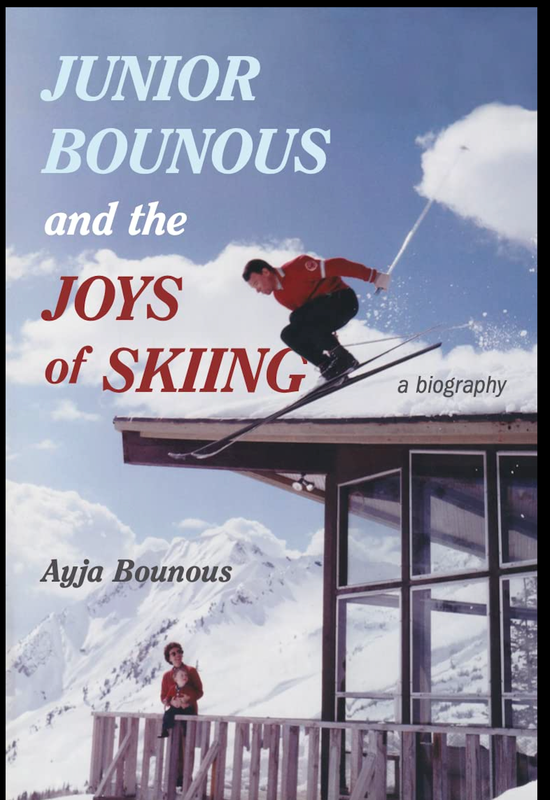
Ayja Bounous has crafted a well-written and comprehensive biography of an iconic American skier and teacher, and a tender tribute to her grandfather.
Junior Bounous was born in 1925 in Provo, Utah, in the Wasatch Mountains, and taught himself to ski at age eight on self-fashioned skis. He became a renowned powder skier and was a favorite model for photographers like Fred Lindholm, appearing frequently in ski periodicals and Warren Miller films.
Bounous’s astounding ability to convey the secrets of navigating powder to other skiers brought students from afar to wherever he was teaching, and they returned year after year.
After explaining how he got the name “Junior,” Ayja Bounous recounts her grandfather’s life-changing encounter with Alf Engen at Alta, their instant rapport and how he fully absorbed Engen’s teaching philosophy. Bounous would later infuse Engen’s methods into the Professional Ski Instructors of America’s American Teaching System.
We learn how, with Engen’s urging, Bounous earned his Forest Service certification to teach skiing at age 23 and then became a full-time ski instructor at Alta, teaching there from 1948 to 1958. In 1958, he was lured 600 miles westward to Sugar Bowl, California, becoming one of the first American-born ski school directors in the country.
The author describes how her grandfather later returned to Utah, in 1966, to become part owner and ski school director of the Timp Haven ski area (on Mount Timpanogos). In 1968, Robert Redford acquired the resort and renamed it Sundance (after his character in Butch Cassidy and the Sundance Kid). Redford prevailed upon Bounous to stay on as ski school director, and the actor thereby became a Bounous-trained powder adept.
In 1970, Bounous was approached to design the trail system for the nascent Snowbird ski resort, which opened in 1971. He then served as ski school director there until 1991, when he was named director of skiing. At Snowbird, Bounous also inaugurated both a children’s and a disabled learn-to-ski program.
Bounous’s partner through all these adventures, from 1952 onwards, was his wife, Maxine (née Overlade), who became a master powder skier in her own right and for her off-piste speed became know as “Fast Max.” A BYU graduate, she became indispensable as an editor when SKI and Skiing magazines published Bounous’s ski tips and PSIA’s instructional ski books included his contributions. Together, they raised two boys (one, Steve, raced for the U.S. Ski Team).
This biography recounts the couple’s full life of world travel and recreation in the off-season, too. They visited more than a dozen countries, from a memorable journey to Bounous’s ancestral hometown in northern Italy to the South Pacific, and from Nepal to New Zealand.
Somehow, the couple also managed to fit in month-long trips with friends and family on Lake Powell, on a houseboat or camping with a ski boat. Bounous loved exploring the many canyons and hidden rock arches that line the immense reservoir. Both would waterski and wake surf well into their 80s. And they botanized with passion, seeking out the myriad wildflower species of the Wasatch Mountains and discovering how the schedule and abundance of their flowering depended upon the snowpack of the previous winter. Junior Bounous is still skiing at the age of 98.
Junior Bounous and the Joys of Skiing, by Ayja Bounous. Printed by Paragon Press, Inc. (2022), softcover, 283 pages. $38
Sixty years ago, Billy Kidd, Jimmie Heuga and Jeannie Saubert validated Bob Beattie’s dream.
By Billy Kidd as told to Seth Masia
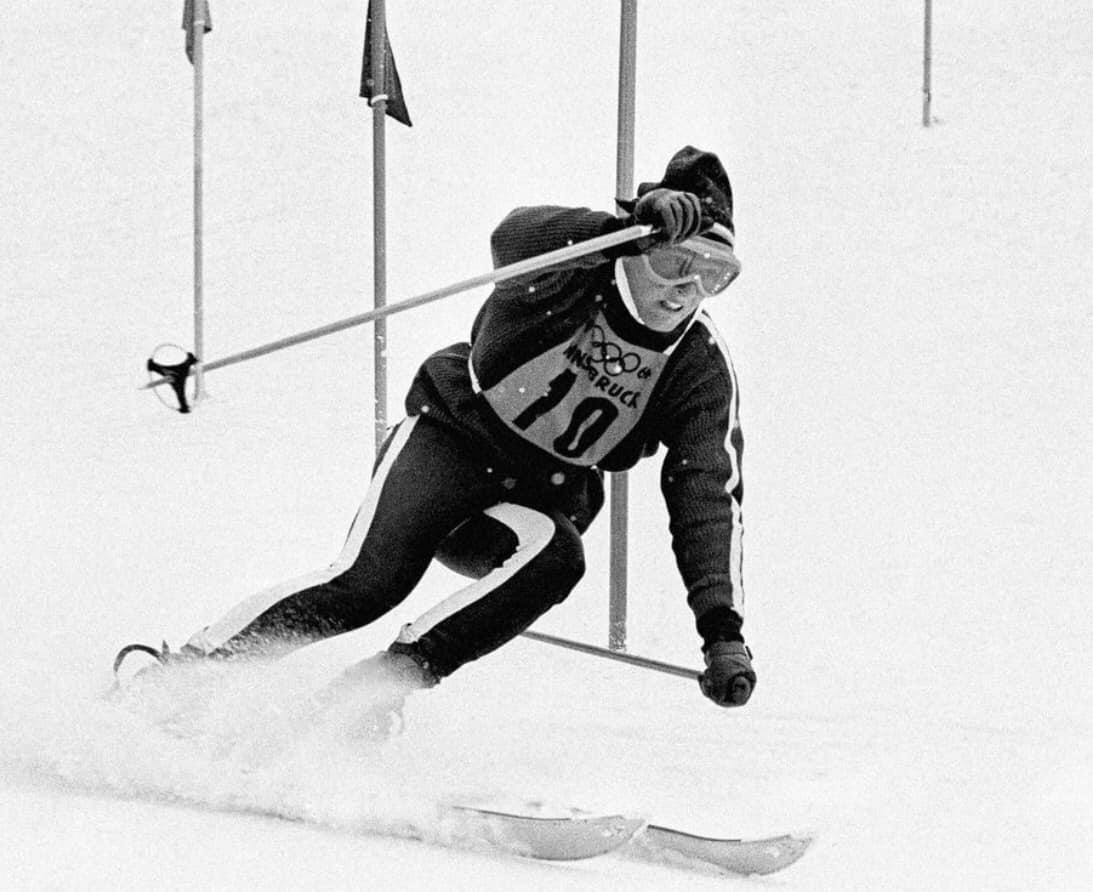
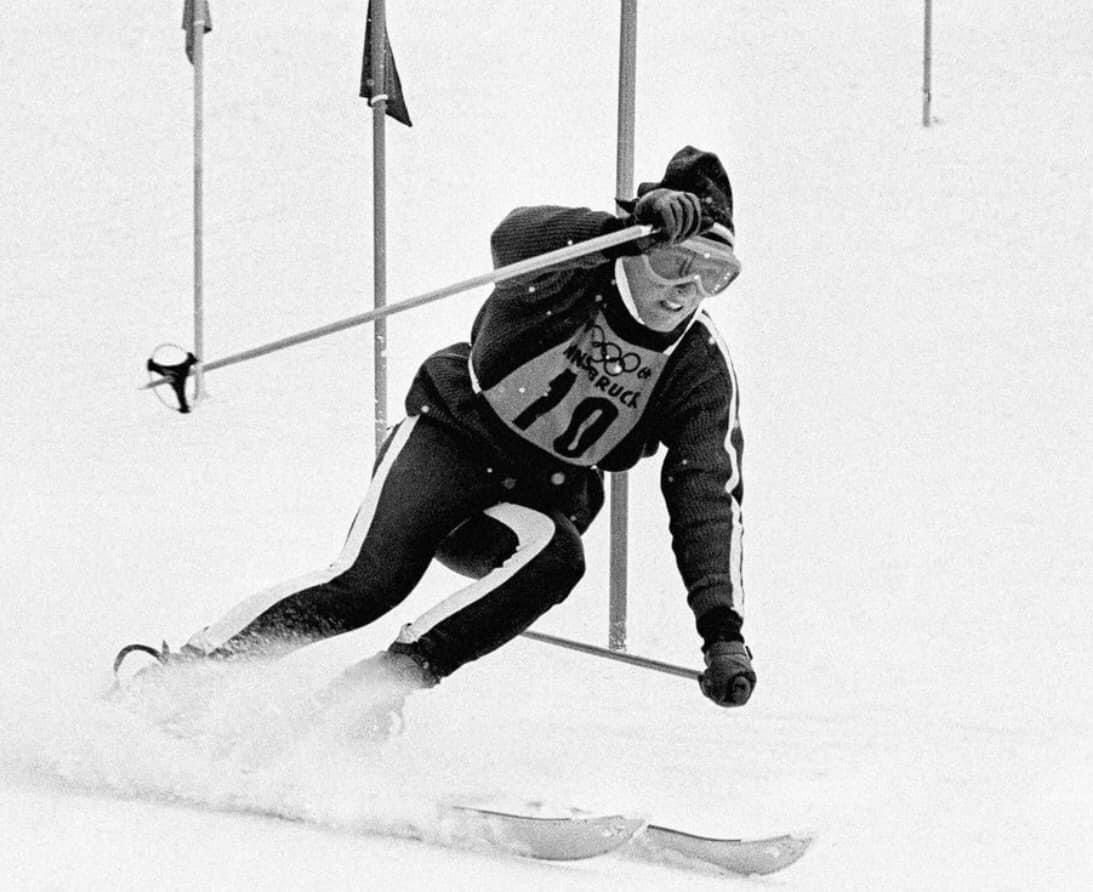
Photo above: Billy Kidd had the fastest second run in the 1964 Olympic slalom to score the silver medal behind Pepi Stiegler.
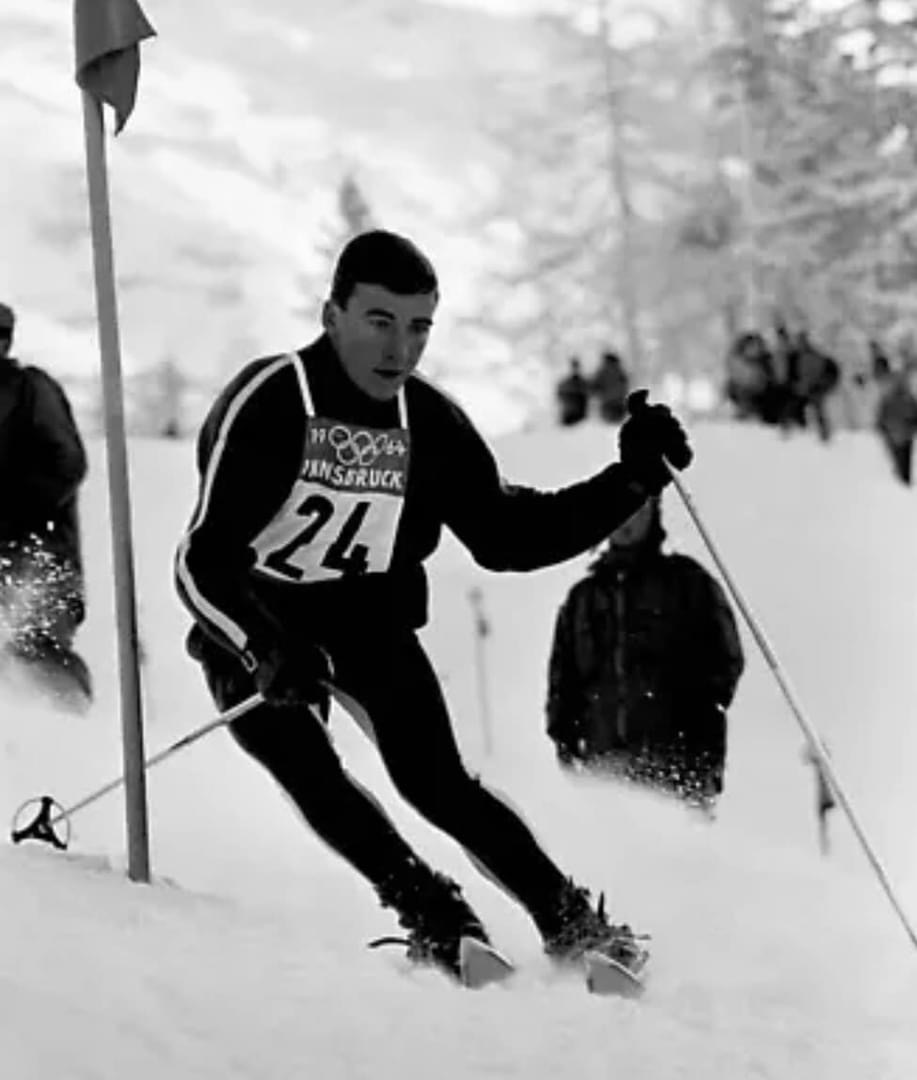
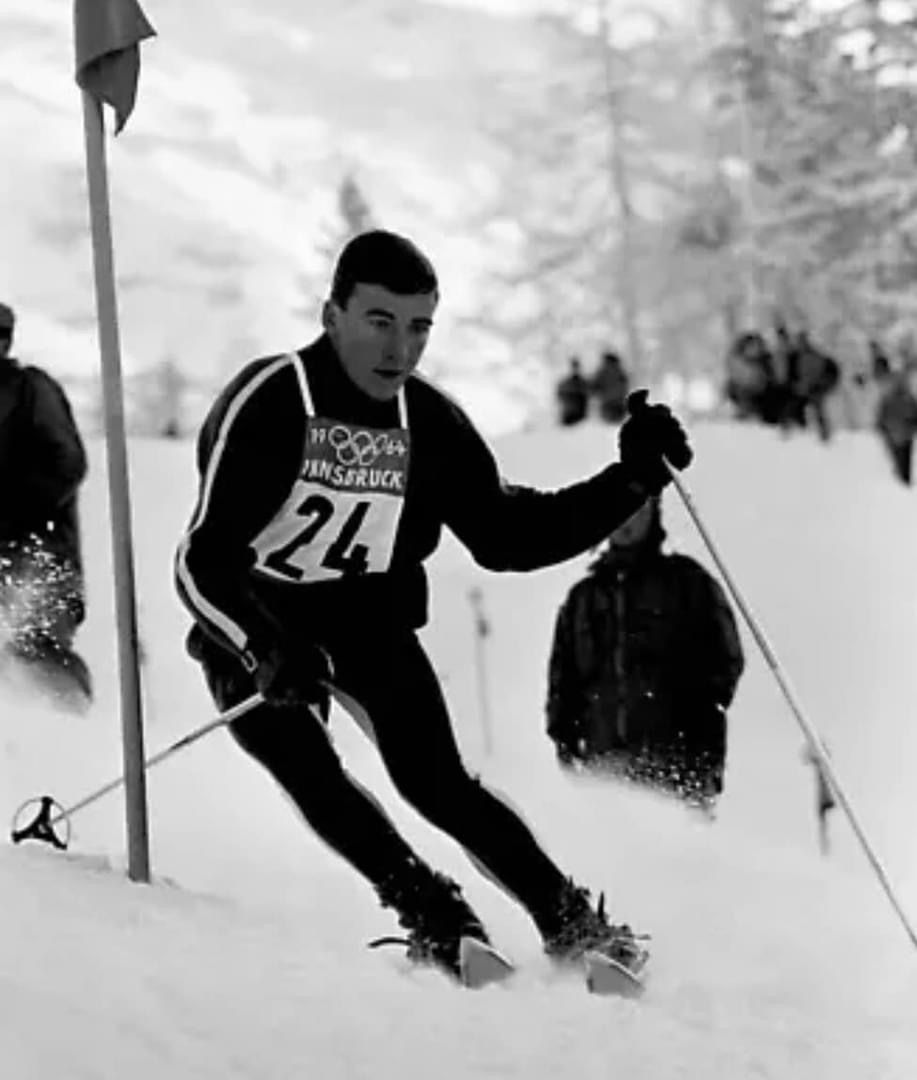
Jimmie Heuga, starting 24th, was third after the first run behind Karl Schranz. He had the second-fastest second run to score bronze.
I first went to Europe in 1961, to Val d’Isère to train for the 1962 World Championships at Chamonix. I was 18, and at Chamoinix I finished eighth in slalom and 15th in GS. For me, finding speed on the race course was a matter of watching the most talented racers carefully, analyzing courses, and figuring out where I could pick up a tenth of a second, here and there.
I got a lot from sequence photography and, especially, from watching Buddy Werner. I could see him plant his pole and turn his skis, not his shoulders, which was the opposite of the old Austrian reverse-shoulder. That meant you could get three turns in 1.5 seconds on 205-centimeter skis.
I was a full-time student, too, and didn’t have time to practice constantly. The key thing was to eliminate mistakes and memorize gates, always. I learned to analyze the course, visualize it, anticipate and react.
Speed also depended a lot on getting my equipment just right, because I couldn’t afford to give away tenths with a ski that was too stiff or with a sloppy boot.
For instance, I had been getting a stronger edge set on ice by canting my boots a bit. I did that by wedging a 10-inch strip of leather strap under the inside edges of the boots, but I knew that it would be more efficient to build that cant angle directly into the boot sole. No one was building a boot that way. Buddy, at age 25, was already importing Heierling boots. It was part of the way he made a living in those days when we couldn’t earn money just skiing, and it was an important relationship for all of us because, with leather boots, we needed new ones about every three to six weeks. So I met Hans Heierling in Val d’Isère and asked if he could build me some canted boots, and I had them in time for the World Championships.
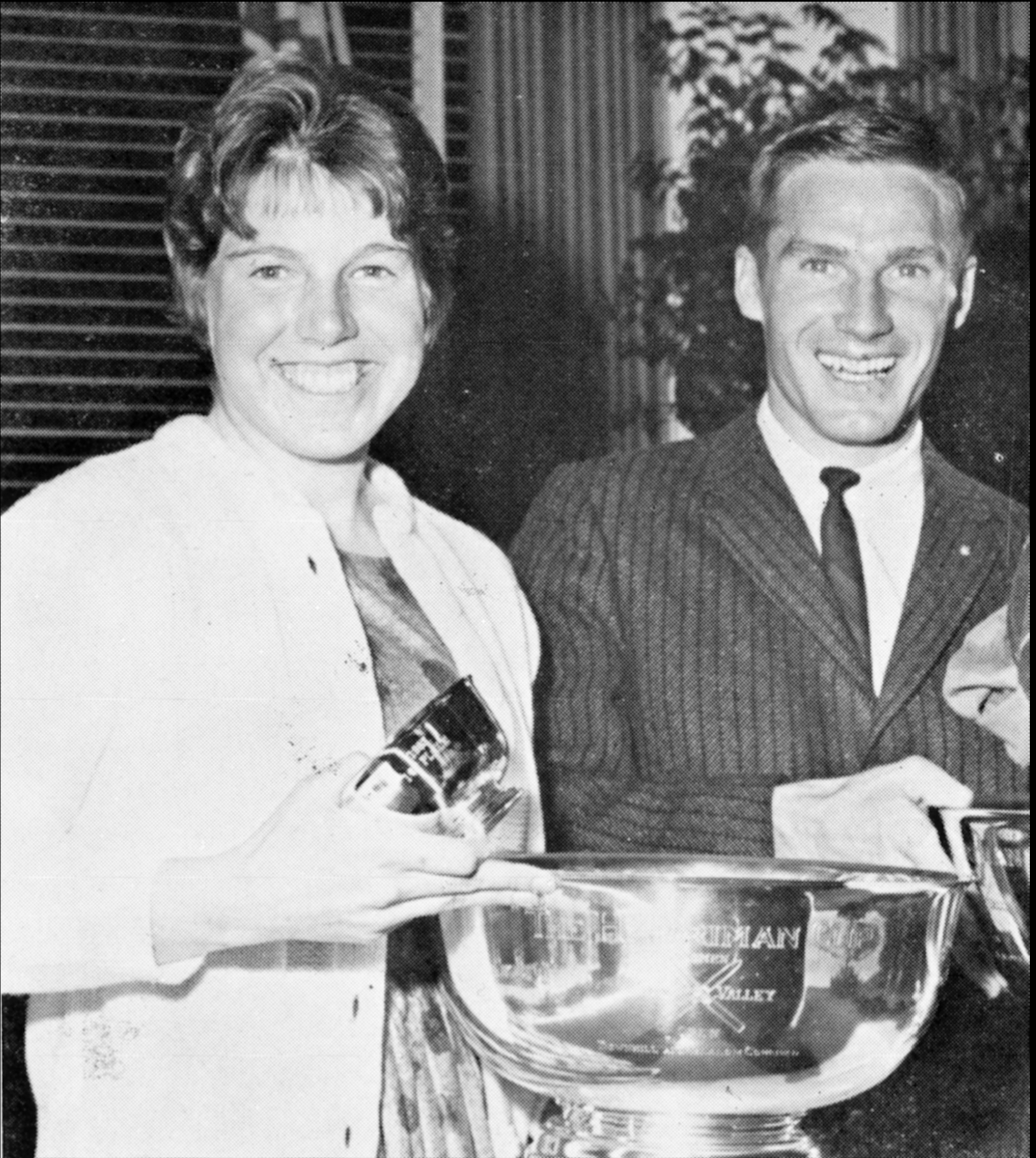
Jean Saubert and Buddy Werner won the 1963 Harriman Cups, and were favorites going into the '64 Olympics.
Also, the team used Marker Simplex bindings. During the winter of 1960–61, I took a backward fall and the toes didn’t release. I skied through the next couple of seasons with a chronically sprained ankle, which required a lot of adjustment in the boot. I mounted up my own skis with Miller bindings, which did release upward at the toe. It took a long time to mount 28 pairs of skis before the World Championships. For the Olympics, I was back on Markers, which we screwed down all the way. With long thongs, the release factor was when the screws pulled out of the skis.
Buddy showed up with the first pair of stretch racing pants. He had contrasting strips of stretch material sewn into the outside seams on each leg. The tighter fit was worth a fifth of a second on the slalom course, which was significant—remember I finished just .14 second behind Pepi Stiegler in 1964.
I loved downhill, but I wasn’t as fast as Buddy and I realized I had no idea about riding a flat ski or aerodynamics. So back home at Stowe I ran the long, flat Toll Road on my slalom skis, which had draggy segmented edges with all those screw heads. I learned to float on a flat ski by minimizing the drag of the screws and edge joints.
At Innsbruck, the first Alpine event on the schedule was the men’s downhill, set for January 30. There’d been very little snow and the Austrian army brought in snow to make a narrow, icy track. There wasn’t much protection to keep racers from crashing into the woods. On the first day of practice, January 25, the top Australian, Ross Milne, came over the crest into the first steep pitch to find a bunch of racers milling around in the middle of the course. He turned to avoid them, went off piste, hit a tree and was killed. There was a lot of talk that he was inexperienced, with the implication that non-Europeans shouldn’t run downhill. Of course, Buddy Werner had been 11th in the 1956 Olympic downhill, when he was just 19, then won the Hahnenkamm downhill in 1959, beating Sailer and Molterer and everyone else. To this day he’s the only American to win the full-length Hahnenkamm, which includes the Mausfalle.
Well, no one wanted to die, but it was downhill and you have to push to win. On race day I drew bib number one. Sixty seconds before the start, I was thinking, “This is not just another downhill. It’s the Olympics. And I could win.” At 30 seconds, I had stage fright. My knees went weak. I needed oxygen. I couldn’t remember the course, except that it was solid ice. At 15 seconds, I wanted to yell, “Wait! I’m not ready!” I tried to breathe, but it felt like there was a leather strap around my chest. Then the starter said, “Go!”
Twelve seconds into the course, I hit a bump and snapped back to reality. All four Americans got down the course okay. We finished in a group, with Ni Orsi, our best glider, 3.4 seconds out in 14th, me 16th, Buddy 17th and Chuck Ferries 20th. The French star François Bonlieu was 15th. Egon Zimmermann won, with Leo Lacroix second. Wolfgang Bartels took bronze, 1.3 seconds back.
This was the last time the Olympic GS was a one-run race. On February 2, we came close in the men’s GS. François Bonlieu started second and set the pace to win gold. Jean-Claude Killy started fifth and finished 2.2 seconds off. Then Jimmie Heuga skied out. So did Buddy. My time held up for seventh. Karl Schranz started 15th and got silver, with Pepi Stiegler bronze. Bill Marolt started near the back of the second seed but finished 12th, just behind Leo Lacroix.
The final Alpine event was the slalom on February 8. For us, of course, this was the climax. Our parents were there. There was a huge crowd, something like 30,000 Austrians.
In the starting gate I’m focused on the shape of the course and the key gate. The key gate is the one leading into the flat—if you blow that you don’t carry speed across the flat. I have a trigger gate, two or three gates above the key gate. That’s where I set up for the key. At Innsbruck the first run was long—78 gates—and the steepest part was at the bottom quarter, with two or three tight turns across the fall line there where it was easy to get sideways across ice, then an opportunity to skate for speed across the final flat.
In the first run, I did well except for getting sideways at about the 15th gate, but I got it back together right away. Pepi Stiegler set the pace. After the first seed I was fifth, after Adolf Mathis, and Buddy was seventh. Chuck Ferries skied out. And then Jimmie, starting 24th, had an absolutely perfect run, just dancing through the gates to finish just a tenth of a second behind Karl Schranz. I think if he’d had cleaner snow, he might have gotten the lead. After that, we thought Jimmie had a great chance to win the gold.
The second run was a shorter, easier course, and the snow was warmer and a bit softer. I had the run of my life and moved into the lead—it turned out to be the fastest time for the second run by a full second. I’m told the crowd was screaming its lungs out for the Americans because they thought Jimmie could win, but I didn’t hear it—I was too focused on my skis. Buddy taught me to listen to my edges: if you can hear them scraping, you’re skidding and losing time.
Then Stiegler skidded in the tight across-the-fall-line turn at the breakover into the steep finish, but he could afford the time and held the lead by just .14 second. Michel Arpin and Luggi Leitner had good runs, but then Jimmie came down and beat them by half a second, moving into third, and that was that. We had silver and bronze medals, behind Pepi. It was the closest race of the week, with just .39 second between first and third.
With the silver medal in slalom, my 16th place in the downhill earned me the FIS bronze medal in combined [combined was not then an Olympic event]. Jeannie Saubert was fourth in the women’s combined.
Jimmie told me he felt bad that he won a medal and Buddy didn’t—he thought it was Buddy’s medal. I understood that. Buddy was our leader and mentor, and he was a hero to the Europeans, too. I felt strongly that this race was a passing of the torch, from Buddy to a group of younger American racers, just as John Kennedy in his inaugural address had described the passing of the torch to a new generation of Americans.
The following winter I did well, winning three races in Europe. But in early 1966 I sprained my ankle again, and then, in August in Portillo for the World Championships, I broke my leg in downhill training. That put me out of action for the first World Cup season. I went back to Boulder and finished my bachelor’s degree in economics. I thought I might go into the ski business. But then I thought, “I missed the gold medal at Innsbruck by just .14 second. I should stay and race until I have that elusive gold medal.” And that’s what I did.
Author Billy Kidd won the combined gold medal at the World Championships in Val Gardena in 1970, along with the bronze medal in slalom. He then retired, turned pr, and won the World Pro Skiing Championship the same year. He recently completed 50 years as director of skiing at Steamboat.
Underfoot, a Quiet Revolution
Out of sight of the press and public, 1964 was a technical revolution.
After the 1960 season, when the French dominated downhill on aluminum Allais Major skis, it was obvious that metal skis offered better glide speed thanks to their high-frequency, low-amplitude vibration, which broke up meltwater surface tension under the base. And so, in 1964, all the Oymnpic medals in downhill and giant slalom were won on aluminum skis. There was a new development in metal skis: both Head and Fischer added thin rubber damping layers to help control low-frequency vibration and prevent chattering on ice. Egon Zimmermann won the downhill on Fischers.
Bob Beattie was a great, inspiring coach, but he wasn’t a technical expert on Alpine skiing—he’d been a football coach and a cross-country skier and coach. He insisted on controlling the U.S. team’s waxing and guessed wrong on both the men’s and women’s downhills. After the women’s race, he told a SKI magazine reporter, “Everyone had Holmenkollen blue and white paraffin. I had a little more white paraffin than we should have. The French had the same as we did. The Austrians apparently called it right: they waxed better.”
This would explain why the American men finished the downhill in a tight group with François Bonlieu. (The fastest Frenchman, silver medalist Leo Lacroix, famously prepared his own gear, to the extent that he later built his own skis.) The U.S. women’s downhill was almost a repeat of the men’s. The winners were Christl Haas, Edith Zimmermann and Trudl Hecher, and Nancy Greene was seventh. The U.S. women were six to eight seconds back, with Starr Walton 14th, then Joan Hannah 15th, Margo Walters 21st and Jeannie Saubert 26th.
Almost unreported at the time was the impending death of wooden race skis. The Goitschel sisters won their slalom medals on the new RG5, made of polyester resin-soaked fiberglass wrapped around a wooden core at the Dynamic factory. Saubert, skiing on rubber-damped Heads with a new narrow sidecut, was fifth after the first run but just tore up the second run, taking bronze. She beat the fourth-place time by almost three seconds. Two days after that, in the GS, she tied for silver with Christine Goitschel, behind Marielle Goitschel. This time, the French twins rode the metal Allais Major.
All three medals in men’s slalom were won on the Kästle Slalom, a lively ski of ash laminates. But Maurice Whoerlé, the Rossignol design engineer, ran a vibration test on one of the Olympic Kästles, when he was working on the Strato, and believes it was a prototype containing fiberglass.
The French might have put a fiberglass ski on the men’s podium, but in the first run of slalom Jean-Claude Killy missed a gate, and Guy Périllat hooked a gate and crashed. Michel Arpin skied well but finished in fourth, a full second behind Jimmie Heuga.
Another technical breakthrough that was unheralded at the time lay inside the leather boots. Introduced in 1962, the Le Trappeur Elite, used by most of the French Alpine skiers, contained stiff fiberglass reinforcment plates around the ankles—between the leather exterior and the foam cushioning inside. Invisible to others, these plates vastly improved edging power. The Elite’s design was widely imitated by other bootmakers, so that all Swiss, Austrian, Italian, American and Canadian skiers had fiberglass boots—two years before Bob Lange got plastic race boots on snow at the 1966 World Championships.
Those stiffer boots enabled racers to edge more, and up-unweight less, to initiate turns, which led to a smoother, more rhythmic technique in slalom and GS. Technical experts noted the reduction of up-unweighting; it was the beginning of what Georges Joubert would later call avalement. —Seth Masia
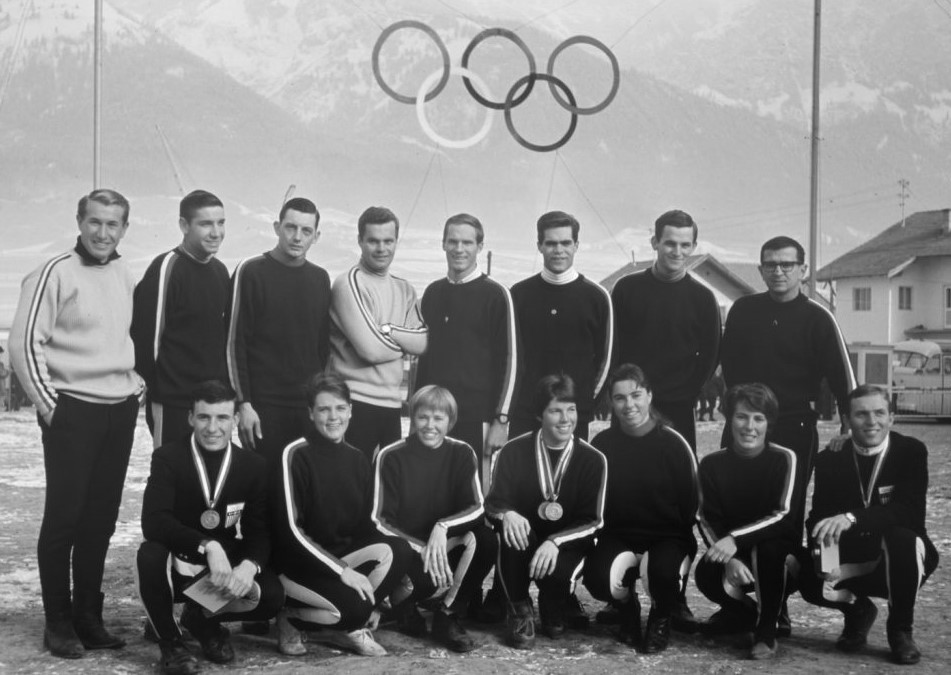
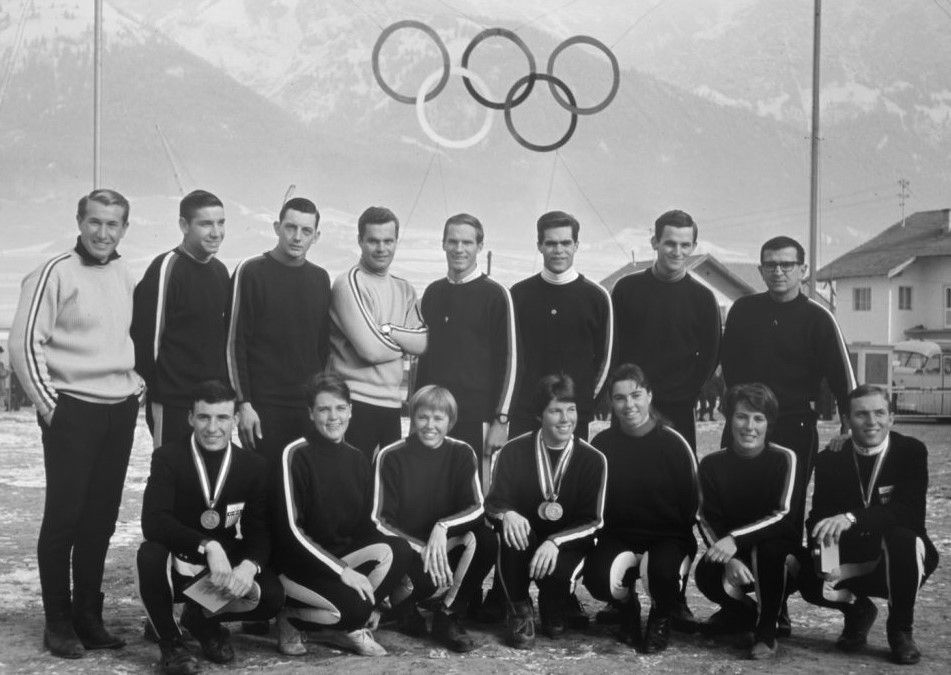
US Alpine Team, 1964: Standing, left to right: Bob Beattie, Ni Orsi, Chuck Ferries, Gordi Eaton, Buddy Werner, Rip McManus, Bill Marolt, Fred Casotti. Front row, Jimmie Heuga, Barbara Ferries, Margo Walters, Jean Saubert, Joan Hannah, Starr Walton, Billy Kidd. Photo: Marriott Library/Marv Melville collection.
Butting Heads with Beattie en route to the Olympic Dream
In Part I of this series (May-June 2023), Howard Head overcame setbacks and pursued his visionary metal ski design. By 1960, he had captured a large part of the recreational market, and metal skis were beginning to dominate downhill racing. Here, Head staff and U.S. racers recall a time of transition and historic achievement.
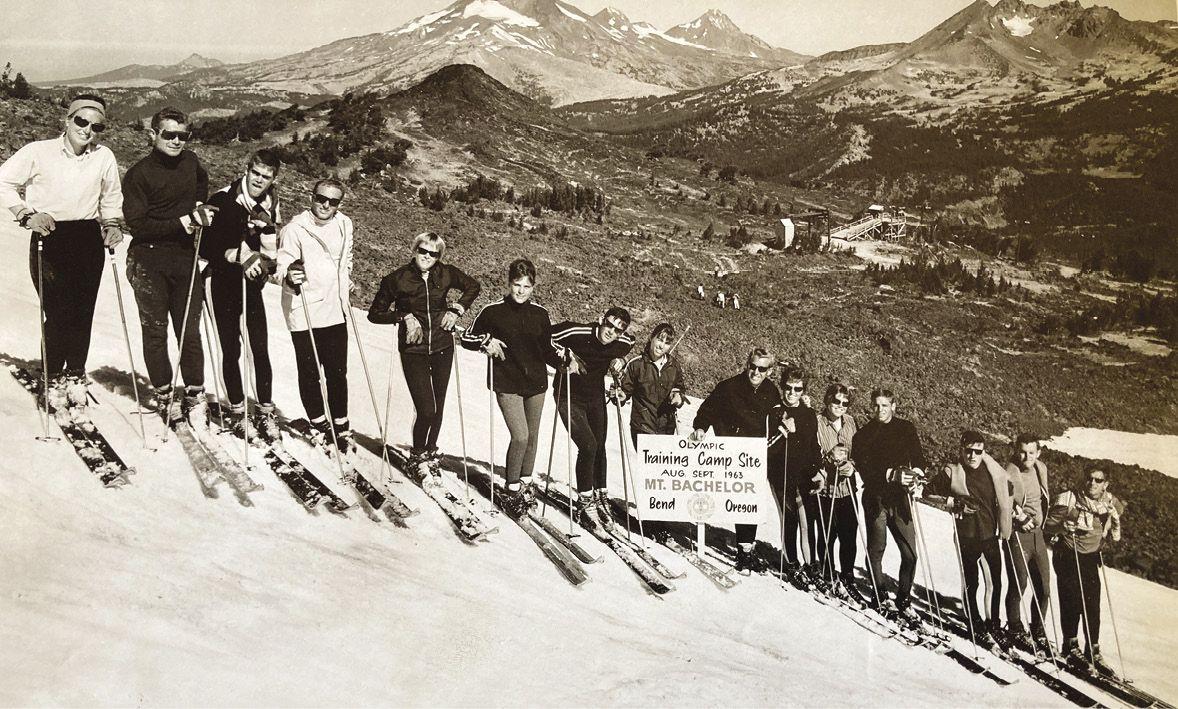
Photo top of page: At the Mt. Bachelor training camp, left to right: Starr Walton, Gordi Eaton, Rip McManus, Billy Kidd, Margo Walters (McDonald), Barbara Ferries (Henderson), Chuck Ferries, Joan Hannah, Bob Beattie, Linda Meyers (Tikalsky), Jean Saubert, Annibale “Ni” Orsi, Jimmie Heuga, Bill Marolt, Buddy Werner. Jim Hosmer photo.
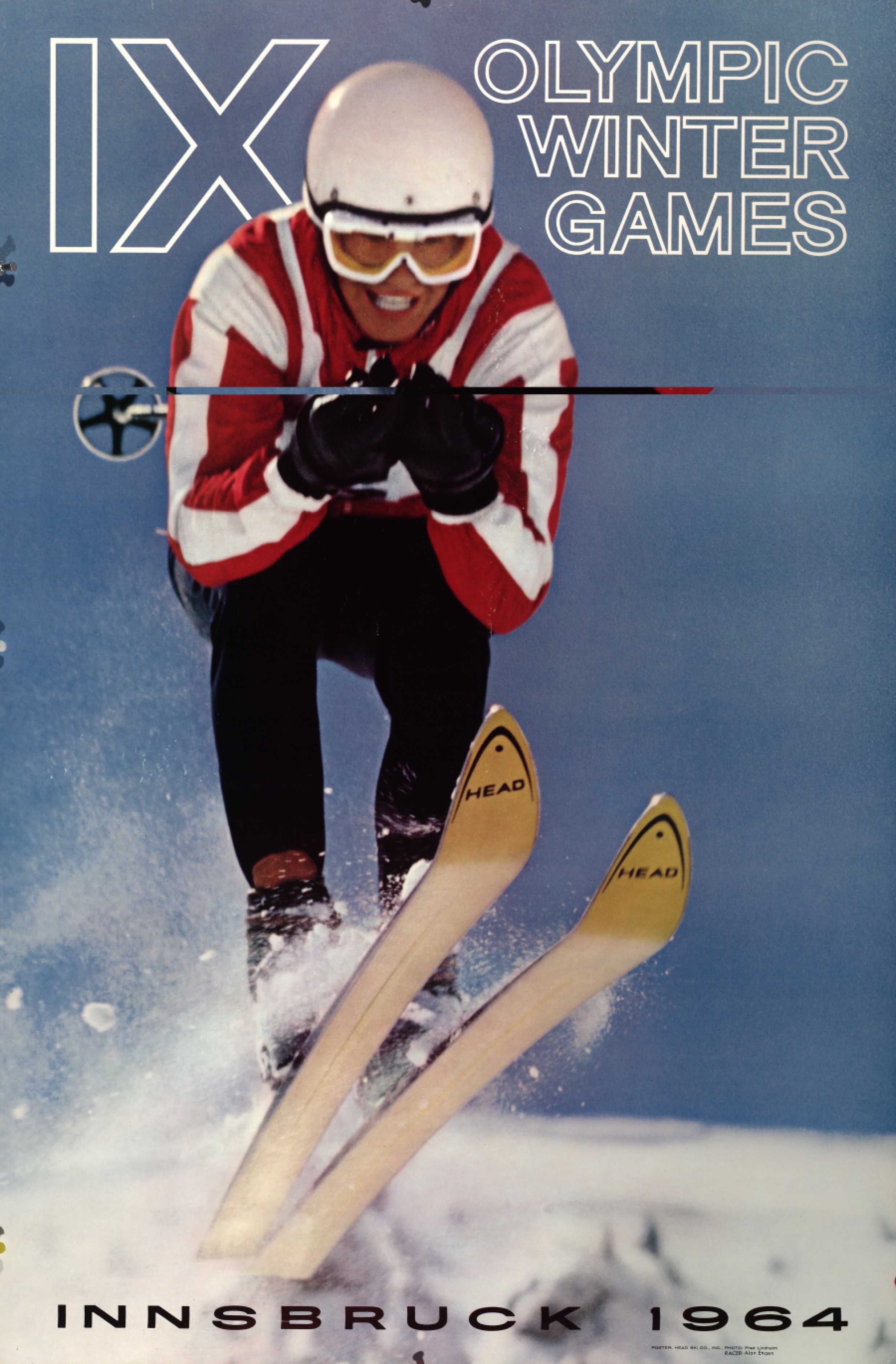
Head Skis launched the Competition model in late 1963. Fred Lindholm photo; skier Alan Engen.
Though American women had been top contenders in Olympic racing, the men had never medaled. In 1961, the National Ski Association picked University of Colorado coach Bob Beattie to renovate the national program. He was authoritative and ambitious, with a background in cross-country skiing and football coaching, but he was not stepping onto a level playing field.
According to U.S. racer Gordi Eaton, “At this time there was a strong emphasis on pro and amateur. We all knew that some European racers were taking money, but we had bought into the Olympic rules.” Tough situation for Beattie, the new strait-laced U.S. coach.
He responded to the challenge by creating a de facto national training center within his program at CU Boulder. He arranged athletic scholarships, access to facilities and support from local families.
Racer (and later coach and administrator) Bill Marolt recalls, “We were going to do it the American way. He had a vision for the program, and it was a game changer.” There were new advantages for the racers, but challenges, too.
For example, Beattie was fixated on physical fitness. As the leaves turned in Boulder, skiers ran the trails of Green Mountain, did the same type of agility drills as football players and hit the weight room.
Ni Orsi: Beats knew that strength was very important to winning.
Barbara Ferries: We did exactly what the boys did, except we were not allowed in the weight room. [Title IX was a decade away.]
Billy Kidd: Beattie knew how to get the most out of his athletes. And one of the things was you get in better shape than anybody else.
Bill Marolt: It was the Exhaustion Method.
1962 winter was a World Championships year. The skiers took incompletes in their classes and headed to Europe, planning to finish schoolwork in the spring. It was an adventure, especially for the women, who felt they were on their own without a coach (though their travel was managed by Fred Neuberger of Middlebury College). Nonetheless, they got good results.
Buddy Werner, winner of the 1959 Hahnenkamm downhill, was the team leader. He helped Chuck Ferries improve and win the 1962 Hahnenkamm slalom and grab second in the combined. Ferries also won the next slalom, at Cortina. His sister, Barbara, took bronze in the World Championship downhill at Chamonix, and Joan Hannah got bronze in giant slalom. Karl Schranz, of Austria, won the downhill and combined on fiberglass skis made by Kneissl.
Back at the Head factory in Timonium, Maryland, a new model was in the works. The Competition sported two layers of aluminum on top with a thin layer of neoprene rubber between them. This structure had a damping effect to reduce chatter. It was Howard Head’s ace-in-the-hole going into 1963.
Head Success in Europe
Jos Minsch at Harriman Cup.
Significant inroads were soon made to the Swiss national team with the help of Walter Haensli, a long-time Head confidant. Swiss skier Josef “Jos” Minsch, on Head skis, won the 1963 pre-Olympic downhill at Innsbruck, upsetting the powerful Austrians. As the European tour and big U.S. events wound down that spring, Werner, on Kästle wooden skis, and Jean Saubert, on Heads, were skiing well.
U.S. Nationals were held that spring at Mt. Aleyska, Alaska. Europeans Minsch, Barbi Henneberger and Willy Favre won some races, but their results did not count toward U.S. titles. Marolt won the downhill. Minsch was fastest in giant slalom but Werner, in second, got that title and also won the combined. Chuck Ferries won the slalom. Saubert took the women’s downhill and GS, Sandy Shellworth the slalom, and Starr Walton the combined. Most skied on wooden Kästle or Kneissl skis.
Jean Saubert at Harriman Cup.
The 1964 U.S. Alpine Olympic ski team was then named—eight men and six women. It was an eclectic group of talented skiers who had earned their spots with key results or were chosen by Beattie. Many excellent racers did not make the cut.
On August 25, 1963, the team met for its first training sessions at Mt. Bachelor, Oregon. The racers stayed at the rustic resort of Elk Lake. It was a fun and challenging situation, and team members had good feelings for each other but mixed feelings about coach Beattie.
Bill Marolt: We had cabins with wood stoves. In the morning, we’d have to build a fire to warm up.
Ni Orsi: We would take the lift up to near the top and then walk up farther to where we trained. No lift. We walked up, skied down and then walked up.
Billy Kidd: Buddy Werner was so gracious and generous, and would help the younger racers.
Barbara Ferries: Linda [Meyers] was the oldest and always the mother, trying to take care of everyone, especially me. Joanie [Hannah] just wanted to race. She had this work ethic—she tried really hard.
Gordi Eaton: Let me say this about Jean Saubert: great lady and a great competitor.
Kidd: Ni was a natural athlete, a champion water-skier. He could do anything and pick stuff up right away.
Starr Walton: Ni was terribly good looking. In Europe, he got in a little trouble because he wouldn’t quite make curfew or was out with girls.
Orsi: Beats was a great coach and tried his best to keep me under control. He even had me move in with him and his wife to make sure I was not destroying my Olympic hopes.
Kidd: I had to tape my ankle like a basketball player—couldn’t run a lot because my ankle would swell up or collapse. But he [Beattie] saw it as I was just not tough enough, not able to keep up, so he didn’t like me that much.
Ferries: There was a bit of tension between some of the girls and Beattie.
Joan Hannah: Beattie was trying to make us all ski the Dyna-Turn. It was his view of how Buddy skied. “Drive those knees!” Problem, he didn’t have the whole picture. We ended up slower.
Walton: Women need women coaches. He was a football coach, a boy’s coach.
Eaton: I loved the guy. It was time for someone to have this exceptional passion and dedication to U.S. skiing and U.S. ski racers year-round!
Marolt: It was a great situation for team building. Everybody jumped in and went as hard as they could go, which was fun.
A crew from Head set up a wax room in Skjersaa’s ski shop at the Mt. Bachelor base. Gordon Butterfield guided strategy and kept notes for the home office. Clay Freeman was a good skier and the racers liked him. The technical savant was Freddy Pieren. According to Head rep Tom Ettinger, “He knew more about how skis work than anyone in the country. Howard always listened to him!”
Kästle set up in an abandoned boat house, while other reps prowled by car from Bend. By the end of the first day, the Head shop had received visits from most of the team and many got filing and waxing help from Pieren and Freeman. Everyone had a common goal: win medals at Innsbruck.
On Tuesday, August 27, Pieren discussed flex patterns. Chuck Ferries opined that men and women need different skis. Tuning work continued. Beattie came by, made a cursory inspection, then left. He returned later to direct the Head team not to work on the racers’ skis; skiers should do it themselves. According to Butterfield’s notes: “Beattie has not been at all friendly. And it is difficult to evaluate if this is his total preoccupation with coaching or actual resentment.”
Reps Warned off Waxing
On Wednesday, Butterfield noted that everyone on the team was testing at least one pair of skis except Werner and Barbara Ferries. Butterfield met with Beattie. It became a dissertation by Beattie on his coaching philosophy, including that ski prep would be a coach/racer domain. The Head crew should not approach team members on the hill, and stay away during dryland training, indoor sessions and meals. Racers could come to the Head shop during their free time to work on their skis and consult with Head techs.
On August 30, Jimmy Heuga took out a pair of Head slalom skis. Werner, Chuck Ferries and Eaton—Kästle stalwarts—did not try the new Head slaloms. Beattie became more amicable.
On Sunday, September 1, Pieren had a chance encounter with assistant coaches Marv Melville and Don Henderson. Both enthusiastically endorsed Head products. Pieren quoted Henderson as saying, “By the time the team gets to Europe, we’ll have them all on Heads.” Butterfield noted in his report, “Relations are now excellent.” But not for everyone.
Walton met with Butterfield and confided she was having problems with Beattie. He advised that she do what he did and talk to the coach, get things out in the open. She was a free spirit, sure about what worked for her. Beattie was regimented, sure that his program was right for everyone. According to Walton, they never did settle their differences.
On September 3, Marolt, impressed by the International Professional Ski Racing Association racers using Heads the previous year, was on GS Comps. He said they were okay, but that he wasn’t skiing his best. Walton moved to a slightly longer slalom ski and reported them good. Her morale improved.
On September 4, Freeman drove Beattie to Bend for an appearance at a Rotary Club meeting. They thanked the locals for their support of the camp. Later that day Pieren and Beattie had a long conversation and needled each other a bit. The result was a more familiar relationship going forward.
Howard Head was inducted into the US Ski Hall of Fame in 1979.
On September 5, Howard Head arrived on the scene. He had breakfast with Bill Healy, president of Mt. Bachelor, and then went up to the training area. As the racers quit for the day, Head greeted each one personally.
Beattie was there and “had to be nothing but jovial,” Butterfield reported . Then, surprisingly, he invited Head to address the Olympic team at dinner. This was a clear breach of his own rules and a possible sign of advancement for Head.
On the morning of September 6, the Head team said its good-byes and departed Elk Lake. Butterfield tapped out the last few lines of his report near Reno, where they dropped Head at the airport. It was a hot afternoon in the eastern Sierra. “It doesn’t feel the least bit like winter…but our mind’s eyes see visions of victory ceremonies at Innsbruck and of medals going to athletes using products made in the USA.”
Ross Milne Killed
Just under five months later, at Innsbruck, Orsi was preparing for a training run in the downhill when there was a course delay. He was on 220-cm Head Comps with Marker bindings, having switched from Kneissl and Look. Around the start, racers were warming up amid bare ground and rocks. There was so little snow that the Austrian army had hauled the stuff in to build the course. Orsi recalls that it was “very rough, narrow with little or no snow on the edges.”
The delay was for Australian racer Ross Milne, who had encountered people stopped on the course during his run. He veered off into the snowless woods and hit a stump. He died on the way to the hospital. Eaton also had a bad fall in training, tearing a boot upper from the sole and suffering a concussion.
The downhill race, on January 30, followed the opening ceremony by just a day, and Orsi remembers, “I regret not being able to march. Beats had the downhillers stay in their rooms to get a good night’s sleep.” Beattie had picked Orsi, Kidd, Werner and Chuck Ferries to run what Kidd called the “ribbon of ice.” All four finished in the top 20, with Orsi and Kidd leading on Head Comps, in 14th and 16th places. Minsch, on Heads, was just six hundredths off the podium in fourth. Orsi believes the Americans missed the wax but doesn’t remember who was responsible. “Our wax was wrong and cost us dearly,” he says. Austrian Egon Zimmermann won by .74 seconds on metal Fischers.
Racers who did attend the opening ceremony were thrilled. Barbara Ferries recalls, “I was like, ‘Oh my God, look what’s happening.’ We got the uniforms, we marched in the parade. It was very exciting.” Walton says, “That’s pretty cool when you walk in representing your country like that.” She also had American-made Head skis. “I am representing the United States, and if they have a ski that’s worthy, if they’ve come along with a ski that’s good, hell, I’d ski on an American ski.”
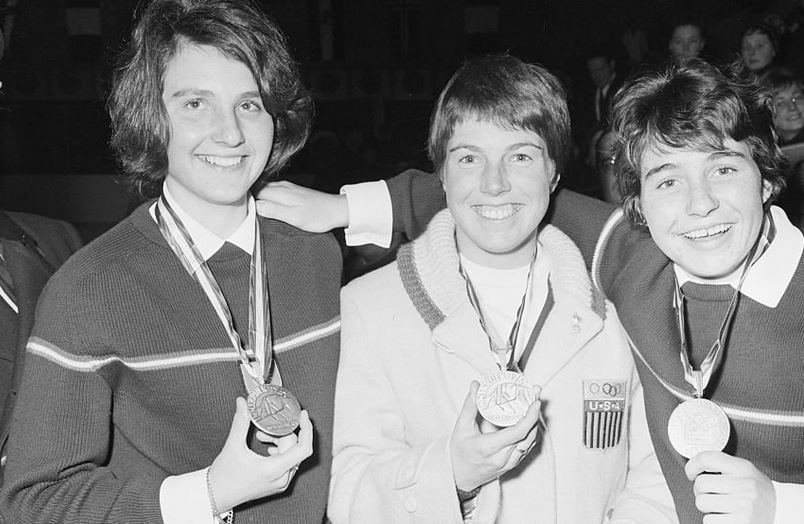
Christine Goitschel (left), Jean Saubert and Marielle Gotischel monopolized the slalom and GS medals at Innsbruck.
Walton led the American women in the downhill, placing 14th, with Hannah right behind her, Margo Walters placed 21st and Saubert 26th, all on Heads. Hannah was disappointed.
“Beattie missed the wax. There is nothing worse than feeling slow skis on the flat,” she says. “The wax should have been skied out. We finished in the order we skied on our skis. Jean Saubert carried her skis to the start and was the last of us.”
The men’s giant slalom was on a steep, icy pitch, but with a rhythmical set. Kidd placed seventh on Head Comps, and Marolt, from bib 28 and also on Heads, was 12th. Heuga and Werner, both on wooden Kästles, disqualified.
Medals for Saubert, Kidd, Heuga
In the women’s giant slalom, Saubert, on Heads, tied for second and secured America’s first skiing medal at Innsbruck—the French Goitschel sisters, in first and tied for second, used aluminum Rossignol Allais 60 skis. Barbara Ferries was 20th, also on Heads, and Hannah and Linda Meyers were 26th and 30th. Saubert scored again in the women’s slalom, taking the bronze on Head skis. Meyers was 12th and Hannah 19th. Ferries disqualified. The winner was Marielle Goitschel (on the new Dynamic-built RG5 fiberglass skis).
Billy Kidd en route to slalom silver.
The men’s slalom was the last Alpine event of the Games. Beattie entered Werner, Chuck Ferries, Kidd and Heuga, all on Kästle skis. In a very close race, Kidd and Heuga made history for American men by taking silver and bronze. Werner was eighth, and Ferries, characteristically pushing too hard, disqualified.
Jimmie Heuga took bronze.
All things considered, it was a fine Olympics for the U.S. team. Beattie’s new system essentially worked. The women continued to excel, and the men finally took home some hardware. And Head cracked into the ski racing market. The U.S. box score: two medals for Head and two for Kästle.
Ni Orsi: For the most part we competed against professionals and with such a disadvantage, I think we did extremely well.
Barbara Ferries: The most important thing Bob [Beattie] did for us was that he put us together as a team. We cheered for each other. It was a fabulous time.
Gordi Eaton: Friendships were made, and they still endure. Most of us feel very fortunate to have been involved during this time.
Ferries: The Head skis—that was a big deal for the American team to have those skis.
Starr Walton: I did the best I could do, and for me, at the end of the day, that’s my gold medal.
Howard Head continued to innovate in ski technology, but in 1969 he sold the company. He had raised his $6,000 opening bet into a $16 million jackpot. Ever the restless inventor, he eventually got into another sports racket and rallied a new company, called Prince.
For research help, the author thanks Richard Allen, Abby Blackburn, Christin Cooper, Chip Fisher, Mike Hundert, Leroy Kingland, Brian Linder, Marv Melville, Paul Ryan and all the quoted racers.
An oral-history interview with Peter Miller, SKI Magazine writer/photographer, by Rick Moulton.
Open to Public?
On
Full Access Article for Public
In 2019, long-distance runner and ski mountaineer Kilian Jornet—with the goal of just testing “how his body will perform”—completed 51 laps on Tusten ski area in Molde, Norway, in 24 hours. He climbed 78,274 feet, crushing previous 24-hour records by a ridiculous margin. To be clear, Molde is at sea level. Jornet climbed 1,535 feet, 51 times, on roughly a one-mile piste. That works out to skinning up at about 2.25 mph for 25 minutes and resting a couple of minutes during a 36-mph schuss. Fifty-one times.
Photo above: Kilian Jornet has been rewriting the record books for ski mountaineering and high-altitude running for more than a decade, sometimes merely as a result of his training regimen. Right: An early ski-endurance competition, the 24 Hours of Aspen attracted elite athletes, television audiences and sponsorship dollars in the 1980s-1990s. YouTube photo
That’s nothing for the Catalan Jornet, who grew up in Chamonix. For more than 15 years he’s been methodically assaulting the records for high-altitude marathons and ski mountaineering. In his recent five-year “Summits of My Life” project, he set the fastest known times (or FKT) for the ascent and ski descent of major mountains including Kilimanjaro, Denali, Aconcagua, the Matterhorn and Mont Blanc, at times shaving hours off previous records. Some of his records have since been broken by Ecuadorian mountain guide Karl Egloff.
Climbing and skiing massive verticals has become a passion with today’s endurance athletes, who are repeatedly blowing by many of the world's best times. Which begs the question, when did vertical-feet-skied become a thing?
Before smart watches and phone apps made vertical-feet scorekeeping easy, it was possible to estimate your numbers from the number of runs completed. Heliski operators charged by the vertical foot, and kept accurate count. You could keep track of your bragging rights whether for 24 hours, a week, a season or a lifetime. Heliski operations certified guest accomplishments with pins and special million-foot prizes, like Mike Wiegele’s silver belt buckles and limited-edition powder suits at Canadian Mountain Holidays.
One of the first vertical-foot-based competitions was the late 24 Hours of Aspen. After 13 events in 16 years, declining television ratings scuttled the show in 2003. But it left behind a slew of records. Chris Kent of Canada did 83 laps for 271,161 feet for the men’s mark in 1991. That’s 216 miles of skiing at an average 66 mph. Kate McBride and Anda Rojs set the women’s vertical record of 261,360 feet in 1997.
Once the genie was out of the bottle, lift- and rotor-assisted records started to topple. In 1994, Canadian speed skier and Chamonix resident Mark Jones logged 212,000 vertical feet in just 12 hours at Les Grands Montets. Next, Dr. Mark Bennett racked up 294,380 feet in 14 hours in the Yukon in 1997 for a new “daylight” world record. Fourteen months later, former U.S. Ski Team racer Rusty Squires chartered a specialized high-altitude helicopter and recorded 331,160 vertical feet in 10 hours and 15 minutes at Big Sky, Montana.
In the meantime, the guides at Wiegele’s were determined to set a record based on the normal constraints of commercial heli-skiing, with a full group of skiers and a single machine. In 1998, Swiss extreme skier Dominique Perret, Chris Kent and Austrian guide Robert Reindl, with Edi Podivinsky and Luke Sauder of the Canadian Alpine Team, logged 353,600 vertical feet in 14½ hours.
Austrian Ekkehard Dörschlag owns the
24-hour record for vertical climbed.
By this point recognition was growing that assisted vertical-foot records were as much about money as skill and endurance. As ski mountaineering boomed (it’ll be a full medal event at the 2026 Milan Cortina Olympics) interest focused on self-powered athletes. In 2009, Austrian Eckhard Dorschlag set a 24-hour world record of 60,350 feet. Ultra-marathoner Mike Foote broke that in 2018 with 68,697 feet. A few months later Norwegian Lars Erik Eriksen took it to 68,697 feet. Then Jornet obliterated that.
Born in 1987, Jornet has captured more Skyrunner World Series and Skimo (ski mountaineering) World Championship medals than we have room to list. He still holds the mark for the Innominata ski traverse on Mont Blanc linking Chamonix and Courmayeur (8 hours 42 minutes), as well as the fastest ascent/descent of Mont Blanc from Chamonix (4:57) and of the Matterhorn from Breuil-Cervinia (2:52).
As for why all the fuss over vertical speed records advancing every season, Nick Heil, writing in Outside, quoted Foote: “How many push-ups can I do in a minute? How long can I hold my breath? How far can I ski in a day? In the end, it’s all arbitrary and contrived, but it gets people to ask, what am I capable of?”
Snapshots in Time
1958 Be Careful What You Wish For
A penetrating statistical study of the ski industry in Colorado and New Mexico has been published by the University of Colorado. Pointing out that a great many more tourists visit Colorado and New Mexico in June, July and August than in the other months of the year, the authors ask if it is not possible to develop the winter tourist industry so that tourist facilities can be used all year. — “Skiers Under Scrutiny in Colorado and New Mexico” (SKI Magazine, October 1958)
1970 The Continuing Death of the Ski Bum
Once upon a time, the ski bum was the ultimate ski insider. As neither an entrenched member of the ski-area management nor a local profiteer, he enjoyed a free-swinging life with lots of time to ski and unlimited access to the inner circles of the ski establishment. It is, therefore, ironic that as the need for ski workers grows, the reputation of the ski bum diminishes. Ski bums, industry management will tell you, are bad news; the title is now synonymous with “hippie.” Many employers won’t consider hiring ski bums, even for temporary jobs. As a result, there are fewer of the old-time ski-bum types than ever before. — Janet Nelson, “But They’re Employed” (SKI Magazine, January 1970)
1978 Risk v. Reward
I have been skiing o.b. for many years. Skiing out of bounds is extremely dangerous. Inevitably some crazy powder addicts (myself included) will continue to leave the “safe” confines of patrolled areas. After reading Lou Dawson’s account and subtle hints (“... how far can you crawl with a spinal fracture?”), I realized certain steps must be taken to ensure the safety or at least the survival of o.b. skiers. Education is what is needed on this topic. — Steven Harrison, Central Valley, New York, “Whistling in the Dark" (Letters, Powder Magazine, Spring 1978)
1981 Crowds and Crashes
The rapidly increasing skiing population has led to an alarming increase in inconsiderate and out-of-control skiers who are a serious menace. Last season, an out-of-control skier crashed into me. He never so much as asked if I needed help. I’ll have a scar I’ll carry for the rest of my life. For too long ski areas have allowed Bonzai Bombers to endanger others on the slope without adequate punishment. It’s time something was done to protect the rest of us from these slope-side criminals. —Thomas F. Warda, Rochester, N.Y., "Slope menaces" (Letters, Skiing Magazine, October 1981)
2007 Bode Rules
Call them the Bode Rules. This year every athlete on the U.S. Ski Team is required to stay in official team housing. Every racer on the team is also prohibited from having a celebratory drink with the coaches after a big win, because it’s a slippery slope from that to, say, being photographed carousing with Miss March 2002 draped on your arm during the Olympics. U.S. Ski Team chief Bill Marolt implemented the stricter guidelines after the strongest American squad in decades limped away from the 2006 Torino Games with only two medals—neither of them won by the phenomenally gifted Bode Miller. —Nathaniel Vinton, “Ski Fast but Party Slow”(SKI Magazine, February 2007)
2021 A Woman’s Place Is On Patrol
“When there are women on a team like this, it lends an important voice and perspective to the job. I can say that having women on patrol keeps everyone connected. Men muscle their way through the job and women do it with finesse,” said Addy McCord, 64, one of the longest-standing professional patrollers in the industry. — Shauna Farnell, “A Surge of Women in Ski Patrols, Once Nearly All Men” (New York Times, February 11, 2021)
Feature Image Media
Image
Article Date
Timestamp
In 2019, long-distance runner and ski mountaineer Kilian Jornet—with the goal of just testing “how his body will perform”—completed 51 laps on Tusten ski area in Molde, Norway, in 24 hours. He climbed 78,274 feet, crushing previous 24-hour records by a ridiculous margin. To be clear, Molde is at sea level. Jornet climbed 1,535 feet, 51 times, on roughly a one-mile piste. That works out to skinning up at about 2.25 mph for 25 minutes and resting a couple of minutes during a 36-mph schuss. Fifty-one times.
Photo above: Kilian Jornet has been rewriting the record books for ski mountaineering and high-altitude running for more than a decade, sometimes merely as a result of his training regimen. Right: An early ski-endurance competition, the 24 Hours of Aspen attracted elite athletes, television audiences and sponsorship dollars in the 1980s-1990s. YouTube photo
That’s nothing for the Catalan Jornet, who grew up in Chamonix. For more than 15 years he’s been methodically assaulting the records for high-altitude marathons and ski mountaineering. In his recent five-year “Summits of My Life” project, he set the fastest known times (or FKT) for the ascent and ski descent of major mountains including Kilimanjaro, Denali, Aconcagua, the Matterhorn and Mont Blanc, at times shaving hours off previous records. Some of his records have since been broken by Ecuadorian mountain guide Karl Egloff.
Climbing and skiing massive verticals has become a passion with today’s endurance athletes, who are repeatedly blowing by many of the world's best times. Which begs the question, when did vertical-feet-skied become a thing?
Before smart watches and phone apps made vertical-feet scorekeeping easy, it was possible to estimate your numbers from the number of runs completed. Heliski operators charged by the vertical foot, and kept accurate count. You could keep track of your bragging rights whether for 24 hours, a week, a season or a lifetime. Heliski operations certified guest accomplishments with pins and special million-foot prizes, like Mike Wiegele’s silver belt buckles and limited-edition powder suits at Canadian Mountain Holidays.
One of the first vertical-foot-based competitions was the late 24 Hours of Aspen. After 13 events in 16 years, declining television ratings scuttled the show in 2003. But it left behind a slew of records. Chris Kent of Canada did 83 laps for 271,161 feet for the men’s mark in 1991. That’s 216 miles of skiing at an average 66 mph. Kate McBride and Anda Rojs set the women’s vertical record of 261,360 feet in 1997.
Once the genie was out of the bottle, lift- and rotor-assisted records started to topple. In 1994, Canadian speed skier and Chamonix resident Mark Jones logged 212,000 vertical feet in just 12 hours at Les Grands Montets. Next, Dr. Mark Bennett racked up 294,380 feet in 14 hours in the Yukon in 1997 for a new “daylight” world record. Fourteen months later, former U.S. Ski Team racer Rusty Squires chartered a specialized high-altitude helicopter and recorded 331,160 vertical feet in 10 hours and 15 minutes at Big Sky, Montana.
In the meantime, the guides at Wiegele’s were determined to set a record based on the normal constraints of commercial heli-skiing, with a full group of skiers and a single machine. In 1998, Swiss extreme skier Dominique Perret, Chris Kent and Austrian guide Robert Reindl, with Edi Podivinsky and Luke Sauder of the Canadian Alpine Team, logged 353,600 vertical feet in 14½ hours.
Austrian Ekkehard Dörschlag owns the
24-hour record for vertical climbed.
By this point recognition was growing that assisted vertical-foot records were as much about money as skill and endurance. As ski mountaineering boomed (it’ll be a full medal event at the 2026 Milan Cortina Olympics) interest focused on self-powered athletes. In 2009, Austrian Eckhard Dorschlag set a 24-hour world record of 60,350 feet. Ultra-marathoner Mike Foote broke that in 2018 with 68,697 feet. A few months later Norwegian Lars Erik Eriksen took it to 68,697 feet. Then Jornet obliterated that.
Born in 1987, Jornet has captured more Skyrunner World Series and Skimo (ski mountaineering) World Championship medals than we have room to list. He still holds the mark for the Innominata ski traverse on Mont Blanc linking Chamonix and Courmayeur (8 hours 42 minutes), as well as the fastest ascent/descent of Mont Blanc from Chamonix (4:57) and of the Matterhorn from Breuil-Cervinia (2:52).
As for why all the fuss over vertical speed records advancing every season, Nick Heil, writing in Outside, quoted Foote: “How many push-ups can I do in a minute? How long can I hold my breath? How far can I ski in a day? In the end, it’s all arbitrary and contrived, but it gets people to ask, what am I capable of?”
Snapshots in Time
1958 Be Careful What You Wish For
A penetrating statistical study of the ski industry in Colorado and New Mexico has been published by the University of Colorado. Pointing out that a great many more tourists visit Colorado and New Mexico in June, July and August than in the other months of the year, the authors ask if it is not possible to develop the winter tourist industry so that tourist facilities can be used all year. — “Skiers Under Scrutiny in Colorado and New Mexico” (SKI Magazine, October 1958)
1970 The Continuing Death of the Ski Bum
Once upon a time, the ski bum was the ultimate ski insider. As neither an entrenched member of the ski-area management nor a local profiteer, he enjoyed a free-swinging life with lots of time to ski and unlimited access to the inner circles of the ski establishment. It is, therefore, ironic that as the need for ski workers grows, the reputation of the ski bum diminishes. Ski bums, industry management will tell you, are bad news; the title is now synonymous with “hippie.” Many employers won’t consider hiring ski bums, even for temporary jobs. As a result, there are fewer of the old-time ski-bum types than ever before. — Janet Nelson, “But They’re Employed” (SKI Magazine, January 1970)
1978 Risk v. Reward
I have been skiing o.b. for many years. Skiing out of bounds is extremely dangerous. Inevitably some crazy powder addicts (myself included) will continue to leave the “safe” confines of patrolled areas. After reading Lou Dawson’s account and subtle hints (“... how far can you crawl with a spinal fracture?”), I realized certain steps must be taken to ensure the safety or at least the survival of o.b. skiers. Education is what is needed on this topic. — Steven Harrison, Central Valley, New York, “Whistling in the Dark" (Letters, Powder Magazine, Spring 1978)
1981 Crowds and Crashes
The rapidly increasing skiing population has led to an alarming increase in inconsiderate and out-of-control skiers who are a serious menace. Last season, an out-of-control skier crashed into me. He never so much as asked if I needed help. I’ll have a scar I’ll carry for the rest of my life. For too long ski areas have allowed Bonzai Bombers to endanger others on the slope without adequate punishment. It’s time something was done to protect the rest of us from these slope-side criminals. —Thomas F. Warda, Rochester, N.Y., "Slope menaces" (Letters, Skiing Magazine, October 1981)
2007 Bode Rules
Call them the Bode Rules. This year every athlete on the U.S. Ski Team is required to stay in official team housing. Every racer on the team is also prohibited from having a celebratory drink with the coaches after a big win, because it’s a slippery slope from that to, say, being photographed carousing with Miss March 2002 draped on your arm during the Olympics. U.S. Ski Team chief Bill Marolt implemented the stricter guidelines after the strongest American squad in decades limped away from the 2006 Torino Games with only two medals—neither of them won by the phenomenally gifted Bode Miller. —Nathaniel Vinton, “Ski Fast but Party Slow”(SKI Magazine, February 2007)
2021 A Woman’s Place Is On Patrol
“When there are women on a team like this, it lends an important voice and perspective to the job. I can say that having women on patrol keeps everyone connected. Men muscle their way through the job and women do it with finesse,” said Addy McCord, 64, one of the longest-standing professional patrollers in the industry. — Shauna Farnell, “A Surge of Women in Ski Patrols, Once Nearly All Men” (New York Times, February 11, 2021)
Did a foggy slalom course on a French mountainside tarnish the coronation of skiing’s king?
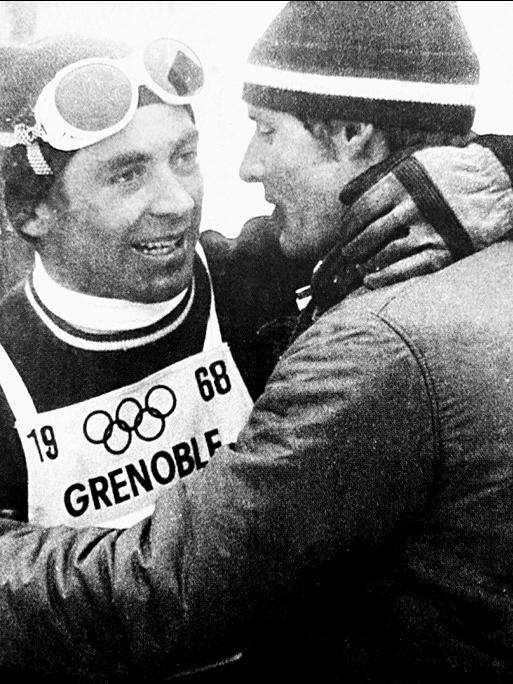
If history follows form at this month’s Olympic games, a controversy is sure to erupt, whether it’s whispers of non-regulation skis or a suddenly strapping racer using pills to pump up. But nothing is likely to eclipse the dispute at the Winter Olympics 38 years ago, which fueled newspaper headlines around the world. Was a race jury right to have disqualified Karl Schranz—Austria’s greatest racer of the era—in the slalom, allowing France’s Jean-Claude Killy to win his third gold medal, instantly turning the handsome Frenchman into a skiing legend?
Photo top: Jean-Claude Killy congratulates Karl Schranz on winning the 1968 Olympic slalom. The race jury later disqualified Schranz’s second run, giving the gold to Killy. To this day, Schranz contends he won. Courtesy SKI Magazine.
The previous winter, Killy had dominated the new World Cup circuit, winning an astounding 12 of 17 races, making him the heavy favorite at the 1968 Grenoble Games. He won gold in the first two races—the downhill and the giant slalom—leading up to the historic slalom competition.
On race day, thick fog enshrouded the course, occasionally lifting to allow a lucky racer to see ahead. Many officials thought the two-run race should be canceled. But the closing ceremony, with its television coverage, was set for the next day.
In the first run, Killy recorded the fastest time, but Schranz was less than six-tenths of a second back, setting the stage for the final run. Killy started first.
“At gates 17 to 20, the fog was tremendous, Killy told me a few years ago. “I slowed almost to a walk. Schranz didn’t even finish. He stopped below gates 19 and 20, claiming that an official had crossed his path. He demanded another run. In his retry, Schranz recorded a combined time a half-second faster than Killy’s, but race officials quickly disqualified the second run. The Austrians protested.
As the crowd awaited the race jury’s decision, Schranz proclaimed himself the victor. Killy, meanwhile, sat with friends, trainers and reporters, drinking champagne to celebrate his two gold medals. After several hours, the jury ruled: Schranz was disqualified. France’s new hero had completed his gold-medal hat trick after all.
Schranz’s reaction was immediate. “If Killy were sportsmanlike, he would refuse the gold medal, he declared. The Austrian would never compete in another Olympics. Now a St. Anton innkeeper, he continues to believe he was robbed in the fog on French snow.
Excerpted from the February 2006 issue of SKI. John Fry (1930-2020) was editorial director of SKI and Snow Country magazines and longtime president, then chairman, of ISHA. He authored the award-winning book The Story of Modern Skiing. His final book, published posthumously, is Abandon Foolish Scheme: Deathly encounters that you won’t find in bestsellers about dying.