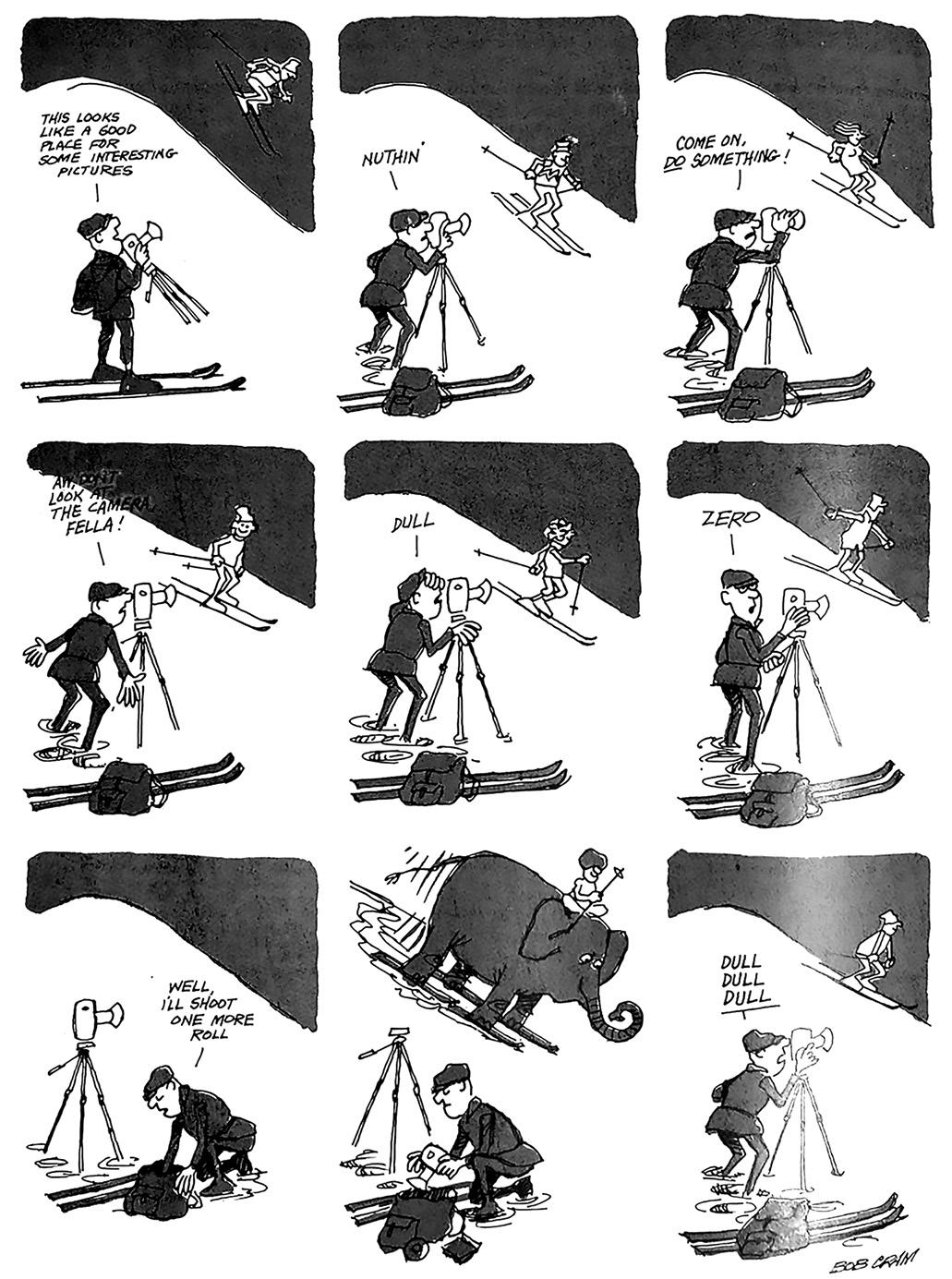
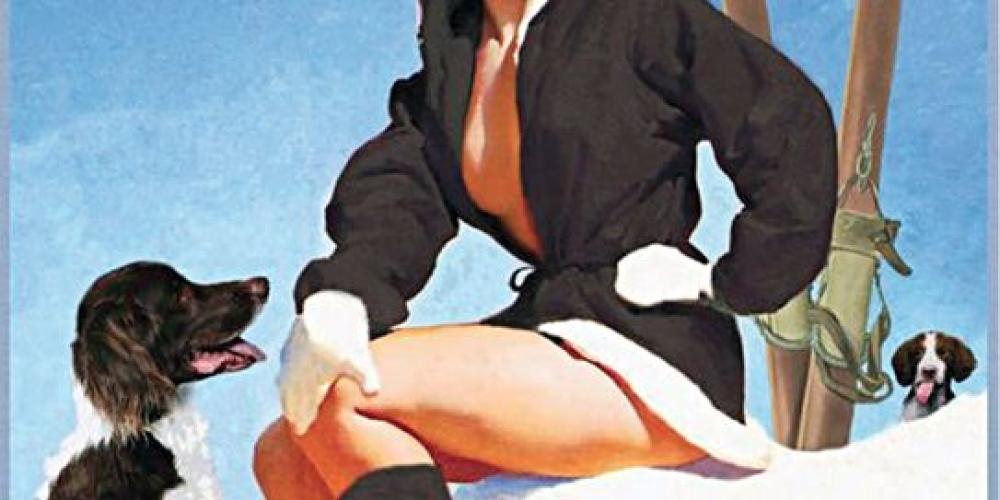
Blue sky, green trees, white snow, happy skier. Every ski photographer risks producing cliché images.
Paul Ryan understands. “In today’s world, we are saturated with photographs in the media and online. Sometimes when I go out to shoot, these images pop up and scream at me ‘Someone’s done that! I’ve seen that!’” he says.
Ryan, 83, offers this wisdom gleaned from six decades behind a lens: “Be open for something odd and new, not necessarily strange, but a different vision of the familiar. Perhaps a juxtaposition of disparate elements in the same frame. Wash from your mind all the classic images that linger from the past. Images by others you’ve seen and loved, even images that you see right away—the obvious.”
To that end, when shooting, he strives for “an empty mind, or at least a clean vision,” a reference to the 1970 book Zen Mind, Beginner’s Mind, which he found inspiring early in his career.
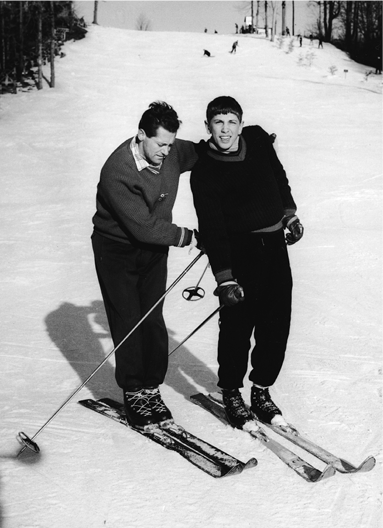
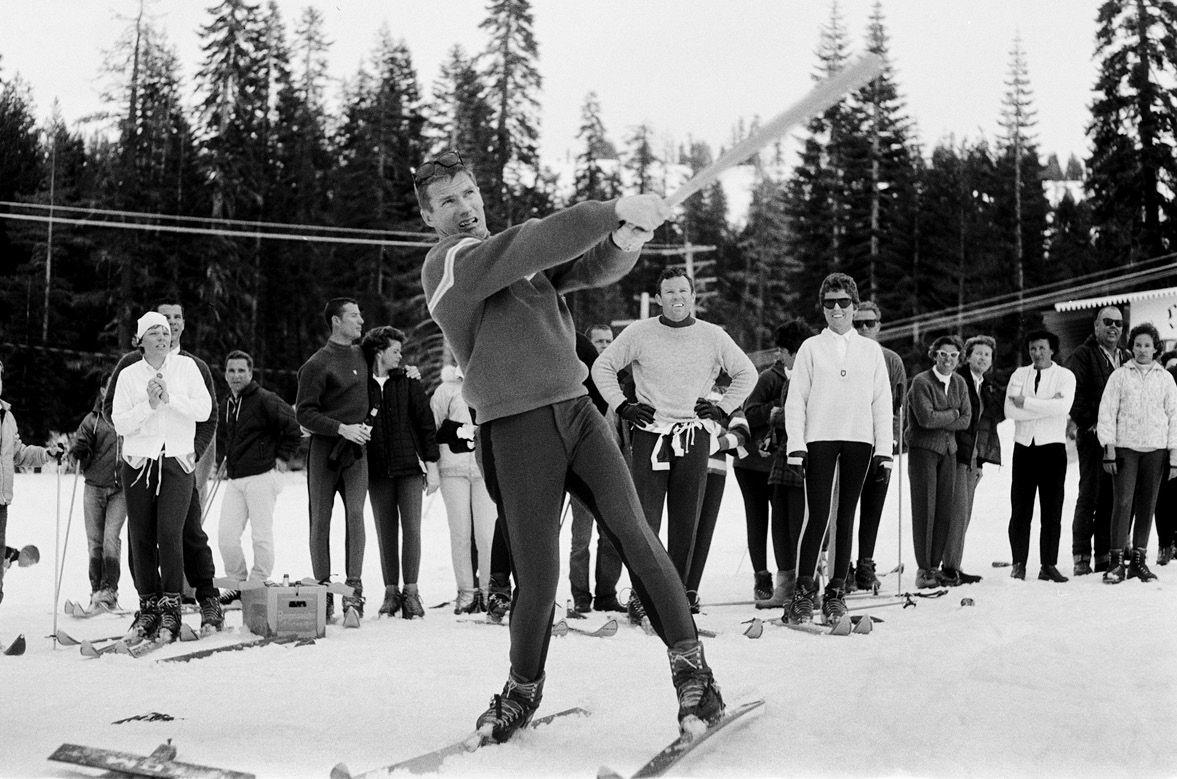
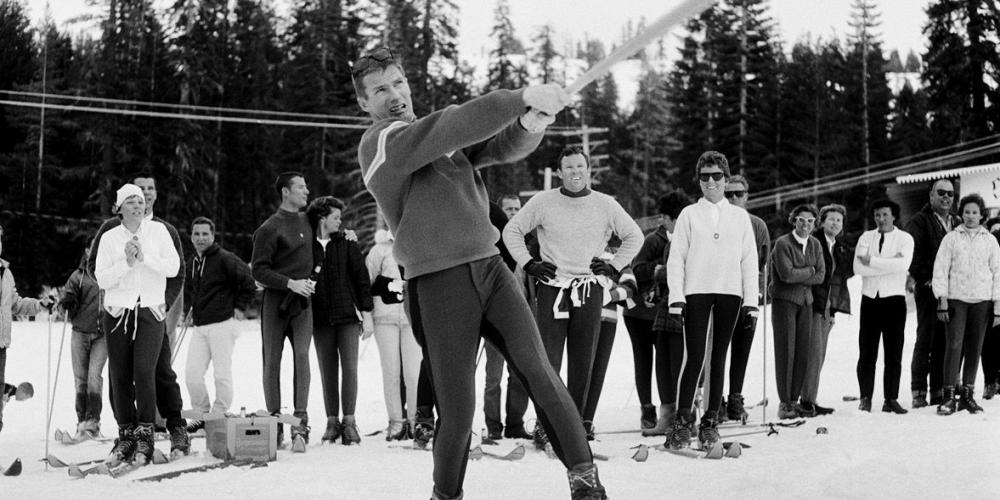
Photo top of page: Ryan started his career as the staff photographer at California’s Sugar Bowl resort. The Silver Belt, the final big race of the season, was held in the late spring. Part of the post-race festivities was a softball game on skis between the racers. “The European racers, unfamiliar with baseball, found the game amusing,” Ryan says. Buddy Werner, a natural athlete and a born competitor, took the softball game—and winning it—seriously. Those are American Olympians Tom Corcoran and Linda Meyers watching the action.
Ryan grew up in Boston and, after taking a BS in engineering, moved to Stowe to pursue what he imagined could be a career in ski racing. An Eastern snow drought in 1960-61 led him to Aspen, and for a few years he spent winters racing and summers in San Francisco, going to film school. He eventually found himself at Sugar Bowl Resort in California for the final race of the season, where general manager Ed Siegel candidly told him that his future wasn’t in ski racing, and hired him as resort photographer.
It was a good fit. John Fry eventually hired Ryan as the staff photographer at SKI magazine for several years. He traveled the world shooting for SKI and other periodicals.
But his professional pursuits expanded beyond skiing. He chronicled the 1960s counterculture in San Francisco. He studied under the greats of the time, including Minor White and Ansel Adams. His photography has been honored in numerous shows, with recent exhibits including “The Sea Ranch, Architecture, Environment, and Idealism” at the San Francisco Museum of Modern Art.
Ryan has easily pivoted between photography and cinematography. His cinema credits include Robert Redford’s “A River Runs Through It” and “The Horse Whisperer.” His documentary work includes “Gimme Shelter,” “Salvador Dali,” and recently a film on George Soros.
He has always found his way back to the mountains. Here are some of his favorite images from a different era. “When on the side of the mountain, I had to pre-visualize the end result, not seeing the film until days later,” Ryan says from his home in Santa Monica, California.
Ryan said that White, one of his early mentors, introduced him to the idea that a compelling photograph is more than a static image—it has an afterlife, of sorts.
“White spoke of ‘Equivalents,’ which is a photographic concept that the photograph mirrors something in ourselves—something that remains in mind after the literal image has faded,” Ryan explains.
To reach that end, Ryan says, the strongest images touch upon a commonality, something universal across the human experience. These images draw the viewer into the frame and into a broader narrative. “The most powerful photos evoke something beyond what was literally in front of the lens. This may come from the implication of what happened just before or of what might happen a moment after,” he says. “What remains is not only the image of the time and place, but a visual residue connected to a broader spectrum of our own experience.”
Of course, in order to achieve White’s concept of “Equivalents,” the photographer does have to first nail the shot. These days, with everyone shooting an endless stream of digital photos at the press of a button, that’s an achievement that’s often underappreciated.
Not by Ryan. “To achieve a high level of visual acuity is demanding,” he notes, “particularly while simultaneously navigating deep powder, an icy mogul field, high speeds or the intensity of race day—all with an array of cameras in check.”
This is the second installment of a two-part photo essay series from Paul Ryan. (See part 1 in the September/October issue.) View this photo essay as a mini-master class in photography, as Ryan explains his approach to his craft and the intriguing backstories to each image. Find more of Ryan’s work at paulryanphotography.com.
Ryan first got to know Billy Kidd during the 1960 season at Stowe. “He was always friendly and curious about photography and actually filmed some of the Megève downhill for me when I was making the Lange film, Ski Racer. This photo was taken at Kidd’s home in Stowe circa 1967. The wall was lined with trophies and his bibs from the 1964 Innsbruck Olympics, where Kidd and Jimmie Heuga became the first American men to win alpine medals. “Ever since 1966, Billy was plagued with recurring ankle injuries,” Ryan recalls. “It was interesting to see a young admirer realizing that even a hero is vulnerable.” Ryan was fascinated throughout his career with catching athletes away from the competition, believing that these moments can tell a story as revealing as the athletic action itself.
One of the many challenges of nailing a great image is “photographing people up close in difficult situations,” Ryan says. Fortunately, Ryan had spent a lot of time with the Canadian team and earned its trust, such as after a nasty downhill tumble by racer Andrée Crepeau, who recalls the crash. “It was on the flats at the bottom of the downhill in Stowe, where I learned that catching an edge is not always reversible. And down I went, face first—real quick.” The resulting image captures both the physical toll of the crash and the indominable spirit of the Canadian’s women’s team. “In photographing emotional situations, it’s always better to be physically close to the people rather than standing farther back with a telephoto lens,” Ryan says.
Great photography is at the intersection of art and science, according to Ryan. Getting the technical aspects right, such as the light, focus and framing, is key. But some of it is just heading into the field and hoping for the best. “Shooting ski action at slower than normal shutter speeds, here 1/8 second, is photographing without the luxury of certainty,” Ryan says. “After a while you get better at anticipating the results, but it’s still guesswork.” Here, at Stowe, the “obscuration of the subject promotes an awareness of the overall graphics in the frame.” Ryan also liked the flame-like gate banner flickering above the racer’s head.
Contrasts help bring a viewer into the frame, seeking out details of the surprising image. “In this case it was the ominous dark tree in the white landscape that attracted me,” Ryan says. “I waited for a bit, assuming a skier would come into the frame. He did and that completed the image.”
In 1970, Ryan made a documentary film on Austrian ski champion Karl Schranz. He filmed for several weeks on the World Cup circuit. “But I was curious to film Karl’s off-season life in his hometown of St. Anton,” Ryan says. He traveled to St. Anton in the summer, after the race season, and talked to locals who knew Schranz since his boyhood. “Karl brought us to meet his mother, who lived in the same small house she had for the last fifty years,” Ryan recalls. “As a widow, she had raised five children.” With photos and medals decorating this modest shrine to her son, Ryan likes the image because it tells as much about Schranz and his upbringing as it does about his mother.
Mammoth was one of the first destinations on Ryan’s unofficial resort itinerary when he headed West as a young racer in the 1960s. “I spent a lot of time there, both skiing and photographing the Mammoth racing program.” The racing operation was a top-notch group, whose roster frequently included members of Mammoth founder Dave McCoy’s family. At the end of a training day, racer Kandi McCoy chats with Dennis Agee, a junior coach at the time, who went on to become the Alpine Director of the U.S. Ski Team. “I liked her shy reaction to a coach’s compliment,” Ryan says.
In 1968, John Fry “had the idea to send me to do a photo story on skiing in the flatlands of the Midwest” for SKI. Ryan ended up at Boyne Mountain, Michigan, with its modest vertical of 500 feet. “For Othmar Schneider, a past Olympic champion and previously at Stowe where I knew him, it must have been confining,” Ryan says. “This image had a feeling of him reaching for something greater—or at least higher.”
John Fry and Mort Lund assigned Ryan to do a photo essay for SKI specifically on the experience of the downhill discipline. “This is the only event where there is a day or more to prepare, inspecting the course and taking a practice run,” Ryan says. “But there is never the sense of totally understanding what it will be like on race day.” At the end of the day prior to the race, there’s one last inspection down the course. Ryan strived to capture the intense preparation and anticipation in this early evening shot of a solitary racer looking down the course. Ryan: “I often find it rewarding to hang around for that extra hour at the end of the day, after the main action has ended. The light is dramatic and interesting things sometimes happen.”
All photographers have favorite assignments. This was one of Ryan’s. “One of my first and most gratifying assignments at SKI was a photo essay on Nancy Greene on the 1967 race circuit. I followed her travels for three weeks, on and off the course,” Ryan says. As well as being a superb racing talent, Ryan learned that Greene was a good friend and dedicated mentor to her teammates. Greene also didn’t let any aspect of her gear go uninspected. “Like many racers of the era, she personally paid exacting attention to the details of her skis,” Ryan says.
For Ryan’s 1969 photo essay, “The Steepness of Stowe” for SKI, he began experimenting with colored gel filters on the lens. “I liked the creative effect and usually made a few photographs this way on most other assignments,” Ryan notes, such as here as part of a story on Roger Staub at Vail (see right). With the analog film of the time, there was no way to know how the gels were working until the film was processed days later.
Digital photography now provides instant feedback (see above). “In contrast, a couple of years ago at the World Cup finals at Aspen I was fascinated with the maze of blue lines left by the multiple course markings. Shooting digitally, I could see the image right away and later, in Photoshop, I was able to exaggerate my impression of the intensity of the blue dye,” Ryan says. “Photography now has evolved to allow for, and even expect, imagery beyond simple representation of reality.”
Beat writers are often accused of writing stories for the audience of other beat writers, bringing nuances into play that can only be picked up on by other pros. The same goes for photographers. Ryan was attracted to the action in this shot for a SKI assignment. The racer is in sharp focus at the 1968 Grenoble Winter Games, with other elements blurred. However, “I liked the patrol sled waiting in the background behind the fencing,” Ryan says. “It quietly portrayed a sense of risk and danger.”
Ryan competed in the Roch Cup slalom in 1962, which became a hinge point in his career. “This was the last of my efforts at ski racing,” Ryan says. “I was decent, but when I was up against world-class racers, I realized I should spend more time at photography.” And for that decision in 1962, skiing’s visual legacy is, indeed, a bit richer.
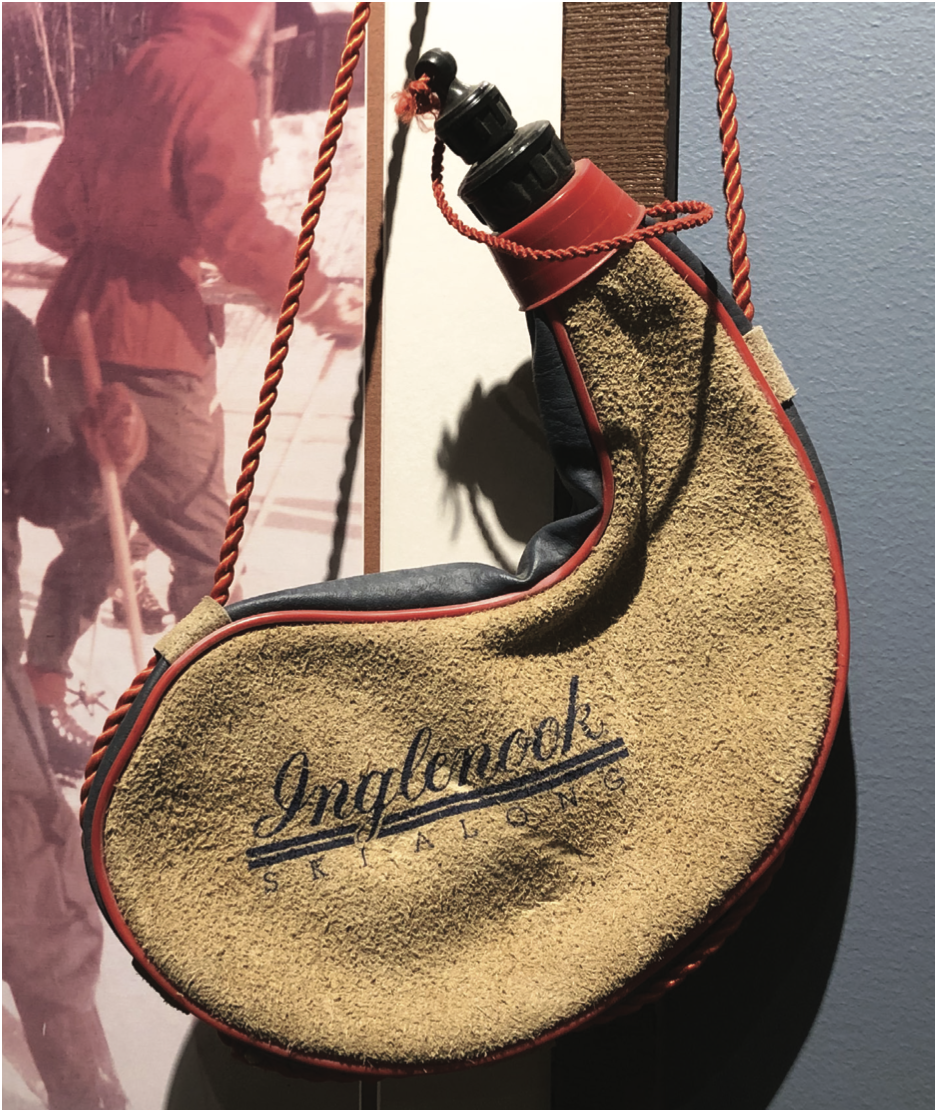
Bota bags could be having a moment. These holdovers from skiing’s golden age laugh at today’s need for social distancing.
What will skiing, riding and cross-county look like in 2020-2021? Will gondolas be fully loaded? Will six-seat chairs be limited to a maximum of only two to three people from the same family? No one knows for certain, and policies vary between resorts. But one thing is sure: In a time of social distancing, skiers will be reluctant to pass around that pocket flask of
Jägermeister to ward off the chill.
The time is right to bring back the bota bag.
Martini trees were a legendary and beloved feature of Taos Ski Valley dating back to the mid-1950s. What could be more memorable than coming across a hidden glass porrón buried in a tree well containing a perfectly-chilled gin martini?
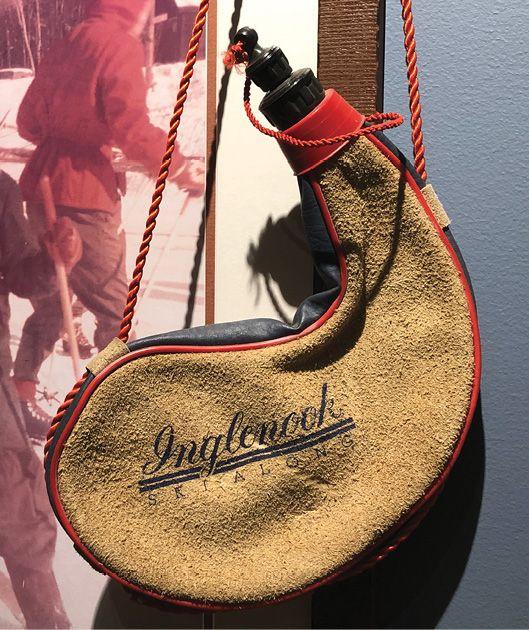
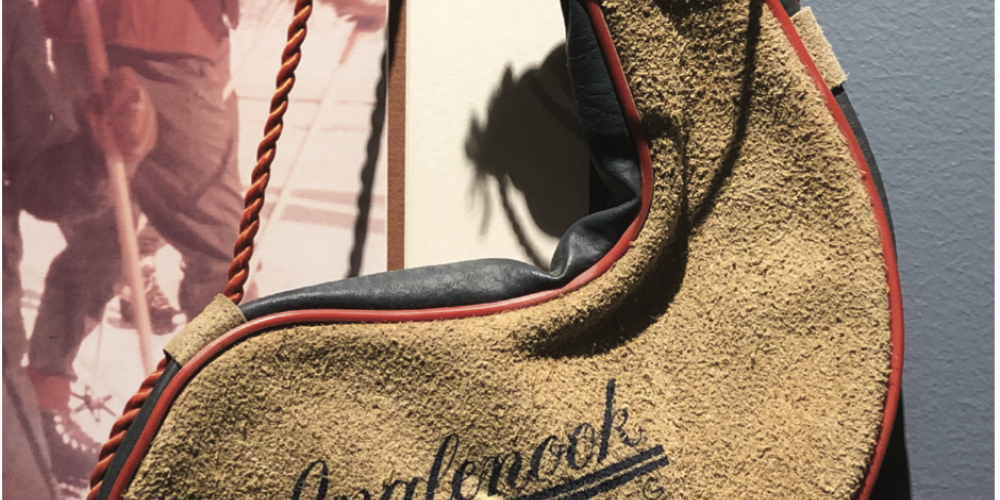
Better yet, what if you could carry a martini around all day? And instead of breakable glass, carry it in a bota bag—a wineskin sling pouch traditionally made of leather, which presumably imparted some retsina-like flavor to the wine. Modern versions with plastic liners could carry martinis, wine or some other bracing refreshment that could be consumed while skiing or riding. What’s more, you could share some liquid courage with your friends and loved ones from a safe social distance of six feet—or farther—depending upon your aim.
The bota bag has a noble lineage, as Assyrian warriors used animal bladders to carry liquids and as floats to cross bodies of water, as seen in this circa 865 BC bas-relief.
The forerunner of the bota bag was the waterskin dating back some 5,000 years. Normally made of sheep or goat skin, it retained water naturally, perfect for desert crossings until the invention of the canteen. The first images of these bladders are from ancient Assyrians, who used them as floats in approximately 3000 B.C.
Botas have an especially long history in Spain. Traditional models were made from leather and lined with goat bladders, often suspended by a red braided shoulder strap. Tree sap was used to prevent liquids from seeping through. Its modern iteration has a handy cap that contains a nozzle with its own stopper to dispense the liquid, usually wine, sometimes peppermint schnapps, or any preferred adult beverage. (Botas have been known to be filled with Mateus, then after the bottle is emptied, it can be turned into a fine candle holder suitable for a college dorm room.)
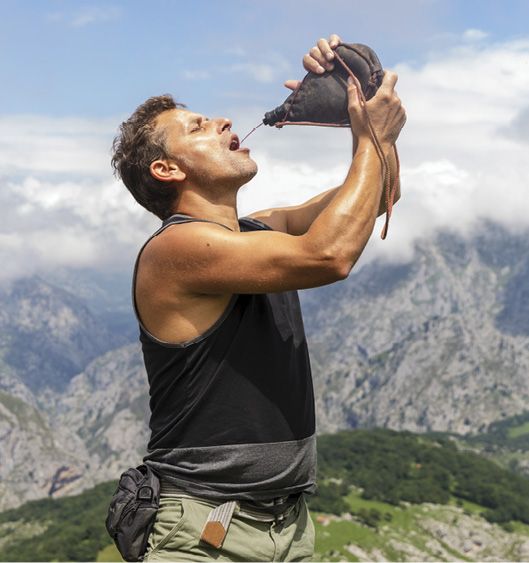
Technique was—and remains—critically important when employing a bota, especially to the Basques, who called it a zahato. No less a drinking authority than Ernest Hemingway explains in the 1926 novel The Sun Also Rises: “He was a young fellow and he held the wine bottle at full arms’ length and raised it high up, squeezing the leather bag with his hand so the stream of wine hissed into his mouth. He held the bag out there, the wine making a flat, hard trajectory into his mouth, and he kept on swallowing smoothly and regularly.” Enough said.
Today, thanks to the internet, there are bota tutorials. Greg Morrill’s blog Retro-skiing.com explains, “First hold the spout with one hand and support the bag with the other hand. Now tip your head back with your mouth open, lift the bota toward your mouth, and squeeze the bag to squirt the wine into your mouth.” Morrill continues, “The mark of an expert bota-user was that once he or she started drinking, the bota would be moved to arms-length while still drinking! Just remember you’ll have to increase the pressure as you move the bota.”
There was a time during the bota’s heyday in the mid- to late-20th century when it was common to see skiers enthusiastically swigging from these soft canteens on a lift, or while a group of friends partied mid-mountain, skis stuck in the snow to form backrests. Often when snow surrounded the nozzle, you could swill icy cold wine slush into your mouth.
Few ski products bring back such a flood of warm memories, or in one case, a rush of adrenaline. My cousin Alan Blumenfeld, 74, from Voorhees, New Jersey, remembers serving on ski patrol at the Big Vanilla at Davos ski area north of New York, and watching from a distance as a hapless skier took an egg-beater fall off a small mogul.
He almost made it until a ski tip caught an edge. “When I skied down to the point of his decimation, the entire area surrounding him was a vibrant red! My heart started racing. I marked off the area quickly and immediately started to check him for what might have been extreme bleeding,” Blumenfeld recalls. “Much to my relief I found that he was fine; the bota bag that was hanging off his neck had exploded during the fall. He was soaked in Chianti. It could have been a scene from The Texas Chainsaw Massacre.” In the end, all was well. “The skier had a few bruises,” Blumenfeld says. “But the bota was terminal, and never recovered.”
There was something slightly illicit about the appeal of bota bags. Brian Fairbank, 74, chairman of Fairbank Group based at Jiminy Peak Mountain Resort in western Massachusetts, recalls, “the only time I used one was when I was under drinking age and an older buddy got some red wine to put in it. I can remember hiding it under my parka and skiing off trail to take a swig.”
A full 16 years old at the time, “I remember thinking how cool it was to drink without getting caught—until I got sick. My stomach and head were killing me,” Fairbank remembers. “That was it for me and bota bags.”
Cindy Suh, 50, of Bricktown, New Jersey, learned later in life that her father had an ulterior motive when breaking out the bota bag. “I always thought it was so cool that my dad would let me drink from it when we were on the ski lift. Years later he told me that prior to that I would just cry all the way up the mountain, saying it was too cold to keep skiing. The wine kept me from crying and shivering.”
The martini trees can still be found at Taos, although in this litigious age, they’re tightly monitored, hung from trees in handcarved wooden lockboxes. Meanwhile, bota bags continue to be sold — in both traditional old-school versions and modern styles that use neoprene to encase one-liter sports bottles made of HDPE-recyclable, BPA-free plastic to handle liquids hot or cold. Have times changed.
Could botas, however, once again be ready for prime time? Perhaps in an era of pandemic-induced social distancing, swigging from a shared bottle of Jager will give way to tossing around a bota bag like some colorful Hemingway character … and then simply taking aim.
ISHA vice president Jeff Blumenfeld, a resident of Boulder,
Colorado, is the president of the North American Snowsports Journalists Association (NASJA.org). He is author of Travel with Purpose: A Field Guide to Voluntourism (travelwithpurposebook.com.)
Bota bags could be having a moment. These holdovers from skiing’s golden age laugh at today’s need for social distancing.
What will skiing, riding and cross-county look like in 2020-2021? Will gondolas be fully loaded? Will six-seat chairs be limited to a maximum of only two to three people from the same family? No one knows for certain, and policies vary between resorts. But one thing is sure: In a time of social distancing, skiers will be reluctant to pass around that pocket flask of
Jägermeister to ward off the chill.
The time is right to bring back the bota bag.
Martini trees were a legendary and beloved feature of Taos Ski Valley dating back to the mid-1950s. What could be more memorable than coming across a hidden glass porrón buried in a tree well containing a perfectly-chilled gin martini?
Better yet, what if you could carry a martini around all day? And instead of breakable glass, carry it in a bota bag—a wineskin sling pouch traditionally made of leather, which presumably imparted some retsina-like flavor to the wine. Modern versions with plastic liners could carry martinis, wine or some other bracing refreshment that could be consumed while skiing or riding. What’s more, you could share some liquid courage with your friends and loved ones from a safe social distance of six feet—or farther—depending upon your aim.
The forerunner of the bota bag was the waterskin dating back some 5,000 years. Normally made of sheep or goat skin, it retained water naturally, perfect for desert crossings until the invention of the canteen. The first images of these bladders are from ancient Assyrians, who used them as floats in approximately 3000 B.C...
After a career covering skiing, photographer Paul Ryan has seen it all.
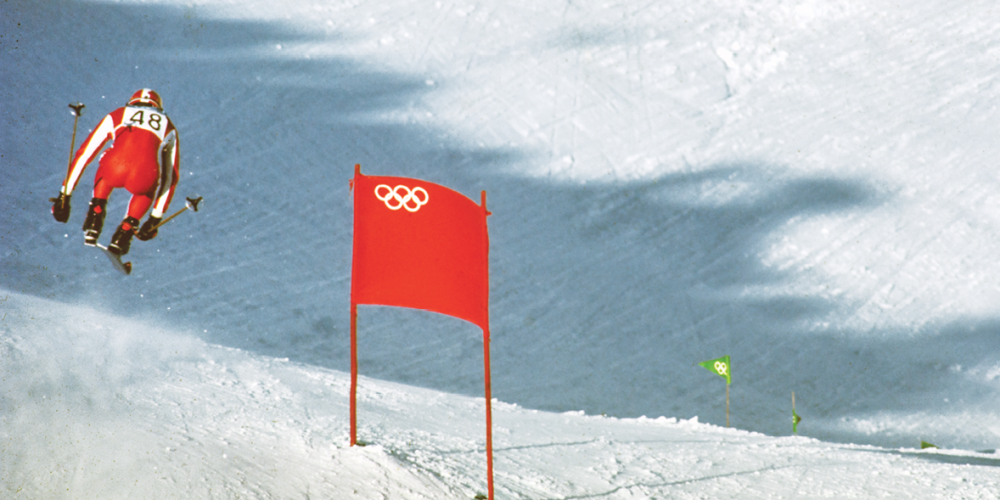
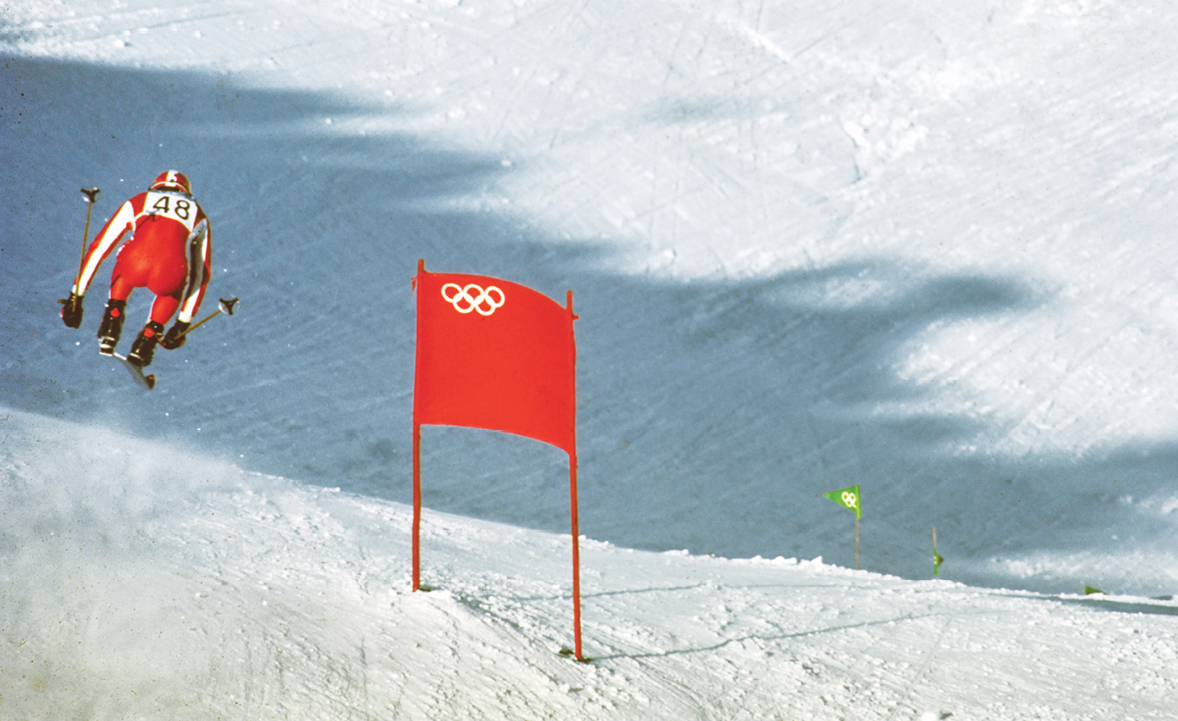
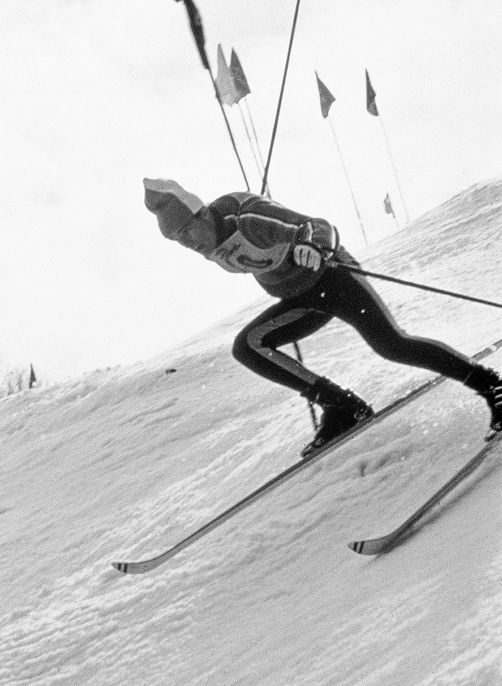
Above: Ryan looks for contrasts when shooting. The dark shadows help visually pop the red-suited racer, next to the red gate, in this image from the 1968 Grenoble Olympic Games. Also, “I liked the sense of launching into the unseen downside of the jump.” Right: Jean-Claude Killy flashes his inimitable style on course in Stowe, Vermont in 1966. The following year, Killy earned the first World Cup overall title, winning 12 of 17 races. Next up: winning the triple crown of alpine skiing, with a sweep of all three Olympic golds at that time (downhill, giant slalom and slalom) at the 1968 Grenoble Winter Games. On skis or off, Killy was as photogenic as they come, says Ryan, who worked extensively with the champ over the years.
"I always was kind of a frustrated ski racer,” admits Paul Ryan, who dabbled in competitive racing in the 1960s. Raised in Newton, Massachusetts, Ryan played hockey for Rensselaer Polytechnic Institute in upstate New York, and after graduation headed north to Stowe, Vermont, to work and follow his racing dreams. In Stowe, racer Marvin Moriarty, of the Moriarty ski hat family, gave Ryan his first camera.
As young ski racers of that generation were likely to do, “a bunch of us decided to abandon career expectations and head out West, eventually landing in Aspen,” he recalls. Ryan and buddies made the racing rounds, competing at various Western resorts, including Mammoth Mountain, where “Dave McCoy let us sleep in the unfinished lodge.”
In the early 1960s, a career beckoned, so Ryan went to graduate film school in San Francisco, but continued to race. He found himself at Sugar Bowl Resort in California for the final race of the season, where he received the career advice of a lifetime. “You are not getting anywhere racing,” Ed Siegel, Sugar Bowl’s general manager told him. “But you’re a pretty good photographer. Come work for us.”
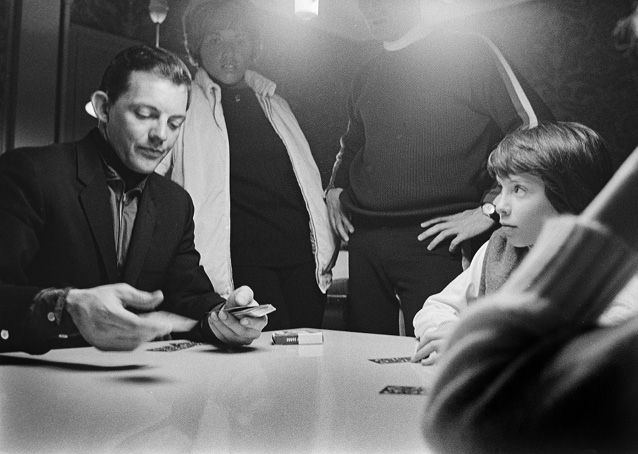
Working a ski camp at Sugar Bowl, California, two-time American Olympic racer Chuck Ferries entertains campers with card tricks. A youngster’s hero-worshipping stare across the frame illustrates Ryan’s “Decisive Moment” philosophy of photography.
He did. “It was my first job getting paid to take pictures,” Ryan says with a laugh. Skiing remained a passion, but he found the time to pursue his craft in San Francisco, and made a name for himself chronicling the 1960s counterculture there. But he had found a home in skiing, and John Fry hired him as the staff photographer at SKI magazine for several years. He traveled the world shooting for SKI and other periodicals.
Ryan’s personal lens was always wider than just the sport of skiing. He studied under the greats of the time, including Minor White and Ansel Adams. His photography has been honored in international shows, with recent exhibits including “The Sea Ranch, Architecture, Environment, and Idealism” at the San Francisco Museum of Modern Art.
Ryan has always moved fluidly between still photography and cinematography. His cinema credits include Robert Redford’s A River Runs Through It and The Horse Whisperer. His documentary work includes Gimme Shelter, Salvador Dali, and recently a film on George Soros.
Ryan has always found his way back to the mountains. This photo essay illuminates an era in skiing’s history and also the progress of photography, which has changed as much as the sport that Ryan covers.
“Photography has evolved enormously since the years when I was very involved in photographing the ski world,” Ryan, now 83, says from his home in Santa Monica, California. “Cameras and iPhones have become very mobile and everyone can take photos of anything.”
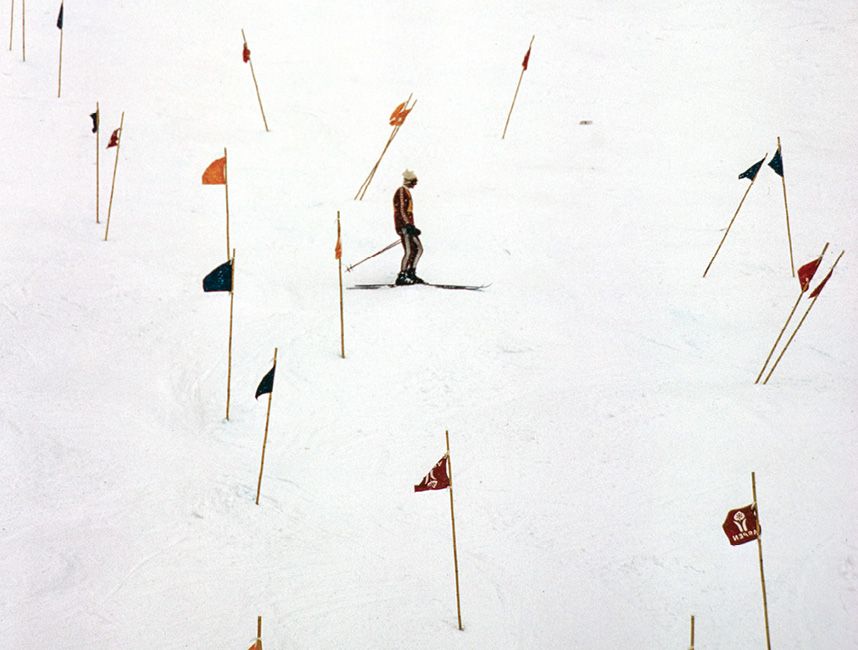
A racer studies “the labyrinth of a seemingly random maze of slalom poles” in Aspen. The solitude of the racer attracted Ryan, as did the vertical orientation of racer to poles. The image reminded Ryan that “Billy Kidd always prided himself on being able to memorize every nuance of a slalom course as well as the terrain. He said to me ‘I can memorize the position of 120 poles. Not only the absolute position but the relative distances between the poles.’”
With the new mobile technology, “images are abundant and personal moments are revealed every day,” he notes. Ever the artist, Ryan sees these advancements not as a threat to his craft, but as new tools to use. “Photoshop makes possible the transformation of photographs into our own impressionistic images, and expressions of our thoughts superimposed onto the events in front of the lens,” he says. “It’s a visually exciting time.”
These images here are from a different time, “when on the side of the mountain, I had to pre-visualize the end result, often not seeing the processed film until days later,” Ryan says.
Though the technology has changed, what constitutes a powerful image has not. Ryan says there are two main components to a successful photo: What he calls “the graphics” or the visual structure of the image, and “the human element,” or the emotions that are shown in the photograph.
Great photography combines both to reveal “Cartier-Bresson’s ‘decisive moment’ in time,” Ryan says. The art is in recognizing that instant. “A compelling photograph is not what happened a second before or a second after. It’s a single moment,” Ryan says. “A photographer’s goal is to capture that decisive moment.”
This is Part 1 of a 2 part photo essay series from Paul Ryan, with the second installment in the November/December issue. View this photo essay as a mini-master class in photography, as Ryan explains his approach to his craft and the intriguing backstories to each image.
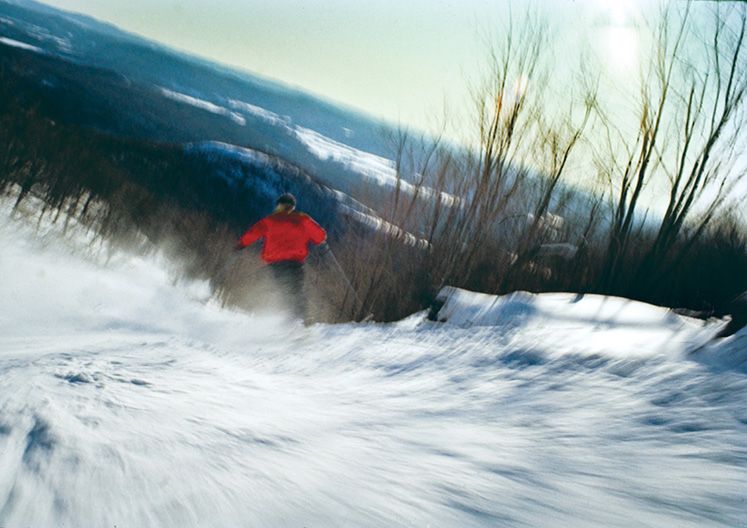
When shooting point-of-view images while skiing, such as at Mount Tremblant, Que, Ryan slows down, “so the skiing becomes intuitive and all the thought goes into what the shot will look like.” He favors wide-angle lenses when moving, and reverts to a kind of point-and-shoot mode, as “looking through the lens is unwise and restrictive.” After years on skis, the veteran gunslinger admits “I got pretty good shooting from the hip.”
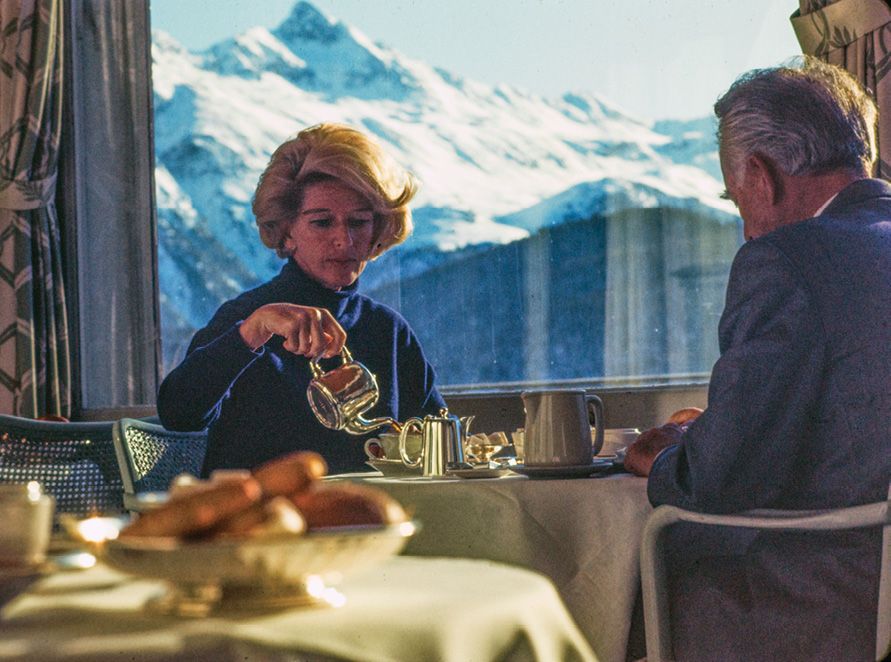
One of Ryan’s first assignments for SKI was a story on St. Moritz, Switzerland. “This scene was probably routine for the Palace Hotel, where we were staying, but the iconic cultural juxtaposition caught my eye immediately,” he says. The curve of the elegantly dressed woman’s hand accenting the flip of her hair and the curve of the tea pot’s spout, with a majestic peak as a backdrop for good measure, add up to a striking narrative.
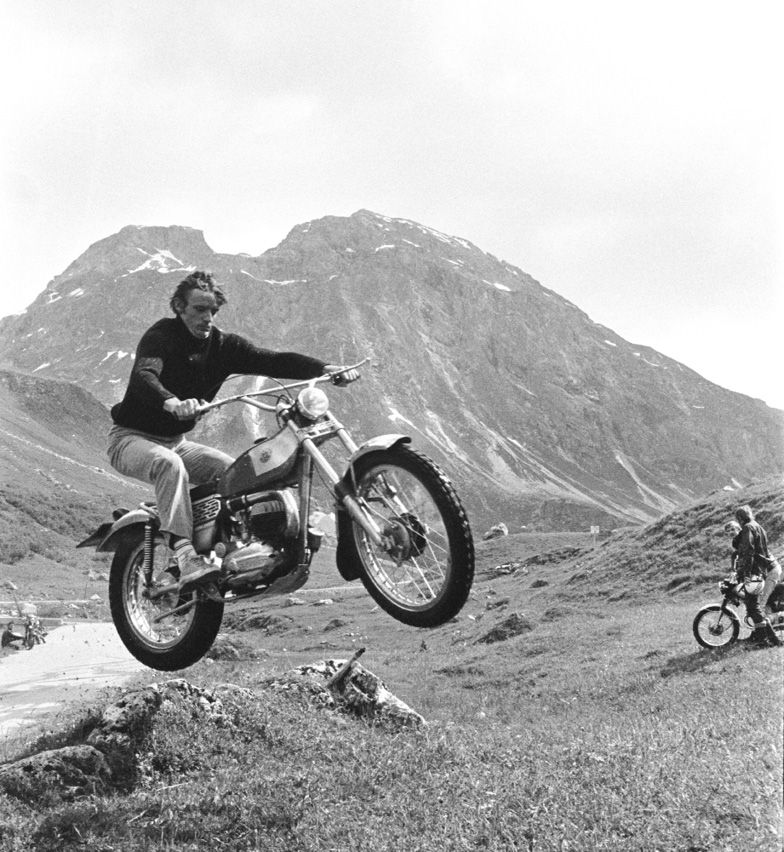
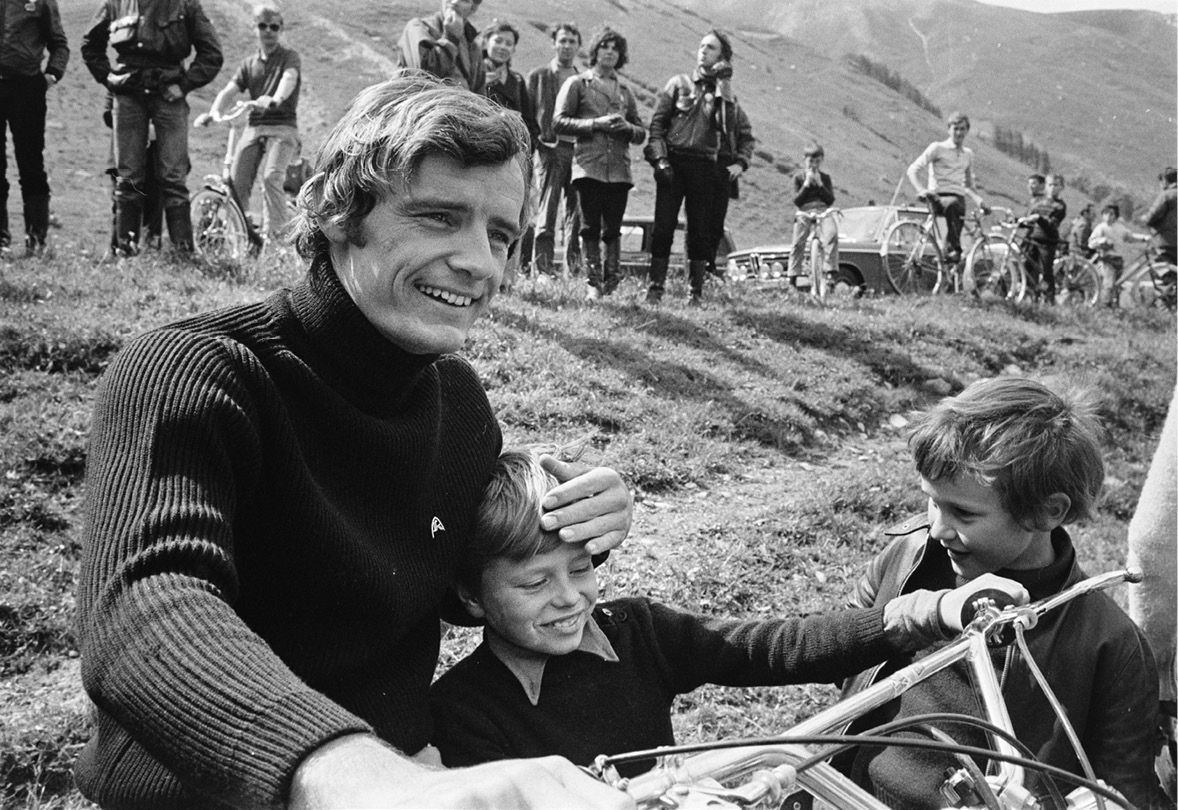
After filming Jean-Claude Killy, Leo Lacroix and other racers in St. Moritz, Switzerland, for a Lange film, Killy invited Ryan to visit him at his home in Val D’Isère, France, to unwind, which included riding motorcycles together. With Killy, Ryan always had his camera at the ready. Not surprisingly, Killy was as aggressive on a motorcycle as on skis. Wherever Killy went, “crowds would gather,” Ryan says. Word got out that Killy was riding in the foothills, so the locals came to watch. Ryan liked the closeup of a local boy trying the controls with Killy, with the crowds forming a wall in the background.
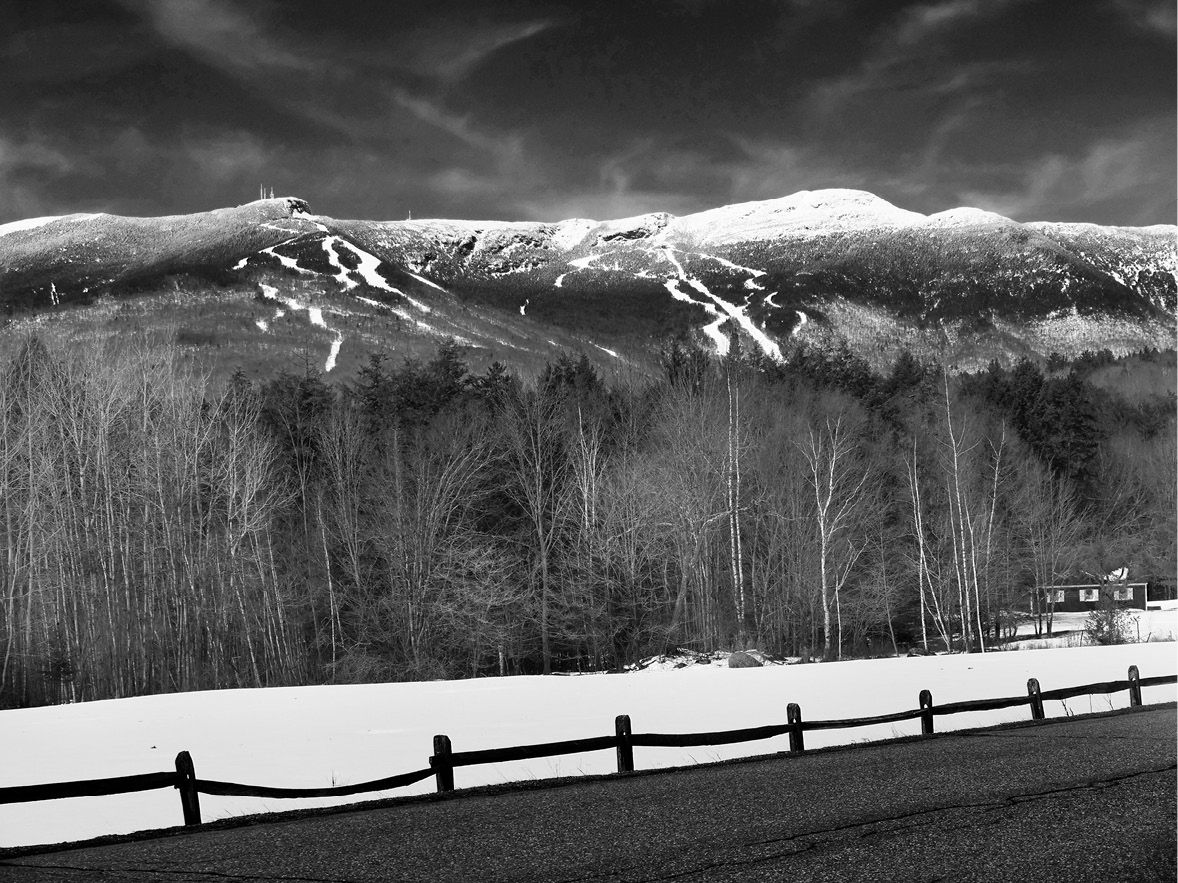
Ryan was leaving an ISHA gathering at Stowe, when he pulled over on a side road to snap this scenic view of Mount Mansfield. He liked the dark fence line silhouetted against the snow at the bottom of the frame, bracketed by the white snow-covered slopes at the top, with the bare trees in between.
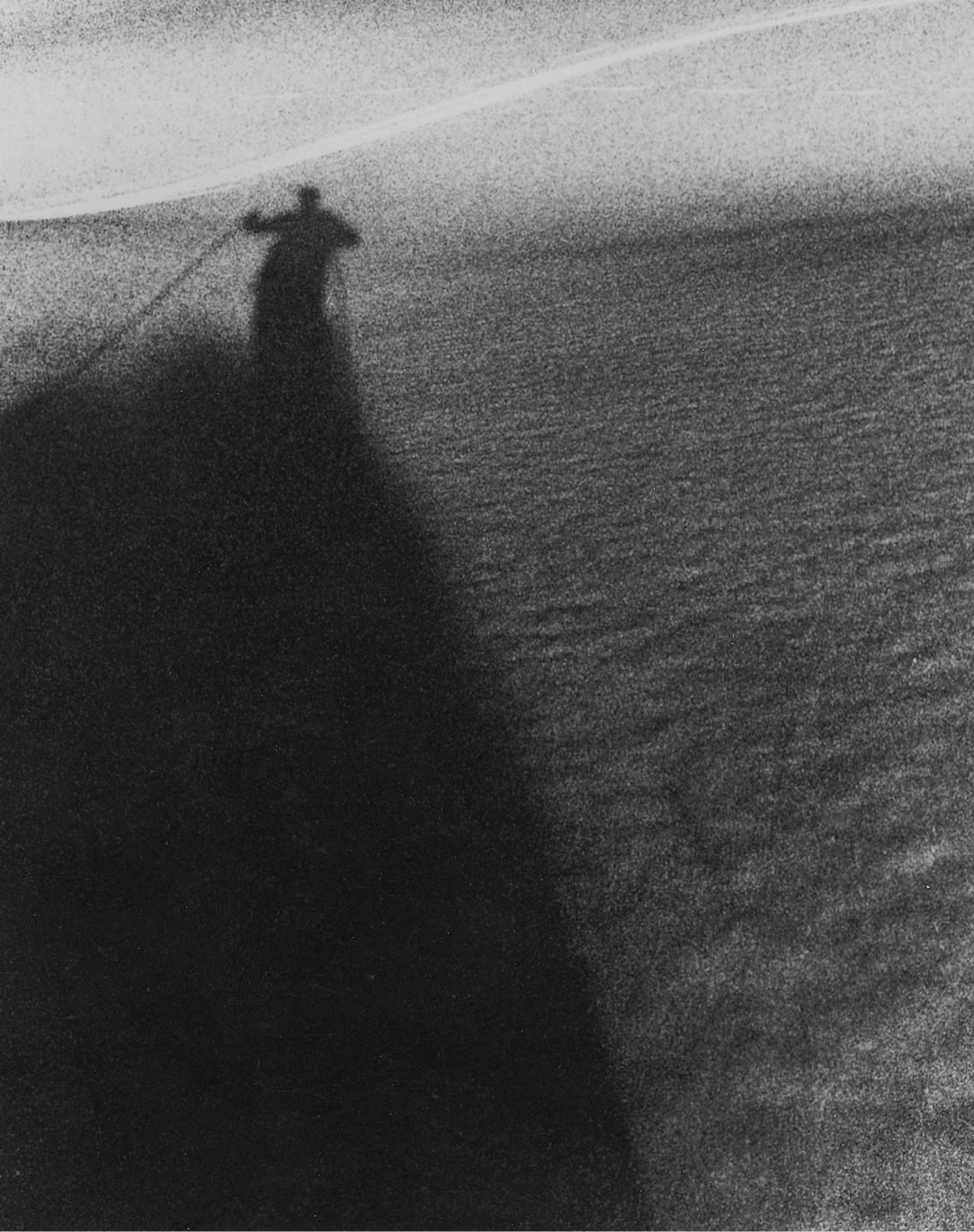
What’s now called a “selfie” has its roots in the professional self-portrait. A self-portrait reveals both a mastery of the artist’s craft and self-image. “Occasionally when skiing an interesting trail, I would just put a wide angle lens on my motor drive Nikon and fire off a few backlit shots of my own shadow while skiing,” Ryan says. “I like that effect.”
When it snows, skiers ski, even amid calamity. That could change with Covid-19. By Andy Bigford
Skiers and the industry have confronted and overcome a variety of disasters—wars, gas shortages, recessions, and terrorism—none of which affected the sport more than the biggest annual influencer of all: the weather. This disaster is different. The novel coronavirus already has trimmed one-sixth of the prematurely closed 2019-20 season, an estimated 8 million skier days and $2 billion in revenue, according to the National Ski Areas Association (NSAA). Travel concerns, social distancing constraints, and the cratering economy could take a much bigger bite out of the upcoming 2020-21 season. Or not.
Just prior to the modern skiing age, World War II was the obvious exception to the weather rule. Many of the 60 or so “ski areas” operating in the U.S. closed during the conflict, as did countless community rope-tow hills, with resort improvements coming to a standstill.
Stowe stayed open. With gas rationing in force, skiers commuted by train and bus, but the lifts spun just six hours a day. The sport supported the war effort in other ways. Stowe skier C. Minot “Minnie” Dole, who founded the National Ski Patrol in 1938, persuaded the U.S. State Department to create the 10th Mountain Division ski troops. At the 10th’s headquarters at Camp Hale in Leadville, Colorado, Ski Cooper was created and then opened to the public after the war...
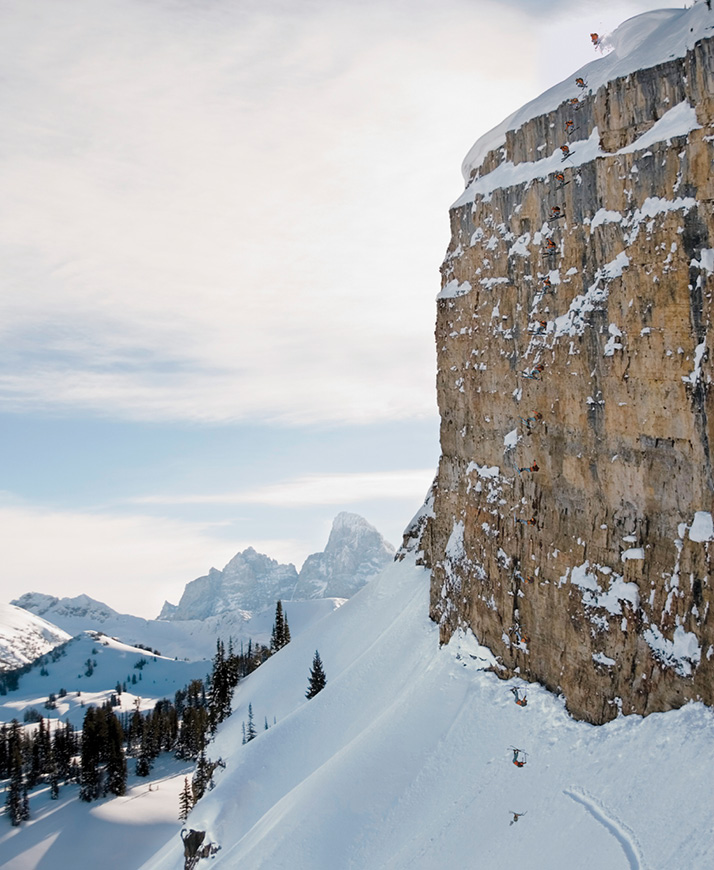
Alpine ski jumpers—sticking Geländesprungs, cliff hucks and gap-jumps—have been sending it for more than a hundred years.
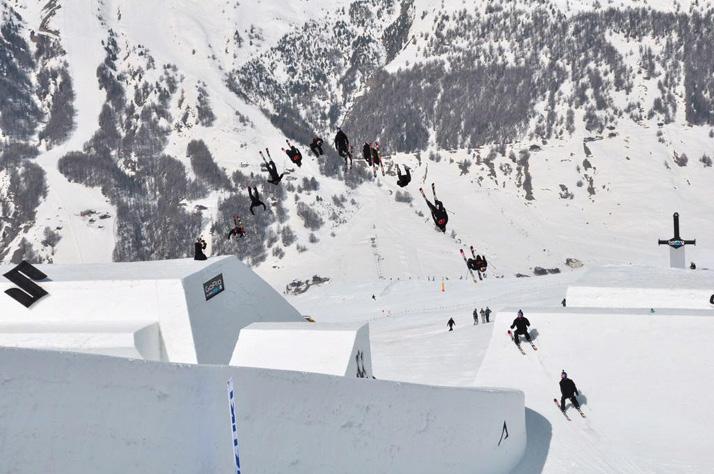
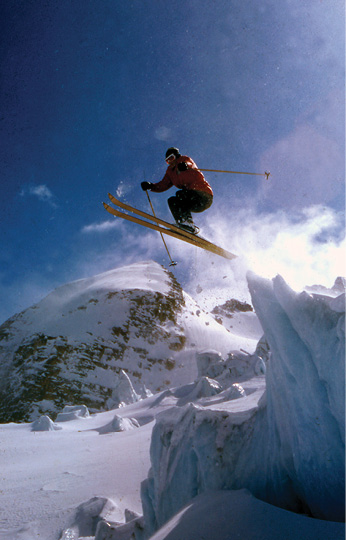
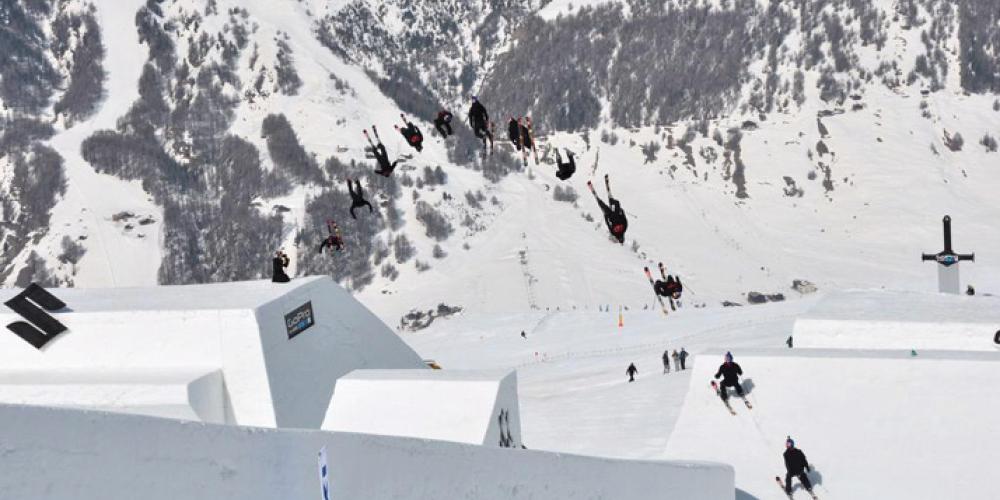
Jesper Tjader explains what he wants to try on a practice run for the 2014 Nine Knights terrain park competition in Livigno, Italy, and no one thinks it’s possible. But he casually skis onto the in-run anyway. He’s planning a transfer from one big ramp to another one about 50 meters (164 feet) away on a completely different course. Coming up short means a face-full of vertical ice and almost certain serious injury. Overshooting isn’t a consideration since nobody believes he’ll clear the massive gap to begin with. But 20-year old Tjader, without consciously knowing it, is riding a wave of Big Air heroics that will define the first two decades of alpine ski jumping in the 2000s. The Swede sticks the landing three times that day on a jump no one else is even thinking about, and the last time he throws a double back flip.
Photo above: Athletic achievements in action sports often arrive unplanned. Swedish freeskier Jesper Tjader decided to try an unprecedented 50-meter “death gap” transfer between ramps during practice at a 2014 competition. He nailed it three times. And on his final attempt, he threw in a double back flip. Suzuki Nine Knights photo.
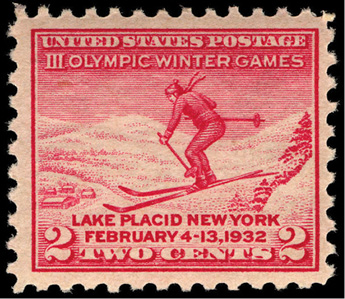
US Postal Service issued its first Olympic stamp for the 1932 Winter Games in Lake Placid. The skier is making a gelande jump but there was no event that year that would have required that technique.
When Skiing Big Air debuts at the 2022 Winter Olympics in China, it will be on the back of these kinds of attention-grabbing feats over the past twenty years. Candide Thovex making the first successful jump on 120-foot Chad’s Gap, near Alta, in 1999. Jamie Pierre dropping a 255-foot cliff huck in 2006 in the Grand Targhee, Wyoming, backcountry, only to have Fred Syversen up the ante to a bonkers, and accidental, 351 feet two years later filming in Norway. Rolf Wilson laid down a 374-foot-long alpine jump in 2011 during a competition off the 90-meter jump at Howelsen Hill, and David Wise popped 46 feet above a park jump in 2016 in Italy, upping the record by more than 10 feet. All of this was accomplished on regular alpine ski gear—and it all began with something called the Geländesprung.
Hannes Schneider likely introduced, or at least popularized, the Geländesprung (literally “terrain jump” in German) in the early 1900s in the Austrian Arlberg. Writing in Skiing magazine in 1964, G.S. Bush mentioned Schneider demonstrating a maneuver where he “used two ski poles instead of one, and, an accomplished jumper, he leaped even when there was no ramp. Rushing across a sharp break in a slope, he’d push himself up and forward on the poles, catapulting himself high over the hill’s edge, and then, by twisting his body and skis, he’d change the direction his skis were facing in mid-flight. He called this spectacular trick, ‘Geländesprung.’”
By the 1950s that description was obsolete and gelandes had come to more broadly encompass all alpine-style jumping that includes ski poles and bindings with locked-down heels—two major things that differentiated it from classic heads-and-tips-first Nordic jumping. It began to make regularly noted appearances in the U.S. in the 1930s where it was mentioned as an activity at areas from Glen Ellen, Vermont, to Badger Pass in Yosemite.
Oddly, it also turned up on an American stamp issued in 1932, commemorating that year’s third Winter Olympics, being held in Lake Placid. As noted collector James Riddell remarked in an article, “The Scandinavian disciplines Langlauf and Springlauf only at Lake Placid! This stamp, strangely enough, depicted a Geländesprung, which hardly suited either event.” Ski journalist Mort Lund observed that the stamp displayed “a form of skiing for which there was no Olympic, world or local competitions…” It may have been the 1940s before the first known gelande events started occurring at places like Alta, Utah.
Seeing is Believing
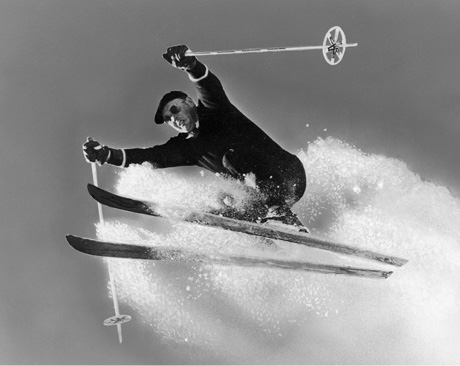
Described by Ernst Hinterseer as "the best all-round skier in the world," Jim McConkey helped create an "extreme" vocabulary in the 1960s. His athletic grace in the air and flair for scene-stealing visuals set the stage for the freeskiing revolution decades ahead. Fred Lindholm photo.
What would primarily propel alpine jumping is photography, which has proven both a blessing and a curse, with detractors claiming that photo fame and peer pressure drive kids to do dangerously crazy things they wouldn’t otherwise. But as the world rolled into the 1960s, magazine photos and movies became major drivers for alpine ski jumping. Not because people were doing it for the cameras, but because the cameras craved it. Big air was dramatic and it sold. Take Jim McConkey, for instance.
A famous early image showed him jumping 100 feet over a ski plane on a glacier in Canada in 1962. He next dropped a 90-foot cliff in the Bugaboos, which was then nearly unthinkable. Ninety feet is still bragging material. And it opened up the mountains to stuff so ridiculous that jumpers had to create wings. Tragically, one who did was McConkey’s son Shane, who died in a skiing and BASE-jumping accident in the Dolomites in 2009.
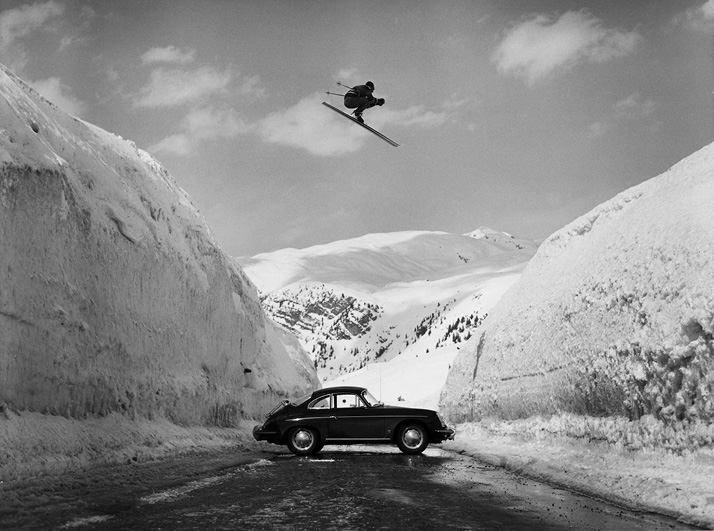
Jim McConkey’s early 1960s plane-jumping image was followed by a 1963 Hans Truöl photo of legendary Austrian racer Egon Zimmermann, who would go on to win the Olympic downhill gold medal, jumping the Flexenpass highway above Lech and clearing a new 356 Porsche in the process. Zimmermann personally gave visitors a postcard of the photo at his Hotel Kristberg in Lech right up until his death at 80 this past August. He once told me that he’d done the jump mainly as a promo for Porsche, which he thought was ironic since he suffered a bad wreck in his own Porsche several years later. The pic is still iconic today and along with McConkey’s plane jump helped create the modern concept of gap-jumping as an Evel Knievel form of showmanship.
Egon Zimmermann agreed to jump over a Porsche parked near Lech, Austria, as a favor to the car company. Hans Truol photo.
The value of film to big league ski jumping was cemented when skiing action scenes, being shot by Willy Bogner in some of the Alps’ most glamorous locales, began appearing in James Bond movies. The high-octane Bond footage gave a big boost to skiing in general and extreme jumping in particular, the latter as a result of three deeply memorable stunt sequences.
James Bond movies upped the ante with the now iconic BASE jump by Rick Sylvester off Mount Asgard on Baffin Island.
The first was in On Her Majesty’s Secret Service in 1969, where George Lazenby’s stunt skiers were German racer Ludwig Leitner and Swiss downhill ace Bernhard Russi. Near the end of a long chase sequence at Murren, Switzerland, Bond jumps over a highway very reminiscent of Zimmermann’s Porsche-clearing gelande. Only Bond did it over a huge snowplow with a snowblower that devours the pursuing bad guy when he doesn’t go big enough. Unfortunately, “Russi was injured when he crashed on the road,” Willy Bogner once told me. But it definitely raised the stakes on gap-jumping and built on the Zimmermann/McConkey foundation.
Next came Rick Sylvester’s mind-boggling jump off Mount Asgard on Baffin Island in 1977’s The Spy Who Loved Me that ended 3,000 vertical feet later with a parachute landing. It was a game-changer that furthered the blending of skiing with BASE-jumping and fired up ski jumpers by exponentially extending the limits of what was possible. The movie scene took three tries for the camera crew to get the shots, but it awed a global audience and inspired people like Shane McConkey. (Sylvester got the coveted call for the Spy stunt because he had skied off El Capitan in California in 1972, which was filmed by a young Mike Marvin, who went on to Hot Dog—the Movie fame. Sylvester’s El Cap feat is considered the first filmed BASE jump on skis.)
In 1981’s For Your Eyes Only, extensive ski scenes in Cortina, Italy, are capped by former 6-time World Champion freestyle skier John Eaves standing in for Roger Moore and jumping off Cortina’s famed 90-meter Nordic hill—on a pair of 205 Olin Mark VI slalom skis. Almost everyone used at least 215s on gelande jumps a lot smaller than a 90-meter, with 220s more likely under foot. Plus Eaves did it tandem, side-by-side with a regular, properly equipped Nordic jumper.
“I had my own jump,” Eaves told me. “It was set at 0 degrees. The Nordic take off was -11 degrees. They need that to get into the air foil. Mine felt like a good kick when I hit it, allowing me to gain altitude over the Nordic jumper immediately. Then I would slowly lose altitude as he went ahead… I did 200 feet once.” It wasn’t out of his wheelhouse, Eaves explained. “I got second place at the Whistler gelande in 1974 on a pair of Dave Murray’s lead weighted downhill skis.”
Big Air, Big Competitions
Alf Engen organized the first National Gelande Championships at Alta in 1964. No surprise: he won it. Courtesy Alf Engen Ski Museum
Competitive alpine ski jumping wasn’t hugely successful over the years, but it was the testing grounds for a lot of what followed. While earlier gelande competitions definitely occurred, Alf Engen staged the first-ever National Gelande Championships at Alta in 1964, and just for good measure won it.
That event lasted for ten years (plus occasional resurrections for anniversaries) before insurance companies and lawyers got involved. But by then there were gelande comps, and their direct descendants in the form of “ski splashes,” going on everywhere: Mad River, Sugarbush, Purgatory’s famous Goliath Gelande, Snowbowl Montana, Steamboat Spring’s Winter Carnival off the 70 and 90-meter jumps. Other hosts included Jackson, Whistler, Alyeska, Aspen’s Winterskol, a swimming pool alongside the Silvertree Hotel in Snowmass, and so on, with a tour that included 13 stops at its peak. But Alta’s remained the granddaddy and the big one everybody aimed for.
Interestingly, Porsche stayed allied with alpine ski jumping over the years, supplying a car as first prize for one of the early gelande events in Vail, won by Mark Jones in 1974 at the then world-record distance of 213.5 feet. The prize got everyone’s attention as much as the length, and helped to jump-start (ahem) the gelande tour.
By this time freestyle skiing aerial events had been going on for a few years in the US and around the world. They were formally recognized by the FIS in 1979 and first showcased at the Olympics in 1994. Combining outrageously vertical air (20 feet above the kicker, up to 60 feet above the landing) with full-on gymnastics (three full back flips with five full twists for example), they’ve made for great TV. They also led directly to the jibbing movement and park and pipe riding that rewards tricks as much as amplitude or distance.
Jamie Pierre, 36, set the cliff jump record at 255 feet in January 2006 near Grand Targhee, Wyoming. He became inverted and plunged headfirst into the snow like a human lawn dart. His only injury: A bloody lip. Red Bull Illume Image Quest
For the last 40 years, the sky has literally been the limit for gelandes, gap-jumps and cliff hucks, to the point where some of it has gone almost beyond the pale and stalled a bit as a result. Meanwhile, park and pipe events have combined most of the other forms of alpine jumping and added some new wrinkles, along with wide exposure and money that both attracts and nurtures a lot of the jumping talent.
Freestyle courses, super-pipes and big air kickers provide highly visible venues for people to go huge while emphasizing tricks and still being able to ski away. That’s because the jumps are vaguely within reason, and are regular events instead of one-off stunts to set a record.
Video Revolution
There’s no avoiding the inherent danger of big air. After Paul Ruff’s fatal 160-foot jump in 1993 near Kirkwood, California, in an attempt to set a world record, some industry insiders said it would slow the seemingly endless rush to push skiing’s limits. Not so.
There are still people, of course, getting big air, and there’s still a market for it, primarily in the ski-porn films that are more popular than ever with platforms like Netflix and YouTube. The video cameras were there when Candide Thovex made the first successful flight over Chad’s Gap in Cottonwood Canyon, Utah, in 1999, throwing in a mute grab, and when he came back the next year and did it with a D-Spin. Yes, the same Chad’s Gap where Tanner Hall, after sessioning it well all day in 2005, came up short trying a switch cork 900 and broke both ankles. On video. He returned for redemption in 2017.
The cameras were running in 2006 when Jamie Pierre stuck a 255-foot cliff drop in the Grand Targhee backcountry of the Tetons. He literally stuck it, going in almost headfirst like a dart and having to be dug out. He’d worked his way up since 2003 from 165 feet to 255 during a series of big leaps in Utah, Switzerland and Oregon.
“I just really wanted to hold the record, even if only for a day,” he said afterward. With a young family, he noted he could now happily “retire” to slightly less hazardous skiing. Sadly, he died at 38 in 2009 in an avalanche in the Alta backcountry.
The heart-stopping heights of serious cliff hucks had progressed to the point in the 1990s where no one was even trying to ski away from them. They would simply plant their landings in deep snow, using the tails of their skis when possible to absorb some impact, and just hope to survive. That was Fred Syversen’s plan in 2008 when he made a filmed practice run, during a movie shoot, to a cliff in Norway chosen to break Pierre’s 255-foot record. But he turned too early in his fast-moving descent, and realized it too late.
“Braking or trying to stop was no longer an option, it simply went too fast,” he posted on social media. “So that left one choice: go for it and do it right!” He turned slightly to avoid rocks to his left, got out over snow and tilted so he didn’t land on his ABS pack that could have damaged his spine. He cratered like an unexploded howitzer shell. His only slight injury came when someone hit him with a shovel digging him out—351-feet later.
There’s also nine seconds of wobbly bystander footage (pure gelande still doesn’t get much love) of Rolf Wilson setting the alpine-jumping world record of 374 feet at Howelson Hill in Steamboat in 2011. You probably didn’t see it even if you lived in Steamboat. “It’s such an odd sport,” allows Wilson, who’s from Missoula, Montana. “One of the sports that doesn’t get a lot of recognition, because the guys that do it really just wanna jump, and see how far they go, and have fun. And we’re a bunch of hooligans to be honest with you.”
Jesper Tjader’s giant transfer in 2014, and David Wise’s 2016 blast, rocked the park and pipe world. And since then Big Air has seemed poised for the next big step. As some alpine jumping records near their survivable outer limits, no one has been lining up to try to beat Syversen’s 351 (12 years ago) or Wilson’s 374 (nine years ago). So what’s on the horizon?
More X Games-style productions; more ski movies; more genius films like Candide Thovex’s with amazing stunts that aren’t always potentially lethal; wing-suited jumpers regularly landing on slopes from big drops without ever popping chutes; and someone letting the true gelande crowd build the jump they yearn for with a lightning fast in-run, adjustable kicker, and endless run out.
Meanwhile, if you want to go really long the best bet is still Nordic ski flying on the 120-meter hills, where the current world record by Stefan Kraft of Austria at 831 feet is just shy of three football fields, no tricks involved.
Jay Cowan has written about skiing for five decades and received Colorado Ski Country USA’s Lowell Thomas Award for print journalism, multiple magazine feature writing awards from NASJA, and has been included in The Best American Travel Writing of the Year. His books include Hunter S. Thompson and his latest, Scandal Aspen.
We’ve all heard that ski resorts will operate this coming winter under social-distancing rules. That means limited cafeteria space, restrooms, chairlift seating, lift-line queues and equipment-rental facilities. Some of these limitations will be addressed by box lunches, new tented outdoor seating and Portapotties, and by online advanced reservation requirements. Many skiers won’t want to fly off on destination holidays, so some major resorts may see a drop in ticket sales.
Meanwhile, in the wake of Black Lives Matter protests, companies say they plan to do more to address diversity issues. CEO Rob Katz of Vail Resorts sent out a letter to employees pointing out the obvious: the skier population is still very largely white, and so is his workforce. Katz has actually been out front on diversity issues, particularly with unprecedented female leadership and training at his company, but also with various programs (and personal donations) to get minority youth on the slopes. It hasn’t moved the needle much, he admits, and he terms this a “person failing.”
It’s hard to recruit new customers of any ethnicity at a time when businesses must ration access—and with the state of the economy. But staffing should be another issue. NSAA president Kelly Pawlak reports that half of resorts are understaffed, by an average of 44 positions. If visas for foreign workers remain unavailable and if international travel remains restricted, resorts won’t be able to staff up with young Latin Americans on temporary work permits. Resorts instead will need to find new seasonal staff, for jobs from mountain operations to cafeteria workers, perhaps in nearby cities—and local recruiting needs to begin now. Some of the new employees will be people of color. Close-in resorts may bus in workers. Destination resorts will have to ramp up availability of employee housing. If hundreds of nearby hotel rooms and condos are empty, as was the case at destination resorts during the Great Recession, that may not be a challenge.
One of the barriers to minority entry into the sport is that newcomers often don’t feel welcome when they don’t see other people like themselves in town. So more Black and brown faces in customer-facing staff positions would help to recruit new populations to the sport, once marketing outreach becomes practical again. Best of all: Some of the new employees will catch the mountain bug, stick around, and advance up the ranks.
Henri Rivers, president of the National Brotherhood of Skiers (NBS), has been talking to resort managers in Colorado, Utah and elsewhere. He points out that diversity needs to happen at all levels. Recruiting people of color for profit-center and senior management jobs isn’t hard. “But you can’t recruit the traditional way,” he said. “Outsource recruiting or look for other resources. Partner with the Black MBA Association or NBS, or with a Black lawyers’ association. Start by hiring four managers. They’ll be successful. There’s no shortage of highly qualified people eager to move out of the city into the mountains, for a better lifestyle.”
Skiing’s history is on the side of diversity. Going back to the early 20th century, once Norwegian immigrant ski clubs got over their resistance to the admission of English-speaking members—and notwithstanding the 119-year-history of anti-Semitism at Lake Placid and other Adirondack communities—the sport has generally accepted new arrivals. European refugees populated resorts beginning with the rise of Nazism, staffing ski schools and launching businesses. Postwar skiing in North America had strong roots in the fight against racist Axis governments.
Officialdom has had more trouble with new forms of snow-sport than with ethnicity. FIS took at least a decade to come to terms with alpine skiing, then with freestyle. More recently, in the 1980s and ‘90s, the sport’s leaders, and many skiers, fumbled badly with the integration of a new kind of customer—snowboarders. This relatively diverse group would eventually become saviors, pumping new life into a stagnant sport, then helping birth the freeskiing movement, which has been welcomed to resorts with untold resources dedicated to terrain parks. Back in February, a few months before George Floyd’s murder, the outdoor and ski industry suppliers banded together on a DEI pledge (diversity, equity and inclusivity). Pre-BLM, there had also been an upsurge in advocacy groups for diversity, ranging from industry- (Outdoor Afro) to consumer-based (Share Winter).
While the general skier population has remained largely of European ethnicity, ski areas have long drawn local ethnic groups as employees and customers, with several marketing efforts launched in the 1990s. Native American and Latinx skiers are unremarkable at resorts in New Mexico and Arizona, Asian skiers common at West Coast resorts. Black skiers remain under-represented despite the success of the NBS. This needs to change. The combination of the pandemic business disruption and the Black Lives Matter movement is an opportunity to accelerate that change.
Pie chart at top of page comes from 2013 SIA particpant study.
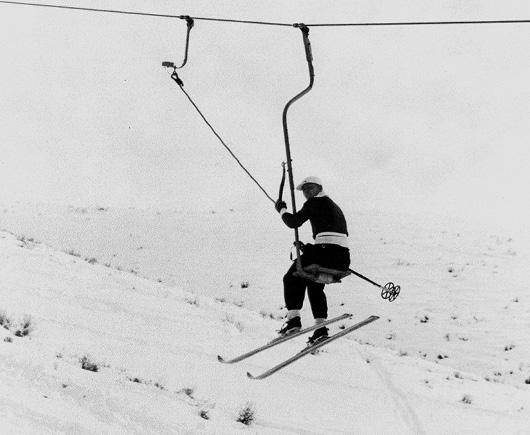
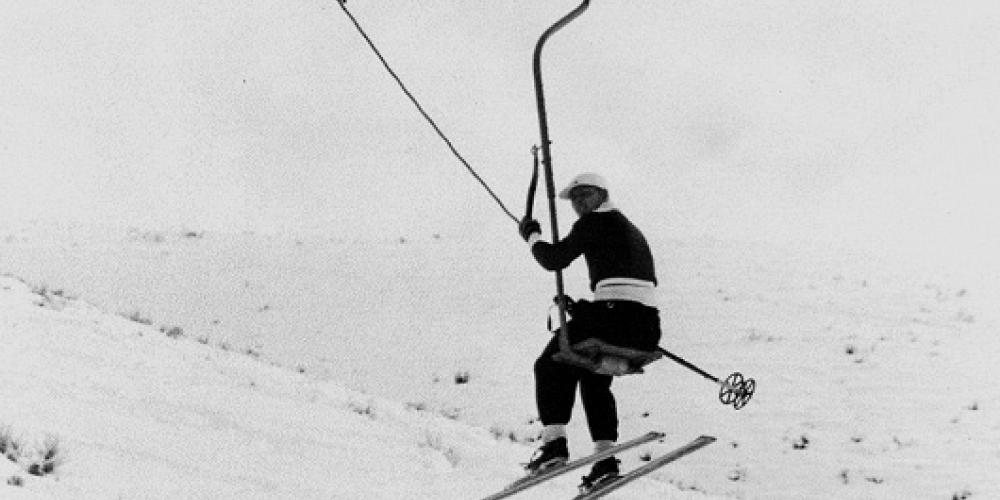
Photo: Alf Engen rides Sun Valley's Ruud Mountain chairlift, location of the jumping hill he designed with Sigmund Ruud, circa 1938. Photo by Charles Wanless, courtesy Alan Engen.
Alf Engen in Sun Valley (the saga continues...)
In a recent letter in Skiing History (May-June 2020), my colleague Kirby Gilbert raised several questions about Alf Engen’s role in Sun Valley’s early days. Kirby wonders whether Alf was in Sun Valley in 1936, since his presence was not mentioned in other accounts at the time.
In his 1985 oral history, Alf said he met Count Felix Schaffgotsch in Utah in early 1936, when the Count was searching for a place for Averell Harriman to build a destination ski resort. Alf showed the Count both Alta and Brighton, before the Count visited Ketchum in February 1936, and found the area that would become Sun Valley. According to Alf, “When I found out that he had picked this place [Ketchum], the Forest Service sent me up here just to see what he had actually picked out…There was lots of snow that year, and it was beautiful. And at the end of the road...of the railroad...there was only one building, there was Pete Lane’s store…I just came to see what he had picked out.”
From 1935 to 1942, Alf worked for the Forest Service as a technical advisor, assisting with planning and developing winter sports areas in four western states. Alf’s son Alan provided me with a list of 31 ski areas in which Alf played a role in planning or developing, which included Sun Valley’s Bald Mountain.
In January 1939, Sun Valley general manager Pat Rogers told Harriman that the Forest Service released Engen to work at Sun Valley. Count Schaffgotsch, Alf Engen, Dick Durrance and Friedl Pfeifer were on Baldy marking trees to be removed for a new downhill course designed by Durrance, the work would be rushed through, and the course would be ready for the 1939 Harriman Cup. Engen also supervised Civilian Conservation Corps workers stationed at a camp in the Warm Springs area, to clear new runs on Baldy to open the mountain for general skiing in winter 1940, after chairlifts were installed. In his oral history, CCC worker Fred Joswig described working with Alf on Baldy. Joswig said Pfeifer, who had a “good eye for a downhill course,” marked trees for removal, and Engen contributed “more than any one person to Bald Mountain’s development than anyone I know.”
As a part-time resident of Sun Valley, I appreciate interest in the history of our country’s first destination ski resort that Durrance said was “the most important influence in the development of American skiing ... Its concentrated and highly successful glamorization of the sport got people to want to ski in the first place.”
John W. Lundin
Seattle, Washington
John Lundin is the author of Early Skiing on Snoqualmie Pass (2018 ISHA Skade Award winner); Sun Valley, Ketchum and the Wood River Valley (Arcadia Press, June 2020); Skiing Sun Valley, a History from Union Pacific to the Holdings (History Press, publication date November 9, 2020); and Ski Jumping in Washington —A Nordic Tradition (History Press, publication date January 2021). John and Kirby Gilbert are both founding members of the Washington State Ski and Snowboard Museum (www.wsssm.org).
Engen’s Son Remembers
I received the latest Skiing History and was interested in the short piece by Kirby Gilbert that talked about my father in Sun Valley during the mid 1930s. I can’t comment much about my father’s early years at Sun Valley working for the Forest Service during summer months. I know he did some early trail cutting. He told me about encountering a wolverine face to face while cutting trails on Warm Springs. Dad backed away without incident, but it was a lasting memory.
I know my father played an important role in the design and construction of the Ruud Mountain ski-jumping hill near the old Proctor Lift. That would have been in 1936–1937 and he did have a good association with Averell Harriman during those years. I used my father’s blueprint design of the Ruud Mountain ski jump as a guide for the one I designed on a hill for Bob Barrett, original owner of the Solitude ski area, in the late 1950s. It was used for intercollegiate competitions for several years in the early 1960s, but was torn down and replaced with a regular run in later years.
Alan K. Engen
Salt Lake City, Utah
Where Grooming and Geometry Intersect
In his “Paradise Lost” article (Skiing History, May-June 2020), Jackson Hogen eloquently explained how carving represents the Nirvana of alpine skiing. I would add that carving stands at the confluence of two evolutions: ski geometry and slope grooming.
Ski designers began experimenting with new sidecuts back in the 1960s. For instance, Dynamic designers moved the waist back about 18cm to take advantage of new racing techniques. Two decades later, alpine races were still taking place on decently prepared but significantly wavy and irregular terrain, making carving choppy and imperfect. As trail grading and grooming improved, resorts created flawless and wide snow ribbons. When shaped skis came of age, they showed their magic power on these smooth new ski runs.
Do all skiers need to carve? I’m not convinced. Many are content with letting their boards skid into each turn. In fact, accomplished carvers account for a small portion of the skiing public. Besides, significant momentum is required to trigger carving. Its maximum efficiency promotes higher speed, but doesn’t allow for slow motion. And it often creates stress on the joints that can prove tiring after a full day on the snow.
If carving is one useful skiing skill, skidded turns are essential in countless circumstances like moguls, crud, steep spots, blue ice, deep snow, trees and out-of-bounds skiing. A skier who doesn’t master skidding will be ill at ease on surfaces that aren’t perfectly groomed. Skidding is in fact a progressive form of edge control while carving is binary; you either carve or you don’t. As a result, I use a variety of skills when I ski, depending on the terrain, the snow and the day: carving, skidding and stem-christies (yes, these too!).
Finally, about the danger of rocker and fat skis: Those are part of the ebb and flow of “cool trends” that we’ve seen come and go in skiing. As the industry pushes them, they grow, stay for a while and falter. Rocker skis are made for the elusive deep snow while fat skis are sluggish and heavy to carry, so when their heydays are gone, they might return to niche status.
J.F. Lanvers
Park City, Utah
Jean-Francois Lanvers, who capped his ski-teaching career with a stint on the French Demo Team, came to North America as a marketing executive, first with Look and then with Lange.
Notes on the New Northlands
I want to thank Jackson Hogen for his article in the May-June issue, which brings to light the concept that we built Northland Skis around. Wider rockered skis degrade the true ski turn.
We pride ourselves in making one of the finest all-mountain carving skis on the market. We went against the trend to go wider and rockered by creating dimensions and ski construction not seen in other skis in the industry. To do this, we went back to the original Northland design. The vintage skis were made from hickory that provided strength, snap and durability. With the new Northlands, we make the core from hickory and white ash, strong hardwoods with excellent performance characteristics. To that we add a full-length layer of Kevlar to quiet and dampen the ski bottom and add strength.
I applaud Hogen for stepping out and speaking his mind about products that the industry has dropped on the skiing public that diminish the ski experience.
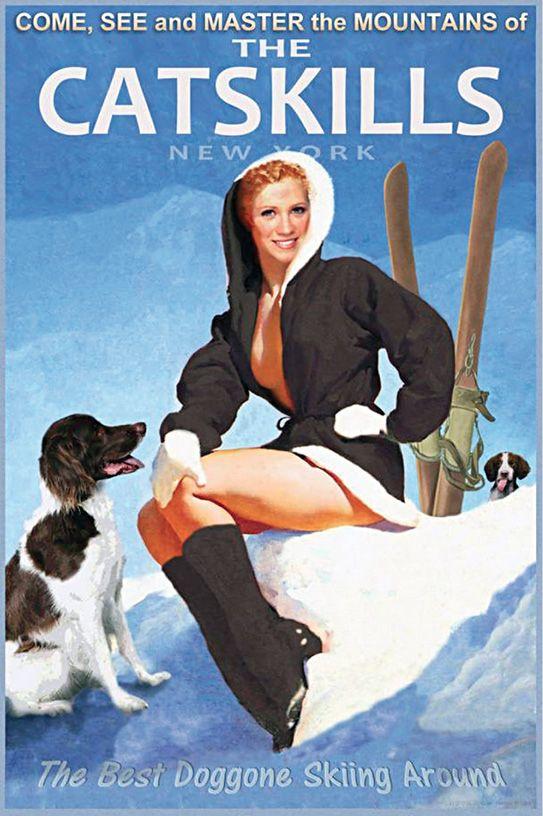
Thousands learned to ski at the Borscht Belt hotels of New York's Catskill Mountains.
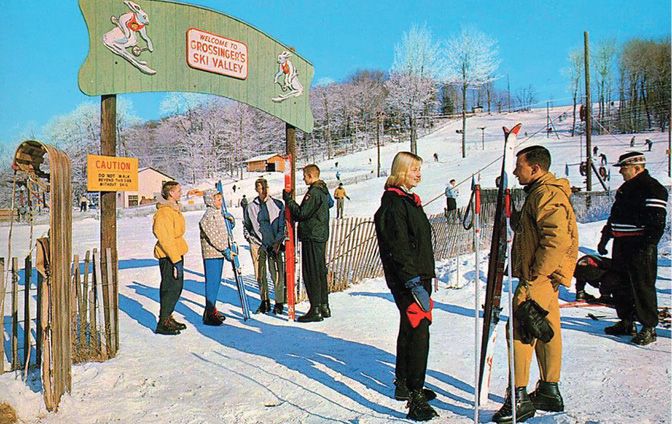
Starting in the early 1950s, hundreds of thousands of Americans learned to ski not on the slopes of major resorts like Sun Valley, Stowe or Aspen, but at more prosaic ski areas and resort hotels with names like Big Vanilla at Davos, the Concord, Gibber’s, the Granit, Grossingers, Homowack Lodge, Kutsher’s, Laurels, the Nevele, the Pines and the Raleigh. These were among the Borscht Belt hotels in the Catskills, about 90 miles northwest of New York City.
Grossinger’s experimented with a surface of ground-up plastic collar buttons, and would collect snow on the property to dump on the slope.
The Borscht Belt—named for a sweet-and-sour beet soup associated with immigrants from eastern Europe—identifies the show-biz culture that arose from Yiddish theater and spawned comedians such as Lenny Bruce, Red Buttons, Sid Caesar, Billy Crystal, Buddy Hackett, Danny Kaye, Carl Reiner and Jerry Stiller. They honed their stand-up acts in the region also affectionately nicknamed the Sour Cream Sierras (sweet red borscht was often served with a dollop of sour cream), or even the Jewish Alps.
The resorts became fictional locations for movies like Dirty Dancing and A Walk on the Moon, and TV shows like The Marvelous Mrs. Maisel, although some were actually shot at look-alike resorts in Virginia, North Carolina or the Adirondacks.
“From the early ’50s up to the early ’70s, the area’s hotels were a haven for upwardly mobile Jewish families who came year-round to eat prodigious amounts of food and chortle at comedians like Jerry Lewis who defined their era,” says Steve Cohen, who wrote lively articles about the Catskills for SKI in 2000 and 2006.
Legendary New York Times snowsports journalist Michael Strauss wrote in SKI in January 1960 (subsequently reprinted in “Borscht, Bagels and Bindings,” Skiing Heritage, December 2000) that “The Catskills were the Alps of mid-coast, middle-class Americans on ski vacations in the mid-20th century.”
chess champion Bobby Fischer gets a skiing lesson from Tony Kastner at Grossinger’s Country Club in Liberty, New York in 1957. In exchange, Fischer taught chess to Kastner. Pictorial Parade/Getty Images
He credits Swiss-born instructor Tino Koch for taking “dime-sized beginner’s areas and turning out hundreds of polished beginners yearning for the more trying slopes of upper New York State and New England.”
For me, it was my boyhood home. Living just a few miles from tiny Holiday Mountain was a dream come true for me, although not so much for drivers who had to contend with machine-made snow drifting onto the adjacent Route 17. Holiday offered only a 400-foot vertical, but I remember the glee of endlessly yo-yoing its narrow white-gauze-bandage runs, riding a Poma and two slow double chairs on weekends and Wednesday evenings after school. I was part of a local vacation attraction that dated back almost 100 years.
SKIING BEFORE THE WAR
Beginning in 1936, Liberty Winter Sports operated the Walnut Mountain rope tow in Liberty, on the site of the now-demolished Walnut Mountain House. Skiers brought refreshments in knapsacks and sunned, like lizards, atop a boulder, according to the CD-ROM Liberty, NY: Memories, produced by Between The Lakes Group (Taconic, Connecticut). In the era before snowmaking, Walnut Mountain depended on natural snowfall. With World War II, and the departure of its male skiers to war, Walnut closed.
October 1948 saw the launch of Christmas Hills in Livingston Manor, now a partially gentrified second home community in the northern part of Sullivan County. According to Sullivan County historian John Conway, writing for the New York Almanack, Christmas Hills had a lot going for it, and there were high hopes for its success. Conway quotes Jeffersonville’s Sullivan County Record (October 21, 1948): “During its first season of operation Christmas Hills will be open every weekend, except during the holiday season when a daily schedule will take effect. It will provide two of the latest type electric ski tows, varied slopes, including alternate ski trails through the woods and a professional ski school.”
The Republican Watchman reported the next day, “There will be the added feature of ‘ski-joring’—the use of a horse for level towing on skis—is planned (sic) as an added thrill for the fast growing ski public.
“The Christmas Hills slopes compare favorably with the best on the Eastern Seaboard. More than 1,500 feet long, the main ski run varies in rise from 30 degrees for the ski expert to a mild 10 to 15 degrees for beginners. Snow conditions should be ideal over a long period and the southern exposure of the slopes afford an exceptionally beautiful setting.”
Conway writes, “Just as it had with the Walnut Mountain ski hill a decade before, the lack of snow prevented Christmas Hills from ever becoming as successful as it might have been.”
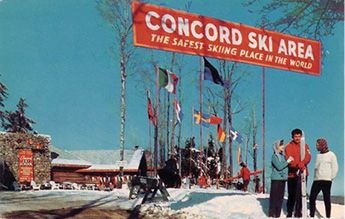
Concord Ski Area’s slogan, “The Safest Ski Place in the World,” was obviously written during less litigious times.
The Concord Hotel in nearby Kiamesha Lake has claimed to be the first ski area to make its own snow (that honor belongs to Mohawk Mountain, which installed Wayne Pierce’s new snow gun in 1950). But the Concord was certainly the first ski area to blow pink and blue snow. Michael Strauss of the New York Times reported that the dye used to color Concord snow badly stained the pants and sweaters of beginners who fell in it.
By 1958, Conway wrote, the hotel was operating an Austrian-manufactured T-bar capable of transporting 460 skiers per hour. Vertical drop was 139 feet.
“At Grossinger’s, before snowmaking equipment was installed in 1952, it was a common practice to physically move as much snow as possible from the hotel’s extensive property to the ski area in order to accommodate the skiers,” Conway wrote. “It was not a foolproof plan, and only occasionally provided satisfactory results.” They also experimented with a surface of ground-up plastic collar buttons.
In the late 1950s, Holiday Mountain Ski Area in Bridgeville was fully operational and billed itself as the closest ski area of its kind to New York City.
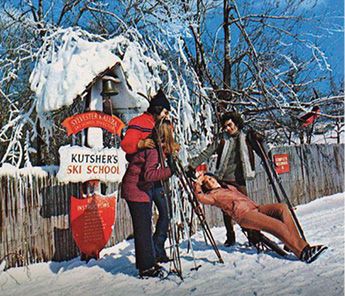
Kutsher’s Hotel was the longest-running of the Borscht Belt grand resorts. It closed in 2013 and has since been demolished.
“It will be no layout to captivate the imagination of experts accustomed to tearing down Stowe’s Nosedive or Mount Greylock’s Thunderbolt, but it will more than suffice for the run-of-the-mill sports lover who wants to test his legs as well as enjoy the sport with a minimum risk of injury,” predicted Michael Strauss in the New York Times on December 8, 1957.
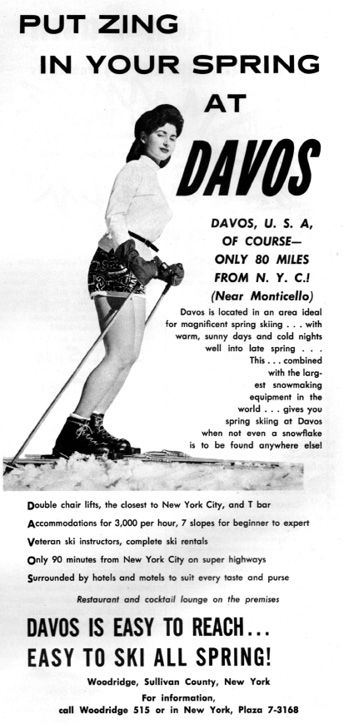
According to Conway’s book, Remembering the Sullivan County Catskills (History Press, 2008), “Holiday Mountain continued to improve its operation over the next several years, and managed to survive the opening of the larger and better equipped Davos in Woodbridge in 1959, as well as the advent and expansion of other ski hills, including the nearby Columbia and the Pines, which, in 1965, became the first hotel to feature a chairlift.”
By 1960, Holiday Mountain was facing stiff competition. There were numerous Sullivan County hotels offering skiing, along with ice skating, tobogganing, endless games of Simon Sez, and the attraction of all-you-can-eat meals. Yet today, Holiday is the county’s only stand-alone ski area, helped in part by reinventing itself as a Ski and Fun Park.
Frozen in Time
Barry Levinson, 59, is a 40-year veteran of the ski industry who teaches part-time at Vail. He was born in Monticello, the county seat of Sullivan County, where he lived for 18 years—in fact, next door to me. We sledded and skied on the hill between our homes. Last summer he returned to the southern Catskills to document the lost ski areas of his youth.
Davos, which later became Big Vanilla at
Davos, offered three chairlifts, four T-bars and a rope tow on a vertical drop of 450 feet. It was popular with beginners and intermediates from nearby New York City.
His Catskill Skiing History page on Facebook documents the remains of dozens of Borscht Belt ski areas. One photo shows a solitary cableless bullwheel at the remains of Big Vanilla at Davos, where at its prime, a waiter in the base lodge would warm your hot toddys with a glowing poker. There are images of chairlifts rotting into the ground and a vintage snowcat stored in a shed with mechanic tools nearby. A YouTube video of Nevele Resort shows skis strewn in the base lodge. A sign offers $20 group
and $60 private lessons (see https://tinyurl.com/neveleruins).
In a recent call with Skiing History, Levinson likened abandoned Catskill ski hills to Chernobyl. “It’s totally frozen in time,” he said. “A post apocalyptic scene. It’s depressing as hell, but fascinating…I documented these lost ski areas out of a sense of nostalgia. Growing up in the Catskills when I was a kid was a nice place to be,” he says.
“While I thought Holiday Mountain was too small, I realized in the grand scheme of things we were lucky to have it. What else would we have done up there in the winter?”
Southern Catskill hotel skiing failed to prosper into the 21st century, with the exception of a small still-operating hill at the Italian-American Villa Roma Resort in Callicoon. Nonetheless, as Michael Strauss wrote in SKI, “there are tens of thousands of Americans skiing today on bigger, better mountains, thanks partly to the early chutzpah of Catskill hoteliers.”
ISHA vice president Jeff Blumenfeld is president of the North American Snow-sports Journalists Association (NASJA.org) and author of Travel With Purpose: A Field Guide to Voluntourism (Rowman & Littlefield, 2019). Learn more at travelwithpurposebook.com.

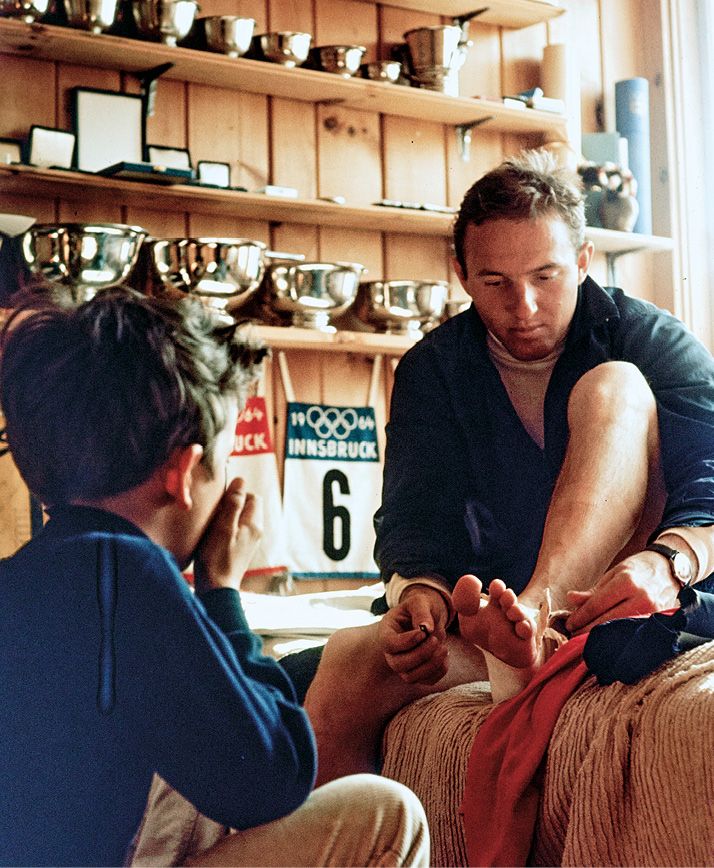 Ryan first got to know Billy Kidd during the 1960 season at Stowe. “He was always friendly and curious about photography and actually filmed some of the Megève downhill for me when I was making the Lange film, Ski Racer. This photo was taken at Kidd’s home in Stowe circa 1967. The wall was lined with trophies and his bibs from the 1964 Innsbruck Olympics, where Kidd and Jimmie Heuga became the first American men to win alpine medals. “Ever since 1966, Billy was plagued with recurring ankle injuries,” Ryan recalls. “It was interesting to see a young admirer realizing that even a hero is vulnerable.” Ryan was fascinated throughout his career with catching athletes away from the competition, believing that these moments can tell a story as revealing as the athletic action itself.
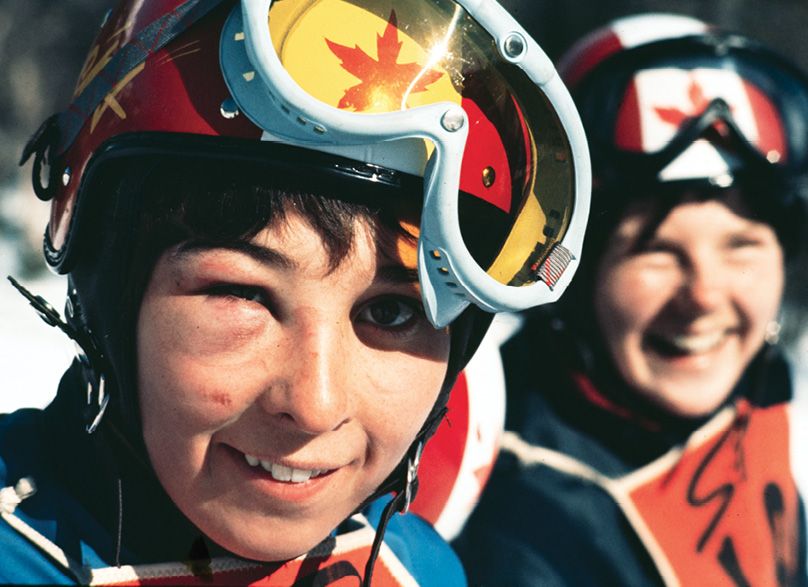 One of the many challenges of nailing a great image is “photographing people up close in difficult situations,” Ryan says. Fortunately, Ryan had spent a lot of time with the Canadian team and earned its trust, such as after a nasty downhill tumble by racer Andrée Crepeau, who recalls the crash. “It was on the flats at the bottom of the downhill in Stowe, where I learned that catching an edge is not always reversible. And down I went, face first—real quick.” The resulting image captures both the physical toll of the crash and the indominable spirit of the Canadian’s women’s team. “In photographing emotional situations, it’s always better to be physically close to the people rather than standing farther back with a telephoto lens,” Ryan says.
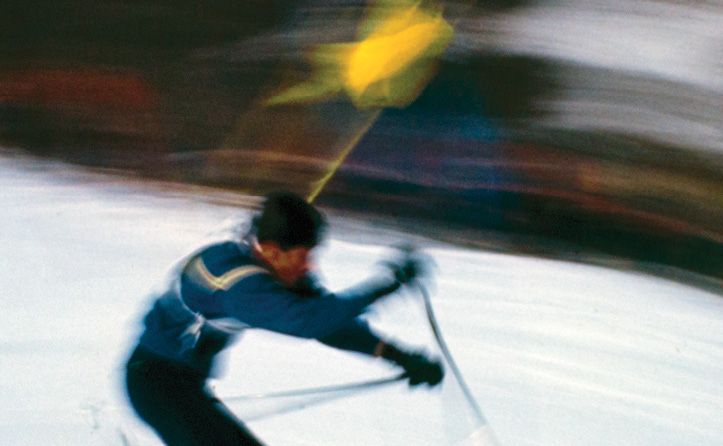 Great photography is at the intersection of art and science, according to Ryan. Getting the technical aspects right, such as the light, focus and framing, is key. But some of it is just heading into the field and hoping for the best. “Shooting ski action at slower than normal shutter speeds, here 1/8 second, is photographing without the luxury of certainty,” Ryan says. “After a while you get better at anticipating the results, but it’s still guesswork.” Here, at Stowe, the “obscuration of the subject promotes an awareness of the overall graphics in the frame.” Ryan also liked the flame-like gate banner flickering above the racer’s head.
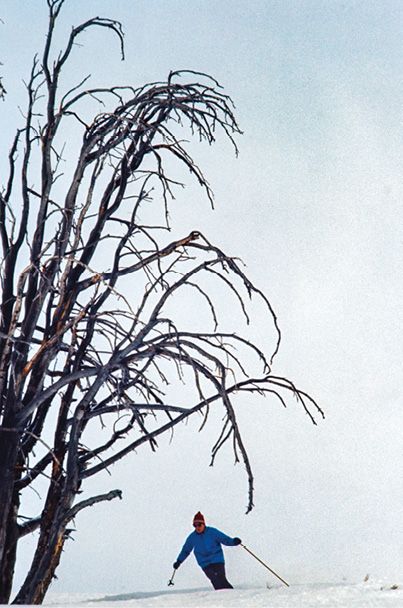 Contrasts help bring a viewer into the frame, seeking out details of the surprising image. “In this case it was the ominous dark tree in the white landscape that attracted me,” Ryan says. “I waited for a bit, assuming a skier would come into the frame. He did and that completed the image.”


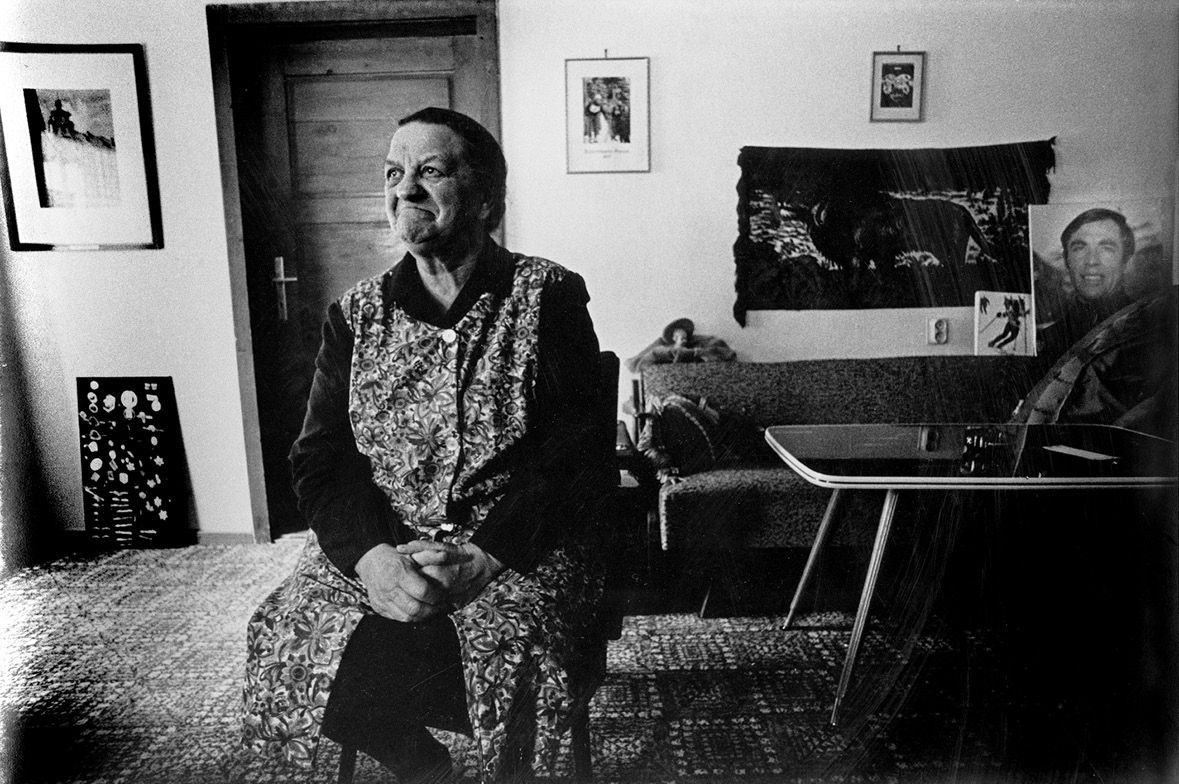 In 1970, Ryan made a documentary film on Austrian ski champion Karl Schranz. He filmed for several weeks on the World Cup circuit. “But I was curious to film Karl’s off-season life in his hometown of St. Anton,” Ryan says. He traveled to St. Anton in the summer, after the race season, and talked to locals who knew Schranz since his boyhood. “Karl brought us to meet his mother, who lived in the same small house she had for the last fifty years,” Ryan recalls. “As a widow, she had raised five children.” With photos and medals decorating this modest shrine to her son, Ryan likes the image because it tells as much about Schranz and his upbringing as it does about his mother.
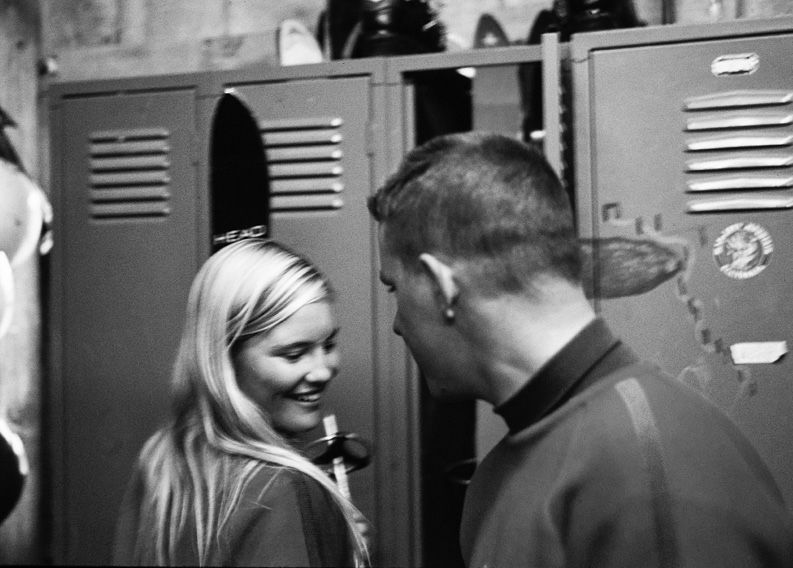 Mammoth was one of the first destinations on Ryan’s unofficial resort itinerary when he headed West as a young racer in the 1960s. “I spent a lot of time there, both skiing and photographing the Mammoth racing program.” The racing operation was a top-notch group, whose roster frequently included members of Mammoth founder Dave McCoy’s family. At the end of a training day, racer Kandi McCoy chats with Dennis Agee, a junior coach at the time, who went on to become the Alpine Director of the U.S. Ski Team. “I liked her shy reaction to a coach’s compliment,” Ryan says.
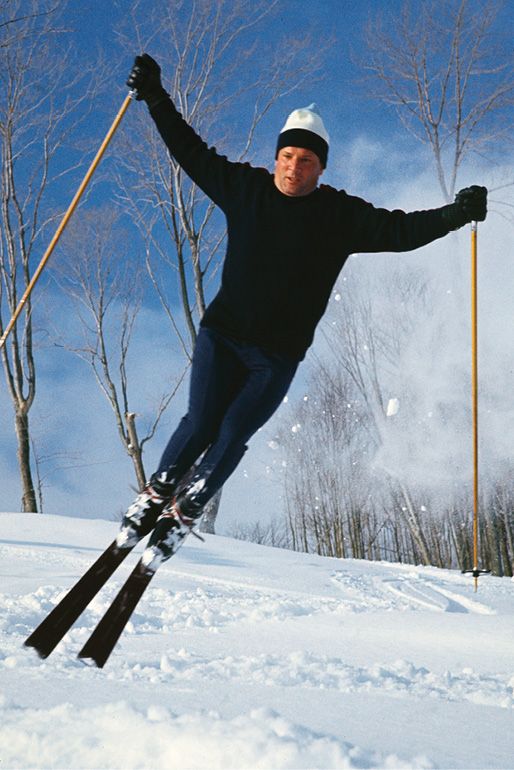 In 1968, John Fry “had the idea to send me to do a photo story on skiing in the flatlands of the Midwest” for SKI. Ryan ended up at Boyne Mountain, Michigan, with its modest vertical of 500 feet. “For Othmar Schneider, a past Olympic champion and previously at Stowe where I knew him, it must have been confining,” Ryan says. “This image had a feeling of him reaching for something greater—or at least higher.”
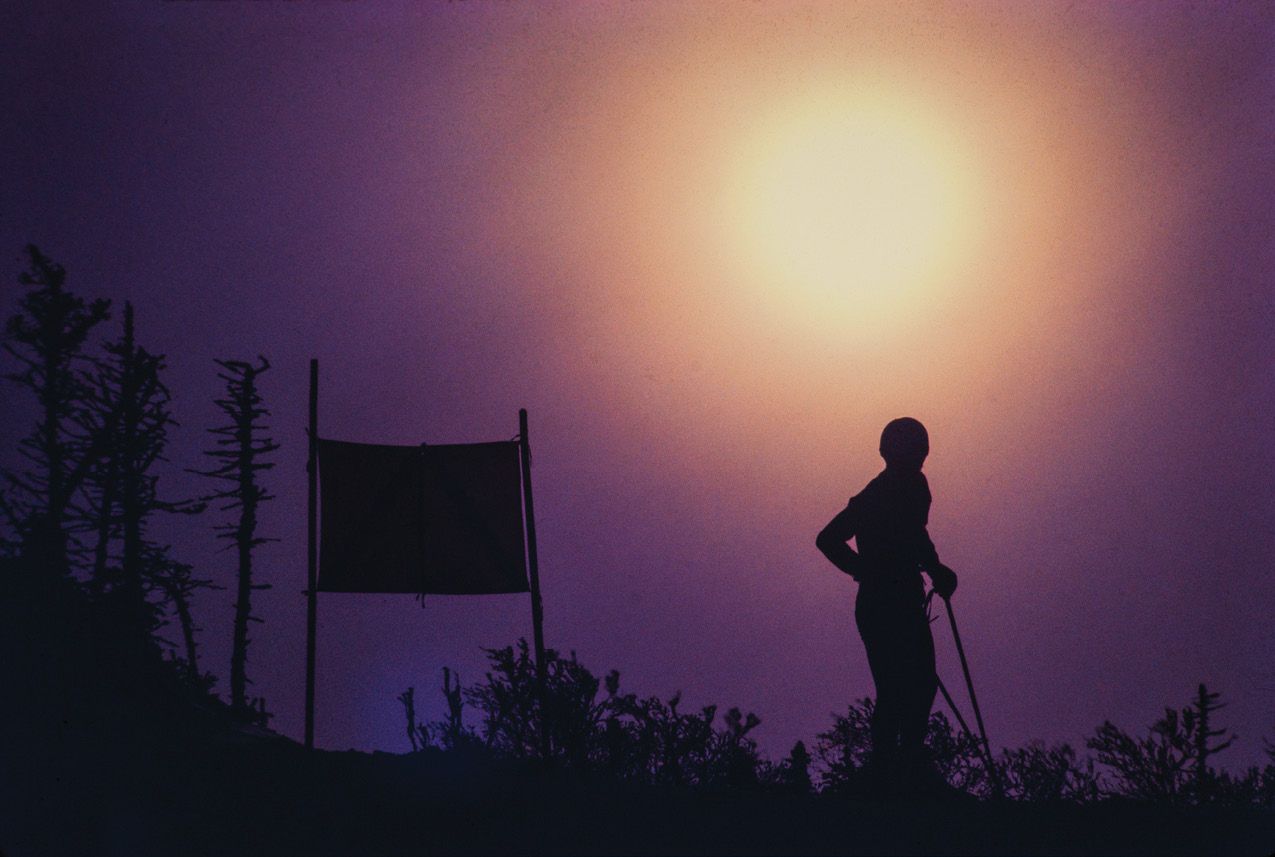 John Fry and Mort Lund assigned Ryan to do a photo essay for SKI specifically on the experience of the downhill discipline. “This is the only event where there is a day or more to prepare, inspecting the course and taking a practice run,” Ryan says. “But there is never the sense of totally understanding what it will be like on race day.” At the end of the day prior to the race, there’s one last inspection down the course. Ryan strived to capture the intense preparation and anticipation in this early evening shot of a solitary racer looking down the course. Ryan: “I often find it rewarding to hang around for that extra hour at the end of the day, after the main action has ended. The light is dramatic and interesting things sometimes happen.”
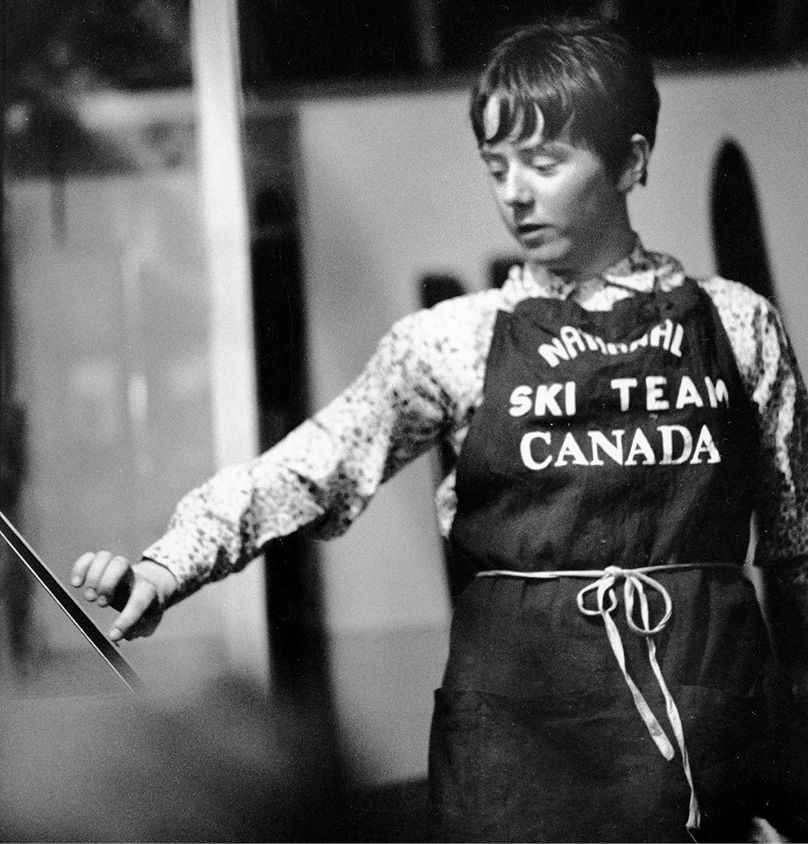 All photographers have favorite assignments. This was one of Ryan’s. “One of my first and most gratifying assignments at SKI was a photo essay on Nancy Greene on the 1967 race circuit. I followed her travels for three weeks, on and off the course,” Ryan says. As well as being a superb racing talent, Ryan learned that Greene was a good friend and dedicated mentor to her teammates. Greene also didn’t let any aspect of her gear go uninspected. “Like many racers of the era, she personally paid exacting attention to the details of her skis,” Ryan says.
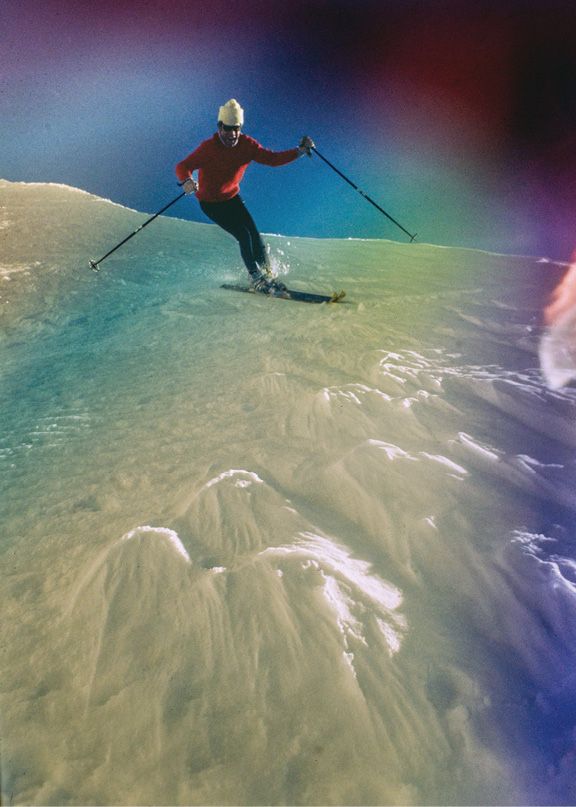 For Ryan’s 1969 photo essay, “The Steepness of Stowe” for SKI, he began experimenting with colored gel filters on the lens. “I liked the creative effect and usually made a few photographs this way on most other assignments,” Ryan notes, such as here as part of a story on Roger Staub at Vail (see right). With the analog film of the time, there was no way to know how the gels were working until the film was processed days later.
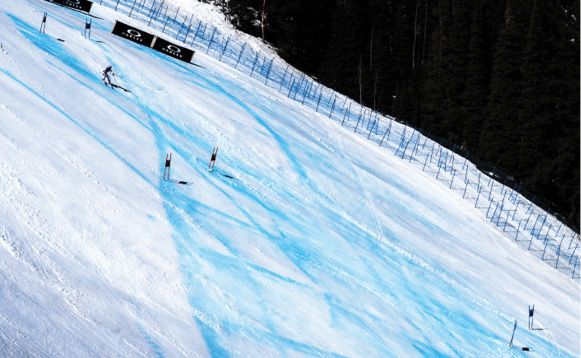 Digital photography now provides instant feedback (see above). “In contrast, a couple of years ago at the World Cup finals at Aspen I was fascinated with the maze of blue lines left by the multiple course markings. Shooting digitally, I could see the image right away and later, in Photoshop, I was able to exaggerate my impression of the intensity of the blue dye,” Ryan says. “Photography now has evolved to allow for, and even expect, imagery beyond simple representation of reality.”
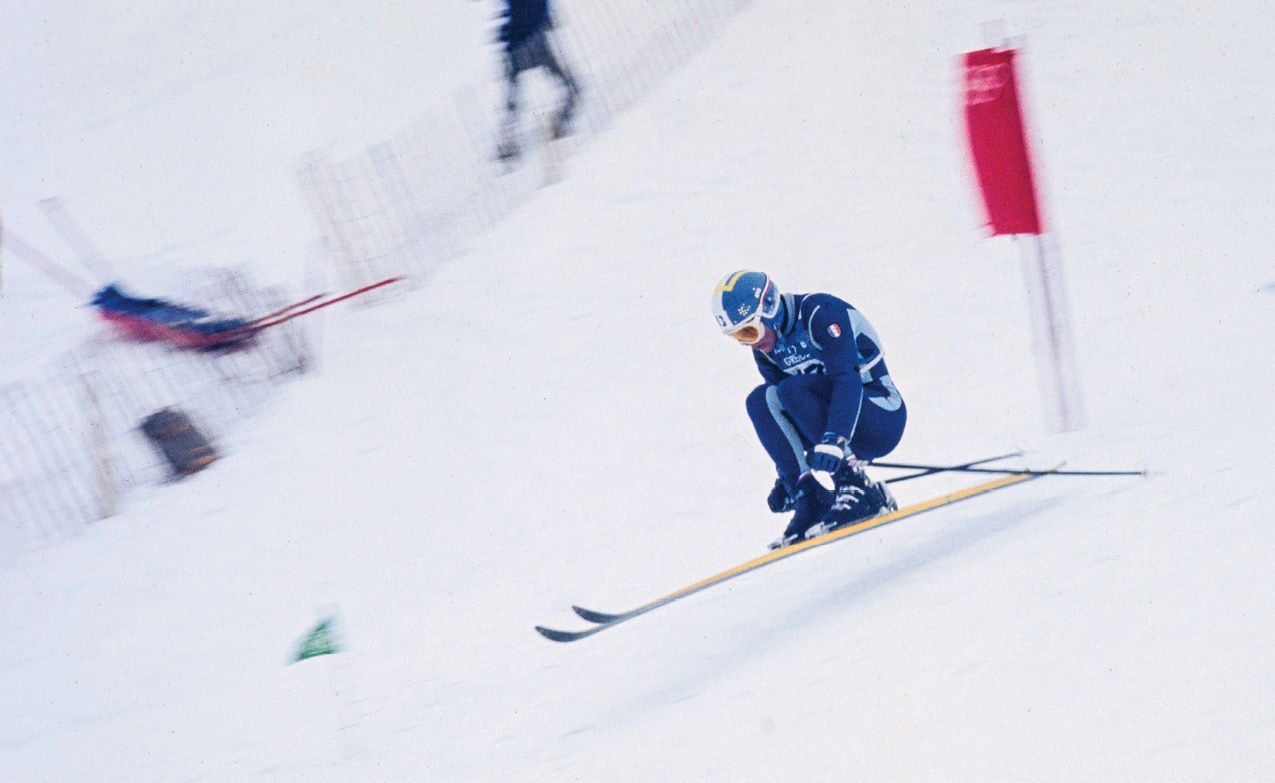 Beat writers are often accused of writing stories for the audience of other beat writers, bringing nuances into play that can only be picked up on by other pros. The same goes for photographers. Ryan was attracted to the action in this shot for a SKI assignment. The racer is in sharp focus at the 1968 Grenoble Winter Games, with other elements blurred. However, “I liked the patrol sled waiting in the background behind the fencing,” Ryan says. “It quietly portrayed a sense of risk and danger.”
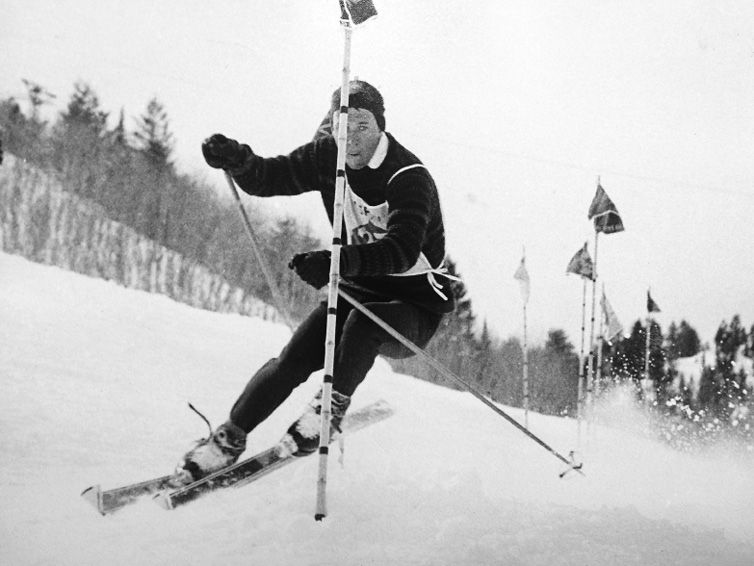 Ryan competed in the Roch Cup slalom in 1962, which became a hinge point in his career. “This was the last of my efforts at ski racing,” Ryan says. “I was decent, but when I was up against world-class racers, I realized I should spend more time at photography.” And for that decision in 1962, skiing’s visual legacy is, indeed, a bit richer.
 Martini trees were a legendary and beloved feature of Taos Ski Valley dating back to the mid-1950s. What could be more memorable than coming across a hidden glass porrón buried in a tree well containing a perfectly-chilled gin martini?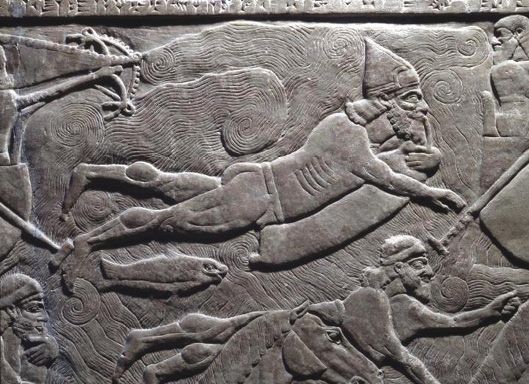


 After a career covering skiing, photographer Paul Ryan has seen it all.