Skiing put Aspen on the map. But bad behavior keeps the town in the news.
In one of the best known and most scandalous ski towns in the world, it’s inevitable that some of the headlines spill over onto the slopes. But scandals were a regular feature of Aspen’s existence from its start in the 1880s as one of the richest and wildest silver mining camps in the West. The most notorious early stories often concerned money, sex, drug abuse and murder, which is still the case today.
Wyatt Earp, for instance, helped make an arrest in Aspen in 1884. That same year, Earp’s buddy Doc Holliday used a pistol in a poker-game shooting elsewhere in the valley, when both men, inconveniently, were wanted in other states for murder. As in every other mining town, Aspen’s population supported thriving cathouses and opium dens.
Fritz Stammberger led a life scripted for
the tabloids, with daring climbs of the
world’s highest peaks and a death clouded
by rumors of international espionage.
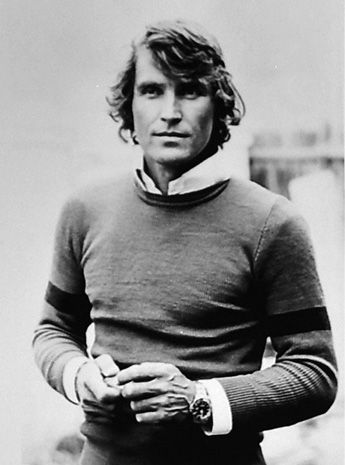
An early skiing-specific scandal involved uber alpinist Fritz Stammberger who lived in Aspen during the 1960s and 70s when he was a founder of Climbing magazine and became one of the leading ski mountaineers of the time. He once chained himself to a tree in town in an unsuccessful attempt to prevent the property owner from cutting it down to build what is now the Miner’s Building hardware store. In the mountains he attracted attention for using no supplemental oxygen and could often be seen skinning to the top of Aspen Mountain with his mouth duct-taped in order to acclimate for the 8,000-meter mountains of Asia.
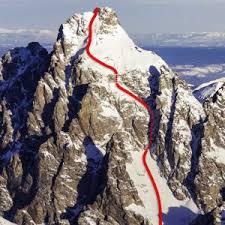
Based out of Aspen, Stammberger became a flamboyant figure locally, but also in climbing’s elite global community. He survived a controversial disaster that claimed the lives of the rest of his 1964 expedition on 27,725-foot Cho Oyu, on the China-Nepal border, where he successfully solo summited and skied down from 24,000 feet to try to get help.
The most scandalous insinuations about him came when he disappeared on a solo skiing and climbing expedition to Tirich Mir in Pakistan in 1975. He spent the night with John McMurtry’s family in Denver on his way to begin that fateful trip, and McMurtry says, “I remember asking him where he was going. He would only say it was top-secret.” Rumors circulated that he may have been spying in the tense region where Russia, China, Afghanistan and Pakistan all shared borders. Multiple efforts to find some trace of him failed. In 1994 Stammberger’s widow, former Price is Right model Janice Pennington, wrote a book called Husband, Lover, Spy, where she said he had been recruited by the CIA and either killed in jihad fighting or imprisoned by the Soviets.
During World Cup and IPSRA ski races in Aspen in the 1970s, several visiting racers and officials got in trouble. Brothers Terry and Tyler Palmer once drove a loaner Jeep up the Little Nell ski run and halfway up Spar Gulch in the middle of the night before getting it stuck. At least they had permission to use the vehicle. Austrian ski stars Hermann Maier and Andreas Schiffer got arrested for stealing a bicycle from a house where they spent the night partying. Their excuse: They needed it to get back to their hotel so they wouldn’t miss their flight out that morning. If they had been a little more ambitious they could have matched World Cup journalist (and Skiing History contributor) Patrick Lang, who was once arrested in Aspen for stealing a car. It was all a misunderstanding. Sort of.
Those hijinks paled alongside the 1976 shooting death of American ski-racing superstar Spider Sabich by his lover, the singer/actress Claudine Longet. Longtime Denver journalist and ski writer Charlie Meyers wrote an excellent story about it for Skiing Heritage (now Skiing History) in 2006.
I had access to some of Spider’s close friends, including Bob Beattie, and have been able to report details that Charlie and others couldn’t. Among them are allegations that Claudine actually stole the pistol she shot Spider with from the house of Spider’s brother Steve, two weeks before the shooting. This potential evidence might have turned the manslaughter conviction into something much different.
The .22 caliber Luger replica was said to have belonged to Spider’s dad, Vlad Sabich Sr., and passed to Steve when the father died.
But Pinkie, as Steve’s friends called him, had been convicted of a felony marijuana charge in 1971, and wasn’t allowed to own any guns. Testimony ultimately declared that the gun passed to Spider’s possession after Pinkie’s conviction. There was also supposedly a substantial payment to Pinkie from entertainer Andy Williams, Longet’s former husband, presumably to keep him from revealing any theft of his gun.
Pinkie never clarified the issue, and died of cancer in 2004. Longet got off with a one-month jail sentence and then married her local attorney (who was married when he went to work for her). To this day, the tragic farce is a black mark on Aspen’s legal system.
That legal system dropped the ball again a year later, when, in June 1977, convicted serial killer Ted Bundy escaped from Aspen’s Pitkin County Courthouse. Bundy was an avid skier and stalked some of his victims at resorts in Utah and Colorado. He was on trial in Aspen for the 1975 Snowmass murder of a visiting nurse from Michigan, Caryn Campbell, whom he had lured into helping him by faking a ski injury.
Recaptured, in December he broke out of the Glenwood Springs jail and committed several more murders in Florida. Bundy was caught in February 1978 and finally executed in 1989.
Donald Trump was making bad relationship news long before he became President of the United States. Several different versions of his 1990 Christmas holidays imbroglio in Aspen made the next day’s front pages in tabloids from Hong Kong to the New York Post. What was known for sure was that both Ivana Trump and Marla Maples were in town with him, and only Ivana was married to him. The rest of the details varied considerably.
Most witnesses (undoubtedly more than there actually were) claim Ivana went off on Marla at Bonnie’s restaurant on Aspen Mountain, called her “Moolah” Maple in her wicked Czech accent and demanded, “You bitch, leave my husband alone!”
Afterward Ivana, who is a former ski instructor, reportedly skied backwards down the slope in front of the Donald, hurling invectives and the occasional snowball at him. It eventually turned into his costliest ski trip ever, reportedly in the neighborhood of $50 million all told for the subsequent divorce. It was rumored that Trump liked to brag, “It was the biggest divorce ever!”
The death of Michael Kennedy while skiing on Aspen Mountain during the Christmas holidays of 1991 was considered scandalous by some, inasmuch as the family was playing football on skis, something they had previously been asked by ski patrol not to do. So the Kennedys had waited for their game until the sweep of the mountain, when there were fewer other people on the slopes.
But it wasn’t other people who were in danger when Michael, having just caught a pass while skiing, pulled it down and then hit a tree head-on. And at that time no one wore helmets. The Aspen Mountain ski patrol cut the tree down the next day to avoid the potential for morbid shrines.
The terrible accident immediately created gossip, including speculation that alcohol or drugs were involved, but toxicology reports said no. And people talked about other Kennedy family excesses (destroying rental houses, illegally trying to buy prescription drugs, heavy partying, etc.) in a town they’d been visiting since the 1960s. However, many who live in Aspen where death in the mountains isn’t a rarity, saw it not as a scandal but simply and sadly what can happen, especially in a large, adventurous and willful family.
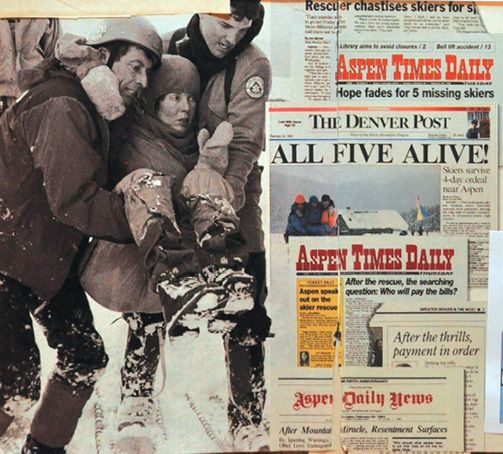
The so-called leader of the group was Ken Torp, and for years afterward any dumbass move in the backcountry was called “Torping.”
A 1993 fiasco made some non-celebrities temporarily famous when five skiers from Denver became lost and stranded on a backcountry hut trip during a brutal February blizzard that had been widely forecast. They were discovered alive after four days of intensive and dangerous searching and quickly went from being semi-heroic survivors to fools in way over their heads. They had gone into the mountains in spite of warnings and put dozens of other lives at risk looking for them. Sports Illustrated magazine gave it four pages. The so-called leader of the group was Ken Torp, and for years afterward any dumbass move in the backcountry was called “Torping.”
Aspen has had no shortage of controversies over the years. Locals have quarreled over aggressive ticket pricing, unionization of the ski patrol, underground ski school instructors and terrain expansion, among other issues.
History suggests that it won’t be long before another major scandal puts Aspen in the news again.
Stay tuned.
This piece contains excerpts from the book Scandal Aspen. Jay Cowan has written about skiing for five decades from his home near Aspen (and now in Montana) and has received multiple writing awards, as well as inclusion in The Best American Travel Writing. His many books include Hunter S. Thompson and Scandal Aspen, his latest.
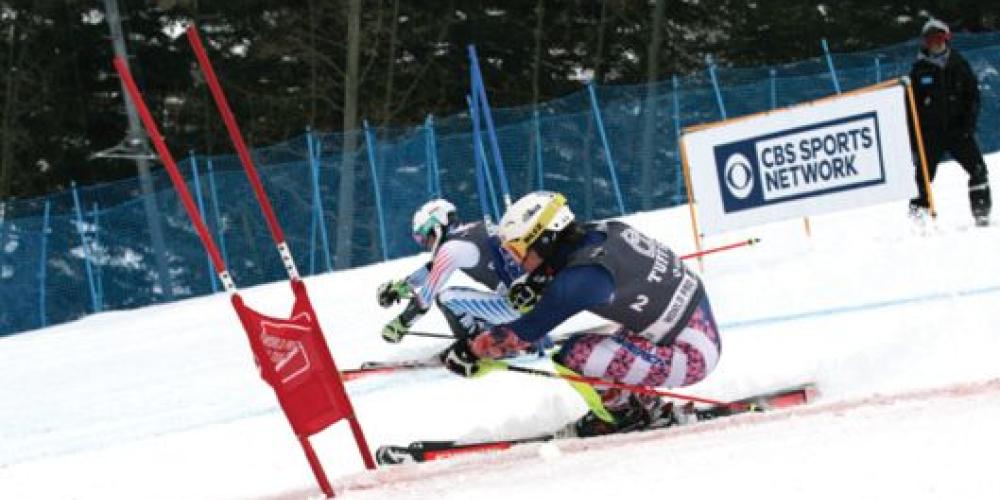
World Pro Ski Tour draws star athletes but suffers short season due to COVID-19.
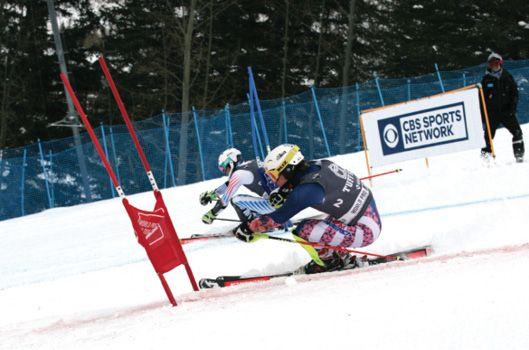
The World Pro Ski Tour never got to the meat of its season, which would have seen seven-time gold medalist Ted Ligety contending with silver-and-bronze Olympian Andrew Weibrecht for $150,000 in championship prize money.
Before the pro season was canceled, Ligety, at age 35, did break away from the World Cup season to compete in two Pro Tour races at Steamboat’s Howelsen Hill and Eldora. He had trouble learning to time the barn-door starting gates and his best finish was a fourth place at Steamboat—proving, he said, that the Tour was serious competition.
The Tour entered its third season with six events scheduled. A long list of sponsors, led by Tito’s Handmade Vodka, offered $300,000 in prize money. When COVID-19 canceled the final three events, Rob Cone of Killington and Middlebury College, a former NCAA champ and U.S. Ski Team Europa Cup racer, topped the field of 21 racers who finished in the money, winning $30,200 for the truncated season. Michael Ankeny, of Buck Hill and Dartmouth College, a veteran of eight years on the U.S. Ski Team, came second ($12,200). Garrett Driller of Squaw Valley and Montana State, an NCAA All American and U.S. Alpine Championship parallel slalom winner, finished third ($8,350).
The Tour Finals at Sunday River and the World Pro Championships at Taos were scheduled for April, after the close of the World Cup and national championships. Ligety and Weinbrecht were on the schedule to compete at those races. “To succeed, the tour needs those top athletes,” said tour chief Jon Franklin, who earned his chops managing top skiers for International Marketing Group. Because the Taos championship event would have awarded $150,000 in prize money, the participation of FIS superstars might have upended the full-season leaderboard. All the events were televised by CBS Sports Network (see season highlights at https://worldproskitour.com/multimedia/).
Franklin predicts a longer, richer tour for the 2020-2021 season. “We don’t have a schedule yet because it has to fit around the NorAm and World Cup schedules,” he points out. He hopes to open the season before the Beaver Creek World Cup in November.
Pro skiing has always depended on the star power of World Cup racers, beginning when Bob Beattie’s new World Pro Skiing circuit recruited the likes of Jean-Claude Killy and Billy Kidd. Fifty years ago, in 1970, Kidd won the FIS World Championship combined gold medal, promptly turned pro and then won the WPS championship the same season. He’s still the only skier to pull that one off. —Seth Masia
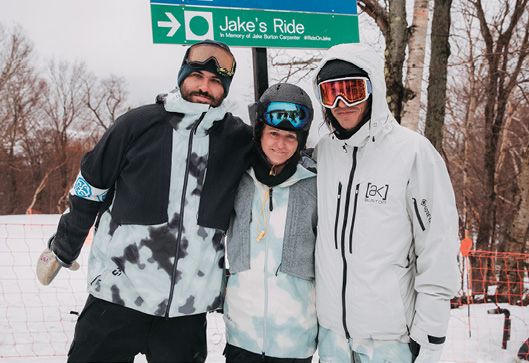
Jake Burton’s wife and business partner, Donna Carpenter,
attended “A Day for Jake” on March 13 at Stowe, Vermont,
with his sons Taylor (left) and Timi (right).
Photo: Jesse Dawson/Burton
A Day for Jake
On March 13, snowboarders around the world took a ceremonial run to honor the late Jake Burton Carpenter —pioneer, innovator and entrepreneur—who died last November of testicular cancer. Though the global “Day for Jake” took some serious hits, most notably from the novel coronavirus and nasty weather, the event still came off at about a dozen resorts, from Avoriaz (France) to Boyne Mountain (Michigan), Big Sky (Montana) and Copper Mountain (Colorado).
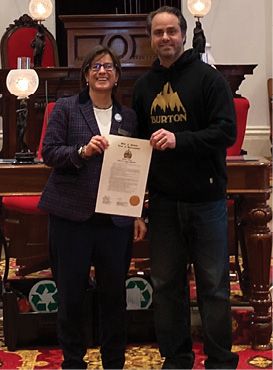
Skiing History editor and Vermont state
Rep. Kathleen James in the statehouse
in Montpelier with Jeff Boliba, a Burton
vice president. A first-term legislator,
James sponsored a resolution honoring
Jake that won unanimous approval from
all 180 of Vermont’s senators and
representatives.
Jake’s wife and business partner, Donna Carpenter, and his sons George, Taylor and Timi, attended the festivities at Stowe, Vermont. A gentle beginner’s trail, Lullaby Lane, was renamed “Jake’s Ride” and Jeff Boliba, Burton’s vice president of global resorts, read a Vermont General Assembly resolution honoring Jake for his role in pioneering and promoting the sport. Just a few days earlier, Boliba had dropped by the statehouse to meet Rep. Kathleen James, a first-term legislator and the editor of Skiing History. James sponsored the resolution, which received unanimous approval from all 180 of Vermont’s Representatives and Senators.
Burton Snowboards then quickly turned its attention to the COVID-19 response, delivering more than 200,000 KN-95 masks to hospitals across Vermont and to Dartmouth-Hitchcock Medical Center, just across the border in New Hampshire. ISHA has launched a digital archive project to document how the ski industry is responding to the pandemic; see page 26.
Looking for Vintage Ski Books?
The word ski is derived from the Old Norse word skið, which means “snow-shoe” and “billet of cleft wood.” It first appeared in print English in 1755, in Volume 12 of The Monthly Review of London, an English periodical.
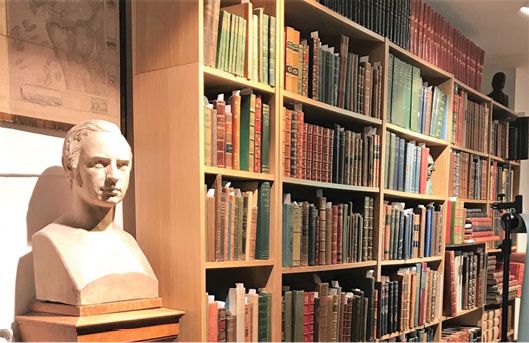
Ruuds Antikvariat,
courtesy M. Michael Brady
With such deep linguistic roots, it’s no surprise Norway is a key source of vintage ski history books. And one of the country’s top shops is Ruuds Antikvariat on Ullevålsveien, a busy north-south artery in Oslo. From the Latin antiquarius, also the root of the word “antique,” Antikvariat means “vintage bookseller” in Norwegian.
The shop was founded in 1972 by Jon Ruud and is now managed by his daughter, Vibeke Ruud. Its glass display cases and shelves include such ski-history classics as Farthest North by polar explorer Fridtjof Nansen (1861–1930), with its many drawings of skiing, then called “snow-shoeing” in English. Another hallmark is Voyage picturesque aux alpes norvégennes (Pictorial Journey Through the Norwegian Alps) of 1821 by Finnish-Swedish military officer and cartographer Wilhelm Maximilian Carpelan (1787–1831), among the first to survey and describe the interior of the country.
Bibliophilism is a cherished part of Scandinavian culture, reflected in the presence of no less than 72 antiquarian and used bookshops in Denmark, Finland, Norway and Sweden. They’re all interconnected in an online network, where you can search more than 1.5 million titles in English, Danish, Norwegian and Swedish (https://www.antikvariat.net/en/?currency=USD). To learn more, go to: https://ilab.org/booksellers/ruuds-antikvariat. —M. Michael Brady
Typo Makes Trump Into X-C Skier
As a leading journal of skiing’s historical record, we feel compelled to correct an error noticed by an eagle-eyed Skiing History correspondent.
Not known as a fitness buff in this COVID-19 time or any other era, U.S. President Donald Trump was recently described (incorrectly) as a Nordic destination skier. On May 9, 2020, Positively Scottish carried the headline “IVANKA TRUMP’S PERSONAL ASSISTANT TESTED POSITIVE FOR CORONAVIRUS, ACCORDING TO A CNN SOURCE.” Included in the text was the startling statement that, “The day after breaking his self-isolation of the White House for a cross-country skiing trip intended to report the country’s willingness to start again, Trump received the news one of his Oval Office waiters tested positive for the virus.” While the route may have been cross-country, ski gear was not involved. —Jonathan Wiesel
Photo: Jeremy Davis
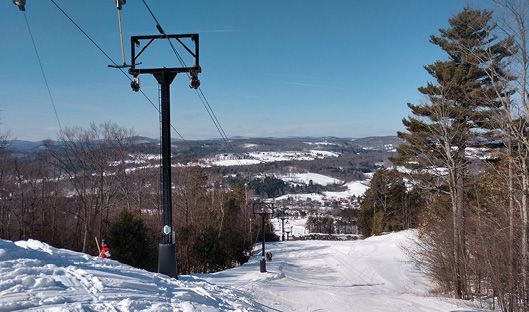
Mount Ascutney Adds T-Bar
Mount Ascutney, a former major ski resort in southern Vermont, operated from 1946 to 2011. Generations of skiers learned to ski at this family-friendly area and were sad to see it become a “lost” ski area. But it wasn’t lost for long.
Several years after it closed, the nonprofit group Ascutney Outdoors worked hard to reopen a few trails, served by a brand-new rope tow in 2016. This past season featured the opening of a refurbished T-bar, expanding the lift-served vertical to just over 400 feet and 10 trails. The upper slopes, under a conservation easement, are maintained as hike-to terrain for those who earn their turns. The lower slopes also host a tubing facility, and an Outdoor Center serves as a hub for skiers, hikers, mountain bikers and community events.
Purchased from Le Relais, a ski area just outside of Quebec City, the T-bar was donated by Glenn and Shelley Seward in 2017 in preparation for future installation. Over the next two years, a fundraising campaign collected enough money for the T-bar to be installed at the end of 2019 and fired up in February 2020.
Ascutney’s humble beginnings are similar to many Vermont resorts. It was founded in 1946 as a rope-tow area by investors Bob Bishop, Catharine “Kip” Cushman, Robert Hammond, Bob Ely, Dr. Peter Patch and Dick Springer. Over the next six decades, the area went through many ownership changes, experiencing financial setbacks but also expansions, including a large hotel in the mid 1980s and a high-speed quad to the summit in 2000. Mounting fiscal problems led to its closure in 2011, and the ski area assets were sold off bit by bit.
Mount Ascutney is now a shining example of a new paradigm for smaller ski areas throughout New England that had financial difficulties or closed. Strong volunteer support, generous donations, and operating as a nonprofit can help these areas to succeed where prior operating attempts have failed. Loyal skiers have refused to let their favorite mountains fall by the wayside and are doing whatever they can to save special places like Ascutney.
Just ask Glenn Seward: “Those of us who love Ascutney don’t give up easily.” For more information, go to www.ascutneyoutdoors.org. —Jeremy Davis
Snapshots in Time
1959 TAKE IT FROM THE TOP
In the days when the rope tow was the mainstay of ski areas, it was relatively easy and inexpensive to provide separate slopes for each class of skiers. But with the introduction of the chairlift, originally intended to serve only more experienced skiers, the situation changed. Operators found that the attractions of the chairlift tempted beginners to ski way over their heads. To alleviate the problem, they cut novice trails from the top of the mountain over lengthy but gentle routes. This solved one problem, but created others. These novice trails frequently merge with more-advanced trails, or worse, advanced trails branch off novice trails. The answer seems to be a radical increase in trail marking. —John Southworth (SKI, December 1959)
1967 THE GREAT DEBATE: HOW LONG SHOULD YOUR SKIS BE?
There is no question today that the problem of the right ski length for the skier has become more and more vexing. Some people claim the best ski is a two-and-a-half footer for beginners, while others say the ski should be as tall as the beginner. Still others stick with the tried-and-true “hand high over the head” rule for every skier. Experiments and trends of recent years have warmed the air with questions: Both Head and Hart, following the lead of Clif Taylor’s Short-ee skis, have had great success with expensive five-foot skis … and last year, Karl Pfeiifer’s school at Killington introduced the Graduated Length Method that proved to be resoundingly popular at Killington and elsewhere. —Morten Lund, “Golden Rule for Ski Length” (SKI, September 1967)
1968 THE WAY IT’LL BE ON TV
In the four years since Innsbruck, television technology has advanced to the point where you will be able to see the dramatic opening ceremonies for the 1968 Winter Olympics live and in color at 11 o’clock in the morning EST and the Alpine skiing events in prime evening time, soon after they actually take place. And the use of split-screen technique at Grenoble will enable viewers to see the tenths of seconds that determine the gold, silver or bronze medals. For instance, if Jean-Claude Killy has competed his final run and is leading in the slalom, we can show Billy Kidd’s run live, with his time running against the time he needs to beat Killy. … The Winter Olympics will be one of the most challenging undertakings we’ve ever assumed at ABC Sports. —Roone Arledge, Vice President, ABC Sports (SKI, February 1968)
1978 WINTER PARK’S MIDDLE EAST CRISIS
George Haddad and entourage came to Winter Park last January for a celebrity pro-am event in a van bearing Minnesota license plates. When the fun-filled weekend was over, a cadre of red-faced officials and press found themselves the victims of one of the neatest little scams since The Sting.
Attired in authentic flowing robe, burnoose and a pair of vintage leather ski boots, Lebanese “oil sheik” Saleim Abdul Haddad hit the slopes and quickly stole the cameras. Photos were submitted to AP and UPI, and the sheik’s inimitable racing style graced the pages of papers from coast to coast. It wasn’t until an alert reader of a Duluth, Minnesota newspaper noted a striking resemblance between the sheik and George Haddad, fun-loving owner of a local shoe store, that the hoax came to light — and the sand hit the fan. —Ski Life (SKI, October 1978)
1989 PUTTING SKIERS TOGETHER
Mingling is a way of life at the Bark Eater, a 150-year-old farmhouse inn nestled in the Adirondack Mountains of upstate New York. Proprietor Joe Pete Wilson brings skiers together at a china- and linen-covered table for family-style dining every evening, seating guests into conversational groups based on personality. On those nights when the chemistry is right dinner can become a late-night affair, ending in a story-swapping marathon.
Joe Pete figures he has about 200 stories in his head, containing humor that ranges from “clean to dirty.” “We spend quality time with a small number of skiers,” he says. “I’d rather have 10 people and make sure they have a good time than 30 people who come and float away, never to be seen again.” —BOB LAMARCHE (SNOW COUNTRY, FEBRUARY 1989)
SKI ART
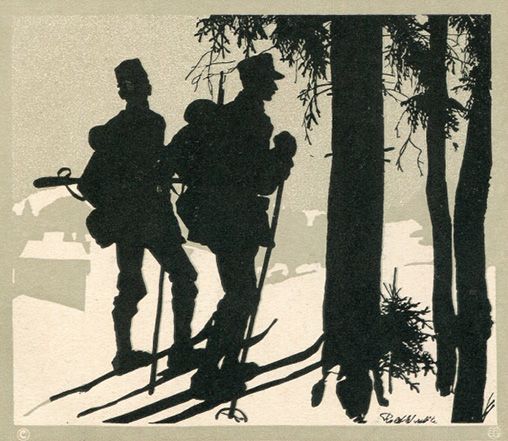
This Winkler silhouette shows World War I ski troops
emerging from the woods.
Rolf Winkler (1884–1942)
The solid shape of any silhouette is what gives the image its power. In the mid-18th century, Louis XV’s finance minister, Étienne de Silhouette, levied a wealth tax on the citizens of France. This brought ignominy upon him; he was mocked and associated with cheapness. In the art world, a quick outline became known as a drawing à la silhouette.
At the time, portraits were painted, and therefore only those who could afford to sit for an artist were portrayed. But some artists had the ability to cut the profile of a person: These “silhouettes” were both quick and cheap and therefore, before photography, increasingly popular with the middle classes. And the cutting was done extremely quickly—for example, if you were visiting a country fair and happened on an artist with scissors in hand. One of the most well-known of these artists used to advertise “three-minute sittings.”
With the development of photography in the mid- to late-19th century, the call for silhouettes declined. However, in the early 20th century, probably inspired by the Arts and Crafts Movement, silhouette artists became extremely popular as they seemed to portray, in a curiously old-fashioned and nostalgic way, a treasured past. Nowhere was this more obvious than during World War I, as displayed here: These troopers are emerging from the woods and heading for the village below, just as they would have done in peaceful years.
Rolf Winkler, born in Vienna in 1884, was a painter, illustrator and silhouette artist. He studied at the Landeskunstschule (State Art School) in Graz, Austria, and later he spent time in Dachau, Germany in a vibrant art colony under the leadership of Ludwig Dill and Adolf Hölzel, landscape painters who were embracing modern trends. Dill was a founding member of the Munich Secession. Winkler settled in Munich in 1905 and over the decades illustrated over 400 books, mostly for juveniles. He also worked for the satiric weekly, Fliegende Blätter (Flying Pages). The illustration here is entitled “Skipatrouille” and was published by Teubner in Leipzig. This extraordinary publishing house specialized in Greek and Roman texts, mathematics and the sciences, and yet here in 1915 is Winkler’s “Ski Patrol,” one of six silhouettes contained in a special folder. Maybe this was their way of supporting the war effort. —E. John B. Allen
The lead poster in Everett Potter’s “Off the Wall” article (Skiing History, March-April 2020) was a 1932 classic by Johan Bull, best known as a popular artist in The New Yorker. He was the father of ski-country architect and ski-resort planner Henrik Bull (1929–2013), long a stalwart member of ISHA. From time to time, Henrik wrote for SKI magazine and then for Skiing Heritage, and often helped us out with lengthy translations from old Norwegian books and newspapers.
From the same issue, I need to correct my error in the article “Marie Marvingt, Superhero.” I identified Harald Durban-Hansen, the Norwegian ski coach, as a Swede. Thanks to Einar Sunde for pointing out this blunder.
Seth Masia, ISHA President
Paonia, Colorado
Meeting the Masters
Two articles in the March-April 2020 issue brought back memories of meeting two of the “greats” in skiing history.
The story about “Alf Engen’s Idaho Roots” recalled a trip to Woodstock, Vermont, in the late 1940s. We skied at Suicide Six and I took my first ski lesson. My instructor, as I recall, was Walter Prager, who at the time was coaching the Dartmouth ski team. Only later did I realize the extent of Prager’s greatness—his Hall of Fame status and achievements as a competitor and mentor to the ski world.
The article on Skiing History Day at Mad River Glen brought back another memorable experience. In the mid 1950s, a friend and I skied there for the day. Late afternoon, we met another friend for a drink at his family’s cabin, tucked in the woods across the road from the base lodge. His father prepared a special recipe for Glühwein in a saucepan on a wood-burning stove. The father was Mad River Glen founder and Vermont ski pioneer Roland Palmedo (see “The Amazing, Intriguing Roland Palmedo” by Mort Lund in the September 2009 issue of Skiing Heritage). Sadly, at the time I didn’t appreciate how special it was to be sharing toasts and conversation with a man who contributed so much to the sport I love, nor can I recall the mulled-wine recipe!
Peter Barrett
Bellevue, Washington
Before There Was Swix
Under present circumstances (COVID-19), I have plenty of time to read every article and word in Skiing History, my favorite publication. On Greg Ditrinco’s well-detailed piece about fluorinated waxes and the FIS (March-April 2020), I’m compelled to mention that a ski-wax company was in operation before Toko and Swix—the French company known as VOLA. Indeed, it’s 85 years old!
VOLA was incorporated in 1935 at Colmar, and moved to Passy in the heart of the French Alps soon after. Reliable Racing Supply has been (and is currently) the U.S. importer/distributor for VOLA. Included in our first direct-mail catalog in 1969 was a VOLA product called “Coloneige.” This product was used to identify the placement of slalom poles into the piste (necessary to reset bamboo poles that were often knocked out by the racers). Soon after, we distributed “Durcineige,” an early use of a chemical to harden the snow.
Currently, Reliable Racing offers several VOLA products direct to the consumer, not limited to ski wax, but including FIS-homologated helmets, goggles, accessories and ski-tuning products. In 2019 they introduced E-wax, a 100 percent biodegradable product, made from plant and animal sources. For the 2020-2021 season they have introduced MyEcoWax, a non-fluorinated race wax with excellent gliding properties, in which more than 50 percent is made from plant and animal sources.
VOLA is a major manufacturer with 34 international distributors, and is a big player on the European competition scene. The current CEO, JF Ferreira, attended the University of Colorado at Boulder, and was an NCAA All-American in skiing.
John Jacobs
Reliable Racing Supply Queensbury, New York
1898: First Tracks in Zermatt
The recent article on Zermatt (Skiing History, January-February 2020) left the impression that skiing began there in the 1928–1929 season. But in the Kleines Zermatter Brevier, we read “it was a gloomy and snow-filled day on 29 December 1898 when the first ski tracks were seen in Zermatt.” These were the tracks of Dr. Hermann Seiler and Viktor Beauclair.
In 1905, “certain amateurs simply solved the question of winter quarters by breaking into inns, calling them huts to reassure their conscience,” according to an account in La Montagne (March 20, 1905). One “modest little inn” was open in 1908, the year the Ski Club Cervin (the French name for the Matterhorn) was founded. Arnold Lunn—the panjandrum of British skiing—weighed in with the judgment in 1913 that it “by no means follows that a good summer centre will make a good winter centre. Zermatt is a case in point.” After the war, the Cervin Club built a jump on the Steinmatte, about a 10-minute walk from the village.
When the “season” began in 1928–1929, General Wroughton, one of the Ski Club of Great Britain’s stalwarts, commented that “Zermatt’s slopes are too steep and rocky to be inviting,” while others judged them “too precipitous for good ski-ing.” “Incidentally,” wondered an old mountaineer almost a decade later, in 1937, “would the place be much good for ski-ing anyway?”
E. John B. Allen
Rumney, New Hampshire
Alf Engen and Walter Prager in Sun Valley, 1947, as co-coaches of the 1948 US Olympic Team. Photo courtesy John Lundin.
Alf Engen in Sun Valley (Part 2)
I enjoyed the March-April “Short Turns” highlighting Alf Engen’s role in early Sun Valley. The article mentions Alf recalling first visiting Sun Valley in winter 1936, which is interesting because that visit is not mentioned in other accounts. Engen was so well known at that time, one would think the media or correspondence of that winter would have noted it. Rather, the founding skiers who greatly helped to determine the layout of the ski runs and lifts on the hills above Ketchum were Charley Proctor, Count Felix Schaffgotsch, Count Erwein Wilczek, Richard Scott, John E.P. Morgan, and some local boys who could ski.
While Alf did direct CCC crews to cut the first runs on Baldy, as the late Mort Lund and others have documented, the trails were laid out primarily by Friedl Pfeifer and Dick Durrance with Alf’s help. It’s also interesting that Dartmouth Outing Club (DOC) members had a role in helping to get Baldy ready. Alf’s CCC crews could not overnight on the mountain, so they could only clear Baldy’s lower slopes in a day’s work. For the upper slopes, Harriman had Dick Durrance hire DOC members to do the clearing and stay in eight-man camps in August 1939. I hope we all get to enjoy the fruits of Alf’s labor when we meet in Sun Valley for Skiing History Week in December!
Kirby Gilbert
Bellevue, Washington
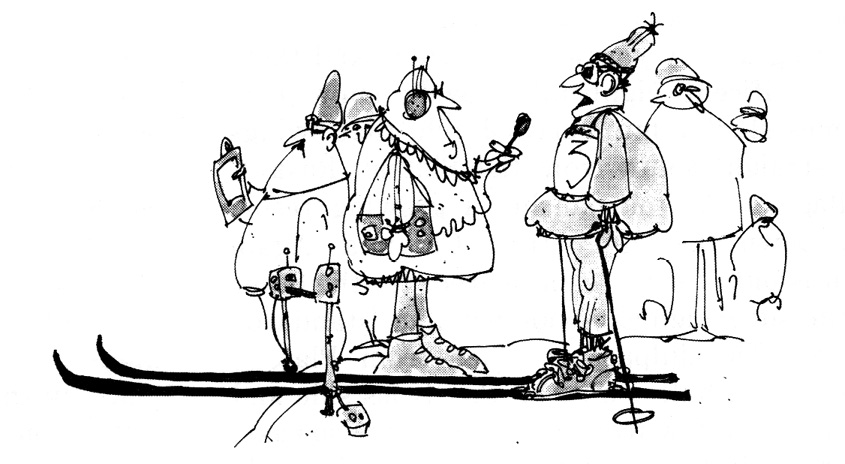
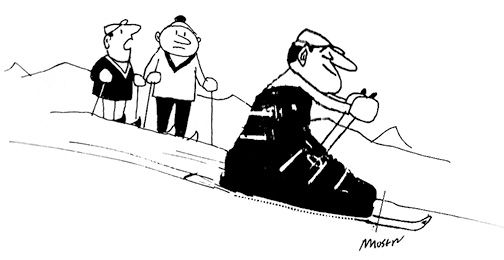
"I say they're overdoing the size of the boots this year." From SKI, October 1969
At the annual Swann Galleries auction, collectors snapped up vintage ski posters of both classic and unique design.
The annual sale of vintage ski and winter posters at Swann Auction Galleries in New York City on February 13, 2020 featured 30 posters, including a handful of American classics, a celebrated Swiss ski poster, and some striking examples of midcentury graphic design.
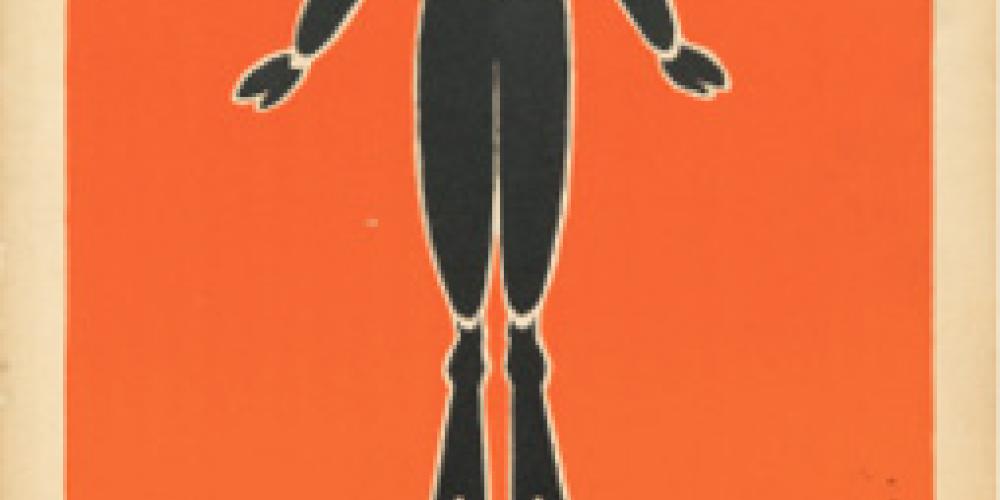
One exceptional example of graphic design on offer was Johan Bull’s window card For Norges Deltagelse | De Olympiske Ski from 1932 (shown above). Measuring just 22 x 14 inches, this was a promotion piece for the Norwegian American Olympic Committee seeking contributions to help send Norwegian athletes to Lake Placid in 1932.
“It’s one of the really unusual pieces we have,” said Nicholas Lowry, president of Swann Auction Galleries, head of the gallery’s poster division and a familiar appraiser on PBS’ Antiques Roadshow. “It mentions the 1924 games in Chamonix and the 1928 games in St. Moritz. The team was preparing for the 1932 games in Lake Placid and that’s followed by a question mark. It’s super simple. “
This powerful and effective image depicts a lone, faceless ski jumper, and the artist reduced his palette to black, orange and white on beige paper stock. Bull, who was born in Oslo, moved to America in 1925 and began contributing cartoons to The New Yorker. The poster soared past its $1,000 top estimate and sold for $1,690 (including the buyer’s premium, which is 25 percent of the hammer price).
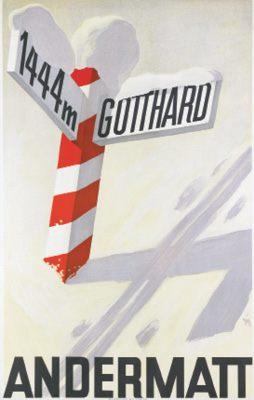
A classic poster on view at Swann work was by the Swiss artist Alex Walter Diggelmann. His Andermatt / Gotthard from 1931 has a simple yet compelling design. It makes plain that this resort at the Gotthard Pass is covered in exceptionally deep snowfall — enough, in fact, to almost hide the road sign. A skier’s tracks go past the sign to drive the point home. Estimated between $1,500 to $2,000, it sold for $1,820.
Another brilliant bit of design was featured in artist José Morell’s España, a 1948 poster celebrating the joys of skiing in the Pyrenees. Published by the Madrid Tourist Office, the estimate was $1,000 to $1,500 and it realized a final price of $1,375.
“We first sold this poster many years ago,” said Lowry. “Talk about suggestive. All you see are the skis, the shadow of the skier and the group of other skiers watching intently. You get the idea that he’s clearly moving fast.”
Knut Yran’s famous image, Norway / The Cradle of Ski-ing, from 1955, sold for $1,430, just shy of its top estimate. It depicts a child in a cradle on the slopes, clasping a pair of ski poles. A pair of skis is sticking upright from the crib, ready for action, with the mountains behind the child. This particular variation has the added text, “Enjoy Your Trip, Go by Ship/ Norwegian American Line,” though Lowry added that “we’ve seen it overprinted with the Pan Am logo before.”
Edwin Hermann Richard Henel was a designer of early German ski posters at the turn of the century but the poster on sale at Swann was done in 1950, just three years before he died. In Garmisch-Partenkirchen / VI. Internationale Wintersportwoche the international winter sports week is suggested by two ski poles, a goalie’s stick, and a photomontage of skating pairs set against a mountain backdrop. This was the first time that the poster has appeared at Swann. The poster was printed just five years after World War II had ended, a time when the ski town was better known as an R&R getaway for the occupation forces of American G.I.s, many of whom learned to ski at this resort. It went for $1,063, a bit lower than its top estimate.
The exuberant female skier in the legendary designer Herbert Leupin’s Switzerland from 1939 is wearing a blouse illustrating the various Swiss winter pastimes, from skiing to ice hockey to skijoring. It sold for $500, less than its $700 low bid.
“That shirt is like a poster in itself,” said Lowry. “It’s priced lower because someone trimmed off the title. But it’s a great image. If someone came to me with a bolt of cloth with that design on it, I’d buy it in a heartbeat.”
A classic Olympic poster was Jack Galliano’s VIII Olympic Winter Games / Squaw Valley, Feb 18—28, 1960, the second of two official posters designed for the Squaw Valley Winter Olympic Games. The first poster was issued before the exact dates of the games were determined. This second poster appeared late in 1959 with the purpose of showing the location of Squaw Valley in relation to a map of the United States and giving the date of the Games. It was eventually printed in five different languages. Estimated between $1,200 and $1,800, it sold for $1,750.
There were three ski posters by the German-born designer Sascha Maurer, best known for his work for New England ski resorts and ski manufacturers.
“I hate to use the words ‘quite common’ with these Maurer posters because it makes them sound cheap,” said Lowry. “They are not rare, but they are among the best American ski posters.”
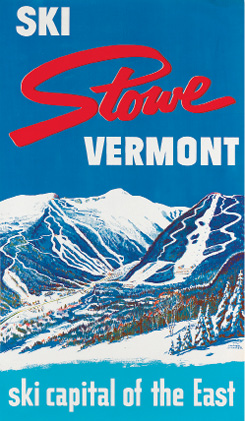
Maurer’s Ski Stowe Vermont / Ski Capital of the East exceeded its $1,800 top estimate to sell for $2,125. “Maurer designed the Stowe logo, the ‘swoosh’” said Lowry.
Maurer’s Flexible Flyer Splitkein / Smuggler’s Notch was also issued in 1935. It depicts a woman in a single chair on the lift, waving to two skiers below, who have left fresh tracks in the snow. The poster hit its top estimate of $3,000.
“This one appears with different overprintings as well,” said Lowry. “Some of the variations were used by small ski areas, small sporting goods stores and in some cases, even restaurants and hotels.”
An artist named W. Rivers was responsible for the strong silkscreen of Yosemite Ski School, an undated image which sold for $1,750, just shy of its top estimate. Designed for the Badger Pass Ski Area, which opened in 1928, it’s very simple with two colors, red and blue and the white of the paper.
A poster by the famed Dwight Clark Shepler, Sun Valley / Union Pacific, was estimated to sell between $8,000 and $12,000 and finished at $10,625. “Shepler designed some of the Dartmouth Winter Carnival posters and others for Sun Valley,” said Lowry. “It’s a wonderful image, graphic and painterly at the same time.”
While the American posters tended to do very well, the erstwhile star of the auction was Winter inDer Schweiz, a masterpiece by the celebrated Swiss graphic artist Emil Cardinaux from 1921. This was the German version of a poster best known in its French version as Sports d’Hiver. The location is not specified but given the mountains, the lake, the high society fashions and the date, it is almost certainly St. Moritz. A work that verges on painterly, this masterful poster was estimated to sell between $12,000 and $18,000 but it failed to meet its reserve price and went unsold. Such is the way of the auction world. For information on upcoming auctions, go to swanngalleries.com.
A frequent contributor to Skiing History, Everett Potter launched Everett Potter’s Travel Report in 2005. It has become one of the most widely read and respected digital sites in the industry. Explore the site at everettpotter.com. All images courtesy Swann Auction Galleries.
Go to the high places to gain vision and restore your soul.
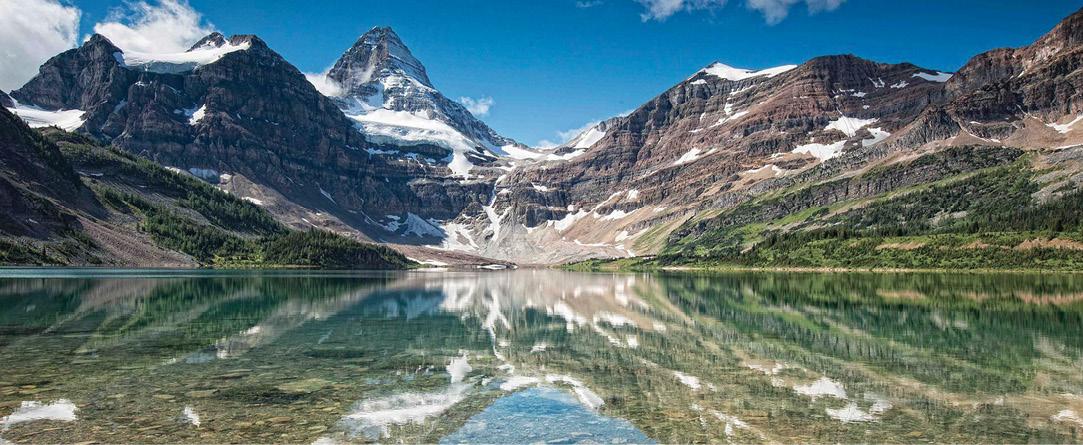
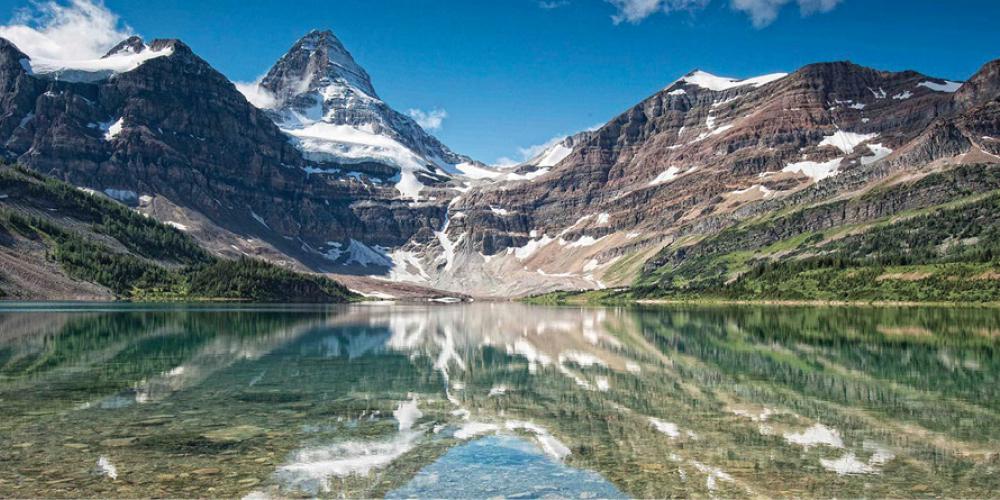
Author John Fry describes Mount Assiniboine Provincial Park in British Columbia as a place where the “sky and the world merged ... [and] the cluttered house of my consciousness was swept clean.”
Fry at home in Katonah, New York in 2015. This photo was taken by his friend, photographer and cinematographer Paul Ryan.
Brochures luring us to the mountains in summer often portray Sybarites soaking themselves in a hotel hot tub at 7,000 feet, maybe after a lung-stretching day of playing tennis or fat-tire biking. Others may be on a golf course or in an outdoor tent at a music concert. Such are the undeniable and not unworthy satisfactions of visiting in summer the places we ski in winter. But here’s a radical thought that I dare to mention at the risk of announcing the least-fashionable idea of the year: Go to the mountains to improve your soul. Millions of people do so throughout the world.
There is much comfort in high hills,
And a great easing of the heart.
We look upon them, and our nature fills
With loftier images from their life apart.
They set our feet on curves of freedom bent
To snap the circles of our discontent.
So begins a fine, early British book on climbing, extolling the tranquility of mind experienced in high places. Still in my own memory is an astonishingly beautiful hike above treeline, through fields of alpine wildflowers, that I once made from Sunshine to Assiniboine in the Canadian Rockies. As I merged myself into a place where the sky and the world themselves merged, the cluttered house of my consciousness was swept clean.
Going to high places to gain vision and restore the mind is a neglected tradition in America. It wasn’t always so. “Thousands of tired, nerve-shaken, overcivilized people are beginning to find that going to the mountains is going home … and that mountain parks and preservations are fountains of life,” wrote conservation pioneer John Muir in 1898.
Edwin Bernbaum, the author of Sacred Mountains of the World, calculates that a billion of the world’s people revere the mountains, some cultures regarding them as the home of the gods. “Despite the hardship and suffering, even the fear encountered in the mountains, people return to them again and again,” Bernbaum declares, “seeking something they cannot put into words.”
Trekking in a region near Lhotse, reputed to be Shangri-La, Bernbaum tells how he “descended into the mist to the valley floor and camped in a meadow … We heard the clear voices of birds singing to one another. In the woods around us, drops of bluish water gleamed like diamonds on necklaces of hanging moss … [and] we felt the presence of a majestic snow peak that seemed to rule over the valley … When we came to a spring welling out of the base of a mossy rock, I knelt to drink the water out of my hands, and felt the peace and beauty flow into my body.”
Extracting moral grace from nature—a sensitivity heightened in the mountains—was a notion advanced by one of America’s early nature writers, John Burroughs. “In nature…you are touching the hem of the garment with which the infinite is clothed, and virtue goes out from it to you.”
Unhappily, too few Americans seem ready to receive such virtue. [The late] Andrea Mead Lawrence, America’s first double gold medalist in Olympic skiing and now a supervisor of Mono County in the heart of California’s Sierra Nevada, believes our lack of spiritual identification with the mountains is at the root of our acceptance of so much unsightly suburban development there, and it makes her weep. “God did not make the Sierra Nevada as a lot-and-block subdivision, and we shouldn’t treat our mountain valleys that way,” she says. “For those who have spent our lives in the mountains, they are the wellspring of our passion and our caring.”
In his 1890 book on New Hampshire’s White Mountains, Julius Ward—who never found a word in the dictionary he didn’t like—wrote of the “unconscious exhilaration” he felt as the “mountains entered his soul and raised his life to their level.” Returning from a climb of one of the Presidential peaks, Ward compared his experience to that of Moses, “purged of the false, the untrue and the unreal.”
A contemporary parable may be found in Lost Kingdom of the Himalaya, where narrator John Clark accompanies a Hunza villager into the high country. “Together we crept out on the rim of a great mountain buttress, like flies on the shoulder of God. We rounded a curve, and there suddenly was the valley below us and the great rocks above. The villager sat down. ‘What are you doing?’ I asked. ‘Looking at my mountains,’ he murmured. He showed me then the meaning of worship…that our bustling minds must relearn.”
ISHA president John Fry died peacefully on January 24, 2020, while floating in the warm waters off Vieques Island, two days after his 90th birthday. His obituary appears on page 33. John was a beloved member of the ISHA family and the global ski community, and we’ll honor his legacy as a ski writer and editor by reprinting some of his finest and most unique articles in upcoming issues of Skiing History. This essay was published in the Spring 1997 issue of Snow Country, with a nod from Fry to quotations from the book Around the Roof of the World by his friend Nicholas Shoumatoff.
“Yes Bud, I have found a few secrets that help lower my time...”
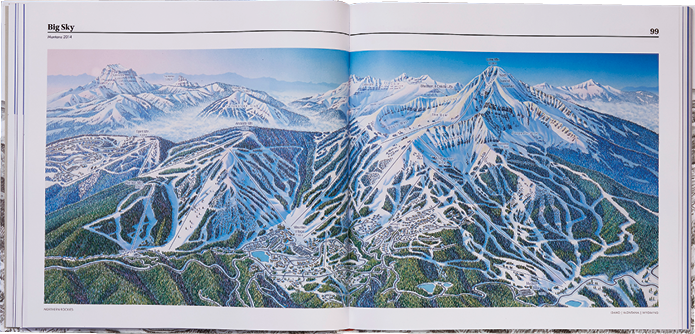
James Niehues has published a new coffee-table book that includes more than 200 of his hand-painted trail maps.
Ski artist James Niehues has published a new coffee-table book that includes more than 200 of his hand-painted trail maps, with text by journalist Jason Blevins. With eight geographically themed chapters, the hardcover book is the definitive collection of the art created by Niehues during his 30-year career.
In the modern digital age, Niehues may be the last of the great mapmakers. The book showcases his exacting process, in which he first captures aerial shots and then explores the mountain himself before painstakingly illustrating every run, chairlift, tree and cliff band by hand. Over the years, he has created maps for resorts across North America, South America, Europe, Asia and Australia, with hundreds of millions of printed copies distributed to skiers on the slopes.
“I’ve always enjoyed the challenge of fitting an entire mountain on a page. Mountains are wonderful puzzles, and I knew if I painted with the right amount of detail and care, they would last,” says Niehues. “A good design is relevant for a few years, maybe even a decade. But a well-made map is used for generations.”
With Big Sky Resort chosen to illustrate the cover and a foreword by pioneering big-mountain skier Chris Davenport, the compilation includes trail maps from iconic destinations such as Jackson Hole, Squaw Valley, Alta, Snowbird, Aspen Highlands and Vail. The book is 11.5 inches tall and opens to a spread of 24 inches wide, the perfect size to showcase the biggest ski mountains in the world. Niehues went all-in on the production process, with Italian art-quality printing, heavyweight matte-coated paper, and a lay-flat binding.
Funded by a successful Kickstarter campaign that raised capital from 5,000 donors, The Man Behind the Maps had over 10,000 pre-orders. The book retails for $90 and ISHA members qualify for free shipping, a $12.99 savings. To purchase, go to jamesniehues.com and use the code Skiing History. Offer valid until February 8, 2020.
The book was constructed with a lay-flat binding and opens to a spread of 24 inches wide, making the maps—like this illustration of Big Sky, Montana—easy to read.
The cover of the November-December 2019 issue of Skiing History—and the accompanying painting of a ski jumper soaring over Salisbury, Connecticut—reminds me of home!
Growing up in northwestern Connecticut, my hero was Roy Sherwood, who competed in the 1956 Cortina Olympics. Roy was the constable on our lake, trying to keep a bunch of delinquents out of trouble. He was a straight shooter and a fair man, and we dedicated the lyrics “Oh Roy, oh Roy, is you the law?” to him. (Long Tall Texan by The Kingsmen, 1963).
In the spring of 1963, I stayed in Aspen at the home of Dave and Sherry Farney, along with cinematographer Dick Barrymore. We were all bagging it on the Farneys’ floor. Future Olympian Cindy Farney was just a toddler. At the time, Aspen was a small town with dirt streets and a few chairlifts. We also skied Vail, then in its first season, and the die was cast: I would get back to Colorado at my earliest excuse (CU, Class of 1969).
As a teen, I revered Buddy Werner, Billy Kidd, Jimmie Heuga and Bob Beattie—names and faces I saw featured in your fall fundraising mailing. As an adult, I was excited to attend a party for business associate and Hall of Famer Chuck Ferries at the home of Barb and Scott Henderson in Nederland, Colorado. Bob, Billy and Jimmie were there.
Having skied since age four, and having had small interactions with some of these greats, Skiing History is my favorite read, month after month.
Jonathan Williams Denver, Colorado
Further on Redford’s Roffe
After reading “The Tale of Redford’s Roffe” in the November-December issue, I thought I’d add a personal touch to Wini Jones’ letter about Roffe’s clothing efforts for the U.S. Ski Team and Redford.
I commuted to work in Seattle with Wini via the Banbridge Island ferry from the late 1970s to the mid-1990s. She was heading into the city to design and manage at Roffe Ski Company, and me to lawyer elsewhere. Back then, I was a 6-foot-tall, 225-pound ex-football player who could not find a ski pant to fit what my future ski tailor later referred to as my “trees.”
Wini took pity in 1985. She invited me to the red-brick Roffe building in downtown Seattle—now pretty much Amazon central. It was snowing hard. Seattle was paralyzed. I walked up a few flights of stairs with Wini to the third floor, an open warehouse-type space with wooden beams. She introduced me to “Sam.” He was mid-70s, me maybe 30.
Sam was handling the tape measure. Clearly, he was a tailor. He and Wini decided on a starting size from which to construct pants for me, the mis-designed client. The result was that Sam Roffe (owner of the company) and Wini (a SKI Magazine “Woman of the Year”) designed, sewed and presented to me a pair of custom-fit, navy blue, over-the boot stretch Gore-Tex ski pants. I wore them well into my three decades at Sun Valley. Today I tuned Wini’s Völkls for Christmas at Whistler. Great magazine!
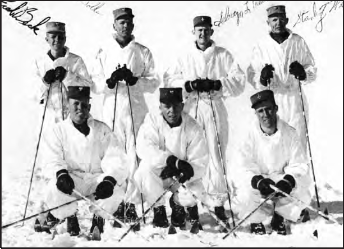
US 1957 Biathlon Ski Team, from left to right (back row): Fred Beck, Quintin Golder, Selwyn Presnal and Stan Walker; (front row) Gunnar Jansen, Gerald Jensen and Fritz Holt.
Early Biathlon Days Great article on biathlon skiing in the December 2010 issue of Skiing Heritage ("Biathlon Boom"). Here is some additional information on the early days of the U.S,. team.
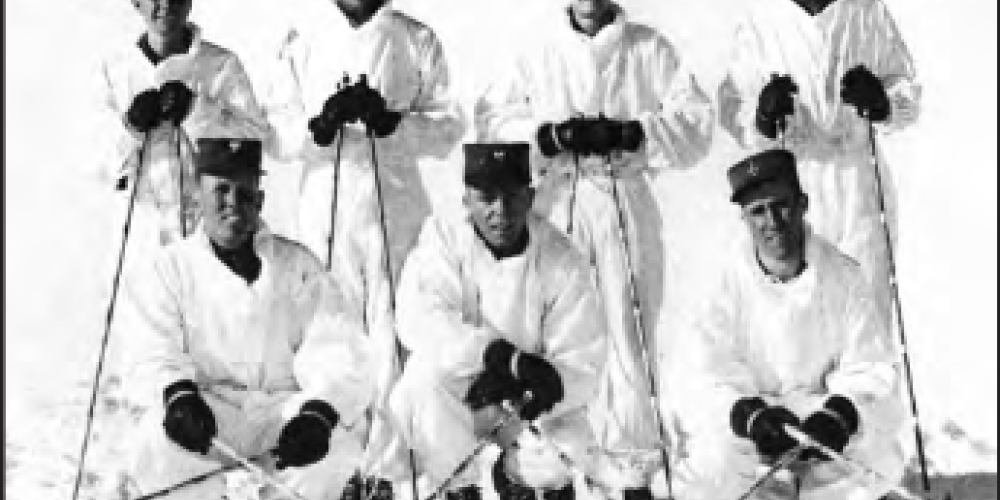
Following WWII and the deactivation of the 10th Mountain Division, what remained of Camp Hale in Colorado was occupied by a small Army group called the Mountain and Cold Weather Training Command, starting in1952. Although their task was to teach skiing, rock climbing, and outdoor survival to various military units, they also ski raced and began biathlon training. Their first competition was at Camp Hale in 1957, followed by a competition in Switzerland. They competed in the first world championship in 1958 at Saalfelden, Austria. Being a military team, they wore camouflage white clothes with civilian knicker socks, boots and skis, with an M-1 rifle strapped to an Army rucksack. The athletes were from all across the country.
Peter Birkeland (MCWTC alum)
Boulder, Colorado
Hearfelt thanks to Heggtveit I thoroughly enjoyed the article on Anne Heggtveit in the December 2010 issue (“Where Are They Now?”). I want to expand on one small part of the article, so—as Paul Harvey used to say—you’ll have “the rest of the story.”
The article made passing reference to her time at Jay Peak. It noted, “On weekends she’d ski at Vermont’s Jay Peak, sometimes with Lucile Wheeler.” Well, for me, as a young skier, her time meant much more than that. Mrs. Hamilton, as we called her, was one of the coaches for the Jay Peak Ski Club in the late 1970s and early 1980s. Our team was comprised mostly of Canadian kids and, like many Vermont ski clubs, a number of went on to earn ski success at places like Burke Mountain Academy. Some even won NCAA titles or raced for the U.S. and Canadian national teams. I was not one of those racers.
I was a kid with very little natural athletic ability. By my second year on the club I felt very discouraged, as I always finished near last place. One day I was having extra trouble because I had just gotten my first new pair of ski boots. Hamilton noticed that I was struggling and that my boots were not allowing me to flex properly. We left the team behind and skied to the base lodge, where she got a stack of napkins. I remember being confused...I hadn’t spilled my hot chocolate, but she was a coach and I didn’t say a word. She put the napkins behind my calf, between the boot shell and the liner. We then went back up the mountain. “Try it now,” she said. I raced better than I had all day...all year...or maybe ever. When practice was over, she told my parents what to tell the ski shop in order to make things right.
That day didn’t turn me into a world-class racer, but it did help to make me a lifelong skier. Instead of quitting, I ended up spending the rest of my elementary and high school years racing for either Jay Peak or our regional high school. In one of my last high school races, I came within within 13/100ths of actually winning! I became a Jay Peak ski instructor and now look forward to each ski season to spend magical time with my 9-year-old daughter and 6-year-old son. Thank you, Mrs. Hamilton! I’ll never forget what you did for me.
John Ferrara
Hinesburg, Vermont
One Javelin, Two Bindings I enjoyed the September issue of Skiing Heritage and the article on Hart Skis by Seth Masia (“A Family Business Rebounds”). From my photo collection: the Hart Javelin AGS 145, 215 centimeters long, with two Marker bindings on the same ski. Not easy to ski if you are not Art Furrer.
Luzi Hitz
Switzerland
Correction I regret several errors in my December 2010 article about Sun Valley, Stars in the Archives. —John Fry
• Nelson Bennett was Sun Valley’s second ski patrol director, not the original one.
• The long sheaves or shafts of his innovative rescue sled were parallel to one another, not in a V.
• Friedl Pfeifer’s bride Hoyt was not Mormon.
• The Shah of Iran may not have skied down Baldy at dusk from a party at the Round House. Dorice Taylor’s memoir of Sun Valley said that the Iranian leader did, but Bennett, who was there, says he didn’t.







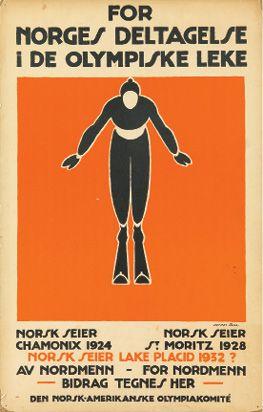



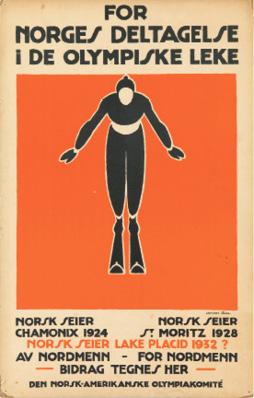
 This powerful and effective image depicts a lone, faceless ski jumper, and the artist reduced his palette to black, orange and white on beige paper stock. Bull, who was born in Oslo, moved to America in 1925 and began contributing cartoons to The New Yorker. The poster soared past its $1,000 top estimate and sold for $1,690 (including the buyer’s premium, which is 25 percent of the hammer price).
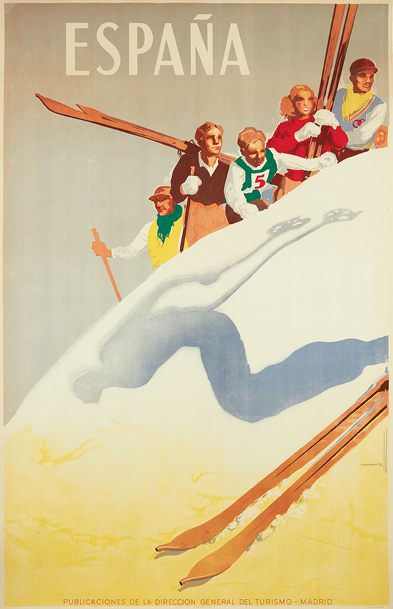 Another brilliant bit of design was featured in artist José Morell’s España, a 1948 poster celebrating the joys of skiing in the Pyrenees. Published by the Madrid Tourist Office, the estimate was $1,000 to $1,500 and it realized a final price of $1,375.
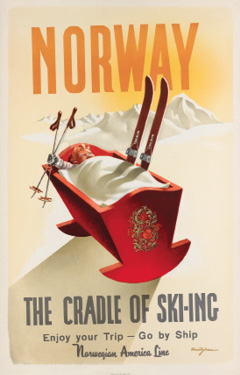 Knut Yran’s famous image, Norway / The Cradle of Ski-ing, from 1955, sold for $1,430, just shy of its top estimate. It depicts a child in a cradle on the slopes, clasping a pair of ski poles. A pair of skis is sticking upright from the crib, ready for action, with the mountains behind the child. This particular variation has the added text, “Enjoy Your Trip, Go by Ship/ Norwegian American Line,” though Lowry added that “we’ve seen it overprinted with the Pan Am logo before.”
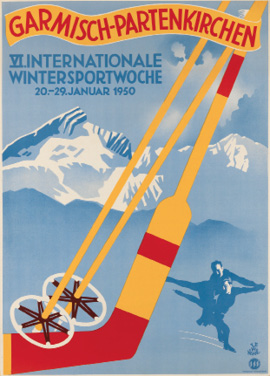 Edwin Hermann Richard Henel was a designer of early German ski posters at the turn of the century but the poster on sale at Swann was done in 1950, just three years before he died. In Garmisch-Partenkirchen / VI. Internationale Wintersportwoche the international winter sports week is suggested by two ski poles, a goalie’s stick, and a photomontage of skating pairs set against a mountain backdrop. This was the first time that the poster has appeared at Swann. The poster was printed just five years after World War II had ended, a time when the ski town was better known as an R&R getaway for the occupation forces of American G.I.s, many of whom learned to ski at this resort. It went for $1,063, a bit lower than its top estimate.
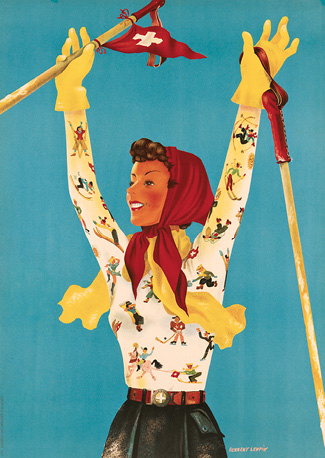 The exuberant female skier in the legendary designer Herbert Leupin’s Switzerland from 1939 is wearing a blouse illustrating the various Swiss winter pastimes, from skiing to ice hockey to skijoring. It sold for $500, less than its $700 low bid.
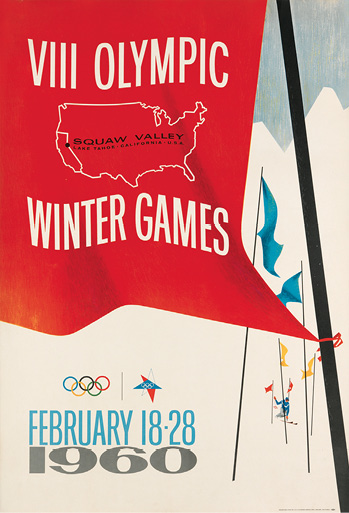 A classic Olympic poster was Jack Galliano’s VIII Olympic Winter Games / Squaw Valley, Feb 18—28, 1960, the second of two official posters designed for the Squaw Valley Winter Olympic Games. The first poster was issued before the exact dates of the games were determined. This second poster appeared late in 1959 with the purpose of showing the location of Squaw Valley in relation to a map of the United States and giving the date of the Games. It was eventually printed in five different languages. Estimated between $1,200 and $1,800, it sold for $1,750.
 “I hate to use the words ‘quite common’ with these Maurer posters because it makes them sound cheap,” said Lowry. “They are not rare, but they are among the best American ski posters.”
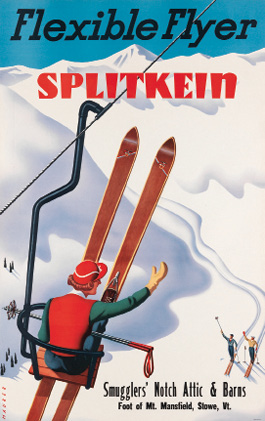 Maurer’s Flexible Flyer Splitkein / Smuggler’s Notch was also issued in 1935. It depicts a woman in a single chair on the lift, waving to two skiers below, who have left fresh tracks in the snow. The poster hit its top estimate of $3,000.
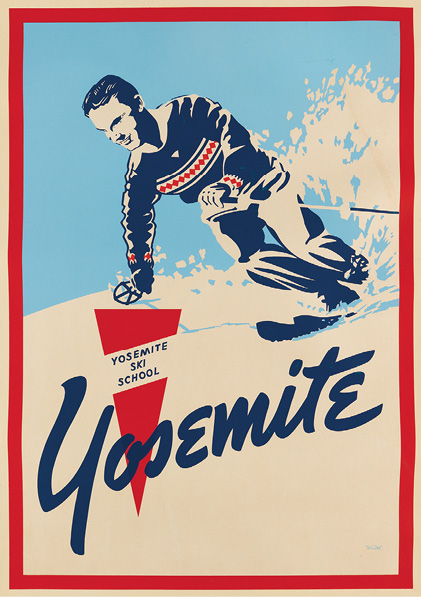 An artist named W. Rivers was responsible for the strong silkscreen of Yosemite Ski School, an undated image which sold for $1,750, just shy of its top estimate. Designed for the Badger Pass Ski Area, which opened in 1928, it’s very simple with two colors, red and blue and the white of the paper.
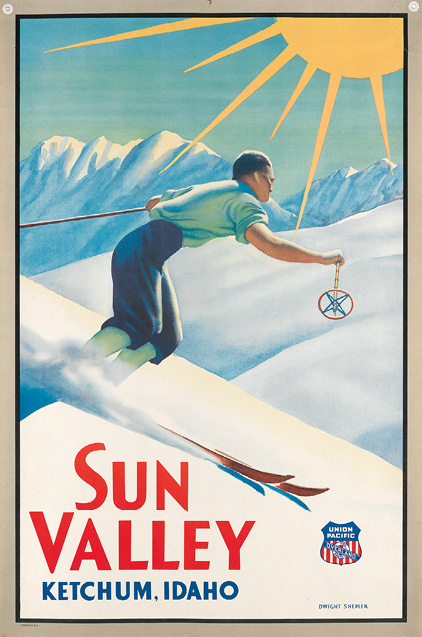 A poster by the famed Dwight Clark Shepler, Sun Valley / Union Pacific, was estimated to sell between $8,000 and $12,000 and finished at $10,625. “Shepler designed some of the Dartmouth Winter Carnival posters and others for Sun Valley,” said Lowry. “It’s a wonderful image, graphic and painterly at the same time.”
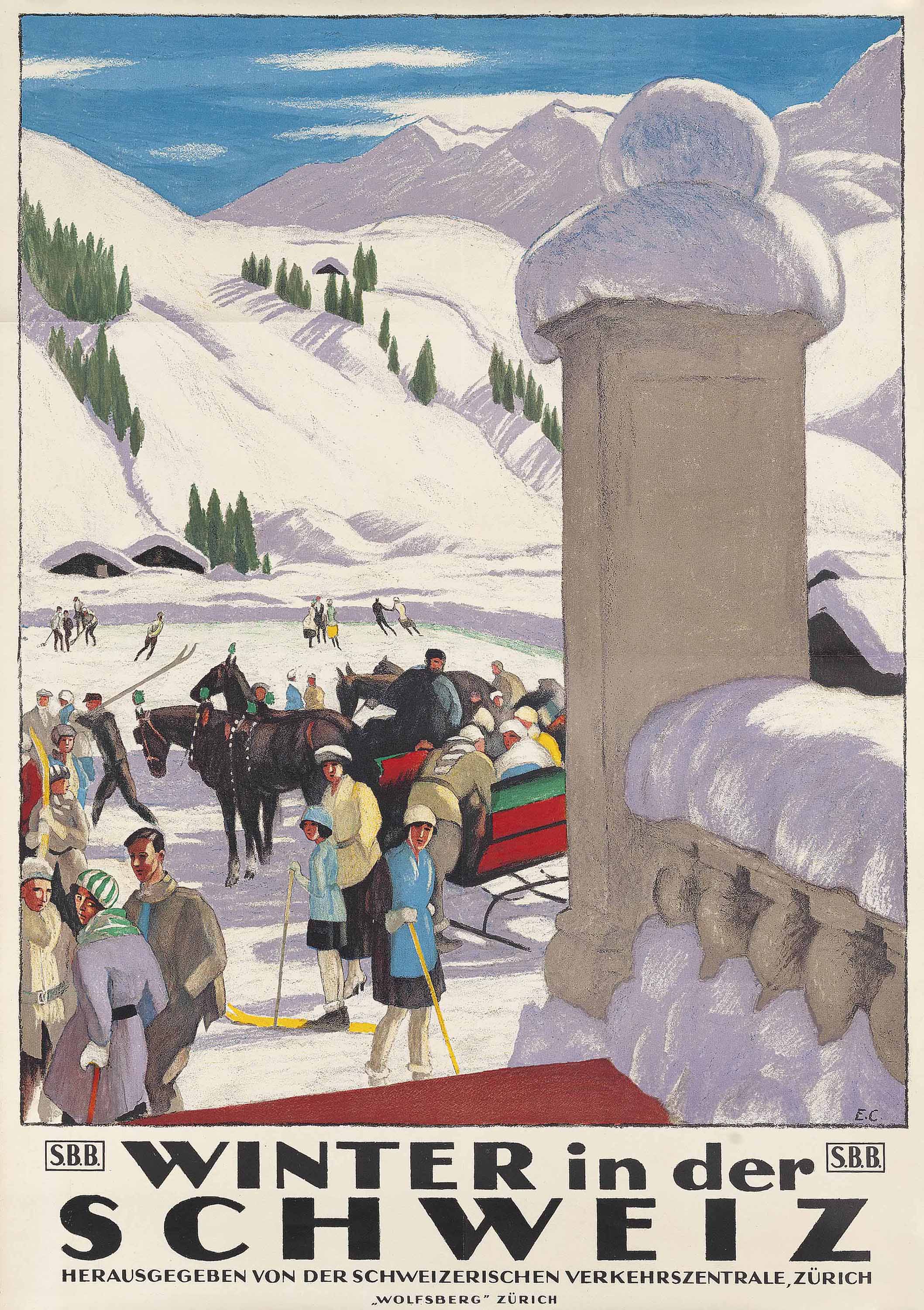 While the American posters tended to do very well, the erstwhile star of the auction was Winter in Der Schweiz, a masterpiece by the celebrated Swiss graphic artist Emil Cardinaux from 1921. This was the German version of a poster best known in its French version as Sports d’Hiver. The location is not specified but given the mountains, the lake, the high society fashions and the date, it is almost certainly St. Moritz. A work that verges on painterly, this masterful poster was estimated to sell between $12,000 and $18,000 but it failed to meet its reserve price and went unsold. Such is the way of the auction world. For information on upcoming auctions, go to swanngalleries.com.