Competition

All forms. Use in place of Racing, Race Results etc

Open to Public?
Off
Feature Image Media
Image
Timestamp

Pondering the environmental impact and future of the costly Winter Olympics.

By John Fry

The organization of the recent Sochi Olympics was superb, and it’s no historical exaggeration to say that the staging of the competitions may have been the best of any Winter Games. When it comes to organizing mass events, there’s something to be said for autocracies, or $50-billion kleptocracies like Vladimir Putin’s Russia.

ISHA’s own Jean-Claude Killy, the IOC chief coordinator for the 2014 Winter Games, told the Wall Street Journal that a key to addressing problems was his access to Putin. “We always had the capacity to go to the top man,” said Killy, who first met Putin in Guatemala City seven years ago. “When you become friends with this guy and ask for something and you see it within two hours, that’s impressive.”

“They did a helluva job!” Roger McCarthy told me. McCarthy should know. The re-designer of Breckenridge and Tremblant, he and Ecosign’s Paul Matthews of Whistler, B.C., planned the trails and base for the alpine competitions at Rosa Khutor outside Sochi. More manmade terrain features were built for the 2014 snow competitions, McCarthy estimates, than at all previous Winter Olympics.

If the Russians didn’t achieve success all by themselves, they were smart enough, and had a fat enough wallet, to import experts from around the world to prepare the venues.

While western journalists and politicians criticized the IOC for endorsing a political system lacking civil rights, former Crazy Canuck downhiller Steve Podborski, who headed his country’s Sochi mission, reflected better what was in the minds of the athletes and coaches. “It’s their country,” said Podborski. “If it’s something you don’t agree with, well then the Olympics is really not the place to do it. You’re going to the Olympics to compete.”

“Have the courage to address your disagreements in a peaceful political dialogue, not on the backs of the athletes,” said IOC president Thomas Bach, in reminding critics of the organization’s political agnosticism.

Sochi attracted participation by 88 nations, a striking contrast to the 1980 Moscow Summer Games that were boycotted by 60 nations. And even if they cost an excessive, corruption-padded $50 billion, Russia now has four world-class ski areas, 50,000 hotel rooms, new docks, international airport, and a railway and road between the sea and the gorgeous Caucasus Mountains. Sochi, a traditional summer vacation magnet for Russians, has been dramatically upgraded. 

Mixed Media

If you were sufficiently patient to wait through the incessant bombardment of commercials, Christin Cooper and Steve Porino, aided by excellent graphic overlays, deftly revealed to viewers the reasons for victory and loss in the alpine races. In the New York Times, Bill Pennington wrote some of the best technical descriptions of alpine ski racing ever published in a general newspaper.

The Times also prodded its readers to worry about the future of the Winter Games. In an article “The End of Snow,” Powder Magazine editor and writer Porter Fox deplored the carbon emission-caused global warming likely to lessen the number of potential host cities that are within an hour of the mountain elevations and temperatures needed for ski and snowboard competition.

At several points, Fox struggled with facts. He stated that most American ski areas are struggling financially, when more today are profitable than at any time. Skier and snowboarder visits to U.S. resorts in the period 2003-13 increased by almost 10 percent over the 52-million annual average of the period 1993-2003.

Fox cited statistics that “the winter sports industry contributes $66 billion annually to the U.S. economy, and supports more than 960,000 jobs.” The numbers encompass just about all the infrastructure of tourism—lodging, retail, travel, food service. Tragic as will be the loss to the ski industry from global warming, a warmer climate may increase, not destroy, jobs in tourism.

An Environmental Conundrum

“Of the 19 cities that have hosted the Winter Olympics,” Fox reported, “as few as ten may be cold enough by midcentury to host them.” None of the ten, coincidentally, is presently on the ever-fluctuating list of cities that say they want to host the 2022 Games. One candidate, Almaty, is in Kazakhstan, a country ruled by a brutal dictator. Another is in strife-torn Ukraine. Take your pick.

Western nations have become averse. The German and Swiss publics, and now the Swedes and French at Annecy, don’t want to shoulder the huge expense and
environmental impacts. The
burden is heavy: Winter Olympic medal competitions, now at almost a hundred, have doubled in the past 25 years, accompanied by a huge increase in hotel room demand.  

Happy to say, Pyeongchang, the South Korean site of the 2018 Winter Olympics, will put the Games in the setting of a ski resort, with competitions scattered around four locations. Korea is cold in winter. Vast amounts of chemicals shouldn’t be needed to salvage the ski and snowboard events, as happened at the mountain cluster of Rosa Khutor, Laura, and Krasnaya Polyana. Sochi mirrored the IOC choice of another sea-level city, Vancouver, for the 2010 Winter Games, where fog, rain and predictably warm weather on Cypress Mountain and the base of Whistler plagued ski and snowboard competitions. 

The problem has been the IOC’s pursuit of bigger and bigger Games hyped with bigger and bigger money. Ever since Grenoble in 1968, IOC-chosen host cities have spent billions on buildings, highways and facilities, often with meager after-use. The demands of a commercially successful, massive Games have contributed to the global warming that now threatens their future.

John Fry is president of the International Skiing History Association. To learn more, go http://johnfry.net.

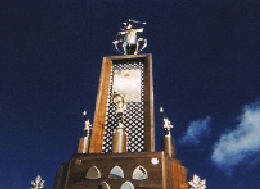
Sochi Olympic Cauldron
Category
Open to Public?
Off
Feature Image Media
Image
Timestamp

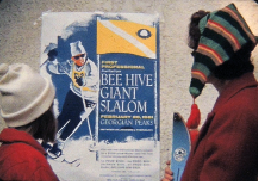
From 1961 through 1967, the annual Bee Hive giant slalom competition attracted the world’s top professional racers to Canada. 

By Caroline Forcier Holloway

On March 7, 2014, the Georgian Peaks ski area in Ontario hosted its annual Super GP Classic, a team giant slalom race on the intermediate Minute Mile trail. Located near the town of Collingwood and overlooking Lake Huron’s Georgian Bay, this private alpine club offers 24 trails with a vertical rise of 820 feet, the highest in the province.

Though the GP Classic is an amateur event, open only to club members, it recalls a little-known but interesting chapter in racing history. On February 26, 1961, Georgian Peaks hosted the inaugural Bee Hive giant slalom. It was the first professional GS race in Canada and a smashing success, attracting elite racers like Stein Eriksen, Othmar Schneider, Ernie McCulloch and Anderl Molterer. For the next six years, top pro racers from Europe and North America convened in Canada to race on the Bee Hive circuit. 


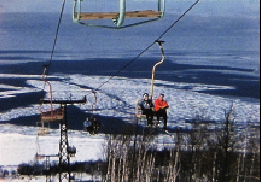
Skiers ride the double chair at Georgian Peaks in Ontario on the day of the event. All frame enlargements courtesy Library and Archives Canada, Dan Gibson Fonds, Bee Hive Films No. 1, 4 and 7.

The event was named after Bee Hive Golden Corn Syrup, an energy food manufactured by the St. Lawrence Starch Company of Port Credit, Ontario, the event sponsor. A Montreal Gazette article published in February 1962, following the second annual Bee Hive, reported that “to those who watched this spectacular and successful event, it was evident that professional ski racing had arrived to stay.” It also established Georgian Peaks as a training ground for Olympic-caliber Canadian alpine racers, including Judy Crawford (who placed fourth in women’s slalom at the 1972 Winter Games in Sapporo), Todd Brooker (who raced on the World Cup from 1981 to 1987 and is now a TV ski-racing commentator) and Brian Stemmle (who competed in four Olympics, from 1988 through 1998).


The driving force behind the first Bee Hive was Ian Rogers, a Toronto lawyer who founded Georgian Peaks in 1960. A key partner was the late Dan Gibson, a portrait photographer, budding filmmaker and avid skier, who was keen on promoting skiing in Collingwood and at Georgian Peaks. Sponsorship was easily secured through Gibson’s skiing friend Lorne Gray, of the St. Lawrence Starch Company. Through its signature Bee Hive corn syrup, the company was already sponsoring national and local sports events, including the National Hockey League. (At the time, corn syrup was a regular staple on breakfast tables, to pour on pancakes or addto your coffee.) The company’s role in the annual GS event included covering the competitors’ expenses, putting up the prize money, and advertising and promoting the race. And every year, a comely “Miss Bee Hive” was on hand to award medals and give each competitor a free can of corn syrup, which the racers drank (as seen in the films). Gibson documented the races and distributed his films for free, to promote the event and the sport of alpine racing—and skiing—across Canada (see “To Learn More”).

The First Bee Hive: Stein Eriksen Wins the Prize


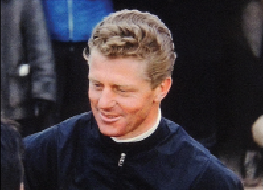
Stein Eriksen won the first Bee Hive in 1961. 

The 1961 inaugural Bee Hive attracted some of the biggest names in ski racing. Stein Eriksen, the Norwegian superstar who had won a gold medal in GS and silver in slalom at the 1952 Winter Games, took first place. Anderl Molterer of Austria, also known as the “Blitz from Kitz,” took second. Fellow Austrian racers Christian Pravda and Othmar Schneider came in third and fourth, respectively. According to Red McConville, the former president of the Canadian Ski Association who raced in the 1964 Bee Hive, Toni Sailer, the world champion racer from Austria, was present for the first Bee Hive, but didn’t compete due to his new career as an actor. In Gibson’s film, he is seen congratulating the Bee Hive winners. In total, 23 competitors raced in the inaugural Bee Hive, including Canadian champion Ernie McCulloch of Mont Tremblant, Québec. 


A newspaper headline of the day reads: “The real heroes of the race, however, didn’t wear skis.” This is a nod to the race organizers and volunteers, who ensured that the race would happen despite poor conditions that almost caused its cancellation. For a week before the race, unusually mild temperatures, mixed with rain and a lack of snow, made for almost non-existent skiing at Georgian Peaks. Officials refused to give in, spending upwards of $3,000 hauling snow by the truckload in the days before the race. On the night before the event, chemical snow cement was used to harden the snow around the slalom gates, and snow was funnelled onto the course through coal chutes. Skiers, local workers, high school students and residents of Collingwood, Thornbury and Clarksburg pitched in to help pack and shovel snow.


The racers were discouraged by the condition of the trail, but on race day, the overnight rain had turned into freezing sleet and the course was lightning fast. By noon, the sun had melted some of the ice and turned the surrounding dirt into mud, making it difficult for skiers and spectators to maneuver.

First-person recollections recount the challenges faced by the first Bee Hive race organizers. In particular, Helen Gibson of Toronto, Dan Gibson’s widow, recalls: “The day before the race there was a disastrous thaw to bare grass. Snow was trucked in, and many helpers shoveled it onto the mountain to make a single track down the course, which froze overnight so the race could be held. (What) a miracle!” She was one of more than 9,000 enthusiastic spectators who lined the course to watch the event.  

Many others recall vivid memories of the first Bee Hive: the “February Thaw” and the difficult course conditions, the excitement of the race, billeting the racers, and the fine reception at the end of the day at a private home in Collingwood, where a select few had the rare opportunity to meet and mingle with the world’s skiing greats, including Eriksen, the star of the day.

Six More Years on the Circuit

The Second Annual Professional Invitation Bee Hive Giant Slalom was held at Mont Gabriel, in Québec`s Laurentian Mountains, on February 25, 1962. With the sponsor offering a larger total cash purse of $5,000, the event attracted even more pros. By changing the location, organizers hoped to promote professional ski racing across Canada and allow greater exposure for the sponsor. The race was held on O’Connell’s Slip (Scott’s Slip), a 4,000-foot-long trail that was reconstructed to make it steeper and tougher, and the resort used the event to promote its state-of-the-art grooming and snowmaking ability. Heli Schaller of Austria was the 1962 champion. 


Christian Pravda 


The Third Bee Hive challenge was held at Devil’s Glen, near Collingwood, on February 10, 1963. Twenty-five pros raced on a course set by Red McConville, the Devil’s Glen co-founder. The champion that year was Ernst Hinterseer of Austria, who had won slalom gold and GS bronze at the 1960 Olympics. Hinterseer returned to Devil’s Glen in 1964 to win the fourth Bee Hive.  This race included three of the world’s leading skiers: Egon Zimmermann, François Bonlieu and Pepi Stiegler, who won GS bronze and slalom gold that year at the Innsbruck Olympics. Other veteran professionals competing at Devil’s Glen included Anderl Molterer, Adrien Duvillard, Pepi Gramshammer, Christian Pravda and Heli Schaller.

The following year, the Bee Hive headed west for the fifth annual race held on March 13, 1965 at Mount Whitehorn in Lake Louise, Alberta. Twenty skiers competed for the trophy including five talented Canadians (Jean Carpentier, Bob Gilmour, Jim McConkey, Al Menzies and Lorne O’Connor). 


The first Bee Hive GS attracted some of the world’s top ski racers, including Othmar Schneider and Christian Pravada (pictured above).


They competed against other world-class racers, including Mike Wiegele, Toni Spiess, Christian Pravda, Pepi Gramshammer, Marvin Moriarty and that year’s Bee Hive champion, Adrien Duvillard from France. The Sixth Bee Hive was set in Eastern Canada, at Lac Beauport, Québec, on February 13, 1966, with 

Ernst Hinterseer capturing first place for the third time. He completed the two-run race with a total time of 2:34.366, and Gramshammer placed second with a time of 2:34.735. The race comprised 42 gates and covered 2,200 feet over a vertical drop of 700 feet.  Altogether, the race included 23 racers with 10 racers from Austria, 10 from Canada, two racers from France and one from the United States (Moriarty). 

According toCanadian Sport Monthly, much attention was placed on the timing mechanism used to clock the Sixth Bee Hive race: a new Heuer timer from Switzerland. “The device is so revolutionary that on the day before the race our officials were still trying to figure it out,” said sponsor Lorne Gray. It offered reliability and accuracy down to one-thousandth of a second.

The seventh and final Bee Hive was moved to Mont Tremblant, Québec, and held on March 12, 1967. Hias Leitner from Austria, silver medalist in the 1960 Winter Olympics, took first place. The film by Dan Gibson offers a record of the racers in action—some in slow motion to showcase their technique and ability—including Herman Goellner, Toni Spiess, Egon Zimmermann, Anderl Molterer and others. 

No one can say for certain why the Bee Hive series ended after a successful seven-year run. Some believe that competitors were asking for more than the sponsor could provide in an overall purse of $5,000, with $2,000 going to the race champion each year. Others say the Bee Hive had a good run and simply died a natural death. Regardless of the speculations, most agree that after Lorne Gray’s untimely death in 1969, the momentum was impossible to regain.

Caroline Forcier Holloway is an archivist, a former CSIA instructor and an avid skier. She lives in Ottawa, Ontario.

Read more about the Bee Hive

Beehive GS
Category
Open to Public?
Off
Feature Image Media
Image
Timestamp

By John Allen

Of 2,856 athletes competing from 88 countries at the Sochi Winter Games, seven came from six first timers: Malta, Paraguay, East Timor, Togo, Tonga, and Zimbabwe.  Outside of the luger from Tonga, all except Togo’s Mathilde Petitjean—who represented France as a junior cross-country racer—compete in alpine disciplines.  All have, in one way or another, dual citizenship.  Luke Steyne, was born in Zimbabwe and moved to Switzerland when he was two and where he has been ever since.  Malta’s Elise Pellegrin was born in France where she now studies.   East Timor’s John Goutt was also born in France (French father, East Timor mother), took to skiing at two at Val d’Isère, trains in Australia during the summer and France in the winter.  Julia Marino was adopted from Paraguay when she was eight months old and came through the US ‘academy’ ranks and is now at the University of Boulder.  Perhaps the most curious case is that of Alessia Afi Dipol whose parents instructed at Cortina and where she started skiing at three.  Her father owns a clothing factory in Togo and although she was born, lives, and trains in Italy, “now I will always stay with Togo.”

 Is this what globalization of Olympism is all about?

Category

Tags

Open to Public?
Off
Feature Image Media
Image
Timestamp

How concern for the national health and military preparedness led France to build the infrastructure for Chamonix, 1924.

By E. John B. Allen


The generation of men and women who took to recreational skiing on the Continent prior to the World War I looked to Scandinavia as the fount of all things skiing, northern countries with a five-thousand-year head start in utilitarian and sporting activities. The Continent’s military noted the effectiveness of Norwegian ski troops and eventually emulated the notion, Russian, German, Austrian, Swiss and Italian regiments were experimenting with ski troops in the 1890s. The English were contemplating training ski soldiers to guard India’s Himalayan frontier.

The French soon followed. Toward the close of the 1800s, Italian-French border relations had taken on a wary unease. The Revue Alpine of 1901 noted that France and Italy had designated frontier zones in which civilians were not allowed. It was natural then that French military officers stationed in the alpine forts had begun by 1891 to consider using ski troops to patrol the alpine border.

Four French officers made attempts to introduce skis to the military: Lieutenants Widmann, Monnier and Thouverez, and Captain Francois Clerc. Widmann was Swedish, Monnier had skied in Norway, Thouverez was with France’s 93rd Mountain Artillery, and Clerc commanded a company in the 159th Infantry Regiment. These four wrote to the French Ministry of War, prodding them toward establishing ski troop detachments.

The major obstacle to the idea was the general ill health of the French mountain people—the population habituated to the altitude and climate from which the crucial recruits must necessarily be drawn. French villagers of the time survived in primitive and unsanitary conditions that were especially deleterious in winter. Tuberculosis and influenza were rampant, along with the afflictions of goiter and rickets. The romantic patina often applied by writers of village life in the Alps before the intrusion of tourism and urbanization ignored the struggle for survival against disease, malnourishment and unsanitary conditions that were endemic a century ago.

The health problems were acute enough that governmental efforts to improve them took on a note of urgency. In 1902 the French Assembly passed a public health law. How it was carried out depended on the efficiency of each region’s Hygiene Council. In Grenoble, for example, the Isère council took up anti-tuberculosis measures right away according to the 1902 archives of the Grenoble Counseil d’Hygène. Problems with drinking water and sewage disposal continued, however, until addressed in 1908.

A French law of April 15, 1910 gave to the high altitude, climatic stations the right to charge vacationers a residence tax under the condition that certain hygienic conditions be guaranteed, a closed sewer system, etc. These rules were modified and finally set down by France’s Academy of Physicians in May 1913.

Both French national and regional governments were also deeply desirous of supporting and maintaining the growth of mountain tourism. Government health initiatives were driven increasingly by economic as well as military and public health considerations. The steep growth of winter sports devotees early in the 1900s occasioned sharp scrutiny during the winter months by local health commissioners. A not inconsiderable amount of money was at stake. The fortress town of Briançon, for example, hosted 50,000 visitors in 1909, a figure that rose to 65,000 by 1911, according to La Montagne, the publication of the Club Alpin Francais (French Alpine Club, or CAF). Mountain tourism was growing to the extent that huts owned by the French Alpine Club were being replaced here and there by small hotels catering to sportsmen.

There was also a second growing stream of city people who came for “the cure,” a better chance to recover from tuberculosis or influenza. Allotte de Fuye, an early alpinist-skier, wrote in 1891, “Doctors will very quickly understand…that influenza cases…should be sent fleeing from the pestilential centers to breathe the revivifying air…with no trace of microbes.”

There were no flu vaccinations in that day. In the next quarter century, the flu mercilessly wiped out a hundred million people around the world  in recurrent epidemics.  In the West, more individuals died as a result of the 1918 flu epidemic than were killed in World War I to that point. People paid great attention to scientific studies promising a healthier environment at higher altitudes. A report in the 1884 Annuaire de l’Oservatoire showed that a cubic decimeter of air could have a widely-varying bacteria count: 55,000 in the Rue de Rivoli, Paris; 600 in a Paris hotel room; 25 at 560 meters altitude in the French Alps and 0 at 2,000 to 4,000 meters. Clearly, such studies supported the belief in the healing and hygienic advantages of health-cum-sporting stations.

The health problems of the mountain population had to be dealt with, first and foremost. Along with disease, alcoholism was frequently given as a reason for their ill health.  But alcoholism was probably not a problem on a level with that of winter living conditions. Maintaining sufficient warmth to sleep comfortably, in the context of sparsely available firewood forced the villagers to use body warmth of their domestic animals. Mountain farmers simply moved above their stables from December to April. The degeneration of the mountain population, Clerc wrote, “is not due to alcoholism…but to the fashion of living in winter.” The captain had recruited in these villages, had gone into “these dens [where] one cannot breathe after a few minutes.”

“Five months stable living,” commented another observer of winter conditions in the French alpine villages. Val d’Isère was Val Misère: “snow, always snow, then snow again and after three days no hope; the beasts are shut up for six months. For a month now the snow has kept us in our houses and all work stops. We await March and April,” was the summation appearing in the 1903-04 Revue Alpine.

Malnourishment was also severe. In 1905, Captain Clerc noted that “in certain high villages…one is unhappily impressed by the rickets of the race. In five male births, one has trouble in a few cantons to find a [20-year-old] fit for service.” A survey by the military showed that a great number of  conscripts from mountain villages had failed to grow to a mature height of more than five feet. Another result of poor diet was that four per cent of the population of mountainous Savoy, long known as “the fortress of goiterism,” suffered from the affliction. Recruits at the Briançon garrison were taken to see the unfortunates, “emblems of beauty,” as one wrote on a postcard home.

The immediate military threat from Germany became stronger toward the close of the 1800s. With the defeat of 1870-71 always in mind, the national need for a pool of youth strong enough to withstand warfare both in summer and in winter spurred the French to found a number of sporting associations to promote healthy, athletic pursuits for youngsters. The Ferry laws of 1881 made military exercises compulsory in schools and may have given the impetus to the burgeoning number of sports clubs engaged in shooting, gymnastics, running and swimming. Although a report from the Jura noted that, while there were 105 shooting clubs in the region compared to eight ski clubs, skiing nevertheless became part of this movement to combine sport, morality, health and patriotism. 

The Cercle de gymnase de Serres was founded in 1876 for “honest recreation and to encourage sentiments of virtue, fraternity and patriotism.” In Gap, Les Etoiles des Alpes was founded in 1884 “to give youth a civic education as preparation for military service.” One sports organization published a statement in 1911 stressing development of the “physical and moral forces of the young, [to] prepare in the countryside robust men and valiant soldiers and create among them friendship and solidarity.”

This is exactly what the French Alpine Club implied in its motto Pour la Patrie par la Montagne. Its leadership sought to persuade mountain villagers that skiing was not just some wealthy acrobatic sideshow. The French Alpine Club’s Winter Sports Commission, created in 1906, was given official charge of French skiing a year later on the condition that the commission recognize the importance of “skiing’s patriotic and military importance and, its moralizing force as a sport.”

The sentiment was based on the belief that, at the turn of the 20th century, the Norwegians had taken to skiing “as part of their regeneration” during their bloodless but acrimonious and bitter struggle for independence from Sweden. Thanks to a general belief that physical exertion could halt the degeneration of the French mountain people, skiing was transformed from a pastime of the adventurous and wealthy into a means to ensure “strong men and strong soldiers.” Herein lay the true purpose of what was billed as CAF’s first Winter Sports Week, yet the diplomas were for a Concours International de Ski. It was held at Mont Genèvre, near Briançon on February 9-13, 1907. Designed as propaganda for military preparedness, it also had the effect of bringing skiing to civilian notice. The French Alpine Club and the French military both pushed skiing as a means to “better the nation’s defense at the same time as bettering the alpine population.” Both Clerc and subsequent commanders at Brançon, Captains Rivas and Bernard, encouraged soldiers who had received ski training during their periods of military service to return to their villages and teach children to ski. This would drag the villagers out of their winter hibernation and ensure a supply of able ski troop recruits. Rivas, for example wrote in 1906 that he was delighted that 15 out of 18 demobilized servicemen were making skis in their own villages that year.

The French Alpine Club made skiing as a patriotic fitness crusade. “The amelioration of the race haunted us,” wrote Henry Cuënot, the leading CAF spokesman as president of its Winter Sports Commission, looking back at the club’s early efforts to promote the sport. “One knew that Norwegians took to skiing as part of their regeneration, one understood its patriotic and military reach. One wanted to make strong men and strong soldiers.”

The French Alpine Club undertook to organize annual international ski meets, beginning with the one in 1907 at Mont Genèvre near Briançon. From the first, these ski meets ranked as major national sporting events covered by a large number of French papers. There were reporters from L’Illustration, L’Auto, Armée et Marine, Le Petit Parisien, Les Alpes Pittoresques—to name five of twelve newspapers represented at Mont Genèvre. Visiting foreigners brought the excitement of international competition with the Italian Alpini providing a special dash. At Genèvre there was an ice Arc de Triomphe. On one side was CAF’s motto, Pour la Patrie par la Montagne (For the Fatherland by way of the Mountains), on the other was L’Amour de la Montagne abaisse les Frontières (Love of Mountains does away with Frontiers).  Patently, skiing was part of the Franco-Italian détente. CAF held its second meet in 1908 at Chamonix. The third in 1909 was at Morez in the Jura. CAF’s letter soliciting prizes for the Morez meet was clear in its meaning: “Our context is the most powerful means of spreading in our country, a sport which regenerated the Norwegian race.” And Norwegians were always present, adding their supreme authority to the competitions.

The theme of regeneration runs through club discussions and reports. Henry Cuënot, the spokesman for regeneration, wrote many of CAF’s notices. The military fully supported the annual meets by providing a band, teams of soldiers, and the patronage of any number of high-ranking officers. These patrons, if they did not attend themselves, sent deputies to speak the right words at the award banquets. At the 1908 meet, General Soyer, filling in for General Gallieni (who had been at the meet the previous year), affirmed that “all mountain sports are incomparable in making men valiant and vigorous.” 

The fourth CAF meet was held in 1910 at Eaux Bonnes and Cauterets and the fifth, the following year, at Lloran. It was CAF’s policy to hold the meets all over snow-covered France. By the time the seventh annual meet rolled around, correspondents from 17 papers covered the event held in the Vosges  at Gérardmer in 1914, and was the occasion of the awarding of the first military Brévet for skiers. Successful candidates won the right to choose which ski regiment they would join when called to the colors, which happened all too soon; August 1914 the tocsin sounded for World War I.

But Chamonix was coming into its own during those years. It was not the mountains that had first attracted men to the Chamonix valley, but its glaciers. In the enlightened 18th century had come the Englishmen Windham and Pocock, the first of a long line of gentlemanly amateurs. Mt. Blanc was climbed in 1786. In the Romantic age, the high lakes were the attraction, and only from about the mid-19th century did alpinism take hold. There was much foreign business prior to skiing in the valley. In 1860 Chamonix welcomed 9,020 visitors, in 1865 the number was up to 11,789, with the English supplying about one third. Chamonix became “a little London of the High Alps” in the summer season. In 1860 there were 7 hotels, 10 in 1865 including the 300-bed Grand Imperial. An English church was built in 1860, the telegraph arrived two years later, the first of the mountain huts, the Cabane des Grands-Mulets was ready in 1864, and Whymper climbed the first ‘needle’ in June 1865. Skiing came in 1898. Arnold Lunn remembered the guide “who regarded his skis with obvious distaste and terror. He slid down a gentle slope leaning on his stick, and breathing heavily, while we gasped our admiration for his courage.” Chamonix skiing prospered thanks to the local GP, Dr. Payot, who took to visiting his patients on skis. By the beginning of the 1907-08 season there were about 500 pairs of skis in town. CAF was mightily pleased with its propaganda, for skiing was “social and patriotic at the same time.” Chamonix was CAF’s choice for its Second International Week in January 1908. Two hotels had remained open for the winter of 1902, four in 1906, and the number tripled by 1908. The hoteliers had been skeptical at first of CAF’s enthusiasm, but had joined in as the day grew closer. They ended up “surprised by the affluence of their visitors” whose choice was for hotels with central heat. Heating was a major concern for villages and towns as they started to attract winter visitors.

The meet was a resounding success. The reception for the alpine troops, the gentry in their sledge carriages made a fine show, baby carriages on runners provided a charm and calm to the physical presence of all the skiers, the lugers, and bobsled teams. The sober colors of the skiers’ clothes mingled with the elegant costumes of the ladies. Officers from Norway, troops from Switzerland and of course, France’s own Chasseurs Alpins were the cynosure of all. The throng included amateurs from home and abroad, and guides and porters busied themselves throughout the town: all under a radiantly blue sky with the Mt. Blanc chain creating a magnificent backdrop, “a picture rarely seen and suggestive to a high degree.” Chamonix had become Chamonix-Mt. Blanc, a “new winter station…equal to the big Swiss centers,” enthused one commentator in the Revue Alpine.

A new winter station? Maybe. Certainly one not to equal those in Switzerland, nor, indeed, could it compare with its status as a summer destination. In the summer of 1907, Chamonix welcomed approximately 2,000 visitors a day, for a total of c. 170,000. A little more than 2,000 had been in town for its winter week. It was a start to Chamonix’ becoming France’s premier ski and winter sports station, even if it could not compete with St. Moritz and Davos.

Although the numbers of visitors did not greatly increase during the winter seasons—11,725 in 1911-12 to l2,975 in 1912-13—Chamonix’ standing as premier in the places to ski was enhanced by CAF’s sixth international competition in 1912. Of course there was commentary in the French papers, but it also received notice in Oslo’s Aftenposten  and in the Italian paper, Lettura Sportiva. Excelsior, a French paper, put it exactly right, just what CAF wanted to hear: “Chamonix shows, this year, as in others, that it knows how to organize sporting events.”

Chamonix capitalized on its renown and started major advertising abroad. “Sunshine is Life” read an advertisement cued to the fogged in English in 1913. Cheap 15-day excursion return tickets from London cost just £4.0.3 in 1913.The following year the town’s tourism committee decided to spend some of its advertising budget on Algerian and Tunisian newspapers. As the war loomed, Chamonix was thinking internationally.

During this pre-war period, skiing also spread throughout the local community. Much of the early enthusiasm was generated by Dr. Payot. He made the Col de Balme on February 12, 1912 and followed it by crossing the Col du Géant to Courmeyeur in 14 hours two weeks later. The following season he did the traverse Chamonix to Zermatt. He not only was an ardent apostle for skiing, but also for its physical benefits. Skiing was seen as liberating Chamonix folk from the servitude of the snow, bringing health and renewal. As Payot wrote in 1907 in La Montagne, Chamonix residents of all ages were taking to the sport enthusiastically. It was life in the open air. It was impossible, wrote Payot, “when one has got the blood going and the lungs full of pure air to endure the nauseous atmosphere of double-windowed houses.”  It was the end of anemia by confinement. Living was being aerated and sun-drenched, and this, better than thirty ministerial changes in the government, would bring both moral and physical benefits.

It was to youngsters, though, that the French government leadership looked, “impetuous and fecund youth which is little by little declining; they all come to ask of the sun and the pure air power for the days to come or the courage to replace what the days past have extinguished.” There was a strain of romantic desperation sounded as the ominous possibilities of armed conflict between France and Germany turned to probabilities on the eve of World War I. Pour la Patrie per la Montagne took on new significance in the years leading up to the declaration of war in 1914. The French Alpine Club organized L’Oeuvre de la Planche de Salut to provide free skis for mountain children. Few would miss the double meaning of Planche de Salut—these skis were not merely healthy boards but they were also boards of last resort, as one might throw out to a drowning swimmer.  In a few years the children “will make a marvelous army of skiers perfectly trained and ready to defend the soil of the fatherland if needed.”

 “Today,” wrote one of the very few critics of the idea of mingling the ideals of sport and war, “it is not only correct but elegant to be patriotic. The wealthy…add snobbism to their personal pleasure in the aid of national defense, even of the regeneration of the race.”

But a patriotic attitude rather than irony held sway generally. The enthusiasm for fitness manifest in the French Alps, was echoed equally in the Jura, where the earliest sports organization was the “Vélo-Club,” founded in 1892, followed by the “Union Athlétique Morézienne” whose manifesto referred to skiing as “an excellent means of social hygiene.” The sick and the tourists came to the little towns of the Jura “to find repose and health in the mountains and the forests of fir.”

As proclaimed in Savoy, the French needed regenerating because of the squalid conditions of the cities. “Alcoholism, venereal disease and tuberculosis continue death’s work,” was one Savoy doctor’s summation in 1906.

The “air cure,” especially for weak children, was promoted in Chamonix. There puny mites were being turned into robust little fellows by sport and sun well prior to the onset of the Great War. Chamonix’ Dr. Servettaz claimed he required only two months to make children “stronger, with larger chests and lungs, muscles more solid and dense, blood more rich.” Chamonix’s high altitude was widely credited with increasing appetite as well as being good for sleeping.

A Mirroir article in 1914 carried a photo of tracks leading straight to a snowy peak with the skier victorious on top. The caption praised the true alpinist who forgoes the easy pleasures of luge and skeleton and who “with will power, courage, endurance, a strong heart, and fighting white vertigo, specializes in great ascents.” These physical and mental attributes, it was widely believed, would carry Frenchmen to victory in the oncoming battles of World War I. In the midst of the war, the French Alpine Club publicly speculated that one possible positive aspect of the war was that it would exercise a happy influence on general health. Whether it did is immeasurable.

Still, the Ministry of War in 1920, two years after the Armistice had been signed, recognized the French Alpine Club as the organization promoting “physical instruction and preparation for military service” by giving CAF a ten-thousand franc subsidy. Tourism and national health, however, had  by then become of more immediate concern than military preparedness. France was urged “to win the peace.” The National Tourist Office, the Ministry of War, the French railroad companies, and syndicats d’initiative all involved themselves deeply in the “future of tourism in France and the development of the race by the cult of sport.”

After the war as well, France’s mountain communities turned the number one national health problem to advantage. In the generation before the advent of antibiotics, tuberculosis killed off French citizens by the tens of thousands. In 1926, it was responsible for some 20% of all French deaths—almost 150,000. Since the only known effective cure was to dwell for considerable length of time in cold, clear mountain air, mountain villages began to bloom with “cure hotels” for tuberculosis patients. The extensive services required by the sanitariums busied villagers profitably in supplying the services required.

The tuberculosis bonanza, paradoxically, could have driven off healthy tourists. The French government, to meet this threat, distributed subsidies to the mountain villages agreeing to stringent conditions for hoteliers in order to separate patients and tourists. In Mégève, for example, all visitors in 1932 had to present a doctor’s certificate, attesting that they were free of the contagion.

The village of Passy went at the problem by dividing itself into two zones: between 1,000 and 1,400 meters, “cure hotels” and pensions catering to the tubercular received guests under medical supervision. The sick were barred from the second zone, within the village itself. As a result of the quarantine approach,  tourists continued to come. In the twenty-five years between 1914 and 1939, Mégève grew from a village with three hotels to a town with 66 hotels—from 140 beds to 2,400.

 Enter the Olympic presence: Winter Olympics had been contemplated since 1899 but had always run up against Sweden’s Colonel Balck, the promoter of the Nordiska Spelen.  His friend, Pierre de Coubertin, founder of the modern Olympic Games and president of the International Olympic Committee, was not especially noted for his keen interest in skiing. He had been impressed with Balck’s Games (particularly the military skijoring races) run every four years, and did not give much thought to trying to incorporate skiing into the Olympic program, in spite of what he said at Chamonix in 1924. He believed, in 1908, that skiing had a “hygienic value of the highest order” and called it “the best medicine for tuberculosis and neurasthenia.”  However, he was often invited to join the Honorary Committee of CAF’s meets.
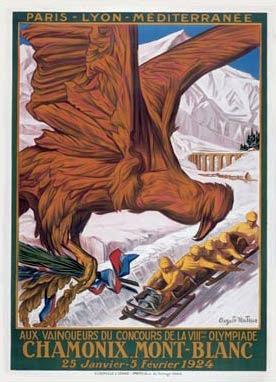
 

After the war, Chamonix was also growing apace in the twin categories of health center and ski station, particularly the latter. It developed the best lifts and the most expert terrain and was, in that sense, the country’s most prestigious ski village. Chamonix in particular and the French in general had acquired an infrastructure and the experience needed to host ever larger winter competitions—both accumulated beginning in the prewar governmental programs concerned with health, war and tourism. The climax of all this effort came in 1924 when Chamonix was chosen as the site of what became in retrospect authorized as the First Winter Olympic Games. It had not been easy. The Scandinavians had opposed joining the Olympics for years. Coubertin was never an advocate and in 1920 believed that “les sports d’hiver sont douteux,” (winter sports are doubtful) as he penciled in on one protocol. The IOC felt increasing pressure to award the 1924 Games to France, “victor and martyr” of World War I. CAF threw its weighty support behind the proposals for winter games. Meanwhile the Scandinavians sent a warning to the IOC that if skiing were included, they would not attend. At its meeting in Lausanne in 1922, the IOC decided that there would be Games under its patronage but they were not to be thought of as “Olympic” and “champions had no right to medals.” The Games, then, were to be considered as merely an extension of CAF’s International Sporting Weeks that had begun at Mont Genèvre in 1907. The Scandinavians did not approve of this but went along with the contract signed with Chamonix (Gérardmer and Superbagnières were mildly considered) on February 20, 1923 since they were assured that they would not be Olympic Games. “It is absolutely essential,” wrote Siegfrid Edström, the Swedish President of the IOC to the French representative Baron W. de Clary, “that the Winter Games do not take on the character of the Olympic Games,” but to characterize them as “international” would ensure Norwegian, Swedish and Finnish participation.” All parties involved kept this international, as opposed to Olympic, front while the Games were in preparation. The Winter Sports Week was “not an integral part of the Olympic Games,” confirmed Fratz-Reichel, the Secretary of the Committee overseeing the plans and installations at Chamonix. As the opening of the Games drew closer, the difference between an international sports week and a Winter Olympic Games became increasingly blurred, even in the Executive Committee of the IOC. In effect, France’s immense turn-of-the-20th century concern with the deteriorating health of its mountain villagers, its efforts to create a healthy population for military preparedness in the first instance, and a desire for profitable mountain tourism as a second priority led to a much grander concept. The mounting of ever more grand ski tournaments readied France in general and Chamonix in particular to produce what amounted to the First Winter Olympics, retrospectively granted that status by the IOC in 1925.

The uneasy beginnings of Winter Olympics at Chamonix continued to plague the Games in 1928. The Norwegian Ski Association voted 29 for participation, 27 against—hardly a vote of confidence for the Winter Olympics. Not one European had faith that the United States could pull off a successful ski meeting at Lake Placid in 1932. At the end of those ill-attended games, the Technical Committee of the FIS sent a stinging rebuke to Godfrey Dewey. In many ways it was remarkable—considering the politics of the 1930s—that the Winter Games survived the Nazi extravaganza at Garmisch-Partenkirchen in 1936. And then the Second World War put Olympic competition on hold for the duration.

Following the war, the Winter Games increasingly took on a powerful life of its own, particularly after it became fueled by television funding. It is now that huge international undertaking quadrennially riveting the attention of the world’s sports-minded.

The focus has changed drastically. Modern Winter Olympic commentators never hazard the thought that the Winter Olympics are put as a marvelous engine for producing a healthier world population or that these Games constitute fine physical conditioning for potential infantrymen. The theme of the Winter Games (and of the Summer Games as well) has become something altogether different, standing in as a benign substitute for war between nations, a sublimation of future Hiroshimas one hopes will never happen.

Today’s Winter Olympics is an exponentially-growing entity producing ever-larger spectacles for the world’s entertainment, achieving ever-greater complexity within its competitions and attracting ever-larger portions of the world’s attention during those weeks every four years when it is being held on the television screens of the world. In retrospect, it exhibits a wondrously paradoxical contrast to that long-ago series of modest French Alpine Club ski competitions from which those first Winter Games were born three generations ago.
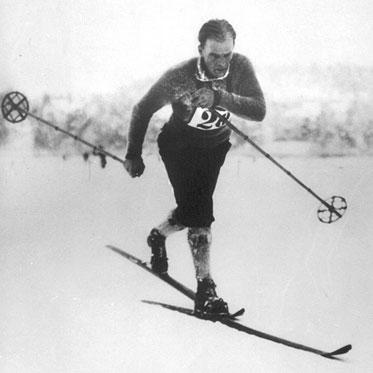
Thorleif Haug, Chamonix 1924
Category
Open to Public?
Off
Feature Image Media
Image
Timestamp

A veteran journalist on the world alpine racing circuit recalls moments of high drama—and humor—from the Winter Games.

STORY BY PATRICK LANG


INNSBRUCK 1976

FRANZ KLAMMER’S RECKLESS
GOLD-MEDAL RUN

Franz Klammer produced one of the most thrilling moments in alpine racing history with his reckless gold-medal run on the treacherous Patscherkofel downhill course at Innsbruck, Austria in February 1976. It was a huge achievement, as there was so much pressure on him prior to that Olympic race. The Austrian had become a hero in his country after having won a dozen downhill races in previous seasons. His fans adored his down-to-earth personality and his aggressive style.

Klammer felt he “had” to win the Olympic downhill for the honor of his ski-crazy country and the estimated 60,000 spectators who gathered along the race course to watch the competition. The streets across the nation were empty and factory workers received a special break, so they could watch the event on TV with millions of their compatriots.

Everyone got nervous after defending Olympic champion Bernhard Russi from Switzerland set the best time after a nearly flawless run. The course was rougher when a nervous Klammer pushed himself out of the starting hut. The screams of thousands of spectators must have been heard for miles. The blow-by-blow delivered over the PA system didn’t help their nerves—Klammer was behind the leaders at the intermediate times. Even his coaches were tense. “He is out, he can’t make it…” shouted triple Olympic champion Toni Sailer, alpine director of the Austrian team, after seeing Franz fly high into the air off the Ochsenschlag jump in the upper part of the run.
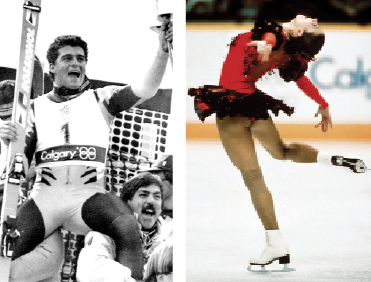
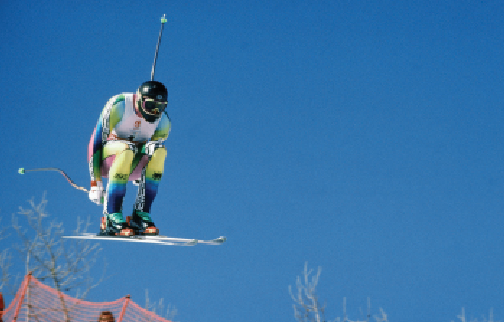

Yet Franz fought hard to stay on line, his arms wheeling in the air while approaching the last turns. He was two-tenths of a second behind Russi. He nearly crashed again on one of the last jumps yet recovered to cross the finish line with the winning time, only a few tenths of a second ahead of his Swiss rival and friend. The crowd went nuts as the announcers in ABC’s commentator booth—Frank Gifford, Bob Beattie and their special host Jackie Stewart, the former Formula One world car-racing champion—told the world the results. “I can’t believe it, he has been amazing!” Stewart said. 

Only a few months later, Franz told me how he managed to clinch that title after his fantastic run. “When I started, the course was basically ruined and I knew I had only a small chance to win,” he said. “So I decided to take even more risks than I had planned, especially in the Ochsenschlag section.

“I had seen in training that a few skiers, including Ken Read of Canada, had tested a straighter yet very risky line there. As I approached it, I made a last-second decision to go for it instead of following my usual rounder line. I made a huge jump and thought I would crash, yet I managed to survive and land on my skis. I was not sure how much time I gained or lost, yet it gave me so much determination that I kept risking everything until the last meter. 

“I was amused later to discover that I was the only skier who dared to take that line. The other favorites were not as gutsy or crazy. That’s how I won that day.”

Photo caption: The race course was rough and the pressure was on when Klammer pushed out of the starting hut in the downhill. “I knew I only had a small chance to win,” he told the author. “So I decided to take even more risks.”

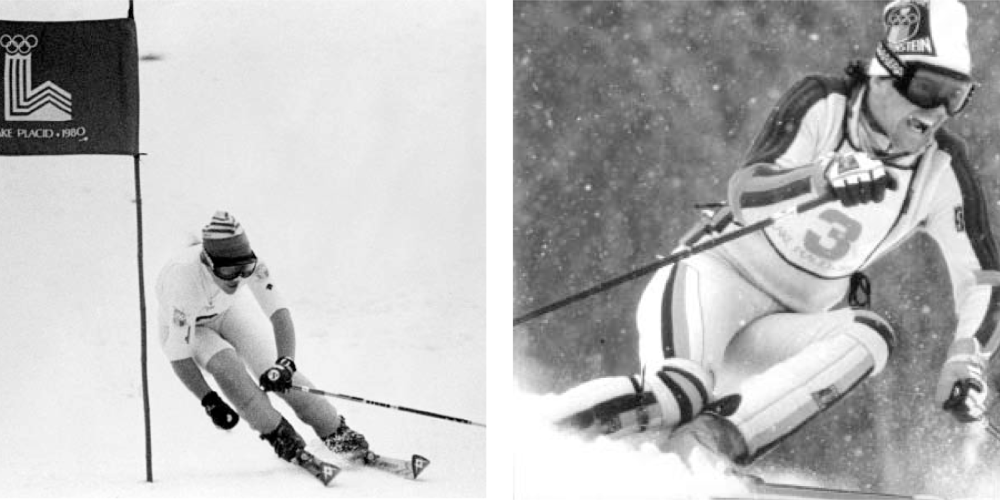
LAKE PLACID 1980

MOSER-PROELL WINS THE RACE… AND WINS REDEMPTION

Annemarie Moser-Proell dominated her time as no other skier before and after her. The Austrian set an impressive record of 62 victories and 115 podium finishes on the World Cup tour in only 175 competitions. Her last victory—in the Olympic downhill at Lake Placid in 1980—was particularly emotional and a great story, too.

To fully understand Annemarie’s crowning achievement, it’s important to look back at the 1972 Olympics at Sapporo, Japan. She was the skier to beat after her great season start, marked by five victories and four podiums finishes in all three classic specialties: downhill, slalom and giant slalom.

Yet the 18-year-old turned out to be the victim of the political storm that eliminated her teammate Karl Schranz, unfairly disqualified by the IOC at the beginning of the Games for having apparently earned endorsement money as a ski racer. 

Schranz didn’t want to leave Japan alone and he put pressure on the entire team to fly back home with him. There were some hot meetings within the Austrian squad, but the other racers didn’t want to miss their chance for an Olympic medal just a few hours before the start of the show. 

One of his strongest opponents was the very determined Annemarie Proell. She fought for her rights, yet lost focus and energy during the intense political battle.

After Schranz flew back to Vienna, where he was welcomed by a huge crowd on the main square, “La Proell” did her best to recoup, yet could not achieve her potential on race days. She finished second in downhill and giant slalom behind the unknown Swiss teenager Marie-Therese Nadig, who had never reached any major podium before the 1972 Olympics.

As a consolation prize, Proell won the FIS gold medal for her success in the three-event combined, yet she apparently threw the medal away after receiving it. 

Four years later, she missed the 1976 Games at Innsbruck; she had retired from racing the previous year to get married and take care of her dad, who was seriously ill. After his death, she staged a successful comeback. After clinching her sixth crystal globe for the overall World Cup title in 1979, Annemarie was aiming for the elusive Olympic gold medal in 1980 that she had missed eight years before. 

Yet this time, she was the hunter: Nadig had dominated the previous downhill races, winning six out of seven, as well as a giant slalom.  Moser-Proell had won three events, including a downhill, yet she had not been charging as hard as usual. But she still appeared confident heading into the Games. “I’m fully ready for Lake Placid; I have enough confidence for the big day,” she told me in January after her win at Pfronten in western Bavaria.

At Lake Placid she managed to stay quiet, resolute and ready for the last assault. On race day, she stayed laser-focused as she made her way down the course, despite strong gusts of wind that disturbed some of her main rivals, including Nadig. The Swiss favorite came in third this time, behind Moser-Proell and silver medalist Hanni Wenzel, who took gold in slalom and GS. Eight years after Sapporo, “La Proell” had enjoyed a superb revenge.

“I’m extremely happy. This success means a lot to me after all those years,” she told reporters at the post-race press conference that I was running in the modest base lodge of the resort. “Even though I had nothing to prove here, it’s a special victory after that nightmare in Japan.” The Austrian was obviously relieved to have blown away the dark clouds of Sapporo that had haunted her.

Having followed her career since her first victory in 1970, it was electrifying to hug her after the press conference—a record-setting athlete who had become a good friend.

CALGARY 1988

ALBERTO TOMBA, WINNING AND WATCHING WITT

The 1988 Winter Olympics in Calgary were particularly intense, with ten alpine competitions held over two weeks. The preceding ski season had been terrific, too, as big crowds closely followed Italy’s unpredictable phenomenon Alberto Tomba, who was dominating the World Cup that season with six victories and a second place standing in the technical events.

In an interview before the Games, La Bomba told the press that his dad, Franco, might buy him a Ferrari if he clinched two gold medals in Canada—a mission he accomplished by winning the slalom and the GS. After his victories, Alberto told me he’d be pleased to watch East Germany’s attractive superstar Katarina Witt competing at the ice arena in Calgary. I spoke about it with ABC studio producer Draggan Mihailovich, a Tomba fan, who organized the journey.

An ABC van brought us from the medal plaza to the Saddledome arena. The Italian skier, closely followed by a crew from a U.S. network, was proudly wearing his two Olympic gold medals around his neck. Thanks to special accreditations, we were standing right at the rink when Witt started to perform. 

We had briefly seen Witt during our walk under the crowded stands, as she was exercising with her trainer, Jutta Mueller. As we approached her, Mueller, who recognized Tomba and might have read about his wish to meet her protégé, pushed Katarina into another room, so she wouldn’t be distracted by the handsome Italian playboy.

We enjoyed watching Katarina claim her second Olympic title after a brilliant show. But the skating star didn’t meet Alberto afterwards. They met later that year in Italy during an exhibition—and then again four years later at Les Menuires, the site of the slalom race for the 1992 Albertville Games.

Once more, it was Draggan, working then for CBS, who set up the encounter in a nice restaurant in the French resort. During the evening, Witt expressed her desire to ski once with Alberto, who had just collected his third Olympic title in giant slalom at Val d’Isère. “No problem, let’s meet tomorrow afternoon,” he said.

The next day, Katarina showed up on time with her gear, which Alberto’s personal bodyguard carried up to the hill. Nearly two hours later, they came back smiling. Witt was exhausted but happy about her exclusive ski lesson. “He was adorable. He showed me plenty of tricks and we had so much fun,” she told me afterwards as we sat down to enjoy hot chocolate and cakes.

The next day, Tomba finished a strong second in a slalom dominated by Norway’s Finn Jagge. Two years later, both Tomba and Witt competed again at Lillehammer. This time, Alberto could not attend her performance, but Gen. Norman Schwarzkopf was sitting next to me.

Photo caption: Italian superstar Alberto Tomba won gold in slalom and GS at Calgary, then cheered from the side of the rink as Katarina Witt of East Germany claimed her second Olympic figure-skating title. Four years later, they met for dinner and a private ski lesson. “He was adorable,” said Witt of her time with La Bomba.

ALBERTVILLE 1992

LITTLE-KNOWN PATRICK ORTLIEB SHOCKS THE SKI WORLD

The steep and sinuous La Face course at Val d’Isère, France, which was built in the late 1980s by Switzerland’s Bernhard Russi, the 1972 men’s downhill Olympic champion, launched an unexpected revolution in the sport.

Russi was selected to design the course by Jean-Claude Killy, co-president of the 1992 Olympic organizing committee, who used to ski on that part of the Bellevarde slope as a kid. Russi traced a new type of downhill that required great technical skills from athletes and a high level of performance from their skis. In fact, the course contributed to new technology in ski construction, ultimately leading to the parabolic “shaped” skis now used by most recreational skiers.

The older generation of established alpine speed specialists from that time—led by Swiss racers Daniel Mahrer, William Besse and 1991 downhill FIS world champion Franz Heinzer—had great difficulties in negotiating La Face with their traditional style, which was to enter the turns at full speed and throw the skis sideways to change direction.

The new downhill skis produced ad hoc for the Albertville course were shorter and narrower at the middle. They also required more feeling from the racers, who needed to steer them continuously from the entrance to the exit of each turn. It turned out that powerful skiers could exit the turns with amazing acceleration, a situation that caused some spectacular crashes.

Interestingly, none of the well-known “technicians” on the tour, like multiple overall World Cup champion Marc Girardelli or local favorite Franck Piccard, the 1988 Super G Olympic champion, clocked the fastest downhill time on race day. That honor went to a little-known Austrian from Lech, Patrick Ortlieb, who had never won a major event.

Wearing bib 1 and with nothing to lose, as he didn’t belong to the circle of favorites, he achieved an aggressive yet controlled run and set a time that nobody could beat. Many of the top guns failed to control their line in the tricky parts of the course.

Patrick Ortlieb’s win was the first surprise of the men’s Olympics events at Val d’Isère, yet he confirmed his success in the following seasons with significant triumphs on the World Cup tour, including winning the legendary Hahnenkamm race at Kitzbühel.

Another surprise was revealed later when my father, World Cup founder Serge Lang, intrigued by Patrick’s last name, discovered that he was a double national: Austrian, as he was born in that country from an Austrian mother, but also French through his dad, a cook from Alsace, who had emigrated to Lech to work, raise a family and run the Montana Hotel there.

“Ortlieb is a well-known name in Alsace; I think I know some of his relatives,” explained Lang, who was also born in Alsace in 1920. Patrick Ortlieb admitted afterwards that he had a French passport lying around somewhere at home, yet he was happy to race for Austria.

Ortlieb’s daughter, a tall racer and 17-year-old beauty named Nina, is now a member of the Austrian C squad after achieving some promising international results. She may soon compete on the World Cup tour. “Is she also French?” I asked him at the 2013 World Cup season start at Soelden. “Possibly yes,” he answered with a grin. 

Photo caption: Ortlieb takes flight over the men’s downhill course on his way to winning gold at Albertville. He was able to hold his line on a difficult course, while established speed specialists struggled.


NAGANO 1998

AFTER A SPECTACULAR CRASH,
HERMINATOR MEETS TERMINATOR

Some of ski racing’s greatest characters have attracted even more attention from the media and the crowds, thanks to nicknames invented by fans, friends or reporters. The best example is Austria’s Hermann Maier, one of the greatest personalities in alpine ski racing. He became famous in 1998 after clinching two Olympic gold medals—in Super G and GS—at Nagano despite a horrific crash in downhill. After that, he was known as The Herminator.

His formidable appearance, his determination on the slopes, and his numerous victories in the weeks prior to his trip to Japan had led reporters to use rougher nicknames, like The Beast, which Maier didn’t like at all. One of them had also briefly mentioned The Herminator, a combination of his first name and the invincible ‘Terminator” movie character, played by another Austrian legend, Arnold Schwarzenegger.

The nickname became particularly apt after he survived his spectacular flight, several meters above the slope, and the post-landing cartwheels in soft snow. Two days after that frightening accident, he was facing the press to confirm his intention to race the following day in Super G. “It was quite a flight—for sure not as comfortable as our journey over here with Lufthansa,” he said with a grin. In a quick one-camera interview I made with him later on, he added, “I’ll be back!”

During one of our early morning production meetings at the CBS office at Hakuba, I discussed Hermann’s chance to excel in the Super G with play-by-play announcer Tim Ryan. “If anybody could do it, it’s for sure Hermann,” I explained with great optimism. I also told Ryan about that funny nickname and Maier’s comment. “That’s a fun story. We should do a feature on it with Arnold,” he said. “I think he is skiing right now at Sun Valley and I know his ski instructor. I’ll call him.”

Ryan didn’t need much time to get hold of Schwarzenegger’s Austrian-born ski instructor, Adi  Erber, and to organize a crew to do an interview with the movie star. Tim also talked directly to “Arnie,” who asked him for Maier’s phone number. 

I gave him the local phone number of Austria’s media coordinator, who did receive a call from Idaho after Hermann’s amazing comeback in Super G. Schwarzenegger was so impressed by Hermann’s triumph and his funny nickname that he wanted to speak to him. During the call, he also invited Maier to visit him next spring in Los Angeles.

They also had a great time in California, so it was no surprise when Arnold came the following year to Beaver Creek to encourage his friend, who clinched two more gold medals at the 1999 Ski World Championships. Apparently they also threw quite a party at Arnie’s suite at the Hyatt Hotel to celebrate the wins. 

Photo caption: Hermann Maier’s nickname, the Herminator, was inspired at the 1998 Games by the movie character played by Arnold Schwarzenegger. The two became friends. Above: Maier on the GS course in Nagano. Right: Schwarzenegger and Maier at the FIS Alpine World Championships in Schladming in February 2013. Austria in February 2013.


Patrick Lang, the son of World Cup founder Serge Lang, has covered 11 Winter Olympics since 1972 and has written about ski racing for dozens of media outlets. His company BioramaSports.com produces the Ski World Cup Guide and provides TV stations with reports from the World Cup circuit. He is a member of the Skiing History magazine editorial board.

History magazine editorial board.

This article first appeared in the January/February 2014 issue of Skiing History magazine.

Franz Klammer, flying down the Innsbruck course in 1976
Category
Open to Public?
Off
Feature Image Media
Image
Timestamp
How the Olympics came to a sleepy Adirondack village
By Morten Lund
The fact that in 1932 an Olympics came to America at all is a story with a bit of a strangeness about it, not least of all, the main American personality involved.  The Lake Placid 1932 Winter Olympics was sought, awarded and brought about by the force of will of one man, a bravura performance by Godfrey Dewey, head of the Lake Placid Club in the New York Adirondacks. The strong-minded son of the strong-minded patriarch Melvil Dewey, Godfrey indeed proved to be that American invention, the one-man band. Not only did he secure the Games, but carried them off successfully in spite of a run of violent disagreements, horrendous organizational problems, and a catastrophic turn in the weather.

 His father Melvil Dewey was the inventor of the Dewey Decimal System, still used to systematize library books. He also invented a system of simplified spelling. and the Lake Placid Club—in that order. Melvil established club in 1895 as a locale of genteel hiking, tennis, swimming and golf, set some three hundred miles north of New York City and half that far from the Canadian border. In 1905, in a daring move for the time, Melvil kept the club open all winter, laying in a supply of toboggans, sleds, snowshoes, and skis. He broke even during his first snow season and thus the Lake Placid Club became the first continuously operating winter resort in the U.S., a title it still holds.

By the time Godfrey took over management of the club in the 1920s, it was recognized as the leading ski center of the East. This was due in part to the constant round of New York celebrities who had skied there: bandleader Rudy Vallee, singer Kate Smith, Broadway dancer Marilyn Miller, among others But it was no Chamonix, no St. Moritz. It had no big hotels, no casinos, no nightlife, only a large rambling club building in faux frontier style known as “adirondack,” which featured posts and beams more or less as cut from the stump, peeled, and roughly trimmed. In addition to rooms in the club, there was a group of large cottages built in the same mode.

The idea of putting an Olympics on at a rustic famiy cottage colony in the Adirondack wilds was staggering in its pretensions. The Club had catered to a restricted list of guests who had sufficient money to spend on expensive  family vacations, and who also did not mind strict rules. There was no smoking, no ostentatious dress and no “rekles skiing,” as spelled out in Dewey’s simplified manner. (The onsite ski club founded by Melvil was officially the “Lake Placid Sno Birds.”) Definitely a family resort, Lake Placid also hosted—for the entertainment of its guests—a series of college ski circuit events from the 1920s onward. The club had good college ski jump at Intervale.  For guests, it had some cross country trails and a decent outdoor skating rink. There were also political connections to the ski establishment, particularly with Fred Harris who had founded the collegiate circuit (after having founded the Dartmouth Outing Club). And with Harry Wade Hicks, the secretary  of the Lake Placid Club who was also secretary of the college circuit and president of the U.S. Eastern Ski Association.   That and a million dollars, Godfrey figured, would give him an Olympics.

Looking ahead, Godfrey managed in 1928 to insert his right-hand man, Harry Wade Hicks. into the job of manager of the 1928 U.S. team at St. Moritz. Godfrey and Harry had gone around the events at the Second Winter Games events lobbying the members of the four-year-old FIS and the 32-year-old International Olympic Committee. In an IOC executive session, Swedish delegate Col. Holmquist declared that in his opinion, although there were ski organizations in the United States and Canada, neither “had the necessary competence to organize ski events.” But for some reason, the IOC as a whole seemed to welcome the idea of an American venue. Perhaps delegates sensed that the alternative was tan endless round of hotel-centered resorts within the 400-mile radius of the Continent’s high Alps, an outcome that would not match the intended international character of the Olympic organization as a whole. The IOC decision was due in 1929 at Lausanne, its headquarters.

“Godfrey Deway,” wrote U.S Academic ski historian John Allen, in his 1994 Olympic Perspectives (from which much of the background material for this section of the article was taken),” was in most ways unsuited for the job of managing a world event but he had an outstanding characteristic which often times played against him but which in the final analysis was responsible for the 1932 Winter Games being  Godfrey Dewey’s Olympics: a meddling stubbornness to see things through his own way. He changed the artist’s designs on the medals, he dealt with the minutiae of bureaucracy… he chose Bjorn Billion already under his thumb as Club instructor to make the rounds of Europe. These were matters he dealt with just as if he were at the Lake Placid Club.” One of his more egregious mistakes was to have Lake Placid Club secretary Harry Wade Hicks lay out the Olympic cross country courses, whose design and execution would be widely criticized.

Godfrey’s stubbornness had some formidable initial barriers to assail. One of them was persuading then-New York Governor Franklin Roosevelt to fund the quarter-million dollar construction of the bobsled run. Then there was convincing the International Olympic Committee that Lake Placid would build a Cresta sled run Godfrey had no intention of funding at all. Then there was the matter of winning over the ski nations in the FIS, the group responsible for sanctioning the ski events, who mostly thought of American skiing as being a backwoods kind of thing, (which it was). Oh, and one other thing. First of all, Godfrey had to block the competing Olympic bid from Yosemite, California.

That bid was headed by William May Garland, president of the California X Olympiad Association. Trying to head him off at the pass, Godfrey wrote Garland a long letter in which he pointed out that the Yosemite winter sport development had a much shorter pedigree than Lake Placid’s, that Yosemite had never held a National Ski Association or USEASA-sanctioned tournament. Godfrey was reluctant, he wrote Garland, “to be placed in the position of urging our superior facilities and long experience in winter sports against the express desire of California.” (which of course was exactly what Godfrey had been doing all along). Godfrey suggested Garland simply withdraw Yosemite’s bid, but Garland replied grimly, “Let the  best man win.”

In April 1929 at Lausanne, Godfrey insisted that Yosemite show the IOC a film making much of Yosemite's natural beauties. He thereby proved that 1) by comparison, Lake Placid was a sophisticated winter sports center, and 2) Yosemite was not much more than a heavily forested, high mountain valley. The IOC delegates opted for Lake Placid.

To put it kindly, Lake Placid did not have nearly the facilities that had already been in place for holding the Chamonix and St. Moritz Games. Lake Placid was the first case of an Olympic infrastructure built expressly to harbor an oncoming Games. It was the first trial of the idea that “if they come, we will build it.” (This is the exact reverse of course of the famed Field of Dreams mantra, “If we build it, they will come.”)

Therefore the cost of the III Winter Olympics reached an astonishing $1 million ($9 million today). It was astonishing not only relative to the much smaller costs of hosting the two previous Olympics but in particular because the Great Wall Street Crash of 1929 had newly precipitated what was going to become the Great Depression. But it can be assumed that most of the club’s conservative middle class members had kept their exposure to Wall Street moderate because the club was able to start things off by raising $200,000 in bonds issued by the adjacent town of North Elba. They were sold to well-to-do members and Lake Placid citizens whose pride or businesses would be sent sky high by a Lake Placid Olympics. When American Olympic Association member Carl Messelt pointed out that the bonds would be irredeemable after the Games were over, since the town treasury would be exhausted, he was ignored. North Elba raised another $150,000 with a second bond issue.

As one initiative, Godfrey sent Fred Harris to the 1930 FIS Congress in Oslo, representing the National Ski Association and USEASA. The FIS was in charge of ski events, so Harris circulated the profiles of the Intervale jumping hill and two course plans for the 50 km cross country among the delegates, who seemed content with that. But they objected to the proposed $10 ($90 today) entrance fee on the grounds that Lake Placid, being so near New York, would be in line to make a killing. That was not the Olympic idea. Still, though the FIS could still pull the rug out from under, Harris left the meeting with the feeling that come decision-time, the Europeans would support Lake Placid.

On the home front, Godfrey was battling the American Olympic Association whose newly-established president, Avery Brundage, was for the first time fitting on his fright mask as the once and future scourge of the Winter Games. Brundage weighed in during January 1931 with the pronouncement that the Lake Placid efforts were “doomed to failure” and made it plain that Godfrey Dewey could expect no help from him. Brundage published an AOA fund-raising brochure under the signature of U.S. President Herbert Hoover in which the Lake Placid Winter Olympics went unmentioned. Godfrey countered with his own fund raising brochure with letter signed by President Hoover in July 1931. Brundage was furious not only because his own fund-raising was being spiked but because Godfrey defrayed the cost of the brochure by carrying advertising. So un-Olympic.

 In the meantime, Governor Roosevelt did appropriate $125,000 in New York State funds for the construction of the bobsled run. Next Godfrey lobbied for $400,00 to construct an indoor rink for the skating and hockey events. But Governor Roosevelt was dubious about the benefit to the general public of a building that would only be in official use for one week before reverting to Lake Placid. It took two more years to convince Roosevelt. On February 9th, 1933, with the Games exactly a year off, the governor signed an appropriation for $375,000. One factor in Roosevelt’s thinking was obviously that in his intended run against Hoover in the 1932 elections for the U. S. presidency, an Olympics would provide a guaranteed platform before a fine array of U.S. press and news film people. (News reels provided the equivalent of TV with news shorts that played before the main movie at all theaters throughout the United States).

Thus the skating events were secure, the bobsled events were all set and the nordic ski events had been provided for. The alpine events were ignored. Although downhill and slalom had been accepted as legitimate by the FIS, which had run its first alpine championships in 1931 at Mürren, Switzerland, Godfrey was anything but anxious to spend scarce resources on building downhill courses—which he hadn't promised anyway.

Seventeen nations, including the U.S., sent a total of 447 skiers, sledders and skaters to the third Winter Olympics. Approximately a fifth of these were U.S. competitors. The rest came overland and by boat.

Naturally, it was a horrible snow year.

The weather was the warmest on record. The upper reaches of the nearby Hudson River, which had reliably frozen solid every year during the 146 years for which weather records had been kept, did not freeze during the 147th year in the winter of 1932. A major thaw hit two weeks before the Games, with temperatures rising from below zero to 50 degrees in 24 hours, ruining the bobsled and cross country courses, the jumps, and the ice, and the training schedules of skiers, sledders and skaters alike.

The weather moderated; tons of snow were dug out of the woods and put onto the courses. Miraculous feats of organization and endurance testified to Godfrey's ability to get things done. George Carroll quoted Godfrey (in the February 1960 Ski) as saying, “ It was a case of never-say-die. We simply refused to admit defeat. Everyone, our own Olympic staff, the International Committee, village, town and state officials labored day and night.”

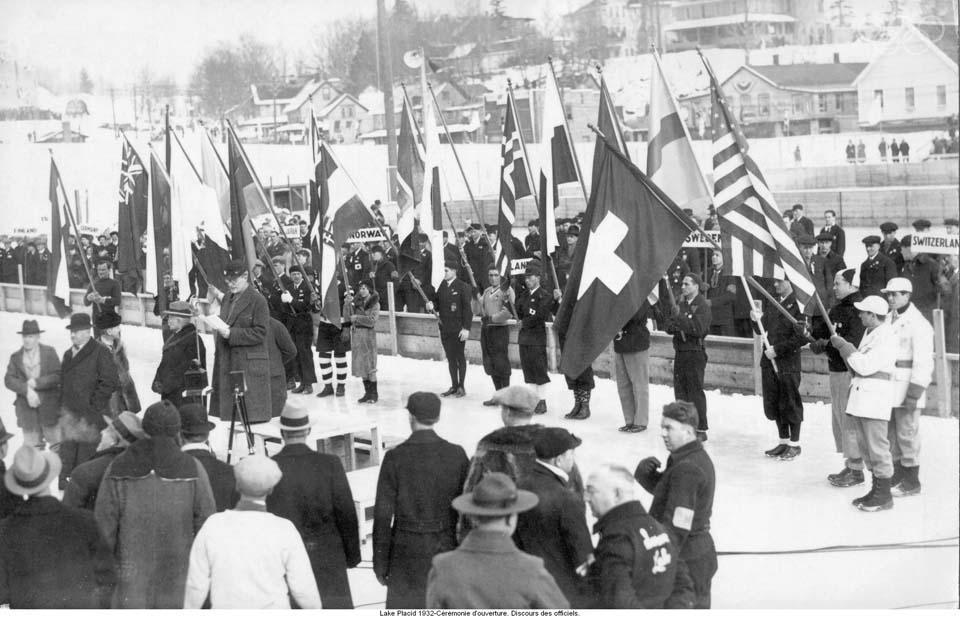
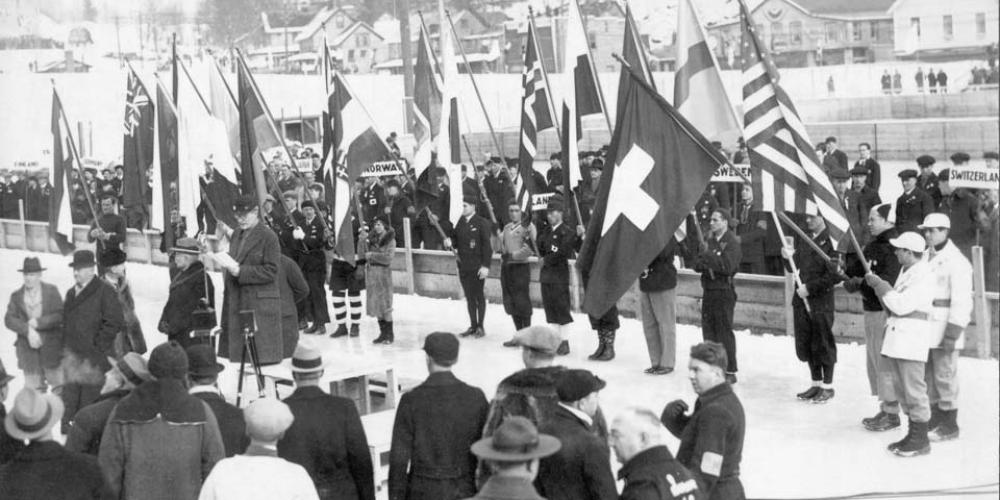
The bob run was repaired (the bobsled event was actually allowed to run a week after the Olympics to reach a conclusion).  Resurfaced skating ovals grew solid. On February 4, 1932 Governor Roosevelt declared the Third Winter Games open and called for world peace. (The Japanese had already opened the preliminaries of World War II by invading Chinese Manchuria.) U.S. skater Jack Shea took the Olympic pledge on behalf of all the competitors.

Two non-skiing events were of interest to the future of skiing. Billy Fiske, the 1928 gold bobsled medalist, won again at the Lake Placid bobsled run and became a national hero. Having learned about skiing at two Olympics, he became a skier himself. In 1936, he was one of three men to finance the first high alpine ski accommodations in the U.S., the Highland Bavarian Lodge outside Aspen. Every name skier from Dartmouth’s ski god Otto Schniebs on down came to stay long weeks at Highland Bavarian and publish thereafter illustrated accounts. Fiske’s effort had a wondrous effect in advertising the mountain beauty of the setting of what would become U.S. skiing’s first mega-resort.

In skating, Norway's Sonja Henie came in head and shoulders over the competition, scoring her second Olympic gold (her first was at St. Moritz).  She would win again at the Fourth Olympics. Launched from her Olympic platform, she would go on to movie career during which she would star in the most famous ski film of all time, Sun Valley Serenade. Even though her skiing in the film was done by doubles, and though she never actually went to Sun Valley (her parts were shot on the studio stage), Henna’s glamour added up to an enormous boost, almost as much as the 1932 Olympics themselves, to recreational skiing in the U.S.

In the 18-kilometer, Norway's Johan Grottumsbraaten, double gold medallist in the 1928 Games, was beaten by two Swedes, Sven Utterstrom and Axel Vikstrom, who had a secret weapon: a diet of brown beans, oatmeal, salt herring and Knackebrod, especially prepared by the Swedish team's traveling cook. Ollie Zetterstram, the first American finisher in the 15km, placed 23rd. The next day, in the combined jump event, Grottumsbraaten scored high enough to win the Nordic Combined gold.

The 50-km event proved to be one of the most contentious. The snow finally came with a vengeance: the season's first blizzard broke upon Lake Placid on the day of the race. The course had been laid out to double back on itself, a design that so angered some of the coaches that three hours were spent in arguing the point back and forth while the blizzard got worse. When the race finally came off, the high-seeded starters had to break track through the soft, new-fallen snow, were all soundly beaten by relative unknowns who started late and had the advantage of a more solidly packed track. The winner was Vaino Likkanen of Finland, who started in 23rd place.

Next to photogenic Sonja Henie in the figure-skating event, the press paid most attention to the exotic entry: Japan. The Japanese were not only copying the military ways of the West with a vengeance but entering the world athletic contests, unfortunately sometimes two faces of a single nationalist coin. Time, in reporting on the Games in its usual lack of comprehension of winter sports at the time, printed Norwegian jumper Birger Ruud's name as “Birger Rudd,” and superskater Sonja Henie's as “Sonja Henje.”

Even more benightedly, Time stated that one of the features of the Games was "the amazing incompetence of the Japanese…The Japanese fancy skaters, who had studied this sport in books, found it hard to keep their footing…two Japanese skiers were injured by turning somersaults off the ski jump, and another who fell down in front of the schoolhouse, amused Lake Placid children by his inability to get up."

The Japanese, contrary to Time's version, were neither wholly incompetent or lacking innovation or courage. During the 50-km, a Japanese assistant coach set up a portable wind-up record player at the most difficult part of the course, a steep ravine. Every time a Japanese skier came by, the coach wound up his machine and blasted out the Japanese national anthem, which so galvanized each Japanese competitor that he scaled the ravine's uphill side at a roaring clip.

The top Japanese jumper, Gaio Adachi, spun into the grandstand in a training jump on the Intervale hill, was injured and had to be hospitalized. Nevertheless, Adachi got up from his hospital bed to post jumps of 196 and 215 feet and placed eighth, foreshadowing the mistake of underestimating the Japanese, which cost us dearly a dozen years later in World War II. More benignly, the Japanese will to win also foreshadowed the Sapporo Olympics of 1972 in which Japanese jumpers swept all three special jump medals.

The amazing heroics of the Japanese aside, Norway dominated the jumping by sweeping the special jump with Birger Ruud getting a silver, the first of a clutch of Olympic medals. The USA’s Casper Oimen came in fifth, the highest score in an Olympic event for the U.S. to date. And then Norway got third in the 50-km as well to make it seven medals in three of the four nordic events.

Norwegians were so fanatic about maintaining the Games a shrine to pure amateurism wouldn't even let the Lake Placid ski pro, Erling Strom, tend the jump hill during the Games. They felt equally strongly that the sanctity of the original aim of the Games, competition of individual against individual, was violated by the country-vs-country slant of U.S. news reportage. The Norwegians' anger was not even the least bit mollified when New York Sun columnist Edwin B. Dooley reminded readers that approximately 90 American entries in all events, including skating, figure skating, and bobsled, had "a combined point total only a few [points] more than…a handful of Norwegians."

Over 80,000 tickets were sold for the third Winter Games. Among the attendees were the requisite celebrities including the world’s most famous radio newscaster, Lowell Thomas, reporting from location, and Admiral Richard Byrd, scouting among the cross-country competitors for rugged specimens who might be persuaded to come on Byrd's next polar expedition. Press coverage was much better and more widespread than had been anticipated. Some of it was a bit hyperbolic because the main hangout of the good old boys among reporters was in the basement bar of a local inn where newsmen took and held nearly all the seats. Columnist Westbrook Pegler called it “the Cellar Athletic Club.”  Wrote George Carroll, “Some of the most dramatic stories of the week were filed by reporters who got no closer to the bobrun or the ski jump.”

The Olympics recruited one of the sports’ staunchest and most effective advocates. “It was the Olympics at Lake Placid that really sold me on skiing.” Writing under his own byline in the February 1960 Ski Life, Lowell admitted that he had gotten hooked after Erling Strom had given him his first ski lesson during the 1932 Olympics. Lowell’s subsequent radio broadcasts from ski resorts like Mt. Tremblant and Aspen, where he had gone to ski, were the kind of exposure publicity agents dream about. Lowell’s nightly audiences registered in the tens of millions and he was usually at a resort for a week or more.

Lake Placid’s post-Olympic notices were mixed. The one from the Technical Committee of the FIS was less than laudatory, commenting somewhat acidly on Godfrey’s tendency to maintain tight control by using only trusted aides. “Too big a burden was undoubtedly placed on two few men’s shoulders and those did not manager to perform all that was up to them. They also lacked skilled helpers possessing knowledge and initiative. The arrangements for the skiing contests must be termed unsatisfactory due to the fact that management was not entrusted to experts.”

But IOC president Count de Ballait-Latour in his official report congratulated Godfrey, saying he was “more than pleased at the plans made for staging the Games in Lake Placid, facilities for the conduct of sports and other arrangements. ” He noted “the exceptional manner in which this obligation was discharged, a great task masterfully handled.”

The closing ceremonies were presided over by New York City Major Jimmy Walker, who could never pass up a party anywhere, even in the snow. The crowds cheered Walker as they had cheered Roosevelt, and cheered winners and losers the whole ten days. The general public tone, in spite of the wet weather, was one of excitement and general self-congratulation that a small American mountain town in splendid natural surroundings had been readied successfully for such a gigantic international event.  The 1932 event was unique. For the first time it was apparent that what big St. Moritz could, little Lake Placid could also do: the proof was there. And the world paid attention.


Lake Placid, 1932
Category
Open to Public?
Off
Feature Image Media
Image
Timestamp
BODE: LOOKING BACK TO THE 2006 OLYMPICS

By John Fry

Even before they turned off the gas to the Olympic Winter Games flame at Turin, the celebration of the world’s most famous skier had become a roast. At websites, Bode Miller fans despaired about their zero-for-five hero who didn’t try hard enough. The U.S. Ski Team’s trustees seethed at Miller’s expression of gratitude to them, “unbelievable a-holes, rich, cocky, wicked conceited super-right-wing Republicans.”  Washington Post sports columnist Tony Kornheiser created bodemillersucks.com about "one of the more colossal losers in recent sports history."

But then a remarkable thing happened. After a couple of weeks of playing golf and sightseeing in Paris, the prodigal star showed up at the World Cup finals in Sweden and did what he was supposed to have done in Italy. He won the Super G and placed second in the winter’s last downhill. He was relaxed and focused. Contrary to popular perception, Miller said that at the Olympics he’d been physically prepared and had tried hard. He complimented the Ski Team and its coaches. And his skiing reminded us of his prodigious talent.

Miller is the only American racer to have gold-medaled twice in a single alpine world championships. He is the first American to have won the overall World Cup title in more than 20 years. At his best, he combines Jean-Claude Killy’s natural feel for equipment with Hermann Maier’s colossal strength at his peak.

Along with Maier, he has shone a needed light on the invasive, less than foolproof way that the IOC’s Dick Pound and WADA are dealing with performance-enhancing drugs and blood enhancement.

Contrary to his self-indulgent image, Miller embraces the sport’s heritage. While other racers gobbled up World Cup points and money by specializing, Miller idealistically pursued the historic World Cup title of all-round skier, competing in every event. A purist undertaking.

In suggesting before the Olympics that participation is his main goal, Miller, in fact, echoed the ideal of Baron Pierre de Coubertin, who founded the modern Olympics. Participating, not winning, is a good message to send to kids, even though Miller is not every parent’s idea of a role model.

Before the Games, Miller accurately reminded us, as Phil Mahre did 20 years earlier, of the slim chances of winning Olympic gold in alpine skiing, where the difference between winning and losing a two-mile race can be as little as one-hundredth of a second, only a few inches of distance. However, that insight, along with Bode’s weak performance leading up to the Games, was ignored by the national media as they played up the exotic story of a White Mountain Tarzan.

Miller has two personae which resonate with contemporary society and the press: the spectacular athlete and the celebrity bad boy. The squandering bad boy, rebelliously bristling at institutions, was on full display at the Olympics, willing to declare that he was comfortable with not winning a medal. He seemed barely to study the courses. Critics wondered: Why practice and go to Carnegie Hall just to be seen on the stage?

When the U.S. Ski Team was in need of leadership, Miler was AWOL. He lacked the grace to show up at the finish line of the Combined slalom to congratulate teammate Ted Ligety on winning the gold that Bode was expected to win. He failed to shut down the motor on the mouth that quipped it was convenient not to have to motor to Turin to accept a medal.

Not that Bode’s sponsors minded. It is sufficient today for an athlete not to win but to talk about his fantasies of meeting a certain figure skater or to perform a cockamamie stunt before the finish line and miss winning the gold medal. The reward of behaving like an arrested adolescent before or at the Olympics is that magazines and TV shows, which seldom cover winter sports, will play up any color and controversy they find.  Bode perfectly fit their quest. He was the gold medalist of publicity.

It was not the kind of publicity, however, that pleased Bill Marolt, the U.S. Ski Team’s chief executive officer and the architect of its recent successes, who had flown to Europe before the Olympics to give his best racer a verbal spanking. Asked later about athlete deportment during the Games, Marolt stiffened his lip and said that, “We will manage these situations with both short-term action with those involved.”

The truth is that the U.S. Ski Team has never enjoyed much success in keeping its competitors in a state of sober obedience. Marolt’s own earlier governance in the 1980s drew resentment from the Mahre twins and wild Bill Johnson. In the 1970s, Spider Sabich and Tyler Palmer rebelled against alpine chief Willy Schaeffler. Miller is heir to an undistinguished American ski racing heritage.

To succeed the team must create an environment for individuals like Miller to succeed. On the other hand, the racer who is selfish and overweening forgets why he needs the team. He may even move into a motor home.

As a consequence of his stoic, lonely Outward-Bound upbringing as a child, Miller tends to isolate himself in a world-defying solipsism. “I don’t have to be what you want me to be,” he seems to say. Actually, it was Muhammad Ali who said that. Not coincidentally, Miller brings to skiing the kind of wondrous technique that Ali brought to boxing.

Having persuaded myself to forgive his Olympic conduct, I suggest that you do the same. A tad of perspective may aid the act of forgiveness.  Skiing itself has not been without its malingerers, including racers who ignored Olympic rules by taking money under the table. Professional athletes are not models of decorum, as newspaper sports pages sordidly remind us daily. But Bode Miller is not among those who have assaulted coaches and hotel receptionists. He hasn’t Terrell-Owened his teammates, or served prison time. He’s simply an eccentric Yankee who tries people’s patience because he stubbornly persists in learning about life on his own.

After Sochi, and another bronze medal, Bode stands 11th on the men's all-time list of "Most Valuable Racers" in Alpine Olympic events. See Matteo Pacor's statistics here.


Bode Miller explodes out of the starting gate
Category
Open to Public?
Off
Feature Image Media
Image
Timestamp
Who are the greatest racers? Look to the Olympics for the skiers able to 
 
conquer pressure. 
 
By John Fry
 
With 48 homers and 130 runs batted in, New York Yankees third 
 
baseman Alex Rodriguez was arguably baseball’s best player during the 2005 
 
season, notwithstanding how he did it. But once in the playoffs, over a time 
 
span roughly equal to that of the Olympic Winter Games, Rodriguez was a no-
hit flop. 
 
Mention the greatest skiers of all time, and you usually hear a recitation 
 
of racers with Rodriguez-like stats. . .for example, Sweden’s Ingemar Stenmark 
 
winner of a record 86 World Cup races, and Austria’s Annemarie Proell, with a 
 
women’s record of 62 races won. And there’s Marc Girardelli with more overall 
 
World Cup titles and starts than any racer in history. But you won’t find Proell 
 
or Girardelli on my list of the greatest Olympic racers. Neither one won more 
 
than one gold medal in a single Winter Games. Stenmark didn’t even compete 
 
in the downhill. 
 
No, skiing’s superstars are athletes who don’t appear on lists counting 
 
most races won. They won races that most counted. At clutch time, in the 
 
Olympics, they showed up. 
 
 Arguably, the best was 1956 champion Toni Sailer. The margins by 
 
which the Austrian won his gold medals were staggering: 3.5 seconds in 
 
the downhill, a mind-boggling 6.4 seconds in the one-run giant slalom, and 
 
4 seconds in the slalom. At the 1958 World Championships, Sailer almost 
 
repeated his Olympic hat trick, placing first in both downhill and giant slalom, 
 
and second in the slalom. With jet black hair and a movie star’s face, the 
 
handsome, six-foot poster-boy Sailer went on to act in films and, later, in 
 
television mini-series.
 
Sailer and Jean-Claude Killy are the only racers to have captured all of 
 
the alpine gold medals available to be won in a single Olympics. . .in their eras, 
 
there were just three. (Super G and special combined races hadn’t yet been 
 
introduced.)
 
Killy, 24, was already an internationally acclaimed champion before 
 
his 1968 Olympic triumph in the French Alps above Grenoble. The previous 
 
winter, in capturing the first overall World Cup title, the Frenchman had 
 
won 71 percent of the races on the calendar, a feat never since repeated. The 
 
pressure on Killy before the Grenoble Games was unimaginably intense. All 
 
day long he was pursued by photographers, autograph seekers and worshipful 
 
fans. To escape, Killy went into seclusion a week before the lighting of the 
 
Olympic flame. When he showed up in the starting gate, he was psyched 
 
and ready. He pulled off the gold medal hat trick, albeit winning by narrower 
 
margins than Sailer enjoyed. 
 
“The greatest racers, in my opinion, win gold at the Olympics and World 
 
Championships,” insists 1970 World Champion Billy Kidd. “The events are 
 
followed on television and in newspapers around the world, and they demand 
 
something that doesn’t come into play in career-long performances and season-
long accumulations of points. . .the ability to win when the chips are down.” 
 
Killy’s and Sailer’s winning all the Olympic alpine races during less than 12 days 
 
and in less than five minutes of competition, are convincing proof to Kidd of 
 
their greatness. 
 
As in tennis and golf, women don’t ski-race with the same strength and 
 
speed as men, but their competitive fervor is no less. In 1952 at Oslo, fiercely 
 
determined Andrea Mead Lawrence won two Olympic gold medals at the age 
 
of only 19, an achievement never equaled by a man. She’s the only American to 
 
win twice in a single Olympics. . . alas, she fell in the downhill. 
 
Germany’s Rosi Mittermaier in 1976 and Liechenstein’s Hanni Wenzel 
 
in 1980 both narrowly missed performing the Sailer-Killy hat trick. After gold-
medaling in the downhill and slalom, Mittermaier came within one-eighth of a 
 
second of winning the giant slalom. 
 
Arguably, the greatest woman ski racer of all time is living among us 
 
today. She is Croatia’s Janica Kostelic, who won three gold medals and a silver 
 
at the Salt Lake Winter Games in 2002. 
 
Then there is 18-season veteran Kjetil Andre Aamodt, whose eight 
 
Olympic medals are a record in alpine skiing. 
 
The greatest perform under pressure, occasionally self-imposed. After 
 
Muhammad Ali talked big and Babe Ruth pointed his finger at the home 
 
run fence, they both delivered. Hermann “the Hermanator” Maier met the 
 
challenge at the 1998 Olympics. After a spectacular airborne, body-crunching 
 
crash in the downhill, he rose like a man from the dead and went on to win 
 
both the Super G and the giant slalom gold medals. Following a nearly fatal 
 
motorcycle crash that left him with a mangled leg, Maier raced again.
 
The great Olympic champions weren’t guys with prepared excuses 
 
built around the inevitability of averages. They went out and conquered 
 
off-days and the law of averages by winning multiple medals. I bow in 
 
reverence to the golden men and women of our sport. 
 
John Fry covered the ski races at four Winter Olympic Winter Games, and has written for 
 
40 years about the World Cup and the World Alpine Ski Championships.
Toni Sailer in 1956
Category
Open to Public?
Off
Feature Image Media
Image
Timestamp
An outraged IOC czar, an impenitent ski racer. Their loathing was mutual.

BY JOHN FRY

Prize money in a single World Cup race is now in six figures. Competitors openly negotiate contracts to promote skis and boots and snowboards, and earn mega-buck bonuses for winning Olympic medals. Commercialized racing on this scale didn’t exist under the FIS (Federation Internationale de Ski) 45 years ago, and prize money was forbidden. Nonetheless, at the 1972 Winter Games in Sapporo, Japan, members of the International Olympic Committee (IOC) regarded ski racing as so tainted by money that it perhaps no longer belonged in the Winter Games.

At the storm’s center were IOC president Avery Brundage, a wealthy, autocratic American businessman, and Austrian racer Karl Schranz, two-time overall champion of alpine World Cup skiing and a favorite to win the Sapporo downhill. Their loathing was mutual. An outraged Brundage saw Schranz as someone who had to be ejected because he stood for the professionalism that would ruin the Olympic movement. An impenitent Schranz mocked the wealthy Brundage, branding him a hypocrite for denying athletes the opportunity to make money from their sport. Today, surveying the often obscene array of corporate logos smothering clothing and banners at Olympic sports venues, the dispute seems laughable. But it attracted world-wide attention at the time.

For some, the story began in 1968 with another controversy. . . perhaps the greatest surrounding the finish of any ski race ever held. Karl Schranz was again the central character. On the final day of the Winter Olympics above Grenoble, France’s national hero Jean-Claude Killy was poised to win the last of the three alpine skiing gold medals. The conditions for the slalom, however, were atrocious. Fog shrouded the course. Gatekeepers often could not see if a racer had made it around a pole. Racing in the second run,  Schranz claimed a figure crossed the course and interfered with his descent, although no official saw anyone. Climbing back to the top, he received permission to re-start his run, and beat Killy by a full half-second. Within hours, though, the jury disqualified him. The next day, I attended a press conference organized by the Kneissl ski factory for Schranz so he could protest his gold medal loss. It was an act that specially irritated IOC chief Brundage, who had earlier attacked the commercial relations between ski manufacturers and racers.

In the four years between the French and Japanese Winter Olympics, the FIS did little to appease Brundage. Among all the sports federations concerned with finding ways to allow athletes to earn money, the FIS proved itself the most inventive and liberal. It began to permit national ski federations, for example, to organize the present-day manufacturer pools through which sponsors funnel money to racers. In return, it allowed the racers to wear commercial logos.

To Brundage, all this was a clear violation of Olympic standards. At 84, after running the IOC for 20 years, he was determined to end the commercial abuses of skiing. . .if necessary, even by throwing as many as 40 of the leading racers out of the Olympics. Not surprisingly, the skiers kept a low public profile.

Except for Schranz. He attacked Brundage and his wealthy, senescent Olympic Committee members directly.  “How can they understand the situation of top ski racers,” he asked the press, “when these officials have never been poor?” That was enough for Brundage, who easily persuaded the IOC to to expel him from the Olympics.

Back in the Tyrolean Alps, prodded by incendiary newspaper headlines, infuriated Austrians called for their racers to leave Sapporo and come home in sympathy. But they didn’t. The tough, embittered Schranz was not popular with his teammates, despite his ranking as the number one alpine skier of the post-Killy era.

When the racers didn’t return, threats were made to burn down the home of the Ski Federation’s chief. Another official’s children were beaten up at school. Austrians perceived Schranz as a hero from a small country, bullied by bigger nations. Stores were flooded with Schranz T-shirts. When he flew back to a parade in Vienna, a horde of 200,000 people welcomed him home, chanting “Karl is richtig, Brundage is nichtig.” A beaming Schranz raised his arms in vindication.

The ski events at Sapporo took place on schedule. Petite Barbara Ann Cochran won America’s only gold, in the slalom. Brundage died in 1975. Efforts by International Management to market Schranz in America failed . . something of an irony. Today he operates a small hotel in St. Anton. To anyone timorous enough to ask, he will affirm that he was robbed of his gold medal in 1968 and that Brundage was wrong.

The truth? I’m certain he never won the Grenoble slalom.

On the other hand, Schranz-- a leftist with a keen sense of class strife -- won the battle to allow succeeding generations of skiers the right to make money. He also helped open the door for legions of sports marketers, lawyers, athlete agents, product sponsors and manufacturers, to say nothing of conflicted IOC officials, to make millions. Is this progress? No. Despite the influx of big money, ski racing was as exciting without it as with it. 

Karl Schranz
Category
Open to Public?
Off
Feature Image Media
Image
Timestamp

Former World Cup superstars and siblings Andreas and Hanni Wenzel have found post-racing success in the business world.

By Edith Thys Morgan

Weg vom Computer raus in den Schnee.” That motto, which urges kids to get away from their computers and out in the snow, is what drives Andreas Wenzel. And it has him driving a lot. In addition to his duties as President of the Liechtenstein Ski Federation, Wenzel is Secretary General of the four-year-old European Ski Federation, an organization of 11 European national ski federations united to grow, promote and improve snowsports in Europe. Wenzel leads the charge on SNOWstar, a series of competitions that combine elements of alpine racing, freestyle and skicross and takes place at partner venues throughout Europe. We’re talking while he drives to Bolzano, Italy, for a symposium on tourism and kids. “It’s not boring,” he says of the constant travel throughout the Alps. “The only thing is the traffic!”

As comfortable as he is on the road and getting things done, Wenzel, half of the brother/sister combo that turned tiny Liechtenstein into a skiing powerhouse in the 1970s and ’80s, much prefers being active in the great outdoors. His connection to nature can be traced to his father, Hubert, a passionate mountaineer and world university champion in the alpine/nordic/jumping combined.

Hubert was among the millions of East Germans who fled west in the early 1950s. He left on bicycle with no money, headed for Munich to study forest engineering. There he met and married Hannelore, a Bavarian shot-put athlete. In 1955, Hubert set out to tour the Alps by bicycle, and after an accident in Switzerland walked 50 kilometers with his bike until he found a shop in Liechtenstein that could fix it. While earning the money for the repairs, he learned that his skills in both engineering and avalanche protection were much in demand in the 62-square-mile country comprised mostly of steep terrain. In 1958, the Wenzels moved to Liechtenstein, with one-year-old Hanni and four-month-old Andreas.

Hubert passed his love of the outdoors to his four children—Hanni, Andreas, Petra and Monica—and instructed them to spend every spare moment being active in the mountains. “We were educated to compete,” Andi explains. “That is not always good from a pedagogical side,” he says with laugh that hints at an intensely competitive household. (Younger sister Petra was 4th in GS in the 1982 Worlds.) The emphasis, however, was always on enjoying the mountains. “As a kid I was out in nature full power,” he recalls. “I was a lousy runner around a track but get me into the mountains and watch out!” The siblings’ ski racing talents grew and in 1974, 17-year-old Hanni, racing for West Germany, won the world championship in slalom.  The family was granted citizenship in Liechtenstein and in 1976 Team Liechtenstein (including the three Wenzel siblings, in addition to Paul and Willy Frommelt and Ursula Konzett) integrated for training with the Swiss Ski Team.

Andreas attended Austria’s famed Stams ski academy, competing in his first Olympics in 1976, at age 17.  In those Innsbruck Games, Hanni won Liechtenstein’s first Olympic medal, a bronze in the GS, and two years later Andreas earned his own world title in GS. But it was at the 1980 Lake Placid Olympics where Hanni and Andreas stole the show in their iconic white and yellow suits, producing four medals (and the first gold) for Liechtenstein. Hanni won a gold medal in both slalom and giant slalom, and a silver medal in downhill, while Andreas nabbed the silver in GS, bested only by Ingemar Stenmark and one of his signature second-run comebacks. The siblings crowned that season by each winning the overall World Cup title.

Hanni competed another four years, but along with Ingemar Stenmark was banned from the 1984 Olympics for her semi-professional status. She retired after the 1984 season, with 33 World Cup wins and two overall World Cup titles. Andreas retired in 1988 after his fourth Olympics, with 14 World Cup wins in all disciplines but downhill. Upon retiring, Andreas immediately dove into work, as racing director for Atomic. After four years there he switched to sports marketing, and was instrumental in bringing the first European sponsors (like Warsteiner beer) to North American ski races. Ten years later, he shifted gears again, becoming a tourism consultant. Then, in 2006, he was asked to become president of the Liechtenstein Ski Federation, and found himself back in the ski racing game.

The Liechtenstein Federation includes nine Skiclubs that teach kids until they are 10 years old. After that, the best qualify for the U12, U14 and U16 programs. The federation has 40 nordic, alpine and biathlon athletes and 11 trainers, but as ever, cooperates with other small nations to provide the best possible training framework. For example, Tina Weirather (daughter of Hanni and Austrian downhill great Harti Weirather, and a star on the current World Cup) races for Liechtenstein, but attended Stams and is now fully integrated on the Swiss team.

It is Wenzel’s work with ESF that keeps him on the road, and brings all of his athletic and business experience together with his passion for growing the sport. In Europe as in this country, kids are spending more time in front of screens and social media, and less time outdoors. “In Europe, we have seventy million people living close to the mountains. We want to get them in the sport and keep them in the sport while developing skills. And having fun is most important!” The SNOWstar events in particular—ten qualifying events and a European final—are aimed at doing just that in a safe environment for kids aged 10 to 16.

The events do not involve multiple sets of skis or race suits and are not set on an icy track. Rather, they are on less-harsh “Playground Snow” (a permanent infrastructure at the resorts, similar to a terrain park), studded with built-in features that demand athleticism while keeping the events lower in speed and higher on fun. Wenzel, known by fellow competitors for his intensity as well as his likeability, thinks kids should back off on ski racing’s regimented rigidity. “If you have to use a measuring tape to set GS for kids, something is not right,” he says. Instead, the courses are set in harmony with the natural terrain, teaching kids how to react and move. “Every day, conditions are different. It’s not just about making a fast turn, though that is important. It is about judgment.”

Wenzel reflects on his own upbringing, and on his father’s melding of nature and training in a competitive atmosphere, when he looks at what he hopes the SNOWstar events will help cultivate in kids. “Kids need to learn intuition, which is not something you can learn in a book,” he says. Intuition is what you do when you don’t have time to think, when you come around a corner fast and have to react to whatever is in your path. “More intuition, less thinking,” he explains. “You have to move with fluidity. Those who panic later rather than earlier are going to win the race.”

Wenzel’s drive to create more opportunities for kids outside the traditional ski racing pedigree is personal. “You know, the raw diamonds come not so much from the Gstaad’s and St Moritz’s. They come from tiny villages,” he says. And even, perhaps, tiny countries.  

Andreas and Hanni Wenzel