Competition

All forms. Use in place of Racing, Race Results etc

Open to Public?
Off
Feature Image Media
Image
Timestamp

Radical racing invention, or a variation of a long-established technique? By John Fry

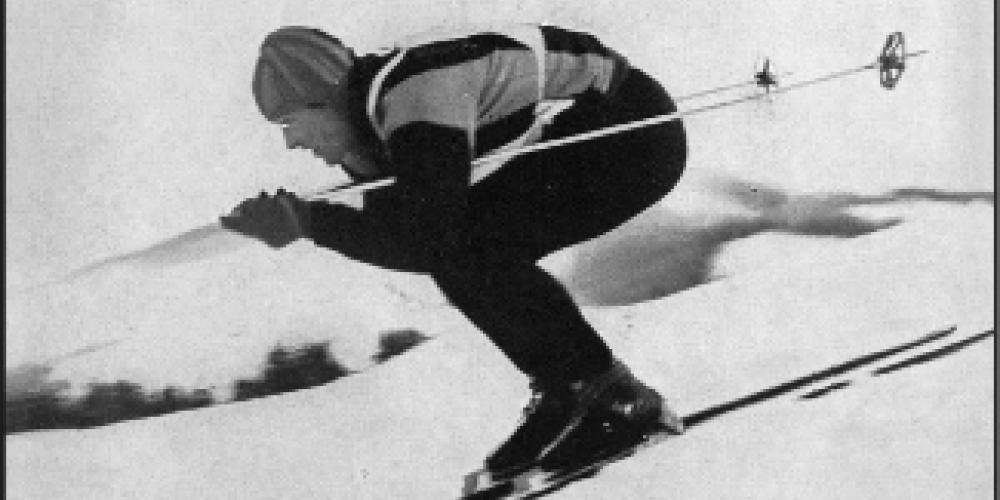
Was the Egg (oeuf in French, Ei in German) a radical ski racing invention? Or merely a stage in the steady progress made in streamlining the skier’s body to achieve faster speeds?

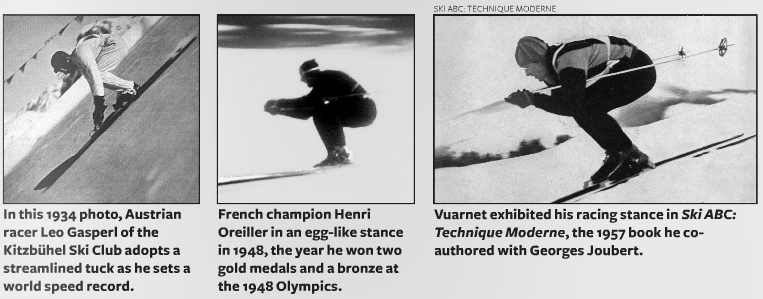
In France the question is alive, and afire with controversy. Jean Vuarnet, his son Alain, and his supporters tell of the enormous research he did to achieve his invention. They cite the French newspaper Le Figaro, which once compared the Egg to the Fosbury Flop, a single change in body action that eventually enabled all high jumpers to leap higher. Vuarnet also suggests retaliation—that doubts about his “invention” only began after his involvement in the controversial firing of six racers from the French ski team in 1973. Critics and opponents, like Jean-Claude Killy, say the Egg wasn’t an invention, but merely a variation of what downhill Olympic gold medalists Henri Oreiller and Zeno Colò were already doing a few years earlier.

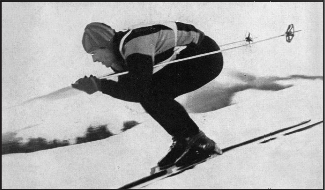
Experts in the rest of the world appear baffled by why there should be a controversy. They mostly see Vuarnet’s work as part of speed skiing’s changing aerodynamics, going back at least to 1930 and 1931, when Gustav Lantschner and Leo Gasperl set world speed records, and earlier to the 19th century, when California gold miners sat low over their long skis to speed downhill. It’s hard to find anyone outside of Gaul who thinks l’Oeuf is anything but a stage in the evolution of the hocke, crouch, tuck and streamlining of the racer’s body. Vuarnet first exhibited his stance in Ski ABC—Technique Moderne. The 1957 book contains a picture of him in what is clearly the optimal aerodynamic stance of the time—poles and lower arms parallel to the skis, which, however, are not as far apart as in later editions of Joubert’s and Vuarnet’s books. No textual analysis is offered.

The foreword to Ski ABC was written by Ralph Miller, who helped with the first English-language edition, and who set a world speed record at Portillo in 1955. Miller thinks Vuarnet’s stance was simply a further refinement of body positions designed to reduce air friction.

The 1960 edition of Ski Moderne (Arthaud) contains excellent photos, illustrations and text about l’Oeuf. It’s the first detailed description I can find in print. A photo sequence of Vuarnet from the pages of Sports Illustrated is wonderful. That magazine, and others at the time, credited Vuarnet’s Squaw Valley downhill gold medal to his use of metal skis, as well as to his superior aerodynamic stance. The Austrians were the big losers. “We missed the wax,” Anderl Molterer told me recently.

I have a copy of the German Ski Moderne, a translation by Hanspeter Lanig, published in 1963. Via e-mail, Lanig told me that l’Oeuf was an invention (erfindung) of a word, not of a technique. And Dick Dorworth, the American who set a new world speed record at Portillo in 1963, says he knew about Vuarnet’s Egg. He thinks stance is shaped considerably by the racer’s own morphology. In competitive downhill racing, the V-J or Oeuf is a technique mostly limited to shaving seconds on flatter sections of the course. How valuable it is depends on the terrain—the Streif on Hahnenkamm and Birds of Prey at Beaver Creek yield less advantage for l’Oeuf than, say, the Sarajevo Olympic downhill of 1984, or the Squaw Valley downhill of 1960.

Austria’s Stefan Kruckenhauser was said to have invented “wedeln” about the same time as Vuarnet “invented” the egg. Both drew their inspiration from racing technique. Lanig might say that the word, not the act, is the invention.

My own view is that Vuarnet’s writing and photos brought into public view the final ideal stance for attaining the highest speeds on flatter sections of downhill courses and in setting speed records—an evolution that had begun at least 30 years before. Joubert and Vuarnet’s 1966 Comment se Perfectionner à Ski (How to Ski the New French Way) shows a further evolution: the bullet or bolide. It was a super-egg-like streamlining of the body, with legs even more splayed, torso even more compressed between the legs. Here, arguably, was the final form. It hasn’t changed much in the ensuing 50 years.

Category
Open to Public?
Off
Feature Image Media
Image
Timestamp

His Olympic gold was only the beginning. The triumphant, sometimes tumultuous professional and personal life of the 1960 Olympic downhill gold medalist, technique analyst, resort developer, and entrepreneur of eyeglass fame. By Alain Lazard

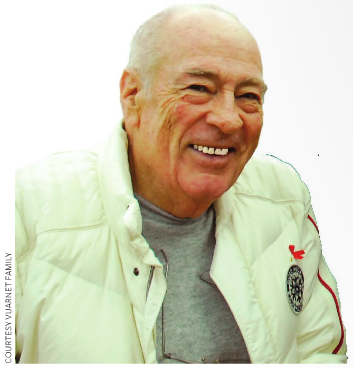
Today in the Haute Savoie of the French Alps quietly lives Jean Vuarnet, 83, captor of the first Olympic medal ever won on non-wooden skis. Vuarnet’s downhill victory at the Squaw Valley Winter Games signaled the start of the most productive decade for the great French national ski team of the 1960s. At the time of the Games, Vuarnet had already begun to co-author, with Georges Joubert, a best-selling series of influential ski technique books. In the period 1968–1975, he directed major changes in both the Italian and French national ski teams. He spearheaded the development of France’s first car-free ski resort, and then launched an eponymous and très chic line of sunglasses, marketed worldwide. Later in life, he experienced a strange twist of events that had their beginning almost 50 years earlier.
Vuarnet is dividing his time these days between the ski town of Morzine, where he was born, and Sallanches, gateway to the Mont Blanc region, where he resides in a boutique retirement home with two other residents, and his lively companion Hifi, a King Charles Spaniel. Sallanches is where the Dynastar ski company has long been headquartered. Last year, Vuarnet—just as he was recovering from hip replacement surgery—suffered a stroke. Despite this double blow, he’s determined to rebound from the ordeal.

From Law School to the Winter Games
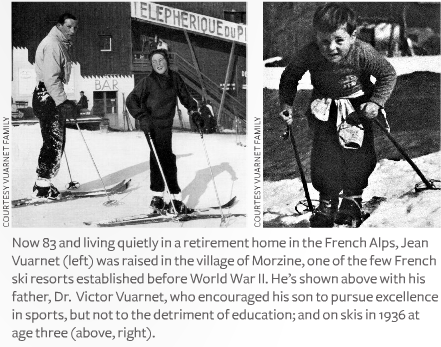
Jean Vuarnet was born on January 18, 1933 in Tunisia, where his father, Dr. Victor Vuarnet, had recently established a medical practice. Originally from Savoie, Dr. Vuarnet soon changed his mind about life in North Africa. He returned with his family to the French Alps in 1934, settling in Morzine, one of few established French ski resorts before World War II.

Little Jean began to ski when he was two-and-a-half years old. When his father bought him his first pair of skis, he threw a fit because he thought they were too short. It was an early indication of his penchant for going straight downhill rather than wasting time with turns.

He was known by everyone in the village as Jean-Jean, the son of Dr. Vuarnet. Like the other kids, he skied and ice-skated whenever possible. He also introduced skijoring to the valley by attaching a harness to Toto, a dog that belonged to his childhood friend Roger Vadim. (Vadim went on to become a movie director and the husband, at various times, of Brigitte Bardot and Jane Fonda.)

When he finished grammar school at age 11, his father sent him to a private boarding school in Paris. He was expected to follow in his father’s footsteps and become a physician. Dr. Vuarnet exerted an overwhelming influence over his son. He encouraged Jean to pursue excellence in sports, but not to the detriment of his education. The elder Vuarnet had achieved this balance himself by attending medical school while playing soccer at an elite level, including his selection to the French national team for the 1936 Summer Games.

Vuarnet’s mother, overshadowed by Victor, had a lesser influence on him. The couple divorced when Jean was 10. His father remarried quickly, but as soon as Jean began to bond with his stepmother, his father divorced and remarried again.

As a high school student in Lyon and Annemasse, Vuarnet skied mostly during the holidays, dabbled in jumping, and became a competitive swimmer. After graduation, he decided to give ski racing a serious shot while earning a college degree. He enrolled as a law student at the University of Grenoble in 1952.

Around the same time, he became romantically involved with a young French-Canadian woman who, after she discovered she was pregnant, wrote a letter to Jean explaining the situation. The letter arrived at the Vuarnet home in Morzine. Dr. Vuarnet opened it, and then promptly decided not to reveal its contents to his son, who was away at college. Jean discovered nothing of what had happened. The girl returned to Montreal, presumably never to be seen again.

At law school, Jean joined the Grenoble University Club (GUC), where the ski program had recently been taken over by a PE teacher named Georges Joubert. It was a remarkable winter. At the French University Games, Vuarnet won the 1952 national titles in downhill, slalom and combined. He also picked up a lasting reputation as a “city racer” from his future colleagues on the French national team, mountain boys who at the time seldom pursued education beyond the age of 13 or 14.

Schooled in cities, Vuarnet was only partly raised in a ski town. He never became a true “natural” skier by his own admission. To compensate, he observed and analyzed what the best skiers were doing. Olympic bronze and silver medalist Guy Périllat expressed it well in a 2002 interview in l’Équipe Magazine: “Jean wasn’t the most gifted among us, but he always scrutinized everything in depth.”

Vuarnet’s attitude was a perfect fit with what Georges Joubert was doing at the GUC. Their first book, Ski ABC: Technique Moderne, published in the fall of 1956, was praised by 1937 overall world champion of alpine skiing, Émile Allais, who contributed a preface. The purpose of the photos in Ski ABC was to demonstrate that the world’s best racers all used the same basic techniques. That opinion contradicted the narrow nationalism prevalent in ski technique at the time, when French, Austrians and Swiss each were claiming to have the superior method.

For more than a decade, Joubert and Vuarnet analyzed and explained what they observed in elite racers, codifying their findings in five books, translated into multiple languages, which influenced ski coaching and teaching around the world. Joubert tended to focus on turning technique, Vuarnet on speed. From their books emerged inventive technique terms, such as the Jet Turn, the Serpent, Avalement (swallowing terrain irregularities), and l’oeuf.

Vuarnet’s downhill research led him to an enhanced streamlining of the body, with feet farther apart for superior gliding. After he used it to win his Olympic downhill gold medal at Squaw Valley, American media called it the “egg,” which translates to French as l’oeuf. Actually, a cartoonist at the French sports daily l’Équipe, André Caza, in 1946 used the word “oeuf” in a comical way to describe the positions employed by cyclists and skiers to streamline themselves.

For Vuarnet, the correct stance was not natural. It required special physical conditioning to build the stamina necessary to hold the position for sustained periods of time. It combined the two necessities for reaching maximum speed in speed racing: a body profile offering minimal air resistance, and the ability to keep skis flat on the snow and properly loaded for the best possible gliding. The racer could employ it to gain time on the easier sections of downhill courses. Later, Honoré Bonnet, the iconic director of the French Ski Team, wanted to call the position “VJ” (Vuarnet Jean), but it was dropped for l’œuf, or aller tout schuss.

The Path to Olympic Gold
During the period leading up to the 1960 Winter Olympics, Vuarnet rose rapidly through the racing ranks, winning regional and national races and competing on the international circuit. He collected seven national titles in all three existing disciplines—downhill, slalom and giant slalom—from 1957 to 1959.

He made the cut to race the giant slalom and the downhill at the 1956 Olympics in Cortina d’Ampezzo, only to discover at the last minute that his GS spot had been given to another team member. Angry, he declared publicly that James Couttet, the French team coach and 1938 world downhill champion, “…was a great racer but a mediocre coach.” The declaration made the front page of France Soir, a daily newspaper with a print run of 1.2 million copies. Vuarnet didn’t ski in the GS or in the downhill…and Couttet resigned.

At the 1958 World Championships in Bad Gastein, Vuarnet won a bronze medal in the downhill, then added three titles at the French National Championships. That year he married the attractive Edith Bonlieu.

Vuarnet’s new bride had experienced family misfortune. She had grown up among four siblings with three different fathers, without knowing her own. One brother was 1964 Olympic GS gold medalist “Le Petit Prince” François Bonlieu, who was killed tragically in 1973. Notwithstanding these challenges, Edith became a formidable racer in her own right, winning three national titles. A leg fracture prevented her from competing in the 1960 Squaw Valley Olympics. She could console herself with the knowledge that, uniquely, she had a brother and husband who were both Olympic gold medalists. (Edith and Jean went on to have three children—Alain, b. 1962; Pierre, b. 1963; and Patrick, b. 1968.)

At the 1960 Winter Games at Squaw Valley, Vuarnet rode a pair of metallic Allais 60s made by Rossignol, designed in collaboration with Emile Allais. At the time, high-performance competition skis were still made of laminated wood. One of the drawbacks of the first metal skis produced was the lack of consistency between the skis in a pair. Vuarnet left France for the Olympics without a pair to his liking. Even with the best pair sent to Squaw Valley, only one ski performed well. He instructed Rossignol to make him a second ski similar to the one he liked… and he received it in California only days before the race! The skis were worth their weight in gold.
A New Life After Racing
On returning from Squaw Valley, Vuarnet was greeted at home by an overwhelming reception in Morzine. He was offered the position of Director of Morzine’s Office du Tourisme, in charge of promoting the resort. He started work immediately. Also, with the aid of ski journalist Serge Lang, he wrote a book, Notre Victoire Olympique. A new life, a new career had begun.

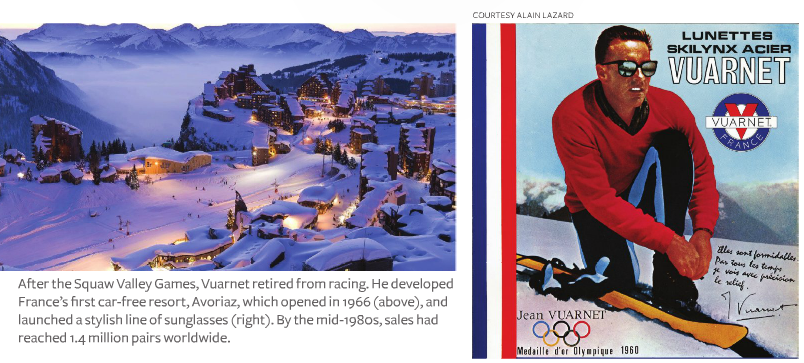
Pouilloux and another eyeglass manufacturer approached him with an offer to develop a new and stylish pair of sunglasses, called the Vuarnet. Sales were slow, but took off in the 1980s after the company was a sponsor of the 1984 Summer Games in Los Angeles, where it introduced its catchphrase, “It’s a Vuarnet Day, Today.” Newspapers compared owning a pair of Vuarnets to having an Hermès scarf. Celebrities Mick Jagger and Miles Davis wore Vuarnet glasses, as did world-class sailors and ski instructors at resorts like Cortina, Courchevel and Megève. Annual sales reached 1.4 million pairs worldwide and in the United States, Vuarnets surpassed Bausch & Lomb’s Ray-Bans for a few years in a row. France rewarded the success with the coveted Annual Export Award.

Creation of the Avoriaz Resort
Beginning in the 1960s, new ski-in, ski-out resorts were being developed in France—among them La Plagne, Tignes, Les Menuires, Flaine and Les Arcs. As head of Morzine’s Office du Tourisme, Vuarnet envisioned a grand project—the development on an adjacent plateau of a high-altitude, pedestrian resort.
“I convinced the municipality to imagine a brand new resort above Morzine,” Vuarnet recalls, “free of cars. It would be Avoriaz.” As the possessor of a law degree, an Olympic gold medal, and knowledge of skiing and the local terrain, Vuarnet was seen as having the assets necessary to launch such an ambitious venture. The municipality gave the project 200 acres of developable land for a base village. Avoriaz, the first no-car resort in France, opened in 1966. Later Vuarnet negotiated an agreement to connect Avoriaz to 11 adjacent resorts, including four in Switzerland. Les Portes du Soleil is now the second-largest complex of interconnected ski areas in the world.

Italian and French National Ski Teams
After the launching of Avoriaz, Vuarnet anticipated devoting more time to his growing family, with two boys and a third on the way. But another challenge arose: The president of the Italian Winter Sports Federation asked him to lead the country’s languishing alpine ski team, ranked 8th in the world. The losing status was unacceptable to the proud Italians, who still remembered the great period of Zeno Colò, 1950 world champion in giant slalom and downhill at Aspen and downhill gold medalist at the 1952 Olympic Games.

Vuarnet hesitated, but finally accepted the challenge, with the condition that he be given carte blanche to run the operation as he wished. He led the team from 1968 to 1972, blessed with the arrival of 18-year-old racer Gustavo Thoeni. Success followed. Before his tenure, the Italian alpine team in 17 years had scored only one podium in the classic races. A year after Vuarnet left the team, 1973, Italy had risen to second in the men’s Nations Cup standings, and a year later first, ahead of Austria. The exceptional team was nicknamed The Blue Avalanche. Between them, Thoeni and Piero Gros won the overall crystal globe, symbolic of the best alpine ski racer in the world, consecutively between 1971 and 1975.

In 1972, Vuarnet was petitioned to accept the vice presidency of the French Ski Federation, which perceived the national team to be in trouble. Against his better judgment, he accepted, with the condition that his friend and collaborator Georges Joubert be placed in charge of the team. Despite what the two men brought to the table—Vuarnet’s just-accomplished turnaround of the Italian team, and Joubert’s transformation of an insignificant university ski club into the number-one team in France—the new assignment quickly turned sour. Their reforms were derailed. The fusion of staff, racers and suppliers, which Vuarnet had been able to create in Italy, did not happen. The French Federation, supported by the government’s Secretary of State for Youth and Sports, decided to fire six top racers for intransigence. Joubert resigned.

The mountain community and 1968 Olympic triple gold medalist Jean-Claude Killy unconditionally supported the racers, leading to a split between Killy and Vuarnet that persists to this day. It’s a long, complicated and unpleasant story. (For one version of what happened, visit www.affairevaldisere.fr; a differing interpretation will appear in the July-August 2016 issue of Skiing History.)

Vuarnet quit after two years. By 1974, he had spent almost 15 years working nonstop since his gold-medal win at Squaw Valley, with little time for family life. Edith had borne the brunt of handling the house, running two ski shops in Avoriaz and raising three boys. The only time the family spent together was during extended summer vacations in the South of France, the Costa del Sol in Spain, and aboard Vuarnet’s sailboats, the Eileen and the Tahoe, a 64-foot custom-built schooner.

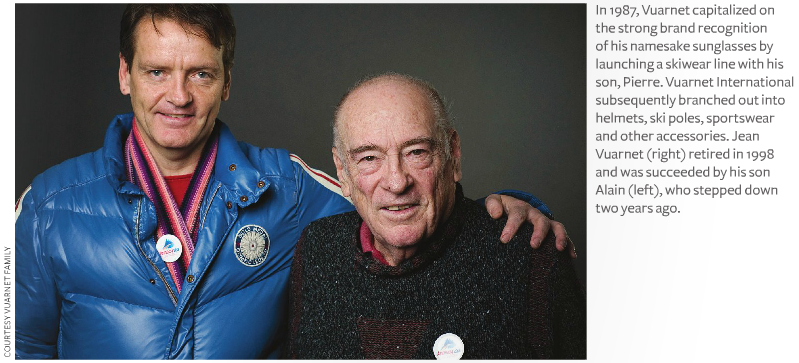
Vuarnet took advantage of this window of time to try his hand at a lifelong passion: books and reading. For a few years he launched and operated a publishing company, Les Éditions VUARNET, which handled titles as diverse as cinema, history, travel guides, sports and medicine. This semi-dilettante period didn’t last. In 1987, Vuarnet decided to capitalize on the strong brand recognition of his namesake sunglasses by launching a skiwear line with his son, Pierre. Subsequently created was Vuarnet International, which branched out into watches, sportswear, shoes, perfume, cosmetics, pens, luggage, leather goods, jewelry, ski underwear, helmets, ski poles and skis. The company came to oversee luxury Vuarnet shops in Brazil and France, and developed licensees with distribution in 30 different countries. Jean Vuarnet retired in 1998. His son Alain, who succeeded him, stepped down two years ago.

Family Tragedy
The years 1994 and 1995 were horrific ones for Vuarnet and his family. In October 1994, news emerged of a mass suicide in nearby Switzerland. The bodies of 53 members of an obscure apocalyptic cult, the Order of the Solar Temple, were found dead and partially burned. A few days later, two journalists showed up at the door of Vuarnet’s chalet in Morzine. From them Vuarnet learned that his wife Edith and Patrick, the youngest of his three sons, belonged to Solar Temple. Thankfully, they were not among the victims. But the family was devastated. Over the next year, they desperately tried to persuade mother and son to leave the sect.

The effort failed. On Christmas Day 1995, another 14 sect members were found in a remote area of the Vercors range near Grenoble, their bodies shot and partially burned. After a week of waiting, Jean learned that Edith and Patrick were among the dead. It was a terrible tragedy. Despite public outcry and civil lawsuits, a key cult leader—a Swiss musician and orchestra conductor—was inexplicably acquitted.

The funeral of Edith and Patrick in Morzine was a moving tribute to the Vuarnets from the local community and afar. Jean received hundreds of condolences from around the world. One was from a Montreal woman named Christiane. She reminded him that they had known one another in the early 1950s. By coincidence, Jean’s son Pierre was living with his Canadian wife and two children in Montreal at the time, so Jean decided to spend the 1996 Christmas holidays with them. While he was there he looked up Christiane. To his shock and surprise, she told him how she had moved to Canada and given birth to a lovely child, Catherine. In Montreal, for the first time, Vuarnet met his biological daughter, named Catherine.

Three years after re-connecting in Montreal, Jean and Christiane married. Over the next 13 years together, they divided their time between Morzine, the Baleares Islands (where Vuarnet moored his schooner, Tahoe), and a picturesque Cantons de l’Est village in Quebec, Knowlton, which happens to be the longtime home of Canadian two-event world champion Lucile Wheeler Vaughan—who had no idea another gold medalist was living nearby.
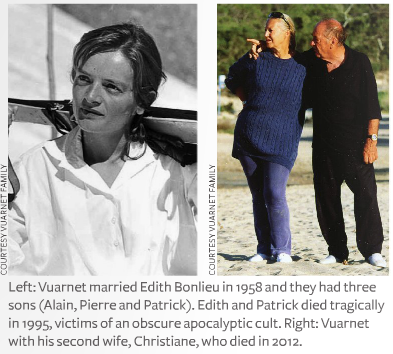
In 2012, Christiane died of a heart attack. After her passing, Vuarnet sought a place where he could spend the remainder of his years. He found a retirement home in Sallanches, then recently returned to his home town of Morzine.

Only a handful of French ski champions have accomplished so much after their successes on the slope—notably Émile Allais, Vuarnet, and Jean-Claude Killy. Vuarnet looks back at his career with pride and equanimity. Over his multi-faceted career, he made a good amount of money, “but money-making,” he says, “never drove the decisions that led to my successes.”

The author, the late Alain Lazard, was a longtime ISHA member and frequent Skiing History contributor. His most recent articles included “Rise and Fall of Racing Nations” (May-June 2015) and “Joe Marillac: The Little-Known Frenchman Who Helped Squaw Valley Win the Winter Olympics” (July-August 2013).
Open to Public?
Off
Feature Image Media
Image
Timestamp

Bob Beattie recently shared some thoughts about the state of ski racing in the United States. Here's what Coach has to say:

  • Alpine ski racing is too expensive. When a parent calls to tell me she paid $25,000 for her kid to be on the U.S. 'C' Team, or $30,000 when moved to the “B” Team it makes me wonder. This is killing our sport!
  • Local programs are our future.  The USST has jumped in after many years away. We need top coaches and leaders at the local level who have leadership capabilities and the ability to keep parents on the sideline! (I could write a book on this).
  • Age levels have changed. Many USST racers are 30 years old or more. Maybe we should only support them if they excel, and only spend money on the younger ones!  Many have wanted to bring back Pro Ski Racing, but  we already have it within the USST – older racers have their own coaches, managers, travel etc.
  • We have a program in Aspen, in which almost 2,000 kids become skiers at  very low cost. They receive bus transportation up the valley and instruction by the Aspen Ski School instructors. Jeff Gorsuch gave 250 pairs of skis, boots, poles, and bindings last week at no charge. A large percentage are Spanish speaking. They could not be skiing without his support. The Aspen Ski Company gave 150 snowboards. We started this several years ago and it is run through the Aspen Valley Ski Club. I would like to see this number double. We should present this to other ski towns. Then we would truly be Best in The World.
  • Formats: Skiing is slow when it comes to new ideas. Let's push team events – with dual racing both at local level and USST.
  • College skiing is alive but not well in the West. Only two out of 12 skiers were Americans in last winter's NCAA Championships from University of Colorado, Utah and New Mexico, and only one from the University of Denver. Education is key, with scholarships and coaching. The USST has ignored college skiing.  It should work to bring it back.


Category
Open to Public?
Off
Feature Image Media
Image
Timestamp

China and the future of the Winter Olympics. By John Fry

The transformation of the Olympic Winter Games within the lifetime of most Skiing History readers has been shocking. 

 
The first Winter Olympics after World War II took place in the magical snowcapped Engadine Alps around St. Moritz, Switzerland. The 1952 Games were held in skiing’s historic Norwegian homeland, Oslo, followed by the gorgeous setting of the ’56 Games amid the soaring Dolomite peaks surrounding Cortina d’Ampezzo, Italy. And who can forget the ceremony opening the 1960 Olympics when the clouds parted and the sun, absent for days, shone gloriously down on the pristine snow-capped Sierra Nevada around tiny Squaw Valley?
 
The early 20th Century’s implicit understanding that snow and cold and mountains would define the location of the Winter Games ended definitively in the
21st Century. Sochi in 2014 (see “After Sochi, What?” in the March-April issue of Skiing History) mirrored the IOC choice of another sea-level city for the 2010 Winter Games, Vancouver, where fog, rain and predictably warm weather on Cypress Mountain and the base of Whistler fogged the ski and snowboard competitions.
 
The Games—which have tripled from 35 medal events in 1968 to more than a hundred today—have migrated from winter wonderlands to sprawling urban centers. Nothing surpasses the International Olympic Committee’s choice of Beijing (population 11.5 million) as the host city for its 2022 Winter Games. Beijing won by a narrow four-vote margin over Almaty, Kazakhstan’s largest city, ringed by impressive 4,000-meter peaks and favored by most top-level skiers I’ve talked to. Voting countries not engaged in winter sports likely affected the Chinese outcome.
 
Beijing’s atmosphere is one of the most polluted in a country where, according to the research organization Berkeley Earth, outdoor air pollution contributes to the deaths of 4,400 people daily. Distant coal-burning plants to the southwest of Beijing create much of the vast metropolis’s air pollution, worse in winter.
 
Fifty-five miles northwest of the Chinese capital is the proposed site of the alpine ski racing competitions in February 2022, Yanqing, a cold, arid, mountainous, treeless desert. The average annual snowfall is five centimeters, about two inches. Arizona’s mountains are lush by comparison.
 
Gunther Hujara, FIS technical expert, and ski resort planner Paul Mathews of Ecosign, Whistler, BC, have spent time at the proposed Chinese ski venues for 2022. I talked at length with both men. Hujara grudgingly acknowledges that it’s technically possible to hold the races on the rugged south-facing terrain. Massive amounts of water, compressed air and pipes would be required to lay snow all the way to the summit.
 
“Our job is to make it work,” says Hujara, who adds, however, that he was not shy in expressing to the IOC misgivings about the site selection. Mathews believes the alpine ski events will be shifted elsewhere. “It’s not unusual for venues to be changed after the Games have been awarded,” he observes.
 
Ecosign has done extensive design work in the Chongli region of China, where the nordic and snowboarding competitions will take place on surfaces entirely
blanketed with machine-made snow. The region is 180 miles northwest of Beijing; high-speed train service will bring it within 50 minutes travel time.
 
The lack of natural snow, while unattractive to a winter sport aficionado’s eyes, is not functionally bad. Alpine course preparation is difficult if major snowstorms unexpectedly arrive. That’s not going to happen in China, where, at the same time, conditions for making snow are good.
 
The climate of the region is similar to that of northeastern China, in Heilongjian Province, where I skied with the late Ned Gillette and Jan Reynolds in the winter of 1980 (SKI Magazine, October 1980.) The hills lie east of the vast Gobi desert. The prevailing westerlies don’t pick up moisture until they cross the Sea of Japan and dump snow on Hokkaido and Nagano, hosts to the 1972 and 1998 Winter Olympics.
 
No significant ski resort existed in China at the time of our pioneering visit, but today Heilonjiang Province is home to China’s most popular and populous ski areas, like Yabuli. The topography and climate are similar to that of Pyeongchang in South Korea, a ski resort region where the Winter Olympics will be held in a little more than two years from now. Preparations for the 2018 Games at one time were months behind schedule.
 
“We have faced huge problems,” says Hujara. The Koreans failed to budget enough time and money for unforeseen but critically needed infrastructure.
 
Ever since Grenoble in 1968, IOC-chosen host cities have spent billions of dollars on buildings and highways, and facilities, often with meager after-use. The expense and tax burden of creating massive infrastructure is what has recently deterred potential host cities in Norway, Sweden, Switzerland, France and other countries from bidding for the Games. It has left the field open to Asian nations, like Russia, Kazakhstan and China, with governments that can impose the tax burden on citizens who don’t have access to the ballot to oppose.
 
By 2022, three Winter Olympics in a row will have taken place outside of the Western world, their birthplace. No one wants them because of their financial and environmental impacts.
 
To encourage countries to bid again in future, the IOC will look favorably on cities with ready-made competition facilities, places where the Games have previously been held. Host cities will be able to save money by having sports, such as the costly bobsled and luge, held in another country, a possibility envisioned years ago by former IOC member Jean-Claude Killy,
 
Will the bidding reforms attract Western European or even North American resorts to seek the 2026 Winter Games? Perhaps they will return to the handsome, photogenic mountains of their early years. It remains to be seen.
 
John Fry is the chairman of the International Skiing History Association, and author of The Story of Modern Skiing (380 pages, available at Amazon).
Category
Open to Public?
Off
Feature Image Media
Image
Timestamp

Bob Beattie speaks out on the “alarming” state of collegiate ski racing in the United States—and how it can be fixed.

By Edith Thys Morgan

Above photo: Courtesy David Bayer Photography

This past May, U.S. Ski and Snowboard Association (USSA) CEO Tiger Shaw announced the first National University (N-UNI) Team, to the tentative applause of the skiing world. The announcement marks a major philosophical shift for an institution that, at best, has tolerated rather than embraced elite athletes progressing through the NCAA ranks. Critics lament the small numbers and lack of female representation on the six-man N-UNI roster, all of whom will compete for their respective colleges while also competing on the U.S. Ski Team (USST). Proponents like USSA Alpine Development Director Chip Knight—himself a USST alum, three-time Olympian and, most recently, head women’s coach at Dartmouth College—see it as a hugely positive first step. 

“It’s a pilot program,” Knight says. “Our hope is to provide a viable path for kids to start school and keep developing [as skiers]. The N-UNI Team is an opportunity to show this can work.” One person who was unequivocally happy with the announcement is the U.S. Ski Team’s biggest fan and boldest critic, Bob Beattie.

Beattie’s influence on alpine skiing started in the late Fifties and Sixties, when collegiate skiing was the repository of the top U.S. coaches and athletes. The New Hampshire native grew up with a love for all sports and attended Middlebury College, where he started his coaching career. He moved to the University of Colorado (CU) to coach football and skiing in 1956, at age 23. Beattie’s Buffs won the NCAA Championships in 1959 and again in 1960, with a team of U.S. racers. Throughout Beattie’s nine years there, CU battled with the dominant University of Denver team and their coach Willy Schaeffler. While Beattie prided himself on his all-American team, Schaeffler aggressively recruited Europeans, mainly Norwegians, who brought him 13 national titles from 1954–1970. 

Beattie went on to coach the first U.S. Ski Team from 1961–1969 (concurrently coaching at CU until 1965), coaching Billy Kidd and Jimmie Heuga to Olympic silver and bronze medals respectively in 1964. He co-founded the World Cup in 1966, founded the World Pro Tour in 1970, and was commissioner of NASTAR. An ABC commentator for four Olympics, Beattie’s name and voice became synonymous with U.S. alpine skiing. Master innovator, promoter and motivator, he remains a thoughtful and outspoken advocate of skiing, offering his views on how to transform, preserve and improve ski racing in the United States. Here, Bob shares his views on the state of collegiate skiing and where, with some encouragement, it might go.


How did you get into skiing?
I grew up outside of Manchester, New Hampshire, and Dad introduced my brother and me to every sport you can imagine, including skiing. We didn’t have much money but we loved the mountains, skiing and just goofing off.

And ski racing?
I got into ski racing in high school, then at Proctor Academy where I went for a year before going to Middlebury College. I was actually better at cross country than at alpine, but I told them I couldn’t compete in cross country because I had a bad heart.

Did you in fact have a heart condition?
No. But I wanted to race alpine. I tried for the alpine team every year. Finally in my senior year I knew I wouldn’t make it, so I raced cross-country. I also played football in the fall and tennis in the spring.

Who was an early influence in ski coaching?
I learned a lot from Bobo Sheehan (then Middlebury coach, whom Beattie temporarily replaced when Sheehan left to coach the 1956 Olympic team). He had a great way of working with people. And we both hated Dartmouth. (Laughs.) I still hate Dartmouth.

Describe your CU experience.
CU ski racing was a big challenge for me and a great love affair. We fought hard with DU all the way and made “only U.S. racers” our password. At one point, the CU athletic director called a meeting with Schaeffler, the DU athletic director, and myself to tell us to “slow down.” That only lasted for a week and we were at it once again!

Your reputation was one of tough love, working harder than the other guys and building team spirit through
suffering. How did that play at CU?

Maybe it was my football background, but physical conditioning was the key to everything.  In addition to hiking to train on St. Mary’s Glacier, we worked out five days a week in the fall. Coaches from other CU sports came to watch and they couldn’t believe it.  We worked out Saturday and Sunday at 8 a.m.! Even today I exchange calls with my guys from then, people I tortured. They love to bring it up.

And nobody dodged the work?
When Spider Sabich—“only a freshman”—was late for training, I let the rest of the team take a break and made Spider do somersaults up the football field until he went into the trees and got sick!

When you first started at CU, you changed the NCAA rules (against Schaeffler’s wishes) so that three out of four racers counted (it previously had been four out of five). Then you took an innovative approach to increasing participation on the ski team.
The CU Ski Club had 3,500 members, so in an effort to broaden the CU Ski Team, I moved my office from the Athletic Department to the Student Union building. We had a film room there and I could take each racer’s video from the weekend and put them on his own reel. Every day around 10 a.m., the place was jammed and noisy, but it built enthusiasm for the team.

Do you still think that's the key—bringing skiing to the people?
Yes! I feel very strongly that CU should have a winter carnival at Eldora, like the ones they have in the East. But it could also attract a wider audience. It could have music and all types of events, both for college and recreational racers.

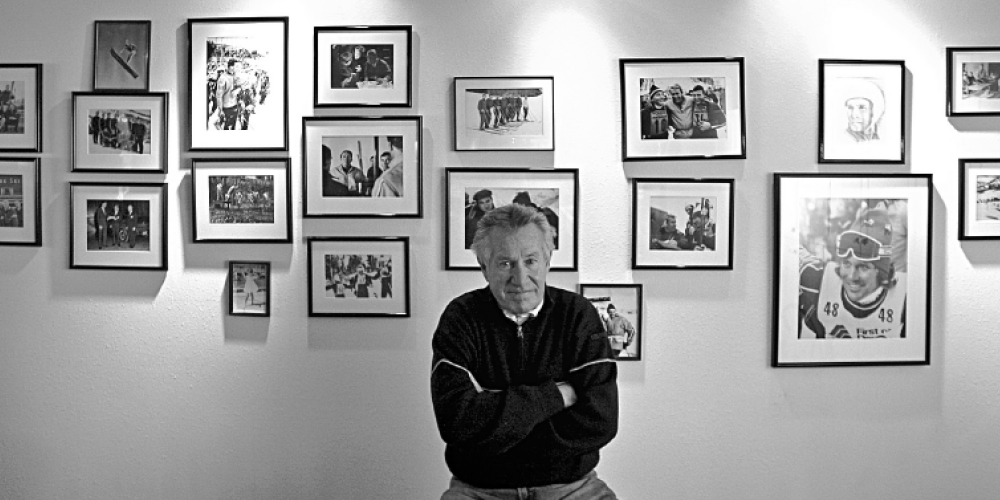
Beattie with an unidentified skier at the University of Colorado, where he coached for nine years, starting in 1956. Under his leadership and with "only U.S. racers" as his creed, CU won the NCAA alpine championships in 1959 and 1960. Photo courtesy of University of Colorado Athletic Department.

What makes college ski racing special?
Academics, the racers themselves, the spirit, and having both men and women competing—it will always stand the test of time. 

These rivalries throughout your career—Dartmouth vs. Middlebury; DU vs. CU; U.S. vs. European— were they bitter or friendly?
It was always friendly in the aftermath. That’s the way it is in skiing. When we get together those [rivalries and arguments] are the things we talk about. I even like that there are lots of Dartmouth people working for the U.S. Ski Team now. It is a disciplined and creative approach. I love that they are involved with college racing. Tiger Shaw’s wife Kristin left the World Champs in Vail to attend a carnival race. I love that!

How do you see the state of college skiing today?
College skiing, particularly in the West, presents an alarming situation. CU, DU, Utah and New Mexico all qualified the maximum 12 men and women allowed for the NCAA championships. They were the top four schools along with Vermont, but only two racers were from the United States! This is not right. Many Western schools (Washington, Wyoming, Nevada, and Western State) have dropped their programs. I question whether there will even be college skiing in a few years.

The European skiers raise the level of competition and lower the penalties. How does that hurt U.S. skiers?
By receiving scholarships, they are depriving U.S. youngsters the chance of receiving an education, and a future in racing. At CU I made it a point to have U.S. kids, many from Colorado mountain towns and others who later moved to Colorado after graduating. 

You have a great deal of respect for current CU coach Richard Rokos, and even supported him for the Colorado Ski Hall of Fame. Under Rokos, CU earned NCAA titles in 1998 and 1999. The majority of those athletes were born within a 100-mile radius of CU.   

The next generation of recruits, however, could not compete against what Rokos called the “Foreign Legion.” DU won four titles in row and UNM won a title with no Americans on the teams whatsoever. So Rokos brought kids from across the pond and CU won the NCAA title in 2006. With the pressure from financial backers, what could he and other college coaches do?
I disagree with the win-win-win approach. It's how you win. And winning can mean different things. It can mean more popularity for the sport. It can mean working with and strengthening local programs and U.S. athletes. 

The mix should mostly be homegrown. What will happen if more colleges are faced with financial problems and drop some sports? Where would CU, New Mexico and Utah fit, unless we show statewide support from the ski industry and local programs?

So the college thing is also an industry thing.
Colleges, local programs, the USST, retired racers, and the media should work together. Getting kids on snow and keeping it affordable is a challenge, but we can all help by working together and asking ourselves, “How can we best support our sport while expanding U.S. participation across the board?” Certainly, universities in snow states can be strong participants. Most families can’t afford the cost, especially with too much travel and parents with money working to “buy” success. We all know skiing is expensive, but we can correct this some by not traveling as much. It’s hard to increase skiing skills riding in a car or hanging out at some far away ski area. 

If the NCAA does not have the will or incentive to change the rules and limit foreigners, what can the coaches do?
Change the rules! Create new rules. In my ancient days we fought the FIS all the way about everything from race sites to seedings. One time in Wengen we fought over FIS rules about seeding and it lasted 3-1/2 hours. We won this battle (Kidd was scheduled to start the slalom wearing #45, but ended up in the first group) by not giving up, not by quiet negotiations! 

All the coaches have to do is stand up and be heard. I'm nudging them a lot. I may be taking a break but I'm not quitting on this one.

Not everyone agrees with you.
(Laughs.) Even my son Zeno disagrees with me. Like many of the college coaches, he believes the reason there are so few Americans is that they aren’t good enough. I say there is no opportunity for them. God bless the Eastern part of the country, where there are still American athletes.

What keeps you up at night?
This!

You’re an optimist. Where’s the hope?
We have a long way to go, but I am 100 percent convinced that skiing can thrive if it is promoted well at all levels.

Beyond going more local, how else could college skiing be improved?
I think having new formats and ideas should come about every year. Add new more interesting events. Maybe dual racing and snowboard events to attract the ESPN X Games audience and gain college press excitement. We should have answers when people ask, “What’s new?”

You haven’t always agreed with the USST approach to college racing.
In the past, the USST ignored college skiing. The philosophy was that you should pluck away top kids and bring them together to one place in a specialty school. I think you need to keep kids in local programs as long as possible.

Where do ski academies fit into that?
I am not a huge academy guy. (Laughs.) I understand it, but I think you can still go to a regular high school, or at least junior high.

What do you think about N-UNI?
It’s a great step in the right direction. The national team needs to work with colleges and college athletes.  What better way to develop kids and gain an education?  The colleges have good coaches and specialize in technical alpine events, plus cross-country.  

For coaches to keep their jobs, isn’t it all about winning?
There is more than winning the NCAA champs, particularly if not many people know about them. Let’s tell the story and let the secret out of the bag! Not all schools need to go for overall team victories. Some might want to specialize in cross-country.  

How do you feel about the U.S. Ski Team today?
It's exciting for me. The USST needs to work with the colleges and vice versa. I have lots of confidence in Tiger Shaw, who understands this and will make adjustments to increase the stature of college skiing.

So you’re a fan of Tiger?
Yes, even though he did go to Dartmouth. 

Edith Thys Morgan is a two-time U.S. Olympian in alpine skiing and the author of Shut Up and Ski. You can read her blog and learn more at www.racerex.com.

Bob Beattie
Open to Public?
Off
Feature Image Media
Image
Timestamp

Click the image above to view a larger version

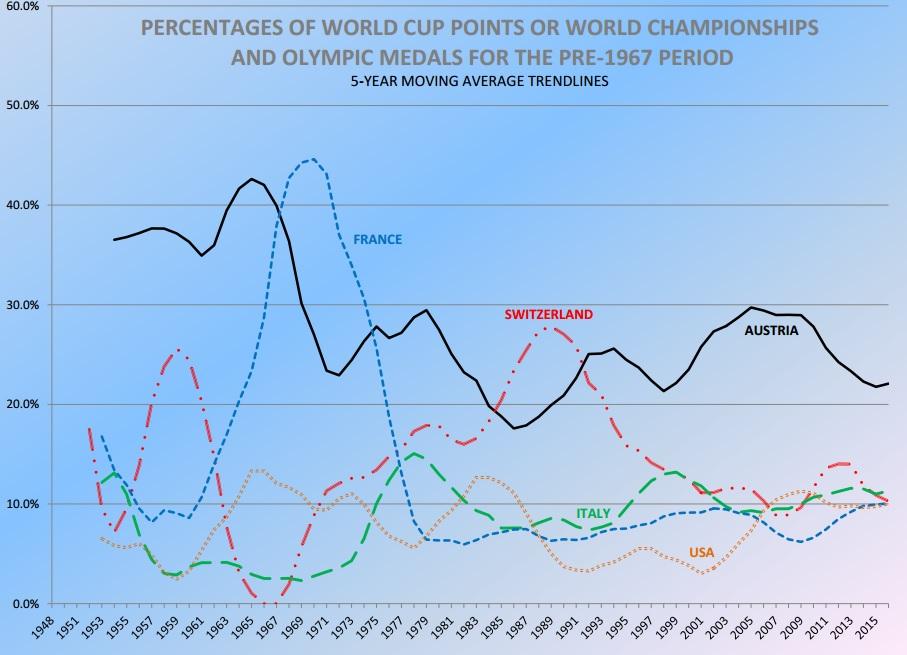
The rise and fall of the top alpine ski racing nations is visible in this unique new chart, created by former French coach and resort analyst Alain Lazard, longtime northern California resident and ISHA member. Lazard has mined masses of data since World War II. The colored trend lines in the chart have been smoothed by using five-year moving averages. For the period 1948–1966, before the creation of the World Cup, Lazard used results of the Winter Olympics and the FIS World Alpine Ski Championships. After 1967, the charted lines are based on Nations Cup points—the number of World Cup points aggregated by individual racers of a national team. The World Cup point formula has been revised five times since 1967, so Lazard has used percentages rather than total points to chart the lines. 

Only three countries have won the overall Nations Cup: Austria (37 times), Switzerland (7) and France (5). The early years were dominated by the French, as reflected in their Nations Cup wins in five of the first six seasons. The Austrian team took over beginning in 1973, followed by Swiss superiority during most of the 1980s. A resurgent Austria charged back to the top in 1988; it has never lost since, in a long streak of 28 consecutive Nations Cup triumphs. Austria’s team dominance of alpine ski racing reached its zenith in the late 1990s and 2000s, when its Nations Cup point total was regularly double that of the second place finisher.

The U.S. ski team’s best Nations Cup performances occurred in the winters of 2005 and 2006 when it placed second, and 1982–84 when it placed third three seasons in a row. Its best performance season, arguably, was 1982 when the U.S. won the women’s Nations Cup.

The highest relative score was registered in 1967, the first year of the World Cup, when France accounted for 44.8 percent of the points awarded. Jean-Claude Killy’s dominance was reflected in his capturing 16.2 percent of the points scored by all men from all nations. The next best was in 1974 by Annemarie Moser-Proell with 14.7 percent of women’s points, and Nancy Greene with 12.4 percent in 1967. In 1977, Ingemar Stenmark captured 10.8 percent of all total men’s points during the season.

The idea for the Nations Cup of Alpine Skiing was conceived by ISHA chairman John Fry in 1966.

Category
Open to Public?
Off
Feature Image Media
Image
Timestamp

Years (shown below in parentheses) represent the period when the athlete competed internationally.


Christl Cranz


Christl Cranz (Germany, 1934–1939): 15 World Championship medals, 2 Olympic medals*

Nancy Greene (Canada, 1960–1968): 3 Olympic medals, winner of the first two overall women’s World Cup titles, 14 World Cup wins.*

Marielle Goitschel

Marielle Goitschel (France, 1962–1968): 9 World Championship medals (including 2 Olympic), 7 World Cup wins*

Annemarie Moser-Proell (Austria, 1968–1980): 9 World Championship medals (including 3 Olympic), 62 World Cup wins, 6 overall titles (record for men and women)

Hanni Wenzel

Hanni Wenzel (Liechtenstein, 1974–1984): 9 World Championship medals (including 4 Olympic), 33 World Cup wins, 2 overall titles 

Erika Hess (Switzerland,1980–1987): 7 World Championship  medals (including 1 Olympic), 31 World Cup wins, 2 overall titles

Erika Hess

Vreni Schneider (Switzerland, 1986–1995): 9 World Championship medals (including 5 Olympic), 56 World Cup wins, 3 overall titles

Janica Kostelic (Croatia, 1998–2007): 6 Olympic, 5 World Championship medals, 30 World Cup wins, 3 overall titles

Anja Paerson (Sweden, 1998–2012): 6 Olympic, 9 World Championship medals, 42 World Cup wins, 2 overall titles

Lindsey Vonn (USA, 2000– ): 2 Olympic medals, 6 World Championship medals, 65 World Cup wins as of March 15 (record), 4 overall titles 

* Cranz, Greene and Goitschel competed in years before the 1967 introduction of the World Cup. The first women's World Alpine Ski Championships were held in 1931.

Category
Open to Public?
Off
Feature Image Media
Image
Timestamp

After a stunning comeback this past winter, Lindsey Vonn surpassed Austrian racer Annemarie Moser-Proell’s record number of alpine World Cup wins. Who’s the greatest? The new record ignites a debate that won’t be resolved anytime soon.

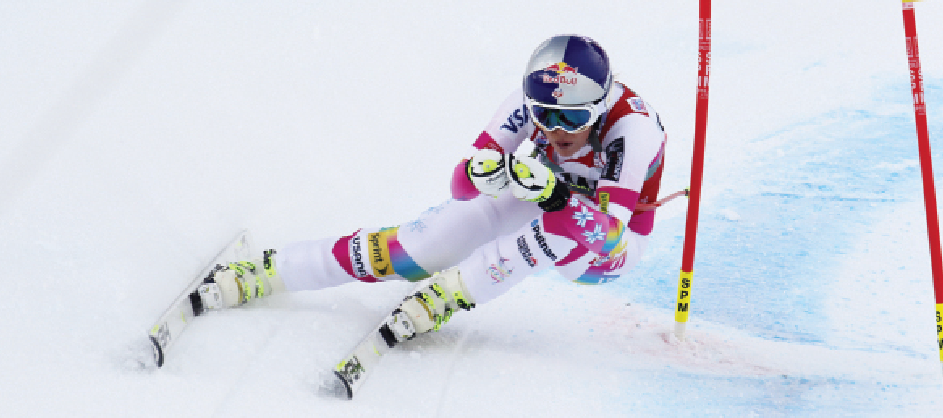
Lindsey Vonn on the downhill course at Cortina d'Ampezzo on January 18, 2015. She won the event, tying Annemarie Moser-Proell's record. The next day, Vonn won the Super G. Photo By Agence Zoom / Christophe Pallot.


By Edith Thys Morgan

When Lindsey Vonn crossed the Super G finish line in Cortina for her 63rd World Cup win on January 19, she knocked Annemarie Moser-Proell off the top step of the podium for total World Cup wins. At press time in early March, she had racked up two more first-place finishes for 65 and counting.

But these landmark victories did nothing to answer this question:  Who’s the greatest all-time skier in the history of women’s World Cup racing? For those who measure such things, Vonn’s record-setting win only fanned the flame of a discussion that won’t be resolved anytime soon.


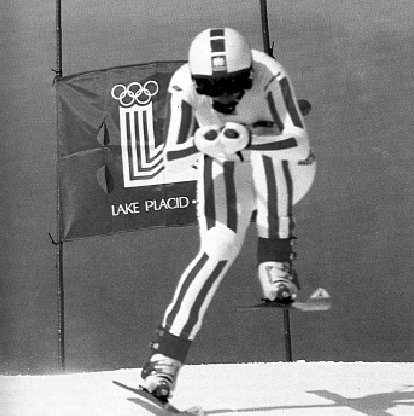
Proell charges toward DH gold at the 1980 Winter Olympics. Photo Courtesy of International Olympic Committee
A dominant champion and colorful character on the women’s tour from 1970 to 1980, Moser-Proell clinched five World Championship titles as well as the 1980 Olympic downhill gold at Lake Placid. During her best years, she scored victories in all disciplines during the same winter — and from 1972 to 1974 notched eleven consecutive downhill victories. She retired in March 1980, with 62 wins, after 11 seasons on the World Cup tour.


Those who favor Moser-Proell, despite Vonn’s record-breaking feat, point to three factors that garner her the top spot: winning percentage, overall titles and the Super G. Vonn competed in 332 races to claim her record, while Moser Proell took a mere 174, a winning percentage of 19 and 35 percent, respectively.  As for overall titles, Vonn is two behind Moser-Proell’s tally of six — but she came crushingly close to matching Moser-Proell’s five consecutive titles (1971–75) in 2011, when she lost what would have been her fourth consecutive title by a mere three points to her closest friend and rival, Maria Hoefl Riesch. Vonn won her fourth overall title the following year.

INTERNATIONAL DEBUT 

Probably the biggest single point of contention is the Super G factor. Both Vonn and Moser-Proell won in all events available to them at the time. Both excelled at speed events, but Moser-Proell’s dominance included GS. The addition of Super G to the World Cup schedule in 1982–83 offered many more events that favored speed skiers, and indeed, 22 of Vonn’s victories were in Super G. As Cindy Nelson points out, there is no question that Moser Proell would have excelled at the event: “She had Tamara (McKinney) feel with Lindsey size, and was best on rolling terrain when she could accelerate. She would have been incredible at Super G.” 

During the shorter span of her career, Moser-Proell was the singular dominant force in women’s skiing. Vonn’s success over eleven years (2004–2015), which included intermittent streaks of dominance in the speed events, is more aptly defined by her dogged persistence, comebacks and longevity, all of which continue to impress. Both transcended the ski world to become legends in their own countries. For Moser-Proell in ski-crazy Austria, that meant elevating herself above the male ski heroes of the day—working, playing and winning at their level and beyond. For Vonn, it meant breaking into the mainstream consciousness in a country that knows and cares little about alpine skiing. It meant capturing and then enduring the white-hot glare of media attention during the most emotionally vulnerable part of her career, and ultimately winning the respect of skeptics and detractors. 

Each in her own day set a new standard among her peers. At the very least, before making any proclamations one needs to look at their paths and understand their respective eras. Here is a closer look at how Vonn and Moser-Proell each achieved 60-plus wins. 


FIRST TURNS

Lindsey Caroline Kildow, born in 1984, learned to ski at age two and was soon thereafter training nightly at Buck Hill in Minnesota under the tutelage of her highly competitive father, Alan, and renowned ski coach Erich Sailer. She moved with her mother to a condo in Vail at age 11, and ultimately the entire family, including four siblings, followed so that she could devote herself to ski training. Right away, coaches at Vail were impressed by her technical mastery and introduced her to speed events, in which she rapidly excelled. By age 11 she was skiing year-round, and by 12 was sponsored by Rossignol, the same ski brand used by her early role model Picabo Street.

Annemarie Proell, born in 1953 as the sixth of eight children, lived in her parents’ farmhouse several hundred meters above the tiny village of Kleinarl, Austria. She started skiing at age four on homemade skis and was the first of her family to ski race. (Her sister Evi had a brief World Cup career.) Her parents, despite being Austrian, had “Keine Ahnung” (“no clue”) about ski racing and could provide neither ski clothes nor good equipment. The local priest recommended her to the regional ski association. After winning her first local championship at age 13, she wrote a letter to a ski company asking for equipment and was denied.


At age 14, Vonn and teammate Will McDonald became the first Americans to win the Tropheo Topolino youth competition in Italy. At age 15, Vonn started traveling with the U.S. Ski Team and was by then doing her studies on the road through the University of Missouri Online. She raced her first World Cup in 2000 at age 17. Her first podium came at Cortina in 2004, in her 46th World Cup race. Her first win came on December 3, 2004 at age 20. By that age, Moser-Proell had 27 wins and three overall World Cup titles under her belt. 

Moser-Proell made her World Cup debut in 1968 at age 14 (then the minimum age to race FIS), falling three times and finishing last at Badgastein. She joined the Austrian Ski Team the following season under the direction of coaching legend Charly Kahr. Her first podium came that January, at age 15 in Saint Gervais, with a second place in downhill. She won her first race, a GS at Maribor, the following season, at age 16, and also captured bronze in giant slalom at the 1970 FIS World Alpine Championships at Val Gardena. At age 17 she won her first downhill World Cup race, and clinched the first of six overall titles in Are, Sweden. Her seven victories that season included all three disciplines on the World Cup at that time—downhill, slalom and (one-run) giant slalom.


HARD KNOCKS

Beyond her skills and competitive drive, coaches remember Vonn’s frequent hard crashes, big high-speed yard sales from which she typically walked away. Her first time in the spotlight was her body-wrenching crash in training at Sansicario during the 2006 Torino Olympics. Despite hospitalization she returned to race, finishing 8th. 

The longevity of her career is thanks in part to enhanced safety in ski racing venues. The frozen hay bales and picket fences that lined World Cup courses in the 1970s have been replaced with the highly effective A and B netting that line today’s venues. Moser-Proell steered clear of the hay bales by being a canny competitor, keeping her own line secret during inspection, and even skiing off course during a training run to observe and find the perfect line. 


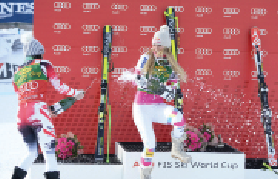
Vonn pops a champagne cork after she won her record- breaking 63rd World Cup race in Cortina in January 2015. Agence Zoom / Christophe Pallot
WELL-ROUNDED

Both Vonn and Moser-Proell won in all disciplines available to them — four for Moser-Proell and five for Vonn. It took Vonn 11 seasons to win her first GS, of only three total. Moser-Proell’s GS was nearly as strong as her DH, and she notched 16 wins in that event. Vonn and Moser-Proell share a relative weakness in slalom, with two and three wins respectively. Both were up against specialists in their day, though with more races in the modern World Cup schedule (17-29 races per year during Moser-Proell’s reign, versus  33-38 during Vonn’s), the task for all-arounders to manage the training, rest and gear required to compete in five distinctly contested events (versus three in Moser-Proell’s era) is considerably more challenging.


EXPERIENCE COUNTS

Vonn has won on the Lake Louise course 14 times. Moser-Proell’s most wins came at Pfronten, which she won seven times, including her last World Cup downhill in January 1980 — the only speed event missed that season by her archrival, Switzerland’s Marie-Theres Nadig. With the tour returning to classic courses annually, as it has in Vonn’s entire career, experience becomes a compounding advantage. During Moser-Proell’s reign, some of the classic downhills on the tour were not run every year, and racers did not ski the hill for Super G as well, giving experienced racers less of a relative advantage. On the flip side, all racers and especially women retired much younger during Moser-Proell’s era, so she did not have to maintain her dominance through multiple waves of young, fresh stars as Vonn has.


GETTING PHYSICAL

Vonn was not athletically gifted in her early years; she was a tall skinny girl and self-described klutz who came into her strength late. That shifted when her father hired a strength coach from the San Francisco 49ers and exploded when she signed with Red Bull in 2005 and became part of their Athletes Special Projects, run by former Austrian downhill trainer Robert Trenkwalder. Per Lundstam, a trainer for the U.S. Ski Team from 1994–2010 and now with Red Bull recalls: “Once she got it into her head to use her physical abilities as a tool she embraced it and thrived.” Vonn, at 5’ 10” and 165 pounds, simply out trains the competition, with high-volume workouts and the most advanced sports science and facilities in Austria and at home.

Moser-Proell also started out as skinny girl who grew mighty in stature. While Vonn’s strength is built through methodical process in the gym, Moser-Proell’s came first from necessity (working on the farm and climbing home after school). Though never known for her athleticism, she skied herself into shape and used the après ski-loving, work hard/play hard image to underscore her overwhelming strength.

OLYMPIC TRIALS

After an impressive sixth place in combined (the best U.S. result for the women’s team) in her Olympic debut at the 2002 Games at Salt Lake City, Vonn came into 2006 as a top U.S. medal contender in the speed events. However, teammate Julia Mancuso stole the show with a gold medal in the GS. Moser-Proell was also upstaged in her first Olympics in 1972. Even as the Austrian team threatened to pull out of the Olympics following Karl Schranz’s ban, Moser-Proell was the clear favorite in both the DH and GS. But Switzerland’s Nadig won gold in both events. Both Moser-Proell and Vonn sat out an Olympics at the peak of their careers — Vonn in 2014 and Moser-Proell in 1976. 


Moser-Proell celebrates her downhill gold at Lake Placid. She retired from racing soon after the 1980 Winter Games. Photo courtesy of International Olympic Committee

POINTS

The current scoring system, where race points are awarded to the top 30 finishers, starting at 100 for a win, was implemented in the 1991–92 season. In Moser-Proell’s era, 25 points were awarded for a win, and points only went to the top 10. Under the modern scoring method,  a consistent racer can amass points even while finishing outside the top 10. 


THE COMBINED FACTOR

Moser-Proell's tally is boosted by seven "statistical combined" events that were calculated from separate — and already individually tallied — slalom and downhill races, a so-called “paper race.” Meanwhile, Vonn's five combined victories represented a new, stand-alone event that consisted of one downhill and two slalom runs.


PERSONAL BUSINESS

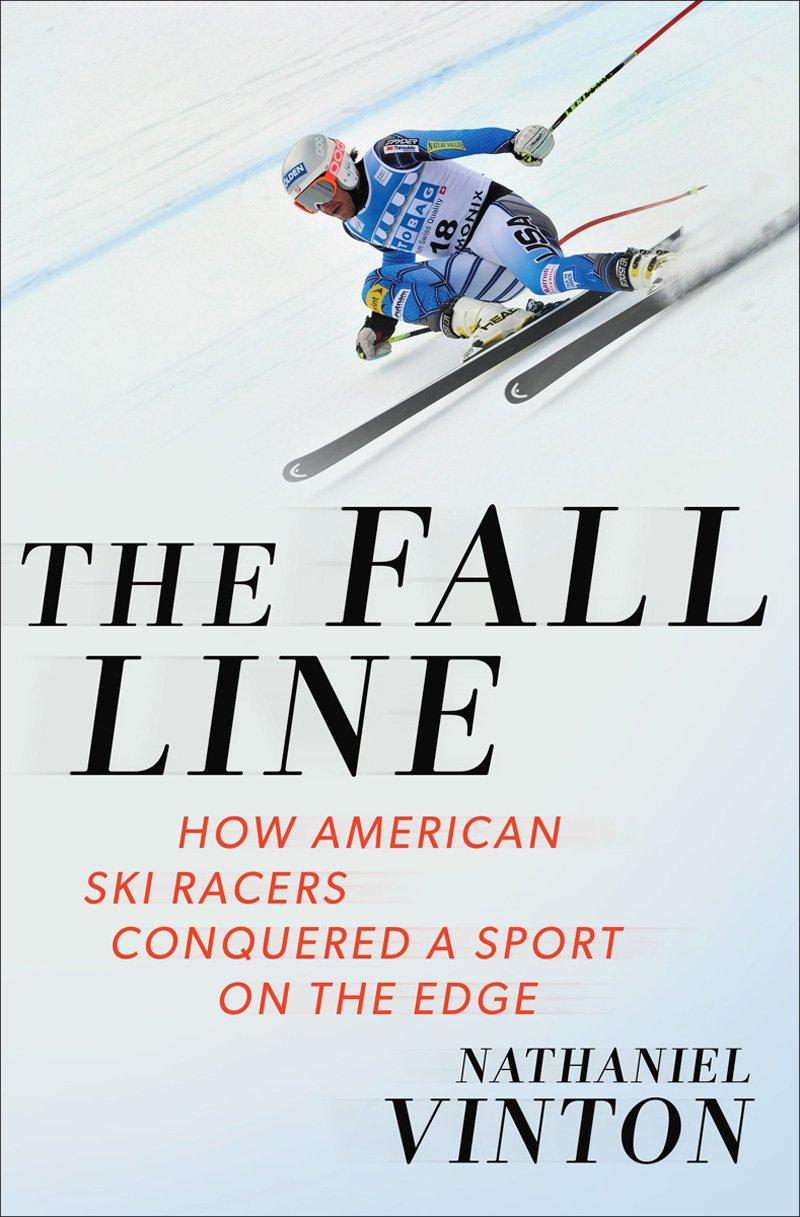
Lindsey Kildow’s career was first managed by her father Alan and then by her husband, fellow ski racer Thomas Vonn, whom she married in 2007. Thomas became the ultimate “rep,” meticulously managing every detail of her career. The couple divorced in 2011. As author Nathaniel Vinton describes in his 2015 book The Fall Line, the divorce “coincided with Lindsey’s rapprochement with the man who had most opposed the relationship to begin with: her father, Alan Kildow, who threw his energy into the brass-knuckled litigation that lasted more than a year.”

Moser-Proell also established a close racer/rep relationship, marrying her ski technician, Herbert Moser, in 1974. They remained together until his death in 2008. 


Vonn has achieved global fame, with red-carpet Hollywood appearances, fashion spreads and magazine covers. She's shown here doing an agility training exercise while shooting an advertisement for UnderArmour in 2011. ASP Red Bull / U.S. Ski Team
FAME

Vonn embraces the media, particularly after posing for the Sports Illustrated swimsuit edition in February 2010, the year she struck Olympic DH gold in Vancouver. She is featured in ads for everything from Under-Armour to
Alka-Seltzer. Her relationship with golf superstar Tiger Woods has vaulted her into another realm, with red carpet Hollywood appearances, a fashion spread in Vogue, cover stories in People and other U.S. magazines and a year-round media presence. Fame in the United States came much later than in Europe, where she endeared herself to fans by conducting interviews in German. In 2010 she won the Laureus World Sports Awards “Sportswoman of the Year” and captured the Best Female Athlete ESPY in 2010 and 2011.

When Moser-Proell won her first overall World Cup in 1970–71, 10,000 people showed up to celebrate in her hometown. Even today, 35 years after her last victory, Moser-Proell, Austria’s Sportswoman of the Century, is among the most highly regarded and loved athletes in Austria. 

Vonn’s global fame, however, eclipses that of Moser-Proell, who was never comfortable speaking to the press in English. Her Cafe Annemarie restaurant at Kleinarl, renamed Café-Restaurant Olympia after she sold it following her husband’s death in 2008, remains a tourist attraction and she appears at major ski events. Though still much loved and revered in her home country, her fame outside of the ski world (she was named a Legend of Honor at Vail in March 2014), does not extend much beyond Austria.

FORTUNE

Vonn’s rewards, in addition to annual multi-millions from contracts with her sponsors, include prize money, which is now awarded at each World Cup race. In 2012, when she won 12 events and the overall title, she topped the list for men and women with $608,000.  In 1976 the Olympics laws were rewritten, allowing leniency to athletes who had received money from sponsors, and acknowledging the under-the-table deals common with top European skiers. Though the money exchanged was far less than today, and prize money was not allowed, Moser-Proell’s version of rock-star status included her own technician, a fast Mercedes, and, best of all to the avid hunter, access to private hunting grounds. 


IMAGE

Just as Vonn is never interviewed without her Red Bull hat on her head or can in her hand, Moser-Proell was closely associated with the cigarettes she enjoyed, whether while partying late at night, or having a smoke just before or after her run. It was at once a ritual of relaxation and of asserting the Alpha role of “La Proell,” as she was called by the French racers and then by international media.


THE COMEBACKS

Both Vonn and Proell took a break at the peak of their careers. Vonn took an involuntary break after her injury in 2013 and the re-injury that kept her out of 2014 Sochi Games. She remained a fixture of the team throughout, but did have to contend with the emergence of a new superstar, teen wonder and Olympic champ Mikaela Shiffrin. Moser-Proell voluntarily retired in 1976, despite the Olympics in her home country, to take care of her ailing father, who passed away later that year. Financial concerns, among other factors, brought her back to the sport the following season, though she was required to requalify for the Austrian team.


ON-SNOW TRAINING

Vonn, like most current World Cup racers, skis year-round on glaciers and in the southern hemisphere during her off-season. Despite the prevailing wisdom of the time (that too much skiing, and training at high altitude, was detrimental), Proell did make the 40-minute drive to Kaprun to take the tram to the Kitzsteinhorn Glacier, which opened for skiing in 1965. Summer skiing allowed Salzburg teams to disrupt the longtime dominance of Tyrol, and led to further glacier skiing developments throughout Austria.


THE GEAR

For contractual reasons, Vonn switched to Head Skis the summer before the 2010 season, inheriting not only Bode Miller’s skis, but his prized technician Heinz Haemmerle. Vonn’s size and strength allowed her to take advantage of the trade-off between the speed offered by longer, stiffer men’s skis versus the maneuverability of shorter women’s skis.   

Moser-Proell skied for Atomic throughout her career, living as she did in the village so close to the Atomic factory in Wagrain. However, tensions in Wagrain rose in the fall of 1974 when Proell briefly considered a switch to Kästle. Upon her return in 1976 she signed on with Atomic through 1980. The newspapers reported that she had “$5 million reasons” to come out of retirement, alluding to the money provided by her sponsors Atomic and Dachstein. Moser-Proell’s size, strength and technique allowed her to ski on 225 cm men’s downhill skis as well, though only when the courses and conditions suited them. 

Moser-Proell did experiment with a steel plate underfoot, but she preceded the era of Derbyflex and integrated binding plates. Vonn’s racing career started after the development of hinged gates and shaped skis, while Moser-Proell predated both of those changes (hinged gates were fully adopted on the World Cup in 1981 and shaped skis appeared in the Nineties). Vonn is reported to travel with 50 skis. Moser-Proell’s quiver, all carefully selected and tested, included three pairs per event, plus two for freeskiing.


Even today, 35 years after her competitive career, Moser-Proell—named Austria's Sportswoman of the Century—is one of the most highly regarded athletes in the nation. She recently said of Vonn: "Nothing better could happen to skiing…[Lindsey] elevates the sport with her achievements."

THE LEGACY

Christin Cooper, who won a silver medal in GS in the 1984 Winter Games, makes the case for Moser-Proell being the original skiing feminist, who paved the way for the opportunities, commercial exposure and equal access that racers like Vonn, Lara Gut and Julia Mancuso now enjoy. “Moser-Proell broke new ground in those areas, and only she had the cred at the time to do it,” says Cooper. “She modeled gnarly, unrepentant competitiveness before women athletes had come to own that space with pride and confidence.”

Vonn, in turn, has taken full advantage of what Moser-Proell started and is creating her own legacy in the sport. "She's the best thing that has happened to skiing in a long time," adds 1968 Olympic triple gold medalist Jean-Claude Killy of France. "An unbelievable athlete…and great ambassador for our sport."

Rather than arguing who is better, perhaps it is more fitting to pass the baton from one great champion to the next, as if to say, “It’s your turn, Lindsey. Run with it and see how far you can go.” 


Edith Thys Morgan is author of Shut Up and Ski: Shootouts, Wipeouts and Blowouts on the Trail to the Olympic Dream. She raced on the World Cup for six years as a Super G specialist, finishing 9th at the 1988 Winter Olympics.

     To read more about Annemarie Moser-Proell, see “Where Are They Now?” in the March-April 2013 issue of Skiing History

Special thanks to ISHA editorial board member Patrick Lang for contributing to this article; to John Fry, who composed the "Top Ten Women Racers" sidebar; and to Tom Kelly at the U.S. Ski Team and Mo Guile at Agence Zoom for photography.

Lindsey Vonn
Open to Public?
Off
Feature Image Media
Image
Timestamp

The Fall Line: How American Ski Racers Conquered a Sport on the Edge

By Nathaniel Vinton

Reviewed by Seth Masia

Followers of American ski racing should feel a bit dizzy at the prospect that the U.S. Ski Team goes into the 2015 Alpine World Championships with a baker’s dozen of racers who have achieved the podium in World Cup races, and six who have won gold medals in recent World Championships or Olympics. The team has never before had this kind of depth – even at the 1984 Sarajevo Olympics, when five Americans medaled, the team claimed only six or seven world class performers.

This era of heady success had its first flowering in Vancouver, in 2010, when Americans won eight alpine medals – five of them by the outsize personalities Bode Miller and Lindsey Vonn. These two athletes, dramatically different in temperament, have piled up World Cup championships while winning in all disciplines. Nathaniel Vinton, who has followed both racers closely for Ski Racing, the New York Times and the New York Daily News, has produced a classic study of the way Miller and Vonn came their separate ways to the top of the sport.

The book is a dual biography, following Miller and Vonn from early childhood, but diving deep into their recoveries from the disappointments of Torino, to triumph at Whistler.  Both athletes skied and won while hurt, and both showed fierce determination in recovering after injury, scoring their greatest triumphs in come-backs after surgery.

Miller and Vonn are natural talents, but in Vinton’s account they emerge as wildly different in character. While Vonn is a study in focused, disciplined ambition, Miller seems chiefly fascinated by the ways he can move through space. Vonn’s family made extraordinary sacrifices to support her talent; Miller’s family, supremely at home in their environment, gave him the freedom to expand in it. The young Miller trained himself by the running the smooth round rocks of the Carrabassett River and speeding, unsupervised, across the ice at Cannon Mountain; the young Lindsey Kildow grew up skiing endless runs of slalom at Buck Hill and Golden Peak. Miller can be said to have supervised his own development, to the extent of splitting off from the U.S. Ski Team for two years to hire his own support crew (he won the World Cup overall title as an independent); Vonn relied on the support of expert coaches, from Erich Sailer and Chip Woods to husband/mentor/manager Thomas Vonn. Vonn is savvy and polished in dealing with the press; Miller’s indifference to appearances has often led reporters into undignified frenzies of gossip-mongering.

Vinton tells a complex story involving dozens of racers, coaches, technicians, sponsors and family members. In a year-long competition like the World Cup circuit, the decisions and accidents of any single racer can have a cascade of consequences through the entire shifting hierarchy. His turn-by-turn descriptions of the ways skiers win – or crash – in significant races are among the best you’ll find in the literature. The Fall Line is a must-read for ski racing fans. Official publication date is February 2, which coincides with the opening event of the World Championships, the women’s Super G. You might want to read it while Vonn and Miller, plus Julia Mancuso, Ted Ligety, Mikaela Shiffrin and their international rivals, make new history at Beaver Creek.

WW Norton, 384 pages, $26.95.

This review appears in the January-February 2015 issue of Skiing History.

Open to Public?
Off
Feature Image Media
Image
Timestamp

From Jackson Hole to Alaska, the former Olympic downhill champ now makes a living as a mountain and river guide. By Edith Thys Morgan

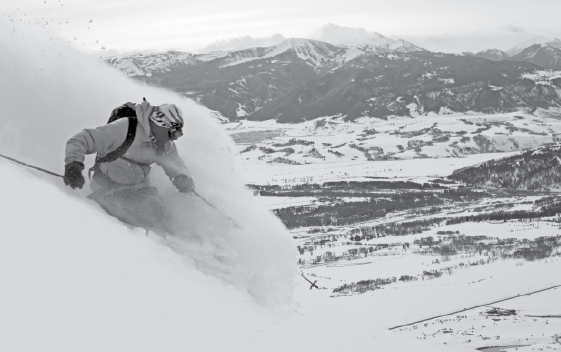
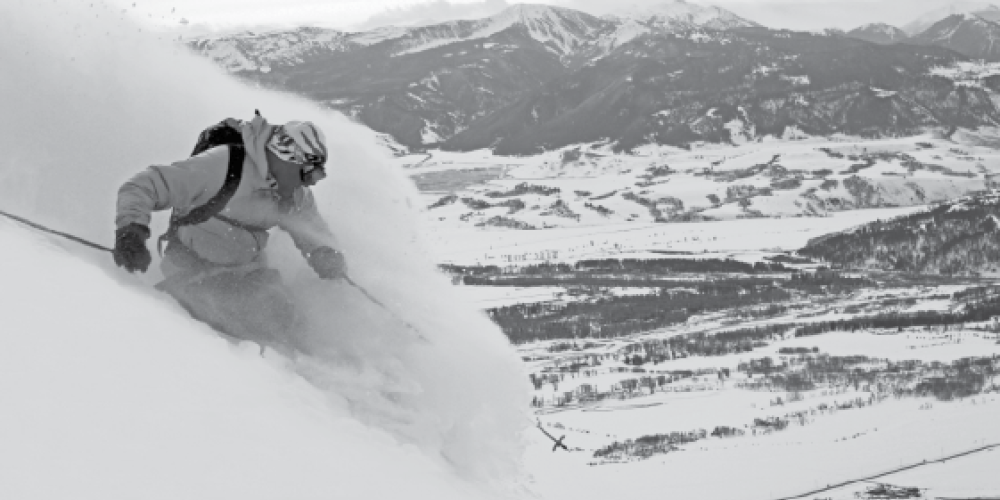
Pictured above: Moe leads skiers through the Jackson Hole backcountry as a guide. Courtesy of Jackson Hole Mountain Resort.

At 8 a.m. on any given powder day in Jackson Hole, Wyoming, up to a dozen backcountry guides gather for their morning briefing to go over snow, weather and avalanche conditions. From there, they meet their clients on the deck of Nick Wilson’s Cowboy Café and hop on the early tram for a day of adventure on 4,000 vertical feet of skier heaven.

Among the guides is one especially boyish, perpetually grinning 44-year-old who looks more like a puppy straining at his leash than one of America’s most successful and steel-nerved downhill ski racers. If you want to feel what it’s like to play hard—to play like it’s your job, in fact—then let 1994 Olympic downhill champion Tommy Moe be your guide.

Known as “Moe Vibe” among his former teammates, Moe still exudes his famously mellow demeanor, though it masks a heavy metal heartbeat—the edgy tune that hums within every World Cup downhill racer, the riff that kicks in when making split-second decisions at 80 mph. It surely sparked when, heading into the 1994 Lillehammer Games, Moe was featured in Sports Illustrated as a poster child for the beleaguered U.S. Ski Team. SI referred to the team as “Uncle Sam’s lead-footed snowplow brigade,” and described Moe, participating in his second Olympics, as “no soaring success.” 

Indeed, Moe’s flight to the top was not direct. The Montana native’s early and spectacular promise was accompanied by youthful exuberance and experimentation that got him kicked out of two ski programs. His father collared him to work construction in chilly Dutch Harbor, Alaska, a stint that firmed up the younger Moe’s resolve to focus his efforts on skiing. 

After settling in at Glacier Creek Academy in Alyeska, Alaska, Moe glided through the youth ranks, capturing Junior Olympics titles. In 1989, he also triumphed at the Junior World Championships and U.S. Nationals. That same year, the late coach Dan Bean captured the magnitude of Moe’s potential at a U.S. Ski Team coaches meeting, when he asserted: “If we screw up Tommy Moe, we should all be shot.” 

And yet, by the early 1990s, Moe’s career had stalled. He had speed and looseness, but was missing discipline. With his big-mountain pedigree and laidback attitude, Moe might have been lured into the extreme skiing scene. But instead he chose the path of persistence, buckling down and focusing on refining his lower speed skills with the U.S. technical coach, Thor Kallerud. 
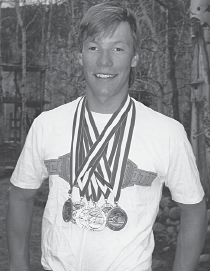
Picture to the left: Moe wearing his medals from the Sun Valley spring series, sometime in the mid-1980s. He rose quickly through the junior racing ranks. Photo courtesy of Megan Gerety.

Everything—skiing, equipment, experience, coaching and teammates— came together in 1994. Despite SI’s dire assessment, AJ Kitt, Kyle Rasmussen and Moe were quietly becoming a force. On the eve of the Olympic downhill, Moe, who was fourth in the final training run, privately decided to win a medal or go down trying. He focused on skiing the hill’s natural rhythm—that so suited his big mountain style—as perfectly and daringly as possible. “To this day when I watch the race, I was the guy who didn’t have that one mistake,” he says.

Not only did Moe win the most coveted and prestigious prize of the Winter Games (only the second American to do so, after Bill Johnson in 1984), but four days later, on his 24th birthday, he captured Super G silver and became the first American male skier to double up on medals in a single Games. Moe had the last laugh with SI, appearing on the cover with the headline, “Golden Boy.” 

Moe admits it was tough to stay motivated after Lillehammer, a challenge further complicated with a season-ending knee injury a year later. He retired at age 28 after the 1998 Nagano Olympics—where he placed 8th in Super G and 12th in downhill—with 12 years on the World Cup circuit and five U.S. National titles.

For better or worse, the trappings of fame did not snare Moe. For a brief time one could get caffeinated with a “Tommy Moecha” in Minnesota’s Mall of America. Within the ski industry, he cashed in on the requisite line of gold-medal endorsement deals, and he raced on Jeep’s King of the Mountain Tour for six years. But Moe, who barely overlapped with Bode Miller in 1998, just missed the catapult to mainstream fame ridden by later U.S. Ski Team stars like Miller, Lindsey Vonn, Ted Ligety and Mikaela Shiffrin. “I could have kept going until 2002 (and the Games in Salt Lake),” he says, “but I had achieved my goals and wanted to move on.”

That included business opportunities that leveraged his passion for outdoor adventure sports like kayaking, fishing and big mountain skiing. Along with partner Mike Overcast, Moe started his entrepreneurial career in 1992 by founding Class V Whitewater, a river guiding business that he parlayed into Chugach Powder Guides in 1997. Soon after, Moe realized he needed a home base in the Lower 48 and signed on as Jackson Hole’s Resort Ambassador in July of 1994, a role that has been a perfect fit for the affable, approachable, leave-your-ego-on-the-tram-dock Moe. 

In 2003, the same year he was inducted into the U.S. Ski and Snowboard Hall of Fame, Moe married fellow Alaskan, Olympian and downhill racer Megan Gerety. He and Gerety are “both pretty Type A,” he admits. During the winter, Tommy reports for duty at Jackson Hole and travels to ski events while Megan teaches fifth grade full time. Come springtime, Tommy shifts into gear for his Alaska season, based at the Tordrillo Mountain Lodge, which he co-owns. While Megan runs the show at home, Tommy guides 12 guests per week on skiing, fishing and the “Cast and Carve” and “Kings and Corn” fishing/heli-skiing adventures.

All the travel makes the summer downtime at home—with Megan and their two daughters, Taylor (6) and Taryn (4)—all the more precious. “It’s cool because it’s not all about us anymore,” says Moe. “It’s all about them.” In addition to mountain biking, paddleboarding and waterskiing, the family logs time outdoors camping, hiking and fishing. 

Moe relishes mixing work and play in his roles as guide, instructor or coach. “Choppers, trams or gondolas: I love it all,” he says. “Being in the mountains, skiing 100 plus days per year and having the life I enjoy...It’s a dream come true.”