Competition

All forms. Use in place of Racing, Race Results etc

Open to Public?
Off
Feature Image Media
Image
Timestamp

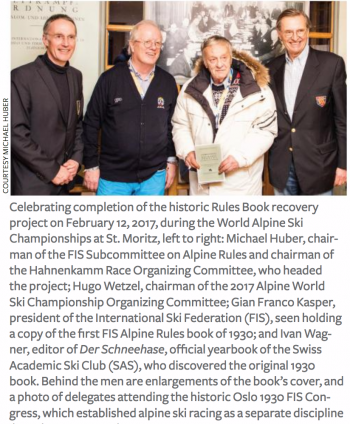
Special report: A six-year effort, led by FIS Alpine Rules chief Michael Huber, has yielded the first comprehensive digital collection of the changing rules that have governed ski racing over 80 years.

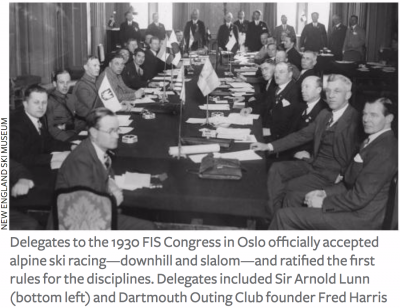
Alpine ski racing has a precise birth date. On February 26, 1930, in Oslo, Norway, the Congress of the International Ski Federation (FIS) officially accepted alpine ski racing—downhill and slalom—as a separate discipline. The FIS had previously recognized only the disciplines of competitive nordic skiing—cross-country and jumping. 

Delegates to the 1930 Congress also adopted the first official rules for alpine racing. But what precisely were they? And where could they be found? Had no one kept a copy? 

For Michael Huber of Kitzbühel, Austria, chairman of the FIS Subcommittee on Alpine Rules and president of the famous Kitzbühel Ski Club (K.S.C.), the challenge was irresistible: to find the book. Huber would spend six years searching for it. And not only seeking the alpine competitions rules book of 1930, but also all official published FIS alpine rules of the past. Huber’s goals were:

  • To make the alpine racing rules as they existed over an 85-year span available digitally for people around the world. 
  • To gain insight into the very early history of competitive alpine skiing. 
  • To understand why specific rules were written as they were, when and how they were changed, and to better identify what was the core of the sport that remained unchanged. 

Huber asked officials, experts, organizations and museums for help. First, the International Skiing History Association (ISHA), through its magazine Skiing History and its Website skiinghistory.org, under the lead of John Fry, sent out an international call, asking people to submit copies of old Alpine Rules books. Well-known ski historian E. John B. Allen of New Hampshire soon reported that the New England Ski Museum in Franconia had a number of books from the 1930s into the 1980s, most in English, some in German. The New England Museum’s staff copied countless pages and sent them to Europe for processing. 

“The Book is Found!”
Still, the most sought-after book, the original rules book of 1930, was missing. 

Then it happened: Last year, Ivan Wagner, the editor of the Schneehase, the official publication of the Swiss Academic Ski Club (SAS), sent a note to Huber. “I think we’ve got it. It’s found!” After much searching, Schneehase’s former editor, Raoul Imseng, had discovered, in Issue No. 4 printed in 1931, the full and official German wording of the International Competition Rules for Slalom and Downhill Races, established at the XI International Ski Congress in Oslo and Finse (Norway), 1930. 

Next step was to translate the German version into English. The long-serving member of the Subcommittee on Alpine Rules, the British native Martin John Leach, who has lived for many years in Switzerland, was ready to do the job. 

Flag Colors, Team Races

What is the content of the Alpine Rules of 1930? The 14 pages are divided into ten chapters. The first chapter deals with the organization and officials needed to run an alpine competition, like “the Setter” and the “Flag-keepers.” The second chapter deals with “Flags” for Downhill—originally red, blue and yellow. 

Another section deals with the different types of start, like simultaneous start, individual start, team and slalom start. Surprisingly, the alpine combined is not of primary interest. (Surprising because the combined was the primary focus of the pre-existing famous Arlberg Kandahar of Hannes Schneider and Arnold Lunn.) Rather the rules focus on “Team Races in Downhill and Slalom.”

It didn’t take long for the original rules to undergo change. Only two years later, the alpine FIS Rules of 1932 defined the flag colors for slalom as two; penalized a competitor five seconds for making a false start; required racers to be more than 18 years of age; and prohibited a competitor from making more than one start unless handicapped by the presence on the course of a spectator or a dog.

The results go live online

The former chairman of the Subcommittee on Alpine Rules and predecessor president of the K.S.C., Christian Poley, added missing books of past years. So the digital archive now includes about 60 different Alpine Rules books from 1930–2016 in English, German and French. 

To create digital access to all of the rules, the copied material had to be scanned and laid out—work done by the staff of the Kitzbühel Ski Club under Barbara Thaler. In a final step, Sarah Lewis, FIS Secretary General, provided a special place on the FIS website for digital storage, so the public worldwide can access more than eight decades of alpine ski racing rules. “Thanks to all who made this project a success,” says Huber.

To access the FIS Alpine Rules book digital archive, go to: http://www.fis-ski.com/inside-fis/document-library/alpine-skiing/#deepli....

Category
Open to Public?
Off
Feature Image Media
Image
Timestamp

INTERVIEW by Yves Perret

In an exclusive interview, Jean-Claude Killy recalls the first season of the World Cup, 50 years ago, when he won 12 of the 17 races, all of the downhills, and finished on the podium in 86% of the races he entered, a record never surpassed.

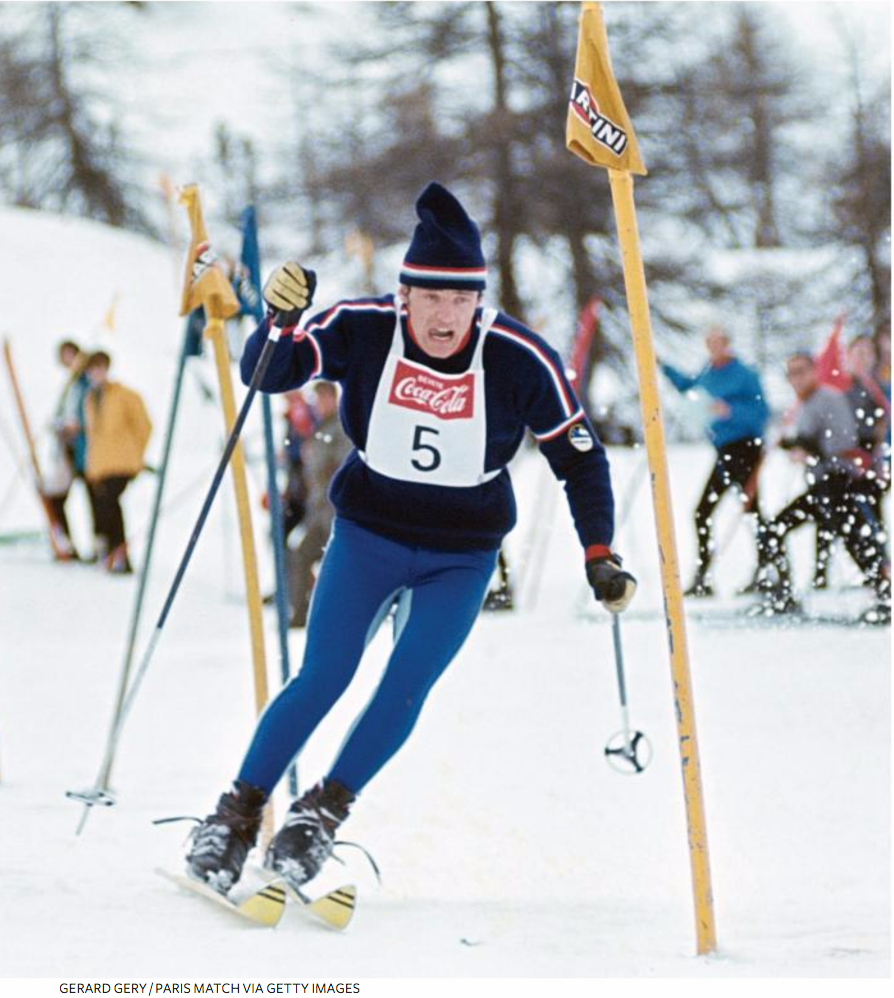
The winter of 1967 remains one of the most memorable in alpine ski competition history. Not only did it introduce the new World Cup—skiing’s first use of a season-long series of competitions to determine the world’s best—it also resulted in an astonishing, never-to-be-repeated record. Jean-Claude Killy won 12 out of the 17 slalom, giant slalom and downhill races on the calendar. He finished on the podium in 86 percent of the 29 races he entered. 

In an exclusive interview with sports editor Yves Perret in the last issue of Skiing History (January-February 2017), Killy told about the origins of the World Cup, his motivations, and his early victories in the historic first season of the World Cup, which this year is celebrating its 5oth anniversary. Part Two is the conclusion. 

Killy had just won both the downhill and slalom at Wengen, Switzerland. Now came a high point of the season—the classic Hahnenkamm competition at Kitzbühel, Austria. . .

Kitzbühel was a special moment. What was it like for you?

Competing at Kitzbühel is the most exciting thing imaginable for a ski racer. You’re in Austria, where skiing is the national sport. We were challenging the guys who embody skiing itself, cheered on by an immense crowd of spectators. I was respected, but my relationship with the Austrian public could be complicated. To relieve myself from the pressure of fans surrounding our living quarters, I sometimes would even send Jean-Pierre Augert, who looked a lot like me, to go into the crowd and sign autographs. 

Winning in Kitzbühel is every skier’s dream. That year I won the downhill, the slalom, and the combined, and I became the first—and still the only—skier to achieve the double-double win in Wengen and Kitzbühel, or triple win including the combined. Nowadays we don’t realize what that represented, but winning the combined was important even if it didn’t count for World Cup points and was a mathematical point combination.

In the Hahnenkamm downhill, the world’s most difficult and dangerous, I came in ahead of the German Franz Vogler by 1.37 seconds, and I beat the course record held by Austria’s Karl Schranz. 

The Kitzbühel slalom is magnificent—staggeringly varied, with sidehills and rhythm changes. The atmosphere can be hostile for rivals of the Austrian team. You have to stay in a bubble, keep concentrated, be removed from the noise and the pressure, focusing on your own run. I was the fastest in both runs of the slalom. I beat by more than two seconds the Swede Bengt-Erik Grahn, who was one of the best slalom specialists of the era. 

I’ll never forget the atmosphere that weekend. The local ski instructors carried me across on their shoulders to the podium to receive my awards. This would have been unthinkable a couple of years earlier. “Superman on Skis!” headlined the Austrian daily Kronen Zeitung the next day.

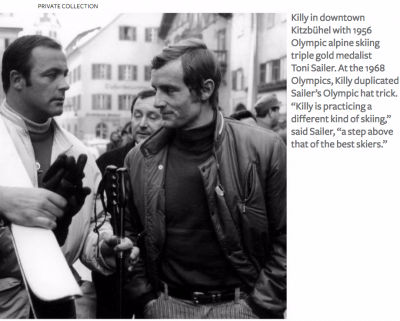
After that victorious weekend, Austria’s greatest racer, Toni Sailer wrote, “Killy is practicing a different kind of skiing, a kind of skiing that is a step above that of the best skiers. His wins are those of an all-around athlete who has reached maturity.” By then I had scored 151 out of the maximum of 175 achievable points at that stage in the season. Austria’s Heini Messner, who was in second, had 75 points.

The winning streak continued with the downhill in Megève…

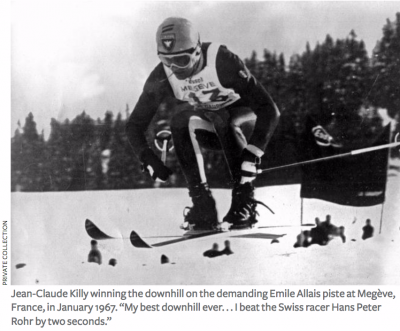
The Emile Allais course was very demanding, with the Bornet face being the most difficult and dangerous section of all of the international downhill races I’d competed in. I beat the Swiss Hans Peter Rohr by two seconds. . . my best downhill ever. I was amazed by the lead. It was my eighth consecutive win. We were in the last days of January, and the 1967 World Cup downhill title was already mine.

Périllat came out ahead in the slalom. He apologized for having beaten me. He had especially wanted to beat Austria’s Karl Schranz, our perpetual rival. I was sick and I fell in the first run, but I finished second anyway, and I won the combined.

I didn’t compete in the World Cup slalom at Madonna di Campiglio, Italy. I took two weeks off. I was imitating Toni Sailer in a way. Before his triple gold medal win at the 1956 Olympics, Toni took several days off from skiing. “That’s what you should do,” he advised.

After resting, I made a comeback at Chamrousse in the February pre-Olympic races, where I won the downhill, as I would the following year in the real Olympics, when I again followed Toni’s strategy of taking a week off. 

Throughout my career, I took inspiration from other top racers in order to optimize my skiing. I watched the way Adrien Duvillard carved his turns. I even copied the weightlifting exercises that I saw Soviet high jumper Valery Brummel do on TV. In 1952 at Val d’Isère when I was a boy, I watched in amazement when Italian champion Zeno Colò started so violently that the starter, who had put his hand on his shoulder, was carried down the hill.  

In the weeks that followed, I continued winning. The season was about confronting each race, one day at a time.  At Sestrières, Italy I won the Kandahar downhill. I liked the course and the beautiful section coming into the forest. We pulled off an all-French podium in the downhill: Killy, Orcel, Périllat. I also went away with a win in the combined. 

The season ended in the USA in March. What was your experience there?

I was on a cloud. I had no doubts, no worries, no anxiety. Going to the States was something we’d been looking forward to. I was close friends with the American racers Billy Kidd and Jimmie Heuga, the son of a French Basque shepherd who had immigrated to the United States. Both were magnificent skiers. I'd met Jimmie in the summer of 1964, my first visit to the U.S. Then in 1965 and 1966 I'd competed in races organized by Bob Beattie. Nothing compared to my U.S. arrival in March 1967, though. A press conference was held when we stopped in New York. We met the governor of Massachusetts. Sports Illustrated, which featured me on its cover three times in my career, ran headlines like “Lafayette, They Are Back.” TIME Magazine hailed me “King Killy.” 

For me, though, the most important thing was to stay on track for the rest of the season, and finish the job.

The Franconia event was very important…

Huge crowds—thousands more spectators than had ever appeared at a U.S. alpine ski event—thronged the slopes of Cannon Mountain, New Hampshire. I won the downhill. I made the last difficult turn above the finish faster than anyone, and it was later named Killy’s Corner. I also won the GS, the slalom and the combined. I had won decisively in all three alpine disciplines, exactly like the gold medal hat trick I performed 11 months later in the Olympics at Chamrousse.

By then I was sure to win the World Cup. It was a special moment of satisfaction, though the season wasn’t yet over.

There were two more events, Vail and Jackson Hole. How did you approach them?

Winning the Nations Cup became the objective that pushed us as a team, not to give an inch. Plus, our own Marielle Goitschel had the chance to win the women’s overall World Cup, which would have been a double triumph for France. It’s always a great moment when you win as a team.

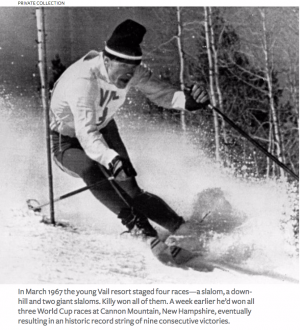
There were four races in Vail: one slalom, one downhill and two one-run giant slaloms. I won all of them. The last race, on Sunday, counting for World Cup points, was held in a terrible snowstorm. 

At Vail, four or five of us shared the same room in the home of our host, Suzie Meyer. It was a fun time. From Vail, I traveled with Louis Jauffret and our friend Bernard Cahier, a famous motor racing journalist, to California, where racing car designer Carol Shelby was waiting for us in his workshop near LA airport. We flew in Carol’s personal plane to Riverside, where we drove all day long on the circuit. 

After a night in Las Vegas, we went to Jackson Hole, Wyoming, for the World Cup Finals. Here two more races—a giant slalom and a slalom—would be held. I was tired; I’d had a sinus infection the previous days. In order to save energy and have a little fun, I inspected the giant slalom course in a sled! I won the race. It was amazing! Including Europe, I had just won nine races in a row—three  downhills, two slaloms, and four giant slaloms. 

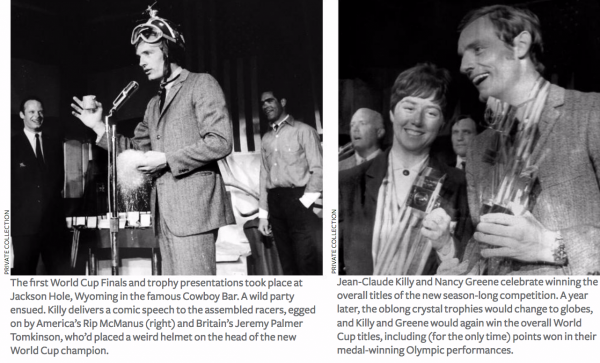
In the last race, the slalom at Jackson Hole, I DQ’d. But I had already earned the maximum World Cup points, 75, in each discipline, ending the season with the maximum possible 225 World Cup points. The Evian mineral water company, first sponsor of the World Cup, paid for my father to come to Jackson Hole, bringing with him the crystal trophy. The official presentation was held later in Evian, France.  

The trophy presentation took place in Jackson Hole’s Cowboy Bar. It was preceded by a reception, with free margaritas and pisco sours for all. It was wild night. I remember that the sheriff came to make order in the streets and—I don’t know how—Marielle (Goitschel) dropped him to the floor. He finally understood who we were, and everything turned out okay.  

The season was over, or almost. There were still a couple of races in Switzerland when I got home. I won a GS at Verbier, and Mauduit beat me in Thyon. But it was on the American tour that the bulk of the job was finished.

Who were your main rivals during that magic winter?

The winter of 1967 was notable for an incredible density of talent. No fewer than 14 skiers from seven different nations placed second in the races that I won. In the overall World Cup, I scored almost twice as many points as the runner-up, Austrian Heini Messner. He was a classic skier—a reserved man but consistent and hard to beat. He was followed in the standings by my teammates—Périllat, Lacroix and Mauduit—and my great buddy Jimmie Heuga. Four times during the season I’d found myself on top of the podium with Jimmie.  

It was an era when an amateur spirit was still felt in the sport. There was a real affinity among us skiers from all different countries. Once on the course, we were rivals, but it didn’t alter our relationships. People talked about a rivalry with Karl Schranz, but the battle took place on skis. The rest of the time we got along really well. With all the skiers of that era, there are plenty of shared memories, moments of laughter, and anecdotes.

This incredible season generated a remarkable level of media coverage and fame. How did you handle it?

Media attention quickly came from beyond the few newspapers and magazines that typically cover international alpine skiing. After my win at Wengen, the media following us were no longer the usual ones like Paris Match and the French television show, Cinq Colonnes à la Une. The popular mass tabloids were onto us. They wanted to know everything about us. . . not just our lives as athletes. By the end of the 1967 season, the tour was a media frenzy.

Guy Périllat warned me in January, at the Tennein Kitzbühel, where we traditionally celebrated our success. He said, “Watch out, don’t get caught up in what happens around you. It brought me down after my 1961 season [Ed. note: In that season Périllat won all the downhills, followed by a dry spell that lasted several seasons.] But I know that won’t happen to you because you know how to keep things in perspective.”

With my experience of 1967, I learned how to deal with the constant presence of special correspondents from the French and international press. I had to be able to open the doors, then close them. That was also what I did the following Olympic season in Grenoble. A 30-minute press conference every day and that was it.

The American tour proved hugely rewarding for me. I had offers from sports agents. I was offered $200,000 to join the professional circuit and manage a ski school in the States. A lot was expected of me, but I had to stay focused on the Olympics the following year.

When did you become aware of the exceptional nature of the 1967 season?

I never really grasped it entirely. I didn’t realize what I’d achieved. Of course, there were the numbers: winner of 19 races out of 29, including 12 World Cups out of 17, and seven of the season’s combineds for a total of 26 first-place finishes. But I never said to myself, “Wow, that’s fantastic!” It’s taken me 50 years to realize how remarkable it was.

In Grenoble in 1968, by comparison, things were actually relatively simple. There were three races within a set period of time, at a date identified well in advance, with an objective that was fairly clear. The 1967 season was a more complicated, elaborate construction. Comparing them is like comparing a sprint and a marathon. 


In the summer of 1967, I quickly moved on to something new. I had an overwhelming passion for motor sports. I won The Targa Florio with Bernard Cahier and drove 1000 KM of Monza, the 24 hours of Le Mans, and the 1000 KM Nurbürgring behind the wheel of a Porsche or an Alpine. It was good to experience other sensations, and new challenges. Now, 50 years later, I’ve had the pleasure of revisiting this incredible season at the request of Skiing History. Thank you!

Yves Perret, who heads a sports media agency in Grenoble, is former sports editor of the Dauphiné Libéré newspaper, and was editor-in-chief of Ski Chrono.

Open to Public?
Off
Feature Image Media
Image
Timestamp

By Michel Beaudry

Nancy Greene of Canada came from behind to win the 1967 inaugural World Cup overall title by the slimmest of margins in a thrilling final race.

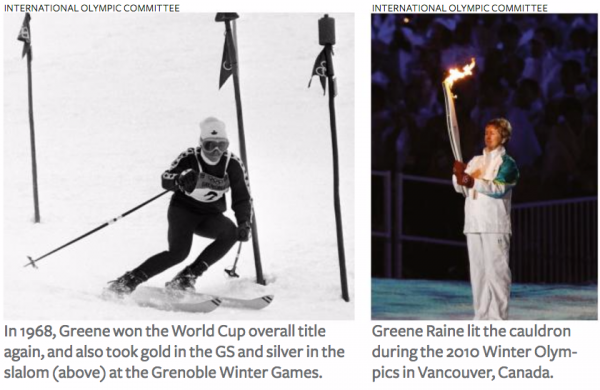
Nancy Greene Raine is a force of nature. A two-time overall FIS World Cup champion (1967-1968) and an Olympic gold and silver medalist at the 1968 Winter Games, Greene Raine was raised in the ski-mad town of Rossland, British Columbia. Her contributions to the sport are legion. Along with husband Al Raine, she was an early promoter of Whistler and Blackcomb Mountains in BC before being drawn east to Sun Peaks in the mid-1990s, where the couple has played an integral role in making it one of the country’s most successful year-round mountain resorts. Her namesake program—the Nancy Greene Ski League—has been the gateway to racing for young Canadians for nearly 50 years. In January 2009, she was appointed as a Conservative member of Canada’s Senate.

In this exclusive interview, conducted in November 2016, Greene Raine, 73, looks back at the 1967 World Cup season, which she won by the slimmest of margins after mounting a late-season comeback.

Only one race left. And the young ski racer they call Tiger knows exactly how high the stakes are. Considered by many to be out of the running for the inaugural World Cup after failing to score any points for nearly two months, 23-year-old Nancy Greene of Canada has mounted an impressive comeback these last few weeks. It started with a third in Franconia, followed by a big-time win in Vail; then came Jackson Hole and a crushing victory in yesterday’s giant slalom. Suddenly her main rival is within reach again. But France’s Marielle Goitschel is still the overwhelming favorite. The only way Tiger can be crowned 1967 overall champion is by winning the slalom today. It’s all or nothing.

Still, Greene is coming into Sunday’s race with a big head of steam. “By this point in the season,” she explains, “I know that if I ski well I can beat anyone. So I’m going for victories, not for fourth-place finishes.” Her giant slalom result on Rendezvous Mountain the day before underscored that attitude: She dominated the one-run race by 1.72 seconds. She’s now only one win away from the title. She knows she can do this.

But the two-run slalom offers its own challenges. “The first run is always a bit of a gamble,” she says. “You want to go flat out and take risks, but you also want to make it to the second run.” Clearly, the same thing is running through the minds of her opponents. For when Sunday’s first run is completed and the times tallied, barely a tenth of a second separates Greene from Goitschel and French teammate Florence Steurer. The ski gods obviously want a dramatic finish to the season.

Who is this Canadian woman who dares to challenge the French skiing juggernaut of the late 1960s? And how the heck has she managed to hoist herself atop the World Cup standings?

Disappointment in portillo

Although Nancy Greene’s story really begins in the remote mountain town of Rossland, British Columbia, one need only revisit the 1966 World Alpine Skiing Championships in Portillo, Chile to get a glimpse of her exceptional drive to succeed.

“I went down to South America with very big goals,” she begins. “I fully expected to be on the podium there.” Makes sense. As a sixteen-year old newcomer to the Canadian Team, Greene had witnessed her mentor and roommate, Anne Heggtveit, win gold at the 1960 Olympics in Squaw Valley. And it had inspired the teenager tremendously. Now, six years later, the experienced racer thought she too could bring skiing glory to her country. But could she really do it? “I was too nervous in the slalom and didn’t perform very well,” she says. “But the downhill was coming up and I knew I was skiing fast.”

Alas, the downhill proved even more disastrous. “I remember my coach quietly telling me in the start gate: ‘Win it! Win it for me, Nancy.’” She sighs. “I guess that got me a little too excited. Near the bottom of the course there was this big roll over a road tunnel. In training, I’d always wind-checked before hitting it. But on race day I decided to take it straight.” Bad decision. “I crashed and somersaulted right into a retaining wall made of ice. I knew I had a good run going. I could even see the finish line…So frustrating.” 

Her best event, the giant slalom, was next. But badly bruised from her downhill fall (and skiing with an undiagnosed fractured tailbone), Greene finished just out of the medals in fourth place. 

Meanwhile, the French team, Les Bleus, had dominated the championships: Two out of every three medals had gone to them. As for Marielle Goitschel, she had won everything but the slalom…and only teammate Annie Famose had skied faster in that race. 

But Tiger didn’t come away from Chile entirely empty-handed. Says Greene Raine: “Rossignol had just come out with a new fiberglass ski they wanted me to try, called the Strato. So I tested a pair in La Parva before the World Championships. And I loved skiing on them. But I decided that I shouldn’t switch skis before such a big event, and I hid them under a huge stack of ski bags so I wouldn’t be tempted.”

Nancy returned home with her new skis and an even greater determination to win. “My coach, a former racer called Verne Anderson, also lived in Rossland,” she says. “And together we trained with a veteran who’d been a fitness trainer in the military. He knew nothing about skiing. But he knew everything about weight training.”

Greene had another secret weapon. The Canadian Team was now based out of Notre Dame University in nearby Nelson, BC. “It was so practical to have a place where everyone could live and work and study together,” she says. Smiles. “Besides, training with the men’s squad meant there was always somebody to chase.”

Things were also progressing well on-snow. And the more she skied on her new Rossignol skis, the more Nancy realized how much they suited her style. “They were 207cm giant slalom skis, and they really set me up for the season. In those days the thinking was that fiberglass skis were great on hard snow but you needed metal skis to go fast on softer snow.” She stops. Laughs. “Well, I trusted those Stratos so much that when I left for the first European races of the 1967 season, I left my metal skis at home.” 

It was a radical decision—and a risky one, given the dramatically different way ski races were being organized that year. “We really didn’t know much about this new circuit called ‘The FIS World Cup’ when we got to Europe in January,” she says. “I’m not even sure the Canadian Ski Association fully understood what was going on. We were all a bit surprised by the changes.”

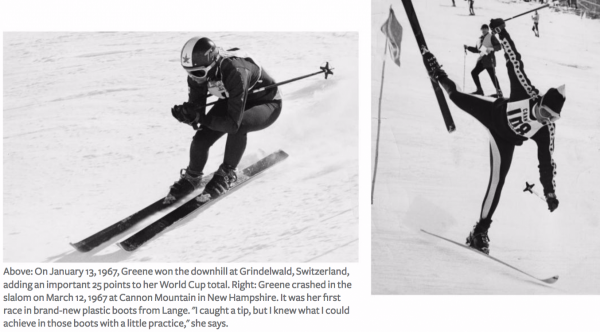
And yet from the moment she came charging out of the gate that year, Tiger made her presence felt. Two World Cup races in Oberstaufen, Germany (a slalom and a giant slalom) and a gap of 1.24 seconds between her and the next finisher in the GS. At the second World Cup stop, in fabled Grindelwald, Switzerland, Greene won twice more, this time adding downhill points to her mounting World Cup lead. Five races, four victories. The Europeans were in shock.

Greene continued to ski well, if not quite at the same scintillating pace. In Schruns, Austria she was third in the slalom and fourth in downhill. Though they were closing the gap, the French women were still behind in the race for the overall crown.

But the members of the Canadian Team had race obligations back in North America and were scheduled to return home. Would Greene be forced to accompany them? “It wasn’t common practice to leave athletes behind to compete on their own in those days,” explains Greene Raine. “But at the last minute, our coaches decided that my teammate Karen Dokka and I would remain in Europe for one more event.”

They didn’t have it particularly easy. “We were responsible for everything,” she says. “We even had to prep and wax our own skis. Still, it was a lot of fun. It felt very liberating to be left alone like that.” But the lack of team support began to show and she failed to earn any points at the next two races in St-Gervais, France. Still, when she left for home in February, many on the circuit were convinced Tiger was making the biggest mistake of her career. By missing the last European stops, they argued, she was leaving the door wide open for her rivals to score points.            

The World Cup points formula was complex that year: only the top three results in each discipline would count toward an athlete’s total in the race for the overall title. “But my dad, the engineer, had crunched all the numbers,” she says. “He was confident that there were still enough races in the spring for me to make up the point deficit.”

And so was Nancy. “I knew that I had to start strong in those first March races in New Hampshire. And if I could do that, well…” Although it was less than the victory she needed, Tiger managed to scratch her way onto the giant slalom podium in Franconia. But it was during the slalom the next day that she had her big revelation.

“The Canadian Team had been working with plastic boots since the previous spring,” she remembers. “One of our coaches, Dave Jacobs, had struck a close relationship with Bob Lange and so the Canadian men had been testing his boots for some time. Well, my feet were so small that it took Lange a long while to make a boot my size. But by March of ’67 they were done, and I received my first pair just before the slalom in Franconia.” A pause. “I remember skiing with them that afternoon. I couldn’t feel a thing. ‘I can’t ski with those,’ I thought. ‘Way too stiff.’”

But the skies cleared that night and Nancy watched the day’s mushy March snow freeze into a hard, firm surface. “I was still struggling with my decision: go with my soft leather boots or try the stiff plastic ones. But then I realized: ‘It’s going to be boilerplate tomorrow. What better time to use the new boots?’”

It wasn’t love at first try. “I was all over the place on my first run… skiing really raggedy. But I got the hang of those boots by the second run and skied really well. Unfortunately I didn’t finish—I caught a tip near the bottom of the course. Still, I knew what I could achieve in those boots with a little practice.”

She never looked back. By the giant slalom in Vail, Greene was in full form again, winning the run by more than half a second. Only the World Cup finals remained. “My dad was still tabulating the points,” says Greene Raine. “’All you have to do,’ he said, ‘is win the last two races and the title is yours.’”

Last Stop, Jackson Hole

For some athletes the pressure would be unbearable. But Tiger thrives on it. Like a laser-guided missile, Greene launched into her Grand Teton weekend by blowing her competitors away in the season’s penultimate race. By the next day and the start of the slalom’s second run, Greene was in a three-way tie for the race lead. The overall title was now within her grasp. But the Canadian had to win the run.

“The course-setter for the second run has provided the racers with a choice,” she remembers. “There’s an elbow set halfway down the course. The rhythm goes one way, but if you jam your skis hard, you can straight-line the gates, and come out of the elbow with way more speed. But it’s risky…” 

Greene sees the trick passage during inspection and thinks, ‘I’ve got nothing to lose. I’m going to shoot the gate.’ But it might prove costly. While most of the women take the easier route, the racer just ahead of her attempts the straighter line, catches a tip at the top of the elbow and takes out all the gates.

Now it’s the Canadian racer’s turn to worry. “There I am standing in the start gate thinking to myself: ‘If they re-set the course any different than it was, I’m hooped.’” 

Meanwhile, the announcer at the finish line is whipping up the crowd. What he doesn’t know is that there are loudspeakers at the start too. Says Greene Raine: “I’m still in the start gate, waiting for the course to be cleared, and all I can hear is the emcee saying over and over: ‘The next racer is Nancy Greene. She needs to win here, folks, second place isn’t any good.’” She laughs. “I think it’s around the fourth time that he says ‘this could be the most important moment in her life’ that something snaps inside me. ‘This is ridiculous,’ I think. ‘It’s Easter Sunday. Look at the view. What a beautiful place this is.’” She pauses for a beat. 

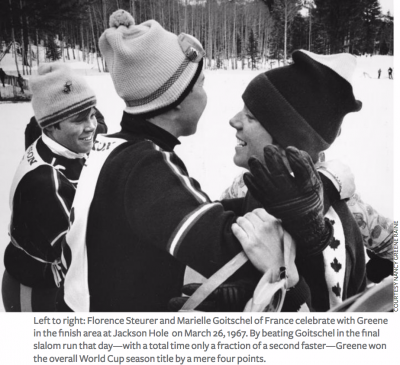
“I’ll always remember that moment,” she says. “It was like an out-of-body experience. And it put me in just the right frame of mind to race that final run.” Another stop. More laughter. “Well, I shot the gate just like I’d planned, and made it safely to the finish line. I think I beat Marielle by 0.07 of a second in the total time.” But it was enough. Tiger had just won history’s first ever World Cup of skiing by the merest of margins: four points (176-172). It was a racing tour de force rarely matched since. And it ensured Nancy Greene’s place in the ski pantheon of all-time greats.  

Nancy Greene, Chamonix
Open to Public?
Off
Feature Image Media
Image
Timestamp

Mikaela Shiffrin on Sunday celebrated her first Overall World Cup Championship, at the culmination of the 50th World Cup Finals in Aspen. She is the fifth American to win the overall globe, following Tamara McKinney, Phil Mahre, Bode Miller and Lindsey Vonn.

At age 22, Shiffrin is already the three-time world champion in slalom and four-time World Cup champion in slalom. 

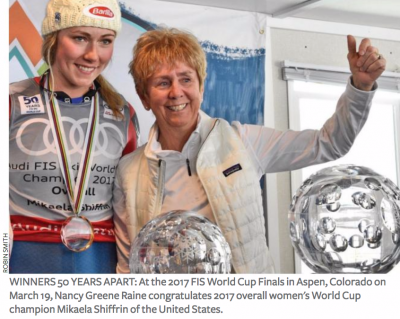
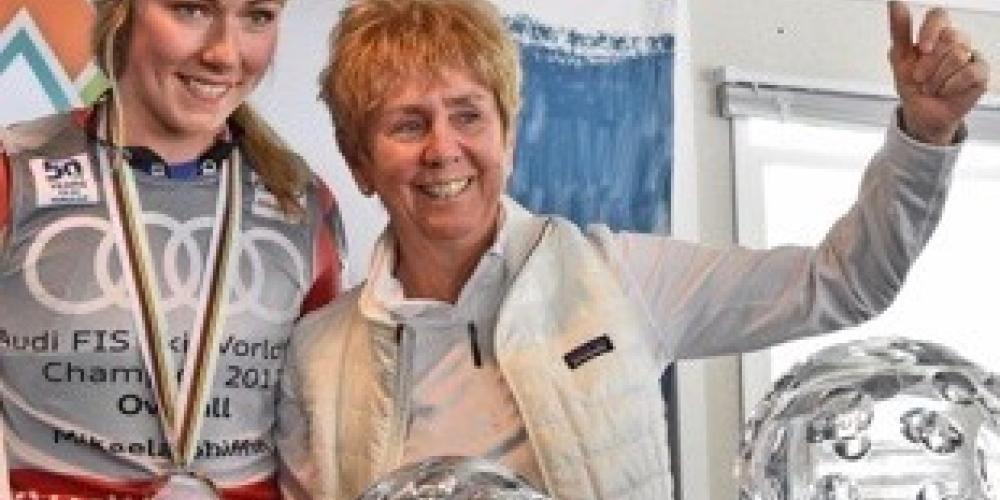
Joining Shiffrin at the awards ceremony was Canada's Nancy Greene Raine, winner of the first two overall World Cup championships in 1967 and 1968.


Mikaela Shiffrin with Nancy Greene Raine
Category
Open to Public?
Off
Feature Image Media
Image
Timestamp

Sa saison 1967 est un plus grand exploit que son triplé olympique. Dans une interview exclusive, Jean-Claude Killy se souvient de la première saison de la Coupe du monde, il ya 50 ans, quand il a remporté 12 des 17 courses, y compris toutes les descentes, et a terminé sur le podium dans 89% des courses qu'il a entrées, un record qui n'a jamais été surpassé.

Interview de Yves Perret, Skiing History Magazine, 2017.

Read this story in English.

Cinquante ans après, la saison 1967 reste un des moments les plus aboutis de l’histoire du ski alpin. La première Coupe du Monde de l’histoire coïncide avec un de ses exploits les plus marquants.

Vainqueur de 19 courses sur 29, dont  12 de Coupe du Monde sur 17, et des six combinés de la saison dont la Coupe des Nations pour un total de 25 « 1st places », Jean-Claude Killy a remporté le premier globe de cristal avec le maximum de points possibles (225) soit 101 points d’avance sur l’Autrichien Heinrich Messner, son dauphin.

Autre chiffre incroyable, il a terminé 88.9% des courses ou combinés auxquels il a participé  sur le podium…

En juin dernier, chez lui, à Genève, « King Killy » comme l’ont surnommé les journaux de l’époque, nous a reçus. Sur la table, il a ouvert les épais albums où sont classées avec méthode les coupures de presse qui retracent les moments forts d’une destinée hors normes. Sur un cahier où sont inscrits ses résultats, d’une écriture rectiligne, une phrase : « La victoire aime l’effort ».

Pendant plusieurs heures, Mister Killy est redevenu le meilleur skieur de la planète.


INTERVIEW

Jean-Claude, comment s’est dessinée la saison 1967 au cours des saisons précédentes?

Cela a été une lente construction, avec des étapes importantes et la même obsession : gagner.

En 1963, je termine onze fois à la deuxième place.

Les Jeux de 1964 à Innsbrück avaient été un désastre technique.

Je perds ma fixation avant dans le slalom. Je chute dans le premier dévers dans la descente. Mes carres avaient été mal travaillées.

Je finis cinquième du géant. Je n’étais pas prêt.

La semaine suivante, je remporte le Kandahar devant Jimmy Heuga, mon copain américain. Ce qui prouve que la base était présente mais que je n’avais pas encore tout résolu.

En 1964, je n’avais pas encore trouvé les solutions à mes problèmes de santé contractés durant la Guerre d’Algérie. J’étais maigre, je n’avais pas d’endurance.

Je faisais des coups comme au Critérium de la Première Neige en 1961 mais je manquais d’un système pour avoir de la constance dans les trois disciplines. Se spécialiser, c’est enlever des chances de gagner et je ne le voulais pas.

Je souhaitais mettre en place une organisation qui me permette de gommer un maximum de ces impondérables qui font la spécificité du ski alpin de compétition.

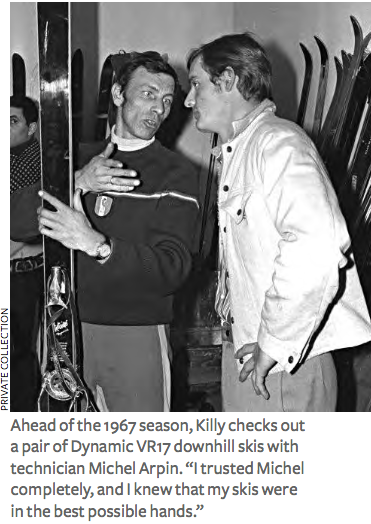
Un des moments importants fut lorsque Michel Arpin a été engagé par Dynamic pour s’occuper de mes skis. Nous étions très complices et il m’avait pris sous son aile depuis mes débuts.

Il était originaire de Saint Foy en Tarentaise, tout près de Val d’Isère, et nous parlions le même patois local. Je savais que mes skis étaient entre les meilleures mains car j’avais une confiance aveugle en lui.


Comment qualifiez-vous le processus qui vous a conduit jusqu’au sommet ?

Ma démarche était personnelle. En équipe de France, on passait tout l’hiver ensemble mais avant le premier stage d’automne, chacun avait sa façon de faire. J’étais à la recherche obsessionnellement de ce qui pourrait me faire progresser.

L’équipement était capital. Il était impératif d’avoir les meilleurs skis existants. On ne peut pas perdre une course à cause du matériel car c’est l’élément déterminant. Je skiais avec le matériel de deux marques, Rossignol et Dynamic, sans contrat d’exclusivité, ce qui me permettait de choisir à chaque course la paire qui me convenait le mieux.

Cela impliquait d’adopter une ligne de conduite différente … et de faire des sacrifices financiers dans l’instant.

En 1963, je termine même 2e du Kandahar avec des skis de descente autrichiens. A Portillo, j’ai utilisé des Rossignol en géant et des Dynamic pour les autres épreuves. Monsieur Bonnet nous comprenait. Le but, c’était de gagner des courses de ski.

J’ai toujours fonctionné ainsi. J’étais animé d’une passion débordante pour le ski, mais tourné vers la compétition.

J’ai fait l’impasse sur les études. Cela laisse du temps… mais cela ferme des portes et peut compliquer la reconversion.

La compétition était une obsession saine car je conservais ma liberté intellectuelle.  Le ski était mon métier.

Pour moi, seule la victoire comptait. Je n’avais pas le choix. C’était simplement ma seule forme d’expression.
 

Quelles ont été les clés de votre réussite?

Il y a à partir de 1965, la conjonction d’éléments qui, liés, ont permis de poursuivre la montée en puissance.

L’organisation Bonnet  qui nous accompagnait vers les sommets en était une.

L’industrie française qui  nous soutenait avec Rossignol, Dynamic, Look, Trappeur, Salomon une autre.

Les stations françaises et les hôteliers n’hésitaient pas de leur côté à nous ouvrir leurs portes pour presque rien.

Nous entrons dans une des plus belles périodes de notre sport avec l’avènement du ski moderne.

Il y a la conjonction de moyens financiers accrus, d’hommes et de professionnels expérimentés.

La diffusion télévisée devient mondiale et contribue à faire des sportifs des mythes.


Il règne alors en France une atmosphère miraculeuse. De Gaulle l’affirme : « Nos sportifs sont nos meilleurs ambassadeurs. »

 D’un coup, on passe des dortoirs de l’UCPA à un hôtel quatre étoiles.

J’ai posé une à une les pièces du puzzle et cela ne s’est fait pas du jour au lendemain.

En 1965, je suis élu Skieur d’Or Martini et Champion des Champions du journal L’Equipe, je remporte 9 victoires, je finis sept fois à la deuxième place.


Quelle est l’importance de la création de la Coupe du Monde dans la réalisation de cette saison incroyable?

Cela faisait plusieurs années que les skieurs ne supportaient plus de jouer une carrière sur une journée de Championnats du Monde ou de Jeux Olympiques. En outre, à cette époque, il était rare, par exemple, de participer à deux Jeux olympiques.

On était tous passionnés de Formule 1 et, pour nous, la référence, était le classement de la saison de ce Championnat du Monde. L’idée d’un classement sur la saison nous semblait la plus juste expression de la réalité de notre sport.

Nous avons souvent discuté de notre frustration  et de ce qui pourrait résoudre le problème et il nous semblait facile d’adapter cela au ski.  Le plan de la Coupe du monde de ski alpin formulé en 1966 par le journaliste Serge Lang, en collaboration avec l'Américain Bob Beattie, le Français Honoré Bonnet et l'Autrichien Sepp Sulzberger, soutenu par le quotidien sportif parisien L'Equipe et des journalistes comme Michel Clare - et John Fry, qui a ajouté la Coupe des Nations au mix, allait dans ce sens.

A Portillo, on était dans l’aire d’arrivée de la descente après ma victoire. Tout le monde pleurait. Serge Lang me demande : « La Coupe du Monde arrive. Comment vas-tu l’aborder. »

Je lui ai répondu : « Je vais la survoler… » Dans mon esprit, cela ne signifiait pas que j’allais l’écraser mais que j’allais en tirer la quintessence pour franchir une étape dans mon parcours sportif.

S’il n’y a pas de Coupe du Monde, il n’y a peut-être pas cette saison 67. C’est plus fort que Grenoble. Il n’y avait désormais plus uniquement les grandes classiques pour couronner la réussite d’une saison.
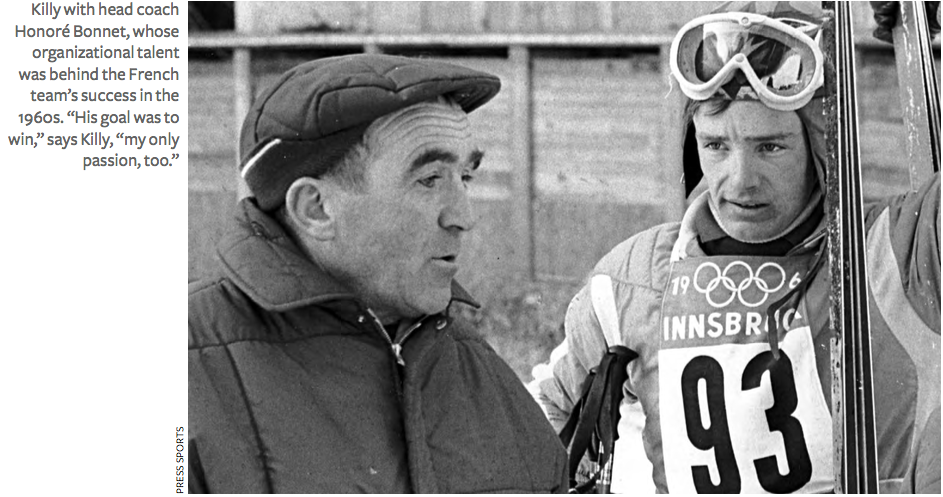
Comment qualifieriez-vous les relations au sein de l’équipe de France?

Nous étions liés à la vie à la mort. On s’entraînait ensemble, on s’affrontait tous les weekends

Aujourd’hui encore, nous restons aussi complices que des frères.

Au printemps 1966, on a skié des kilomètres au col de l’Iseran sur le glacier de Pissaillas. On s’est mutuellement nourris de nos qualités, de nos personnalités. Il y a toujours eu entre nous du respect, de l’humilité.

En 1967, Honoré Bonnet était à un an de la retraite mais le système était en place et fonctionnait parfaitement.

Michel Arpin s’occupait de mes skis et des chronos. Je savais que je pouvais m’appuyer totalement sur son savoir-faire et chacun dans l’équipe avait son rôle.

Par exemple, Melquiond apportait son calme et sa sérénité. Nous avons été compagnons de chambre pendant 7 ans sans qu’il y ait le moindre conflit d’égo.

Périllat était le capitaine de route écouté et respecté.

Léo Lacroix amenait son optimisme, sa bonne humeur… et son talent.

Mauduit le géantiste et Jauffret le slalomeur étaient des skieurs magnifiques.

Tous les talents de cette équipe et ces tempéraments additionnés formaient une formidable escouade.
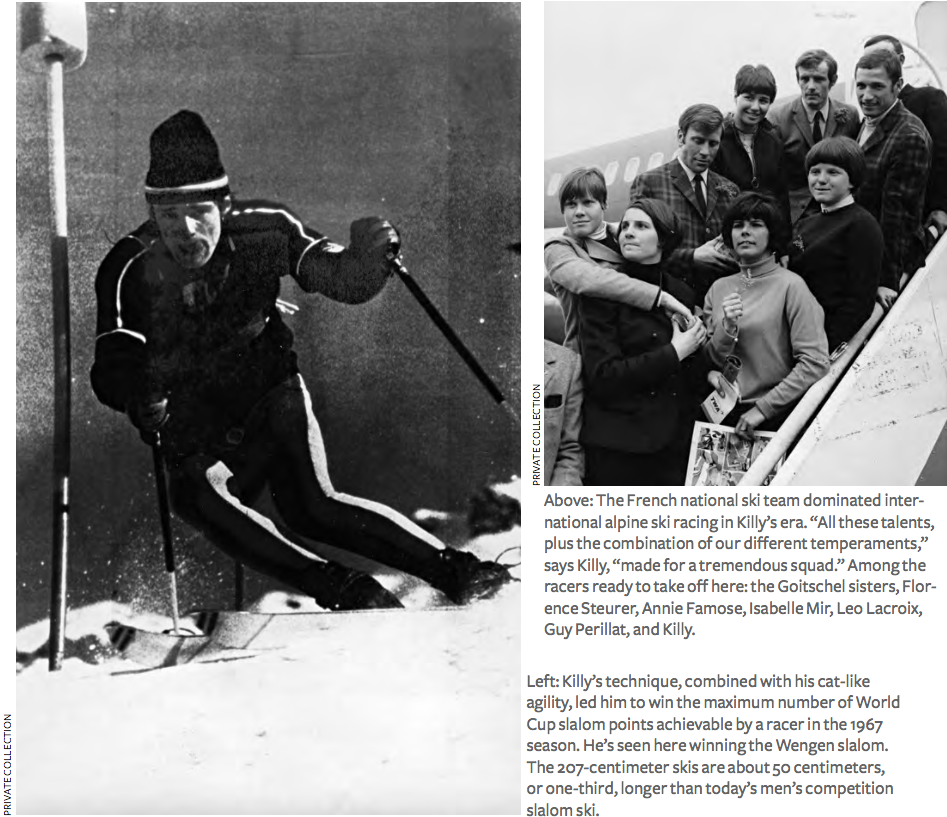
Abordons, la saison 1967… Débutée en décembre 1966 chez vous, à Val d’Isère, par le traditionnel Critérium de la Première Neige…

Léo dit encore aujourd’hui en riant : « Je suis le seul à avoir battu Killy en 1967 en descente » car il s’était imposé à Val d’Isère. Lorsque je le taquine, je lui rappelle que c’était en décembre 1966 …

Le Critérium ne comptait pas encore pour la Coupe du Monde. C’était un beau moment de la saison. Celui-ci est un peu particulier car c’est la première fois qu’il se disputait sur la nouvelle piste de la Daille, la Oreiller-Killy.
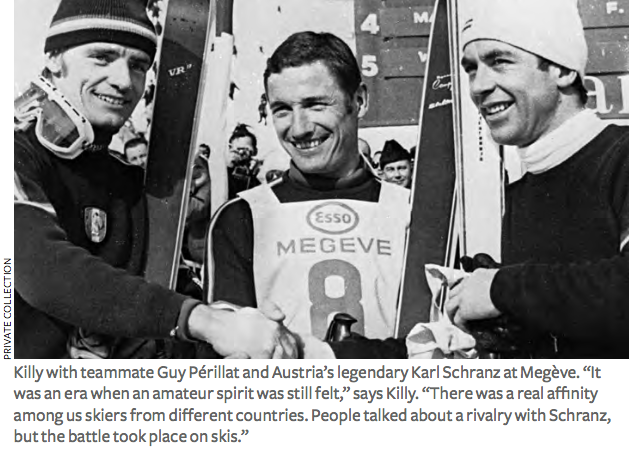
La Coupe du Monde débute le 5 et 6 janvier à Berchtesgaden où vous terminez troisième du géant. Mais le premier succès vient quelques jours plus tard dans le géant d’Adelboden, première victoire d’une série de huit en comptant les combinés…  

Je gagne avec le dossard 13. Adelboden a toujours été une des pistes de références en géant. Y gagner, c’est valider une condition physique et des qualités. Le premier succès est un passage important.


Vous enchaînez avec deux victoires (descente et slalom) à Wengen. Quelle est l’importance de ce doublé?

Je préférais Kitzbühel à Wengen.

Dans la descente, je devance Léo de 25 centièmes. C’est la première victoire française dans le Lauberhorn depuis Guy Périllat en 1961. Elle a d’autant plus de saveur que les Autrichiens avaient qualifié notre triomphe de Portillo de folklorique et ils nous attendaient au tournant.

Pour toute l’équipe, c’est un moment important.

Je domine aussi le slalom qui est, pour moi, le plus pentu et le plus difficile de l’année.  

Avec ce triplé, puisque je remporte aussi le combiné, j’ai l’impression de rentrer définitivement chez les grands.


Kitzbühel, la semaine suivante, est un moment à part. Comment l’avez-vous vécu?

Courir à Kitzbühel était ce qu’il y avait de plus excitant. On était en Autriche, pour défier des mecs qui représentaient le ski, supportés par une foule immense. On me respectait mais j’avais des rapports parfois compliqués avec le public.

Il m’est même arrivé d’envoyer Jean-Pierre Augert, qui me ressemblait beaucoup, pour traverser la foule et signer des autographes.

Gagner à Kitzbühel, c’est le rêve de tous les skieurs. Cette année-là, je remporte la descente, le slalom et le combiné et je deviens le premier à réaliser ce double triplé.

On n’a pas conscience aujourd’hui de ce que cela représente mais remporter, comme à Wengen, le combiné est important même si cela ne comptait pas pour la Coupe du Monde. 

En descente, je devance Vogler d’1’’37 et je bats le record de la piste qui appartenait à Karl Schranz.

Le slalom de Kitzbühel est le plus beau. Il est très varié, avec des dévers, des changements de rythme. Il règne parfois une ambiance hostile et il faut savoir rester dans sa bulle. Je bats le Suédois Grahn, qui faisait partie des meilleurs spécialistes de la discipline de plus de deux secondes en gagnant les deux manches.

Il a régné durant ce weekend une ambiance que je n’oublierai jamais. J’ai traversé la station sur les épaules des moniteurs de ski de la station pour aller chercher mes récompenses. Cela aurait été impensable quelques années plus tôt.

« Superman sur des skis » titrait le Kronen Zeitung, un des principaux quotidiens autrichiens le lendemain.

Après ce weekend victorieux, Toni Sailer a écrit: « Killy pratique un autre ski, un ski d’un échelon supérieur à celui des meilleurs. Ses victoires sont celles d’un athlète complet arrivé à maturité. »

J’ai  alors marqué 151 points sur 175 possibles. Messner, deuxième,  possède 75 points.  


La série continue en descente à Megève…

La piste Emile Allais est très exigeante avec son mur Bornet qui est le passage le plus difficile et le plus dangereux des descentes internationales sur lesquelles j’ai couru.  

Je devance Hans Peter Rohr de deux secondes. Je réussis ma meilleure descente. Je suis étonné de l’avance. C’est ma huitième victoire consécutive et le globe de cristal de la descente est gagné.


En slalom, Périllat s’impose  et s’excuse de m’avoir battu. Il voulait surtout dominer Schranz, notre éternel rival.  Pourtant, je suis malade, je tombe dans la première manche mais je finis deuxième quand même et je gagne le combiné.


Je déclare forfait pour les épreuves de Madonna. Je prends quinze jours de pause et je fais ma rentrée à Chamrousse pour les pré-Olympiques où je m’impose en descente.

Un jour Toni Sailer m’avait raconté qu’avant ses trois victoires de 1956 aux Jeux Olympiques de Cortina, il avait arrêté de skier plusieurs jours. « Tu devrais faire cela » m’avait-il dit. Je l’ai imité en 1967, puis, un an plus tard avant les Jeux Olympiques de Grenoble, où je m’étais échappé une semaine à Montgenèvre chez mes amis Jauffret et Melquiond pour m’éloigner du ski et de la compétition.

Durant toute ma carrière, je me suis inspiré d’autres champions pour optimiser mon ski. Zeno  Colo que j’avais vu emporter le starter avec lui pour sa façon de sortir du portillon de départ, Adrien Duvillard pour sa manière de conduire le virage ou même le sauteur en hauteur soviétique Valery Brummel dont j’ai repris les exercices de weight lifting vus à la télé.


Les semaines suivantes, j’enchaîne ensuite sur le Kandahar à Sestrières avec un triplé français -Killy, Orcel, Périllat- en descente et une victoire dans le combiné très recherchée à l’époque. J’aime cette piste et l’entrée en forêt, superbe, le long des arbres.


La saison s’achève aux USA avec la traditionnelle Tournée américaine. Comment l’avez-vous vécue?

La fin de saison s’est déroulée dans la facilité. Il y a zéro doute, zéro soucis, zéro angoisse. Je suis sur un nuage.

Nous nous envolons pour les USA et c’était un moment que nous attendions avec impatience. J’étais très ami avec les coureurs américains –notamment Billy Kidd et Jimmy Heuga, le fils d’un berger basque français qui avait émigré aux Etats-Unis- qui étaient aussi de magnifiques skieurs.

Aller là-bas, traverser l’Atlantique était toujours un plaisir et une aventure. Pour ma génération, c’était un voyage important. Un de mes rêves d’enfant était de connaître l’Amérique

A la fin de cette saison 1967, cette tournée est un monument médiatique.

J’ai des propositions d’agents. On m’offre 200 000 dollars pour rejoindre le circuit professionnel et gérer une école de ski aux USA.

A l’escale de New York, une conférence de presse est organisée. Nous sommes reçus par le gouverneur du Massachussets.

On attend beaucoup de moi mais je dois rester concentré.

Dans Sports Illustrated, dont j’ai fait la couverture à trois reprises au cours de ma carrière, on peut lire des titres comme « Lafayette, they are back » ou « King Killy ».

Mais pour moi, il s’agit de ne pas perdre le fil de la saison et de terminer le boulot.  


L’étape de Franconia est importante…

Je gagne la descente. Une section difficile de la piste de Cannon Mountain est rebaptisée « Killy’s Corner» (Virage Killy). Cette fois, c’est sûr, je gagne la Coupe du monde.

Je remporte aussi le géant, le slalom et le combiné. Ce sont des moments de plénitude rares mais la saison n’est pas encore terminée.


Il reste pourtant deux dernières étapes à Vail et à Jackson Hole, comment les abordez-vous?

La Coupe des Nations devient un enjeu pour nous qui nous pousse à ne rien lâcher. L’équipe de France s’impose et c’est toujours un bon moment de gagner collectivement.

A Vail, je gagne deux géants, une descente et un slalom.

Evian, le commanditaire de la Coupe du Monde, offre le voyage à Robert, mon père, qui amène le globe de cristal  à Jackson Hole.

Là-bas, j’étais fatigué, j’avais souffert d’une sinusite les jours précédents.

Je reconnais la descente … en luge pour ménager mes forces et prendre un peu de bon temps.

A Jackson Hole, je gagne encore un géant.

La saison est finie ou presque puisqu’il me reste encore des courses en Suisse à mon retour à Verbier où je gagne, et à Thyon, où je suis battu par Mauduit.

Mais c’est durant la tournée américaine que le « boulot » a été terminé.

Je suis heureux de partager du bon temps avec mes copains.


Quels ont été vos adversaires durant cet hiver magique?

C’est une saison d’une incroyable densité avec 14 skieurs issus de sept nations, qui ont pris la deuxième place des courses que j’ai remporté.

Heinrich Messner a terminé à la deuxième place du classement général de la Coupe du Monde. C’était un skieur « classique », un homme discret mais toujours régulier et difficile à battre.

Je me suis retrouvé à quatre reprises sur la plus haute marche du podium accompagné de mon grand copain Jimmy Heuga. C’était une époque encore « amateur » dans l’esprit. Il y avait une vraie complicité entre les skieurs de toutes les nations avec lesquels on partageait de très beaux moments.

Une fois sur la piste, nous devenions adversaires, sans que cela n’altère nos relations. On a parlé de rivalité, notamment avec Karl Schranz mais la bagarre, c’est sur les skis qu’elle avait lieu. Le reste du temps, on s’entendait vraiment bien. Avec tous les skieurs de cette époque, nous avons des dizaines de souvenirs en commun, de fous rires partagés et d’anecdotes.


Cette saison incroyable a déclenché une médiatisation et notoriété hors normes. Comment l’avez-vous gérée?

Cela a vite débordé du cadre du ski alpin. A partir de Wengen sont arrivés des médias qui n’étaient pas ceux qui nous suivaient d’habitude comme Paris Match ou l’émission de télé très populaire en France Cinq Colonnes à la une.

Aujourd’hui, on parlerait de presse « people » qui voulait tout connaître de nous et pas seulement de nos vies de sportifs.

En janvier, au Tenne, à Kitzbühel, où nous avions l’habitude de fêter nos succès, Perillat m’avait mis en garde : « Fais attention, ne t’occupe pas de ce qui se passe autour. Cela m’a coulé après ma saison 1961 (nldr : durant cette saison, il avait remporté toutes les descentes avant de connaître un passage à vide de plusieurs saisons). Mais je sais que cela ne t’arrivera pas car tu sais faire la part des choses. »

1967 m’est tombé dessus et j’ai appris à composer avec la présence constante des envoyés spéciaux de toute la presse française et internationale. Il fallait être capable d’ « ouvrir » les portes puis de les refermer. C’est également ce que j’ai fait la saison suivante à Grenoble. Trente minutes de point presse chaque jour et c’est tout.


Quand avez-vous pris conscience du caractère exceptionnel de cette saison 67?

Je ne l’ai jamais perçue dans sa totalité. Je ne me suis pas rendu compte de ce que j’ai réalisé. Bien sûr, il y a des chiffres : 12 de Coupe du Monde sur 17, vainqueur de 19 courses sur 29, et six combinés de la saison pour un total de 25 « 1st places.»

Mais je ne me suis jamais dit « C’est fantastique »

Il m’a fallu 50 ans pour m’apercevoir que cela n’était pas commun.

Chaque époque possède ses challenges. Longtemps, ce qui m’a hanté, c’est ma deuxième place en descente à Kitzbühel en 1968. Cela m’a rendu malade. Comme quoi l’esprit se focalise parfois sur des anecdotes.

La saison 1967 est posée dans mon histoire sportive entre les Championnats du Monde de Portillo en 66 et les Jeux Olympiques de 1968. Elle fait face aux objectifs d’une journée, les fameuses « courses du jour J ». Ce sont, pour moi, des exploits qui vivent bien les uns à côté des autres et se complètent.

Finalement, 1968 à Grenoble, c’était assez « simple »… Il y avait trois courses, dans un laps de temps déterminé, à une date connue bien à l’avance, avec un objectif finalement assez clair.

1967, c’est une construction plus compliquée, plus élaborée…

Les comparer, c’est comparer un sprint et un marathon.

A l’été 67, je suis passé à autre chose assez vite. J’avais une passion immodérée du sport automobile. La Targa Florio, Monza, les 24 Heures du Mans, le Nurbürgring au volant de Porsche ou d’Alpine.  C’était bien de vivre d’autres moments, d’autres sensations, d’autres défis.

Aujourd’hui, c’est en me replongeant avec plaisir 50 ans après à la demande de Skiing History dans cette saison incroyable que je me rends compte que ce n’était pas si mal. Thank you, guys !

Yves Perret, qui dirige une agence de médias sportifs à Grenoble, est l'ancien rédacteur sportif du journal Dauphiné Libéré et rédacteur en chef de Ski Chrono.
Killy gagne le descente Wengen
Open to Public?
Off
Feature Image Media
Image
Timestamp

It's the first three-peat in World Championship slalom since Christl Cranz did it in 1937-39.

By Tom Kelly

The 19-year-old German ski racer gave a tug on the laces of her leather boots, clicking them into the cables on her long wooden skis. Behind her was the towering Piz Nair, the iconic peak on Corviglia at St. Moritz, high in the Swiss Alps.

A day earlier she had won silver in the downhill on Piz Nair - five minutes, 38 seconds down the mountain. It was the first medal of her young career. Now it was time for slalom, as she placed her bamboo poles into the snow and pushed out onto the course.

Christl Cranz was the first great superstar of women's alpine ski racing - a new sport in the 1930s, making its Olympic debut in 1936. Belgium born, her family moved to Germany after World War I when she was just a child. She was skiing by six and took to it with a passion, eventually winning a dozen world titles and her sport's first Olympic gold at Garmisch-Partenkirchen, Germany in 1936.

Among her accomplishments were three straight World Championship slalom titles from 1937-39 - a feat never matched in 78 years. That is, until last week in St. Moritz when young Mikaela Shiffrin dominated the day to win her third straight gold.

There's a reason no one had matched the record of Christl Cranz. It's tough! The intensity of competition three quarters of a century later makes it more difficult than ever to stay on top.

As the second run approached on Saturday, Shiffrin sat in the snow atop the slalom hill on Suvretta. An umbrella provided shade for her as the sun baked the snow. Her physical therapist piled snow atop her boots to keep the plastic hard and responsive for the race just minutes ahead.

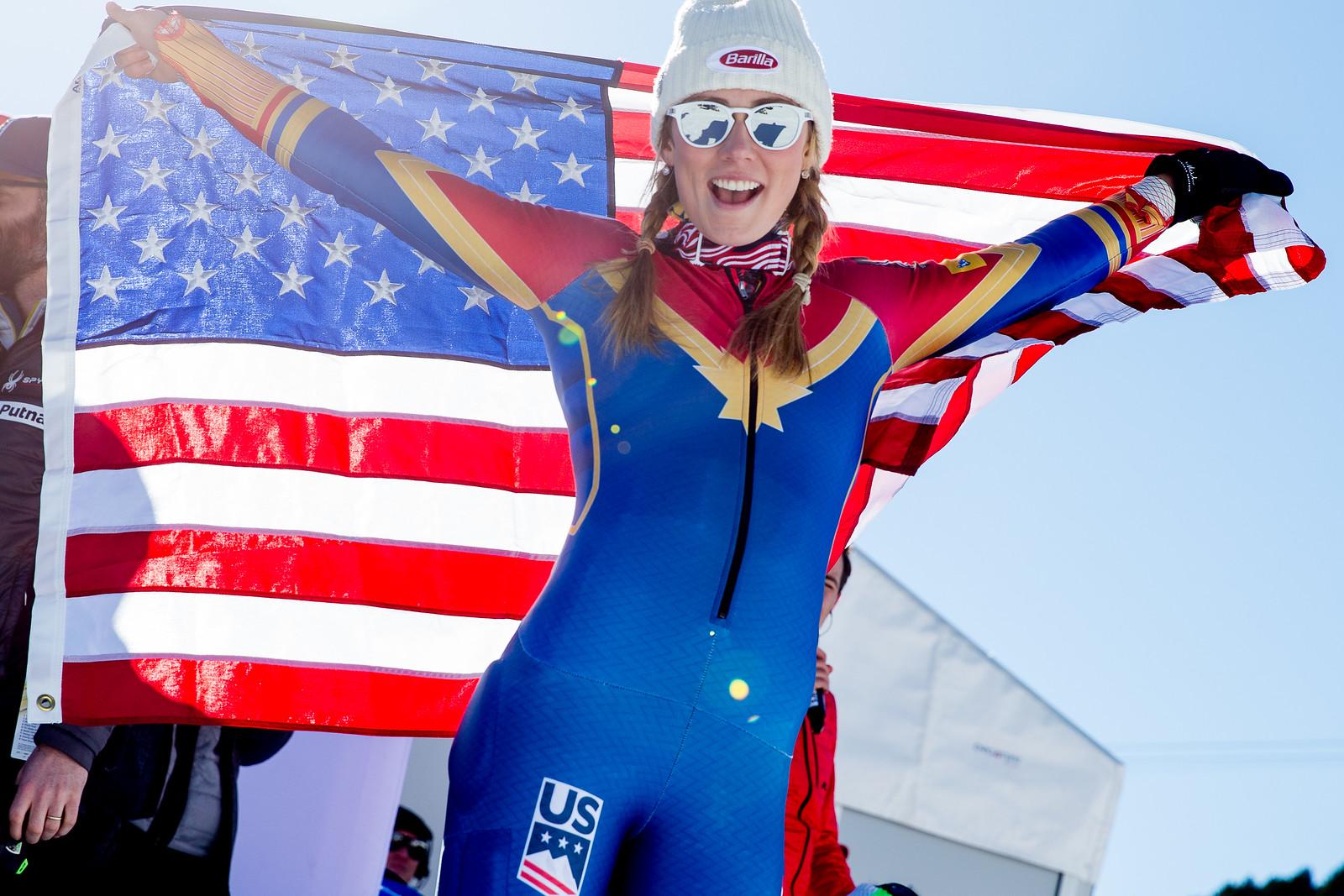
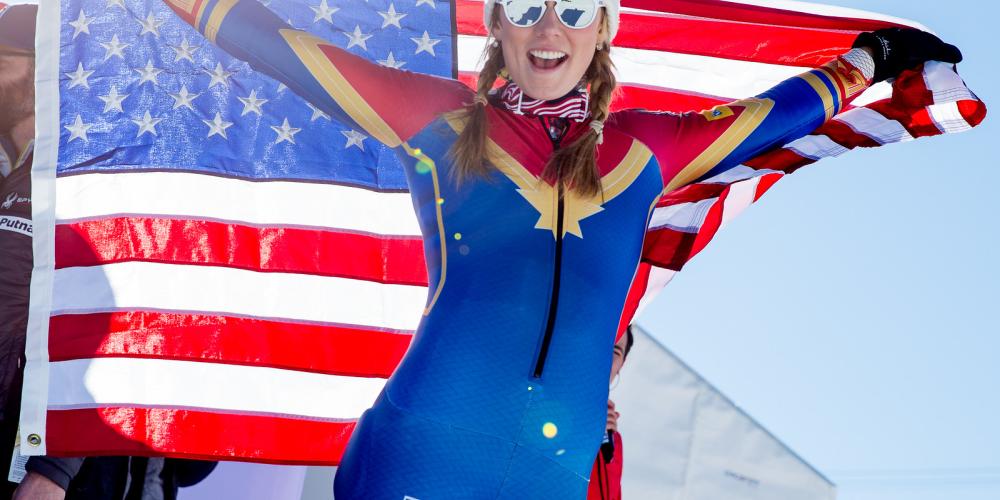
Shiffrin came to slalom day with a different look about her - hair braided into two pigtails, reminiscent of one of her slalom ski racing heroes Janica Kostelic of Croatia, who won the World Championship slalom in 2003 at St. Moritz. The two braids had brought her out of a funk two years ago when she had a slow start to the season before finally winning in Kuhtai, Austria on the eve of the World Championships at Vail/Beaver Creek.

While Shiffrin had a first run lead, the race is never over until the final gate. Swiss Wendy Holdener was only .39 back. Any simple mistake could spell the difference. Holdener would run 29th, Shiffrin 30th. And Holdener put down a strong run.

Now it was Mikaela's date with destiny.

"I tried to pretend like it was a new race completely," she said. "When I was in the start gate, nothing like that was on my mind. It was just, 'now it's time to go.'"

As an 18 year old in Schladming, Austria four years ago, Shiffrin broke through to win her first gold by .22 over home country favorite Michaela Kirchgasser. Two years ago, she withstood the pressure of a hometown World Championships to repeat the title by .34 over Sweden's Frida Hansdotter. In St. Moritz, Holdener had now put down the gauntlet with a solid run that ignited the hometown crowd.

Slalom is about subtleties. When you watch Mikaela Shiffrin ski, you may not even notice it - the direction, the precision, the comfort in her skiing, her confidence. But it plays out quickly in the timing splits.

Split by split, the light went green. Despite being 30 racers into a softening race course, Shiffrin continued to build her lead. And coaches knew the best was yet to come. In the first run, her entire lead was captured on the flat bottom split. And she did it again on the second run, crossing the line 1.64 seconds ahead of Holdener - an unimaginable margin.

Shiffrin is too early in her career to think much about records. "It's a lot to think about - it's a long time ago," she said in response to tying the record. "It's difficult to perform so well in big events three consecutive times. It's not easy and I can understand why people haven't done it.

"But my team around me is really great. My coaches are amazing and we've managed the season really well. I'm really proud of us taking a step back and saying 'I'm not doing the combined or super G. I'm just focusing on my events.' It put more pressure on the GS and slalom, but it worked out."

What sets Mikaela Shiffrin apart as one of her sport's greatest champions is her perspective. She doesn't get caught up in the hype. She endears herself to the media not so much as a champion, but as a real person who passionately cares about her sport.

"It's really cool. But, to be honest, I don't really know what it means yet," she said. "I wasn't thinking about that. Today my real focus was just on the day - on both my runs and my own skiing. I wasn't trying not to worry about anybody else - any of the other skiers.

"Today it wasn't about three medals," she said. "It was just about today and one medal."

Christl Cranz would have been proud.

 
Category
Slideshow Teaser
What made 1967 one of the most memorable seasons in alpine ski competition history.
Banner Image
screen_shot_2017-02-06_at_10.05.03_am.png
Open to Public?
Off
Feature Image Media
Image
Timestamp

By Yves Perret

Lire cet article en français

It was greater than his famous Olympic gold-medal hat trick. In an exclusive interview, Jean-Claude Killy recalls the first season of the World Cup, 50 years ago, when he won 12 of the 17 races, including all of the downhills, and finished on the podium in 86% of the races he entered, a record that’s never been surpassed.

Fifty years after the fact, 1967 remains one of the most memorable seasons in alpine ski competition history. Not only did it introduce the new World Cup—skiing’s first use of a season-long series of competitions to determine the world’s best—but it also resulted in an astonishing, never-to-be-repeated record. 

Jean-Claude Killy of France won 12 out of the 17 slalom, giant slalom and downhill races on the calendar. He was the victor in all the classic downhills, and the Hahnenkamm and Wengen combineds, something no man has since done. 

Jean-Claude Killy of France won 12 out of the 17 slalom, giant slalom and downhill races that made up the 1967 World Cup season. He was the victor in all the classic downhills, and the Hahnenkamm and Wengen combineds, something no man has since done. For the whole season, he participated in 29 races, and won an amazing 19 (66 percent) of them. He finished on the podium in 86 percent of the competitions he entered. He also won six of the season’s downhill-slalom "paper" combineds.

Killy won the first World Cup crystal trophy with a perfect 225 points, the maximum possible in a system in which a racer, who’d won three races in a discipline, could not earn more points in it. First-place was worth 25 points, compared to 100 points today. His one-man World Cup point total topped that of a whole nation—Italy, West Germany or the United States. 

In 1965 in SKI Magazine, Serge Lang had crowned him with the nickname “King Killy,” a title repeated by newspapers and magazines around the world. Last summer, the “King,” 73, invited me to his home near Geneva. On the table in front of us Killy spread open neatly organized, thick albums of press clippings displaying the highlights of his exceptional career. Written in upright handwriting in the notebook containing his race results, is the sentence “La victoire aime l’effort” (Victory loves effort). Over several hours of conversation, he was once again the best skier on the planet.

INTERVIEW: Part 1

Jean-Claude, how do you look back at your 1967 season, and how did it come together after what had occurred in the previous seasons?

If the World Cup hadn’t been invented, my 1967 season might not have been what it was. It was a greater achievement than my 1968 gold-medal hat trick at the Grenoble Winter Olympics, for which most people remember me.  

I got there by a slow process of building. My constant obsession was winning. I managed to pull off a couple of wins, like the Critérium de la Première Neige in 1961 when I was 18 years old. In 1963, I finished in second place 11 times. And the 1964 Winter Olympic Games in Innsbruck were a technical disaster. I lost the toe piece of my binding in the slalom. In the downhill, my edges weren’t correctly sharpened, and I fell on the first fall-away turn. I finished fifth in the GS. In short, I wasn’t ready. 

The week after the Olympics I won the giant slalom of the Arlberg-Kandahar in Garmisch, Germany, ahead of my American friend Jimmie Heuga. It proved that I’d brought my skiing to a decent base, but there were still kinks to be worked out. 

I hadn’t yet resolved health issues that had affected me since I suffered jaundice when I served as a 2nd class soldier in the French Army during the Algerian war. I was skinny. I lacked endurance. In Paris, journalist Michel Clare introduced me to Doctor Creff, a specialist in exotic diseases. He found out that I also suffered from
amebiasis, and helped me to recover. But I had to work a lot harder than my teammates to be in top physical shape. 

I also needed a system that would allow me to be successful and consistent in not just one, but all three alpine disciplines—slalom, giant slalom and downhill. Specialization limits the opportunities to win. I wanted to develop a system that would address all of the variables that make alpine ski racing such a complex sport—equipment, start number, ski preparation, snow type, weather conditions and more.  

What made a difference?

A key challenge was equipment. It’s crucial to have the best. You can’t allow yourself to lose because of your skis. I skied on two different brands, Rossignol and Dynamic, without having an exclusive contract with either company. It allowed me to choose the pair of skis that would be best for each race. 

At the 1966 World Championships in Portillo, Chile, I used Rossignols in the GS, and Dynamics for the other events. In 1963, in the Kandahar, I even finished second on a pair of Austrian downhill skis.  I was prepared to make financial sacrifices so that I’d be free to use the equipment I wanted.

Above all, I was helped when the Dynamic ski company hired Michel Arpin to take care of my skis. He was from the town of Saint-Foy-Tarentaise, right near my hometown of Val d’Isère. We spoke the same local dialect. Michel had an amazing practical intelligence. Like me, he’d dropped out of high school at 15. When we started our collaboration, I told him: we will make fewer mistakes because we are going to know more than the others. I trusted Michel completely, and I knew that my skis were in the best possible hands.

Describe the process that took you to the top.

As members of the French national team, we spent the whole winter together. But before the first fall training camp we each pursued our own way of doing things. I was on a personal, obsessive quest to figure out what would help me improve, fueled by an overwhelming passion for skiing focused on racing. I opted not to continue my studies. I dropped out of high school. For many young racers, it’s a questionable decision. It limits your options, and can complicate finding a career after ski racing. For me, though, racing was a healthy obsession. It didn’t lessen my ability to think on my own. My aim was to be a free man. Skiing became my profession. 

Winning was all that mattered. I didn’t have a choice. It was simply my only form of expression. France’s head coach Honoré Bonnet understood that. The goal was to win races. 

What were the keys to your success?

Beginning in 1965, several factors came together, fueling the French national team’s growing momentum. The organizational talent and coaching of our leader Honoré Bonnet was one factor that helped us. Another was support from French ski industry—manufacturers like Rossignol and Dynamic skis, Trappeur boots, Salomon and Look bindings. French ski resorts and hotel owners also welcomed us with open arms, charging us next to nothing for lodging and meals. The atmosphere in France at the time was incredibly supportive of ski racing. 

“Our athletes are our best ambassadors,” declared France’s President General Charles de Gaulle. All of a sudden we went from the dormitories of a simple UCPA outdoor center to four-star hotels.

It was the beginning of a golden age for the sport. . . a convergence of increased financial resources, the right people, and experienced professionals. Plus, television broadcasting had gone international, transforming athletes into stars.

In 1965, after nine wins and seven second-place finishes, I was voted the Martini Skieur d’Or, and Champion of Champions by the newspaper L’Equipe. One by one, I’d assembled the pieces of the puzzle.

What was the impact of the World Cup’s creation on the outcome of your incredible 1967 season?

The specific formula and name for the World Cup didn’t come from the racers, but the idea—the force for change—did. Racers were exasperated that their entire careers could depend on a single day’s result in the Winter Olympics, or once every four years when a separate FIS World Championships were held. Nothing big happened in odd-numbered years. Careers were short. Few racers enjoyed the chance to ski in two Olympics. We often discussed our frustration, and what could solve the problem. 

We were all fans of Formula 1 car racing, in which the best are determined by accumulated results over a season-long competition. So it was easy for us to embrace the plan for a World Cup of Alpine Skiing formulated in 1966 by journalist Serge Lang, collaborating with   America’s Bob Beattie, France’s Honoré Bonnet, and Austria’s Sepp Sulzberger, supported by the Paris-based sport daily l’Equipe and journalists like Michel Clare—and John Fry, who added the Nations Cup to the mix. 

During the August 1966 World Alpine Championships at Portillo, Chile, FIS President Marc Hodler gave it the green light. It would enable us to accumulate points in a series of races, including the classics of the Kandahar, Kitzbühel and Wengen, as well as races every winter in America. The mineral water company Evian supplied beautiful crystal trophies. 

At Portillo, I remember being in the finish area of the downhill after my gold medal win. Everyone was crying. Serge Lang said to me, “The World Cup is coming. What’s your strategy going to be?”

“I’m going to fly through it,” I answered. “It’s going to be a lot of fun.” In my mind, I was going to get the most out of the new system in order to take my sports career to a new level. From then on, more than just the big classic events in the Alps would be the measure of a successful season.  

How would you describe the relations among members of the French team?

We trained together and we competed against each other every weekend. Even to this day, we’re like brothers. 

In the spring of 1966, we skied run after run together on the Pissaillas glacier at the Col de l’Iseran, preparing for Portillo, Chile—the only FIS World Alpine Championships ever held in the southern hemisphere. Our different strengths and personalities helped us to support each other. There was always a deep feeling of mutual respect and humility. 

Our inspirational leader Bonnet, 47, a year away from retiring, had put in place a system that functioned superbly, both for the men and for our great women’s team at the time. Each member of the team had his own role. Michel Arpin took care of my skis and did timekeeping. I could fully rely on his technical expertise. 

Jules Melquiond brought to the team a calm, serene temperament; we were roommates for seven years, and we never had even the most minor ego clash. Team captain Guy Périllat was listened to and respected. Léo Lacroix contributed his optimism, good humor, and especially his talent. Georges Mauduit, the giant slalom specialist, and Louis Jauffret, the slalom specialist, were magnificent skiers.

All of these talents, plus the combination of our different temperaments, made for a tremendous and cohesive squad.

The 1967 season began in December 1966 at your home resort of Val d’Isère, with the traditional Critérium de la Première Neige . . .

The race was special that year because it was the first time it was held on the new Daille run, called Oreiller-Killy or OK, which I had helped to design. (Editor's note: Henri Oreiller was 1948 Olympic downhill gold medalist.) Léo Lacroix, who won the race, still laughs when he recalls it today. “I’m the only one to have beaten Killy in downhill in the 1967 season,” he says. I remind him that it was in December 1966. The Critérium didn’t yet count for World Cup points. The World Cup didn’t begin until January 5th at Berchtesgaden, Germany, where I finished third in the GS. 

Your first success came a couple of days later in the GS at Adelboden, Switzerland, the first in a series of eight victories, counting the Combined. You went on to win twice (downhill and slalom) at Wengen, also in Switzerland. What was the importance of this double win?
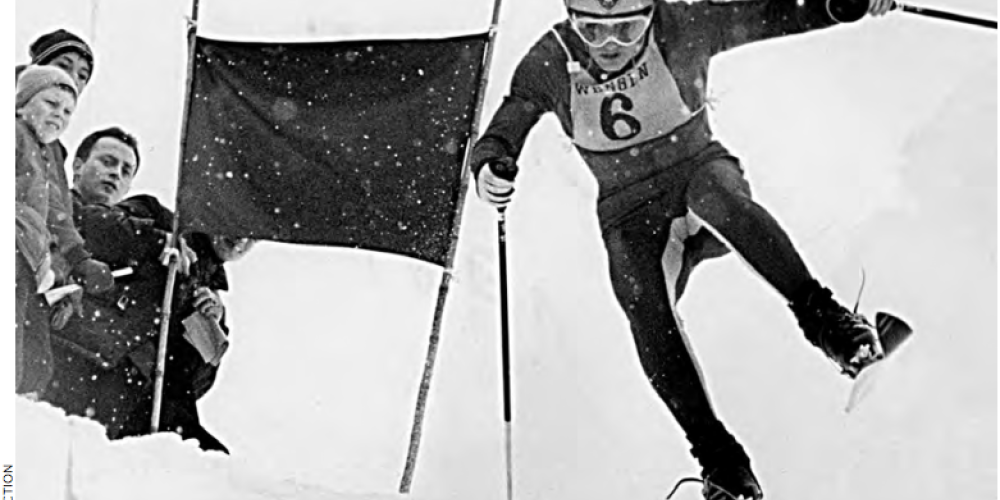
At Adelboden, I won with the GS with bib number 13. It was no bad luck for me! Adelboden has always been a benchmark for the GS. Winning there confirms a certain level of physical training and technical skill. In any season, too, the first win is significant.

At Wengen, in the downhill on the Lauberhorn, I was 25 hundredths of a second faster than Léo Lacroix. It was the first French victory in the Lauberhorn since Guy Périllat’s win in 1961. It was even sweeter because the Austrians, who maybe thought our triumph in the World Championships five months earlier at Portillo was a fluke, were expecting us to fail. It was an important moment for the whole French team.

At Wengen I also dominated the slalom, which I felt was the steepest and hardest of the year. With this triple victory-—I won the combined—I got the impression that I was finally playing in the big leagues for good. The next week would be the incredible challenge of Kitzbühel.  

In the March-April 2017 issue of Skiing History, we’ll present the second part of this exclusive interview with 1967 World Cup overall men's alpine champion Jean-Claude Killy, plus an interview by journalist Michel Beaudry with Nancy Greene-Raine of Canada, who won the 1967 women’s overall World Cup title. The World Cup is celebrating its 50th anniversary this season.

Interview by Yves Perret
Yves Perret, who heads a sports media agency in Grenoble, is the former sports editor of the Dauphiné Libéré newspaper, and was editor-in-chief of Ski Chrono.

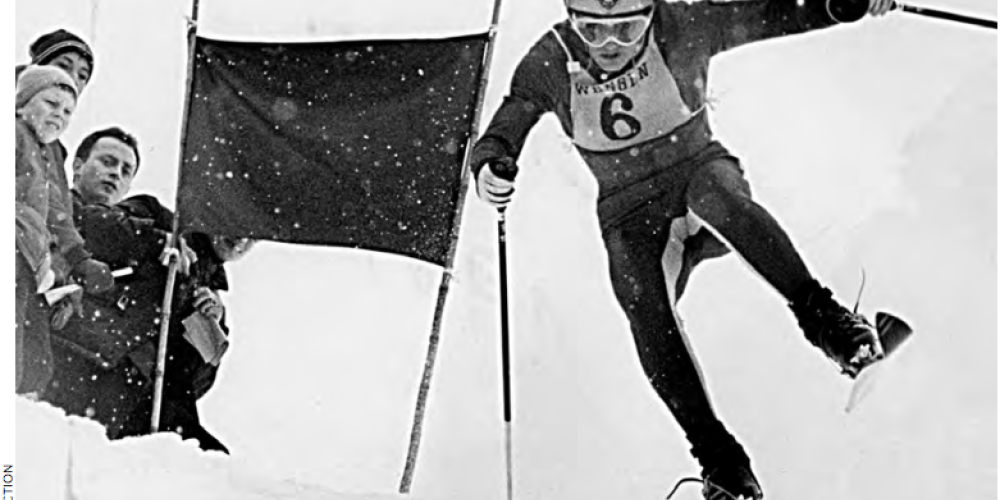
Jean-Claude Killy winning the classic Lauberhorn downhill at Wengen
Category
Open to Public?
Off
Feature Image Media
Image
Timestamp

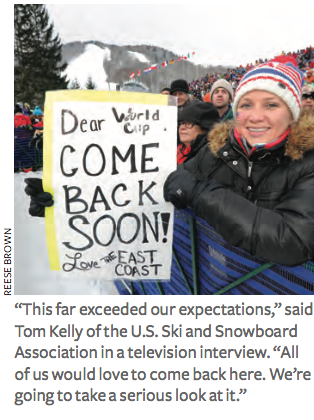
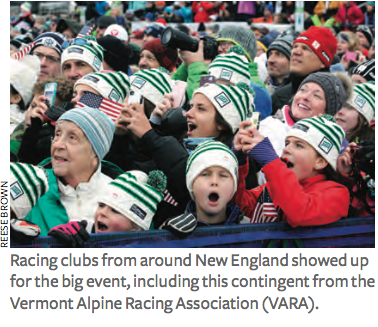
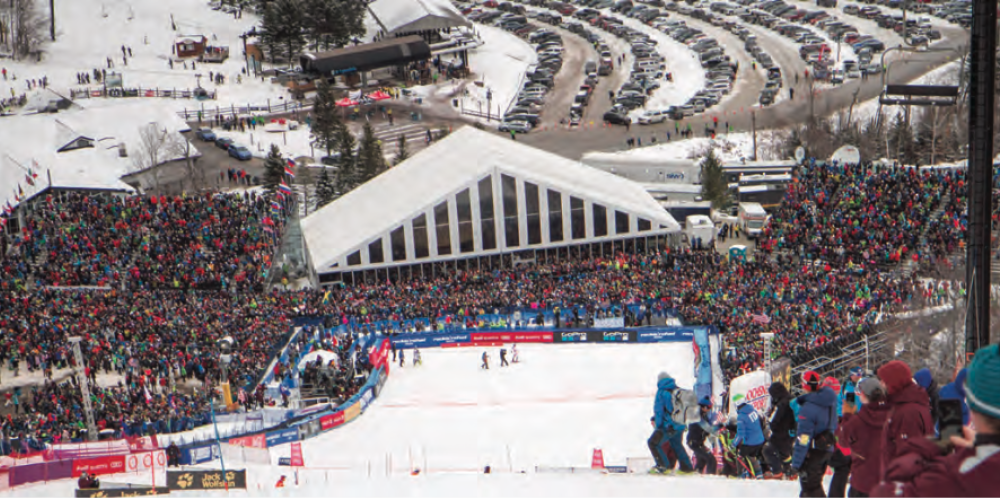
In November 2016, 16,000 fans attended a World Cup alpine ski race in New England, where love of the sport has never waned. By JOHN FRY

Last November was a transformative month. . . not only for politics, but possibly for American skiing. In politics, a neglected bunch of underemployed voters, largely unobserved and resentful of political correctness and diversity, had grown skeptical of the Establishment’s message and mission. The result was an electoral surprise. 

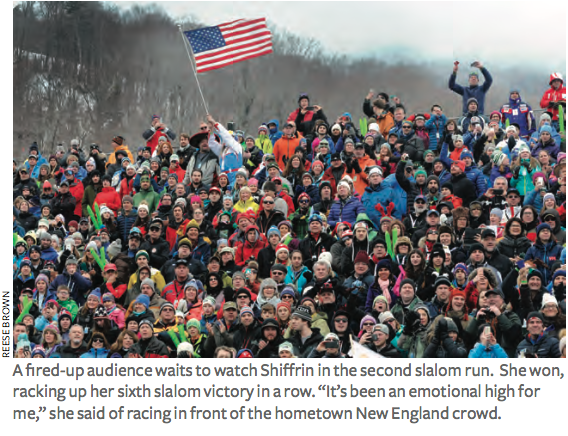
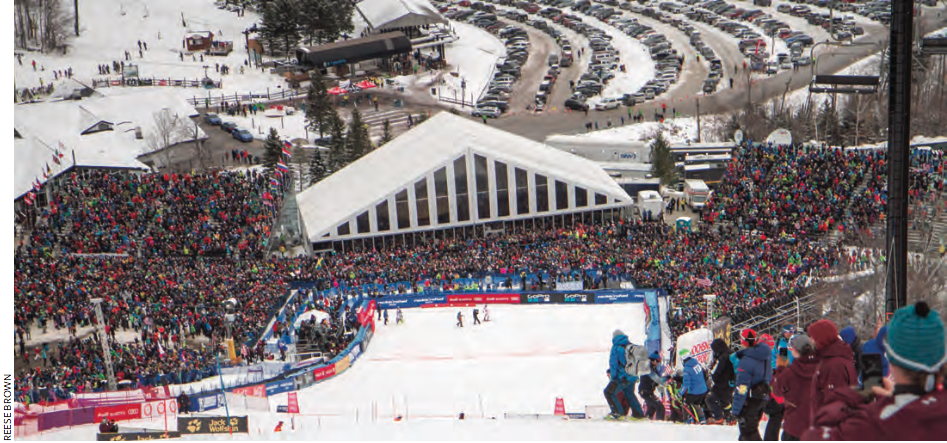
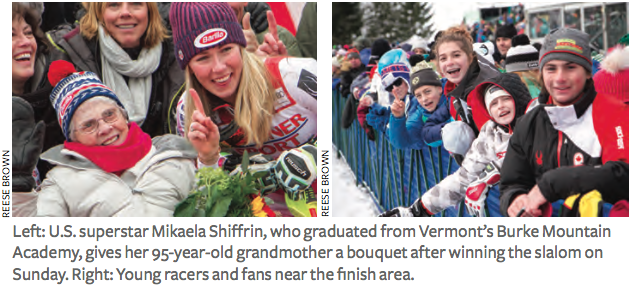
A parallel with skiing may seem remote, but how about this? Two weeks after the election, more than 15,000 enthusiastic fans unexpectedly showed up at an alpine ski race. And as many came back the second day. Those kinds of crowds hadn’t shown up at a World Cup race in 50 years in the United States, since Jean-Claude Killy won all three races on Cannon Mountain, New Hampshire in 1967. 

Who were these forgotten people who jammed the roads leading to the Superstar slope at Killington? Who would have expected such a throng? 

Not the various organizations that have erased the word “ski” from their names, replacing it with the amorphous, somewhat inaccurate “snowsports” as part of a fruitless endeavor to unite skiing with a culture whose mission has been to replace skis with snowboards. Not the advertisers and publishers who have sought to cure anemic participation with images of young men recklessly hucking cliffs, doing aerial flips, in baggy clothing derived from urban street wear.

The thousands who lined the slopes and filled the stands at Killington, including children, came to see another chapter in the hundred-year-old sport of alpine ski racing. In the world’s top women racers they could observe athletic form to which they can relate their own technique, most obviously in giant slalom: carving turns, skis out from under the body, head and shoulders aimed downhill, going fast. 

Nothing else on the slopes—freestyle, aerials, snowboarding—does this, or possesses such a rich history.  

The surprise is where all it happened. Vacated by American skiing’s national organizations, which moved West, the Northeast is a region akin to the neglected industrial heartland, made famous in the recent election. It’s snow country’s Rust Belt. . .at least, figuratively. Over the past 50 years the Northeast has suffered the loss of hundreds of lift and rope-tow-served ski areas—up to 650 across New England and as many as 250 in New York, according to Jeremy Davis of the New England Lost Ski Areas Project (www.nelsap.org). Ski companies and associations headquartered in the East have folded or moved west. 

However, in New England, the historic cradle of American skiing, love of the sport has never waned. The heartbeat is strong. If you include the amount of skiing they do in Colorado in the total, Northeastern skiers account for fully a third of national skier-days. They also purchase about a quarter of alpine equipment. They were the ones who thronged the spectator stands and the roads leading to Killington. 

Credit Powdr Corp.’s Herwig Demschar (Austria) and U.S. Ski Team President Tiger Shaw (Dartmouth, Stowe), among others, for making the risky bet that World Cup racing, after an absence of 25 years, would be a success in the East. The crowds of spectators have also served to remind FIS officials that 56 million people live within a few hours’ drive of Vermont and New Hampshire ski mountains. Tops in TV ratings for ski racing are Boston and New York, the world’s media capital. The FIS should waste no time in putting the U.S. Northeast permanently on the annual calendar of World Cup races. 

Looking ahead, too, ski areas may question why they spend hundreds of thousands of dollars building free-admission terrain parks, while charging guests to compete in NASTAR. An easy open-gated course enables recreational skiers to sense an approximation of what Lindsey Vonn and Bode Miller experience, or what the world’s best women racers were doing at Killington on Thanksgiving weekend, exciting a thrilled public, and reminding us of the path to making a great sport even greater, again.  


The writer voted the Democratic line in the recent U.S. presidential election. His opinions are his own, and not necessarily those of the International Skiing History Association. Fry is the author of the award-winning Story of Modern Skiing (University Press of New England, 2006).

Category
Open to Public?
Off
Feature Image Media
Image
Timestamp

By Tom Kelly

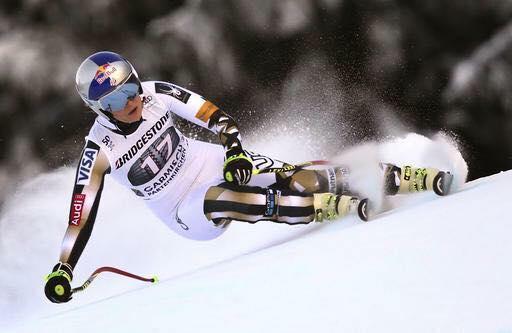
Over the past decade, Lindsey Vonn has established herself as one of the world's most notable athletes. People on the street know Lindsey Vonn. They recognize her as an accomplished ski racer and cultural hero of her time - a glamorous woman whose image has graced every level of global media.

What they don't see is the Lindsey Vonn who spends six to eight hours in the gym every day -  sweating and toiling to tone her 32-year-old body to accomplish things never before achieved in her sport. And with each painful injury, that work becomes harder.

It was no surprise that last weekend in the Bavarian village of Garmisch-Partenkirchen, she broke down in tears - letting her emotions loose in the finish area, hugging her father, doing a dance with the fans and looking back up at the imposing Kandahar run with a smile.

It was just a broken arm, some would say, that stole the first six weeks of the Audi FIS Ski World Cup season from her. But this wasn't just any broken arm. A downhill training crash at the U.S. Ski Team Speed Center at Copper Mountain, CO in November shattered her humerus. She showcased the x-rays on Instagram, detailing the fragmented bones and the metal plate and screws surgeons in Vail used to put it back together again.

Next came the work. There was pain. There were tears. Then there were pullups - maybe earlier than doctors would have liked. But she had a mission.

A week before Garmisch, after  just a few on-snow days at Vail, Vonn crossed the Atlantic bound for the tiny Austrian mountain village of Zauchensee south of Salzburg. It was a very special place for her. A year ago, the legendary Austrian Annemarie Moeser Proell was in the finish to greet the American star when she matched the record of 36 downhill wins.

A win would have been a fairy tale. But it wasn't in the cards. After days of waiting for weather to break for downhill training, Vonn mustered a 13th on the twisty-turn track that rips its way from the towering peak of the Gamskogel to the charming village below.

She tucked away the experience in Zauchensee and traveled to Garmisch with hope and confidence. The Kandahar is one of those big downhills with broad shoulders and bold, sweeping high-speed turns. Six of Vonn's then 76 World Cup wins had come there (among them a slalom win in 2009) - including a big victory a year ago by 1.51 seconds. Still, she had such little time on snow - and almost nothing at speed - she thought she may need to scale back her expectations.

The Kandahar stands proudly in the shadow of the Zugspitze. The women's course starts high in the Troeglhang, arcing boldly through the Bavarian forest - big sweeping turns. But while the top may be bathed in sunshine, the winding track is dark and bumpy, making it terrifyingly difficult to visualize your line. This was a course you skied with intuition and feel.

Vonn kept her cards close in two training runs, running fifth fastest on her final try but failing to  make one of the final gates. No worries. She knew she could adjust her line on race day.

Standing at the top, she knew what she had to do. German hero Veronika Rebensburg kicked it off with bib number one to take the lead. One by one, no one could match her time. Then came the matchup ski racing fans can expect to see in every speed race this season as Swiss star Lara Gut came into the gate. Gut knifed it down the Kandahar to take the lead. Soon it was Vonn's turn, in the familiar 17th start position.

She charged out onto the course, arcing her way onto the Kandahar and through the chicane turns of the Schussanger. The first intermediate time came up red, a slim gap to make up on Gut. Pointing her skis into the fall line, Vonn took on the look of a champion. This was not the same ski racer with the wide and shaky turns of a week earlier. She rocketed down through the Himmelreich and dropped over Waldeck - the steepest pitch on the course.

Suddenly the 2010 Olympic champion was up by .39 seconds over Gut.

Vonn continued to put down bold turns, skiing a courageous line - taking calculated risks, skiing on a mission. Now it was down to the final turns through the FIS Schneisse and into the Tauber Schuss - time ticking and ticking.

As she crossed the finish line, there a moment of silence. Then there was the roar of the crowd. She saw the scoreboard and it was green. She hugged her hands into her chest, looking into the crowd for her father, before collapsing prone on the snow sobbing uncontrollably.

Sport fans see what takes place in the arena. But sometimes they get a look deeper inside. In Garmisch-Partenkirchen on Saturday, they saw into the heart of one of the world's greatest athletes. Even if you're Lindsey Vonn with 77 World Cup wins, they don't come automatically and they are never easy.

It's one thing to set a goal of winning, it's quite another to achieve it. Lindsey knows she can match Ingemar Stenmark's record of 86 World Cup wins. She knows she can race against the men. But she, and only she, bears the burden of achieving it.

"To be honest, I wasn’t sure what I was capable of," she said fighting back tears in the finish. "I tried to risk more and believe in myself. I know people don’t think about how much blood, sweat and tears it took to get here today.

"Words can't describe how happy I am right now. Hard work pays off in the end.

"I did it!!"

Vonn victorious at Garmisch.
Category
Open to Public?
Off
Feature Image Media
Image
Timestamp

By Tom Kelly

Gold comes in many forms. Last weekend on the icy pitch of the fabled O.K. course in Val d’Isere, France, a 15th place World Cup super G result gleamed brighter than an Olympic medal for Ryan Cochran-Siegle.

Cochran-Siegle is a Vermont native who has made Park City his home the last few years, living with his cousin and former U.S. Ski Team racer Jessica Kelley and her husband, well known Park City athlete and coach Adam Cole.

It had been nearly four years since his last major international speed event in February, 2013. On the third gate of the combined downhill at the 2013 World Championships in Schladming, Austria, he crashed, shredding his left knee. Multiple surgeries and hundreds of days in the gym later, he scored a career-best finish on a weekend that could define his pathway leading up to PyeongChang in just 14 months.

The son of 1972 Olympic slalom champion Barbara Ann Cochran, Cochran-Siegle had a textbook career going. He won his first U.S. Championship medal at age 19 in 2011. That next December he scored his first World Cup points in the Birds of Prey super G with a proud mom in the finish. Two months later he captured double gold at 2012 World Junior Championships in Italy.

He was on his way. Until that fateful day in February, 2013.

Standing in the start gate for his return to World Cup speed, his mind was calm and focused. “Starting 61 was super nice because I had no expectations,” he said. “You really have to have a pretty incredible run. There was no pressure – it was a win-win in my eyes.”

Few athletes could have survived what he had endured for nearly four years. At his side was a team of doctors, trainers, coaches and family. His gold medal attitude of patience and perseverance would serve him well.

He planted his poles at the top of the historic O.K. course that bears the initials of Val d’Isere’s most famous sons, Henri Oreiller and Jean-Claude Killy and did what he has always loved to do: he skied.

It was a long road to Val d’Isere. Much of his knee was destroyed from the accident. Initial rehab went well and he was back on snow. But it didn’t last. Another surgery. No go. One option remained – transplant surgery. While not that unusual, it was a procedure that wasn’t ideal for the levels of stress an athlete puts on the knee. But if there were ever a candidate, Ryan Cochran-Siegle was the one.

“We really blazed our own path on this one,” said the team’s medical coordinator Chris Antinori. “There was really no precedent to draw from looking at other college and professional sports for athletes having this procedure and returning to a high level of sport participation. But a lot of good things and good people came together to make this a positive outcome. RCS is the only elite skier and athlete that I am aware of to return and be successful at an elite level.”

He could have given up at any point in time. But he didn’t.

“Having had prior success, I didn’t want that to be my final race – I wasn’t ready to be done,” said Cochran-Siegle. “The amount of energy I put into my rehab – I wanted to do it right. That was the only way to make it out with what I wanted to still achieve.”

Bunkering down at the Center of Excellence and hitting the books at Westminster College, he waited for the call. Finally, it came – a donor had been found. In August, 2014 he underwent a third surgery at the Steadman-Hawkins Clinic in Vail.

Then came the work. At first, eight weeks non-weight bearing but still working every day on his good leg. Then mundane, simple exercises to patiently bring him back to strength. Six months later on February 2, 2015 – when his teammates were parading into the World Championships at Vail/Beaver Creek – Cochran-Siegle was doing his first barbell squats. A milestone day, strength coach Tracy Fober at his side.

He was on snow that summer, carefully undertaking a prolonged return to snow process together with his teammates Tommy Biesemeyer and Resi Stiegler under the watchful eye of coach Bernd Brunner. Patience was his virtue. The 2016 season was a good one mixed with some NorAm podiums, a couple FIS race wins, a pair of medals at U.S. Championships in Sun Valley and a point-scoring finish in a World Cup at Kranjska Gora.

But he wanted to get back to speed.

There’s a certain protocol in a World Cup finish area as the race day wears on. While the winners are already doing their TV interviews, eyes remained glued to the scoreboard watching to see who might make an attack from the back. RCS didn’t win the race. But, boy, did he turn a lot of heads.

Up on the race course, team trainer Antinori felt a deep swelling in his heart. Back home at the Center of Excellence, his strength coach Fober, passionately watched the TV broadcast on her computer – ignoring the meeting she was attending and shouting out loud as he crossed the finish line. As a coach or trainer, it tugs at your heart and brings tears to your eye to see a hard working athlete achieve success.

“When I crossed the finish line it was a huge relief,” he said. “I didn’t know I had that good of a run. It felt like I was on the fine line of skiing well and going out. But when I saw I was 15th
I was surprised, a little overwhelmed and super happy – immediately super happy.”

Cochran-Siegle lives in Park City with his cousin Jess Kelley and her husband, former athlete and team coach Adam Cole. In Ryan’s room, Cole hung a 2002 poster of Norwegian star Lasse Kjus that says: ‘Three-Time Olympic Champion – Inspiration.’

Ryan Cochran-Siegle is an athlete to watch. On his Instagram channel he’s posted a saying: ‘It isn’t the mountain we conquer, but ourselves.’

The gold medal goes to Ryan Cochran-Siegle.

Ryan Cochran-Siegle
Category