Competition

All forms. Use in place of Racing, Race Results etc

Open to Public?
Off
Feature Image Media
Image
Timestamp
Author Text
By John Fry

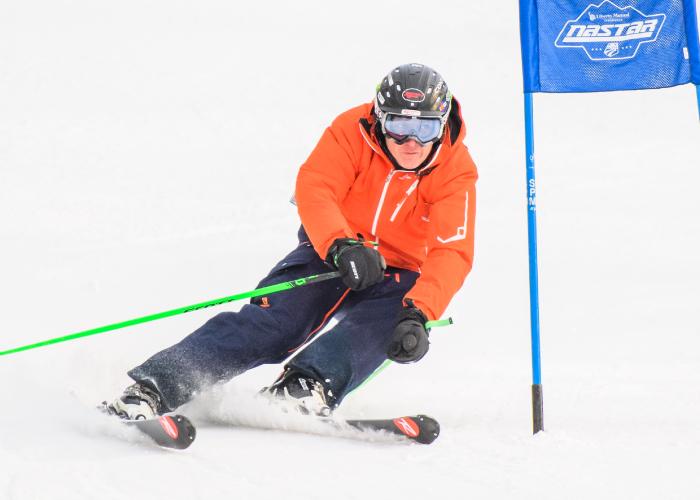
NASTAR, the world's largest recreational racing program, began 50 years ago when this editor wanted to introduce the equivalent of golf's par to the sport of skiing.

The environment for people learning to ski has varied little over the years. Ungainly tip-crossing neophytes are herded into classes of eight to a dozen students. After a day, or perhaps five days, they emerge skilled enough to achieve what they want: to descend the mountain on pleasant trails, while enjoying the scenery and the company of friends. 

Most recreational skiers are like golfers who play a round without keeping score, or tennis players happily lobbing the ball back and forth across the net.

Beginning as editor-in-chief of SKI Magazine in the spring of 1964, I worked across the hall from the editorial office of GOLF Magazine, whose editorial director I would become five years later. GOLF's editors relied heavily on supplying readers with tips to lower their handicaps. Golfers could relate their scores to a PGA player's sub-par round, or their own putting to Arnold Palmer's challenge of sinking a 10-footer. How great it would be, I thought, if I could ratchet up SKI's newsstand sales using the same appeal! How great it would be if it were to become a goal of ski instruction!

To read the rest of this story, see the January-February 2018 issue of Skiing History magazine. To read the digital edition online, you must be a member of ISHA. Not a member? Join today!


Feature Image
Category
Open to Public?
Off
Feature Image Media
Image
Timestamp

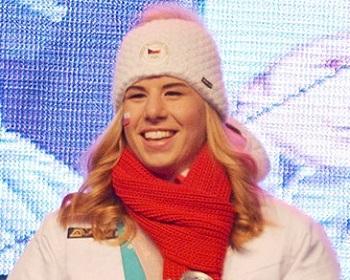
Ester Ledecka broke a training barrier and crossed a cultural divide.

By Seth Masia

When Ester Ledecka astonished the world, and herself, by winning Olympic gold in both Super G and parallel snowboard GS, she became the first woman to win in two different sports at one Olympics. It was not only an historic event. Ledecka also fused two frequently combative cultures, skiing and snowboarding, once at war with one another.

The Czech's history-making feat recalls the most impressive Olympic ski crossover of all time -- Norwegian Birger Ruud's performance at the Garmisch-Partenkirchen Winter Games in 1936. Ruund won both the jump (gold medal) and the downhill (no gold medal, because in alpine only medals for slalom and downhill combined were awarded that year -- gold medalist was Germany's Franz Pfnur). Like all Olympic alpine racers that year, Ruud was required to use the same skis for the slalom and downhill. His feat surprised few: He was already regarded as the strongest skier in the world. 

David Sedlecký photo

To read the rest of this story, see the March-April 2018 edition of Skiing History magazine. To read the digital edition, you must be a member of ISHA. Not a member? Join ISHA now, for $29 (digital edition) or $49 (print edition), published six times each year.

Open to Public?
Off
Feature Image Media
Image
Timestamp
Author Text
By Kathe Dillmann

NASTAR’s mid-1970s national coordinator fondly remembers the low-tech camaraderie of the racing program’s early days. 

By 1973, under the direction of former U.S. Ski Team coach and director Bob Beattie, NASTAR had expanded from the original eight to 80 ski areas, attracting recreational skiers to make 80,000 runs. With such rapid growth, Beattie—who was also running the World Pro Ski Tour—needed to expand his staff.

In the mid-winter of 1973, Bob Beattie decided to hire a public relations director for NASTAR, a job that had been held by Aspenite Greg Lewis. When Beattie tapped Lewis to announce his World Pro Ski Tour races, the NASTAR job opened, and I took it. By that spring, I’d been promoted to NASTAR national coordinator. 

It was a swift change of gears for me, a totally new world of big money, credit cards, expense accounts, fancy restaurants and lodges. “Nothing like going to restaurants where no entrée is under $7!,” I remember thinking at the time. But it wasn’t hard to get used to.

Back then, NASTAR operated in a low-tech world. To process results, we used a futuristic computer something akin to “Hal” of the then-popular film 2001 Space Odyssey. Hal sat in a cool, dark facility in Boulder. At our headquarters near the Aspen airport, we sorted hand-written weekly race results that we then shipped via courier to Boulder for punch-card processing, ultimately determining national finalists and other awards. Our office ran on Selectric typewriters, land lines, snail mail and hand labor.

SETTING THE PACE

The NASTAR season got underway each year with the December pacesetting trials to determine the national zero handicapper against whom all NASTAR scores were compared.

We traveled the country to run these events. Some memorable moments: torrential rain and impenetrable fog at Crystal Mountain, Washington; Indianhead, Michigan, where the local drink was cheap brandy and soda; too much snow and broken timing equipment at Sugarbush, Vermont; perfect venues and perfect hosts at Waterville Valley (New Hampshire), Alpine Meadows (California) and Vail (Colorado); and the Eastern Slopes Inn at Mt. Cranmore, where the pacesetters flocked to the indoor gym and pool after midnight.   

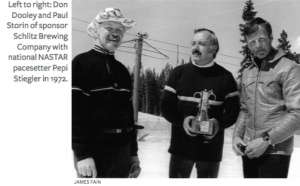
Austrian triple Olympic medalist Pepi Stiegler, director of skiing at Jackson Hole, was the perennial zero handicapper during my NASTAR stint, 1973 through 1977. He wasn’t unseated in my era. I recall watching Pepi slip effortlessly through the gates on Vail’s Golden Peak, with World Pro champion Spider Sabich waiting at the bottom, holding the lead. Pepi won again. “He doesn’t even look fast,” said Spider. “How the hell does he do it?” 

Spider and other stars of the World Pro Ski Tour—Olympians Hank Kashiwa, Otto Tschudi and Moose Barrows among them—brought PR glitz and personality to NASTAR. Touring pacesetter Barrows stood inside the day lodge atop the Indianhead slopes one year, skis and goggles on, fully suited and booted up. It was 30 below zero. He ventured outside only long enough to make his runs. Another time, we arrived in the dark of night at the massive Telemark Lodge in Cable, Wisconsin, with Alpine Meadows pacesetter Jorge Dutschke in tow. When we headed outside the next morning, he said, “I can’t see the ski hill; the lodge is in the way.” Hill vertical: about 300 feet.

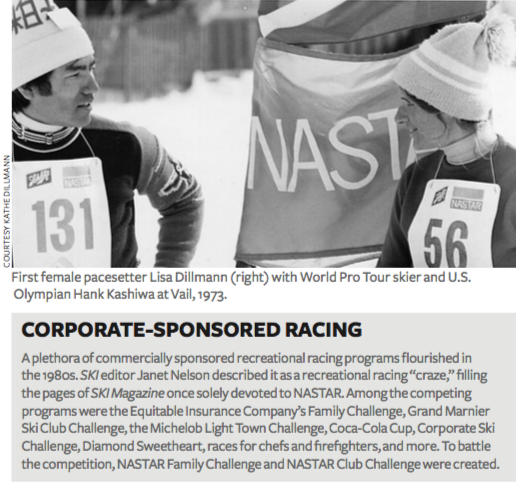
Early on my twin sister Lisa was the only female pacesetter running with the men pacesetters, at the Vail trials, before Bonne Bell initiated its women’s pacesetter program. Keystone founder Max Dercum was perennially our oldest pacesetter, in his 50s at the time. Max personified NASTAR’s raison d’etre: pacesetters and racers alike all earned their handicaps when scored against Pepi’s time, adjusted by age.

SPONSORS COME AND GO

My first big NASTAR road trip was to Vail in mid-season 1973 to jumpstart the new Johnnie Walker Red Cross-Country NASTAR, with its own pacesetting trials. With my NASTAR colleagues, we welcomed a stalwart group of cross-country pros, including the hard-charging Ned Gillette, out of the Trapp Family Lodge in Stowe, who would go on to become one of the most successful big-mountain climbers and skiers of his generation.  

That sport was still in its infancy in the U.S. and this sponsorship was a mismatch lasting but one season. Granola-crunching Nordic skiers and ski bums were not scotch drinkers. As the corporate bigwigs feted us, we quietly poured their sponsored beverages into nearby potted plants. 

Doral cigarettes came on board the alpine NASTAR early on with a special windshirt prize. There was no such thing as an anti-smoking movement back then. Their execs in Winston-Salem had rarely seen snow and none of them skied. Small wonder they soon left NASTAR for bowling and stock car sponsorships.  

Bonne Bell was the first successful promoter of colorless sunblock lotion. No more zinc-covered clown noses. Their all-female Ski Team supplied glamour along with cases of product. 

Pepsi got what it wanted from its sponsorship of Junior NASTAR: NASTAR resorts had to agree to pour Pepsi, not the other big brand. With NASTAR’s growing popularity, it was a profitable deal for their regional distributors.  

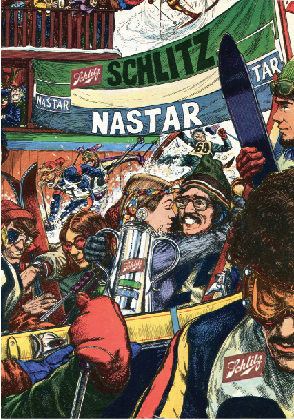
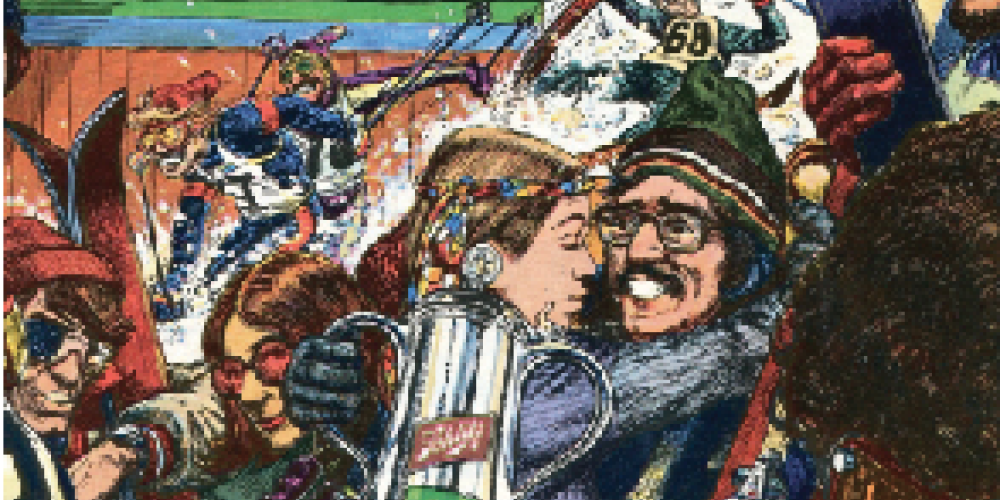
We enjoyed a great relationship with Schlitz beer. Their white-haired, mild-mannered PR pro Don Dooley was an avid skier and a real workhorse who helped us through many a mad scramble posting Finals press releases, working alongside us well past midnight every year. We snail-mailed at least one release per competitor, with photograph, to each finalist’s hometown newspaper—more than 100 pieces, all handled manually.

SNAFUS IN THE OFFICE

The shared headquarters of NASTAR and the World Wide Ski Corporation was always chaotic and never dull. The office was ably managed by the colorful Jenni Seidel, who kept things rolling through storm and calm. She was infamous for kicking the copier to “fix” it; when that failed, she dumped wine into the toner. It worked!  

Imagine what it cost NASTAR for a marketing director’s blunder in ordering thousands of promotional posters he’d commissioned—a cartoon facsimile of Superman donning ski clothing in a phone booth—“From skier to racer in a single bound.” We were issued a cease-and-desist order by Marvel Comics and the whole truckload had to be dumped.  

One season a large batch of enameled NASTAR medals incurred serious chipping. There were a lot of unhappy customers. We got the problem fixed in a hurry, sent nice letters out with new medals and put that issue behind us. But I’ll never forget the charming hand-written note from one seven-year-old Squaw Valley girl thanking us for sending her a new medal. “Your letter is funny. The metal [sic] is pretty,” scribbled little Edie Thys [Morgan]. I always like to think NASTAR was Edie’s jumping-off point to the U.S. Ski Team and the 1988 and ’92 Olympics and her subsequent career as a ski writer.

THE SCHLITZ NASTAR FINALS 

The Schlitz NASTAR Finals were a big deal. How we managed it all without computers, email and fax machines is amazing to contemplate in today’s high-tech world.

Hal the computer spit out the results by mid-March, tapping the top regional recreational racers with the lowest handicaps, male and female, in adult age classes. The biggest miracle was how we got all of them to the same airport, at around the same time, from all points of the compass. We had to telephone each of 80 winners and arrange for their travel, coordinated by the doggedly efficient Aspen Travel agency.  

The NASTAR Finals of that era were an expense-paid trip for the finalists—free air, lodging, and bus to the venue from the airport. Nothing was more gratifying than calling up a winner and announcing, “You’ve won a free trip to the NASTAR Finals.” The responses were hilarious, some thinking we were a crank call, others screaming to family members in the background, but all buckling down to help us get them to the big event. Their excitement was contagious, even though we were exhausted by then.  

They came from all over the country, from all walks of life, of all ages, body shapes and sizes. There were no racing suits, no helmets, no special racing skis. It was competing for the pure fun of it. Out of hundreds of finalists in my NASTAR days, two come to mind who may jog the memories of Skiing History readers.

Goldie Slutzky, wife of Izzy, founder of Hunter Mountain with brother Orville, made the cut in 1974. The Finals were at Sun Valley, where four different weather patterns assaulted us—rain, hail, snow, fierce winds. There was no sun in Sun Valley. But our finalists were undaunted, least of all Goldie, whose bubbly personality buoyed all of us. When she completed her first run, she collapsed in a heap past the finish line. We rushed to her aid, only to hear her giggling. When we got her on her feet, she whispered, “I’ve split my stretch pants.” Quickly remedied with a draped wind jacket, Goldie carried on.

Then there was 10th Mountain Division veteran J. Arthur Doucette from the Mt. Washington Valley of New Hampshire. He qualified for the Snowmass finals in 1976, at age 68 the oldest competitor I remember. He was on his sixth pacemaker and, at altitude, required an occasional nip from an oxygen tank. After completing his race runs, Arthur donned his full 10th Mountain rucksack and white-camouflage uniform and skied the course again to wild cheers. 


The NASTAR finalists loved to ski and loved NASTAR. Though they came to compete, winning was not foremost in most of their minds. It was the spirit of NASTAR that bonded us all. Such memories last a lifetime.

Feature Image
Category
Open to Public?
Off
Feature Image Media
Image
Timestamp

NASTAR, the world’s largest recreational racing program, began 50 years ago when this editor wanted to introduce the equivalent of golf’s par to the sport of skiing.


By John Fry

The environment for people learning to ski has varied little over the years. Ungainly tip-crossing neophytes are herded into classes of eight to a dozen students. After a day, or perhaps five days, they emerge skilled enough to achieve what they want: to descend the mountain on pleasant trails, while enjoying the scenery and the company of friends. 

Most recreational skiers are like golfers who play a round without keeping score, or tennis players happily lobbing the ball back and forth across the net. 

Beginning as editor-in-chief of SKI Magazine in the spring of 1964, I worked across the hall from the editorial office of GOLF Magazine, whose editorial director I would become five years later. GOLF’s editors relied heavily on supplying readers with tips to lower their handicaps. Golfers could relate their scores to a PGA player’s sub-par round, or their own putting to Arnold Palmer’s challenge of sinking a 10-footer. How great it would be, I thought, if I could ratchet up SKI’s newsstand sales using the same appeal! How great it would be if it were to become a goal of ski instruction!

At the time, however, it wasn’t an idea especially appealing to the Professional Ski Instructors of America. PSIA’s Official American Ski Technique (later renamed American Teaching Method or ATM) didn’t much resemble what good skiers were doing. They were making stepped turns, using split rotation, and carving on fiberglass skis. Many beginners were learning on short skis with the new Graduated Length Method (GLM). Progressive instructors were looking ahead, but the American Ski Technique was still living in its Austrian past.

Even the name “American” looked outdated. Nationalistic differences in technique were rapidly dying. I set up a cover photo, in which three skiers—Austrian gold medalist Pepi Stiegler, French pro champion Adrien Duvillard, and Canada’s Ernie McCulloch—were seen together in a slalom flush. All three made roughly the same turn. It didn’t look much like the final form of PSIA’s American Ski Technique. 

My thinking was heavily influenced too when in 1967 I arranged for Georges Joubert’s and Jean Vuarnet’s bestselling Comment Se Perfectionner à Ski to be published in English as How to Ski the New French Way. The principal way for skiers to advance their technique, the authors believed, was to mimic the actions of champion racers.

SKI’s racing editor Tom Corcoran wrote a column condemning the gulf between racing and what recreational skiers were being taught. He lauded an innovation at Sun Valley. The resort had cordoned off a special slope, not too steep, dedicated to timing recreational skiers as they made runs through easy open gates. It was the equivalent in golf of a Par-3 course. Mont Tremblant Ski School director Ernie McCulloch also made pupils learn how to turn through gates. 

Resorts like Sun Valley and Tremblant staged standard races for guests. Entrants who ran the course within a set time limit received a shoulder patch, and possibly a gold, silver or a bronze pin. The prestigious standard races were not necessarily easy—they could be long and challenging. You could compare yourself to others who’d been in the race, but not directly to someone who wasn’t in it. Your rating was only good for the day of the competition. By contrast, a consistent 10-handicap golfer knows that on any day, on any course, he’s likely to play 10 strokes better than a 20-handicapper.  
THE SCORELESS SPORT

In October of 1967 I wrote to complain that skiing was virtually a Scoreless Sport, the title I used for my editor’s column in SKI Magazine. I spent much of the subsequent winter asking race officials and instructors how the equivalent of golf’s handicap could be created for skiers. 

One weekend at Mt. Snow in Vermont the ski school director, a French Canadian, told me about France’s Ecole de Ski Nationale Chamois program. For certification, an instructor had to perform well enough in the Ecole’s annual Challenge, a classic slalom course with hairpins and flushes, to earn a silver medal—that is, be less than 25 percent behind the time recorded by the fastest instructor. Back at his home area, the certified instructor could set the pace for local participants in a Chamois race—a single run slalom. Gold, silver and bronze were awarded according to the percentage the skier’s time lagged behind the pacesetter’s.
It didn’t take long for the dim bulb in my cerebrum to light up: Use time percentages, not raw times, to rate skier performance. And do it, not with a difficult slalom, but rather by offering a simple open-gate setting on intermediate terrain, anticipated by Corcoran. (In 1972, France’s National Ski School—after three or four years of experimentation—introduced the Flèche, a separate, easier test than Chamois—an open-gated giant slalom similar to a NASTAR course.) 

Here was an unwitting, unconscious, unintended collaboration between a French program, little known in North America, and an American program that would blossom into something much bigger, imitated in other countries, enabling tens of thousands of recreational skiers to measure their ability, and glimpse into what it might feel like to be racing in the Olympics. 

RACE RATINGS VALID ANYWHERE, ANY TIME

In France a skier participating in Chamois was rated against the local pacesetter’s time, which was not corrected to account for the percentage by which the instructor had lagged behind the fastest time when he’d competed against other instructors. Adjusting the local pacesetter’s time so there’d be a national standard was a vision I had for NASTAR.  (Twenty years later, in 1987–88, France adopted the NASTAR principle of speeding up the local pacesetter’s time to create a single standard for a Chamois rating.)   

In my mind, the fastest time should be that of a top racer on the U.S. Ski Team. It would work as follows, I imagined. If pacesetter Klaus at Mount Snow was originally three percent slower than the nation’s fastest racer, and a Mount Snow guest was 20 percent slower than Klaus, then he or she would be about 23 percent slower than America’s fastest skier would have been if he’d skied the Mt. Snow course that day. Presto! The skier would have a 23 handicap. The sport of skiing could enjoy the equivalent of golf’s par! A skier would know that on any slope anywhere, through a couple of dozen gates, on a surface that could be sticky or icy, it didn’t matter, the rating would be valid. If he or she had a 23 NASTAR handicap, he was seven percentage points better than someone with a 30 rating.

The possibilities seemed limitless. You could make the results of races around the country equivalent to one another. You could take two equally rated skiers and put them in an exciting head-to-head race. Or you could handicap two unequal racers, delay the start of the better skier, and maximize their chances of reaching the finish line at the same time, making it appear to be an exciting race. On a 300-foot-vertical Michigan hill, you could have a competitive experience equivalent to one at a Rocky Mountain resort. 
What I had in mind was a national standard race. I gave it the acronym NASTAR.

The NASTAR idea needed an infusion of money to become a reality, and so SKI Magazine flew me to Chicago to meet with a potential sponsor, the now-defunct Schlitz brewery. I explained the concept to them. The Schlitz guys liked it. 

“The program’s called NASTAR,” I explained. 

“No, no. It’s got to be the Schlitz Open,” the ad agency guy shot back. 

Returning home, I told my wife, who is German, that the meeting had gone well, but that we were stuck on the name. 

“What is it?” she asked. 

“The Schlitz Open,” I replied. She shrieked with laughter.

“What are you laughing about?”

“Schlitz is our word for the fly on a man’s pants!” 

The next day, I phoned the advertising agency in Chicago and told them the news. Within hours, I received a return call informing me that Schlitz had agreed to the name NASTAR. 

JIMMIE HEUGA

In December 1968, with Tom Corcoran’s indispensable help, the pacesetting trials took place at his new Waterville Valley resort in New Hampshire’s White Mountains. For the first time, an idea that had existed only on paper became a physical reality. 

Jimmie Heuga clocked the fastest times, earning the title of national pacesetter. Charlie Gibson, a tall, spare, laconic mathematics whiz from IBM, who would later become president of the U.S. Ski Association, developed statistical tables, by which local ski areas could compute the handicap ratings of recreational skiers. Gloria Chadwick, a perpetually cheerful, obsessively organized New Englander, quit her job running the U.S. Ski Association in order to manage NASTAR.

In the winter months of 1969, NASTAR’s first season, 2,500 recreational skiers competed at eight areas across the country—from Mt. Snow in Vermont to Alpental in Washington, and at Vail, where the charismatic Swiss champion Roger Staub had become ski school director. 
The standard for winning gold, silver and bronze pins was different for men and women. Two winters later, the standards for medal winning began to take age into account as well. Response was upbeat. The well-known New York Times ski columnist Mike Strauss said that “NASTAR is the best thing to happen to skiing since the introduction of the rope tow.” 

SANDBAGGING ON SKIS?

At the end of the first season, Schlitz flew 39 successful NASTAR medalists to a final race at Heavenly Valley, California. They raced head-to-head, starting with times adjusted by their handicaps. It didn’t occur to me that competitors might contrive to inflate their handicaps—the practice known as sandbagging in golf. The Minneapolis Star’s ski columnist Ralph Thornton wrote a column suggesting the possibility that some racers had sandbagged, cheating Midwest skiers of victory. 

Well, I thought, if the race was worth cheating at, NASTAR is clearly a success. 

How to enhance NASTAR’s popularity? One possibility was to incorporate the program into ski schools, as an objective way for instructors to measure the progress of students. I proposed the idea to the Professional Ski Instructors of America. 

Many people, I argued, are able to ski proficiently, even elegantly, when they’re able to choose anywhere to make a turn. The instructor observes, applauds the student’s form, and advances him to a higher class. But what about making a must-do turn, at high speed, to avoid a tree? What about being forced to enter a gate at the right point in a race? It’s far more difficult to turn at a given spot. The skier must master skills like gliding, skidding, drifting, pivoting, rebounding, absorption and stepping, as well as carving, in order to get specifically from Point A to Point B. Instructors could use NASTAR to monitor people’s advancing skill. The skier’s handicap would become the measure of his progress in taking lessons. 

Deficient in powers of persuasion and lacking in political skill, I failed to convince anyone at PSIA, except notably Willy Schaeffler, that the organization, already famously resistant to innovation, should get behind NASTAR. 
My other hope was to interest the U.S. Ski Team. By linking the national handicap to the speed of the country’s fastest skiers, NASTAR could serve as a grassroots system to identify young talent for future national teams.

MEETING IN A MANHATTAN STEAM ROOM

How to persuade the U.S. Ski Team to supply pacesetters? It wouldn’t be easy. Alpine director Bob Beattie preferred to exert control over programs involving the Team. I thought I might have a better chance of gaining Beattie’s support if I could enlist the persuasive Corcoran to talk to him. 

One day, when I determined that both Corcoran and the itinerant Beattie would be in New York City, I arranged for us to meet at the New York Athletic Club on Central Park South. When Corcoran and I arrived in the club’s lobby, we learned that Beattie was in the steam room. We were told to meet him there. 

Upstairs in the locker room, we stripped. Groping our way into the hot mist of the steam room, we found the perspiring coach. Inside the foggy chamber, Corcoran attempted to convince Beattie of the benefits of a union with NASTAR. It would make the Ski Team visible on the slopes and in the magazine. By tying the times of the best U.S. racers to NASTAR ratings, the Ski Team would enter into the daily awareness of recreational skiers. And a fraction of the recreational skier’s entry fee would be donated to the always sagging Ski Team treasury.

Emerging from the heat of the steam room, his face reddened to the color of a scalded beet’s interior, Beattie appeared to me to be unconvinced. What I didn’t know was that the coach himself was concocting in his mind his own five-year, multi-million-dollar plan. Called the Buddy Werner League, it aimed—like Little League baseball—at tapping into 250,000 young athletes, through a program named after the late U.S. racing star. 

BEATTIE REIGNS FOR 30 YEARS 
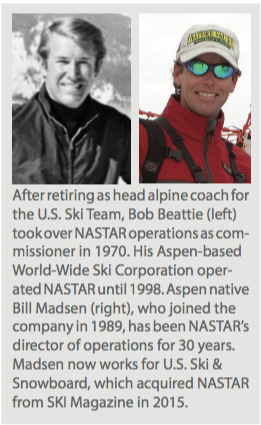
Although the trip to the steam room had been a failure, Beattie’s view of NASTAR changed a year later. Retired from the Ski Team, the former coach was seeking entrepreneurial opportunities. His search coincided with SKI’s search for a way to keep track of thousands of entries at a rapidly rising number of ski areas wanting to join in hosting the popular new races. 

Off-site computers and software didn’t exist at the time. To pay for the labor-intensive organization, a way had to be found, not only to make ski areas pay, but to extract money from sponsors like Pepsi and Bonne Belle as well as Schlitz. 

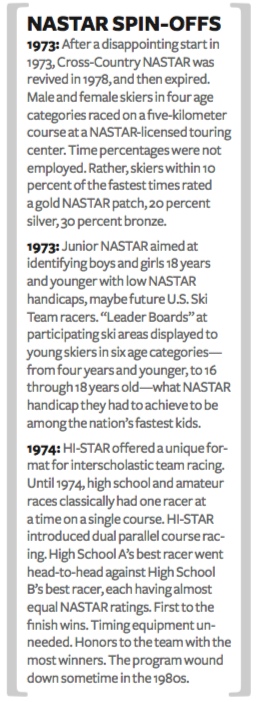
Under license from SKI, Beattie took over the operation of the program that he had once spurned. He was the ideal guy to run it. In NASTAR’s second season, the number of participating ski areas grew to thirty-nine. Sponsorships proliferated. Resorts took in money from guests willing to pay to race. Offshoot programs were created—like Pepsi Junior NASTAR and Hi-Star for interscholastic competition.

Fifteen winters later, prodded and promoted by the former Ski Team coach, who was now also pro racing impresario and TV commentator, NASTAR grew to 135 areas, attracting a quarter of a million recreational racers each winter. In Canada Molson’s Beer launched a copycat Molstar program. NASTAR clones sprouted in Scandinavia, Switzerland and Australia.

In conversations in lift lines and in base lodges, I heard the thrilled voices of intermediate skiers who’d raced for the first time in their lives. Excitedly they compared their handicap ratings. Friends, who’d never before skied competitively, told me of butterflies in their stomach as they stood in the NASTAR starting gate. Children boasted about winning a bronze pin. At a NASTAR finals, where recreational racers from 5 to 85 years of age competed, I saw a helmeted 10-year-old boy and his grandfather hugging one another as they rejoiced over their results. 

NASTAR was conceived in the 1960s—the age of Killy, Kidd, Greene and other alpine racing stars. Putting their faces on SKI Magazine’s covers added tens of thousands to newsstand sales. For me, here was material proof of where the interest of readers belonged.  In their desire to learn from racing I was a believer. 


John Fry is the author of The Story of Modern Skiing, a history of the revolution in technique, teaching, competition, equipment and resorts that took place after World War II. In 1969 through most of the 1970s, he was editorial director of GOLF Magazine, as well as of SKI. He is indebted to veteran ski moniteurs Gerard Bouvier and J-F Lanvers for obtaining fresh historical information about France’s Chamois and Flèche programs.
Category
Open to Public?
Off
Feature Image Media
Image
Timestamp

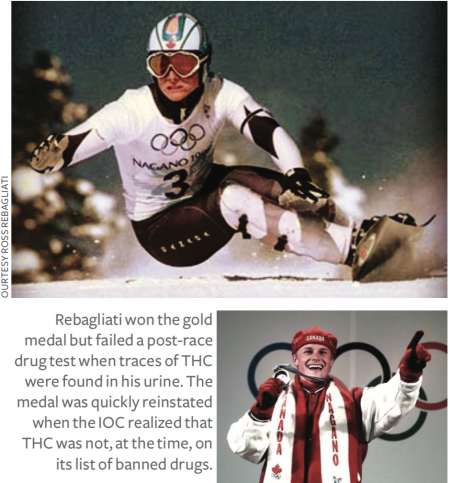
At the Nagano Olympics, he was stripped of snowboarding’s first gold medal. The next day, he had the medal back. Today, Ross Rebagliati is a successful marijuana entrepreneur in British Columbia. By Michel Beaudry

I wouldn’t change a thing,” says Canadian snowboard legend Ross Rebagliati. Owner of one of the most notorious gold medals in Winter Games history, the happily married father of three insists he long ago made peace with his past. “Sure, it hurt when it happened,” he admits. “It totally changed my life. But it also provided new opportunities for me and my family.”

Today the 46-year-old is a successful medical marijuana entrepreneur in British Columbia’s bucolic Okanagan Valley (use of marijuana for medicinal purposes has been legal in Canada since 2001, and the country plans to legalize the drug for recreational use in the summer of 2018). His dispensary is called Ross’ Gold. It’s a play on words, but also a reflection of where he wants to take his company. “My Olympic story makes up a big part of our storefront,” he explains. “Every day I bring my medal out and put it on display. I guess you could say I’m on a bit of a mission: I want our products, our brand, to set the gold standard in the business.”

And yet “it was a deeply traumatic experience,” concedes the former Whistler resident of his Olympic trials. “Especially since it didn’t need to happen. I’d never felt the full weight of negative media before. It was overwhelming.”

Anyone who followed the Winter Games that year can’t help but remember Ross’ story. It was February 1998, and snowboarding was poised to join the Olympic family in Nagano, Japan. The giant slalom had been scheduled for the first day and the field was stacked. “They’d watered down the course the night before,” remembers Ross. “And the hill was perfect—firm enough to set a good edge, but soft enough to hold your line.”

Race day dawned sunny and clear. But the first run did not go entirely to plan for the young Canadian. “I made two or three big mistakes that nearly stopped me in my tracks,” he confesses. “But to my surprise I was still among the top eight, barely a tenth [of a second] from first place.” 

Throwing caution to the wind, Ross charged the second run like a man possessed. “By the time I reached the breakover and the steep part of the course, I was flying,” he says. “I remember barely being able to change my edge before hitting the next gate.” 

His aggression paid off. In one of the most exciting giant slalom finishes in Olympic history, Rebagliati bagged the gold by the slimmest of margins. Says Ross: “I remember watching the Winter Games as a kid and daydreaming about standing on the top step of the podium…and it was happening for real. I had to pinch myself.”

His euphoria would be short-lived. During a routine drug test, a trace of THC, the active component in cannabis, was detected in Rebagliati’s post-race urine sample. It was a miniscule amount (less than 18 nanograms per millitre) but it was enough to convince the IOC brass to set the disqualification process in motion.

“I didn’t have a clue,” insists Ross. “We’d been warned by our coaches about the drug-testing protocol and I’d stayed away from weed for months.” Still, he hadn’t quite cut himself off from the culture. “All my Whistler friends indulged, but they respected my decision. I still hung out with them. I just didn’t toke with them.”

Picture the scene: “It’s the next morning and I’m hanging out with a few teammates in my room,” he begins. “Our race is done. Our Olympic contest is over. We’re all looking forward to becoming Games tourists now.” 

Suddenly two coaches appear at Rebagliati’s door. “Sit down, Ross,” says one. 

“I knew immediately it was about my drug test,” he says. “I was sure it had something to do with weed.”

The next few hours passed in a blur. First he was driven from the relative calm of Shiga Kogen Resort to IOC headquarters in Nagano and the already-alerted press. It was the first big Olympic story and the media was in a feeding frenzy. “The whole Canadian Mission Team staff was there,” he remembers. “They formed a circle around me and tried to get me inside. People were screaming questions at me. Accusing me of all sorts of things. I felt like I had betrayed my country. I was in shock, emotional, ashamed.” 

But worse was yet to come. While his case was being argued in the IOC court of arbitration, Ross was arrested by the Japanese police and charged with importing an illegal substance. “It was surreal,” says Ross. As he sat in his Nagano cell, the devastated snowboarder played back the events of the last 24 hours. How could this have happened? 

And then everything changed. In what can only be described as a scene from the theatre of the absurd, it was revealed during another round of court hearings that THC wasn’t on the IOC’s banned list after all. “So the lawyers told me: ‘You’re good to go’,” says Ross. “The next day I boarded a flight to LA for an appearance on the Tonight Show with Jay Leno. I mean, talk about a turnaround. Still, I was really angry. I’d spent time in jail, me, the gold medal winner. And all for nothing.”  

After the Nagano Games, the IOC did place THC on the banned drug list. The legal limit was set at 30ng/ml. The level in Ross’ urine in the 1998 sample was half that amount.

Meanwhile, the fallout from his wrongful disqualification continued to haunt his life. 

 “My homecoming was marked by a big party in the Whistler town center,” he says. “The place was packed. I should have been on cloud nine.” And yet the 26-year-old couldn’t fully enjoy the celebration. “I was still feeling guilty…like my Olympic performance was tarnished somehow.”

That nagging sense of unease increasingly shut him off from his friends and family. Ross says he didn’t leave his Whistler condo for weeks. “I was afraid to answer the door even for the pizza delivery guy,” he remembers. “The media had branded me as the ‘stoner snowboarder who won the gold.’ But that wasn’t me.” 

Rebagliati eventually overcame his demons and got back on his snowboard…only to find that his status had changed. “My legacy was badly damaged by the Internet,” he says. “I lost sponsors, lost supporters. After 9-11, I was even put on the U.S. no-fly list and told I wasn’t welcome in America anymore. It had major consequences. Suddenly I couldn’t compete at events like the X-Games. My snowboarding career was done.”   

So Ross moved on with his life. He’d made some good moves early in Whistler’s booming real estate market and was now reaping the financial benefits from those investments. He got married, had a child, and in 2006 moved east to Kelowna in BC’s Okanagan Valley. It looked like the still-boyish champion had turned things around for himself. 

But there were more bumps in the road. His marriage broke apart. Some business deals soured. Things just weren’t working out. So he returned to Whistler in 2010 and started questioning himself all over again. What could he do, he wondered, to finally bring closure to his still-troubled Olympic saga? And then it came to him.

Snowboarding’s first Olympic gold medalist launched his medical marijuana dispensary, Ross’ Gold, with partner Patrick Smyth in January 2013. The media picked up on it immediately. Over the next few months, he and his company were profiled in USA Today, the Huffington Post, the Canadian Broadcasting Corporation (CBC) and the Toronto Star. By 2015, his branded glassware and products could be found in nearly a hundred stores across Canada. And when the Liberals promised to legalize pot during that year’s federal election, Ross was quick to jump on their bandwagon. 

“We opened our first storefront in Kelowna in December 2016,” he says. “And now we’re looking to acquire, or pair up with, a local vineyard.”

“I probably wouldn’t be in the marijuana business today if I hadn’t lived the experience I did in Nagano,” he adds. “But I certainly wasn’t forced down this road.” 


Married again, back in Kelowna and now the father of three children—Ryan, 8, Rosie, 5, and Rocco, 2—Ross feels like he’s finally found his place. “I want to feel good about being an Olympic champion. And with Ross’ Gold I can do that. I see it on my customers’ faces every day: my story does make a difference to their lives. And that makes me truly happy. As I said before, I wouldn’t change a thing.”  

Open to Public?
Off
Feature Image Media
Image
Timestamp

Jake Hoeschler of the US Ski Team and University of Colorado, interviewed by ISHA's Seth Masia, on StoryCorps. Recorded by Kat Haber.

Category
Open to Public?
Off
Feature Image Media
Image
Timestamp

Who’s the greatest? For skiers able to win under pressure, look to their single-Olympics record. By John Fry

Mention the greatest alpine ski racers of all time, and you usually hear a recitation of racers with career-long stats—for example, Sweden’s Ingemar Stenmark, winner over 16 winters of a record 86 World Cup races; and Lindsey Vonn, who has broken Annemarie Moser-Proell’s 62 victories, with 78 by the end of 2017. Neither of them won more than one gold medal in a single Winter Games. And how about Marc Girardelli, with five World Cup titles? And Marcel Hirscher, with a record six? And Karl Schranz, at the top of his game from 1957 to 1972? None of the three is an Olympic gold medalist.    

Skiing’s superstars are athletes who don’t appear on lists counting most races won. They won races that most counted. At clutch time, in the Olympics, they showed up.  

“The greatest racers win gold at the Olympics and World Championships,” insists 1970 FIS Alpine World Champion Billy Kidd. “The events, compressed into a couple of weeks, demand something that doesn’t come into play in career-long performances and season-long accumulations of points…the ability to win when the chips are down.”

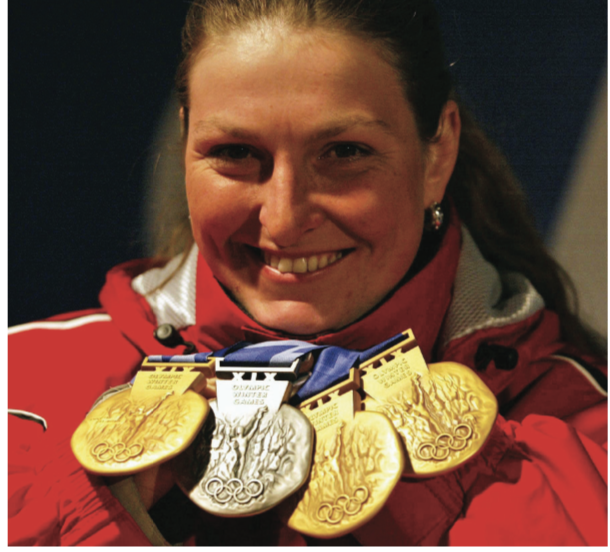
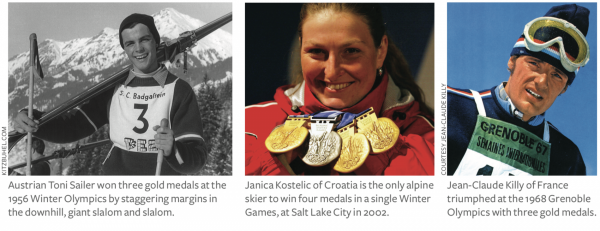
The most outstanding single Winter Olympics alpine skiing performance arguably belongs to Croatia’s Janica Kostelic. At Salt Lake in 2002, she won gold medals in the slalom and giant slalom, won silver in the Super G, and competed in two more races—a downhill and a slalom—to win the combined. She went on to triple-gold at the FIS World Alpine Ski Championships three years later. Not a few experts regard her as the greatest woman ski racer of all time.

Arguably the best male Olympian was 1956 champion Toni Sailer. The margins by which the Austrian superstar won his gold medals were staggering: 3.5 seconds in the downhill, a mind-boggling 6.4 seconds in the one-run giant slalom, and 4 seconds in the slalom. At the 1958 World Championships, Sailer almost repeated his Olympic hat trick, placing first in downhill and giant slalom, and second in the slalom. With jet-black hair and a movie star’s face, the handsome poster boy Sailer went on to act in films and TV mini-series. Later, he served as head coach of the Austrian national team, and chaired the FIS Alpine Committee.

Sailer and Jean-Claude Killy are the only racers to have captured all of the alpine gold medals available to be won in a single Olympics…in their eras,  there were just three. (Super G and actively raced combineds didn’t exist at the time.) Killy, 24, was already an internationally acclaimed champion before his 1968 Olympic triumph in the French Alps above Grenoble. The previous winter the Frenchman had won 71 percent of the races on the World Cup calendar, a feat never since repeated. (See “Killy’s Winter, Never Equaled,” Skiing History, January-February and March-April 2017) The pressure on Killy before the Grenoble Games was unimaginably intense. For days on end he was pursued by photographers, autograph seekers and worshipful fans. To escape, Killy went into seclusion a week before the lighting of the Olympic flame. When he showed up in the starting gate, he was psyched and ready. He pulled off the gold medal hat trick, albeit winning by narrower margins than Sailer had.

In an almost superhuman performance at the 2002 Salt Lake Winter Olympics, Norway’s Kjetil Andre Aamodt competed in all five alpine events, gold-medaling in the Super G and the combined, placing 4th in the downhill, 6th in the slalom, and 7th in GS. Remarkably, in four separate Winter Games, Aamodt won an unrivaled total of seven Olympic alpine medals.

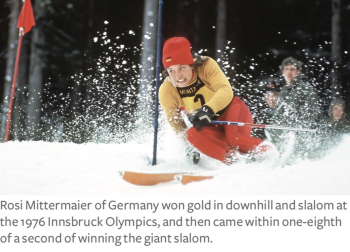
Bavaria’s Rosi Mittermaier in 1976, and Liechenstein’s Hanni Wenzel in 1980, both narrowly missed performing the Sailer-Killy hat tricks. At the Innsbruck ’76 Olympics, after gold-medaling in the downhill and slalom, Mittermaier came within one-eighth of a second of winning the giant slalom. As a result she won the paper combined title, not an Olympic medal. Married to former German champion Christian Neureuther, Mittermaier is the mother of World Cup racer Felix Neureuther.

At the Lake Placid 1980 Winter Olympics, Liechenstein’s Hanni Wenzel won gold medals in the slalom and giant slalom, narrowly missing the hat trick with a silver in the downhill on Whiteface Mountain. She easily won the World Championship gold medal in the combined, its final appearance on paper as a statistical combination of slalom and downhill. That winter she won the 1980 overall World Cup season title as did her brother Andy, a family triumph. Hanni was banned from the 1984 Winter Olympics by the International Ski Federation (FIS) for accepting promotional payments directly, rather than through her national ski federation, removing her chance of winning another Olympic medal. Sweden’s Ingemar Stenmark was similarly affected. Like Wenzel, he was a double gold medalist at Lake Placid. The only other Olympic medal Stenmark ever won was a bronze at Innsbruck in 1976. His record total of 86 World Cup wins has yet to be surpassed.    

In 1952 at Oslo, fiercely determined Andrea Mead Lawrence won two Olympic gold medals at the age of only 19, an unprecedented youthful achievement. She crashed in the downhill trying to win a third gold. She’s the only American to win twice in a single Olympics, a record that Mikaela Shiffrin may break in Korea. 

For an Olympic performance under pressure it’s hard to equal what Austria’s Hermann “the Herminator” Maier did at the 1998 Winter Olympics in Japan. After a spectacular airborne, body-crunching crash in the downhill, he rose like a man from the dead, and went on to win both the Super G and the giant slalom gold medals. Following a nearly fatal motorcycle crash in 2001 that left him with a mangled leg, Maier rose to become overall World Cup champion again. 
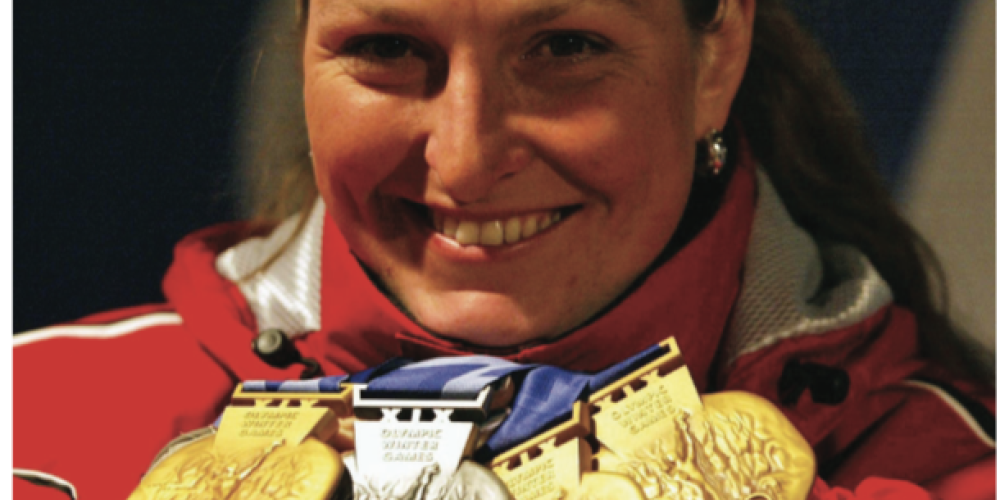
Switzerland’s Vreni Schneider was a 1988 double gold medalist in slalom and giant slalom at Calgary. Additionally, she won another three Olympic medals, including a gold, at Lillehammer in 1994, plus six FIS World Championship medals. She is one of the great women ski racers of all time, winning 55 World Cup races, a total exceeded only by Lindsey Vonn and Annemarie Moser Proell.  

Arguably the most electric personality who ever appeared in the starting gate of a ski race, Alberto Tomba was a double gold medalist at the 1988 Calgary Winter Olympics. Over a dozen winters from 1986 to 1998, Tomba won 13 world championship and Olympic medals, plus no fewer than 50 World Cup slaloms and giant slaloms. Powerfully built, with curly black hair and a volcanically engaging Italian charisma, La Bomba at Calgary famously presented ice skater Katarina Witt with a huge bouquet of flowers as she glided off the ice from her gold-medal-winning performance.

Olympic medals can’t deliberately be won, once observed Bode Miller, who’s on camera as a technical analyst for NBC in Korea. “In ski racing,” he said, “you have on-days and off-days, and sometimes the Olympics fall on an off-day. It’s the law of averages.”

Maybe, but the great Olympic champions weren’t racers who succumbed to the inevitability of averages. They went out and conquered off-days and the law of averages by winning multiple medals. I bow in reverence to the golden men and women of our sport.  


John Fry covered the ski races at four Olympic Winter Games. “How Skiing Changed the Olympics” is the subject of a chapter in his award-winning book The Story of Modern Skiing, published in 2006.

Category
Open to Public?
Off
Feature Image Media
Image
Timestamp

Cross-country racers and jumpers who have dominated the Winter Games. By Bob Woodward

To be a dominant cross-country skier come the Olympics is to be a sprinter, a middle-distance ace and a marathoner. It’s tough. Ask Finland’s Juha Mieto, who took silver in both the men’s 15- and 50-kilometer events at the 1980 Lake Placid Games. In the 15K, Mieto went full bore from the start. In the 50K, he set a steady, workmanlike pace until the fast final ten kilometers. Unfortunately, Mieto doesn’t make the “dominant” list, as Soviet skier Nikolay Zimyatov won three gold medals (in the 30K, the 50K and the 4x10 relay) to rule the Lake Placid Olympics.

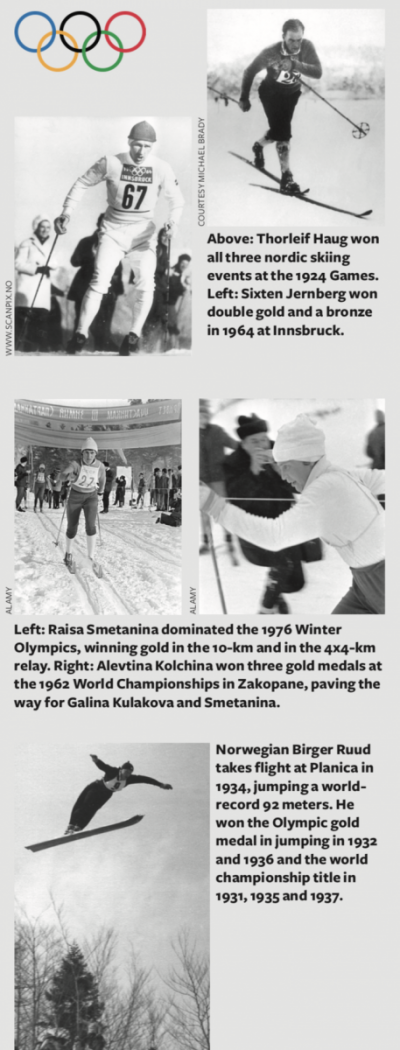
On the women’s side, Soviet great Alevtina Kolchina paved the way for those who came to rule the Games—among them, Galina Kulakova and Raisa Smetanina. It’s interesting to speculate how those two would do today in the skate/freestyle events. After all, they were easily the two most gifted and dominant athletes in the sport for years.
 

Men

1924 Thorleif Haug

1957 Sixten Jernberg

1964 Sixten Jernberg

1980 Nikolay Zimyatov

1992 Bjørn Daehlie and Vegard Ulvang


*Special mention to Gunde Svan for multiple medals in 1984 and 1988, and Thomas Alsgaard for medalling in 1994,1998 and 2002 


Women

1968 Toini Gustafsson

1972 Galina Kulakova

1976 Raisa Smetanina

1984 Marja-Liisa Hamalainen

2010 Marit Bjørgen

2014 Charlotte Kalla

*Special mention to Stefania Belmondo for medals in 1992,1994,1998 and 2002


Jumping

Historically, the jumping medals have been broadly distributed among athletes and nations. It’s hard to be dominant, as newer and younger talents enter the sport yearly. But there have been exceptions, and they are:


1932, 1936, 1948 Birger Ruud

1984 Jens Weisflogg

1988 Matti Nykänen 


*Special mention goes to Simon Ammann with medals in 2002 and 2010

Category
Open to Public?
Off
Feature Image Media
Image
Timestamp

Who’s the greatest men’s giant slalom racer of all time? With each passing generation, racing fans renew the ongoing debate. By Peter Oliver

It’s a pot that sports fans of all stripes love to stir. Call it GOAT stew—who is or was the Greatest Of All Time? Football’s Tom Brady or Joe Montana or Johnny Unitas? Tennis’s Roger Federer or Rod Laver or Bill Tilden? The hagiology of sporting greats is reassessed with each passing generation.

So when Steve Porino, the thoughtful ski-racing TV commentator, suggested on air that in today’s World Cup men’s giant-slalom field Austria’s Marcel Hirscher, the U.S.’s Ted Ligety, and France’s Alexis Pinturault were the GS GOATs from their respective countries, the stewpot stirred on the hot stove of Porino’s Facebook page. All sorts of World Cup history buffs chimed in.

Hirscher? Yes, though with a strong challenge from Hermann Maier. Ligety? Certainly, though the Mahre brothers could arc pretty decent medium-radius turns, too. But Alexis Pinturault? A great GS racer to be sure, but had Porino forgotten a Frenchman named Jean-Claude Killy? 

Pitting athletes of different eras against one another is always nettled with complication in the search for common comparative ground. And for the record, there’s little argument that the greatest GSer from any country was and is the inimitable Swede, Ingemar Stenmark, who won 46 World Cup GS races in a 16-year career. 

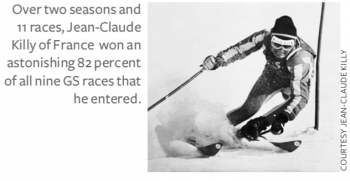
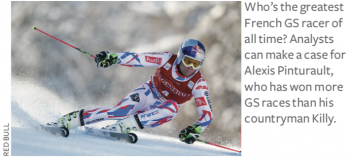
But back to the Pinturault-Killy debate. Porino based his call, fairly enough, on total wins, and indeed, Pinturault passed Killy’s nine World Cup GS wins in December. But how about winning percentage instead? Pinturault wins about 17 percent of the World Cup GS races he enters—pretty darned good, until stacked against Killy’s brilliant GS winning rate of 82 percent.

To be fair, Killy’s World Cup career lasted just two seasons and 11 GS races (he was second and third in the two he didn’t win). So a very small sample. Still, Pinturault didn’t get his Killy-topping tenth World Cup GS win until his 59st start. Checkmark in the Killy column.

But not so fast. . .The shortness of Killy’s career gave him the unfair advantage of being in his prime for every World Cup race he entered. He was 23 years old when the World Cup was launched in 1967, and he retired at just 25. His World Cup record doesn’t include years of pre-prime apprenticeship, as Pinturault’s record does, nor late-career decline. Also, when Pinturault began as a 17-year-old in 2009, Ligety and Hirscher were already dominant World Cup forces. 

Raising another point: GS fields in Killy’s day weren’t as strong or deep. Switzerland’s Edmund Bruggmann and Austria’s Herbert Huber, second and third to Killy in the 1968 GS standings, were competent, but they were hardly Hirscher and Ligety.
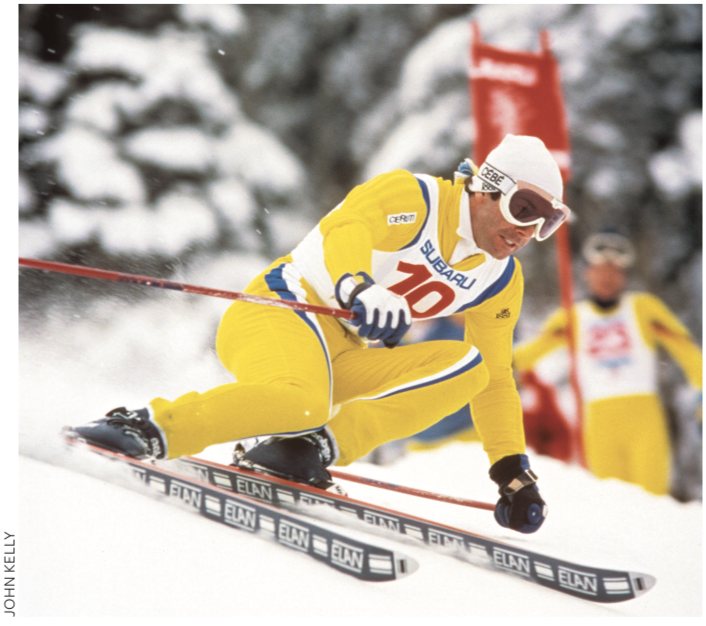
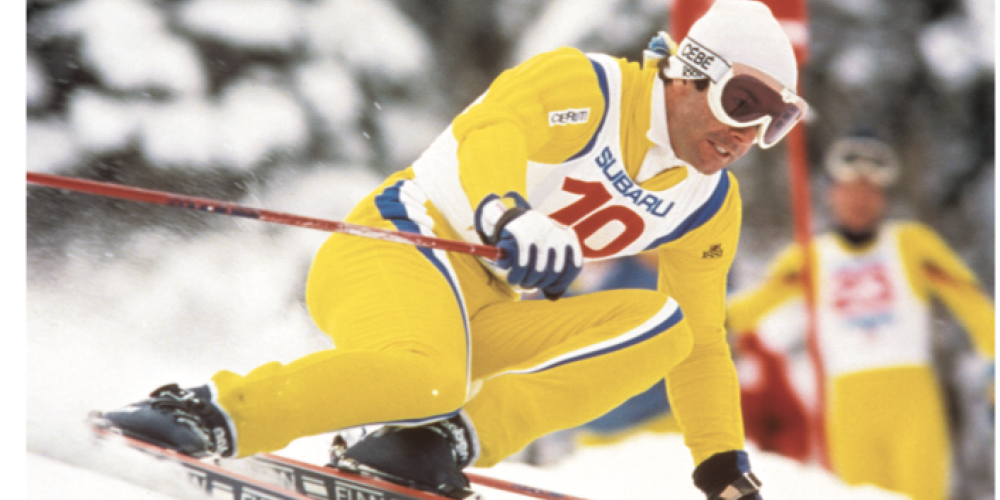
Killy was unquestionably the better all-rounder. He raced and won in three disciplines—slalom, GS, and downhill—and won 67 percent of all the World Cup races he entered. In today’s age of specialization, Pinturault has raced just four World Cup downhills, without distinction. 

In 2018, however, Killy would probably be a specialist, too. The grueling 2017–18 World Cup schedule comprises 42 races, including Olympic events, discouraging all-event participation. The 1968 World Cup schedule, including three Olympic events, consisted of just 22 races. Last year, as a tech-event specialist, Pinturault still entered 26 World Cup races, 11 more than Killy did as an all-eventer in 1968.

Almost no one attempts the Herculean effort of all-event racing today, especially when current World Cup scoring rules—very different than in Killy’s day—have allowed a specialist like Hirscher to win six straight overall titles without scoring points in a single downhill. As an all-eventer in winning his first World Cup overall title in 2005, Bode Miller entered a punishing 36 World Cup races (plus another five world championship races).
 

Pinturault’s career is obviously a long way from over. So, too, is the ongoing GOAT debate. 

Category
Open to Public?
Off
Feature Image Media
Image
Timestamp

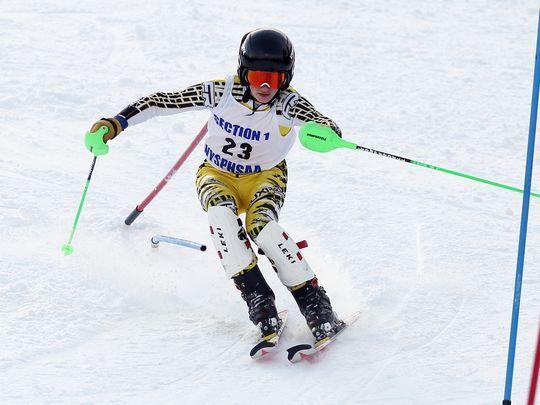
What if you thought that you’d straddled a slalom gate pole, and the gatekeeper missed seeing it? And you earned a good result for you and your team?

            It happened this past February during the New York State Slalom Championships at Bristol Mountain in the Adirondacks. John Emerson, 15, a sophomore at John Jay High School in Westchester County, 30 miles north of Manhattan, was among the youngest in a 64-boy field. Starting 53rd in the first run, he blistered the course, registering the ninth fastest time.

            Against racers with single-digit bib numbers in the second run, he wound up in sixth place, enough for a medal in the NY State Championships.

            Yet something about the run didn’t seem right to Emerson. After the race, he watched the video his father had taken. In super-slow motion, on a large computer monitor, he clearly saw that he’d straddled one of the gates.

            “In real-time it was only a fraction of a second and impossible to see, but in slow motion the video was clear,” wrote Ken Kostick in the Bedford Record Review.

            And so, less than a half hour before the medal ceremonies for the top finishers in the slalom events, Emerson made a startling announcement. He would not accept the fifth-place result, nor the honor that went with it.

            New York State Public High School Athletics Association chief Robert Zayas said at the awards ceremony that he’d never witnessed an act of sportsmanship as great as Emerson’s. Athletes, coaches and parents gave the young man a standing ovation.

            “In a sport with more than 1,300 active high school racers,” said John Jay ski coach Chris Reinke, “John demonstrated the highest level of sportsmanship.”

            “There is no podium for what this individual did,” said John Jay coach Tom Adamec. “It was an act that was selfless, honest, compelled by integrity and, most of all, loyalty to oneself.”

            Chris’ older brother is also a promising racer. Says their father Tony Emerson, “Ski racing involves hard work, danger, speed, brutal weather, how to deal with losing, and more. There’s no better sport to teach kids lessons in adversity.”  --Seth Masia

John Emerson
Category