Eliasch to step back at Head, pledges to modernize race formats
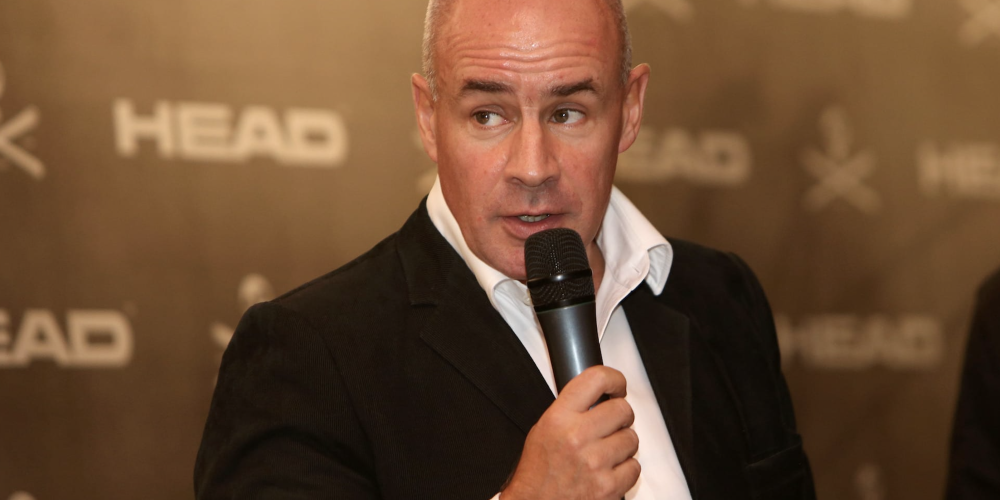
Billionaire businessman Johan Eliasch was elected president of the International Ski Federation on June 4, pledging to re-energize competitive skiing with possible new race formats and more dynamic broadcasts.
Eliasch, the 25-year CEO of Head and an active environmentalist, was elected on the first ballot, with 65 of the 119 votes. In an online press conference, Eliasch told reporters “I think it shows the FIS family is ready for change. I always said, ‘If you want to keep things the way they are, I am not your candidate.’”
Each candidate made a 10-minute video presentation. Eliasch’s pitch included endorsements from Lindsey Vonn and Aksel Lund Svindal, both of whom raced on Head skis during their championship careers. Former U.S. Secretary of State John Kerry endorsed Eliasch’s candidacy, noting his position on the immediate need to address climate change.
Eliasch, 59, was born in Sweden but has lived in London since joining the private-equity firm Tufton in 1985. From 1999 to 2010 he held a variety of environmental-stewardship positions in the British Government, under both Labour and Conservative prime ministers. He acquired Head out of near-bankruptcy in 1995, at age 33, made it profitable within two years and took it public in 2000. Eliasch holds a master’s degree in engineering and put 3 percent of Head’s revenue into research and development. To back up his climate activism, in 2005 he established the Rainforest Trust and bought 400,000 acres (162,000 hectares) of Amazon forest, along with the company logging that land. He halted logging and replanted.
Eliasch runs Head out of its London office, but pledged during his campaign to leave his Head role if elected. “I will step down as chief executive of Head,” he said during the press conference. “And if there are any decisions which have potential conflict of interest, I will of course recuse myself.” He declined to say if he would divest his financial position in Head, according to Associated Press reports. “If we have phenomenal success for FIS, it will benefit all stakeholders,” he added.
Just the fifth FIS president in its 97-year history, Eliasch succeeds Gian Franco Kasper, who held the office since 1998 and leaves one year early. The next FIS election is scheduled next year after Eliasch oversees a majority of the medal events at the Beijing Winter Olympics in February 2022.
Rival candidates were former world downhill champion Urs Lehmann of Switzerland, former FIS secretary general Sarah Lewis of Britain (fired by Kasper last year) and FIS vice president Mats Årjes of Sweden, Kasper’s own choice. Lehmann and Årjes won elections for seats on the ruling FIS Council, which Eliasch will chair.
In his initial post-election news conference, Eliasch promised to give FIS’s 135 national associates more voice in decision-making and more opportunities to host events. He pledged to begin work “as soon as possible” on reviewing race formats. He also pledged to modernize FIS media policies by centralizing broadcast rights and expanding broadcasts across new media.
Halston on Netflix: How fashion came to the Olympics
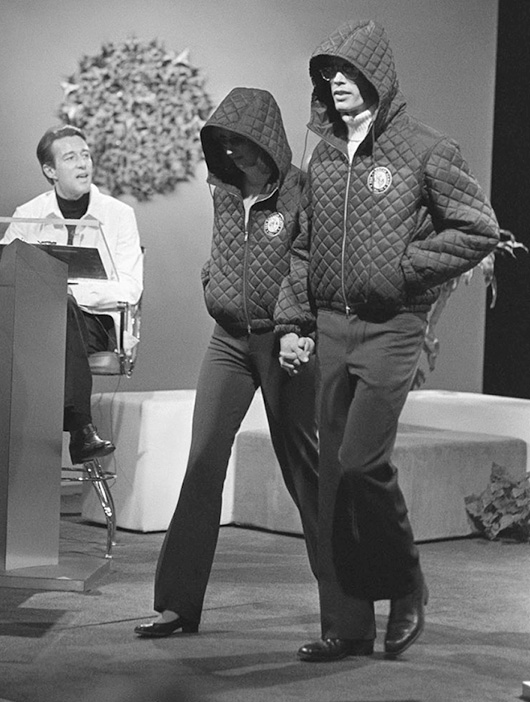
Halston introduces athletic uniforms, 1976
The five-part Netflix series Halston, released in May, follows the American designer as he transforms his name into an international fashion empire. Not mentioned in the biopic is that Halston volunteered to create the U.S. Olympic Team uniforms for both the summer and winter games of Centennial Year 1976. That kicked televised Olympics into a fashion showcase: Levi Strauss signed up to do the uniforms in 1980 and 1984, and Ralph Lauren has done it every year since 2008—and will again for 2022 (in recent years Lauren has done suits for the opening and closing marches, while Nike has provided uniforms for medal ceremonies).
As the website Fashionista notes, the designers “imbued elements of national identity into their uniforms, projecting idealized American aesthetics intended to make an impact on the world stage at crucial moments in the nation’s history.”
It wasn’t always that way. The first international Olympic Games in 1896, in Athens, featured athletes wearing their own clothes or uniforms from their athletic clubs. At the first winter games, at Chamonix in 1924, American skaters wore white pants and sweaters with a stars-and-stripes shield on the chest. Thereafter the winter teams had uniforms composed variously of navy-blue warm-ups, white sweaters and pea coats.
Montgomery Ward produced Halston’s 1976 uniforms, without the official insignia, and sold the Olympic line in its catalog. Halston pocketed a percentage. The uniforms weren’t universally admired. “Opening Ceremony uniforms for the winter games included simple dark navy jackets with hoods worn with plain loose trousers, while podium outfits looked like simple leisure suits with turtleneck tops,” Fashionista reported. A letter in the New York Times called them a “disgrace to the team and affront to the nation.”
“Despite mixed reviews, Halston is definitely worth the binge,” Forbes reports. “It’s fun to travel back in time throughout the 1970s and ’80s.”
This 616-page book is not something you lug to the beach. It’s a skiing media extravaganza that takes you from the Alpine heart of Europe through the Mediterranean—skiing on Corsica, anybody?—then to the north. Denmark’s green carpet of Neveplast on the roof of Copenhagen’s power plant can give you an 85-foot vertical, 365 days of the year. Move on to Eastern Europe, and to the Americas north and south, and elsewhere on the corners of the globe. This is, after all, Skiing Around the World, Volume II: Collecting Ski Resorts, by Jimmy Petterson.
Journey to the sands of Qatar and Oman, and to the massive indoor-skiing center of Dubai (104° F outside and 25° F inside). Continue to Azerbaijan, Tajikistan, North Korea—Kim Il Jung’s Masikryong does not compare well with PyeongChang, the 2018 Olympic venue in South Korea, especially for lifts.
Petterson travels as far east as Kamchatka and finishes in Antarctica: an exhausting, pleasurable, sometimes enchanting 45 chapters. Whew! You could consider it a hardcover skier’s bucket list.
How does Petterson do it—and on senior-citizen knees? The answer: live a life full of curiosity, as we are all told we should do, spiced up with the athletic joy to keep your body in motion. Every page supports that life theory. Here are magnificent skiing photographs: powder spumes follow Petterson making first tracks at Livigno and on pristine glaciers in Antarctica, then panoramic views of Kamchatka. Then ‘tourist’ photos: the author posing with skis on shoulder at St. Basil’s cathedral in Moscow, Ugandans and their animals, the 1,500-room Atlantic Palace Hotel in Dubai. There are enthusiasts skiing and swimming naked, and not a few celebrations, libations and guitar at hand.
Here I sit in rural New Hampshire and I revel in Petterson’s exploits. I ski along with him in the Alps and Scandinavia, at resorts I, too, have known, and I feel a nostalgic rush.
I turn a page or two and am in Peru, then Lesotho (not highly recommended), Greenland and the Ukraine. Turkey looks intriguing. There is a feel for the spray of powder, living free, and having a heck of a time of it for over 40 years. —E. John Allen
Skiing Around the World, Volume II: Collecting Ski Resorts by Jimmy Petterson, Published by Ski Bum Publishing Company, (2019), hardcover, $97, Winner: 2021 ISHA Baldur Award. www.skiingaroundtheworldbook.com
The Forgotten Race of the 10th Mountain Division
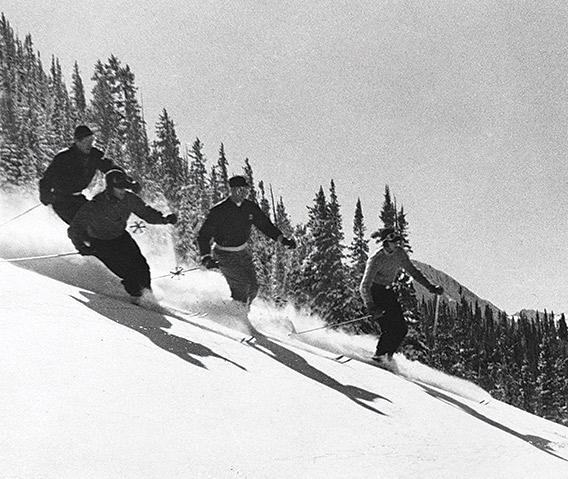
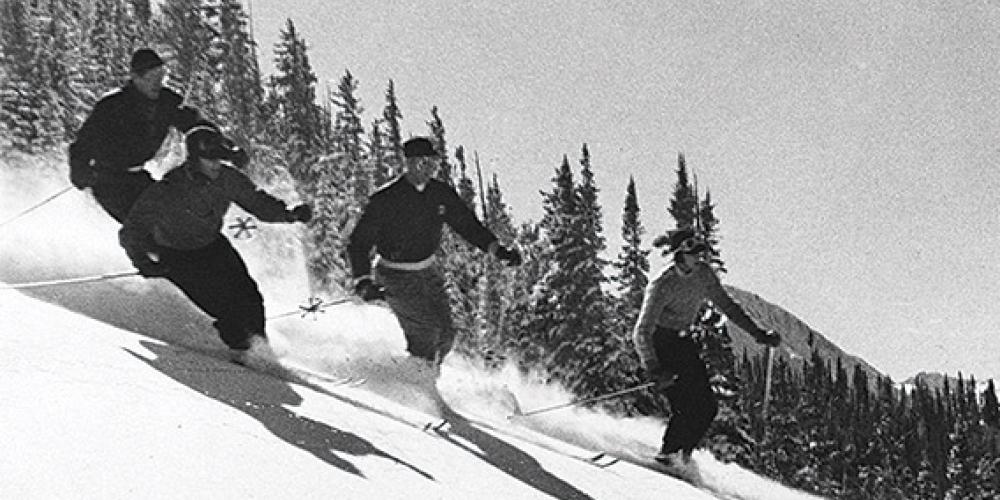
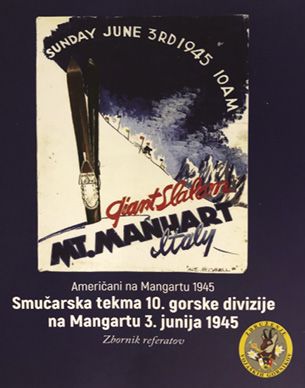
On June 3, 1945, the 10th Mountain Division of the US Army held a special race on Mount Mangart. At first glance, this is hardly a breathtaking announcement, but it was the first peace-time race, only 26 days after Germany’s unconditional surrender ended World War II in Europe. However, the authors of Američani na Mangartu 1945. Smučarska tekma 10. gorske divizije na Mangartu 3. junija 1945 (English translation: Americans on Mount Mangart: Ski Race of the 10th Mountain Division at Mount Mangart, Slovenia, on June 3, 1945) are more interested in detailing “a race long forgotten by Americans,” and one of which Slovenians—whose national winter sport is skiing—were unaware.
The race took place on Mount Mangart, 2,679 meters (8,789 feet), situated in today’s Slovenian Triglav National Park. This corner of the world has a varied border history whose modern roots lie in the line between the Kingdom of Italy and the Austro-Hungarian Empire. After World War I, a new border was drawn by the 1920 Rapallo Treaty. After World War II, the Morgan Line of demarcation separated Tito’s partisans and the area under Allied military administration. It was signed on June, 10, 1945, and lasted until September 15, 1947, so this ski race took place during the uncertain days of immediate post-war land settlements.
The book, in Slovenian but with chapter summaries in English, includes 10 papers presented at a conference titled Americans on Mount Mangart. The centerpiece is Brigadier Janez Kavar’s essay on the race itself. The essay details the top times: Sgt. Prager (1.05.2), followed by Sgt. Steve Knowlton six seconds back (1.11.4).
There were an astonishing number of DNFs. I can only suppose this is because none of the men had any real race practice while fighting in Italy. Readers will recognize Herbert Schneider, Dev Jennings, John Litchfield and Arthur Doucette to pick four prominent personalities among the 50 men listed.
Supporting essays explain the border problems (Karla Kofol), the general history of military skiing and the Yugoslav Partisan Olympics held in January 1945 (Aleš Guček). Col. Boštjan Blaznik, commander of the NATO Centre of Excellence for Mountain Warfare, presents an overview of modern military skiing.
The book also maintains that Alpina boots and Elan skis made their mark in North America as a result of the American connection. At just over 100 pages, with many photographs, the book brings this uncelebrated military race out of the shadows of
history. —E. John Allen
Americans on Mount Mangart: Ski Race of the 10th Mountain Division at Mount Mangart, Slovenia, on June 3, 1945. Editor: Janez Kavar. Proceedings Editor: Matijo Perko. Editor: Bohinjska Bela, Association of the Slovenian Military Mountaineers. Winner: 2021 ISHA Ullr Award. Available from tomaz.pirjevec@telemach.net.
Visions of Arlberg Past
There has been a recent focus on ski-history photography. In the United States, the interest ranges from an upcoming exhibition of 1950-2000 photos by the New England Ski Museum in Franconia, New Hampshire, to the donation of Ray Atkeson’s photo archive to the University of Oregon. In Europe, an exhibition is planned of the works of Emanuel Gyger and Arnold Klopfenstein, Swiss photographers of the 1920s and ’30s, by the Swiss Alpine Museum in Bern. And now here is Martin Rhomberg and Christof Thöny’s Sichtbar: Eugen Heimhuber: Fotographien am Arlberg und Hochtannberg (English translation: Eugen Heimhuber’s Vision: Photographs of the Arlberg and Hochtannberg.) It’s 128 pages of stunning photographs by Heimhuber (1879-1966), mostly from the 1920s but some earlier.
The book is sourced from a trove of 30,000 glass plates from Heimhuber and covers a number of his excursions. This is, the editors tell us, probably the largest photo collection (estimated 250,000 taken from 1876 to 1960) from a single source with documentation to go with it.
Sichtbar has four short essays in German and translations in English. Sections portray Stuben, St. Christof, St. Anton, Lech, Zürs and Warth. We see the Arlberg before any lifts. We see single and double ski spoor in a lonely line up the Widderstein in February 1911, and on the Schindler Spitz in 1920. It’s a world gone by.
There is St.Anton before the razzmatazz of industrial downhill skiing. And Zürs, today claiming 88 lifts, but the photos show the Edelweiss and Alpenrose inns alone in the landscape.
We learn the importance of regional pioneers such as Dr. Max Madlener of Kempten and Dr. Christof Müller of Immenstadt and, yes, there is a photo of Hannes Schneider jumping off the Rendelschanze (Rendel jump) in 1914. This book is a wonderful evocation of the Arlberg, through the lens of a skilled photographer. — E. John Allen
Eugen Heimhuber’s Vision: Photographs of the Arlberg and Hochtannberg edited by Martin Rhomberg and Christof Thöny. Published by Lorenzi Verlag (2019), 128 pages, hardcover, $30. Winner: 2021 ISHA Skade Award.
Mount Assiniboine: The Story
This coffee-table book, with 336 pages and 382 images, is a tribute to the many people who made Mount Assiniboine so special. Historian Chic Scott has written more than a dozen books on the Canadian Rockies and knows the collections of the Whyte Museum of the Canadian Rockies, perhaps, like no other. So it’s not surprising to find Mount Assiniboine: The Story full of evocative photos of the mountains and its people.
The first section starts with the local First Nations, followed by the explorers, priests, and early mountaineers. It ends with James Outram’s first ascent of Assiniboine in September 1901. Four more sections are dominated by personalities.
During 1913-1927, A.O. Wheeler promoted the area to mountaineers and tourists, and in 1922 the Mount Assiniboine Provincial Park came into existence. Then came two mercurial skiers, the Marquis degli Albizzi and Erling Strom, who brought the first skiers into Assiniboine and got the initial Assiniboine Lodge constructed. Strom’s 55-year tenure at the lodge introduces all sorts of characters: horse wranglers, Chinese cooks, guitar-strumming cowboys, dog-sled drivers, Swiss guides, pilots, and a parade of strong women, not least Lizzie Rummel, who ran her own camp for 20 years.
During World War II, the lodge was open only in summer. After the war, although summer tourism picked up, skiing tourists preferred the rope tow, t-bar, and chairlifts. The long haul to Assiniboine on cross-country skis was no longer attractive to clients who did not have a month to spend, but only a weekend for mountain skiing.
Part Five covers the Renner Years (1983-2010), introducing many improvements. It tells how regional bureaucracy at its worst almost removed Sepp and Barb Renner as hosts; they were about to leave the lodge when they learned that their contract had been renewed. After 2010, their work was taken on by their son and two friends—a happy ending.
This book includes the sources used, a good bibliography and index, which all add to the tales of camp and lodge living, to knowledge of the prime movers and to the story of those for whom the mountain came to dominate their lives. —E. John Allen
Mount Assiniboine: The Story by Chic Scott. From Assiniboine Publishing (2020), hardcover, 336 pages and 382 images. $75. Available from The Assiniboine Lodge (assiniboinelodge.com)
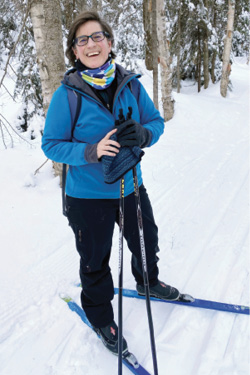
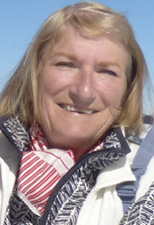
ISHA's Board of Directors has elected a new chairman, three new directors and a new treasurer. They are:
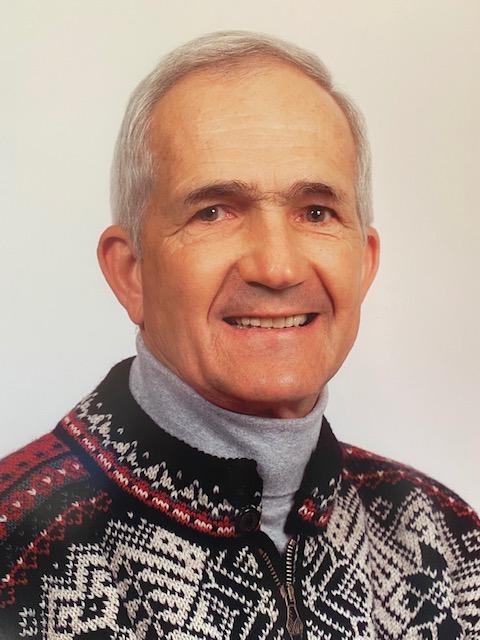
Rick Moulton (Chairman), long-time chairman of ISHA’s Awards Committee, is an independent film producer based in Huntington, Vermont. His most notable films include the Vermont Memories series for Vermont Public Television, “Legends of American Skiing” (1983), “Spirit of a Classic” (Mad River Glen, 1988), “Ski Sentinels” (National Ski Patrol, 1983), “Thrills and Spills in the North Country” (New England Ski Museum, 1998), “Passion for Snow” (Dartmouth skiing, 2012) and “Voice of America: Lowell Thomas and the Rise of Broadcast Journalism” (2018). Rick studied mass communication at the University of Denver.
Henri Rivers (Director) was elected president of the National Brotherhood of Skiers (NBS) in March 2020. NBS comprises 50 ski clubs in 43 cities, with 3,500 members. A native New Yorker, he has been an avid skier since 1975. Henri is a PSIA-certified instructor and USSA official. He first became involved with NBS in 1996. In 2003 he became a coach for the NBS national team and in 2008 he was appointed the Olympic Scholarship Fund administrator. During his tenure as OSF administrator, he grew the national team to 15 athletes. In 2016 he was appointed national competition director and in 2018 was elected executive vice president of NBS. He served for two years before being elected national president. After 25 years managing large construction projects, including hospitals, dormitories and other municipal facilities, in 2007 he founded Drumriver Industries, which designs and builds renewable energy projects.
Christof Thöny (Director) of Bludenz, Austria, studied at the University of Innsbruck and teaches Catholic religion and history at the Bundesgymnasium Bludenz, while working as a project manager and publisher. Since 2005 he has been curating historical and cultural exhibitions. He is the author of more than 50 publications, mainly focused on regional history and the history of skiing. His projects include “Hannes Schneider, Pioneer of Skiing,” staged in the Arlberg and at the New England Ski Museum; “80 Years of Arlberg Kandahar” at the Museum St. Anton; “Wintersportarchiv,” funded by the EU and including ski museums and associations in Vorarlberg and Allgäu (wintersportarchiv.org); and the skiing-history website skispuren.com. His book “Skispuren” won an ISHA Ullr Award in 2020.
Ivan Wagner (Director) is chief editor of Der Schneehase, the Swiss Academic Ski Club (SAS) yearbook, which received an ISHA Lifetime Achievement Award in 2020. Born in Prague, he trained with the Czech national ski team. After the Russian invasion of 1968 he emigrated with his family to Switzerland, studied electrical engineering at the Federal Institute of Technology (ETH Zurich), and joined SAS in 1969. He became a successful university alpine racer and mountaineer. Ivan earned a master’s degree in industrial management at Purdue and spent four decades in banking, retiring as chair of banking and financial services at Ernst & Young. He’s a member of the Kandahar Ski Club and received its Sir Arnold Lunn Medal in 2010.
Bob Soden (Treasurer) has been involved with ISHA for many years, as a writer/researcher and historian and as chair of the Museum Outreach Committee. He is working on a history of Jay Peak. A lifelong resident of Montreal, Bob studied engineering at Sir George Williams University and Concordia University. In 1963 he achieved certification from the American Ski Teachers Association of Natur Teknik. Though English is his mother tongue, he is fluent in French and uses both in promoting ISHA in Canada. For 40 years Bob was involved in engineering management and consulting. He has been a project manager for multiple large paper companies and has worked with Petro-Canada and the TransCanada Pipeline.
Other officers were re-elected. They are President Seth Masia, Vice Presidents Jeff Blumenfeld, Wini Jones, and John McMurtry, and Secretary Einar Sunde.
2021 ISHA Awards Video Now Online
Due to Covid-19 restrictions, the ISHA Awards Program, originally scheduled for Snowmass, was held online on April 29. View a video of the program, with brief talks by the honored writers and filmmakers, at skiinghistory.org/events.
Shuttered for five years, Maine's Saddleback Mountain has reopened. Can it do well by doing good?
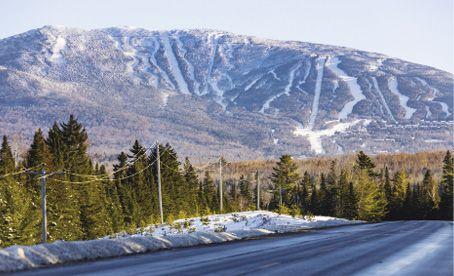
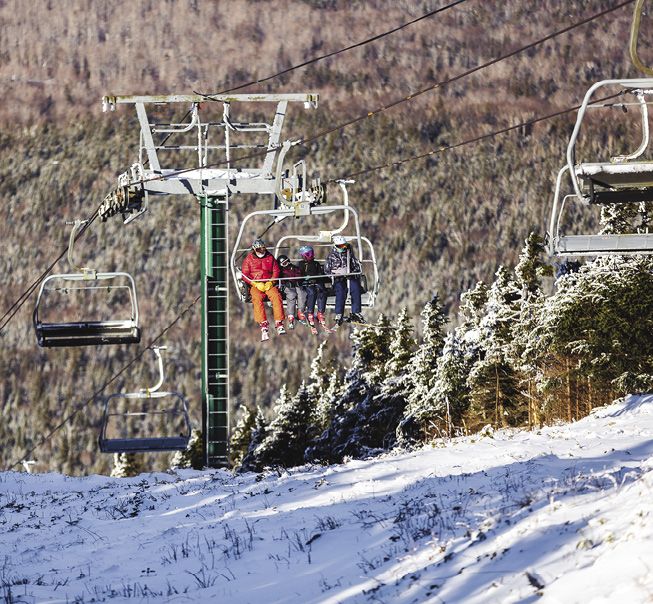
December 15, 2020, dawned cold and windy—and with the Covid-19 pandemic raging. But that didn’t stop about 300 skiers and boarders from riding the new Rangeley high-speed quad at Saddleback Mountain near Rangeley, Maine. It was the first time in five seasons that the lifts had spun at Saddleback—one of New England’s hidden gems. And more than just the ski area’s loyalists were happy. The entire region breathed a sigh of relief.
The $7.2 million Rangeley quad cuts ride
time in half, to about four minutes.
Courtesy Maine Mountain Media
“There’s been a steady stream of people who have come to me, some of them ecstatic, some of them just really emotional, about how much it means to them that the mountain is open again,” said Saddleback CEO and general manager Andy Shepard. He’s a former L.L. Bean executive who started the Maine Winter Sports Center (now Outdoor Sport Institute) to help revive the economy of Maine’s far northern Aroostook County and teach the area’s youth how to ski.
But this is more than a story of a shuttered ski area’s resurrection. In an era of mass consolidation in the ski industry, it’s a story about a new model of ski-area ownership built on the foundation of impact investing, a financial strategy, growing in popularity, aimed to deliver social benefits in addition to financial gains. In Saddleback’s case, it’s about bringing back jobs and helping the local economy, which in turn helps the local community.
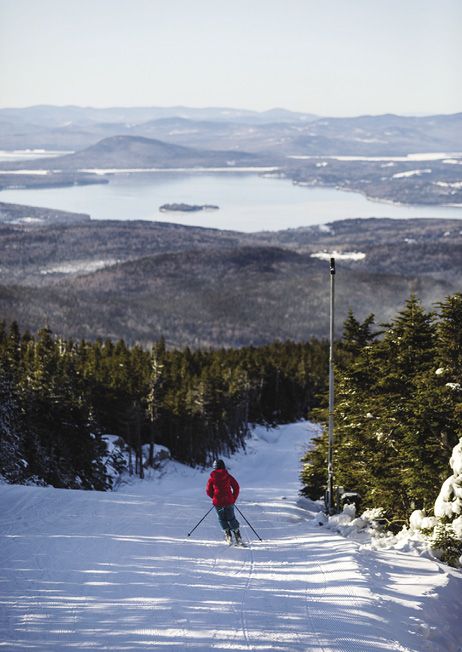
Rangeley Lakes provide year-
round recreation. Maine Mountain
Media
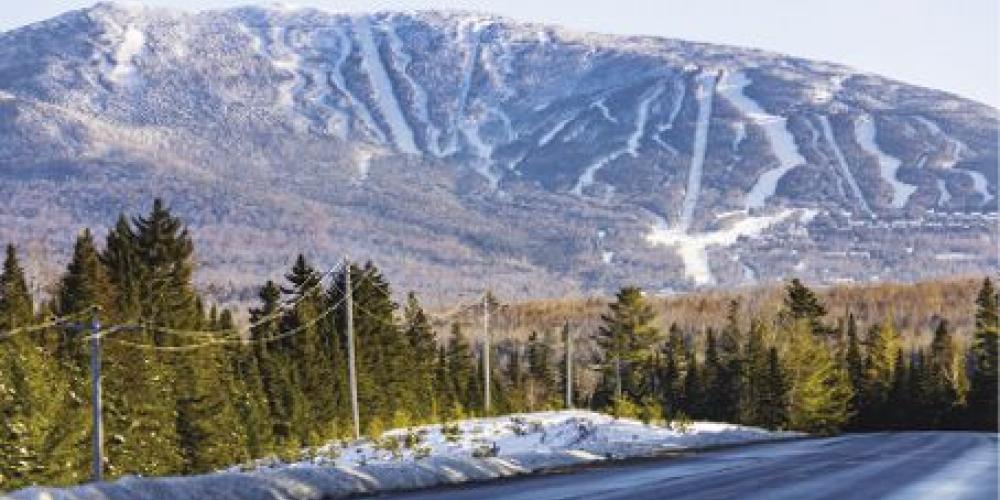
When Saddleback opened on New Year’s Eve 1960—with a 4,120-foot summit and the highest base elevation in New England—the owners envisioned the resort becoming the “Sun Valley of the East.” It promised 2,000 vertical feet of skiing, 200 inches of snow annually, and stunning views of the Rangeley Lakes region—the lakes themselves offer four-season recreation. But the lofty ideal was never achieved. The secluded resort—a three-hour drive from Portland and four-plus hours from Boston—was perhaps too secluded, especially with limited lodging in the area. During Saddleback’s first 18 years, it had five owners.
In 1978, Donald Breen, a Massachusetts businessman, came along with plans to revive the ski area. But the Appalachian Trail corridor runs across Saddleback’s above-timberline summit, and Breen spent almost two decades battling the National Park Service over access rights to the trail corridor. By the time Breen and the NPS came to an agreement in 2000, the battle had derailed Breen’s expansion plans. He sold the area for $8 million to retired University of Maine geologist Bill Berry and his wife, Irene, in 2003.
For a decade, the Berrys ran Saddleback as a labor of love, improving snowmaking, enlarging the base lodge, adding more expert terrain, and replacing a vertiginous T-bar with a chairlift. Saddleback has always had a devoted community of skiers—“a sense of family that I have not experienced, and I’ve been in this business for a long time,” noted Shepard. Saddleback patrons included locals and part-time residents alike, with nary a distinction between them—unlike the contentious vibe between the two groups at many large resorts. Skier visits climbed steadily.
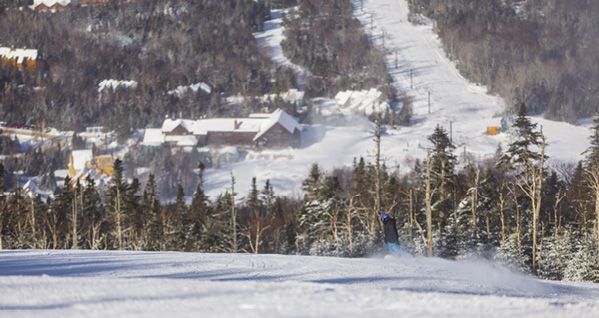
Newly renovated base lodge will be
joined by a planned mid-mountain
lodge. Maine Mountain Media.
But the Berrys had to weather the Great Recession (2007-2009), and Saddleback lacked a high-speed chairlift—an amenity that has become a standard resort convenience, even at modest ski areas. As a result, annual skier visits began to decline.
Unwilling to invest further capital, the Berrys put Saddleback on the market for $12 million in December 2012. But no buyers came forth. Three years later, they announced that if they could not acquire $3 million in funding for a new chairlift, they would not open for the season.
Potential buyers came and went over the next four years, including a group of Saddleback faithful who wanted to operate the mountain as a nonprofit Mad River Glen-like co-op. Then came a shyster from Australia proposing an EB-5 Ponzi scheme similar to the failed debacle at Vermont’s Jay Peak. “The community was put through the wringer, hopes raised and dashed on a regular basis,” said Shepard.
Locals and Saddleback fans had almost given up hope when Shepard’s group rode in on a white horse. Or rather a horse of a different color. Knowing how important Saddleback was to the Rangeley community, Shepard had been working with the Berrys since 2014 to secure a suitable buyer. And with his experience founding the Maine Winter Sports Center, Shepard knew that the mountain was as important an economic driver to the Rangeley region as the Sports Center was to Aroostook County.
He knew Saddleback could be profitable—but only if someone would first inject millions of dollars into the infrastructure. But who was going to invest that kind of money in an out-of-the-way ski area and in an industry that is susceptible to climate change? A traditional investor looking for private equity-style returns would look elsewhere. The state's Department of Economic and Community Development knew where to look. Early in 2018, they brought in Boston-based Arctaris Impact Fund, which has been investing in projects in the Rust Belt and other economically disadvantaged areas for more than a decade. Arctaris leverages non-traditional impact investors and nonprofit foundations that are motivated by making a societal difference and will settle for smaller returns, New Markets Tax Credits, state-guaranteed loans, and support from the community and local foundations. Saddleback fit the profile.
It took two years to close the agreement, but Arctaris purchased Saddleback on January 31, 2020, for $6.5 million, with a plan to invest $38 million over the next five years in new lifts, base lodge refurbishment, a new mid-mountain lodge, a solar array to power the mountain, a hotel, daycare center, employee housing, and other modern resort necessities.
Arctaris co-founder Jonathan Tower sees the deal as a chance to revitalize a region hit hard by Saddleback’s closing. “This is about more than opening a mountain,” said Tower. “This is about restoring 200-plus jobs to the community. It’s about the regional economic impact of Saddleback. And it’s about the health and wellness benefits of an operational mountain.”
With negotiations complete, Arctaris asked Shepard to become Saddleback’s CEO and general manager. Shepard was especially attracted to the deep connection between mountain and community. “It’s more than a ski area,” he said. “It’s been a family to people. There’s a deep sense of responsibility that goes along with that. Knowing that we’re stewards of that kind of connection is important to me. I’ve tried to make sure we build an organization of people to whom that’s equally important.”
Both the pandemic and the regional economy made Saddleback’s first season a challenge. Many people who once worked at Saddleback have moved away, so the hiring pool is smaller than it once was. But Shepard is confident that workers will be lured back by competitive wages, a creative program to provide year-round benefits like health insurance to seasonal workers, and the soon-to-be-built employee housing and daycare center.
Saddleback’s modest pass prices for youth and elders is another nod to the community. Purchase a season pass in the spring and prices range from $30 (under 6) to $50 for local students to $30 for a super senior pass (80 and over)—a pass category that is no longer offered at most resorts. In addition, all passes can be purchased under an installment plan.
Shepard is equally confident that the new Rangeley high-speed quad, which cut the 11-minute ride time by more than half, a refurbished base lodge, and a planned mid-mountain lodge atop the quad will attract more skiers to Saddleback. The mid-mountain lodge will have views west to New Hampshire’s Mount Washington and a flat roof planted with sod and blueberry bushes so that the building is largely hidden from across the ridgeline.
When new skiers and riders discover Saddleback, Shepard hopes that they will integrate into the community, as has happened for generations. “People care for one another here,” he explained. “There’s very little judgment about political opinions and who’s got money and who doesn’t. It’s just people who love Saddleback, people who love doing things with family and friends.”
In 2020, donors dug deep to help ISHA weather trying times. Fundraising set a new record.
For the seventh year in a row, donors to the nonprofit International Skiing History Association set a record for unrestricted donations. Thanks to the generosity of ISHA members, individual donations in 2020 rose 15.6 percent over the previous best year (2019).
The 2020 Fundraising Campaign raised a total of $136,857 in gifts from 443 individuals. The ISHA Board of Directors thanks Christin Cooper and Penny Pitou for leading the annual drive.
Fifty-four companies and organizations contributed $35,000. Due to the Covid-19 pandemic, many ski industry firms lost customer traffic, with the result that ISHA’s corporate sponsorship revenue fell 33 percent for the year. However, total unrestricted donations rose .3 percent.
In 2020, membership dues covered about 18.6 percent of ISHA’s annual costs for publishing the magazine, maintaining the website, producing the annual ISHA Awards program, and maintaining communications with the membership. The balance of the budget was met through charitable contributions, corporate sponsorships, bulk sales of the magazine to our museum partners, foundation grants and revenue from investment funds.
On the expense side of the ledger, 67 percent of the budget went to support ISHA programs (magazine and website publishing, awards program). The remainder went to administration (member service, bookkeeping and audit, fundraising, member recruitment).
ISHA is a 501( c )( 3 ) public charity, eligible to receive grants from family and community foundations, donor-advised funds and corporate matching programs, in addition to direct contributions from individuals.
If you’re interested in supporting a specific ISHA program, please contact president Seth Masia at (303) 594-1657. If your firm would like to be a corporate sponsor, contact Peter Kirkpatrick at (541) 488-1933.
ISHA Income 2020
Individual donations $132,506 (59%)
Memberships $50,694 (23%)
Corporate Sponsorships $35,000 (16%)
Magazine sales (museums, other partners $6,399 (3%)
Total revenue $224,599
ISHA Expenditures 2020
Magazine content, editorial $74,397 (30%)
Magazine printing, distribution $45,598 (19%)
Events, ISHA Awards program $36,501 (15%)
Website content, management $7,169 (3%)
Administration, bookkeeping $63,542 (26%)
Fundraising, member recruitment $13,158 (5%)
Audit, tax preparation $3,725 (2%)
Total $244,090
HONOR ROLL
Listed here are the donors who supported ISHA’s mission with tax-free donations and gift memberships above and beyond their membership dues in 2018. –Seth Masia, President
Pinnacle Club
$10,000 and up
Barry & Kristine Stott
Chairman's Circle
$5,000 to $9,999
Elliot Cooperstone
Renie & Dave Gorsuch
Jake & Maureen Hoeschler
Jean-Claude Killy
Nicholas Paumgarten
Nicholas Skinner
SuperG(ivers)
$2,000 to $4,999
John J. Byrne
Mike & Carol Hundert
Liza-Lee & George Kremer
Stephanie McLennan
Jack Nixon In memory of Gwen James Nixon
Charles Sanders
History Leader
$1,000 to $1,999
Osvaldo & Eddy Ancinas In memory of John Fry
Skip Beitzel, Hickory & Tweed Ski Shop
Albert & Gretchen Rous Besser
Christin Cooper-Tach & Mark Tach In memory of John Fry
Chris & Eileen Diamond
Charles Ferries
E. Nicholas Giustina
Adolph Imboden
Peter Looram
Seth Masia In memory of John Fry & Dick Bohr
Judy McLennan
Marvin & Renee Melville
Janet Mosser
Richard & Deborah Pearce
Penny Pitou
Barbara Alley Simon
Bob Soden
John Stahler
Carol & Barry Stone In memory of John Fry &
Jeff Stone
Stephen Storey
Ivan Wagner, Swiss Academic Ski Club
Thomas Wilkins
Gold Medalist
$500 to $999
Michael & Diana Brooks
Jeffrey Burnham
Michael & Jennifer Calderone
Robert Craven In honor of Penny Pitou
Jack & Kathleen Eck
Curtis Emerson
Tania & Tom Evans
Peter Fischer
Mitch & Kim Fleischer
Jim & Barbara Gaddis
Vernon Greco
Hugh Harley In memory of John Fry
Robert Irwin
Joe Jay & Susan Jalbert, Jalbert Productions In memory of Calvin Beisswanger
Nigel Jones
Jim & Dorothy Klein
Winston Lauder
Win Lockwood
Robert & Alice Looney
J. Howard Marshall III
Debby McClenahan
Andy & Linda McLane,
McLane Harper Charitable Foundation
David Moffett
Chauncey & Edith Morgan
Stan & Sally Morse
David Moulton
Trygve Myhrven
Bradley Olch
Peter Pell Sr.
Charles & Janet Perkins
Lee Perry Jr.
Doug & Ginny Pfeiffer
William Polleys
Nancy Greene Raine
David Scott
Jay Stagg
Einar Sunde
Otto Tschudi
Lee Turlington In honor of Marcel Barel
U.S. Ski and Snowboard Hall of Fame
Roger Wangen
Silver Medalist
$100 to $499
Peter Abramson In memory of John Fry
Guy Alexander
Graham Anderson In memory of John Fry
Coralue Anderson
Gordon Arwine
Carol Atha
Michelle Avery
Alan Baker
Brian Balusek
F. Michael Bannon
Pat Bauman
Phil Bayly
Tom Beachman
Kevin & Cyndy Beardsley
Bob Beattie
Stephen & Louise Berry
Nicholas & Ellen Besobrasow
Michael Bing
Rick & Judy Birk
Heather Black
Tom Blair
Jeff Blumenfeld, NASJA
Spencer Bocks
Bruce Boeder
Junior & Maxine Bounous
Charles Bowen
Bob & Christana Boyle In memory of Gus Gnehm
Sally Brew
Michael Briggs
Jerome Britton
G. Stanley Brown
Jan & Judith Brunvand
Jackie & John Bucksbaum,
John and Jacolyn Bucksbaum Family Foundation
Eddie Bunch,
The Bunch Family (Alpine Ski Shop)
Frank Cammack
Doug Campbell
Duncan Campbell
Chris Cannon
Dorothy Cantor
Rick Carter
Warren & Gretchen Cash
Harvey & Reserl Chalker, Alpine Sports
Kathryn & Charles Chamberlain
Barbara Clark
Jaycee & Patty Clark
Cal Conniff
Sven & Mary Dominick-Coomer
Jay Cowan
Art & Sharon Currier
Chris & Jessica Davenport
George & Jean Davies
Michael & Vicki Dawson
Mike Day
Mike Dederer
Yves Desgouttes
Kathe Dillmann In memory of John Fry
Peter Dirkes
Dave Donaldson
Mike Douglas
Alex Douglas, Mount Seymour History Project
James Duke
Robert Ebling III
John Eichenour
Rett Ertl
Gregory Fangel, Woodenskis.com
John Farley
Sally Faulkner
Anthony & Barbara Favale
Diane & Jim Fisher
Ingie Franberg
W. D. Frank
Victor & Karin Frohlich
Dick Frost
Marlies Fry
Tony Gagliardi In memory of Andy Nault
Ken Gallard In memory of John Fry
Caleb & Sidney Gates
Hans Geier In memory of John Fry
Pepi & Sheika Gramshammer
Ellen Greer
Larry Gubb
Aleš Guček In memory of John Fry
Edson Hackett
H. Fred Haemisegger
Susie Hagemeister
Mike Halstead In memory of John Fry
John Hansen
Erica Hansen In memory of Hank Garza
Stefi Hastings In memory of John Fry
Bettie Hastings
Robert Havard
Cathy Hay, Alpine Sport Shop
Irene & Michael Healy
Tom & Roberta Heinrich
Jim & Linda Henderson
John Hoagland
Karin Hock Baker In memory of Nick Hock
Randy Hoffman
Ron Hoffman
David Holton
Steve Irwin
Joe Irwin
David Jacobs
Bill & Cheryl Jensen
Phil & Brigitte Johnson
Wini Jones
Donald Jones
David Kaufman
Hank Kaufmann
John & Denise Kelley
Paul Kenny
LeRoy Kingland
Leon Kirschner
Pete Kolp
Mike Korologos
Madi Kraus
Ivo Krupka
Erik Kvarsten
Michael Lafferty
William Lash
Jeffrey & Martha Leich
John Lewis
Tom & Laurel Lippert
Alan Lizee
John Lovett
Jean Luce
Phil Lutey
John Maas
James & Dianne Mahaffey
Tom Malmgren
James Mangan
Garrett R. Martin
Bob & Trudy Matarese
Jeff Mayfield
Sloan McBurney
Stephen McGrath
Sandra McMahon
John McMurtry In memory of John Fry
Christine McRoy
Charlie McWilliams
Paul Mehrtens Jr.
Peter Miller
Louisa & Steve Moats
Gregory Morrill
Halsted Morris
Roger Moyer
Paul Naeseth
Carolyn Nally
Michael Neal
Connie Nelson, Alf Engen Ski Museum Foundation
Timothy Nelson
New York Museum of Skiing Hall of Fame
Paul Oliver
Gary & JoAnn Olson
George Page
Philip Palmedo
Tom Parrott
Fred Passmore
Tom & Sally Patterson
Albert & Carol Pierce
LuAnn Dillon & Tom Pierce
Brian Poster
Glen Poulsen
Bob Presson
Michael Prinster
Peggy Proctor Dean
Christian & Joanie Raaum In memory of Gus Raaum
Carey & A. Todd Rash
Ken Read
Stuart Rempel
Ken Rendell
Jim Renkert In memory of John Fry
Grant Reynolds
Thomas Rhodes
Wilbur Rice
Alex Riddell
Bill Roberts
Albert & Julia Rosenblatt In memory of John Fry
Jan Rozendaal
William Rude In memory of John Fry & Pat Doran
Paul Ryan
Mary Sargent
David Schames
Rod Schrage
Don Schwamb
Bill Scott
Allan & Sally Seymour
Tom & Sandy Sharp
Christopher Shining
Peggy Shinn In memory of John Fry
Brad Simmons
Donald Simonds
Richard Sippel
Constantine Siversky In honor of the Siverskys
Ski Barn In memory of Carol and Richard Fallon
Lowell Skoog
Michael Smith
Terrell & Tammie Smith
Alicia Smith
Ann Soden
Robert Sorvaag
Glenn Spiller
Rick Stark
Arthur Stegen
Nancy Stone, Buck Hill, Inc.
Rick Stoner
John Stout
Sam Stout
Robert Tengdin
Joannie & Mark Ter Molen
Robert & Sue Thibault
Simeon Thomas
Brent & Bonnie Tregaskis, Snow Summit Ski Corp
Bradford & Una Tuck
Charles Upson
Juris Vagners
Paul Vesterstein
Susan Voorhees
Bruce Wadsworth
Dick & Barbara Wagner
Karl Wallach
Lawrence Walsh In memory of Walt Roessing and John Fry
Patrick Walsh
Annie Ward
Ray Dave Watkins
William Webster
James Wick
Thomas Wies
Alice & Brad Williams
Heggie Wilson
Maurice Woehrlé
Carmen Yonn
Bronze Medalist
Up to $99
Horst & Kit Abraham
Michel Achard
Drew Adams, Glacier
Ski Shop
Steve Adams
Robert & Margaret Albrecht
Boyd Allen III In memory of John Fry
Vicki Andersen, NASJA West
Tom Andrews
Larry Asay
Nat Barker
Peter Birkeland
Jim Bogner
Richard Boutelle
Rouene Brown
Frank Brown
Nancy Brucken
Charlie & Mary Seaton Brush
William Burns Jr. In memory of James Reilly
Frank Carrannante
Thomas Clark
Ned & Jan Cochran In memory of Tage Pedersen
Ron Costabile
Larry Daniels
Chris Dawkins
Dennis De Cuir
Thomas Dillon
David Downs
Randy Draper
Duane Ecker
Murray & Gretchen Fins
Margaret Fuller
Bill Fundy
Bruce Gaisford
Tracy Gibbons Sturtevant’s
Martin Glendon
Austen Gray
Wende Gray
John Greenwood
Jim Hamblin
D. Anne Heggtveit Hamilton
Alden Hanson, Apex Ski Boots
Sherri Harkin
Brett Heineman
Nathan & Monica Hill
Suzanne Hoffmann, Blizzard Ski Club In memory of Calvin Beisswanger
Sandy Hogan
John Holland
William & Linda Holman
Kris Husted
Julien & Trudie Hutchinson
David Ingemie
Walter Jackson
John Jacobs,
Reliable Racing Supply
Kathleen James
Karen Jeisi
JJ Johansson
Kirk Johnson
Richard Jones
Jeff Kahn
Peter Kirkpatrick,
PK Company
Earl Kishida
Bill La Couter
Joseph LaBarbera
Duane Larson
Charlie Leavitt
Mimi Levitt, Alta Lodge
Nicholas Lewin
Sandy & Colleen Liman
John Lutz
Nina MacLeod
Dick & Jo Anne Malmgren
Constance Marshall
Nick Martini
Richard Mason In memory of David E. Mason, Sr.
Jessie McAleer
Woods McCahill
Christian McDonald
James & Barbara McHale
Leslie McLennan
Millie Merrill
Donald & Susan Miller
Louis Miller
Mark & Janet Miller, Antique Skis
Michael Moore
Rick & Melinda Moulton
Keith Nelson
Christopher Newell In Honor of Chris Newell
Greg Newton
Allen Pachmayer
Deanna & Val Painter
Ruth Parton
Scott Peer
Nancy Pesman
Paul & Margie Prutzman, Pinnacle Sports
Evelyn Pitt
Roland Puton
Thomas Quinn
Edward Rengers
Marsha Rich
Reinhard Richter
Joseph & Cynthia Riggs
Gary Rivers
Jack Robbins
Paul Rogers
Bruce Rosenoff
Fred Runne
Rick Rust
Fred Schaaff
Jake Schuler
Greg Sewell
Peter Shelton
John & Judy Sherman
Geoff Smith
Linda Socher
Sheila Spalding
Gretchen Sproehnle
Mark & Janet Standley
Audrey Staniforth
William Stecker
Robert Sullivan
Rod Tatsuno
Polly Thompson
Richard Tillema
Louise Van Winkle
Lucile Vaughan
Janet Wadsworth Evans In memory of Donald Wadsworth
John Waring
Doug Webb
Tom West
Lisa West
Lon Whitman
Scott Willingham
Jack Wolber
Bob Woodward
Frederick Yost
Leading the Way
The following ISHA members have kick-started our 2021 fundraising by giving $100 or more by March 1, 2021.
Karin Hock Baker
Michael Bannon
Beekley Family Foundation
John Byrne | In honor of the Byrne Family
Chris Cannon
James Clarke
Richard Crumb
Caleb Gates
Nick Giustina
Scott Jackson
Jean Claude Killy
William Lash
Caroline & Serge Lussi | Adirondack Foundation
Juliette Clagett Maclennan
Thomas & Diane Malmgren
Seth Masia
Stephanie Mclennan
Marvin & Renee Melville
Trygve & Vicki Myhren
Carolyn Nally
Thomas Pierce & Luann Dillon
Barbara Thornton
Lawrence Walsh | In memory of Walt “The Wordsmith” Roessing
Carmen Yonn
2021 Corporate Sponsors
ISHA deeply appreciates your generous support!
World Championship ($3,000 and up)
Gorsuch
Polartec
World Cup ($1,000)
Aspen Skiing Company
BEWI Productions
Bogner
Boyne Resorts
Dale of Norway
Darn Tough Vermont
Dynastar | Lange | Look
Fairbank Group: Bromley, Cranmore,
Jiminy Peak
Gordini USA Inc. | Kombi LTD
HEAD Wintersports
Hickory & Tweed Ski Shop
Intuition Sports, Inc.
Mammoth Mountain
Marker-Volkl USA
National Ski Areas Association (NSAA)
Outdoor Retailer
Rossignol
Ski Area Management
Ski Country Sports
Snowsports Merchandising Corporation
Sport Obermeyer
Sports Specialists, Ltd.
Sun Valley Resort
Vintage Ski World
Warren and Laurie Miller
World Cup Supply, Inc.
Gold ($700)
Gold ($700)
Race Place | BEAST Tuning Tools
The Ski Company (Rochester, NY)
Thule
Silver ($500)
Alta Ski Area
Boden Architecture PLLC
Dalbello Sports
Ecosign Mountain Resort Planners
Fera International
Holiday Valley
Hotronic USA, Inc. | Wintersteiger
MasterFit Enterprises
McWhorter Driscoll, LLC
Metropolitan New York Ski Council
Mt. Bachelor
New Jersey Ski & Snowboard Council
Russell Mace Vacation Homes
Schoeller Textile USA
Scott Sports
Seirus Innovations
SeniorsSkiing.com
Ski Utah
Swiss Academic Ski Club
Tecnica Group USA
Trapp Family Lodge
Western Winter Sports Reps Association
World Pro Ski Tour
ISHA Heritage Partners
These museums and organizations actively support ISHA by providing our journal, Skiing History, as a benefit to their members and donors. We’re proud to share our mission of preserving skiing history with these institutions, and we encourage you to support them!
U.S. Ski and Snowboard Hall of Fame & Museum www.skihall.com
INTERNATIONAL SKIING HISTORY ASSOC. HONORS 14 OF THE BEST HISTORICAL BOOKS AND FILMS OF 2020
MANCHESTER CENTER, VT (Feb. 8, 2021) – The International Skiing History Association (ISHA), the nonprofit organization whose mission is to preserve and advance the knowledge of ski history, today announced the 14 recipients of its annual awards honoring the best works of history published during 2020.
First established in 1993, the ISHA Awards include the year’s best creative works of ski history, including books, films, websites and other media projects.
From the frozen spine of the Colorado Rockies to the icy steeps of Riva Ridge in Italy; to ski tourism in Idaho's remote Wood River Valley; Arapahoe Basin in the Rockies; the Arlberg region; and the history of handicapped skiing; to movies about the American men’s downhill team; and a book the size of a coffee table that covers skiing around the world, these winners exemplify the best in ski communications.
“We like to think of these as the Pulitzers of snowsports history, projects that honor the people and places that have made skiing so memorable for millions of current and past enthusiasts,” says Seth Masia, ISHA president.
“Few sports have impacted so many people as passionately as skiing.”
The awards will be presented during an online event to be held in April 2021. To see the 2020 Awards Presentation Program, and for details about ISHA Awards, go to https://skiinghistory.org/events Meanwhile, watch for reviews of the winning books and films in the Media Reviews section of the magazine accessible through skiinghistory.org.
The 2020-21 winners are:
ISHA Ullr Award
Maurice Isserman: The Winter Army: The World War II Odyssey of the 10th Mountain Division, America's Elite Alpine Warriors Houghton Mifflin Harcourt, 2019
Janez Kavar (ed). Američani na Mangartu 1945: smučarska tekma 10. gorske divizije na Mangartu 3. Junija 1945 Slovenia.
Zdruzenje vojaskih gornikov Slovenije, 2020 [Title in English: Americans on Mount Mangart 1945: Ski race of the 10th Mountain Division at Mount Mangart, Slovenia June 3, 1945]
Maurice Woehrlé Les Peuples du Ski: 10,000 Ans d’Histoire Books on Demand, 2020 [Title in English: Skiing Peoples: 10,000 Years of History]
ISHA Skade Award
John W. Lundin Skiing Sun Valley:A History from Union Pacific to the Holdings The History Press, 2020
Nancy Campbell Stone Buck Hill: Let's Give it a Whirl! A History 1954-2015 Printed by Smith Printing Co. LLC, 2019
Cathleen Norman with Alan Henceroth Arapahoe Basin:A Colorado Legend Since 1946 The Donning Company Publishers, 2020
Martin Rhomberg and Christof Thöny (Hg.) Sichtbar: Eugen Heimhuber - Fotografien am Arlberg und Hochtannberg Lorenzi Verlag, 2019 [Title in English: Eugen Heimhuber’s Vision - Photographs of the Arlberg and Hochtannberg]
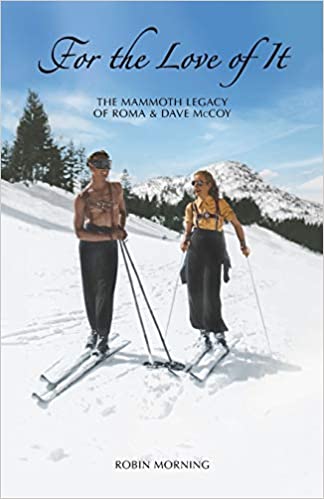
Robin Morning For the Love of It: The Mammoth Legacy of Roma and Dave McCoy Blue Ox Press, 2020
Donald A. Johnston Hotel Kosciusko: The History and Legacy of Australia's First Planned Alpine Resort Produced by The Perisher Historical Society, printed by Hogan Print, 2020
Ingrid P. Wicken Lost Ski Areas of Tahoe and Donner The History Press, 2020
ISHA Baldur Awards
Jimmy Petterson Skiing Around the World II: Collecting Ski Resorts Skibum Publishing Company, 2019
ISHA Film Awards
Fresh Tracks Produced by: TFA Group + Leimkuehler Media Producers: Mo Finn and Lena Moss Glaser Executive Producers: Jeremy Snyder, Katie Leimkuehler and Mallory Weggemann Director: Hans Rosenwinkel [*Note all the "producers" (as listed in the film credits)]
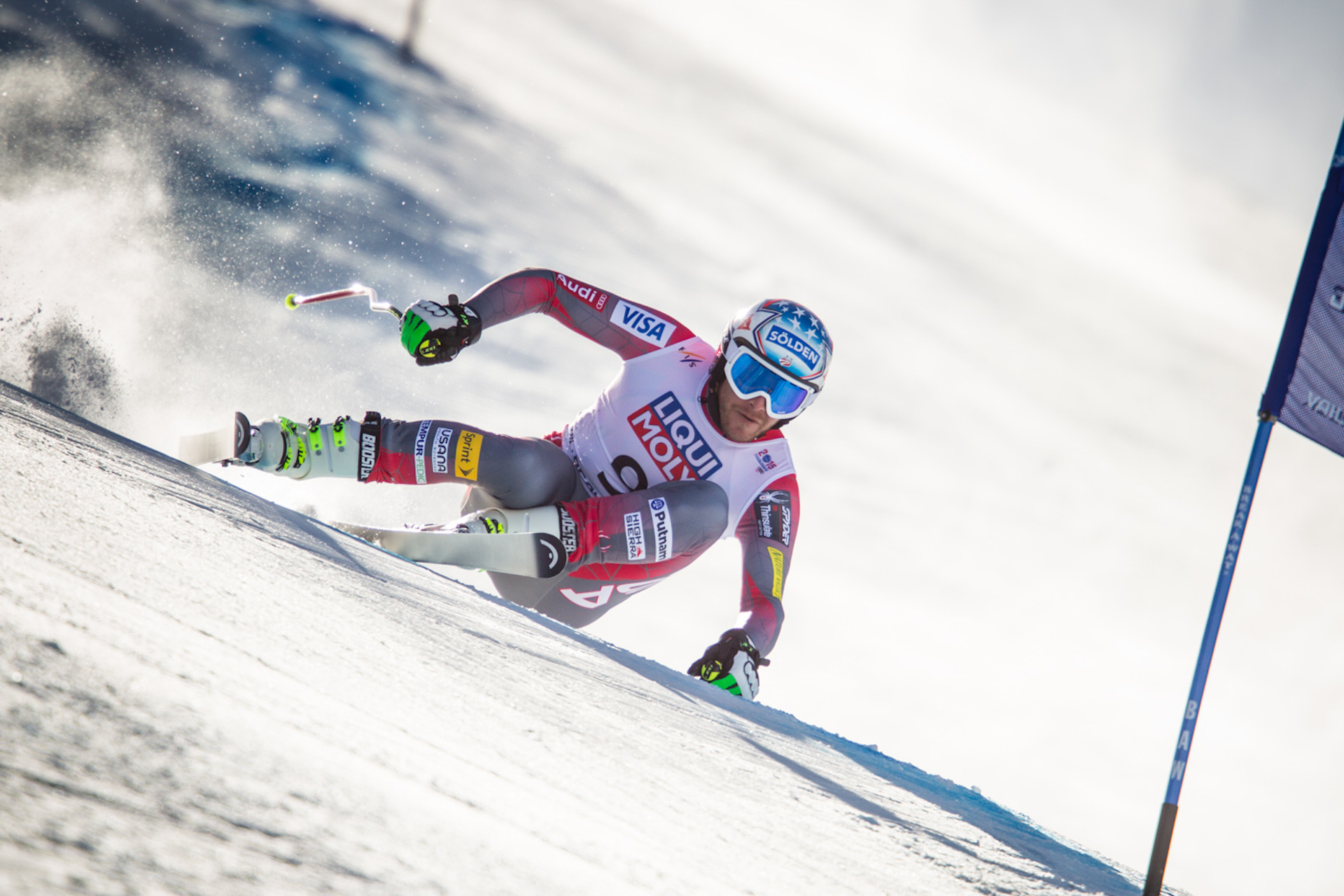
Bode Miller USSST photo
[The] American Downhiller: The Legend of the Men's Team Produced by Claire Brown and Scott Lyons Editors: Susie Theis and Claire Brown Narration: Steve Porino POC, Ski Racing Media and Jalbert Productions
About ISHA
The International Skiing History Association (ISHA) is a 501(c)(3) nonprofit organization whose mission is to preserve and advance the knowledge of ski history and to increase public awareness of the sport’s heritage. It is recognized worldwide as an important resource for comprehensive, accurate information on the history of ski resorts, personalities, equipment, technique and events. ISHA’s 1,400 members – including resort and industry leaders, World Cup and Olympic racers, leading authors and historians, and passionate skiers from two dozen nations – share a love of the sport and its rich past. The association publishes the magazine Skiing History six times a year. For more information, including details on membership, view www.skiinghistory.org.
During the Covid19 shutdown, ski resorts went into shock, and at this writing have not yet recovered. Nonprofit organizations of all sorts faced financial crisis as corporate sponsors retrenched. ISHA faced a cash-flow crunch: we couldn’t be sure of the revenue to support production and mailing of the magazine, the website and the next round of ISHA Awards.
And so, in October, we asked ISHA members to dig deep and contribute early to our annual fourth-quarter fundraising campaign. And you did! By year’s end, ISHA’s loyal and generous donors beat the previous fundraising record by 15 percent, contributing more than $136,000 in gifts by individuals and families. And most of our corporate sponsors renewed their commitment to ISHA’s mission.
As a result ISHA completed its fiscal year with only half the deficit we forecast last March, at the beginning of the Covid19 shutdown. On behalf of fundraising chair John McMurtry, and campaign leaders Christin Cooper and Penny Pitou, ISHA thanks its donor-members, its sponsors and the dedicated readers of Skiing History.
Look for details of ISHA’s fundraising and financial status in the upcoming March-April issue.
ISHA Awards 2021
ISHA’s Awards Committed has announced the winners of the 2021 ISHA Awards, honoring the best works of history published during 2020. They are:
Ullr Awards
Maurice Isserman for The Winter Army, a history of the 10th Mountain Division.
Janez Kavar for Americani na Magartu 1945, recounting a 10th Mountain Division race in Slovenia.
Maurice Woerhlé for Peuples du Ski, a 10,000 year history of the skiing peoples of Eurasia.
Skade Awards
Donald A. Johnston for Hotel Kosciusko, a history of the Australian ski resort.
John W. Lundin for Skiing Sun Valley, a history of the resort from its beginning.
Robin Morning for For the Love of It, the story of Roma and Dave McCoy.
Cathleen Norman with Alan Henceroth for Arapahoe Basin, a history of the ski area.
Nancy Stone for Buck Hill, a history of the ski area.
Martin Rhomberg and Christof Thöny for Sichtbar, Eugen Heimhuber’s photos of the Arlberg, 1900 to 1930.
Ingrid Wicken for Lost Ski Areas of Tahoe and Donner
Baldur Award
Jimmy Petterson for Skiing Around the World II, stories about exotic ski areas.
Film Awards
Kate Leimbuehler, Jeremy Snyder and Hans Rosenwinkel for “Fresh Tracks,” about pioneer amputee skier Paul Leimbuehler.
Claire Abbe Brown, Scott Lyons and Susie Theis for “The American Downhiller,” the story of U.S. men who won classic downhills.
The Awards will be presented during an online event to be held in April. To see the 2020 Awards Presentation Program, and for details about ISHA Awards, go to https://skiinghistory.org/events Meanwhile, watch for reviews of the winning books and films in the Media Reviews section of the magazine.
Farewell to Kathleen James
Changing of the guard
Kathleen James joined ISHA in 2009 as editor of Skiing History. She expanded her role in 2015, overseeing ISHA’s day-to-day operations, including membership services and fundraising. The continuing success of the magazine and ISHA’s infrastructure is largely due to Kathleen’s wisdom, diligence and expertise.
Two years ago, Kathleen was elected to the Vermont General Assembly, representing her hometown of Manchester and several nearby communities. She was re-elected in November 2020. With increasing responsibility in the Education Committee and several caucuses—focusing on climate action, tourism, and the rural economy—she recently resigned from ISHA to focus on her political work. If you’d like to reach Kathleen, she still receives email at kathleen@skiinghistory.org.
Kathe Dillmann
In 2019, ISHA hired Kathe Dillmann as Business and Events Manager, and Laurie Glover as Membership Services and Marketing Manager. They may be contacted at kathe@skiinghistory.org and laurie@skiinghistory.org. They’ve now smoothly assumed all of Kathleen’s administrative duties and I’m sure readers communicating with the office will find them every bit as helpful and informative as Kathleen was.
Greg Ditrinco
Throughout the past year, Greg Ditrinco has shared editing duties at the magazine with Kathleen. With this issue, Greg takes the reins. Greg knows ski-magazine publishing inside and out. He joined Snow Country in 1995, then worked at SKI Magazine from 1999 to 2017, first as executive editor and then as editor-in-chief. And he’s familiar with ISHA, as he won an ISHA Award in 2011 for the 75th Anniversary Issue of SKI Magazine. Contact Greg at greg@skiinghistory.org.
Frankly, we’re still figuring out how to fill the hole left when John Fry passed on a year ago. But we’re confident of maintaining the very high standards John set for the magazine.
Late deliveries
Many readers didn’t receive the November-December issue until January. The magazine was mailed December 9, but got caught up in the widespread holiday postal delays. Next year we’ll mail that issue before Thanksgiving. So sorry for the inconvenience.


 The Forgotten Race of the 10th Mountain Division
 Visions of Arlberg Past
 Mount Assiniboine: The Story



 Rick Moulton (Chairman), long-time chairman of ISHA’s Awards Committee, is an independent film producer based in Huntington, Vermont. His most notable films include the Vermont Memories series for Vermont Public Television, “Legends of American Skiing” (1983), “Spirit of a Classic” (Mad River Glen, 1988), “Ski Sentinels” (National Ski Patrol, 1983), “Thrills and Spills in the North Country” (New England Ski Museum, 1998), “Passion for Snow” (Dartmouth skiing, 2012) and “Voice of America: Lowell Thomas and the Rise of Broadcast Journalism” (2018). Rick studied mass communication at the University of Denver.
 Henri Rivers (Director) was elected president of the National Brotherhood of Skiers (NBS) in March 2020. NBS comprises 50 ski clubs in 43 cities, with 3,500 members. A native New Yorker, he has been an avid skier since 1975. Henri is a PSIA-certified instructor and USSA official. He first became involved with NBS in 1996. In 2003 he became a coach for the NBS national team and in 2008 he was appointed the Olympic Scholarship Fund administrator. During his tenure as OSF administrator, he grew the national team to 15 athletes. In 2016 he was appointed national competition director and in 2018 was elected executive vice president of NBS. He served for two years before being elected national president. After 25 years managing large construction projects, including hospitals, dormitories and other municipal facilities, in 2007 he founded Drumriver Industries, which designs and builds renewable energy projects.
 Christof Thöny (Director) of Bludenz, Austria, studied at the University of Innsbruck and teaches Catholic religion and history at the Bundesgymnasium Bludenz, while working as a project manager and publisher. Since 2005 he has been curating historical and cultural exhibitions. He is the author of more than 50 publications, mainly focused on regional history and the history of skiing. His projects include “Hannes Schneider, Pioneer of Skiing,” staged in the Arlberg and at the New England Ski Museum; “80 Years of Arlberg Kandahar” at the Museum St. Anton; “Wintersportarchiv,” funded by the EU and including ski museums and associations in Vorarlberg and Allgäu (wintersportarchiv.org); and the skiing-history website skispuren.com. His book “Skispuren” won an ISHA Ullr Award in 2020.
 Ivan Wagner (Director) is chief editor of Der Schneehase, the Swiss Academic Ski Club (SAS) yearbook, which received an ISHA Lifetime Achievement Award in 2020. Born in Prague, he trained with the Czech national ski team. After the Russian invasion of 1968 he emigrated with his family to Switzerland, studied electrical engineering at the Federal Institute of Technology (ETH Zurich), and joined SAS in 1969. He became a successful university alpine racer and mountaineer. Ivan earned a master’s degree in industrial management at Purdue and spent four decades in banking, retiring as chair of banking and financial services at Ernst & Young. He’s a member of the Kandahar Ski Club and received its Sir Arnold Lunn Medal in 2010.
 Bob Soden (Treasurer) has been involved with ISHA for many years, as a writer/researcher and historian and as chair of the Museum Outreach Committee. He is working on a history of Jay Peak. A lifelong resident of Montreal, Bob studied engineering at Sir George Williams University and Concordia University. In 1963 he achieved certification from the American Ski Teachers Association of Natur Teknik. Though English is his mother tongue, he is fluent in French and uses both in promoting ISHA in Canada. For 40 years Bob was involved in engineering management and consulting. He has been a project manager for multiple large paper companies and has worked with Petro-Canada and the TransCanada Pipeline.




 –Seth Masia, President


 ISHA Ullr Award
  ISHA Skade Award
 ISHA Baldur Awards