How one local saved the Borscht Belt’s last ski area.
For nearly 70 years, every southern tourist, every comic, every singer, every song-and-dance man in the Catskills has driven past a ski lift counterweight inscribed with “16 Tons,” just outside of Monticello, New York.
Though no longer in use, the weight remains along Route 17, the main artery linking New York City, 85 miles south, to the so-called Borscht Belt resort area (see Skiing History, “The Sour Cream Sierras,” May-June 2020). The otherwise mundane concrete block paid homage to the 1946 Merle Travis coal-mining song Sixteen Tons, popularized by Tennessee Ernie Ford in 1955.
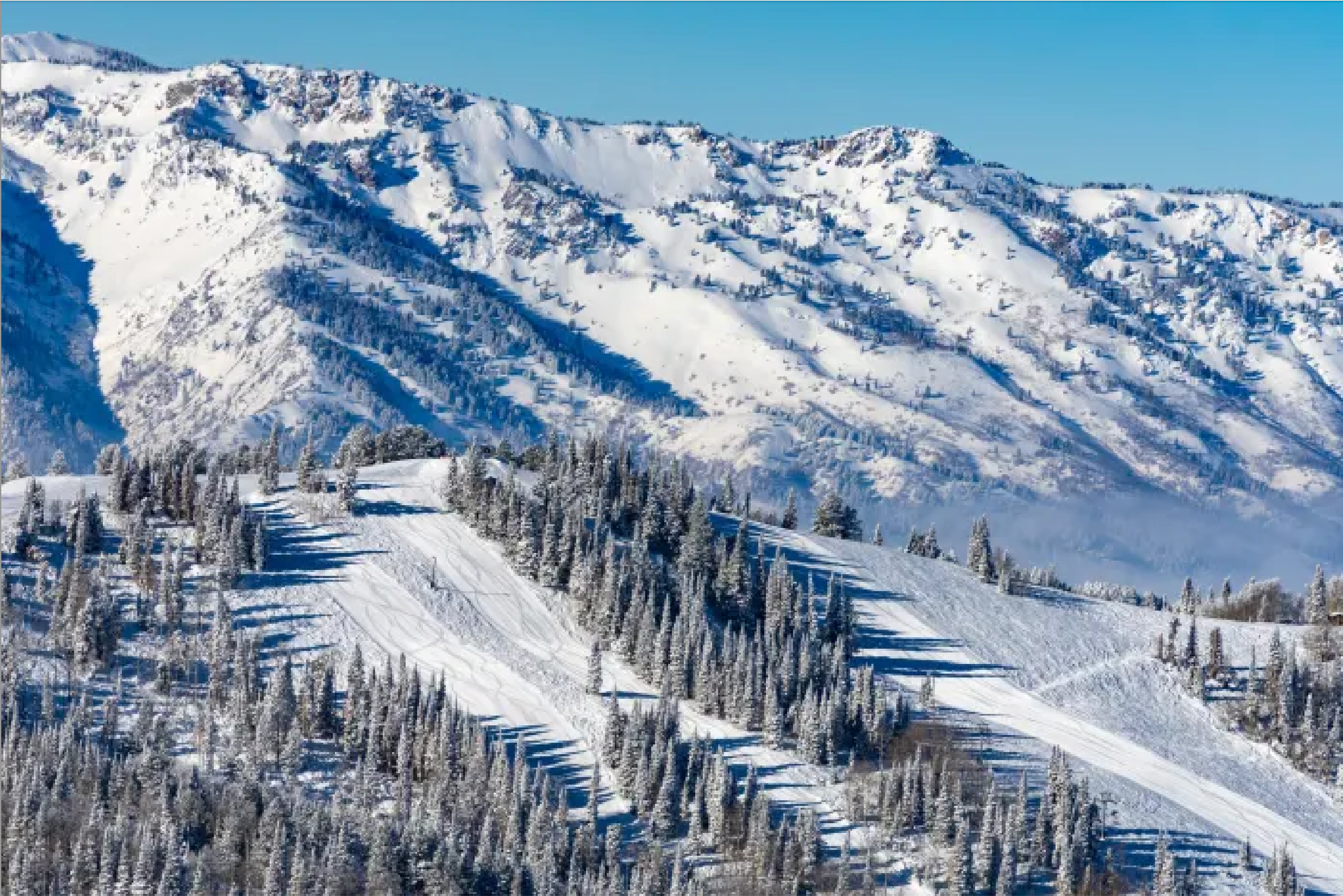
The counterweight has been free advertising for a 440-vertical-foot municipal ski area called Holiday Mountain, situated between the Neversink River at its base and a divided four-lane highway up top. Although the lettering has since faded, this beloved ski hill, the last dedicated ski area in the southern Catskills according to the Facebook group Catskill Skiing History, is undergoing a multi-year renovation driven by a local entrepreneur who is also a lifelong skier and ski patroller.
Holiday Goes Private
The hill’s riverside terrain opened for skiing in November 1949, with three electric tows, rolling slopes, expert trails and a “Swiss Ski School” to bring authentic Alpine techniques to New York skiers. The original iteration of Holiday, developed by local businessmen Don Hammond, a department store owner, and Manny Bogner, a lumber dealer, also offered a warming hut and ski shop—but it was abandoned after a few years due to a lack of snow, according to Remembering the Sullivan County Catskills, by local historian John Conway.
In December 1957, when the town of Thompson parks commission purchased the property from local resident Maude A. Crawford for $5,000, the ski area reopened with two rope tows and a 900-foot platter-pull lift with an uphill capacity of 900 skiers per hour, according to the Conway book.
Holiday wasn’t as challenging as, say, Stowe’s Nosedive terrain, but in 1957 the New York Times gushed that the ski area will “more than suffice for the run-of-the-mill sports lover who wants to test his legs as well as enjoy the sport with a minimum risk of injury.” Trails and slopes sported holiday-related names, including Easter Parade, Birthday Schuss and Christmas Bowl. Forty years later, as losses mounted and local taxpayers grew tired of deficits ranging upward of $250,000 per year, town leaders decided to bail out of the ski business.
The ski area was purchased from the town in 2000 by Craig Passante, son of the late owner of the nearby Villa Roma Resort (which still offers skiing and snow tubing to guests). The younger Passante, a Hofstra University graduate with a degree in marketing and an honorary doctorate in hospitality, tried to pump new life into the aging facility by adding a family-activities park, motocross course and special events.
The adjacent Neversink River, known for world-class fly fishing, was a blessing for snowmaking but flooded the 1950s-era base lodge in April 2005. In summer 2011, Hurricane Irene and Tropical Storm Lee caused more damage, according to the Sullivan County Democrat (June 13, 2023). What’s more, low snowfall totals during those years did little to help Passante turn the struggling ski hill around.
Determined to prevent the land from being sold for a housing development, Monticello native Michael Taylor, a longtime ski patroller at nearby Plattekill Mountain and great-grandson of original landowner Maude Crawford, purchased the teetering ski area in May 2023.
No Holiday
“This ski area was about to drop dead,” wrote Stuart Winchester of The Storm Skiing Journal and Podcast in November 2024. “Then Mike Taylor bought it. … He has resources. He has energy. He has manpower. And he’s going to transform this dysfunctional junkpile of a ski area into something modern, something nice, something that will last. And everyone knows it wouldn’t be happening without him.”
Tayor, 58, is a successful businessman, the CEO of his family’s propane and heating-oil business in the New York Tri-State area. Still, preventing the ski area from becoming another entry in the directory of lost ski areas was no holiday.
Overcoming the reluctance of banks to loan to a modest ski area, Taylor spent $10 million in renovations, encountering enough bumps along the way to fill a World Cup mogul run. However, he remains dedicated and optimistic about Holiday’s future. “We’re 85 miles from 12 million people,” Taylor told the Sullivan County Democrat shortly after purchasing the area. “We can’t fail.”
Taylor and his team, often improvising on the fly, had to contend with snowmaking pumps and guns that clogged with river grass; a pump-house fire that caused $500,000 in damage; extensive soil erosion caused by the motorcross operation; a scarcity of chairlift parts; the cancellation of local after-school ski programs and the costly landscaping of the adjacent Bridgeville Cemetery, which dates back to the late 1700s. To add to the financial challenges of running a diminutive ski area, a fire damaged the attic of its new snowtubing lodge one week before opening this season, delaying the launch of this popular kids’ activity.
From Molehill to Mountain
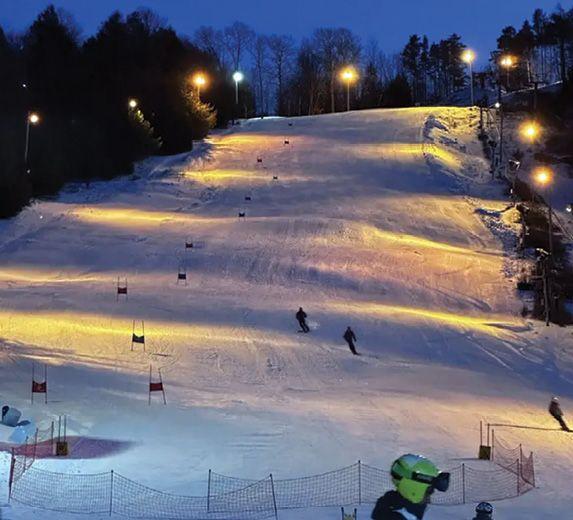
Today, it’s hard to imagine a small ski area—with just 40 skiable acres, a stingy 55-inch average annual snowfall and a 1,600-foot summit—doing so much with so little. This season the mountain opened with nine trails, anchored by a refurbished quad and triple chair. Other amenities include an 11-lane lighted snow-tubing park and a ropetow and conveyor lift overlooking the cemetery. An upgraded snowmaking system, including 200 new guns and towers and eight miles of snowmaking pipe, strive to compensate for the area’s typically modest snowfall. A true community ski area, Holiday is closed on Mondays. One benefit of its tiny footprint, Holiday is able to offer night skiing across all of its terrain—a staple amenity for a family area.
There’s also Mambo Night, a new trail that honors the Cuban-themed dance parties once held at now-defunct Catskill resorts, and Hackledam, named after a former tanning and lumbering community that existed nearby in the late 1800s. The double black, winch-groomed trail is said to be one of the steepest in the Catskills. “We’ve really rebuilt this ski area from the ground up,” says Taylor.
Fond Memories
News about Holiday’s resurrection was greeted by the region’s skiers like a powder forecast. Jeff McBride, 66, now of Las Vegas, Nevada, and a grandson of Don Hammond, lived within sight of the mountain and started skiing there at age four. “I loved skiing Holiday nearly every day of the season,” he says, “practicing Daffies, back scratchers and side-tucks almost daily for annual freestyle skiing contests.
McBride, who became a professional magician and has several entries in the Guinness Book of World Records, especially remembers drinking hot Dr Pepper with lemon in the base lodge. (Apparently “hot Doc” was a thing back then, according to the web channel Tasting History with Max Miller.)
Catskill skiing historian and native Barry Levinson, 65, who now resides in Gypsum, Colorado, recalls that as a kid, “I kinda hated this little rinky-dink 440-foot hill with a highway on top and a gravel pit on the bottom that did not look like the pictures I saw in SKI, Skiing and Powder magazines.” However, “now, with age and perhaps wisdom and a sense of nostalgia I look back on it and feel lucky to have had that hill in my backyard. Holiday Mountain [was] neither a holiday nor a mountain, but it was ours.”
Future Plans
The conversion of Route 17 to Interstate I-86 has been a long-term state project, with major upgrades planned to bring the section passing Holiday Mountain up to Interstate standards, according to the New York State Department of Transportation. Still several years away, this will reduce commuter congestion during weekday peak hours and mitigate weekend vacation traffic, hopefully leading to more ticket sales for Holiday.
Today Taylor is singularly focused on his mission, as determined as ever to answer the question of “How do we get kids off their phones and out recreating again?” As he told Storm Skiing, “You can’t make me happier than to see busloads of kids improving their skills and enjoying something they’re going to do for the rest of their lives.”
Jeff Blumenfeld grew up skiing at Holiday Mountain. A resident of Boulder, Colorado, Blumenfeld is vice president of ISHA and past president of the North American Snowsports Journalists Association. He chairs the Rocky Mountain chapter of the Explorers Club and has covered the adventure field in ExpeditionNews.com for 32 years.
Moderated by Charlie Sanders, president of the North American Snowsports Journalists Association and ISHA Board member; with Chris Gloninger, meteorologist and climate educator; Wendolyn Holland, renewable energy consultant to the US Dept of Energy, and ISHA Board member; and Seth Masia, ISHA president and former executive director of the American Solar Energy Society.
Authors and producers to be honored March 22 in Park City
ISHA’s Awards Committee has announced the winners of the 2023 ISHA Awards, honoring the best works of history published or produced during this past year.
The awards will be presented during a banquet in Park City, Utah, on March 22. Watch for reviews of the winning books and films in the Media Reviews section of this magazine.
Ullr Awards
• Around the World in 50 Slopes, by Patrick Thorne
• Georges Blanchon: Cet homme protée libre et généreux, by Daniel Sage
• Winterdanse: The Misplaced Art of Snow Ballet, by Michael Russell
• Une Histoire des skis Dynamic: Skis de Légende adoptés par des coureurs exceptionnels, by Jean Michal
Baldur Awards
• Junior Bounous and the Joys of Skiing, by Ayja Bounous
• Disneyland on the Mountain: Walt, the Environmentalists, and the Ski Resort That Never Was, by Greg Glasgow & Kathryn Mayer
Skade Awards
• From Ranch to Resort: The History of Sierra at Tahoe, by Christopher C. Couper
• Eldora: Six Decades of Adventure, by Rett Ertl and Andy Bigford
• Skiing off the Roof, by Rick Walkom
Film Awards
• Full Circle: A Story of Post Traumatic Growth
Trevor Kennison, Barry Corbet, Josh Berman and Trish Sullivan-Rothberg
• Buried: The 1982 Alpine Meadows
Avalanche Jared Drake, Steven Siig (directors and producers); Evan Hayes, Mark Gogolewski, Shannon
Houchins, David Hillman and Michael Sugar (executive producers)
• Alf Engen: Snapshots of a Sports Icon
Alan and Barbara Engen (producers)
Cyber Award
• Perisherhistory.org/au, Perisher Historical Society
Honorable Mentions
• Baldur: Without Restraint, by Robert C. DeLena and Ryan C. DeLena
• Skade: Skiing in Colorado, by Colorado Snowsports Museum and Hall of Fame and Dana Mathios
• Film: NGR: The Fabulous Life of Nancy Greene Raine, by Lainey Mullins
• Film: Sierra Nevada Ski and Olympic History: And the Future SNOW Museum, by Eddy Ancinas and Steve
Jensen
Join us in Park City, March 20–23
The International Skiing History Association and the U.S. Ski & Snowboard Hall of Fame will hold our annual joint gathering in Utah. We invite you to join us for four days of skiing with friends and colleagues, on-snow tours, lectures, fashion shows, meet-and-greets and back-to-back evenings of awards honoring the 2023 ISHA Award winners (Friday evening) and Hall of Fame Class of 2023 (Saturday evening).
Schedule of Events
(subject to change)
Wednesday, March 20
100 Years of Winter Olympics anniversary party, with vintage fashion show beginning 5 p.m., at the Alf Engen Museum
Thursday, March 21
• Group skiing at Sundance Ski Resort
• ISHA John Fry Lecture: Billy Kidd discusses the 1964 Olympics
• Doug Pfeiffer memorial dinner
•Welcome Party
Friday, March 22
• Group skiing at Solitude; free-heel skiing at White Pine Touring with Jan Reynolds
• Women in Industry Award, honoring Judy Gray
• Gorsuch fashion show
• ISHA Awards Reception and Gala Banquet
• Industry party
Saturday, March 23
• USSS Hall of Fame Induction Banquet
• After-burner party
For full event details, ticket packages and discounted lodging at Black Rock Mountain Resort, go to skiinghistory.org/events. Details on discounted lift passes will be sent after you book banquet tickets.
In this day of perpetual social media marketing hooks, “extremes” sell: hottest, tallest, biggest, fastest. Ski resorts are not immune. However, determining a superlative like the longest ski run on the planet is not as simple as it would seem.
This exercise is rife with caveats. Are we talking about vertical feet or length? Lift-served or not? Off-piste or maintained? Perhaps the most mainstream solution is to determine the longest runs by using both vertical and length—further sorted by some sort of lift service. Or perhaps just consider it a skier’s bucket list.
Guinness Book of World Records says that a run at Davos, Switzerland, from the Weissfluhjoch to Parsenn, is “the longest all-downhill ski run in the world” at 7.6 miles in 6,692 vertical feet (12.3 km and 2,034 m). Many may disagree, partly due to the ambiguous “all-downhill” criteria, designed to exclude anything with a hike or another lift ride in the middle. Or a bus ride at the end. And we won’t delve into Guinness’s definition of lift-served.
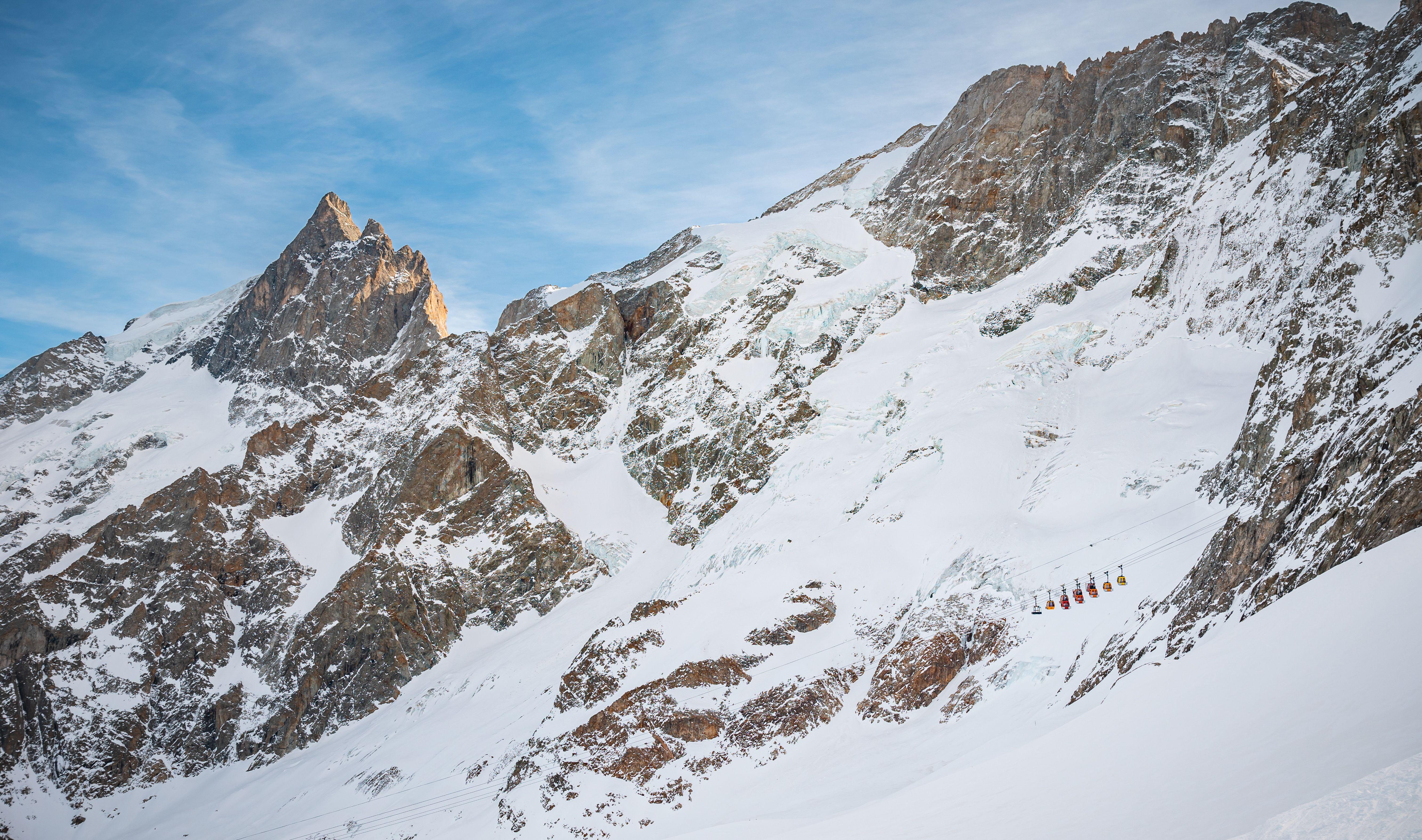
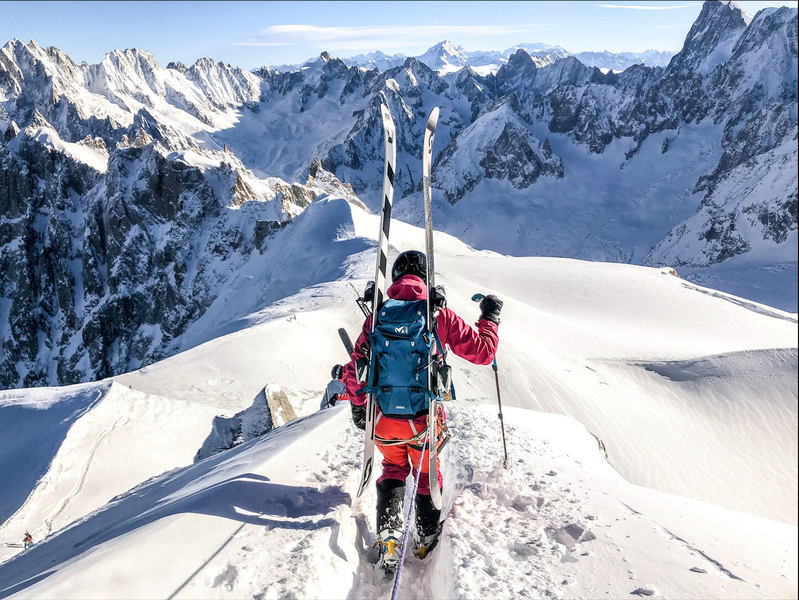
One of the best-known lift-served long runs in the world is Chamonix’s Vallée Blanche, which helps explain why we feel a little mystical about such endless terrain. Its most far-flung route is 13.67 miles (22 km), all of it off-piste and bedecked with chamois, blue-ice caverns, crevasses, lurching seracs and stupefying mountain views. Its full 9,200-foot vertical (2,797 m) goes all the way to the Chamonix valley floor, though
climate change has increasingly made that a rare reward.
Zermatt, Switzerland, features what is marketed as the longest red (intermediate) run in the world. The 13.6-mile (22 km) trail from the Klein Matterhorn to the Italy's Valtournenche measures 7,739 vertical feet (2,353 m) and delivers you to another country. It does require a lift ride in the middle, however.
Alpe d’Huez, France, describes its famous Sarenne route as “Europe’s longest black run.” The nearly 10-mile (6.2 km) descent in 5,872 vertical feet (1,785 m) can be done, according to the resort, “without having to take a lift.”
North America looks to Revelstoke, Canada, for bragging rights. Revelstoke claims the Last Spike as the longest maintained ski run in North America at 8.3 miles (13.4 km). As a plus, the run descends the resort’s full vertical, which at 5,620 feet (1,708 m), is tops on the continent.
A future the size of the terrain? Ian Matteson photo
Netflix Co-Founder Buys North America’s Resort-Acreage King
Powder Mountain, Utah, Tries Again to Be the Resort of the Future
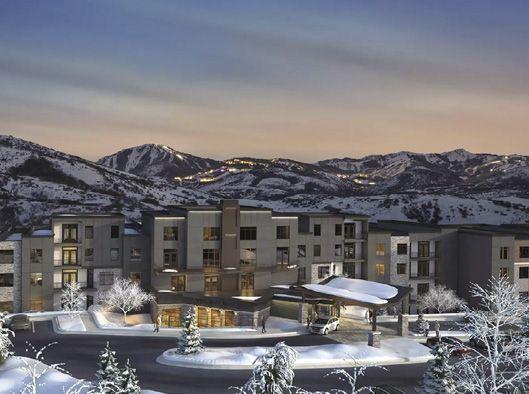
Tech money has joined forces with the largest ski resort (by skiable acres) in North America, in what may have been an inevitable marriage. On September 6, 2023, with a $100 million investment, Netflix co-founder Reed Hastings became the majority owner of Powder Mountain. Hastings had already acquired a minority stake in the Eden, Utah, resort, which covers over 8,464 acres—roughly 16 percent broader than Park City.
Hastings has only started his re-imagining of the resort in what he has termed “Powder Next.” To that end, he recently pulled all available residential lots at Powder off the market. “That’s a big step that you do when you have confidence that it’s going to be a lot more successful in a year,” Hastings told the Salt Lake Tribune. “So we kind of don’t want to sell those lots at current prices.” Hastings said he envisions the reworked resort as being a “premium place in the world for being and doing.”
Perhaps Powder Mountain will go full circle with that vision. It was purchased by a group of Silicon Valley entrepreneurs out of foreclosure for $40 million in 2013. Their vision was to build a future-embracing, eco-friendly resort with 500 homes developed around a hub of education, research and alternative medical facilities. Various challenges ensued, and fewer than 10 percent of the homes were built. Hastings, who stepped down as CEO of Netflix last January and now serves as executive chairman of the company, already had a home at the resort before he bought in. —Greg Ditrinco
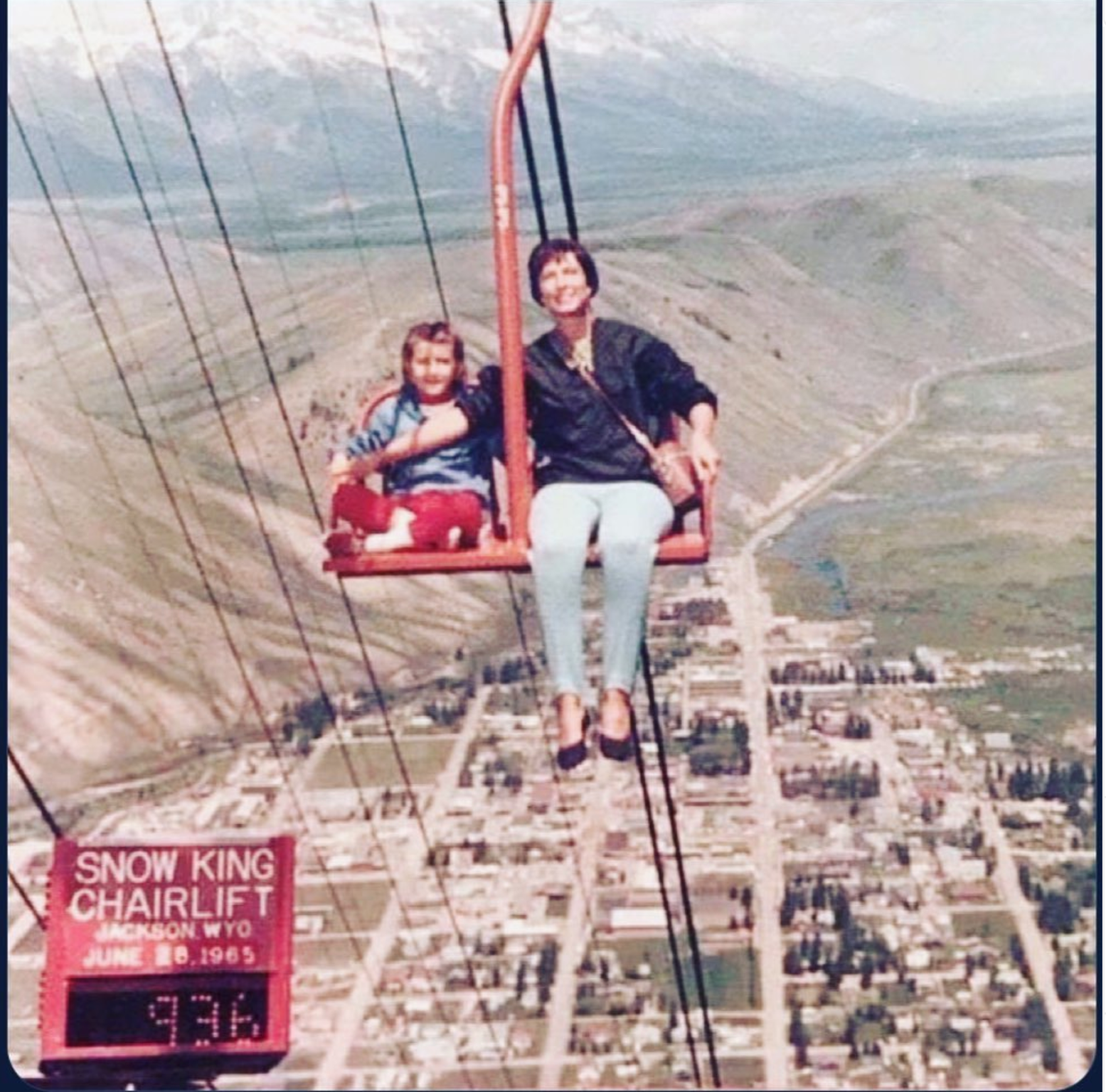
Snow King lift: Wooden towers.
Old Time Lift Safety
Snow King Mountain Resort, Wyoming, about a dozen miles and several thousand light years in attitude from Jackson Hole Mountain Resort, remembers the good ol’ days. The resort also wisely recognizes that hazy nostalgia might cloud some of the darker aspects of those good ol’ days. For instance, this image, dated June 8, 1965, posted on Snow King’s Instagram feed, is headlined “Safety Standards in the 1960s.” Snow King wisely notes that “We have upgraded a bit since these days!” A Skiing History editor recalls riding that chair. Its towers were made of telephone poles, bolted together into tripods. They creaked.
Snapshots in Time
1924 And So It Began
The Winter sports of the eighth Olympic Games were officially opened today with the customary Olympic ceremonies, presided over by Gaston Vidal, Under Secretary of State for Physical Education. M. Vidal received the oaths of amateurism by the athletes entered for the competition. The teams of all the nations represented, bearing their national flags and emblems, then paraded from the City Hall to the skating rink, where the actual competitions will begin tomorrow. On the arrival at the rink Under Secretary Vidal declared the official opening of the sports. His voice, caught up by enormous amplifiers on top of the grandstands, was sent reverberating up the sides of the high mountains which give the Chamonix Valley its magnificent setting. — “The Olympics in Winter” (New York Times, January 25, 1924)
1975 Free-Heel Revolution
If you’re a cross-country skier in the West, you may well consider yourself a pioneer. Just as the frontiersmen had to adapt to the mountains of the West, so also do cross-country skiers have to adapt their methods and equipment. And since touring is just beginning to boom in the West, the field is wide open for search and discovery. Here in Crested Butte, the telemark turn has turned the sport upside down. A group of skiers will ski to the top of a mountain with the sole purpose of linking a hundred or so telemarks together down a virgin bowl. — Rick Borkovec, “Trendsetters” (Powder, November 1978)
1989 A Turn for the Worst
“Collisions have become the number one cause of injury in skiing,” said Linda Meyers Tikalski, a U.S. Ski Team member and an Olympian at the Squaw Games. “Skiers think control means ‘not falling.’ The new skiers don’t think ‘turning.’ They think ‘cruising.’ Unless we can convince skiers that good skiing is good turning, we’re in trouble.” — Mort Lund, “No-Risk Skiing” (Snow Country, February 1989)
1990 Olympic Need
I have enjoyed reading your magazine through the years. There is only one suggestion I have for you. Let’s see more time and money spent on our U.S. Olympic ski team and on Olympic racing worldwide. Even though it is two years away, there are athletes preparing. I feel it would be interesting to see what is happening in the Olympic world. — Lori Bucher, Aurora, Indiana, Letters, “More on the Olympics” (Skiing Magazine, October 1990)
2001 Bye-Bye Ban; Hello Boarders
The Aspen Skiing Company is looking to youth to lead it out of the wilderness of complacency and sagging skier numbers into a more prosperous future. Thus it was on April Fools’ Day, of all days, last season that the resort’s notorious anti-snowboarding walls came tumbling down on Aspen Mountain to great fanfare, if not the actual trumpets of Jericho. Because it’s Aspen and therefore good news copy, on April 1 the town is jammed with more satellite uplinks than after Ivana Trump spied Donald’s girlfriend during a family ski vacation. — Jay Cowan, “The New Aspen” (SKI Magazine, September 2001)
2023 Shrinking Prominence
Mont Blanc’s peak has been measured at 4,805.59 m (15,766 ft 4 in), which is 2.22 m shorter than in 2021. The mountain, which straddles France, Italy and Switzerland, is measured every two years to try and track the impact of climate change on the Alps. French chief geometer Jean des Garets said the shrinking could have been caused by less rain this summer. “We’re gathering the data for future generations,” he said. “We’re not here to interpret them, we leave that up to the scientists.” — “France’s highest mountain Mont Blanc is shrinking.” (BBC.com, October 5, 2023)
Pandemics create social change. In the 14th century, the Black Death killed at least one-third of Europe’s population. In western Europe, the resulting labor shortage drove up wages, freed the serfs, inspired adoption of time-saving technologies in agriculture and manufacturing, accelerated the growth of cities and trade, triggered peasant rebellions and hastened the replacement of feudal economic arrangements with capital investment schemes. Wealth inequality decreased. It took 250 years for the aristocracy to regain its 80 percent wealth concentration, and it had to open its ranks to bankers and merchants.
On a smaller scale, in the wake of Covid-19, ski towns and skiing culture are experiencing greatly accelerated social change. Thanks to modern medicine, the virus proved about 150 times less deadly than the bubonic plague, and its social effect thus far is almost the opposite of the 14th-century experience. Across the larger economy, Covid-19 concentrated wealth mightily, into the hands of internet retailers and tech entrepreneurs. Anyone who has lived in or visited a ski town over the past three winters noted ominous changes since Covid arrived early in 2020.
Real Estate Spikes
High real estate prices, and rents, soared higher. Using one prominent region, among many, in Colorado’s Eagle and Pitkin counties (which includes Vail and Aspen), the median selling price of a condo more than doubled between April 2019 and April 2023, from $850,000 to $1.75 million, rising an average of 23 percent per year. (During the previous 20 years, which included the dotcom crash and the 2008 subprime mortgage crisis, the average annual increase was about 3.5 percent.) The median price for a single-family home rose 320 percent, or 43 percent annually, from $2.5 million to $10.5 million (compared to an average annual 13.5 percent appreciation over the previous 20 years).
One reason for these spikes in value is that technology enabled wealthy people to work from home, and they chose to do it in the isolated splendor of luxurious mountain retreats. Another is that real estate looked like a sensible hedge against a volatile stock market, especially when mortgage rates fell below 3 percent in 2020 and 2021, while inflation peaked briefly at 9 percent in 2022 before falling to about 4 percent in May 2023. Even a severe recession is unlikely to bring real estate prices down to earth. Finally, any ski town can be an attractive refuge from climate change.
Covid, and resulting low interest rates, drove more modest inflation in other wealthy real-estate markets—prices of the top 5 percent of homes rose less than 11 percent worldwide at the peak of the boom in early 2022. As a result, Bloomberg reported, sales at the top of the U.S. market fell 17.8 percent that quarter.
Employees Driven Out
In all ski towns, rising prices and rents accelerated the flight of service employees. Those who kept their jobs faced long, expensive and sometimes dangerous commutes along snowy mountain roads. Along with labor shortages, the situation was tough on locally owned businesses, too. Many folded, to be replaced by restaurants, hotels and retail stores owned by cash-rich public corporations. NIMBY millionaires have even, perversely, worked to prevent construction of new employee housing. Pity the employee-housing resident forced to leave town at retirement. The exile of longtime residents greatly dilutes the character and flavor of ski towns, both for locals and visitors.
Crowded Slopes
Ah, visitors. Visitation to ski towns skyrocketed. At the height of Covid’s social distancing and masking experiments, outdoor sports boomed. Retailers sold out of bicycles, camping gear and ski equipment. After the ski resorts shuttered in March 2020—they were considered potential Covid super-spreader sites—skier visits for that winter dropped 12 percent, to 51.1 million in the U. S. (according to the National Ski Areas Association), and fell about 18 percent worldwide. But visits at U.S. resorts soared back to 59 million for the 2020–21 season and set a record at 60.7 million in 2021–22. Vail Resorts reported a 67 percent drop in profits for the fiscal year ending in July 2020, but set records in 2022, with revenue above $2.5 billion and profits up 15 percent over pre-Covid 2019.
There’s no evidence, however, that these record skier visits are based on any growth of the skier population. It’s never been more expensive to learn to ski at a destination resort—a well-heeled newcomer might spend $10,000 for lifts, lessons and lodging over the first week of a skiing career (for that kind of money you could earn a private pilot license). But with cheap season passes, existing skiers skied more often. Covid sent them home from the office and their kids home from school; the internet encouraged them to work from hotel rooms. As a result, skiers lined up in droves, creating early-morning lift lines and tromping out the powder by 9:30 a.m.
The rush sparked resentment among the swollen population of second-home “locals” and shrinking cast of seasonal employees. Locals have cursed tourists in the past (remember the “Turkey, Go Home” sentiment of the early ’70s?) but today’s wage-earning locals also resent lack of housing, static income and the entitled attitudes of some wealthy patrons.
Meanwhile, lodging costs inflated, too. The traditional shoulder and low seasons evaporated, as hotel owners found they could fill $500-per-night rooms until after Easter.
Long Term Trends
It’s likely that most of these changes would have happened anyway, but absent Covid, at a much slower rate. As noted, in Aspen and Vail, home prices rose about 13.5 percent per year for the two decades ending in 2019. At that rate, the median single-family home would be $4.2 million today and wouldn’t reach today’s value of $10.5 million until the year 2031.
All this may prove a boon to smaller resorts. “Independent” has become a valid brand. On the other hand, former ski-bum secrets are in many cases rapidly Aspenizing. Powder havens like Fernie and Big Sky are growing too expensive for the kind of gap-year ski bum who might once have settled in for good.
We’re decades past the era when someone like Whip Jones could respond to an overpriced monopoly market by building a competing resort (in his case, Aspen Highlands). We may be stuck with gentrified ski towns with no room for colorful ski bums, or for middle-class mom and pop with three kids in a van. And if you’re a lifelong skier, your options for retiring to a ski town have narrowed, perhaps vanished.
What can a middle-class skier do? Travel afield. Search out that off-brand indie mountain with cheap motels nearby. Go to Europe, where you can still buy a $50 daily pass for a network spanning three valleys and 120 lifts and get a $120 hotel room. Buy a winterized motorhome. Free your heels: climb for your turns or ski cross-country.
Resorts and ski-towns have proposed dozens of schemes for affordable employee housing. They want to repurpose or replace existing structures, build on city-owned land, incentivize homeowners to rent space on year-long leases (instead of short term), or import tiny homes. Any and all projects can meet with vociferous local opposition. Opponents cite neighborhood impacts on congestion, noise and architectural unsightliness, but it often boils down to anxiety about having working-class families around the corner. It’s a universal problem: Everyone recognizes a social issue but few want to be part of the solution. In May, the Colorado legislature failed to enact a statewide land-use bill meant to encourage construction of affordable housing because counties and towns didn’t want to cede authority to the state.
In economics, the concept of tragedy of the commons describes the overuse of a finite resource by self-interested individuals. That’s where we stand. No zoning law, or peasant rebellion, can restore the original spirit of the ski town.
Seth Masia is the president of ISHA.
Snow Country December 1988
“She wants to know if it’s got the modified slalom sidecut with pre-preg glass laminate for superior shock absorption.”
This induction class (Class of 2020) was recognized in 2022 after Covid-related delays. The Class of 2021 will be recognized at a physical event in the Fall of 2022.
Alexandre Bilodeau (Athlete Freestyle) of Montreal (photo above) won two Olympic gold medals in moguls, at the 2010 and 2014 Games. He won five FIS World Championship medals (three golds) and achieved 48 World Cup podiums, including 19 victories. In 2006, at 18, he became the youngest skier to win a World Cup mogul event. In 2009, he won the FIS overall titles for both moguls and freestyle.
Gordon Canning
Gordon Canning (Alpine Builder) joined the staff of Blue Mountain in 1970 under his father-in-law, Jojo Weider, and became president in 1978. He built the business into a year-round resort and retired in 2014. He built it into a year around resort. In 1999 he led a successful partnership with Intrawest to create Blue Mountain Village.
Philip Chew
Philip Chew (Para Alpine Coach) was diagnosed with bone cancer at age 25. During treatment he heard about disabled skiing, and went on to win Canadian, European and World Championship medals in all Alpine disciplines. After retiring from the Para National Ski Team in 1992, Phil became the first Level 3 Coach with a disability. He coached for 21 years and trained 24 athletes who moved up to the National Team, among them Paralympic and World Championship medalists.
Joe Fitzgerald
Joe Fitzgerald (Freestyle Builder) was a founding member of the Canadian Freestyle Ski Association. After earning a degree in physical education, Fitzgerald became the first freestyle technical director at the Canadian Ski Association. He developed certification programs, organized World Cup events in Canada and was chief of competition for the Calgary Olympics. He joined FIS in 2000 as freestyle director and oversaw inclusion of ski cross, halfpipe, slopestyle and big air to World Cup and Olympic status.
Darrell MacLachlan
Darrell MacLachlan (Alpine Builder) grew up racing in Calgary and became an Alpine race official. Beginning in 1992 he served as chief of race for the Lake Louise World Cup. He took the same role for men’s Alpine events at the 2010 Olympics and served as a technical delegate in Sochi. He died of cancer at age 63.
Dave Wood
Dave Wood (Nordic Coach) began skiing in his late teens in Prince George, British Columbia, and raced cross-country beginning in 1980. He began coaching in 1986. In 1998, Dave took over the struggling national cross-country ski team. Under his helm, Beckie Scott won gold at the 2002 Olympics. At the 2006 Games, Chandra Crawford won gold, while Sara Renner and Beckie Scott won silver in the team sprint.
Vermont Hall of Fame Names Class of 2022
After a two-year hiatus, the Vermont Ski and Snowboard Museum will hold its induction ceremony at Bolton Valley on September 24. Honorees are:
• Ralph DesLauriers, founder of Bolton Valley Resort
• Jim Holland, ski jumper and entrepreneur
• Rip McManus, Olympian, broadcaster, film star
• Betsy Pratt, steward of Mad River Glen ski area
• Greg Morrill, historian (Paul Robbins Award)
• Catamount Trail Association (Bill McCollum Community
Award)
Feature Image Media
Image
Article Date
Timestamp
Canadian Ski Hall of Fame Inducts Class of 2020
This induction class (Class of 2020) was recognized in 2022 after Covid-related delays. The Class of 2021 will be recognized at a physical event in the Fall of 2022.
Alexandre Bilodeau (Athlete Freestyle) of Montreal (photo above) won two Olympic gold medals in moguls, at the 2010 and 2014 Games. He won five FIS World Championship medals (three golds) and achieved 48 World Cup podiums, including 19 victories. In 2006, at 18, he became the youngest skier to win a World Cup mogul event. In 2009, he won the FIS overall titles for both moguls and freestyle.
Gordon Canning
Gordon Canning (Alpine Builder) joined the staff of Blue Mountain in 1970 under his father-in-law, Jojo Weider, and became president in 1978. He built the business into a year-round resort and retired in 2014. He built it into a year around resort. In 1999 he led a successful partnership with Intrawest to create Blue Mountain Village.
Philip Chew
Philip Chew (Para Alpine Coach) was diagnosed with bone cancer at age 25. During treatment he heard about disabled skiing, and went on to win Canadian, European and World Championship medals in all Alpine disciplines. After retiring from the Para National Ski Team in 1992, Phil became the first Level 3 Coach with a disability. He coached for 21 years and trained 24 athletes who moved up to the National Team, among them Paralympic and World Championship medalists.
Joe Fitzgerald
Joe Fitzgerald (Freestyle Builder) was a founding member of the Canadian Freestyle Ski Association. After earning a degree in physical education, Fitzgerald became the first freestyle technical director at the Canadian Ski Association. He developed certification programs, organized World Cup events in Canada and was chief of competition for the Calgary Olympics. He joined FIS in 2000 as freestyle director and oversaw inclusion of ski cross, halfpipe, slopestyle and big air to World Cup and Olympic status.
Darrell MacLachlan
Darrell MacLachlan (Alpine Builder) grew up racing in Calgary and became an Alpine race official. Beginning in 1992 he served as chief of race for the Lake Louise World Cup. He took the same role for men’s Alpine events at the 2010 Olympics and served as a technical delegate in Sochi. He died of cancer at age 63.
Dave Wood
Dave Wood (Nordic Coach) began skiing in his late teens in Prince George, British Columbia, and raced cross-country beginning in 1980. He began coaching in 1986. In 1998, Dave took over the struggling national cross-country ski team. Under his helm, Beckie Scott won gold at the 2002 Olympics. At the 2006 Games, Chandra Crawford won gold, while Sara Renner and Beckie Scott won silver in the team sprint.
Vermont Hall of Fame Names Class of 2022
After a two-year hiatus, the Vermont Ski and Snowboard Museum will hold its induction ceremony at Bolton Valley on September 24. Honorees are:
• Ralph DesLauriers, founder of Bolton Valley Resort
• Jim Holland, ski jumper and entrepreneur
• Rip McManus, Olympian, broadcaster, film star
• Betsy Pratt, steward of Mad River Glen ski area
• Greg Morrill, historian (Paul Robbins Award)
• Catamount Trail Association (Bill McCollum Community
Award)
02/16/2023 - 3:02 PM
Open to Public?
On
Full Access Article for Public
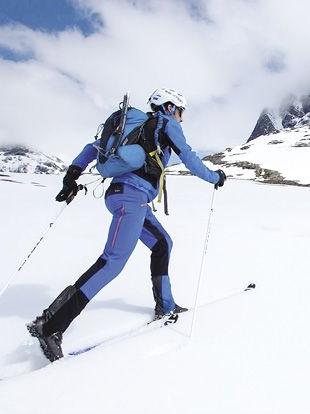
In 2019, long-distance runner and ski mountaineer Kilian Jornet—with the goal of just testing “how his body will perform”—completed 51 laps on Tusten ski area in Molde, Norway, in 24 hours. He climbed 78,274 feet, crushing previous 24-hour records by a ridiculous margin. To be clear, Molde is at sea level. Jornet climbed 1,535 feet, 51 times, on roughly a one-mile piste. That works out to skinning up at about 2.25 mph for 25 minutes and resting a couple of minutes during a 36-mph schuss. Fifty-one times.
Photo above: Kilian Jornet has been rewriting the record books for ski mountaineering and high-altitude running for more than a decade, sometimes merely as a result of his training regimen. Right: An early ski-endurance competition, the 24 Hours of Aspen attracted elite athletes, television audiences and sponsorship dollars in the 1980s-1990s. YouTube photo
That’s nothing for the Catalan Jornet, who grew up in Chamonix. For more than 15 years he’s been methodically assaulting the records for high-altitude marathons and ski mountaineering. In his recent five-year “Summits of My Life” project, he set the fastest known times (or FKT) for the ascent and ski descent of major mountains including Kilimanjaro, Denali, Aconcagua, the Matterhorn and Mont Blanc, at times shaving hours off previous records. Some of his records have since been broken by Ecuadorian mountain guide Karl Egloff.
Climbing and skiing massive verticals has become a passion with today’s endurance athletes, who are repeatedly blowing by many of the world's best times. Which begs the question, when did vertical-feet-skied become a thing?
Before smart watches and phone apps made vertical-feet scorekeeping easy, it was possible to estimate your numbers from the number of runs completed. Heliski operators charged by the vertical foot, and kept accurate count. You could keep track of your bragging rights whether for 24 hours, a week, a season or a lifetime. Heliski operations certified guest accomplishments with pins and special million-foot prizes, like Mike Wiegele’s silver belt buckles and limited-edition powder suits at Canadian Mountain Holidays.
One of the first vertical-foot-based competitions was the late 24 Hours of Aspen. After 13 events in 16 years, declining television ratings scuttled the show in 2003. But it left behind a slew of records. Chris Kent of Canada did 83 laps for 271,161 feet for the men’s mark in 1991. That’s 216 miles of skiing at an average 66 mph. Kate McBride and Anda Rojs set the women’s vertical record of 261,360 feet in 1997.
Once the genie was out of the bottle, lift- and rotor-assisted records started to topple. In 1994, Canadian speed skier and Chamonix resident Mark Jones logged 212,000 vertical feet in just 12 hours at Les Grands Montets. Next, Dr. Mark Bennett racked up 294,380 feet in 14 hours in the Yukon in 1997 for a new “daylight” world record. Fourteen months later, former U.S. Ski Team racer Rusty Squires chartered a specialized high-altitude helicopter and recorded 331,160 vertical feet in 10 hours and 15 minutes at Big Sky, Montana.
In the meantime, the guides at Wiegele’s were determined to set a record based on the normal constraints of commercial heli-skiing, with a full group of skiers and a single machine. In 1998, Swiss extreme skier Dominique Perret, Chris Kent and Austrian guide Robert Reindl, with Edi Podivinsky and Luke Sauder of the Canadian Alpine Team, logged 353,600 vertical feet in 14½ hours.
Austrian Ekkehard Dörschlag owns the
24-hour record for vertical climbed.
By this point recognition was growing that assisted vertical-foot records were as much about money as skill and endurance. As ski mountaineering boomed (it’ll be a full medal event at the 2026 Milan Cortina Olympics) interest focused on self-powered athletes. In 2009, Austrian Eckhard Dorschlag set a 24-hour world record of 60,350 feet. Ultra-marathoner Mike Foote broke that in 2018 with 68,697 feet. A few months later Norwegian Lars Erik Eriksen took it to 68,697 feet. Then Jornet obliterated that.
Born in 1987, Jornet has captured more Skyrunner World Series and Skimo (ski mountaineering) World Championship medals than we have room to list. He still holds the mark for the Innominata ski traverse on Mont Blanc linking Chamonix and Courmayeur (8 hours 42 minutes), as well as the fastest ascent/descent of Mont Blanc from Chamonix (4:57) and of the Matterhorn from Breuil-Cervinia (2:52).
As for why all the fuss over vertical speed records advancing every season, Nick Heil, writing in Outside, quoted Foote: “How many push-ups can I do in a minute? How long can I hold my breath? How far can I ski in a day? In the end, it’s all arbitrary and contrived, but it gets people to ask, what am I capable of?”
Snapshots in Time
1958 Be Careful What You Wish For
A penetrating statistical study of the ski industry in Colorado and New Mexico has been published by the University of Colorado. Pointing out that a great many more tourists visit Colorado and New Mexico in June, July and August than in the other months of the year, the authors ask if it is not possible to develop the winter tourist industry so that tourist facilities can be used all year. — “Skiers Under Scrutiny in Colorado and New Mexico” (SKI Magazine, October 1958)
1970 The Continuing Death of the Ski Bum
Once upon a time, the ski bum was the ultimate ski insider. As neither an entrenched member of the ski-area management nor a local profiteer, he enjoyed a free-swinging life with lots of time to ski and unlimited access to the inner circles of the ski establishment. It is, therefore, ironic that as the need for ski workers grows, the reputation of the ski bum diminishes. Ski bums, industry management will tell you, are bad news; the title is now synonymous with “hippie.” Many employers won’t consider hiring ski bums, even for temporary jobs. As a result, there are fewer of the old-time ski-bum types than ever before. — Janet Nelson, “But They’re Employed” (SKI Magazine, January 1970)
1978 Risk v. Reward
I have been skiing o.b. for many years. Skiing out of bounds is extremely dangerous. Inevitably some crazy powder addicts (myself included) will continue to leave the “safe” confines of patrolled areas. After reading Lou Dawson’s account and subtle hints (“... how far can you crawl with a spinal fracture?”), I realized certain steps must be taken to ensure the safety or at least the survival of o.b. skiers. Education is what is needed on this topic. — Steven Harrison, Central Valley, New York, “Whistling in the Dark" (Letters, Powder Magazine, Spring 1978)
1981 Crowds and Crashes
The rapidly increasing skiing population has led to an alarming increase in inconsiderate and out-of-control skiers who are a serious menace. Last season, an out-of-control skier crashed into me. He never so much as asked if I needed help. I’ll have a scar I’ll carry for the rest of my life. For too long ski areas have allowed Bonzai Bombers to endanger others on the slope without adequate punishment. It’s time something was done to protect the rest of us from these slope-side criminals. —Thomas F. Warda, Rochester, N.Y., "Slope menaces" (Letters, Skiing Magazine, October 1981)
2007 Bode Rules
Call them the Bode Rules. This year every athlete on the U.S. Ski Team is required to stay in official team housing. Every racer on the team is also prohibited from having a celebratory drink with the coaches after a big win, because it’s a slippery slope from that to, say, being photographed carousing with Miss March 2002 draped on your arm during the Olympics. U.S. Ski Team chief Bill Marolt implemented the stricter guidelines after the strongest American squad in decades limped away from the 2006 Torino Games with only two medals—neither of them won by the phenomenally gifted Bode Miller. —Nathaniel Vinton, “Ski Fast but Party Slow”(SKI Magazine, February 2007)
2021 A Woman’s Place Is On Patrol
“When there are women on a team like this, it lends an important voice and perspective to the job. I can say that having women on patrol keeps everyone connected. Men muscle their way through the job and women do it with finesse,” said Addy McCord, 64, one of the longest-standing professional patrollers in the industry. — Shauna Farnell, “A Surge of Women in Ski Patrols, Once Nearly All Men” (New York Times, February 11, 2021)
Feature Image Media
Image
Article Date
Timestamp
In 2019, long-distance runner and ski mountaineer Kilian Jornet—with the goal of just testing “how his body will perform”—completed 51 laps on Tusten ski area in Molde, Norway, in 24 hours. He climbed 78,274 feet, crushing previous 24-hour records by a ridiculous margin. To be clear, Molde is at sea level. Jornet climbed 1,535 feet, 51 times, on roughly a one-mile piste. That works out to skinning up at about 2.25 mph for 25 minutes and resting a couple of minutes during a 36-mph schuss. Fifty-one times.
Photo above: Kilian Jornet has been rewriting the record books for ski mountaineering and high-altitude running for more than a decade, sometimes merely as a result of his training regimen. Right: An early ski-endurance competition, the 24 Hours of Aspen attracted elite athletes, television audiences and sponsorship dollars in the 1980s-1990s. YouTube photo
That’s nothing for the Catalan Jornet, who grew up in Chamonix. For more than 15 years he’s been methodically assaulting the records for high-altitude marathons and ski mountaineering. In his recent five-year “Summits of My Life” project, he set the fastest known times (or FKT) for the ascent and ski descent of major mountains including Kilimanjaro, Denali, Aconcagua, the Matterhorn and Mont Blanc, at times shaving hours off previous records. Some of his records have since been broken by Ecuadorian mountain guide Karl Egloff.
Climbing and skiing massive verticals has become a passion with today’s endurance athletes, who are repeatedly blowing by many of the world's best times. Which begs the question, when did vertical-feet-skied become a thing?
Before smart watches and phone apps made vertical-feet scorekeeping easy, it was possible to estimate your numbers from the number of runs completed. Heliski operators charged by the vertical foot, and kept accurate count. You could keep track of your bragging rights whether for 24 hours, a week, a season or a lifetime. Heliski operations certified guest accomplishments with pins and special million-foot prizes, like Mike Wiegele’s silver belt buckles and limited-edition powder suits at Canadian Mountain Holidays.
One of the first vertical-foot-based competitions was the late 24 Hours of Aspen. After 13 events in 16 years, declining television ratings scuttled the show in 2003. But it left behind a slew of records. Chris Kent of Canada did 83 laps for 271,161 feet for the men’s mark in 1991. That’s 216 miles of skiing at an average 66 mph. Kate McBride and Anda Rojs set the women’s vertical record of 261,360 feet in 1997.
Once the genie was out of the bottle, lift- and rotor-assisted records started to topple. In 1994, Canadian speed skier and Chamonix resident Mark Jones logged 212,000 vertical feet in just 12 hours at Les Grands Montets. Next, Dr. Mark Bennett racked up 294,380 feet in 14 hours in the Yukon in 1997 for a new “daylight” world record. Fourteen months later, former U.S. Ski Team racer Rusty Squires chartered a specialized high-altitude helicopter and recorded 331,160 vertical feet in 10 hours and 15 minutes at Big Sky, Montana.
In the meantime, the guides at Wiegele’s were determined to set a record based on the normal constraints of commercial heli-skiing, with a full group of skiers and a single machine. In 1998, Swiss extreme skier Dominique Perret, Chris Kent and Austrian guide Robert Reindl, with Edi Podivinsky and Luke Sauder of the Canadian Alpine Team, logged 353,600 vertical feet in 14½ hours.
Austrian Ekkehard Dörschlag owns the
24-hour record for vertical climbed.
By this point recognition was growing that assisted vertical-foot records were as much about money as skill and endurance. As ski mountaineering boomed (it’ll be a full medal event at the 2026 Milan Cortina Olympics) interest focused on self-powered athletes. In 2009, Austrian Eckhard Dorschlag set a 24-hour world record of 60,350 feet. Ultra-marathoner Mike Foote broke that in 2018 with 68,697 feet. A few months later Norwegian Lars Erik Eriksen took it to 68,697 feet. Then Jornet obliterated that.
Born in 1987, Jornet has captured more Skyrunner World Series and Skimo (ski mountaineering) World Championship medals than we have room to list. He still holds the mark for the Innominata ski traverse on Mont Blanc linking Chamonix and Courmayeur (8 hours 42 minutes), as well as the fastest ascent/descent of Mont Blanc from Chamonix (4:57) and of the Matterhorn from Breuil-Cervinia (2:52).
As for why all the fuss over vertical speed records advancing every season, Nick Heil, writing in Outside, quoted Foote: “How many push-ups can I do in a minute? How long can I hold my breath? How far can I ski in a day? In the end, it’s all arbitrary and contrived, but it gets people to ask, what am I capable of?”
Snapshots in Time
1958 Be Careful What You Wish For
A penetrating statistical study of the ski industry in Colorado and New Mexico has been published by the University of Colorado. Pointing out that a great many more tourists visit Colorado and New Mexico in June, July and August than in the other months of the year, the authors ask if it is not possible to develop the winter tourist industry so that tourist facilities can be used all year. — “Skiers Under Scrutiny in Colorado and New Mexico” (SKI Magazine, October 1958)
1970 The Continuing Death of the Ski Bum
Once upon a time, the ski bum was the ultimate ski insider. As neither an entrenched member of the ski-area management nor a local profiteer, he enjoyed a free-swinging life with lots of time to ski and unlimited access to the inner circles of the ski establishment. It is, therefore, ironic that as the need for ski workers grows, the reputation of the ski bum diminishes. Ski bums, industry management will tell you, are bad news; the title is now synonymous with “hippie.” Many employers won’t consider hiring ski bums, even for temporary jobs. As a result, there are fewer of the old-time ski-bum types than ever before. — Janet Nelson, “But They’re Employed” (SKI Magazine, January 1970)
1978 Risk v. Reward
I have been skiing o.b. for many years. Skiing out of bounds is extremely dangerous. Inevitably some crazy powder addicts (myself included) will continue to leave the “safe” confines of patrolled areas. After reading Lou Dawson’s account and subtle hints (“... how far can you crawl with a spinal fracture?”), I realized certain steps must be taken to ensure the safety or at least the survival of o.b. skiers. Education is what is needed on this topic. — Steven Harrison, Central Valley, New York, “Whistling in the Dark" (Letters, Powder Magazine, Spring 1978)
1981 Crowds and Crashes
The rapidly increasing skiing population has led to an alarming increase in inconsiderate and out-of-control skiers who are a serious menace. Last season, an out-of-control skier crashed into me. He never so much as asked if I needed help. I’ll have a scar I’ll carry for the rest of my life. For too long ski areas have allowed Bonzai Bombers to endanger others on the slope without adequate punishment. It’s time something was done to protect the rest of us from these slope-side criminals. —Thomas F. Warda, Rochester, N.Y., "Slope menaces" (Letters, Skiing Magazine, October 1981)
2007 Bode Rules
Call them the Bode Rules. This year every athlete on the U.S. Ski Team is required to stay in official team housing. Every racer on the team is also prohibited from having a celebratory drink with the coaches after a big win, because it’s a slippery slope from that to, say, being photographed carousing with Miss March 2002 draped on your arm during the Olympics. U.S. Ski Team chief Bill Marolt implemented the stricter guidelines after the strongest American squad in decades limped away from the 2006 Torino Games with only two medals—neither of them won by the phenomenally gifted Bode Miller. —Nathaniel Vinton, “Ski Fast but Party Slow”(SKI Magazine, February 2007)
2021 A Woman’s Place Is On Patrol
“When there are women on a team like this, it lends an important voice and perspective to the job. I can say that having women on patrol keeps everyone connected. Men muscle their way through the job and women do it with finesse,” said Addy McCord, 64, one of the longest-standing professional patrollers in the industry. — Shauna Farnell, “A Surge of Women in Ski Patrols, Once Nearly All Men” (New York Times, February 11, 2021)