Where are they now?

Open to Public?
Off
Feature Image Media
Image
Timestamp

Former World Cup superstars and siblings Andreas and Hanni Wenzel have found post-racing success in the business world.

By Edith Thys Morgan

Weg vom Computer raus in den Schnee.” That motto, which urges kids to get away from their computers and out in the snow, is what drives Andreas Wenzel. And it has him driving a lot. In addition to his duties as President of the Liechtenstein Ski Federation, Wenzel is Secretary General of the four-year-old European Ski Federation, an organization of 11 European national ski federations united to grow, promote and improve snowsports in Europe. Wenzel leads the charge on SNOWstar, a series of competitions that combine elements of alpine racing, freestyle and skicross and takes place at partner venues throughout Europe. We’re talking while he drives to Bolzano, Italy, for a symposium on tourism and kids. “It’s not boring,” he says of the constant travel throughout the Alps. “The only thing is the traffic!”

As comfortable as he is on the road and getting things done, Wenzel, half of the brother/sister combo that turned tiny Liechtenstein into a skiing powerhouse in the 1970s and ’80s, much prefers being active in the great outdoors. His connection to nature can be traced to his father, Hubert, a passionate mountaineer and world university champion in the alpine/nordic/jumping combined.

Hubert was among the millions of East Germans who fled west in the early 1950s. He left on bicycle with no money, headed for Munich to study forest engineering. There he met and married Hannelore, a Bavarian shot-put athlete. In 1955, Hubert set out to tour the Alps by bicycle, and after an accident in Switzerland walked 50 kilometers with his bike until he found a shop in Liechtenstein that could fix it. While earning the money for the repairs, he learned that his skills in both engineering and avalanche protection were much in demand in the 62-square-mile country comprised mostly of steep terrain. In 1958, the Wenzels moved to Liechtenstein, with one-year-old Hanni and four-month-old Andreas.

Hubert passed his love of the outdoors to his four children—Hanni, Andreas, Petra and Monica—and instructed them to spend every spare moment being active in the mountains. “We were educated to compete,” Andi explains. “That is not always good from a pedagogical side,” he says with laugh that hints at an intensely competitive household. (Younger sister Petra was 4th in GS in the 1982 Worlds.) The emphasis, however, was always on enjoying the mountains. “As a kid I was out in nature full power,” he recalls. “I was a lousy runner around a track but get me into the mountains and watch out!” The siblings’ ski racing talents grew and in 1974, 17-year-old Hanni, racing for West Germany, won the world championship in slalom.  The family was granted citizenship in Liechtenstein and in 1976 Team Liechtenstein (including the three Wenzel siblings, in addition to Paul and Willy Frommelt and Ursula Konzett) integrated for training with the Swiss Ski Team.

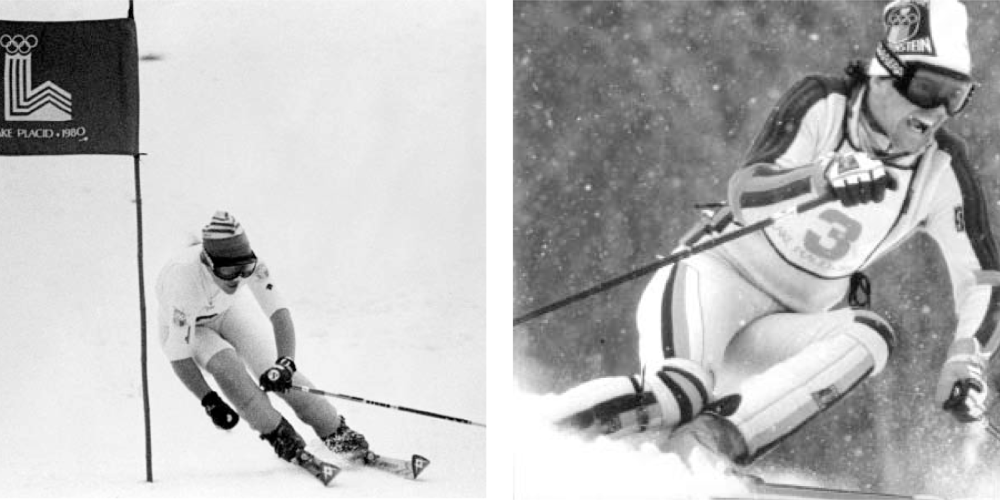
Andreas attended Austria’s famed Stams ski academy, competing in his first Olympics in 1976, at age 17.  In those Innsbruck Games, Hanni won Liechtenstein’s first Olympic medal, a bronze in the GS, and two years later Andreas earned his own world title in GS. But it was at the 1980 Lake Placid Olympics where Hanni and Andreas stole the show in their iconic white and yellow suits, producing four medals (and the first gold) for Liechtenstein. Hanni won a gold medal in both slalom and giant slalom, and a silver medal in downhill, while Andreas nabbed the silver in GS, bested only by Ingemar Stenmark and one of his signature second-run comebacks. The siblings crowned that season by each winning the overall World Cup title.

Hanni competed another four years, but along with Ingemar Stenmark was banned from the 1984 Olympics for her semi-professional status. She retired after the 1984 season, with 33 World Cup wins and two overall World Cup titles. Andreas retired in 1988 after his fourth Olympics, with 14 World Cup wins in all disciplines but downhill. Upon retiring, Andreas immediately dove into work, as racing director for Atomic. After four years there he switched to sports marketing, and was instrumental in bringing the first European sponsors (like Warsteiner beer) to North American ski races. Ten years later, he shifted gears again, becoming a tourism consultant. Then, in 2006, he was asked to become president of the Liechtenstein Ski Federation, and found himself back in the ski racing game.

The Liechtenstein Federation includes nine Skiclubs that teach kids until they are 10 years old. After that, the best qualify for the U12, U14 and U16 programs. The federation has 40 nordic, alpine and biathlon athletes and 11 trainers, but as ever, cooperates with other small nations to provide the best possible training framework. For example, Tina Weirather (daughter of Hanni and Austrian downhill great Harti Weirather, and a star on the current World Cup) races for Liechtenstein, but attended Stams and is now fully integrated on the Swiss team.

It is Wenzel’s work with ESF that keeps him on the road, and brings all of his athletic and business experience together with his passion for growing the sport. In Europe as in this country, kids are spending more time in front of screens and social media, and less time outdoors. “In Europe, we have seventy million people living close to the mountains. We want to get them in the sport and keep them in the sport while developing skills. And having fun is most important!” The SNOWstar events in particular—ten qualifying events and a European final—are aimed at doing just that in a safe environment for kids aged 10 to 16.

The events do not involve multiple sets of skis or race suits and are not set on an icy track. Rather, they are on less-harsh “Playground Snow” (a permanent infrastructure at the resorts, similar to a terrain park), studded with built-in features that demand athleticism while keeping the events lower in speed and higher on fun. Wenzel, known by fellow competitors for his intensity as well as his likeability, thinks kids should back off on ski racing’s regimented rigidity. “If you have to use a measuring tape to set GS for kids, something is not right,” he says. Instead, the courses are set in harmony with the natural terrain, teaching kids how to react and move. “Every day, conditions are different. It’s not just about making a fast turn, though that is important. It is about judgment.”

Wenzel reflects on his own upbringing, and on his father’s melding of nature and training in a competitive atmosphere, when he looks at what he hopes the SNOWstar events will help cultivate in kids. “Kids need to learn intuition, which is not something you can learn in a book,” he says. Intuition is what you do when you don’t have time to think, when you come around a corner fast and have to react to whatever is in your path. “More intuition, less thinking,” he explains. “You have to move with fluidity. Those who panic later rather than earlier are going to win the race.”

Wenzel’s drive to create more opportunities for kids outside the traditional ski racing pedigree is personal. “You know, the raw diamonds come not so much from the Gstaad’s and St Moritz’s. They come from tiny villages,” he says. And even, perhaps, tiny countries.  

Andreas and Hanni Wenzel
Open to Public?
Off
Feature Image Media
Image
Timestamp

He created the first mass-produced fiberglass cross country ski, and the biggest ski factory in Colorado.

By Seth Masia

Today, John Lovett leads a company that makes scientific instruments used to monitor the earth’s atmosphere. But his career began in high school, when he designed a pair of cross-country skis.

Lovett was a student at the Colorado Rocky Mountain School, a private boarding school where kids prep for college while engaged in the great outdoors. Roger Paris, the school’s French teacher, was also a six-time world champion kayaker, and his real vocation was to teach whitewater sports. He taught his students to build their own boats, with fiberglass.

In 1966, at 15, Lovett used the school’s kayak workshop to build a pair of cross-country skis, laminating a maple core with fiberglass. He now thinks this may have been the first pair of glass XC skis in the world. He made 15 more pairs and sold them to his classmates at $10 a pair. He experimented with the core thickness to get the flex just right, working to duplicate the spring and kick of a good wooden Norwegian ski.

“I was skiing in the backcountry a lot, and our 55-millimeter wooden cross-country skis would often break,” he says. “I just wanted something that wouldn’t break.” The design he settled on was 55 millimeters at the waist, with little or no sidecut, and a maple or birch veneer laminated to the base to take pine tar and wax.

Lovett graduated from CRMS in 1969 and moved to Boulder to attend the University of Colorado. But what he really wanted was a job making skis at the Lange/Dynamic factory in Broomfield. He talked to Wells Lange and Ian Ferguson, and wound up with a job in the ski-repair department working with Ken Harrell. 

When Harrell moved to A&T to work with Dynastar, Lovett went along. He continued to build glass cross-country skis in his spare time. Lange engineer Lew Greenberg joined the Lovett Ski Co. as a partner in 1971, but they couldn’t agree on production issues.

A&T wanted to distribute the ski. They loaned Lovett $54,000 to start and operate the business. He borrowed more money from his grandmother, and bought Greenberg out. Then he built a factory on Central Avenue on the east side of Boulder. By 1976, Lovett was selling 70,000 pairs a year of foam-core Lovett cross-country skis, private-label skis, and alpine skis—more than Head made at its factory in North Boulder. Lovett was 25 years old.

Lovett had invented a cheaper way to make a torsion-box ski. Instead of using an expensive milled cavity mold, as Dynamic, Lange, Head and K2 did, he figured out that anodized aluminum angle, riveted to an aluminum sheet, would hold the materials accurately in the InterMontana presses. For a machinist, he hired a smart Kansas farmboy named Lyle Felbush who could build anything. Lovett could whip out a new mold set in a few days, for about $200.

By 1973, Lovett was selling the first steel-edged XC ski with a polyethylene base—in effect, the first of the “norpine” skis on which the modern telemark movement would emerge. The cross-country market was new and growing, but sales didn’t match the production capacity. So he used the base-and-edge capability to build an alpine ski for kids, which A&T sold as the Hummer. He took orders for private-label skis from Gart Bros., then for other retailers. With his inexpensive tooling, he could charge a modest fee for design and engineering and then crank out a few thousand pairs of skis under a customer’s brand.

In 1974, Bob Burns lost his job as a sales rep at K2. In the fall, he drove down from Sun Valley in his Jaguar and asked Lovett to build him an alpine ski to sell. Lovett worked around the clock with his assistant, Laura Clevett. They took an old 207-centimeter Dynamic and made the sidecut deeper, then made a mold from tooling resin. They designed the construction  around a Dynastar-style omega foam core, making it torsionally stiff with a soft flex pattern for bump skiing. “We made two pair and they looked like hell,” Lovett recalls. “We molded the first pair in a cross-country press, so it had double camber—a lousy line for an alpine ski. But Burns went to Vail to show them off and they worked just great.”

A ski company was born, as a partnership between Lovett and Burns and half a dozen investors in Sun Valley, Vail and Aspen. Lovett designed and built the skis and Burns sold them. Burns told his friends he was making the skis in his garage in Sun Valley, and Lovett kept air-freighting two or three pairs at a time to Friedman Field from Stapleton Airport.

The new skis still had no paint, nor even a name. In Sun Valley, people called it “Burnsy’s ski.” Burns claimed the ski used a woven sagebrush core. Eventually, after a disagreement  over the graphics, they settled on big squares of primary colors and called it The Ski.

Lovett brought in his brother Kevin to set up a manufacturing facility in Ogden, Utah after the first winter. Mike Brunetto joined up to help manage the factory. Burns was a genius marketer and sales boomed. Burns insisted that the skis were made in Sun Valley, and kept the real source of the design secret.

The relationship didn’t last. In 1977 Lovett sold his half of the company to Burns, and Brunetto took over The Ski factory in Ogden.

In 1977, Lovett and Ken Harrell made about 100 pairs of Lovett alpine skis, but that energy was blunted when A&T couldn’t keep pace financially with the growth of production. The factory needed more capacity, and the distributor couldn’t swing it. In 1978, Lovett approached Al McDonough of Eastern Mountain Sports, the biggest U.S. retailer of cross-country skis. Within two weeks, EMS agreed to buy the factory.

Lovett walked away from the ski industry. He worked with Robert Redford for a couple of years. He took over the Frank Shorter line of running gear and staged a turnaround. During the 1980s, he did product development consulting for a number of companies. In 1987, he took over management of Allied Marine in Miami, Florida, and turned it into the world’s largest dealership of Hatteras yachts. In 1992, he put together a partnership to pioneer computerized high-frequency stock trading. After 1997, he settled in Edwards, Colorado for a few years, working on some “new urbanism” real estate developments.

In 2007, Lovett returned to Boulder as CEO of a company he’d invested in. Droplet Measurement Technologies makes high-precision instruments for atmospheric studies. The instruments are used by NASA, NOAA and other leading research organizations worldwide, for pollution studies, climate and rainfall research, weather modification studies, and aircraft icing certification.

And he skis a lot. “Those early years in the ski industry were the best time,” Lovett says now.  “Maybe everyone feels this way about the beginning of a career, but that era brought the most interesting challenges and the chance to work with the most stimulating people.  It was a golden time.”
John Lovett
Category