Twenty years ago, a tragedy triggered a push for safer ski racing that grew into a movement to empower people with spinal-cord injuries.
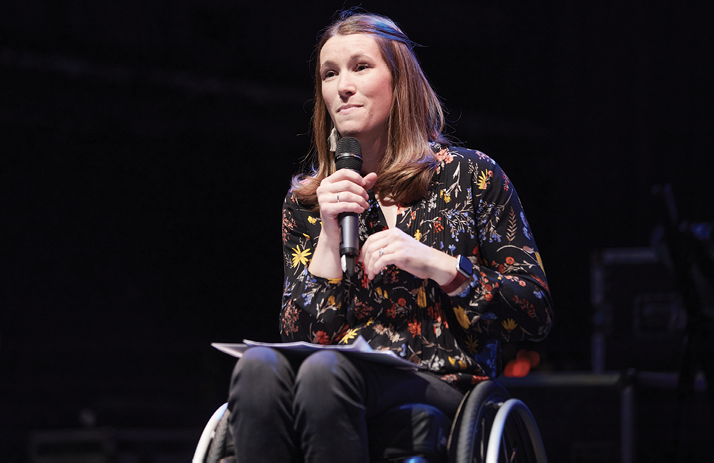
Photo top: Kelly Brush speaking. Kelly Brush Foundation photo.
Last winter a community of skiers gathered in Burlington, Vermont, to commemorate the 20th anniversary of Kelly Brush’s devastating ski accident during a giant slalom race at the Williams College winter carnival. The gathering was no somber occasion, however. It celebrated all that the Kelly Brush Foundation (KBF)—formed in the wake of the accident—has accomplished in the past two decades and offered a look at where it’s headed in the future.
Since the first Kelly Brush charity bike ride in September 2006, KBF has fulfilled one of its missions by changing the culture of ski racing in the U.S., making safety a priority rather than an afterthought. Ski clubs in all 50 states have benefitted from KBF grants that subsidize safety upgrades and equipment, along with education on how to properly use them. The annual bike ride now contributes more than $1 million of the $3 million-plus the organization raises annually.
Those funds not only go towards preventing accidents like Brush’s but also to KBF’s other, closely related mission: “To inspire and empower people with spinal-cord injuries to lead active and engaged lives.” To that end, the foundation awards grants to fund adaptive gear and instruction for at least 23 different sports, host adaptive sports camps and partner with 16 rehab centers to ensure that people with a spinal-cord injury know the opportunities available to them.
Now, KBF is focused on the next 20 years. That involves continuing its work at home and taking ski-racing safety global through a partnership with FIS. Moreover, building on its work in creating opportunities in adaptive sports, KBF leads a movement to make outdoor recreation a reality for all.
Two Missions
On February 18, 2006, Brush, a 19-year-old sophomore at Middlebury College, was racing at the Williams College winter carnival at Jiminy Peak Mountain Resort in Hancock, Mass. She caught an edge and tumbled off the course into an unprotected lift tower. The accident left her with four fractured ribs, a collapsed lung and a severe spinal-cord injury at the T 7-8 level. She spent the next six months rehabilitating and learning to navigate her new life in a wheelchair.
Even from the hospital, Brush’s first thoughts were getting back on the mountain with her teammates. Skiing was an integral part of her life that she refused to surrender. Her parents, Mary and Charlie, have deep skiing pedigrees. Mary Seaton, a U.S. Ski Team athlete, competed in the 1976 Olympics in Innsbruck, Austria. She went on to earn All-American honors racing for the University of Vermont, then competed on the women’s pro tour. Charlie Brush skied for Middlebury (’69) then returned as a coach from 1971-81.
Once in rehab, Brush and her family also envisioned a foundation that strategically looked beyond just preventing similar ski-racing accidents. “We came up with the two missions,” Brush recalls. “Improve safety in ski racing and empower people with spinal-cord injuries to participate in adaptive sports.”
The first step was getting herself back into sport. Her teammates organized the first Kelly Brush Ride that September. The $60,000 raised far exceeded the cost of the monoski that got Brush back on the slopes with her team by Thanksgiving. With the surplus, the Brush family embarked on the safety part of the mission. They reached out to about 40 ski clubs across the country and offered them $1,000 grants along with a letter about Brush’s story and the direction to “improve skier safety.”
Raising the Standard
Every year since, the grant program has provided funds to purchase B-net (six-foot-high plastic fencing anchored into the snow) and other safety equipment or enhancements. The foundation sends posters to clubs every year, reminding them that “ski-racing safety is no accident.” The main goal has been to change the culture of ski racing from a place of just trying to get the race off, to one where safety is a prerequisite. “That’s not where it was when I got hurt,” recalls Brush. “Then, people didn’t know what they needed to make a safe venue.”
From the start, KBF enlisted support for its mission through personal connections in the skiing and ski-racing communities. When Tiger Shaw came on as head of the United States Ski and Snowboard Association in 2014, he embraced KBF. The two organizations partnered to hire a safety consultant, Paul Van Slyke, who traveled nationwide to help resorts and race organizers make safety plans for venues by anticipating potential hazards and educate clubs and parents about what upgrades were needed. Those measures not only include netting but also setting courses and identifying areas of danger where someone might slide off course and hit a tower or other obstacles.
KBF grants have provided more than 80,000 feet of B-net to more than 150 clubs in every state that has Alpine skiing. Today, “B-net Parties” to line courses with netting are a regular part of every ski-racing series’ venue prep and tear-down. It is exactly the type of protection that would have helped prevent Brush’s injury. These all-hands-on-deck efforts also help embed a culture of safety into the racing community.
In 2018, a U16 Green Mountain Valley School racer suffered a life-threatening laceration on his inner thigh after his ski released. He survived because quick-thinking coaches and volunteers improvised a tourniquet out of a belt. The racer’s family then collaborated with KBF to launch the Stop the Bleed program, which has provided more than 5,000 bleeding-control kits to ski clubs along with in-person training.
Van Slyke’s “Clean Hill Initiative” was one of KBF’s founding principles. It established standards and guidelines to increase safety by eliminating unnecessary tools, equipment and people from active racing and training venues. Perhaps most importantly, having consultants, practices and equipment in place has allowed race organizers to prioritize safety.
Beyond B-Net
For many years, the foundation revolved around the Kelly Brush Ride, sitting dormant for six months between giving out grants from one ride and planning the next. In 2014 KBF was at an inflection point of growth and decided to push ahead. The foundation expanded organically into the “inspire and empower” branch of its dual mission. Since then, the adaptive sports side—supporting athletes’ journeys post injury and getting them back into sports—has grown exponentially.
These efforts include wheelchair sports like basketball, tennis, pickleball, soccer, football, tennis and even rugby. Increasingly they also involve outdoor activities like road and mountain biking, surfing, paddling and water sports and, of course, skiing.
Athletes with disabilities who hope to pursue recreational sports face many challenges, beginning with envisioning a future that includes sport. Then comes the expense of adaptive gear, which frequently runs into the thousands of dollars. Added to that is the need for instruction, transportation to a venue and, for some outdoor sports, accessible trails.
KBF addresses these hurdles through multiple avenues aligned with three strategic pillars. The first is awarding grants to ensure that all people with disabilities have access to at least one piece of adaptive recreation equipment. A basketball power chair—the most requested item—costs $4,500; a handcycle, the second-most requested item, is $7,000. When awarding its “Try It First” grants, the foundation seeks out first-time grantees, often people who are deciding to become active for the first time after injury.
The next pillar is helping potential participants know what sports are available to them and how to access relevant resources. KBF partners with 16 rehab facilities to educate therapists and patients on the positive role that recreation can play in their new lives post rehab. The foundation also organizes camps in single or multiple sports, bringing together people all along the injury and experience spectrum.
“You don’t know what’s possible until you start to see it,” says Brush, “and if you can see it, you can get inspired to do it.” She remembers her first “aha” moment of biking outside on a handcycle, feeling her heart beating fast and thinking, “Oh, this feels like sports, and I can do this again.” She also remembers a powerful visit in rehab from decorated Paralympian Sarah Will, who pulled up in herF-150, got out of it by herself and told Brush and her family about all the things she does while living a full life independently.
The third pillar involves transforming recreational spaces to improve access for adaptive-sports participants. “Equipment is great, but if we don’t have somewhere to use it, it’s not useful,” says Brush. For example, KBF partners with organizations to assess mountain-bike trails, give grants for the work to make them adaptive accessible, then reassesses them. In Vermont, KBF has assessed 188 miles of trails. Those that get approval receive aMTB (adaptive mountain biking) signage from the Vermont Mountain Bike Association. The hope is that this accreditation will grow across the country, and beyond KBF.
Brush uses herself as an example of why transforming spaces matters. “The thing people really want to do is what they had done six months before they got hurt—go and play with their partner or family at the park. That’s the thing that’s going to feel really empowering.”
Thinking Globally
Brush, who toggled between her work as a nurse, as a mother of two girls (ages seven and 10) and the foundation, has put nursing on hold to focus on parenting and KBF. Former board member Wing Pepper assumed full-time duty as executive director in fall 2025 and guides a team of 12 employees.
Amid this work, ski-racing safety remains central to KBF’s mission. While the culture has come a long way at home, there remains a glaring gap outside of the U.S., highlighted by recent ski-racing fatalities during training in Europe and South America. After the death of Italian World Cup skier Matteo Franzoso in September 2025, KBF issued a statement to the FIS, reiterating that safety needs to be a priority and at the same level in training as it is in racing.
The letter led to a partnership between KBF and FIS; they will work together on initiatives and programs to both improve safety and elevate para-sport globally. Brush and Van Slyke have teamed up to lead those efforts for KBF. “A big piece of that is educating coaches, officials and race organizers, as they have been here,” Van Slyke says. “We have been so successful in North America. Now we’re trying to get the same message across in Europe.”
When Brush reflects on the past 20 years, she is equal parts incredulous and validated. “I don’t know if I would have dreamed up all that we’re doing, but we are still really true to who we have always been,” she says. “We came up with the two missions within a couple months after my accident. And it’s spot on to what we’re doing now. I love that.”
Regular contributor Edie Thys Morgan was a two-time Olympian on the U.S. Ski Team. She profiled Hilary Lindh in the September-October 2026 issue.
Foundation Grants Hard at Work
B-net fencing is designed as a dynamic system that absorbs and distributes a skier’s energy rather than acting as a hard stop. To work properly the system requires at least 60 meters (200 feet) of fence—roughly three 20-meter nets woven together. How much B-net a ski run needs is determined by each run’s homologation plan, which takes into account the hill’s steepness, width, terrain and obstacles, as well as the expected skier speeds.
Grants from KBF allow smaller clubs to make safety a priority and larger clubs to safely utilize more terrain. For example, fencing Training Hill, the premiere competition venue at Vermont’s Burke Mountain Academy (BMA), requires 110 nets. Dippers, Burke’s speed venue, requires 300 of the pricier nets required for super G and downhill courses. Fencing all of BMA’s three competition and training runs simultaneously would require 460 total nets. B-net costs roughly $500 per net, including all the poles and clips. KBF provides matching grants to contribute roughly half that cost.
For most programs, purchasing enough B-nets (which last 5-7 years with proper care) is a big investment that may require multiple years. The full 460 speed and tech nets, if purchased at once, would cost Burke around $250,000. Instead, it relies on help from KBF to replace and build more inventory each year. Willy Booker, BMA’s head of school explains, “We have been successful in getting matching grants from KBF for most of our net over the last eight years and it has made a huge difference!” —ETM
The first World Cup snowboarding competition in the U.S. in 1995 helped launch the sport into the mainstream.
The year 1995 was an awkward one between skiers and snowboarders. Skiers were the establishment. Snowboarders were hip, striving to be recognized as legitimate in snow sports yet purposely antiestablishment. The two mountain-based cultures did not get along.
Most ski resorts allowed snowboarding, welcoming its youthful energy and dollars. But there were big-brand holdouts, cautious about accepting this radical new way to glide down mountains. Snowboarders purposely separated themselves from skiers, with their own brands of gear and apparel, shops, hangout spots and “comps” (competitions). Being a skier posed a dilemma when I was asked to be a television commentator for the first World Cup snowboarding event in the United States, at Mount Bachelor, Oregon.
If you’re wondering why a television network, in this case Prime Sports, would hire a skier for a snowboarding broadcast, it’s because there simply weren’t any snowboarders back then who had commentated for a mainstream sports broadcast. Ski-race commentators were close enough, according to the executive producers of that era—who likely didn’t participate in either sport.
During the 1990s, most boarders, even the top riders in the world, were fairly new to the sport. Some grew up skiing and wanted to try something different. Many crossed over from skateboarding and surfing. A snowboarder who had been riding for 10 years was a veteran. The best riders in the inaugural World Cup season, during the winter of 1994–95, were teenagers.
Thirty years ago, the sports television landscape itself was evolving dramatically. Cable television was growing quickly but gave viewers only 10 percent of the programming available on it today. A premium cable subscription got you a whopping 40 channels if you lived in a city, half that elsewhere. The major networks mainly aired sports round-ups and an event or two on weekends. Or you could tune into ESPN, Prime Sports Network, SportsChannel, or a few others. At major ski resorts, you could watch a morning show on Resorts Sports Network, hosted by Andy Mill and me, about skiing and, occasionally, snowboarding, then watch ski movies. YouTube and streaming sports coverage did not yet exist. The Internet was in its infancy, accessible via dial-up and often accompanied by long-distance phone charges. Only about 12 percent of the U.S. population had cell phones.
World Cup snowboarding, formally called the Grundig FIS World Cup, made its debut as a circuit in January 1995, with several events in Europe before coming to Mount Bachelor in early March. This launch proved to be another source of conflict.
In 1995, the International Olympic Committee (IOC) leaned toward adding snowboarding to the 1998 Winter Olympics in Nagano, Japan, but the sport needed a credible international governing body. The IOC selected the established Federation Internationale du Ski (FIS), which had no existing snowboarding structure, over the five-year-old (and countercultural) International Snowboard Federation (ISF), which had already hosted a couple of world championships. As a result, a number of ISF stars boycotted FIS competitions, most notably Norwegian Terje Håkonsen, widely considered the top rider at the time. But some athletes switched to FIS, due to the allure of the Olympics.
Thanks to its potential as a new Olympic sport in three years, Prime Sports Network, a competitor of ESPN that later morphed into Fox Sports, was eager to cover the first snowboarding World Cup in the United States on its Prime Olympic Showcase. I was excited for the opportunity to co-host the program but was stressed at the assignment as well. My job at Mount Bachelor included interviewing athletes at the bottom of the halfpipe. Would they talk to me? Acutely aware of the rift between skiers and snowboarders, I would be the essence of uncool in the eyes of many of the boarders.
Though my broadcast partner, Tim Singer, would call the action for the spring 1995 competition, I had to be the expert both on-camera and in the booth. I knew nothing about high-level halfpipe competition, and I only had a week to learn. It’s not like I could Google the rules of World Cup snowboarding or the biographies of the athletes. Most of my education would need to happen at Mount Bachelor.
The on-site logistics triggered more heartburn. The event included men’s and women’s slalom, giant slalom and halfpipe, but the focus of the TV coverage was the men’s halfpipe, which was located far enough up the mountain that I would need to take the chairlift to get there. Should I use skis or a snowboard? On skis, I was an agile expert, able to get around a mountain without effort, carry broadcast gear, adeptly shoot point-of-view footage and manage a mic. On a snowboard, I was a beginner. I could probably get to the halfpipe in one piece, if conditions were perfect.
I decided to use ski gear, prioritizing getting the job done over trying to fit in. Imagine my surprise when I arrived at the halfpipe to find a mix of skiers and snowboarders! The athletes were on snowboards, of course, but most of the coaches and officials were on skis, just to get around competently.
When the first round of qualifying got underway, I planted myself under the PA emcees, pad and pencil in hand, then scribbled pages of notes on the athletes, their tricks, the scoring system and anything else I could glean about halfpipe competition. By the first run of the finals, I felt more grounded in the halfpipe world.
Back then, there was one judge for each of the categories: standard maneuvers, rotations, amplitude, landings and technical merit. An athlete’s scores for both runs in the finals were combined for the overall result. Today’s judging categories are more comprehensive, accounting for a rider’s skill and style through progression, amplitude, variety, execution and difficulty. A team of six judges scores each run; the highest and lowest scores are thrown out, and the other four scores are averaged. Only the best of an athlete’s three runs in the finals counts.
The halfpipe of the 1990s was much smaller, too. Its walls were 10 to 12 feet high, and the structure was about 100 yards long and some 50 feet across from lip to lip. Today, the halfpipes in international competition, often called superpipes, dwarf their 1990s ancestors: 22 feet high, 65 feet across and up to 600 feet long.
Athletes in the 1990s could not generate as much height in those smaller pipes. As a result, basic spins wowed the crowd during that first World Cup season. The holy grail was landing a 720 (two full rotations), which sounds pedestrian compared to today’s triple cork 1040s (three off-axis flips with three full rotations).
The McTwist—a backside 540 with a single front flip—was the pinnacle of inverted tricks, unless Mike Jacoby was riding. His “Jake Air” (also known as the “J-Tear”), a frontside 540 with a handplant on the lip of the halfpipe, was a crowd pleaser. Placing a hand on the lip of the halfpipe today is unthinkable in elite competition, as it limits a jump’s amplitude, which in turn reduces the opportunity for flips and spins, key to high scores.
At the Bachelor World Cup, Jacoby competed in slalom and giant slalom in the two days leading up to the halfpipe, where he finished sixth. Giant slalom would ultimately be his best event on the World Cup and his ticket to snowboarding’s debut as an Olympic sport in Nagano, where he finished well off the podium. Slalom has since disappeared from international snowboarding.
The stars of the halfpipe at Mount Bachelor were Lael Gregory and the now-legendary Ross Powers. Gregory pulled off a flawless run, starting with a front-side tail grab, then a 720 to a 540, and ended with a handplant on the lip, which now sounds so humble but was heroic at the time. Powers, who celebrated his 15th birthday at Bachelor, stumbled on his 720, handing the win to Gregory.
Gregory went on to earn the first overall World Cup halfpipe title that winter but faded as a dominant competitor shortly after. He did not qualify for the 1998 Winter Olympics and quietly retired in 2000.
Powers made the 1998 Olympic team for halfpipe and earned his first Olympic medal, a bronze, at Nagano. He went on to win gold in the Salt Lake City games four years later. And I went on to cover hundreds of hours of skiing and other sports on television but only a few more snowboarding events. However, that pioneering telecast from Mount Bachelor remains one of the most memorable moments of my 20-year broadcast career.
A member of ISHA’s board, Lisa Ballard, formerly Lisa Densmore, was a familiar face on snowsports television during the 1990s and 2000s. Her numerous media awards include three Emmys. Today, she hosts Masters race camps, along with freeskiing trips when she’s not competing on the FIS Masters circuit.
It took until 1972 for the U.S. to field a women’s Nordic team in the Winter Games.
Jessie Diggins’s two medals at the 2022 Winter Games in Beijing came 50 years after U.S. women made their Olympic debut in cross-country skiing. The challenges that Diggins overcame to win those medals—nerves, expectations, cold weather, food poisoning—could be a metaphor for the hurdles that American women faced in the lead-up to the 1972 Winter Olympics.
Nonetheless, the five American women who competed in Sapporo, Japan, saw their Olympic debut as an opportunity and an adventure, a chance to pursue the sport they loved around the world. At the time, they did not realize they were breaking trail for women like Diggins who would one day follow in their tracks.
The Long Uphill Climb to Competition
Although women have cross-country skied for as long as men—in 1206, for example, the Norwegian Birkebeiner warriors did not ski Crown Prince Haakon to safety during the country’s civil war on their own; Haakon’s mother, Inga, accompanied them—being allowed to compete in the sport was a long uphill climb.
Photo top: 1972 Olympic Team. Left to right, top: coach Marty Hall; middle: team manager Gloria Chadwick, Trina Hosmer, Barbara Britch and Martha Rockwell; front: Margie Mahoney and Alison Owen. Courtesy Barbara Britch Craig.
The reasons were many. Despite a lack of evidence, it was considered unhealthy and even dangerous for women to compete in grueling sports, a risk to “delicate” reproductive organs. It was also considered unladylike. Mothers advised their daughters against developing “manly” physiques lest it hamper their marital prospects. And it was unseemly for women to sweat—or, rather, be seen sweating.
Until 1952, the only Winter Olympic events for women were figure skating and Alpine skiing, neither of which was perceived as “sweating” or brutish sports. When reporters (all of them men) covered these sports, they referred to the competitors as “girls” and noted their hair color and outfits. Title IX legislation that would help women’s sports proliferate in the U.S.— first at the college level, then professionally—was still two decades away. And all the coaches, of course, were men.
Surprisingly, perhaps, the International Ski Federation (FIS) was more open minded about women competing in Nordic sports, and, in 1951, voted to include women’s cross-country skiing in the 1952 Olympic Winter Games. Twenty women from eight nations competed in a 10-kilometer race, with the Finns sweeping the podium. The U.S., however, would not send a women’s cross-country ski team to the Olympics for another 20 years.
The Americans Get Started
Even if it had been socially acceptable for women to exercise strenuously, cross-country skiing was little known in the U.S. in the mid-20th century. The tide began to turn in the 1960s. In Anchorage, Alaska, 1960 Olympic biathlete Dick Mize helped develop cross-country skiing as part of the junior high physical education curriculum, with races held every Saturday in winter. Meanwhile, in Wenatchee, Washington, U.S. Army biathlete Herb Thomas started a kids’ cross-country ski program, with one girl on the roster. And in Vermont, Martha Rockwell skied on the Putney School’s boys’ team, coached by Nordic combined Olympian John Caldwell, whose first edition of The Cross-Country Ski Book, credited with popularizing the sport in the U.S., hit the shelves in 1964.
By 1966, coach Marty Hall and U.S. Nordic director Al Merrill talked about forming a U.S. women’s team, with an eye on the 1968 Olympics. To make the national team, skiers had to race five kilometers in under 24 minutes, and in under 22 minutes to make the Olympic team. But no races yet existed for women to hit these marks.
At junior nationals that year, 13-year-old Alison Owen, from Herb Thomas’s program in Washington, qualified in the Pacific Northwest region, the lone girl on that team. But officials at nationals didn’t know what to do with her. They finally allowed her to race with the boys but stationed an ambulance nearby in case she succumbed to the effort.
To increase interest in cross-country skiing among women, Caldwell arranged in 1967 for three female Swedish skiers to tour the U.S., giving clinics and competing in races—and illustrating that women could be both beautiful and athletic. During their Anchorage stop, the Swedes beat every man in a five-kilometer race. But 15-year-old Barbara Britch, who had started skiing in 1964 at Anchorage’s Central Junior High School, was only three seconds slower than the third-placed Swede.
One month later, on March 10, 1967, in Duluth, Minnesota, 17 girls from around the country competed in the first girls’ races at junior nationals: a five-kilometer and a three-by-five-kilometer relay. Britch led a strong Alaska contingent, winning the five kilometer by more than two minutes; the Alaskans also handily won the relay. “I was amazed by the [the Alaskans’] racing skis, special boots and coaching,” recalls Owen. “Our skis were more like touring skis, obviously much slower.”
Other regions soon caught up to the Alaskans, and in 1968, five women were named to the first U.S. national team, including Britch (Owen qualified but was too young), with Hall as their coach. They participated in women’s-only training camps and that December, three of them traveled to Sweden for two weeks to compete in junior races.
In Sweden, the enthusiasm at the races was “shocking to the U.S. ladies’ team,” wrote Britch in a summary of her early ski career. Crowds lined the trails and filled the stadiums, and in the first race, the crowd at the back of the course sang the Beach Boys’ song “Barbara Ann” as she skied by.
“I’ve never outright laughed during a race until then,” Britch wrote. “Nearly caused me to tip over and ski off the track.”
The Americans raced three times in Sweden, with Britch taking a first, second and sixth.
A Bigger World Stage in 1970
By 1970, the U.S. was ready to compete at the world championships. Britch made the team; a freshman in college, she had to drop out of the University of Vermont (UVM) to attend training camps and fundraising events in the lead-up to worlds. Owen, at age 17, was still in high school and remembers that her teachers did not know what to do with her. “I was missing so much school,” she recalls. “No men or boys were doing that. It was groundbreaking and breaking open people’s views of what was possible.”
They were joined by Rockwell, whose mother had encouraged her to ski again after she had raced against the Swedes on their 1967 “good will tour” and beaten everyone except the Swedes. The 25-year-old had won the five-kilometer and 10-kilometer races at the national championships in 1969. Rounding out the squad was Trina Hosmer, a talented runner who had started cross-country skiing in 1966 after her soon-to-be-husband and his Nordic teammates at UVM encouraged her to try it. After Trina graduated with a master’s degree in 1968, the Hosmers moved to Seattle, where Trina was training with the renowned Falcon Track Club. “I was fit—I just didn’t know how to technically ski well,” she recalls.
Before the team members headed to Europe, Sports Illustrated introduced them to the sporting world. In a sign of the times, sportswriter William Johnson referred to the women as “Nordic lasses” and “lovely little women,” and quoted one of them saying, “No boy likes a girl with biceps.” Johnson also noted the heavy odds faced by the women as they raced against competitors from countries where Nordic sport was part of the sociocultural fabric and/or that had institutional sports (and often doping) programs.
But Hall stood by the team: “These kids are so determined to do well that one of them—maybe Barbara Britch or Martha Rockwell—might finish in the top 10,” he told Johnson. “Don’t be surprised, they’re really in fine shape.”
En route to the world championships, the team stopped in Sweden for warm-up races. Hosmer remembers “being soundly beaten by this 40-year-old woman who was a schoolteacher and a mother and who was racing part-time.” But reflecting an attitude that pervaded the team, Hosmer did not view it as a negative experience. Instead, she realized that cross-country ski racing can be a life-long sport.
At the championships, the Americans were mostly outclassed by the competition—but not daunted (even after Hosmer was pushed off the course by a determined Bulgarian in the relay). Britch embraced the opportunity to race against the world’s best: “I knew that they were going to be a lot better than me, but I wasn’t intimidated,” she says. “I was fascinated to watch how they skied, how they trained, how they moved.”
For the young Owen, it was “a wake-up call for me, there’s a whole world out there.”
At Last, the Olympics
Two years later, the U.S. sent its first women’s cross-country ski team to the Olympics. Five tryout races were held in Vermont, with points given in each race and the overall totals determining the Olympic squad. Rockwell swept the races, with Britch finishing runner-up in three (she missed the 10-kilometer race due to illness). Owen, Hosmer and Margie Mahoney also scored podium finishes during the tryouts. From Anchorage, Mahoney had taken up cross-country skiing as a high-school sophomore in 1968 and then trained at Alaska Methodist University (now Alaska Pacific University), the first collegiate Nordic ski team for women, started by coach Jim Mahaffey.
From tryouts, the team traveled first to Chicago—where they picked up their Sears, Roebuck & Co. uniforms—then on to Sapporo. Only Hosmer had been to Japan (the previous year for an Olympic test event; she roomed briefly with 14-year-old figure skater Dorothy Hamill). But her teammates were seasoned travelers by now, too, accustomed to the challenge of language barriers and foreign customs. “It wasn’t overwhelming,” remembers Owen. “It was an exciting adventure.”
Before training and racing, the women waxed their own skis—the one pair they had brought from home or the Kazama wooden skis they were given in Japan. “I remember corking for hours,” says Hosmer of the process used to meld the wax into the ski base. “The idea was to hold [your ski bases] up to the lights and be able to kind of see your face [in the shine].”
The women marched in the opening ceremony, with Team USA–issued red capes. “We looked like Clara Barton,” quips Hosmer. The first women’s race, the 10 kilometer (all racers used the classic ski technique until the late 1980s), was held three days later, with Owen wearing bib No. 1. By the end, the Soviet Union’s Galena Kulakova had the number 1 by her name, winning in 34:17.82. Rockwell crossed the line in 16th place, about a minute and a half off the podium. It remained the best Olympic finish for an American woman in cross-country skiing for the next 30 years.
Owen was the next American finisher, in 35th place, with Mahoney and Hosmer in 36th and 41st, respectively. “I had to really work with myself to just do what I could do and not try to ski above myself,” Owen says. “I think I did okay for a 19-year-old not on drugs.”
Kulakova won the five-kilometer race as well, with Rockwell finishing 18th, Britch 31st, Owen 36th and Mahoney 39th—all within about two minutes of the top finishers.
“I felt like I had pretty good races,” says Mahoney. “I was disappointed in the results as always. You’re like, ‘How the heck am I this far behind everybody?’ … Turns out the Russians were doping, but we didn’t know that then.”
In the relay, Britch, Owen and Rockwell finished last, just one second behind Canada. The Soviets, of course, won.
The Americans were undeterred by the results. “It was just the excitement of racing—I loved it—and then getting to travel,” says Mahoney. For Hosmer, gratification came through the joy of skiing and the opportunity to do it every day for half the year.
Owen saw the 1972 Olympics as a breakthrough for women. “It was work for sure and many challenges to overcome,” she says. “But we had so much, and I would like to always remember to be grateful for what we had: our travel paid, team sponsors for uniforms, food and lodging paid, entry fees paid, people to help us, good ski equipment. And being the first at this was exciting to me.”
“Considering we skied in an unknown sport in the U.S. against professional athletes in Europe and the Soviet Union, I think we rose to the occasion,” adds Britch. “I’m proud of what we all contributed to the development of the sport and to women’s athletics.”
What Came Next for the Women
After the 1972 Winter Games, Britch never skied again. “It was an economic decision,” she says. She soon married and became a real estate broker, then pioneered lithium exploration.
Rockwell, Owen and Mahoney continued racing, with all three competing in one more Winter Games (1976 for Rockwell and Mahoney, 1980 for Owen). In 1978, Owen won what is now considered the first women’s World Cup race. At the end of that season, she was ranked seventh overall in the world, with five Russians and a Finn ahead of her.
Hosmer returned to running after Sapporo, and Olympic pentathlete Pat Daniels encouraged her to try out for the 1972 Summer Games in the 1,500. But Hosmer sustained a foot injury and stopped training. Had she made it, she would have become the first woman in history to compete in both the summer and winter Olympics. In 1997, Hosmer entered her first master’s cross-country ski world championships and has since won 60 master’s medals.
Peggy Shinn has covered eight Olympic Games. Her book, World Class: The Making of the U.S. Women’s Cross-Country Ski Team, was published in 2018.
In 1972, Dan Mooney dropped off the U.S. Ski Team. Nine months later, he raced head to head with Jean-Claude Killy—and won.
In the spring of 1972 I was 21 years old. A couple of years earlier I had fought my way onto the U.S. Ski Team, with my sights on the ’72 Winter Olympics. I was hurt and frustrated at subsequently not making the cut for Sapporo. Then in March, I was disqualified in the first run of the slalom at the national championships at Mt. Bachelor. Before the race had even ended, I caught a ride back to the condo and sat alone, sipping beer while contemplating my future. I couldn’t expect the team to carry me four more years until the 1976 Olympics. I had the sinking feeling that I was at the end of my ski-racing career.
I thumbed through the latest issue of Ski Racing magazine, not paying particular attention to its contents. What caught my eye was a full-page ad promoting the last two World Pro Skiing Tour races of the season, to be held the next week in Steamboat Springs and Vail, Colorado.
Pro ski racing, created by former U.S. Ski Team Coach Bob Beattie, was in only its third season. “Beats” had already recruited some Olympians for the tour, starting with Billy Kidd, who became the 1970 World Pro Champion, and Spider Sabich, pro champion in 1971 and ’72. After Sapporo, Beats recruited Hank Kashiwa and Tyler Palmer. I knew Tyler well.
I phoned Beattie, and he invited me to try to qualify in Steamboat. But first I needed to get to Colorado, and I only had about 10 dollars to my name. I figured it was going to take $300 to travel there, pay the entry fee and leave me a little for food and a beer. The only person I could ask for that type of a loan was my mother, a war bride who was born and raised in Germany. She expected me to go back to college if I left the ski team. She said no at first, but I promised that if pro racing didn’t work out, I would make a beeline to Denver and register for spring quarter. She was silent. I held my breath. Then she said, “Ach du liebe, Danny, you are the wild one in the family.” She agreed, on condition I pay her back and keep the promise.
Mooney borrowed $300 from his mother to race at Steamboat, and repaid her. Courtesy Granite Chief.
Early the next morning Ken Corrock drove me to the bus station. I arrived in Steamboat on a Wednesday afternoon and got signed up for qualifying on Thursday morning. In pro racing, you didn’t get to the money round until you were down to 16 racers, and there were more than 100 skiers trying to make it to the group of 16.
Then my skiing just clicked. I was on fire. The first round, I had the fastest time. I won in the afternoon round, too. People noticed, including Beattie. He told me after the second qualifying round that I was looking really good. I started to think this pro racing thing might just work.
I aced the Friday qualifiers and was in the money round after four qualifying races. Ski racing was fun again. I was hanging with my friend Tyler, and life seemed grand.
In Saturday’s giant slalom I made it to the quarterfinals. In Sunday’s slalom I got to the semifinals. In two days I made about $1,500, which would be about $12,000 in 2023. I went to Vail the next week and made another $500. $2,000 in two weeks! I was in heaven—I had done what I wanted to do, made a name for myself at the pro level and had momentum going into the next winter. I had a good chance at sponsorship for the 1972–73 season.
I repaid my mom the $300 and never went back to college. Tyler and I flew first class to the Bahamas for two weeks.
I went home to Squaw Valley for the summer. My old friend Warren “Hoot” Gibson, coach of the junior ski team there, had put together an amazing summer training program, and I wanted to work out with his kids while looking for sponsorship, starting with K2, my supplier on the ski team.
Brutal training
Warren’s program was intense. Every morning at 7 a.m. we cycled from Squaw Valley to Truckee High School, about 30 miles round-trip. In the afternoon, we did a five-mile run on the high school track, then on Monday and Wednesday hit the weight room, doing did 10 reps at each of the 10 stations. On Tuesday and Thursday we did sprints: 10 440-yard laps (four miles in all), followed by 10 220s, with a one-minute rest period between laps. If you didn’t complete your lap in the allotted time, you had to do a bonus lap. On “Black Friday” we did both weights and sprints.
I protested that the program was overkill. Warren put his arm over my shoulder and said, “I hear that Jean-Claude Killy is going to join the pro tour this year. Do you want to get in the starting gate against him and not be in the best physical condition possible?”
“What, me race Killy, head to head? That will never happen.”
“But what if it does?”
He had me. I did the 30-mile cycles, the five-mile runs, the 440s, the 220s and the weights. The pain was unreal. It was a long summer and fall.
In early June I made my call to Gordy Eaton, director of racing for K2. He listened politely and then explained that it was still too early in the year for a decision but that he would throw my hat in the ring. I agreed to call back in July.
That month I went to Aspen for a World Pro Skiing press conference, and Tyler was there. I talked him into coming with me to Squaw to join Warren’s program. When he got there and saw the enormity of it, he, too, protested. But Warren had the gift of gab and had Tyler on board in less than five minutes.
I called K2 again in July and got the same answer. They strung me along until October, then told me that Spider Sabich would be their only racer on the pro circuit that year. I was furious. If I had known that in June, I’d have had time to line something up. Now, with less than two months until the first race, it was too late. I would have to go in as an independent and hope to have some good early results. Then maybe some sponsor would pick me up.
Over the summer, we had learned that Rossignol was putting together a team of skiers from different countries for the pro tour. They needed an American because the tour was an American invention and we did all of our competitions in North America. Beattie had arranged for Tyler to be the American.
At the end of October, with less than four weeks to go before the first race, Beattie called to tell Tyler that Lange had come up with a much better offer for him. When Tyler told me this, I felt a glimmer of hope. “Rossignol will have to replace you with another American,” I said.
Without hesitation, I phoned Rossignol and got through to the director of racing, Gerard Rubaud. I had met him once, and when I introduced myself now, he was nice enough to tell me he knew me. I didn’t waste any time and explained to him that Tyler had just signed with Lange, which means he needed an American. “With three weeks till the first race, I am calling to let you know I’m your guy,” I said.
Gerard responded, “This is all news to me. Let me make a few phone calls, and I will call you back.”
When he did, Gerard offered to pay my expenses to train with the team for two weeks in Vail and then to compete in the first two races. If I finished third or better in either of those races, he’d offer a contract to keep me on the team for the season. If I failed, I’d be on my own.
In Vail, plucked by Rossignol from the depths of despair, I trained with Alain Penz and Pierre Pouteil-Noble, from France; Otto Tschudi, from Norway; and Malcolm Milne, from Australia. I knew Otto pretty well, but no one else. I tried to stay out of the way and keep a low profile. I was nervous but hung in there, and by the time we left for Aspen, for the first race, I felt pretty good.
No Luck in Aspen
At Aspen, I had no problem making it into the round of 16. But in my first heat I walked out of a binding and disqualified. One chance gone, three to go. The next day in the slalom I qualified but fell in the first round. I couldn’t afford mistakes like that. Aspen was a bust, and I left frustrated but not defeated. (Ed: It wasn’t a glorious weekend for Killy or Sabich, either. They both struggled to qualify. Killy, unsponsored and racing on borrowed K2 skis, then lost the first round of GS to Harald Stuefer; on Rossignols, he fell in the quarterfinals of slalom. Sabich crashed in the first round of GS and lost to Ken Corrock in the first round of slalom. Stuefer won the GS, and Hugo Nindl the slalom. Penz took second in both races.)
In Vail the next weekend, I skied out of the course in the round of 16 on Saturday. I had one chance left, the slalom on Sunday. At least Killy, now skiing for Rossignol, got to the finals in GS, where he lost to Stuefer.
This was it, Sunday morning. I could feel the pressure before I even got out of bed. I kept saying to myself, “You can’t make mistakes today, you have to ski perfect, you have to go after it, you have to concentrate.” I made it into the semifinals with four racers left: myself, Tyler, Sabich, and Killy. I was matched against Tyler, and Sabich against Killy. The losers would go on to race for third and fourth place, the winners for first and second. Tyler, a slalom specialist, had won a World Cup slalom in Kitzbühel the previous winter. He grew up in New Hampshire, where all they do is practice slalom on boilerplate ice. I skied well, but he took me and moved on to the finals.
Last Chance at Vail
Spider beat Killy. And there I was, paired against the greatest ski racer in history. He owned three World Championship gold medals, three Olympic gold medals and six World Cup titles. He was my idol. I was going to get only one chance, and slalom was not my strong event.
I headed to the lift for the ride to the start. Tyler appeared out of nowhere to share the chair. “Moondog,” he said, “You can beat him. He doesn’t know who you are. He doesn’t know you ran 10 million 440s this summer. He is in your house. You need to beat him out of the start, go into the first jump ahead of him or neck and neck. You do that, and you’ve got a shot at the deal.” He made me a believer.
Some 5,000 fans lined the course and the finish area. Beattie was announcing through loudspeakers set up along the course, and he was good at working up a crowd.
When that gate opened, I shot out like a cannon, getting an early lead. Through the early gates, I could feel Killy’s presence right on me. We hit the first jump side by side, and as we neared the second jump, he took a slight lead. We hit the second jump and sprinted to the finish. He took the first run by 2/10th of a second, not a huge lead. Going back up the lift, Tyler pumped me up again.
“See, he’s not so bad. 2/10th of a second. You’ve got him! He’s nervous, he didn’t expect you to be so close! Nail him out of the start again, get to the first jump and turn on the afterburners.”
For the second run, we switched courses, and in the starting gate I pounded my ski poles in the snow, taking deep breaths. I looked over at Killy. To my surprise, he was just standing there looking at me, so I stopped fussing and stared back. This went on for about 15 seconds, and—call me crazy—I swear I saw fear in his eyes. At that moment I said, loudly, “Okay, let’s do this!” I think the starter may have been quietly rooting for me because he said, “Mr. Mooney has indicated he would like to proceed with the second run. Do we have a clear course? Racers ready?”
When those gates opened, it was clear that Killy had no intention of letting me beat him. And me? Well, I had something to prove. We raced like men possessed: hitting gates, taking chances. We hit the first jump neck and neck. Through the middle of the course it was more of a slugfest than a ski race. Nearing the second jump, Killy faltered slightly and I gained a slight lead. At the jump I led by about half a ski length, just enough so I could no longer see him in my line of sight. I landed and focused on the finish, five gates to go. I put everything I had into it, and more.
I crossed the finish line and looked over my shoulder to see where he was. No Killy. I came to a stop. The finish area was eerily quiet—even Beattie was silent. I looked up the hill and there between the second jump and the finish was Killy, standing on the hill and putting his ski on. Then Beattie came on the PA: “Ladies and gentlemen, I have the official ruling from the chief of course. Jean-Claude Killy landed wide off the second jump, hooked a tip and missed a gate, officially disqualifying. The Moondog has done it. He has upset Killy and taken third place!”
Tyler was the first one to me. He wrapped his arms around me and slapped my back: “You did it, Moondog, you pulled it off! You son of a bitch! When did you become a slalom skier?”
A crowd gathered. I had press and TV people asking me all these questions. How did I do it? What was my strategy? I was speechless. Then, working his way through the crowd, coming towards, me was Jean-Claude. People stepped aside to give him room. He put out his hand to shake mine and said, “Congratulations, Dan. Today you skied like a true champion. You deserved to win.” I think I said thank you, or at least lipped it.
At five o’clock, I met Gerard at his hotel room. He handed me a contract from Rossignol. I thought of the condo in Bend where this roller coaster adventure had begun. Then I picked up the pen. I had only one thought: “Moondog, you’re going to the Show.”
What's better than winning a race? How about a banner headline in the New York Times?
Dan Mooney finished the season as the eighth-place prizewinner on the pro tour, earning $10,100. Killy trained hard over Christmas break and came back with a Team Rossignol contract to win the season championship, and $28,625 in prizes.
Feature Image Media
Image
Article Date
Timestamp
In 1972, Dan Mooney dropped off the U.S. Ski Team. Nine months later, he raced head to head with Jean-Claude Killy—and won.
In the spring of 1972 I was 21 years old. A couple of years earlier I had fought my way onto the U.S. Ski Team, with my sights on the ’72 Winter Olympics. I was hurt and frustrated at subsequently not making the cut for Sapporo. Then in March, I was disqualified in the first run of the slalom at the national championships at Mt. Bachelor. Before the race had even ended, I caught a ride back to the condo and sat alone, sipping beer while contemplating my future. I couldn’t expect the team to carry me four more years until the 1976 Olympics. I had the sinking feeling that I was at the end of my ski-racing career.
I thumbed through the latest issue of Ski Racing magazine, not paying particular attention to its contents. What caught my eye was a full-page ad promoting the last two World Pro Skiing Tour races of the season, to be held the next week in Steamboat Springs and Vail, Colorado.
Pro ski racing, created by former U.S. Ski Team Coach Bob Beattie, was in only its third season. “Beats” had already recruited some Olympians for the tour, starting with Billy Kidd, who became the 1970 World Pro Champion, and Spider Sabich, pro champion in 1971 and ’72. After Sapporo, Beats recruited Hank Kashiwa and Tyler Palmer. I knew Tyler well.
I phoned Beattie, and he invited me to try to qualify in Steamboat. But first I needed to get to Colorado, and I only had about 10 dollars to my name. I figured it was going to take $300 to travel there, pay the entry fee and leave me a little for food and a beer. The only person I could ask for that type of a loan was my mother, a war bride who was born and raised in Germany. She expected me to go back to college if I left the ski team. She said no at first, but I promised that if pro racing didn’t work out, I would make a beeline to Denver and register for spring quarter. She was silent. I held my breath. Then she said, “Ach du liebe, Danny, you are the wild one in the family.” She agreed, on condition I pay her back and keep the promise.
Mooney borrowed $300 from his mother to race at Steamboat, and repaid her. Courtesy Granite Chief.
Early the next morning Ken Corrock drove me to the bus station. I arrived in Steamboat on a Wednesday afternoon and got signed up for qualifying on Thursday morning. In pro racing, you didn’t get to the money round until you were down to 16 racers, and there were more than 100 skiers trying to make it to the group of 16.
Then my skiing just clicked. I was on fire. The first round, I had the fastest time. I won in the afternoon round, too. People noticed, including Beattie. He told me after the second qualifying round that I was looking really good. I started to think this pro racing thing might just work.
I aced the Friday qualifiers and was in the money round after four qualifying races. Ski racing was fun again. I was hanging with my friend Tyler, and life seemed grand.
In Saturday’s giant slalom I made it to the quarterfinals. In Sunday’s slalom I got to the semifinals. In two days I made about $1,500, which would be about $12,000 in 2023. I went to Vail the next week and made another $500. $2,000 in two weeks! I was in heaven—I had done what I wanted to do, made a name for myself at the pro level and had momentum going into the next winter. I had a good chance at sponsorship for the 1972–73 season.
I repaid my mom the $300 and never went back to college. Tyler and I flew first class to the Bahamas for two weeks.
I went home to Squaw Valley for the summer. My old friend Warren “Hoot” Gibson, coach of the junior ski team there, had put together an amazing summer training program, and I wanted to work out with his kids while looking for sponsorship, starting with K2, my supplier on the ski team.
Brutal training
Warren’s program was intense. Every morning at 7 a.m. we cycled from Squaw Valley to Truckee High School, about 30 miles round-trip. In the afternoon, we did a five-mile run on the high school track, then on Monday and Wednesday hit the weight room, doing did 10 reps at each of the 10 stations. On Tuesday and Thursday we did sprints: 10 440-yard laps (four miles in all), followed by 10 220s, with a one-minute rest period between laps. If you didn’t complete your lap in the allotted time, you had to do a bonus lap. On “Black Friday” we did both weights and sprints.
I protested that the program was overkill. Warren put his arm over my shoulder and said, “I hear that Jean-Claude Killy is going to join the pro tour this year. Do you want to get in the starting gate against him and not be in the best physical condition possible?”
“What, me race Killy, head to head? That will never happen.”
“But what if it does?”
He had me. I did the 30-mile cycles, the five-mile runs, the 440s, the 220s and the weights. The pain was unreal. It was a long summer and fall.
In early June I made my call to Gordy Eaton, director of racing for K2. He listened politely and then explained that it was still too early in the year for a decision but that he would throw my hat in the ring. I agreed to call back in July.
That month I went to Aspen for a World Pro Skiing press conference, and Tyler was there. I talked him into coming with me to Squaw to join Warren’s program. When he got there and saw the enormity of it, he, too, protested. But Warren had the gift of gab and had Tyler on board in less than five minutes.
I called K2 again in July and got the same answer. They strung me along until October, then told me that Spider Sabich would be their only racer on the pro circuit that year. I was furious. If I had known that in June, I’d have had time to line something up. Now, with less than two months until the first race, it was too late. I would have to go in as an independent and hope to have some good early results. Then maybe some sponsor would pick me up.
Over the summer, we had learned that Rossignol was putting together a team of skiers from different countries for the pro tour. They needed an American because the tour was an American invention and we did all of our competitions in North America. Beattie had arranged for Tyler to be the American.
At the end of October, with less than four weeks to go before the first race, Beattie called to tell Tyler that Lange had come up with a much better offer for him. When Tyler told me this, I felt a glimmer of hope. “Rossignol will have to replace you with another American,” I said.
Without hesitation, I phoned Rossignol and got through to the director of racing, Gerard Rubaud. I had met him once, and when I introduced myself now, he was nice enough to tell me he knew me. I didn’t waste any time and explained to him that Tyler had just signed with Lange, which means he needed an American. “With three weeks till the first race, I am calling to let you know I’m your guy,” I said.
Gerard responded, “This is all news to me. Let me make a few phone calls, and I will call you back.”
When he did, Gerard offered to pay my expenses to train with the team for two weeks in Vail and then to compete in the first two races. If I finished third or better in either of those races, he’d offer a contract to keep me on the team for the season. If I failed, I’d be on my own.
In Vail, plucked by Rossignol from the depths of despair, I trained with Alain Penz and Pierre Pouteil-Noble, from France; Otto Tschudi, from Norway; and Malcolm Milne, from Australia. I knew Otto pretty well, but no one else. I tried to stay out of the way and keep a low profile. I was nervous but hung in there, and by the time we left for Aspen, for the first race, I felt pretty good.
No Luck in Aspen
At Aspen, I had no problem making it into the round of 16. But in my first heat I walked out of a binding and disqualified. One chance gone, three to go. The next day in the slalom I qualified but fell in the first round. I couldn’t afford mistakes like that. Aspen was a bust, and I left frustrated but not defeated. (Ed: It wasn’t a glorious weekend for Killy or Sabich, either. They both struggled to qualify. Killy, unsponsored and racing on borrowed K2 skis, then lost the first round of GS to Harald Stuefer; on Rossignols, he fell in the quarterfinals of slalom. Sabich crashed in the first round of GS and lost to Ken Corrock in the first round of slalom. Stuefer won the GS, and Hugo Nindl the slalom. Penz took second in both races.)
In Vail the next weekend, I skied out of the course in the round of 16 on Saturday. I had one chance left, the slalom on Sunday. At least Killy, now skiing for Rossignol, got to the finals in GS, where he lost to Stuefer.
This was it, Sunday morning. I could feel the pressure before I even got out of bed. I kept saying to myself, “You can’t make mistakes today, you have to ski perfect, you have to go after it, you have to concentrate.” I made it into the semifinals with four racers left: myself, Tyler, Sabich, and Killy. I was matched against Tyler, and Sabich against Killy. The losers would go on to race for third and fourth place, the winners for first and second. Tyler, a slalom specialist, had won a World Cup slalom in Kitzbühel the previous winter. He grew up in New Hampshire, where all they do is practice slalom on boilerplate ice. I skied well, but he took me and moved on to the finals.
Last Chance at Vail
Spider beat Killy. And there I was, paired against the greatest ski racer in history. He owned three World Championship gold medals, three Olympic gold medals and six World Cup titles. He was my idol. I was going to get only one chance, and slalom was not my strong event.
I headed to the lift for the ride to the start. Tyler appeared out of nowhere to share the chair. “Moondog,” he said, “You can beat him. He doesn’t know who you are. He doesn’t know you ran 10 million 440s this summer. He is in your house. You need to beat him out of the start, go into the first jump ahead of him or neck and neck. You do that, and you’ve got a shot at the deal.” He made me a believer.
Some 5,000 fans lined the course and the finish area. Beattie was announcing through loudspeakers set up along the course, and he was good at working up a crowd.
When that gate opened, I shot out like a cannon, getting an early lead. Through the early gates, I could feel Killy’s presence right on me. We hit the first jump side by side, and as we neared the second jump, he took a slight lead. We hit the second jump and sprinted to the finish. He took the first run by 2/10th of a second, not a huge lead. Going back up the lift, Tyler pumped me up again.
“See, he’s not so bad. 2/10th of a second. You’ve got him! He’s nervous, he didn’t expect you to be so close! Nail him out of the start again, get to the first jump and turn on the afterburners.”
For the second run, we switched courses, and in the starting gate I pounded my ski poles in the snow, taking deep breaths. I looked over at Killy. To my surprise, he was just standing there looking at me, so I stopped fussing and stared back. This went on for about 15 seconds, and—call me crazy—I swear I saw fear in his eyes. At that moment I said, loudly, “Okay, let’s do this!” I think the starter may have been quietly rooting for me because he said, “Mr. Mooney has indicated he would like to proceed with the second run. Do we have a clear course? Racers ready?”
When those gates opened, it was clear that Killy had no intention of letting me beat him. And me? Well, I had something to prove. We raced like men possessed: hitting gates, taking chances. We hit the first jump neck and neck. Through the middle of the course it was more of a slugfest than a ski race. Nearing the second jump, Killy faltered slightly and I gained a slight lead. At the jump I led by about half a ski length, just enough so I could no longer see him in my line of sight. I landed and focused on the finish, five gates to go. I put everything I had into it, and more.
I crossed the finish line and looked over my shoulder to see where he was. No Killy. I came to a stop. The finish area was eerily quiet—even Beattie was silent. I looked up the hill and there between the second jump and the finish was Killy, standing on the hill and putting his ski on. Then Beattie came on the PA: “Ladies and gentlemen, I have the official ruling from the chief of course. Jean-Claude Killy landed wide off the second jump, hooked a tip and missed a gate, officially disqualifying. The Moondog has done it. He has upset Killy and taken third place!”
Tyler was the first one to me. He wrapped his arms around me and slapped my back: “You did it, Moondog, you pulled it off! You son of a bitch! When did you become a slalom skier?”
A crowd gathered. I had press and TV people asking me all these questions. How did I do it? What was my strategy? I was speechless. Then, working his way through the crowd, coming towards, me was Jean-Claude. People stepped aside to give him room. He put out his hand to shake mine and said, “Congratulations, Dan. Today you skied like a true champion. You deserved to win.” I think I said thank you, or at least lipped it.
At five o’clock, I met Gerard at his hotel room. He handed me a contract from Rossignol. I thought of the condo in Bend where this roller coaster adventure had begun. Then I picked up the pen. I had only one thought: “Moondog, you’re going to the Show.”
What's better than winning a race? How about a banner headline in the New York Times?
Dan Mooney finished the season as the eighth-place prizewinner on the pro tour, earning $10,100. Killy trained hard over Christmas break and came back with a Team Rossignol contract to win the season championship, and $28,625 in prizes.
With her 87th World Cup win, Mikaela Shiffrin eclipsed Ingemar Stenmark’s record that stood for 34 years. Shiffrin went on to add her 88th victory on the final day of the 2022-23 season.
One prominent fan was particularly happy on March 11, when Mikaela Shiffrin broke Ingemar Stenmark’s 34-year-old record of 86 World Cup wins. Stenmark himself, watching on television from his home in Stockholm, was ecstatic. He had been looking forward to this day for a special reason.
Patrick Lang has covered Shiffrin's career since her World Cup debut in 2011. Patrick Lang photo.
“Finally, I won’t be troubled again about this overall record—hopefully for the rest of my life,” the reclusive Swede had told a former Italian racing rival. It was only four years since Lindsey Vonn’s many injuries put an end to her quest at 82 wins. Vonn would surely have surpassed Stenmark were it not for her spate of injuries, especially those from the horrific crash at the 2013 World Championship super-G, which took her out of the 2014 Sochi Olympics and probably cost her a dozen World Cup wins.
Serial gold medalist Ted Ligety has observed, acutely, that part of success for any athlete is avoiding injuries. He added a fundamental truth about all high-risk sports: you have to be so good technically that you can win without running 100 percent all the time.
Ligety thus identified Shiffrin’s core strength: She skis with such consummate balance that she rarely crashes and has suffered no major injuries, other than a strained knee a few years ago. With that level of skill, Stenmark predicts that Shiffrin, now 28, will reach 100 wins. She only needs 12 more in the coming winters, after winning 14 this year (and 17 in 2019).
Comparing Shiffrin’s career to those of earlier athletes is neither objective nor useful. Until amateur rules were relaxed in the 1980s, top skiers like Toni Sailer, Jean-Claude Killy, Nancy Greene and Annemarie Moser-Proell often stepped down around age 25 simply in order to earn a living, whereas Bode Miller retired at 39. The early Alpine tour visited about a dozen resorts for some 24 races. Today’s schedule packs in twice that many. On the other hand, one might argue that Shiffrin’s endurance—her ability to rest and rebound between tightly scheduled races—is itself a remarkable achievement.
An open heart
Yet there is much more to admire in her! Shiffrin’s articulate personality has illuminated the World Cup circuit for the past 12 years. Search YouTube for her soundbites and video interviews, and you get a sense of what she openly shares with competitors, friends, coaches and reporters: the highlights and upsets, the joys and sorrows, the life lessons, the tragedies and rebounds. While many racers mouth platitudes in interviews, Shiffrin’s instinct is to open her heart and speak frankly, with self-aware intelligence.
Breakfast of Champions
This was particularly poignant after the sudden death of her father, Jeff, in early February 2020. Mikaela wrote of her family’s heartbreak, referring to him as “our mountains, our ocean, our sunrise, our heart, our soul.” She is now also very open about relationships, notably with hunky Aleksander Aamodt Kilde, 30, the 2020 overall World Cup champion and top speed specialist.
Her genuine candor is often amusing. In San Vigilio, Italy, moments after scoring her 84th World Cup victory at Kronplatz, Shiffrin broke a taboo in women’s sports when she casually told an Austrian TV reporter that she was “… in an unfortunate moment of the monthly cycle, so I’m more tired right now.” She added, with a laugh, “We just normalized talking about that.”
The translation to German missed the point. “She was so busy that she had no time to train on her bike,” the reporter said, live on air. On social media, Shiffrin posted the interview clip with video of her riding a stationary bike. “So nice to get my monthly cycle. Just in case anyone else is confused, we’re talking about my period. #normalizeperiods.”
Not crazy for records
Shiffrin dislikes the word “record.” It first came up in December 2018, at Semmering, near Vienna, after her 36th slalom win. She was embarrassed at being told this was one more than the slalom victories of her childhood hero, Marlies Schild. “Marlies, for me, is always going to be the best,” Shiffrin said. “I wouldn’t be where I am without being able to watch her ... yeah, (the record) is incredible, but she deserves that spot in my mind. If I can inspire any young athlete as much as she inspired me, then I did my job in this sport. On paper I’ll hold the record, great, but to me she will always be the greatest slalom skier because she pioneered a new style of slalom skiing.”
In Åre, after she passed Stenmark’s score, a Swedish TV reporter asked what she would like to say to Ingemar. “Not too crazy for records, it should never be happening,” she began. “I never believed someday I would be in this position, it’s pretty incomprehensible. No matter whatever I do, it will never compare to what you achieved in your life. The biggest dream for me is to be mentioned in the same sentence with you, after your very inspiring career.” She explained that she had been exchanging text messages with the Swedish star and felt honored by some of his comments.
She’s also uncomfortable being called the GOAT. “All I can really see in my mind is an image of a baby goat, or like a fainting goat. That’s what comes in my head,” Shiffrin said once. “I just kind of laugh.” She added that the label doesn’t belong to just one skier.
Rediscovered
In January, as Shiffrin closed in on Vonn’s mark of 82 wins, the U.S. media swiftly rediscovered her. Suddenly, 10 months after her painful Olympic experience in China, American reporters resurrected the wonder girl who had won three medals at Sochi (2014) and Pyeongchang (2018). Despite poor TV coverage in the United States, and the absence of U.S.-based reporters on the World Cup tour, Americans were interested again. Her triumphs in Sweden made headlines, as did her post-season media tour. Her appearances on Today and Jimmy Fallon put Alpine racing back in the spotlight. Not bad for a country where fans had to watch the races on expensive streaming services.
Shiffrin’s modesty, humanity and good-humored sincerity were forged by her parents, Jeff and Eileen. The family mantra was, “Be nice, think first, have fun—and make a few good turns.” It’s not surprising that her priorities created sympathy among top champions from other sports. In 2021, Shiffrin tweeted support for Simone Biles, who was subjected to a hate campaign after skipping several competitions following an attack of “twisties” during the 2020 Tokyo Olympics.
Seven months later, when disaster struck on Chinese snow, Shiffrin faced the same kind of hideous hate messages on social media. She didn’t run away from reporters and gave sincere, often poignant, answers when trying to explain what was happening. Biles reached out to help, writing “I know this all too well, I’m sorry you’re experiencing this, people suck. Just remember how AMAZING you are, we’re all cheering for you, proud of you, love & support you. Go kick some ass Saturday! But most importantly, embrace the moment. Have fun [heart] love ya!!!”
Colorado Governor Jared Polis declared March 11 “Mikaela Shiffrin Day.” In early April, Vail threw a huge welcome-home party. She was overwhelmed by the empathy shown by the public, especially the younger kids, whom she hopes to have inspired by her attitude and her “few good turns.”
Epilogue: At age 25, Marco Odermatt has scored 24 World Cup victories, 13 of them this season. He also won two FIS gold medals and three crystal globes, while scoring a men’s record 2,042 World Cup points (Shiffrin posted 2,206 points this year). If he stays healthy, within a decade Stenmark’s phone may well ring again when Odermatt breezes past 86 wins for a new male record.
As the heir to journalist and World Cup founder Serge Lang, Patrick Lang has followed Alpine ski racing circuit since the 1950s. He wrote about Hermann Maier in the November-December 2022 edition of Skiing History.
Long-time ski journalist Patrick Lang has covered Shiffrin since she made her World Cup debut in 2011.
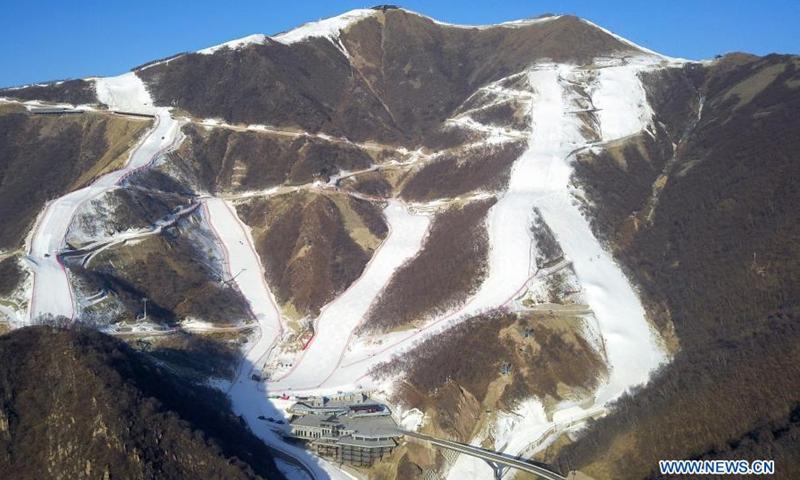
When Alpine skiing athletes head to the Beijing Olympics, they will do so with an unprecedented lack of knowledge about the venue. While Nordic and freestyle events will be contested at known recreational venues in the Zhangjiakou Competition Zone, 140 miles from Beijing, the Alpine events will be in the more mountainous Yanqing Zone. Remote Xiaohaituo Mountain, 55 miles northwest of Beijing, receives little, if any, natural snowfall. All of its facilities, including the race trails designed by Bernhard Russi, were constructed for the Games.
It is not unusual to build a venue explicitly for the Olympics, nor for athletes to have had limited exposure to the venue. Ideally, however, FIS holds at least one World Cup test event in the year prior or, failing that, a Continental Cup–level competition. In 1988, for example, the Nakiska resort was built to host Calgary’s Alpine events, and in the season before the Games it hosted women’s NorAm and men’s World Cup competitions. New venues in both Sochi and PyeongChang hosted World Cup races prior to the Games.
The Alpine venues for Beijing, however, have hosted no World Cup events because of the pandemic. The only test event was a series of FIS competitions with, at most, seven Chinese athletes—none of whom were World Cup level— in each event. They competed on a downhill course that was shortened from 890 meters drop to 470. Compounding the mystery is an air of secrecy surrounding every aspect of the Games. Those who have first-hand knowledge are tight-lipped to preserve their livelihoods, and information flows on a need-to-not-know basis.
WHY IT MATTERS
Test events accomplish many things. First, they give organizers a dry run testing everything from the venue itself—things like terrain and safety features, snowmaking and course set—to the logistics of running a world-class skiing event. These include timing systems, course workers, safety protocols, schedules, transportation, access and many other processes.. Second, test events reveal which areas may need improvement or even wholesale change. Such was the case at PyeongChang’s Jeongseon Alpine Centre, where sections of the downhill course laid out in the summer were entirely reset after testing by top-level athletes. Terrain features, like the spectacular bumps that are typically built into new courses, can’t be called safe until run at race speed. Finally, testing also gives athletes a chance to become familiar with the courses, which can in turn help their preparation.
WHAT WE DO KNOW
Piecing together point-of-view footage and the venue’s topography—long, flattened ridges that run along spines, then dive down steep pitches—a few things are clear. Where it is steep, it is very steep—especially the 68-degree pitch out of the start and another sustained plunge with four full downhill turns. Those translate to high speeds—but how high, nobody knows. And where it is flat, especially in the narrow canyon runout at the bottom of the course, it is very flat.
The “Whiteface” section of the course may be an homage to the 1980 Olympic venue or to the prevailing temperatures. This past October the mercury dipped to 9 degrees Fahrenheit, and the wind, as one visitor described, “blows like crazy.”
The snow is entirely man-made and will be, Russi promises, the consistency of concrete. This is a good thing to forestall course deterioration but will make it nearly impossible to reshape any terrain features after the forerunners give the course its first real test, a few days prior to the event.
EQUIPMENT CHALLENGES
The lack of testing presents a unique challenge for ski technicians. Typically, they arrive armed with their own experience plus a database of historical snow and weather conditions for the venue. In Beijing they will have nothing to go on but the data gleaned from previous skicross and snowboard events in Zhangjiakou’s “Secret Garden” —some 30 miles away—as well as climate and geographical information. Chemist Thanos Karydas, founder of Dominator wax, gathered winter data on the area: average annual snowfall of 5cm/2 inches, high winds, very low temperatures, sunny days and clear nights. He knew it would not be business as usual. Karydas explains, “The rule with wax is that it has to be harder than the snow,” to which he adds, “and everything that is in the snow.”
In this case, that includes heavy concentrations of clay and salt in the snowmaking water (piped in 7.5 km/4.6 miles from two reservoirs), as well as the sand blowing in from Mongolia and debris from the massive earthmoving during trail construction. Dominator formulated a special series of Beijing waxes for extreme cold temperatures, extremely aggressive snow and massive daily temperature swings due to sun exposure.
WHAT THE ATHLETES SAY
World Cup ski racers are trained by their sport to be adaptable, and in press interviews they have been mostly optimistic, seemingly comforted by the egalitarian lack of information and experience. In other words, nobody will have an advantage. Some have voiced concern over the restrictions and logistical hoops that are outlined in their International Olympic Committee-issued “playbooks” and gleaned from athletes who recently returned from China. Others, like Swiss downhill favorite Beat Feuz, sum up the understandable frustration of having a third straight Olympics in a place devoid of skiing culture and fans: “They’ve been great competitions,” Feuz said of Sochi in 2014 and PyeongChang in 2018, “but after Wengen and Kitzbühel, it’s a bit of a culture shock.” The lack of spectators experienced in Korea will be even more pronounced in Beijing, to which no international fans can travel. As far as soaking up Chinese culture, if November’s SkiX and SnowboardX test event is any indication, it will be muted by the reality that all of the Chinese nationals encountered—starting with the flight attendants on Air China—will be wearing hazmat suits and masks.
THE UPSIDES
Building a venue from scratch, and designing it for convenience with a huge budget, does have its advantages. The ski runs are a 10-minute gondola ride from the Olympic village, which skiers will share with bobsled, luge and skeleton athletes. Negligible winter precipitation bodes well for blue skies and eliminates cancelation due to snowstorms.
While new Olympic venues are famous for last-minute construction scrambles and shoddy finish work, the lodging and facilities were close to complete in November, as well as convenient, spacious and comfortable. The food, while unusual, improved with feedback.
One industry veteran of many Olympics came away from the November events with an optimistic approach, asking himself, “What can we learn? How can we adapt? What are some things we need to do next time we come back?”
His key takeaway for anyone packing? “Bring more coffee!”