President Joseph R. Biden created his first national monument, and the country’s 130th, in October, protecting for future generations a rugged landscape in the heart of the Rocky Mountains where the legendary 10th Mountain Division trained for Alpine warfare during World War II.
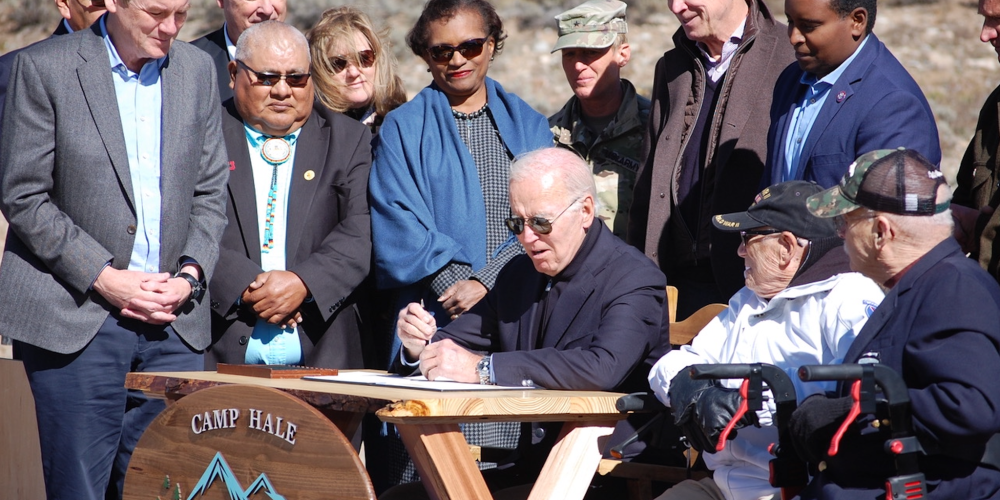
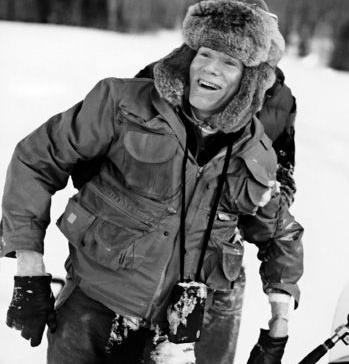
Photo above: President Joe Biden at Camp Hale, with 10th Mountain veterans Robert Scheuer and Bud Lovett (seated right), and (standing, left to right) Sen. Michael Bennet, Ute tribal leaders, Sen. John Hickenlooper and Rep. Joe Neguse.
Biden traveled to Red Cliff, Colorado, for the designation of the Camp Hale-Continental Divide National Monument, standing with state officials not far from the ruins of the winter warfare training camp along Tennessee Pass and the headwaters of the Eagle River.
The president arrived at Eagle County Regional Airport on Air Force One, then was transported by motorcade to meet a crowd of about 200 VIPs and media waiting at Camp Hale in a temporary pop-up village that included Secret Service snipers in the hills behind the podium. Tenth Mountain Division Foundation historian David Little believes this is the first visit to Camp Hale by a sitting president.
According to a White House statement, “This action will honor our nation’s veterans, Indigenous people and their legacy by protecting this Colorado landscape, while supporting jobs and America’s outdoor recreation economy.”
The area lies within the ancestral homelands of the Ute tribe and is treasured for its historical and spiritual significance, stunning geological features, abundant recreation opportunities and rare wildlife and plants. “This is the story of America the beautiful,” Biden said before signing the declaration next to two of the few surviving veterans of the division, Robert Scheuer and Francis “Bud” Lovett. “You can just feel the power of this place,” Biden added, recalling the days when his family traveled to ski in Colorado. “It takes your breath away.”
Said Sen. Michael Bennet, one of the Colorado Democrats who pushed for the designation, “With every passing year, there are fewer World War II veterans who trained at Camp Hale left to tell their story, which is why it is so important that we protect this site now.”
The winter conditions were so tough that some of the soldiers nicknamed the area “Camp Hell.” All that remains of a military base that covered 1,500 acres with 245 barracks housing up to 15,000 soldiers and staff are crumbling foundations of an ammunition depot, field house and firing range.
In 1987, the National Association of the 10th Mountain Division designated the Denver Public Library and the Colorado Historical Society as joint repositories of its historical materials. The Colorado Snowsports Museum, based in Vail, hosts the largest 10th Mountain public exhibition in the U.S.
“This is a great day for the 10th who trained there, outdoor recreation and the Ute tribe,” said Denise Taylor, president of the 10th Mountain Division Descendants. Added Ellen McWade, Rocky Mountain chapter director of the 10th Mountain Descendants, “Becoming a national monument is a huge deal for us. It will help keep the history of Camp Hale alive and prevent their memories from disappearing.”
The 10th Mountain Division played a pivotal role in the European theater of the war by weakening Axis forces from their position in the Italian Alps, thanks to training acquired at Camp Hale. Scaling a 1,500-foot cliff during a night attack, they were able to push back elite units of the Axis forces. Their skills and grit were instrumental in the war effort. (See page 22 for a story about the 87th Mountain Infantry Regiment training on Mt. Rainier.)
After the war, many of these soldiers returned to the mountains, lending their training and expertise to a burgeoning ski industry. More than 60 ski areas in the United States owe their origin and development to these veterans. Today, the outdoor industry, inspired and built by these vets, generates $374 billion in economic activity and supports tens of thousands of jobs across the country, according to the White House.
ISHA Vice President Jeff Blumenfeld, a resident of Boulder, Colorado, is son-in-law of the late U.S. Army veteran Arnold R. Kirbach, who taught skiing and rock climbing at Camp Hale.
After 86 years, the magazine slashes its print run and hopes to persevere online.
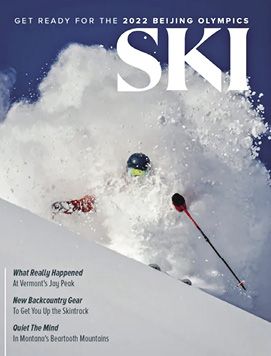
After more than a decade of battling losses in subscribers and newsstand sales, SKI recently announced it will publish only one print issue a year. The magazine will continue to publish an annual print winter gear guide, but it will be a “unified” effort with its sister brands, which includes Outside and Backpacker.
In a May email to contributors, SKI editor Sierra Shafer explained that Outside Inc., owner of SKI, “made the difficult decision to reduce print by 80 percent across the company.” SKI will publish an annual print issue “for the foreseeable future,” Shafer writes. “SKI is still producing a traditional issue, our Destination Guide. Beyond that, our print plan for 2023 is still developing.”
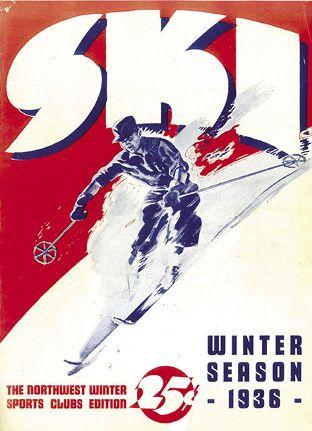
After Skiing magazine shuttered just shy of its 70th birthday in 2017, and Powder scuttled in 2020 after nearly 50 years in print, SKI was the sport’s sole surviving mass-market publication. Before its advent, skiers read news of the sport in a variety of regional and club newsletters. The sole national publication was the American Ski Annual, published by the National Ski Association. In 1935 Seattle native Al Nydin had the idea for a national commercial magazine. The first issue of SKI appeared in January 1936, with four issues (November-February) pledged for the following season. SKI was later rebranded as Ski Illustrated and moved to New York City when World War II broke out; it was resuscitated in 1948 in Hanover, New Hampshire, by publisher William Eldred, who combined Ski Illustrated, Western Skiing and Ski News under the present title SKI. In 1962, under New York publisher Arnie Abrahamson, SKI incorporated Ski Life.
At its peak around 1988,
SKI published eight issues
a year for an audience of
about 450,000.
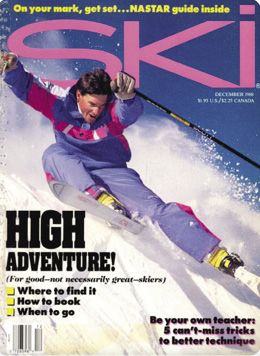
At its peak in the 1980s and 1990s, SKI published eight issues annually, including a summer issue for several years. For the 1988–89 season, a full-time editorial staff of 15 published 1,696 pages of national content, plus regional editions in the East, Midwest and West. The decline began in the mid-1990s, when readers discovered they could find more timely information, for free, on websites—including skinet.com, published by SKI and Skiing magazines, by then under the same corporate umbrella, AOL-Time Warner. Advertising revenue soon followed the audience. Like most surviving legacy media brands, SKI gradually transitioned largely to web publishing. “With a renewed focus on our digital content, we are still actively assigning and publishing work for the web,” Shafer wrote.
By 2021, the magazine
was largely web-based, with
just three print issues.
A long line of corporate owners fought a rear-guard battle to maintain the viability of the print edition. Most recently, Pocket Outdoor Media went on a buying spree in 2021 and acquired a handful of active lifestyle brands, including SKI, Outside and Backpacker. Pocket rebranded itself as Outside Inc. and refocused its business model with “Outside +” memberships, which provide access to content from the company’s 30-plus brands online. The monthly membership cost has recently been cut from $5 a month to $2.99 a month for the first year. Along with the decision to drastically reduce print runs companywide, Outside Inc. also announced it was laying off approximately 15 percent of its staff across all brands.
Is the party over for SKI and other print magazines? The advertising model for print seems irretrievable. The continued health of Skiing History proves that a small but devoted reading audience remains, perhaps filling the role of the original nonprofit American Ski Annual. Similarly, the quarterlies Ski Journal and Adventure Journal, along with the twice-a-year Mountain Gazette, make entertaining reading. But all charge subscription rates that allow survival without advertising support.
Aspen’s Birthplace of Skiing Preserved
Landowner deal balances development rights with protection for the Highland Bavarian Lodge
Highland Bavarian Lodge opened
with high expectation in 1936.
Aspen Times photo.
An often-forgotten slice of Aspen’s skiing history will be preserved in a deal that gives a landowner additional development rights as a tradeoff to protect the historic site.
The Pitkin County commissioners in June approved an agreement that will preserve the Highland Bavarian Lodge and bunkhouse, the true cradle of skiing in the Aspen area. The structure will receive historic designation and be remodeled to restore its historical significance.
Property owners Meredith Loring and Sami Inkinen funded creation of a documentary film recounting the significance of the site in the development of Aspen skiing, according to coverage in the Aspen Times. The documentary will be donated to the Aspen Historical Society. A brochure on the history also will be created and a road plaque will be installed.
The Highland Bavarian Lodge was built at Ashcroft in late 1936 and opened in time to host Christmas guests. It was part of a grand vision for a ski area in the upper Castle Creek Valley (see “What Might Have Been,” March-April 2021). Ski trails were cut along the valley floor and hardier guests could ascend on climbing skins to Richmond Ridge. The owners’ grandiose plans lost momentum during World War II. After the war, development of Aspen Mountain eclipsed the Ashcroft project.
The Highland Bavarian Ranch covers 82 acres up valley from the confluence of Castle and Conundrum creeks. The property spills over to the east side of Castle Creek Road, but the owners have pledged to place a conservation easement on that section, and on 49 acres in total, the Aspen Times reported. The owners could have torn down the lodge because Pitkin County’s historic preservation program is voluntary.
As a tradeoff to the preservation of the lodge and bunkhouse, the county will grant 7,500 square feet of additional floor area for a home on the property. A home of up to 13,250 square feet can now be constructed. In addition, a density bonus was awarded for a second home of 5,750 square feet on the main ranch parcel.
Snapshots in Time
1957 More (Not) the Merrier
To handle the army of skiing Americans that was passing last year’s record 3.5 million, slope operators were constructing luxurious lodges and higher capacity lifts, were scientifically grooming trails and putting snow on usually bare slopes. Old-line ski addicts who once welcomed the boom in the sport are now finding it a nuisance with the crowds at the slopes and inns they once had to themselves. — “NEW SLIGHTS ON SLOPES” (LIFE MAGAZINE, FEBRUARY 1957)
1968 PHONING IT IN
A new 24-hour telephone service for the latest ski reports is in operation. By dialing LY4-7500, skiers can obtain information on snow conditions in the East. The 24-hour service is supported by the New York–New Jersey American Motors Dealers Association. — “24-Hour Phone Service Offers Latest Ski Reports” (NEW YORK TIMES, DECEMBER 24, 1968)
1970 POWER PER POUND
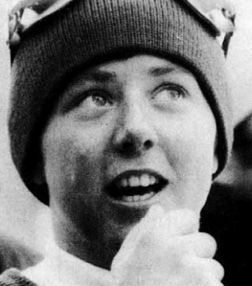
Nancy Greene
Women racers are women, first and foremost. Very often I meet people who remark that they thought I would be much bigger. I suppose they expect us to be Amazons. Actually, the average female ski racer is the same size as the average girl. What is important is the strength per pound. This does not mean bunched muscles, either, because suppleness, gracefulness and balance are extremely important. — NANCY GREENE, “THE WOMAN RACER AS A WOMAN” (SKI MAGAZINE, JANUARY 1970)
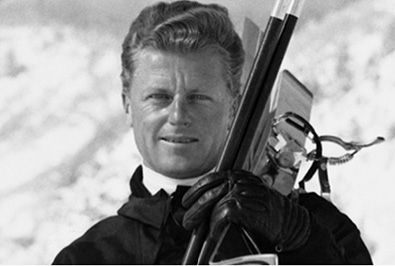
Stein Eriksen
1981 STEIN'S ADVICE
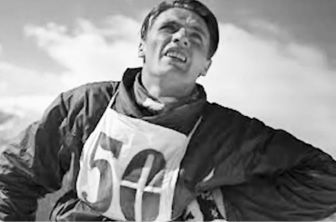
I don’t care what people say about nightlife and drinking. If you want to be on top of your skis, your mind has to be absolutely crystal clear, and you have to be in top physical condition. — STEIN ERIKSEN, INTERVIEW (POWDER MAGAZINE, JANUARY 1981)
1990 PLEASE STICK TO SKIING
The January issue of your magazine devoted six pages to snowboards and snowboarding. With all due respect to the interests of others, if I wanted a magazine about snowboards, then I would subscribe to Snowboarding Magazine, if it existed. Please stick to skiing. — DAVID R. SEGAL, REDONDO BEACH, CALIFORNIA, “NO MORE SNOWBOARDS,” LETTERS (SKIING MAGAZINE, MARCH 1990)
2003 WHERE'S THE DISCOUNT?
I’m glad you recognize that there are people over 70 who still like to ski. How about an article called “The Top Resorts for Seniors?” With the current trend of not offering free lift tickets to seniors, I would like to know which resorts still value us. After all, what we don’t spend on hefty lift ticket prices, we make up for in food, beverages and a lifetime of dedication to the industry. — JIM MORGAN, MIDLAND, MICHIGAN, “SENIORS SKI,” LETTERS (SKI MAGAZINE, MARCH-APRIL 2003)
The celebrity artist visited Aspen for more than 20 years.
Andy Warhol died in 1987. But his cultural significance remains white hot, as his obession with fame, celebrity and personal branding is more relevant than ever in today’s media–dominated world. Perhaps predictably, Warhol mania is on the rise, with plays staged in London and New York and the airing of the Netflix series The Andy Warhol Diaries, all exploring the man and the myth. What isn’t commonly known about Warhol is that he was enchanted with Aspen, bought property there and visited often enough to be considered a part-time local.
(Photo above: credit Mark Sink)
The man who deified Campbell’s soup cans (to his lasting regret, he claimed) had been coming to Aspen off and on for about 15 years before he even learned to ski. That happened in December of 1981, when he and photographer Christopher Makos decided to take a lesson at Buttermilk. As longtime Aspen instructor Gerry Bohn recalls, “I was a supervisor at the time, and we ran out of instructors, so I gave him a two-hour private.”
Warhol wrote in his diary about the Powder Pandas slope and its T-bar: “We did about two hours of zigzagging and going up the handrail and you just sort of sit on the thing and go up the whole hill and it was really fun.” He also mentioned falling three times, which isn’t bad for a first-time skier.
Denver-based photographer Mark Sink lived part time in Aspen then and worked for Warhol at Interview magazine. He remembers meeting Warhol and Makos at Buttermilk that day. “We just talked at the base,” says Sink. “I asked if he had tried the ‘flying wedge’ down; he thought that was a funny term. He was done for the day, hurt his hand in a fall on the baby hill. His Rolex hurt his wrist, apparently. I remember him talking about Reggie Jackson and other stars in the lift line. His star-spotting was amazing anywhere we went.”
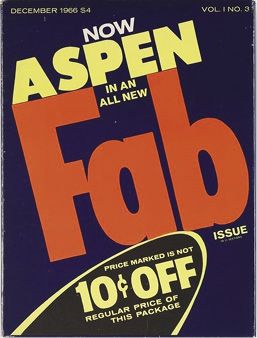
In 1966, Warhol guest-edited
this edition of the Aspen Times
On that same visit, Warhol and Calvin Klein met Paramount heavyweight Barry Diller and his ski instructor for lunch at West Buttermilk. Then Warhol went for dinner with Diller, Italian film producer Marina Cicogna and Diana Ross at Andre’s, where Ross, as Warhol recalled in his diary, was wearing “a cowboy hat and big white shoes” and danced on top of the table. A media star himself, habitually surrounded by celebrities, Warhol was as star-struck as any skier who drove up from Denver for the day.
Warhol first came to Aspen in the mid-1960s at the invitation of locals John and Kimiko Powers, major modern art collectors and some of his biggest patrons. John was running the Aspen Center for Contemporary Art at a time when it was one of the most important avant-garde art communities in the country. Warhol participated in several Colorado exhibitions sponsored by Powers. And in 1966 he guest-edited the third issue of an experimental arts and culture magazine called Aspen (also known as Aspen in a Box), founded by part-time Aspenite Phyllis Johnson, a former editor at Women’s Wear Daily and Advertising Age. Warhol’s issue, like all of them, was bundled in a box, which he had designed to resemble one of his trademark cultural references, a package of Fab laundry detergent.
In 2021, the Aspen Art Museum
staged a Warhol retrospective.
Far from just a casual visitor, Warhol during this period bought land just downvalley from Aspen. In the early ’80s he also bought a house in Aspen and devoted a chapter of his book America to the town.
In the summer of 1984, at the star-studded Aspen Tennis Festival fundraiser for the United Cerebral Palsy Research and Educational Foundation, Warhol arrived on the back of a Harley piloted by Jack Nicholson. Warhol offered to do a portrait of the highest bidder at the celebrity auction, and it drew so much interest that he agreed to do four of them at $40,000 each, raising a quick and generous $160,000 for the cause. It would be his last trip to town before his death.
The Powers Art Center near Aspen, which showcases John and Kimiko’s collection, continues to regularly display many of Warhol’s works. And his only major museum retrospective in North America in 2021-22 recently closed at the Aspen Art Museum. The cliché about Aspen is that real locals came for the skiing but stayed for the intriguing people. For Warhol, it was always about the people, and the skiing was mainly a way to meet more of them.
SNAPSHOTS IN TIME
Allais coached what
he knew.
1952 Voice of Experience
No one knew better than Coach Émile Allais what the team was up against. Once the greatest of all racers in Europe, he had lost his front teeth years ago at Chamonix in the French Alps and shared this deficit now with most of his boys who had lost theirs at places like Reno, Aspen and Whitefish, Mont. He not only knew all the tricks but invented most of them himself, including a special racing crouch, ventilated goggles that would not fog up and even a new method of skiing. — Marshall Smith, “Hell on Snow,” on the American downhill team training for the 1952 Oslo Olympic Games (Life Magazine, February 11, 1952)
1970 Timeless Tuning Tip
It’s a great day. Great snow. You feel great. But your new skis seem to have a mind of their own. So you tighten your boots, loosen your bindings, have your poles shortened. But your skiing is still going haywire. Before you pack the whole shebang into the attic, take a look at your ski bottoms. Minor problems there often cause major problems in your technique, even with new, high-priced skis. — Editors, “Sure, Why Not Blame Your Skis?” (Skiing Magazine, February 1970)
1974 View from Texas
The important point to remember about skiing is that until the basic skills are mastered, the sport is not to be enjoyed. —
Suzanne O’Malley, “Who is That, Lying in the Snow in a $200 Ski Outfit?” (Texas Monthly, December 1974)
Killy laments
all-around
racer
1980 Not So Special
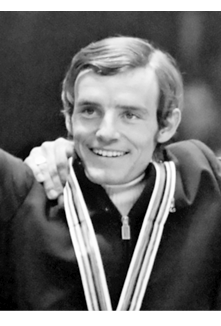
With the extreme specialization we see today, a good downhiller cannot be a good slalom skier the way it was when I raced. — Jean-Claude Killy, interview (Powder Magazine, September 1980)
1998 Mountains of Opportunity
Now at least I can get my vacuum cleaner fixed in Ketchum and I certainly couldn’t do that when I moved here 20 years ago. New entrepreneurs are filling up business niches I didn’t even realize existed. Tourism might just be a phase in the economic growth of mountain towns. —“State Rep: In Search of Common Ground,” Wendy Jaquet, interview (Snow Country Magazine, February-March 1998)
2000 Can You Hear Me Now?
I would like to ski in the fantasy land with the three gentlemen who wrote against cell-phone use on the slopes. I am lucky enough to live and work 10 minutes from a great ski area and if I can steal a few hours from work to go skiing, then the cell phone is a small price to pay. It sure beats being stuck at your office desk waiting for that one call that might bring in a huge deal. I would imagine that skiers—real skiers, anyway—will agree that skiing is better than working. I also enjoy calling my friends and telling them what they are missing. — Steven Strauss, Coplay, Pa., “Pro Phone,” Letters (SKI Magazine, May-June 2000)
A new and improved bidding process might give Utah the edge.
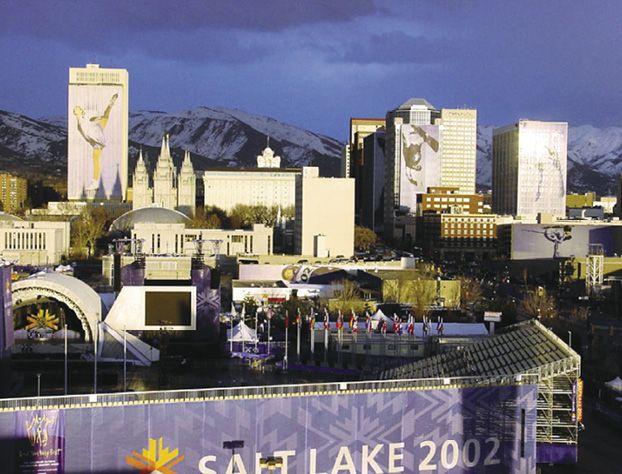
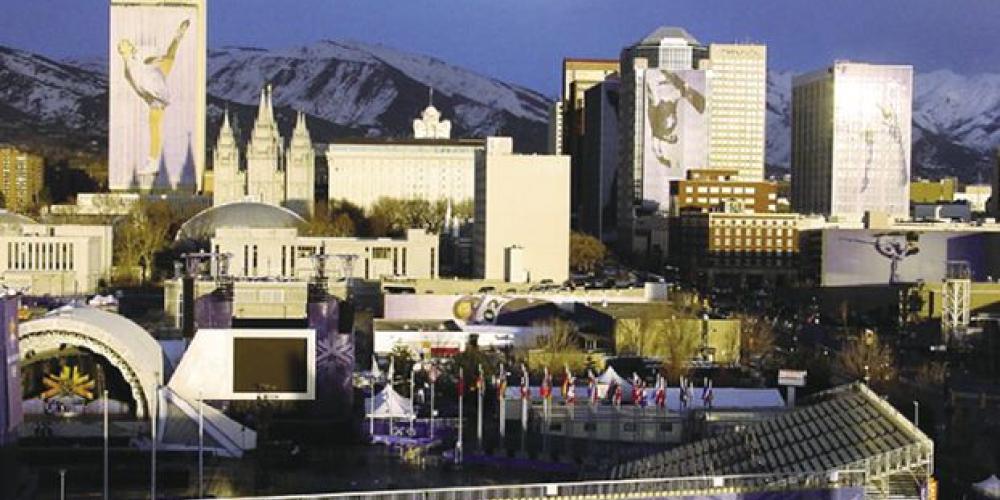
Salt Lake City, which hosted the Winter Olympics in 2002, has begun a bid process to bring back the Games as early as 2030, according to Susanne Lyons, chair of the United States Olympic and Paralympic Committee (USOPC).
“We are already in dialogue with the IOC–not yet for a specific year,” Lyons said at the USOPC’s press conference in Beijing, per Reuters press coverage. “Depending on what the needs of the overall Olympic movement are, that could happen as early as 2030 or it could happen after that.” Park City officials held a public meeting on February 15 to hear proposals from the Utah Olympic Legacy Foundation.
After criticism of its bidding process, the International Olympic Committee (IOC) is working to streamline the process. With costs soaring and public support waning, the IOC now prefers previous host cities with venues already in place. This gives Salt Lake an edge, Lyons indicated.
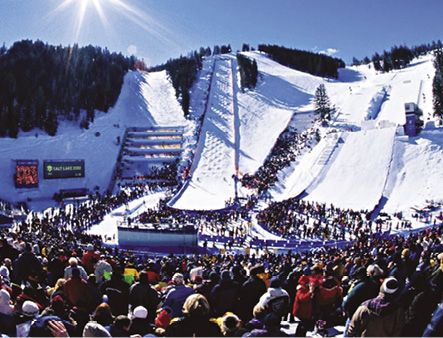
The freestyle venue at Deer Valley.
Vancouver, which hosted the 2010 Winter Games, has also expressed interest, as has 1972 host Sapporo. Public opinion in both cities appears split over proposed budgets around $2.5 billion. The Barcelona-Pyrenees region has also prepared a bid.
Host-city hesitance became evident with the 2024 Summer Games: Of five initial bids, only Paris and Los Angeles stuck it out. With no alternatives, the IOC gave Paris the 2024 event and L.A. got 2028. Only one city bid for the 2032 Summer Games: Brisbane, Australia got the IOC nod by default.
By the numbers, the 2022 Beijing Games hosted 2,900 athletes over 109 competitions. While reusing some venues from the 2008 Summer Games, Beijing still reported costs of $4 billion for Olympic-specific necessities. That doesn’t include new permanent infrastructure, such as the $9 billion high-speed rail line linking Beijing to the two Olympic-venue ski resorts. After the athletes leave, the high-speed train remains. Will tourist traffic make it pay? No one knows.
Approving 10-figure budgets is a tough sell these days for host cities, especially with reports of chronic corruption tainting the awarding process. Oslo, Norway, reported a 55 percent voter opposition to hosting the 2022 Winter Games, and pulled out of the bidding process.
In order to attract more host cities, the IOC no longer requires elaborate bid proposals costing millions of dollars. Instead of holding multiple votes to thin the candidates, the IOC now works to identify a “preferred bidder” and positions itself as a partner in the process.
IOC’s new focus on cities with existing venues appears to be working. The Paris 2024 Summer Olympics, per press reports, will be 95 percent staged in venues that already exist. More than 90 percent of the events for the 2026 Milan-Cortina Winter Games will be held at venues already in place.
As Lyons noted, the USOPC hopes that gives Salt Lake a leg up—both with the IOC and with the local community. “Salt Lake City has made it very clear to our partners at the IOC that they are ready and able to go as soon as we are needed,” Lyons said. –Greg Ditrinco
Dave Ryding, meet Mouse Cleaver
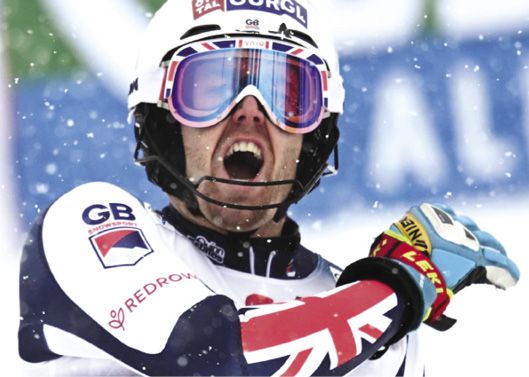
When, on January 22, Dave Ryding aced the Hahnenkamm slalom to become the first British skier to win a World Cup race, he joined an exclusive club. Ninety-one years ago, another Brit, Gordon “Mouse” Cleaver, won the very first Hahnenkamm combined trophy.
Dave Ryding celebrates his first World
Cup victory, at age 35. ESPN photo
At the time (March, 1931), Austrian skiers were astonished that they’d been bested by an Englishman who wasn’t even a member of the British team (they assumed he hadn’t qualified, and that the “team” skiers must be even better.). That “team” consisted of members of the Kandahar and Downhill-Only Ski Clubs from Mürren and Wengen. Cleaver’s combined victory was based on finishing ninth in the downhill and second on a slalom course set by Bill Bracken, winner of the first-ever Lauberhorn slalom and combined held in February 1930.
No British subject topped a podium again in a premier race until Ryding’s victory. Konrad Bartelski came close, with a second-place finish in the 1981 Val Gardena downhill. The Scot Alain Baxter claimed bronze in slalom at the 2002 Salt Lake Olympics—only to have his medal revoked after a still-controversial drug test.
Mouse Cleaver joined the RAF in 1937 and became an ace, flying Hurricanes in France and in the Battle of Britain. In August 1940, his canopy was shattered by gunfire, sending plastic shards into his face and eyes. Near blind, he bailed out. He never flew again. While Cleaver lost the right eye entirely, and most of the sight in his left, an ophthalmologist noted that the plastic fragments didn’t inflame his eyes. This insight led to the invention of plastic lens implants. –Seth Masia
Snapshots in Time
1952 Heaven on Earth
When warm winds and spring sunshine put an end to skiing in the rest of the U.S., the season is just beginning at New Hampshire’s Tuckerman Ravine. Although there are none of the usual comforts available to skiers, such as warming huts and ski towns, Tuckerman skiers have other compensations. As the sun gets warmer in the valley, it turns the icy crust to crumbly “corn” snow, and skiing on “corn” is considered by fanatics as close to heaven as they will get on earth. — “Spring Skiing,” Life Magazine (March 10, 1952)
1968 Dial a Run
A new 24-hour telephone service for the latest ski reports is in operation. By dialing LY 4-7500 skiers can obtain information on snow conditions in the East, including New York, New Jersey, Vermont, New Hampshire and Massachusetts. The service is supported by the New York-New Jersey American Motors Dealers Association. — “24-Hour Phone Service Offers Latest Ski Reports” (New York Times, December 24, 1968)
1975 Biting Commentary
As a dentist living and practicing in a ski-oriented community, I treat hundreds of adolescents who are ski enthusiasts. For many years I have had SKI and Skiing magazines in my waiting room for my young patients to read. Your February article “The American Pros” is so electrifying with bar-room language, however, that I had to cut out most of the pages. — David R. Williams, Boulder, Colorado, “Take the Teeth Out of It” (Letters, SKI Magazine, September 1975)
1980 Redford’s One Run Too Many
I always make the mistake of skiing past what I should in terms of my fatigue. I’ll take a run right after the run that’s been so perfect, but the legs just won’t hold up and you won’t be quite as quick. Then you get mad so you go back and do it again to prove you can do it and you’re worse yet. —Robert Redford, “Who is that Guy?” (Powder Magazine,
November 1980)
1990 Easiest Way to Improve
Probably the single most common mistake skiers make is believing that their skis don’t need to be waxed. Properly waxing your skis is the easiest way to improve their performance on the slopes. New skis are normally iron waxed at the shop where they were purchased. If not, you can wax them at home. —Jim Deines, “Tuning Tips” (Skiing Magazine, February 1990)
1996 The Revolution Starts Now
Promises are cheap, but are they believable? Well, this time it’s true. The Shaped Ski Revolution is here and it will make skiing more fun. It’s a revolution that will free thousands of skiers from the drudgery of the skidded turn, and thousands more will ski longer, stronger and faster. —Jackson Hogen, “Revolution” (Snow Country, October 1996)
In Brattleboro, Vermont, ski jumping remains a popular tradition.
In 1909, Dartmouth junior Fred Harris, of Brattleboro, Vermont, founded the Dartmouth Outing Club. That same winter he leaped from a primitive ski jump for the first time, according to the new book Harris Hill Ski Jump, the First 100 years.
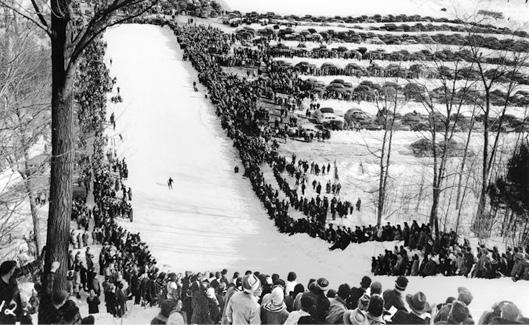
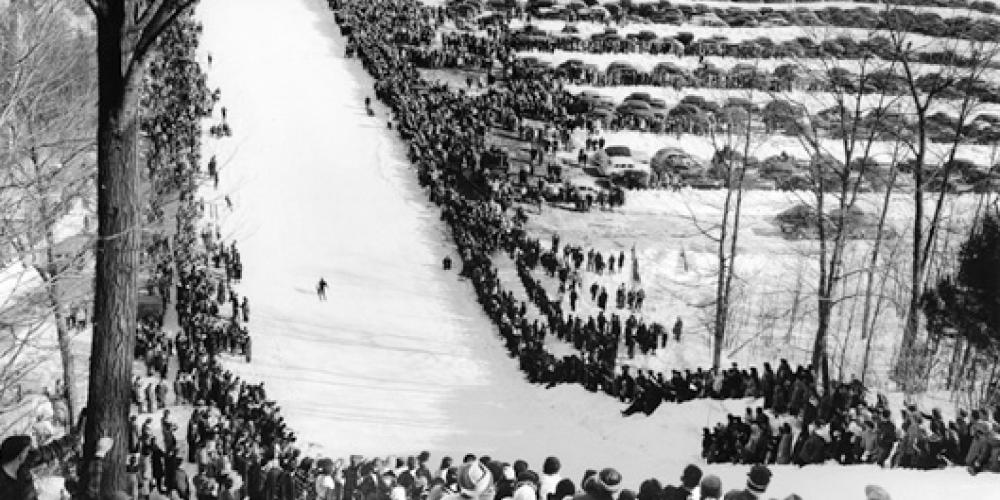
Photo above: Some 10,000 spectators encouraged 160 athletes at the 1951 National Championships.
“Broke my skis to pieces,” Harris wrote in his diary. He grabbed another pair and tried again. “Fell twice,” he recorded. “Tried several times, and at last made it. Hurrah! Twice. Oh, ye Gods!”
That tenacity led to the construction of the Brattleboro Ski Jump, which Harris organized (and paid for) in 1922. The jump cost $2,200 to construct and was completed one week before its first competition, during which Bing Anderson, of Berlin, New Hampshire, set a New England distance record, at 48.5 meters (158 feet). Later that year, the hill hosted the Vermont State Ski Jumping Championships, followed by the National Championships in 1923. Over the century, the hill has hosted 18 national and regional championships.
In 1924 the wood-trestle inrun was increased in height and Henry Hall raised the hill record to 55 meters. Improvements in 1941 brought the hill up to the 90-meter standard, and Torger Tokle jumped 68 meters. Structural improvements, including a steel tower, followed in the post-war years.
The jump was rechristened the Harris Hill Ski Jump during the 1951 National Ski Jumping Championships, which drew a crowd of 10,000 spectators cheering more than 160 jumpers. In 1985, Mike Holland jumped 186 meters for a new world record. The following year, with the help of Mt. Snow, the hill got a snowmaking system.
By 2005, the hill no longer met international standards for profile or structural integrity and shut down. Over the next three years the community raised $600,000 to upgrade and meet FIS requirements for 90-meter Continental Cup events. In 2011, Harris Hill hosted the first FIS ski jumping tournament in the United States.
Over its long history, Harris Hill has considered itself a progressive operation, looking to promote ski jumping for everyone. For instance, it took the International Olympic Committee until the 2014 Sochi Games to allow female jumpers. The Brattleboro-based jump beat that by 66 years; Dorothy Graves competed there in 1948.
The hill record stands at 104 meters (341 feet), set by Slovenian Blaz Pavlic in 2017. The centennial competition is scheduled for February 19-20.
“The jump provided heroics for all to see,” winter sports historian and Skiing History contributor John B. Allen notes in the 100th anniversary book. “It really did seem that a man could fly.”
Dating back to 1928, the biennial Winter University Games will return to Lake Placid in 2023.
The 2021 World University Winter Games, scheduled for Lucerne, Switzerland, last December, were canceled due to pandemic-related travel restrictions. Lake Placid, New York, is set to host the next edition of the biennial winter games in January 2023.
The idea for the Games emerged from the 1891 Universal Peace Congress in Rome, which proposed a series of international student conferences that would include sports events. While the conferences never happened, the concept led Frenchman Jean Petitjean and modern Olympics founder Pierre de Coubertin to create the International Universities Championships, hosted by the Confédération Internationale des Étudiants (CIE). Summer games were held in Paris (1923), Prague (1925), Rome (1927), Paris (1928), Darmstadt (1930), Turin (1933), Budapest (1935), Paris (1937), and Monaco (1939), and then were halted by World War II. A number of “winter” events were actually summer games held in September.
In the autumn of 1924, Walter Amstutz, Willy Richardet and Hermann Gurtner held the first meeting of the Swiss Academic Ski Club (SAS), and over the next three years organized downhill and slalom races between Swiss and international university teams in Mürren, Wengen and St. Moritz. In 1928 these races culminated in the First International Academic Winter Games, in Cortina d’Ampezzo, Italy. Because the event was endorsed by the CIE, many consider the Cortina races to be the progenitor of the Winter Universiade. The 1928 downhill and slalom were organized by SAS president Gurtner; both races were won by André Roch. The Academic Winter Games were held five more times before World War II, from 1933 on in odd-numbered years to avoid conflict with the Winter Olympics and FIS World Championships.
The Games were restarted in 1947, but soon afterwards the CIE disbanded, and successors arose on either side of the Iron Curtain. Western countries formed the International University Sports Federation (FISU) in 1949, while Eastern European nations had their own Union Internationale des Étudiants (UIE). The two groups held their own rival summer and winter games until 1957, when Petitjean was able to hold a summer games in Paris, including Soviets and a token team of six Americans. Thus was revived the term Universiade, implying that students of all nations could compete.
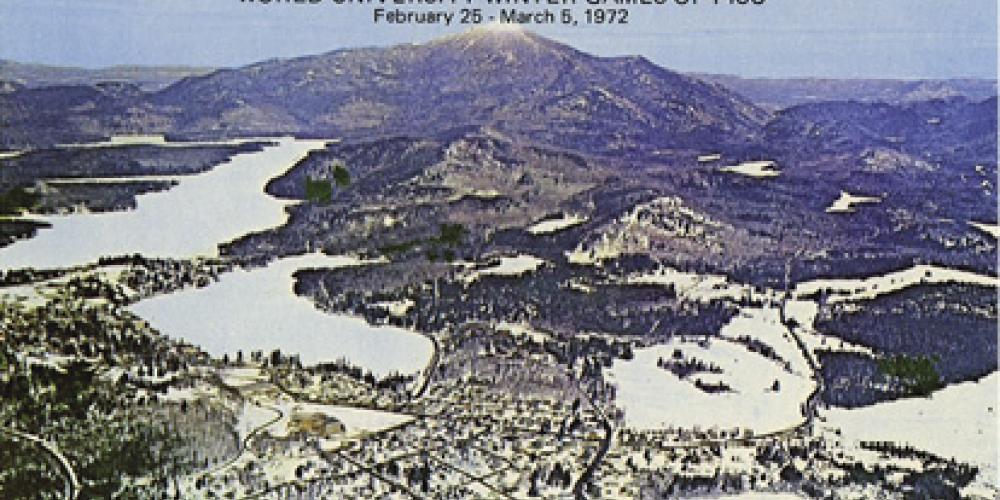
The first post-war Winter Universiade was held in Chamonix in 1960. Charles de Gaulle opened the ceremonies, with 151 athletes from 16 countries participating in 13 events in five sports. Thereafter, games were held in Europe on a two-year schedule, and the Seventh Winter Universiade came to Lake Placid in 1972.
The small village in New York’s Adirondack Mountains had hosted the 1932 Winter Olympics. After World War II, facing vigorous wintersports growth in New England and Colorado, the resort town lost its luster. Locals saw international sporting events as a route to reinvigorating the economy, and in 1960 they launched a new Olympic Organizing Committee.
Rebuffed in its initial attempts to gain a second Olympic bid, the organizers looked for alternatives. By the late 1960s, it appeared that Denver would be the U.S. choice to host the next winter Olympics. The best alternative multi-sport international competition was the World University Winter Games. While some upgrades were necessary, Lake Placid had the competition and hospitality facilities in place. All the town needed was money.
National federations balked at the cost to fly teams across the Atlantic. With the backing of New York State, Lake Placid offered a package including round-trip airfare, busing from Montreal, lodging in Lake Placid, and breakfast and dinner daily. The total price for participants: $324 per person. The deal was done.
Opening ceremonies were held February 26, 1972. There would be 25 competitions in seven sports: Alpine and Nordic skiing, biathlon, ski jumping, figure skating, speed skating and hockey. There were 351 athletes from 23 countries. The games were just a few weeks after the close of the 1972 Winter Olympics. While there was some overlap, most participants had not competed in the Sapporo Games.
The start of the Universiade was not exactly what organizers had planned. The opening parade from the Lake Placid Club to the outdoor arena at the speed-skating oval got a late start, leaving spectators restless in the evening cold. “There was a lot of horseplay,” recalled Jim Rogers, local ceremonies chief. By the time the athletes entered the arena, discipline had given way to youthful exuberance. The Italian team commandeered a sleigh and circled the oval while singing songs. The torch bearer was American skier James Miller. As he ascended the podium, oil from the torch he was carrying spilled, and the sleeve of his wool sweater caught fire. He was able to slap down the flame and light the cauldron—but it was an inauspicious start to the ceremony. Richard Nixon was busy, concluding his historic trip to China and sent a brief message read from the podium. New York Governor Nelson Rockefeller was a no-show. “The wonderful part of the opening ceremonies was the brevity of the speeches,” noted one local newspaper columnist.
The competitions went off as scheduled. Arrangements for athletes were praised. The major issue was weather: spring came early. Roby Politi, village native and two-time All-American skier, remembers temperatures going from “cold to warm to cold to warm, to even warmer.” Temperatures, below zero at the opening ceremonies, at one point reached 58 degrees Fahrenheit. “I remember ruts a foot deep on the course,” says Politi, who finished 20th in the giant slalom. It was worse for the Nordic skiers and speed skaters, who raced on slush.
Caryn West, a member of the U.S.
Ski Team B squad, won Alpine
combined gold. The Stanford grad
went on to a career on stage and
screen.
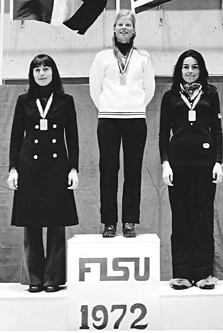
U.S. athletes finished a distant second in the overall medal count with seven, behind 29 won by Soviet students. The best American skiing result was turned in by Stanford University’s Caryn West, who took the overall Alpine gold medal. Canadian Lisa Richardson won the women’s downhill by 3/100th of a second.
In his final report to the FISU organizers, Austrian official Prof. Werner Czisiek noted “the Winteruniversiade 1972 in Lake Placid must be called a great success.” He enthused about the logistics of transportation and efforts “to arrange different activities to bring people into contact with people of other nations.”
The successful 1972 Games proved to be a key factor a couple of years later, when Denver withdrew from hosting the 1976 Winter Olympics. Innsbruck stepped up as the replacement and Lake Placid, with facilities and organization in place, was selected for 1980.
And so Lake Placid will get the centennial Universiade to number 30 in the winter series (it would have been 31 had the Lucerne events taken place). More than 1,600 athletes, ages 17 to 25, from more than 50 countries and 600 universities are expected to compete in 86 medal events in 12 sports over 11 days. It will be only the second time the Winter Games have been held in the United States. (Buffalo, New York, hosted the summer version of these games in 1993.)
New York State, through its Olympic Regional Development Authority (ORDA), has invested more than $300 million to upgrade its winter sports venues. All facilities now meet international competition standards.
Phil Johnson is the longtime ski columnist for the Daily Gazette in Schenectady, New York.
SNAPSHOTS IN TIME (OLYMPIC EDITION)
1931 French Wine vs.Prohibition Paris—The French athlete’s wine is so important an item of his training diet that the government will be asked when Parliament meets next week to seek permission for the Olympic team going to Lake Placid, N.Y., to take wine along. Deputy Poittevin served notice today that he would ask the Premier to intercede with the American Government so that the skaters and skiers might have the “necessary rational ingredient of their training regime.” — “French Deputy Wants U.S. to Permit Wine to be Brought Here by Olympic Athletes” (New York Times, November 5, 1931)
1960 Pedal to the Metal During the 1959-60 season, the French ski manufacturer that supplied the national team had provided Jean Vuarnet with wooden skis that he found far too flexible. “It was a disaster,” Vuarnet said. “So I went to their factory in Voiron and had a good look around. I came across a pair of metal skis that were just my size. They’d been tossed aside but they looked okay to me. I took them and tried them out in the Émile Allais Cup in Megève. One of the skis got bent but I still managed to finish fifth. So I called the manufacturer and asked them to send me a new pair because the [1960] Games were coming up.” Vuarnet became the first skier in Olympic history to win gold on metal skis. — “Vuarnet Takes Downhill Skiing to the Next Level” (Olympics.Com, February 1960)
1972 Colorado Olympic DNF Denver—The Olympic torch will not be passed to the Rocky Mountains in 1976, top organizers of the Winter Games said Tuesday after voters in Colorado cut off state funds for the event. Clifford Buck, of Denver, president of the U.S. Olympic Committee, said, “Needless to say, it is a tremendous disappointment to me. I think it’s a tragedy for the state, and a tragedy for the nation that the people of Colorado were not aware of the great privilege and great honor to host the 1976 Winter Games. But the majority has spoken.” — “Voters Reject ‘Privilege’”(Eugene Register-Guard, November 8, 1972)
Alberto-ville Olympics, 1992
1992 Olympic Training, the Tomba Way At five o’clock, Tomba will get down to the serious business of training, but for the moment nothing is more important than enjoying the last days of summer lolling on the beach in the company of a lovely teenage girl whom he met while serving as a judge for the Miss Italy contest. — Patrick Lang, “The Road to Alberto-ville” (Skiing Magazine, January 1992.)
2006 Golden Aamodt Sestriere Borgata, Italy—Someone said if you looked at his media guide picture without knowing he was a skier, you’d think he were a bank president. Yet, Norway’s Kjetil Andre Aamodt made more Olympic history at Sestriere Borgata when, out of the 25th start—he zipped down in 1 minute, 30:65 seconds and made it stand up against Austria’s Hermann Maier, who finished .13 of a second back—he won the gold in the super-giant slalom. Aamodt came to Turin as the all-time alpine leader in medals with seven. Now he has eight. — Chris Dufresne, “Norway’s Aamodt shocks in super-G” (The Baltimore Sun, February 19, 2006)
2010 Peak Performance For the athletes, the Olympics, as he described them, were a festival of internationalism and frenzied liaising—“It’s a Small World” meets Plato’s Retreat. The impression I got was of an Athletes Village teeming with specimens of youth and fitness, avid men and women who’d spent their ripest years engaged in fierce, self-denying pursuit of peak physical performance, and who now, mostly after they’d competed, could throw off their regimens, inhibitions, and sweats, and pair off, with Olympic vigor and agility. It changed the way I watched the Games. And it made me wish I’d worked a little harder in practice. — Nick Paumgarten, “The Ski Gods” (The New Yorker, March 15, 2010)
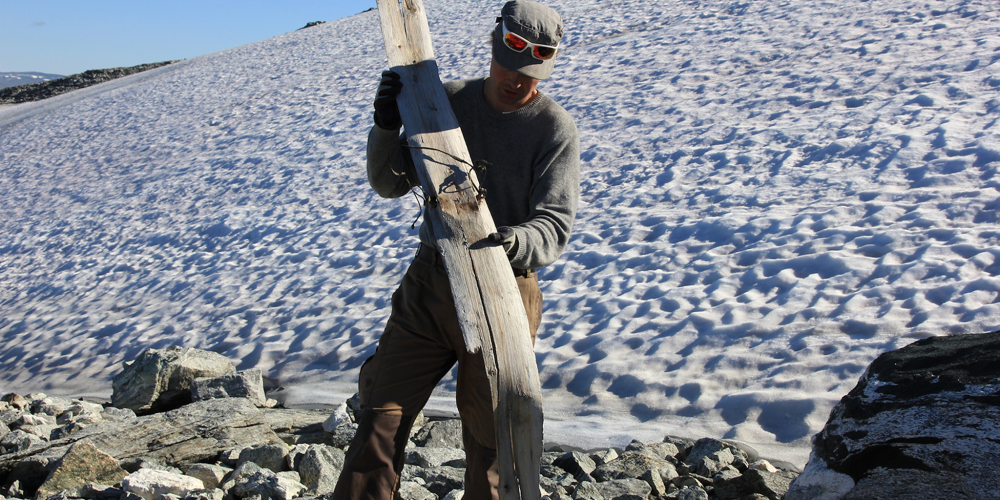
Seven years later, Norwegian archaeologists have a full pair
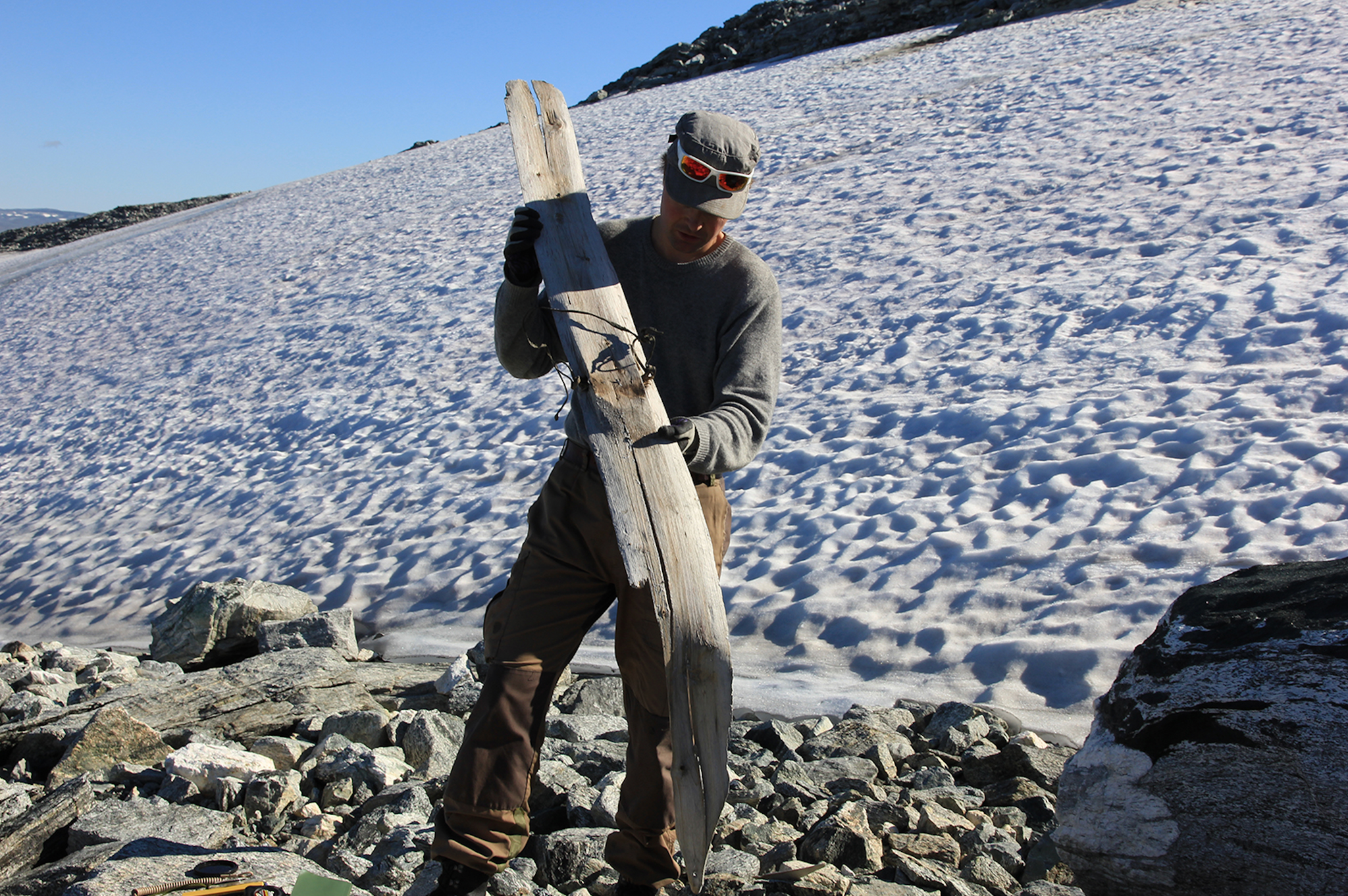
In 2014, archaeologists found a lone “pre-Viking” wood ski frozen deep in the Digervarden Ice Patch in southern Norway, where it had been entombed since the eighth century. The ski was remarkably well preserved and included remnants of a birch-and-leather heel-strap binding, according to scientists from Norway’s Glacier Archaeology Program (GAP), who led the discovery (see “Glaciers Yield Ancient Skis,” Skiing History, March-April 2019).
Since skis travel in pairs, the scientists have monitored the ice patch for seven years, hoping that summer thaws and glacial retreat would reveal the ski’s partner. In late September, scientists discovered the site of the ancient yard sale: They exhumed the second ski less than 20 feet from the original discovery.
Buried deeper in the ice than the first ski, the second ski is better preserved, reported Lars Pilø, an archaeologist with GAP, on the organization’s blog, SecretsoftheIce.com. The ski measures about six feet long (187 centimeters) and 6 inches wide (17 centimeters). The skis had been repaired repeatedly, indicating heavy use. They were not a matched set and were paired after each had been used previously, which didn’t surprise Pilø. “The skis are not identical, but we should not expect them to be. The skis are handmade, not mass-produced,” he blogged. “They have a long and individual history of wear and repair before an Iron Age skier used them together and they ended up in the ice 1,300 years ago.”
Pilø reports that the two skis now stand as the best-preserved ancient pair on record. In 1924 a pair was found in a bog in Kalvträsk, Sweden—along with a ski pole—later carbon-dated about 5,200 years old, but one of the skis is in fragments and no binding parts survived (see “The European Origin of Skiing,” by Maurice Woehrlé, Skiing History, July-August 2021).
Squaw Valley Is Now Palisades Tahoe
After decades of consideration across multiple regimes, the resort scrubs the slur from its name.
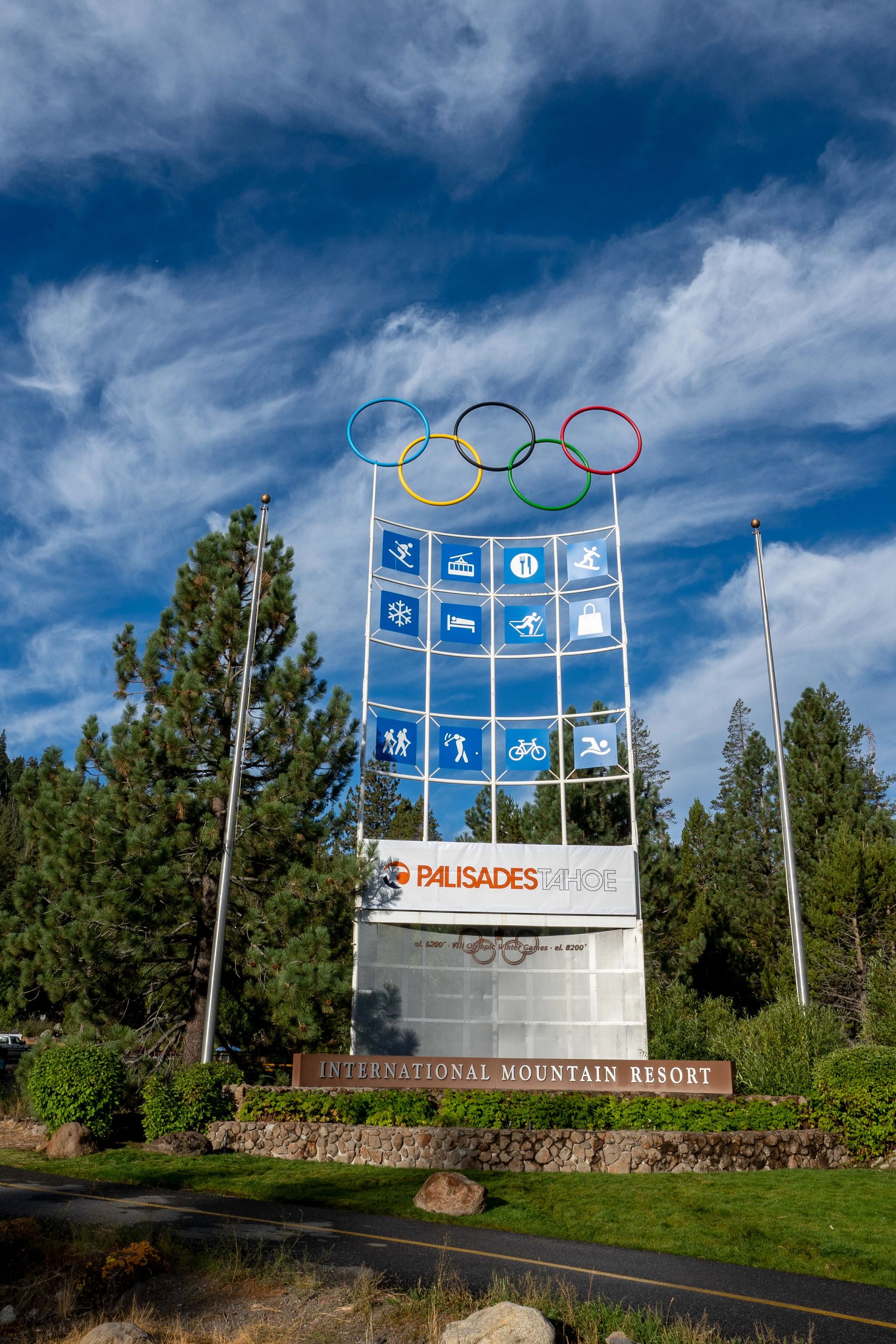
Monument to the 1960 Winter Olympics.
Palisades Tahoe photo.
A year after announcing that it would change its name, Squaw Valley-Alpine Meadows made the move in September and is now officially Palisades Tahoe, a reference to the rugged granite walls and vertiginous terrain that earned the resort early fame as the birthplace of American extreme skiing.
The name Squaw Valley pre-existed the founding of the resort in 1949. The term “squaw” is now widely considered a sexist and racist slur against Indigenous women. The new name unifies the Olympic Valley and Alpine Meadows base areas under one banner.
Members of the local Washoe tribe had advocated for years to rename the resort. Former resort owners Nancy and Alex Cushing told reporters in the 1990s that a name change was under consideration.
“We were compelled to change the name because it’s the right thing to do, especially for the generations yet to come, who will grow up without having to use a slur to identify the place where they chase their dreams down the mountain,” said Ron Cohen, who launched the name-change process when he served as the resort’s president. “We spent more than a year making sure that we were doing right by the community,” said Cohen, who now runs California’s Mammoth Mountain.
Efforts to wash offensive names off the map are gaining traction. The Reconciliation in Place Names Act was recently re-introduced in Congress to update the names of more than a thousand locations in the U.S. that are considered derogatory. For instance, Denver skiers heading to the slopes can see the peak of Squaw Mountain. The governor of Colorado has established an advisory board to consider name changes throughout the state, with similar efforts underway in Utah and other places.
Squaw’s name change has led to other updates within the resort. The base area village on the Olympic Valley side is now called The Village at Palisades Tahoe. The process to rename Squaw One and Squaw Creek chairlifts is underway. Officials expect the process of updating physical name designations and corporatewide branding to be a multi-year project.
“Part of me is going to miss the old name,” Charles Carter told the California Globe news website. Carter worked as a parking attendant at the 1960 Olympics and has lived in the valley ever since. “If you ask anyone here, the name doesn’t matter so much as these mountains,” he said.
SKI ART: Tycho Ödberg (1865-1943)
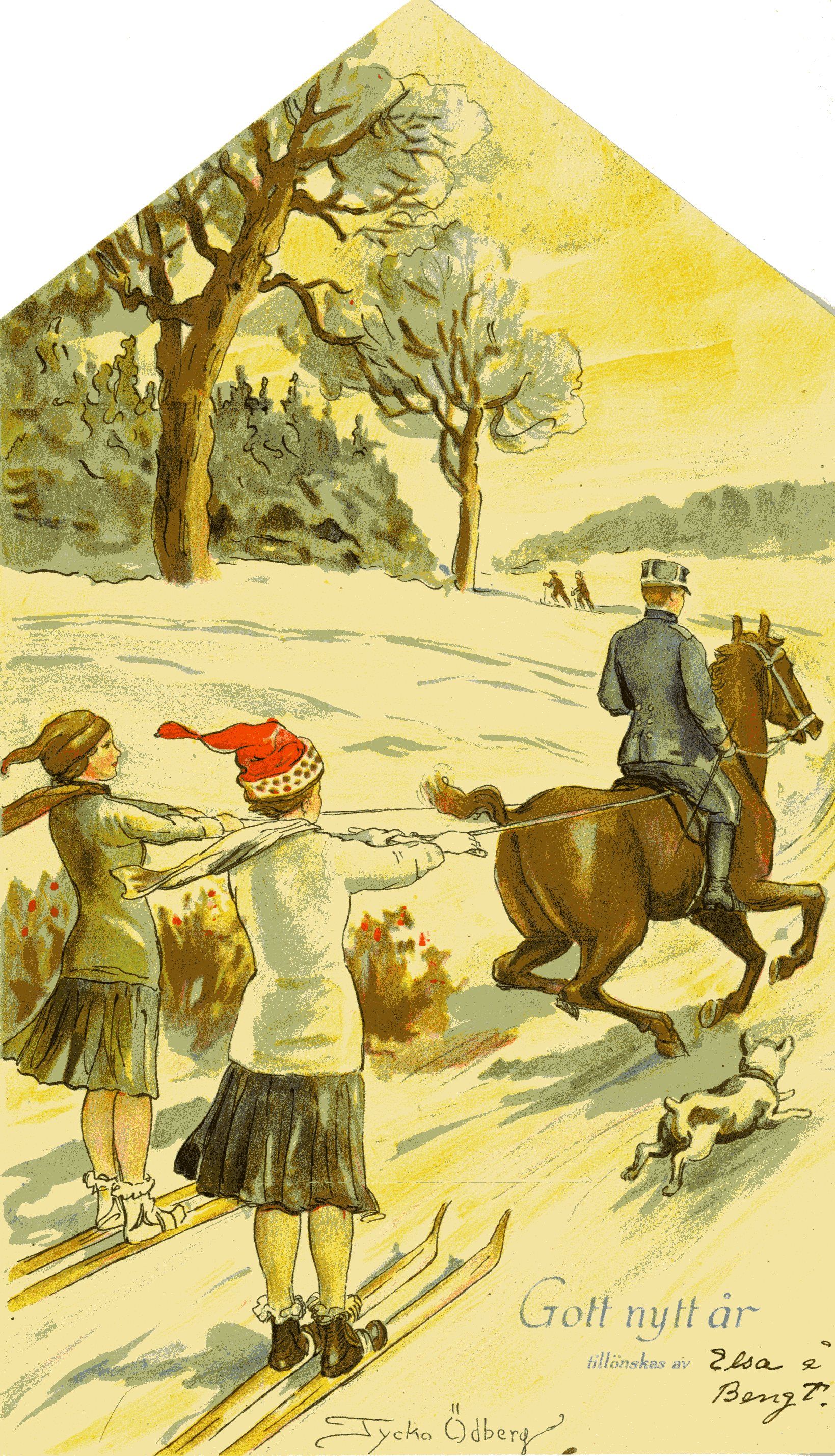
Tycho Ödberg painting, 1928, from the
inside of an envelope.
Many years ago, while searching a catalog for old skiing-related postcards, I came across this 1928 painting by Tycho Ödberg, a Stockholm illustrator and graphic artist who was respected for his landscapes. In 1888, like many Scandinavian artists of his era, he made the trek to study at the Académie Julian in Paris. Upon his return, he was a regular at the Academy of Fine Arts in the Swedish capital from 1891 to 1897.
I was charmed by its direct and simplistic appeal to the joys of skiing in the winter landscape. To my amazement, it was an illustration on the inside of an envelope—the first I had ever seen. It was specially designed for seasonal greetings: Gott nytt år (Happy New Year). This was an extraordinary find: Not only does Ödberg portray correctly all the technical elements of skiing, but the context seems just right; a civilian-military mix that was partially responsible for the way modern skiing has developed.
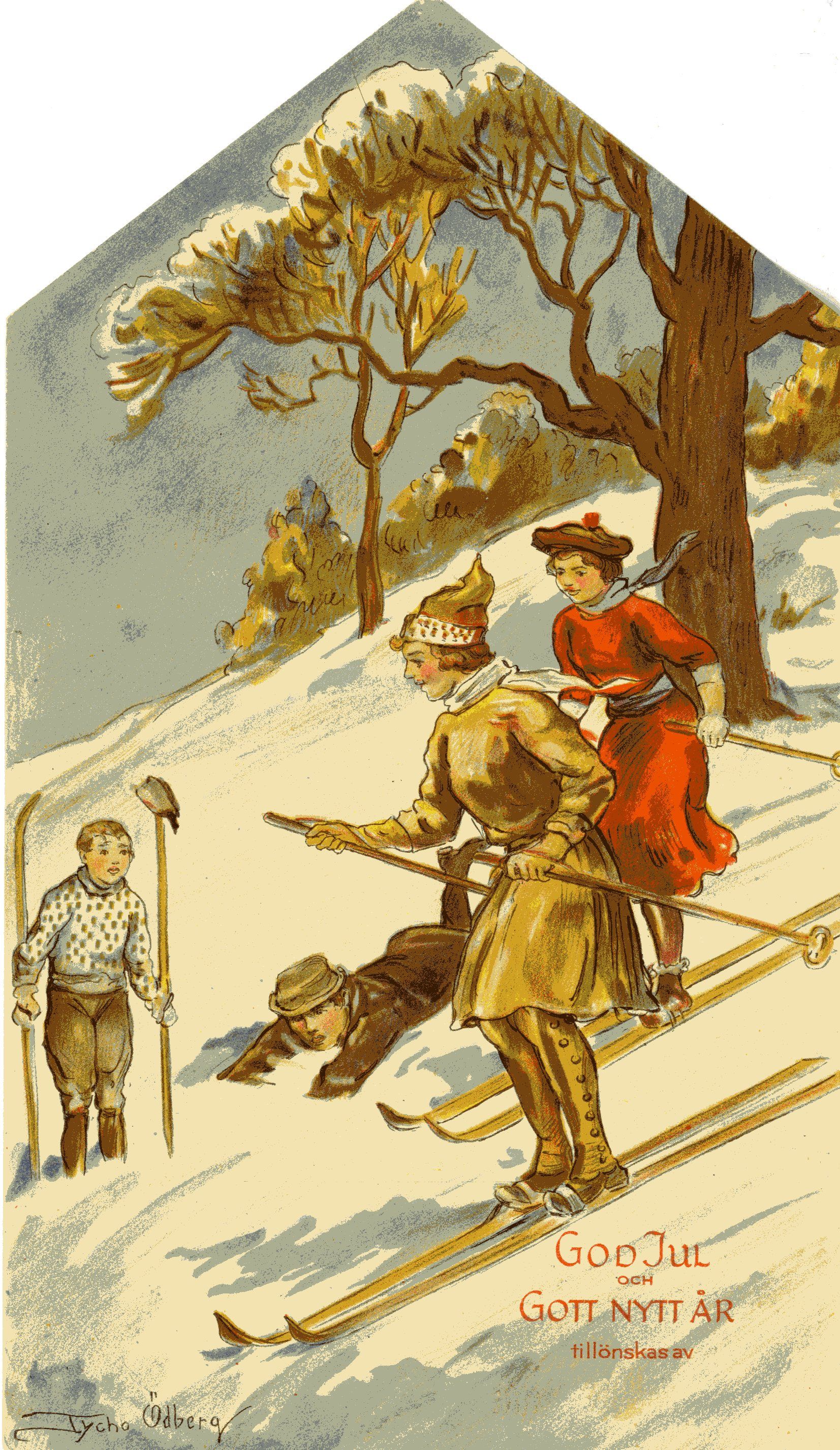
More envelope art from Tycho Ödberg.
The catalog listed another Ödberg ski painting and it, too, was on the inside of an envelope. I acquired both items and used the skijoring painting as the cover for my book Culture and Sport of Skiing from Antiquity to World War I, the first time, I believe, it has been given any publicity.
Ödberg illustrated a number of books, including Viktor Balck’s Gymnastics in 1889, so he was no stranger to portraying sporting activities. This was impressive—Balck was Swedish sport’s “Trumpet of the Fatherland.” Ödberg also turned a number of his paintings into postcards, as many artists did in the 1920s and ’30s.
Ödberg works hang in the National Museum, Stockholm’s City Museum and City Hall, as well as in Uppsala and Gothenburg. For me, pride of place in my varied ski image collection are these two paintings on the insides of envelopes. —E. John B. Allen
Snapshots in Time
1956 Shrewd Planning
Sirs: I am returning the $3 two-year renewal form unsigned though I have always enjoyed reading your magazine. On Jan 22, I will be married to a girl with one year left on her subscription. — E.C.S., BUFFALO, NEW YORK, “HOME ECONOMICS” (LETTERS, SKI MAGAZINE, FEBRUARY 1956)
1969 Price Hike
An increase in price for lift tickets was announced yesterday for the state’s two ski areas, Cannon and Mt. Sunapee. The price for adult tickets at both areas on weekends was raised to $9. Weekday tickets were raised to $7. Season tickets were increased about 20 percent to $145. — “PRICES FOR SKI LIFTS RISE” (NEW YORK TIMES, SEPTEMBER 21, 1969)
1979 Fully Crazed
The gelande jumpers are a traveling gaggle of fully crazed ski addicts without a brain in their heads who party ’til sunrise and fly over the 50-yard-line on 223s without helmets or insurance. Oh, wait. They asked me not to write that. — DAN MCKAY, “LIKE A GOLF BALL” (POWDER MAGAZINE, OCTOBER 1979)
1988 Measuring Up
When in doubt, go shorter. One of the main advantages of today’s improved ski technology is that you can get the same smoothness and stability from a 203 that once was only possible on a 210. — JACKSON HOGEN, “THE RIGHT SKI LENGTH” (SNOW COUNTRY MAGAZINE, MARCH 1988)
2021 High Expectations
This is not science fiction. This is real Olympian life. Shiffrin is entering a World Cup alpine ski season that begins this weekend in Soelden, Austria. It will include her third Olympics, this one in February in Beijing. She is 26 and won gold at each of her previous Games—in the slalom as an 18-year-old in Sochi, Russia; and in the giant slalom four years later in PyeongChang, South Korea, where she added a silver in the alpine combined. Win three medals— a distinct possibility, if not an expectation—and she’ll match Janica Kostelic of Croatia and Anja Parson of Sweden with the most Olympic medals of any woman on the slopes. — BARRY SVRLUGA, “MIKAELA SHIFFRIN KNOWS PAIN AND LOSS. NOW SHE’S BACK ON TOP OF THE MOUNTAIN” (WASHINGTON POST, OCTOBER 21, 2021)
2021 Aging Well
When he set off down the mountain, he skied straight into a Guinness World Record. No one his age had ever done something like this. [Junior] Bounous was 95 years and 224 days old on April 5—230 days older than the existing heli-skiing record-holder, a Canadian named Gordon Precious, who checked in at 94 years 306 days when he made his run in 2019. It was an achievement for the ages, literally. — LEE BENSON, “PRESENTING THE WORLD’S OLDEST HELI-SKIER” (DESERET NEWS, JUNE 6, 2021)
Aspen Highlands founder Whip Jones had a knack for publicity stunts. His 1960s Bash for Cash, anything-goes citizen downhill also had a knack for mayhem and injuries. But the race did result in a popular poster of that era.
From its inception in a valley dominated by Aspen Skiing Corporation properties, Aspen Highlands always strived to stand out. Owner and founder Whipple Van Ness Jones, a maverick by nature, centered his area on pushing the boundaries on entertaining customers and garnering publicity.
After the area opened in 1958, Stein Eriksen, Highlands’ first ski school director, did flips—an audacious trick for that era—at the bottom of the mountain every day. A dozen years later, ski patrollers began jumping off the patrol shack roof, pulling toboggans. Eriksen’s eventual replacement, Fred Iselin, performed Reuel christies down the mountain while reading his own book. So it was probably inevitable that something as brash and fundamentally American as the Bash for Cash would be created here. The event featured racers charging en masse, like lemmings, down a cliffy run for a pot of money at the finish.
Jones blamed the event on the original head of the ski patrol. “There’s no question that Charlie Bolte was the biggest character I ever knew at Highlands,” Jones later explained. “On the job he had a fondness for explosives. And after work he was quite a prominent member of the customers at the bar. He also came up with the idea, maybe at the bar, for our famous race the Bash for Cash.”
Early versions of this madness—with a Le Mans-style–start, no gates and few rules—ran on Lower Stein, near the area’s base. In the early 1960s it was moved much nearer to the top of the mountain. It plunged down the Olympic run face and cut across to the Wall, a short, steep, punishing mogul field, with a run-out finish to the $100 cash prize. The winner was the first one down without falling.
“We started it each week by blowing up a case of dynamite. That was a hell of a charge,” recalled Jones. Indeed. And almost as insane as the fact that they ran the race every week.
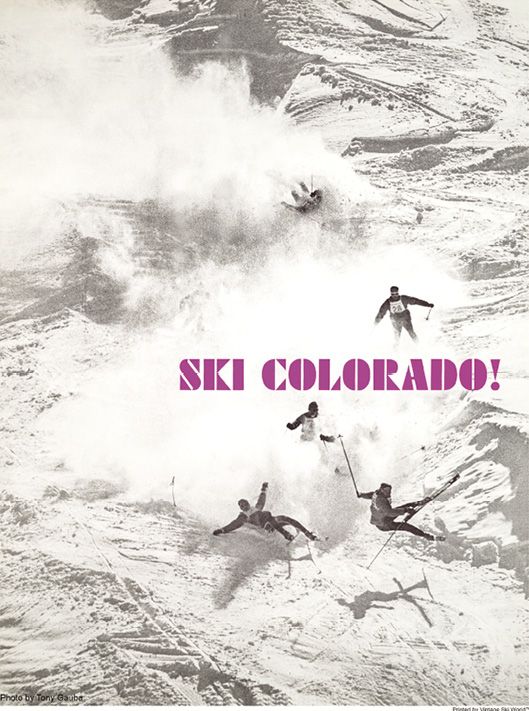
Not surprisingly, it occasionally produced chaos like that in the mid-1960’s poster (see left), part of a sequence of three images taken right after the start on the Olympic face by the late Tony Gauba of Aspen. Highlands instructor and patrolman Paul Dudley is one of those in the photo, and one of the few who didn’t get hurt.
“I’m the one still standing in the poster,” he laughs. “Then the s*** hit the fan and people started colliding.” He remembers, “Twenty or less of us lined up side-by-side at the start and right away the run narrowed to about five feet wide with powder on either side.”
He and his friend Doug Rowley had practiced for the event and decided Dudley would try to shoot that gap, and Rowley would follow a little behind everyone and hope to safely pick his way through in case Dudley didn’t make it.
“When the chaos started, I skied off to my left into the powder and stopped and then the screaming started. Everyone was hurt. Broken bones, concussions, cuts. Some of them skied down. They hauled others off, and they found one guy later halfway down the mountain just walking in a daze,” Dudley says.
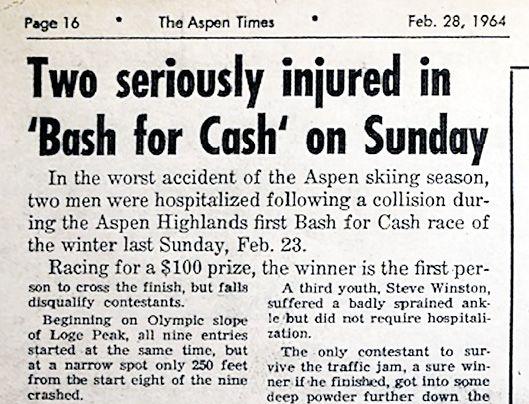
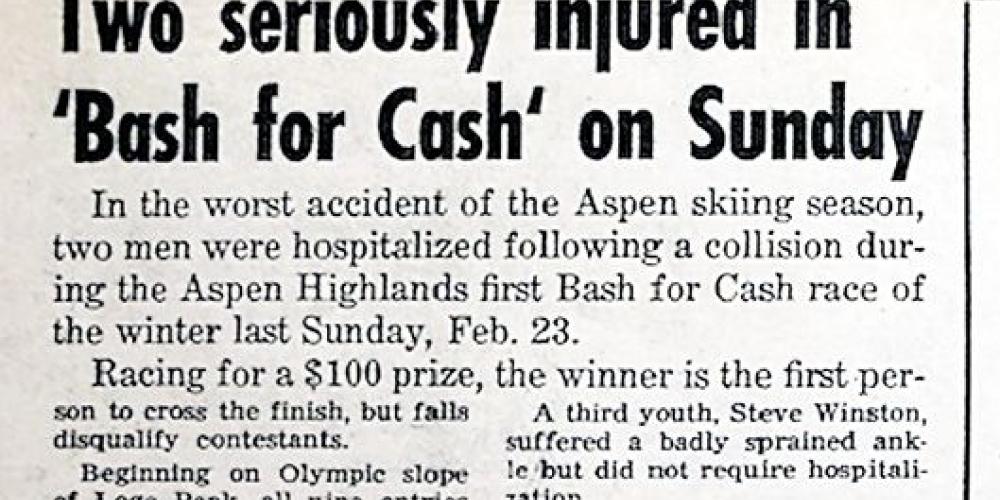
A story in the Aspen Times about that particular race, published in the February 28, 1964, issue, led with this: “In the worst accident of the Aspen skiing season, two men were hospitalized following a collision during the Aspen Highlands first Bash for Cash race of the winter last Sunday, Feb. 23.”
Jones, who witnessed the carnage, said no one was sure what happened. “Two of them fell or collided,” the story quoted him as saying, then adding its own summary: “The other contestants either fell trying to avoid the first two or ran into them.”
Attending physicians at the Aspen Valley Hospital were Robert Oden and Robert Barnard. Racer Myron Leafblad of Wisconsin had “the worst spiral fracture I’ve ever seen,” Oden said. Highlands instructor Mike Riddell “had his upper jaw broken in two places and his upper front teeth torn away,” the Aspen Times reported.
An angry letter from the doctors to the newspaper was followed by an editorial that noted that “in the excitment of competition,” sports participants “must be protected from themselves,” and that Bash for Cash failed miserably on that front. “Racers and race organizers are lucky that more were not hurt, or that no one died,” the editorial read.
The Forest Service, which owns most of the Aspen Highlands property, along with the ski area’s insurance company, are said to have caused the event’s demise the following season. The Aspen Skiing Company purchased Highlands in 1993. But a faint whiff of mayhem and cordite still lingers over the mountain, the locals’ favorite among ASC’s properties.
Les Arcs Named “One of the Most Significant Works of Postwar Architecture”
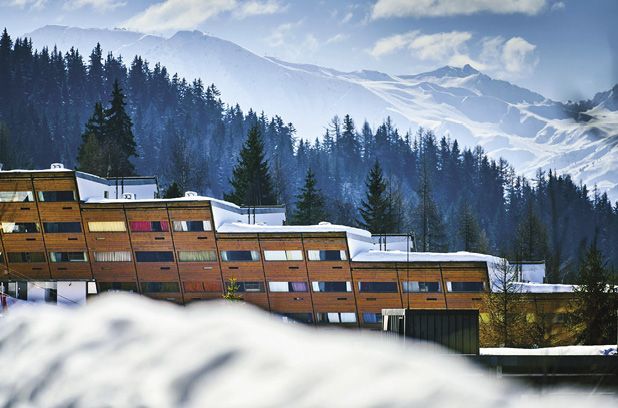
Charlotte Perriand designed the Cascade hotel
to fade into its mountain backdrop. Agence Merci
Les Arcs, in Savoie, France, is known for its avant-garde architecture, conspicuously different from the traditional Alpine designs prominent at many European resorts. The New York Times agrees on the resort’s distinction, naming Les Arcs No. 14 in “The 25 Most Significant Works of Postwar Architecture,” by Kurt Soller and Michael Snyder, published in August.
One of the first mega-resorts, Les Arcs consists of five interconnected base areas, each named for its elevation in meters. All but Arc 1950, the last of the areas constructed, were built in a modernistic style. The Times story notes the innovative work of French architect (and skier) Charlotte Perriand, a leading figure of 20th-century design. She took on the project in the late 1960s, at age 65.
“Perriand approached the construction of her ambitious Les Arcs resort as an opportunity to introduce the masses to what she described as the ‘possibility of self-transcendence’ offered by mountain landscapes,” the story reported. Perriand’s portion of the project consisted of “two clusters of hotels and apartments set into the mountain slope with views up to the pastures above.”
With a tight construction schedule, Perriand incorporated prefabrication techniques lifted from shipbuilding. “To assemble a structure that could accommodate 18,000 beds in the span of just seven months, she used mold-formed polyester to make easily reproducible kitchens and bathrooms. Carefully planned setbacks in the facade transformed the building itself into a slope, providing each of its long, narrow rooms with expansive views.”
The Cascade building (above), at Arc 1600, is noted as an example of her inspiration to have the hotel disappear into the mountain environment. “The ski chalet doesn’t rank that brilliantly in terms of sustainability or honorable usage of materials, particularly nowadays, but that modular approach to building—the way she integrated into the landscape and the woodiness of the prefabricated construction—is amazing, as are the furnishings inside,” the story reported.
Eliasch to step back at Head, pledges to modernize race formats
Billionaire businessman Johan Eliasch was elected president of the International Ski Federation on June 4, pledging to re-energize competitive skiing with possible new race formats and more dynamic broadcasts.
Eliasch, the 25-year CEO of Head and an active environmentalist, was elected on the first ballot, with 65 of the 119 votes. In an online press conference, Eliasch told reporters “I think it shows the FIS family is ready for change. I always said, ‘If you want to keep things the way they are, I am not your candidate.’”
Each candidate made a 10-minute video presentation. Eliasch’s pitch included endorsements from Lindsey Vonn and Aksel Lund Svindal, both of whom raced on Head skis during their championship careers. Former U.S. Secretary of State John Kerry endorsed Eliasch’s candidacy, noting his position on the immediate need to address climate change.
Eliasch, 59, was born in Sweden but has lived in London since joining the private-equity firm Tufton in 1985. From 1999 to 2010 he held a variety of environmental-stewardship positions in the British Government, under both Labour and Conservative prime ministers. He acquired Head out of near-bankruptcy in 1995, at age 33, made it profitable within two years and took it public in 2000. Eliasch holds a master’s degree in engineering and put 3 percent of Head’s revenue into research and development. To back up his climate activism, in 2005 he established the Rainforest Trust and bought 400,000 acres (162,000 hectares) of Amazon forest, along with the company logging that land. He halted logging and replanted.
Eliasch runs Head out of its London office, but pledged during his campaign to leave his Head role if elected. “I will step down as chief executive of Head,” he said during the press conference. “And if there are any decisions which have potential conflict of interest, I will of course recuse myself.” He declined to say if he would divest his financial position in Head, according to Associated Press reports. “If we have phenomenal success for FIS, it will benefit all stakeholders,” he added.
Just the fifth FIS president in its 97-year history, Eliasch succeeds Gian Franco Kasper, who held the office since 1998 and leaves one year early. The next FIS election is scheduled next year after Eliasch oversees a majority of the medal events at the Beijing Winter Olympics in February 2022.
Rival candidates were former world downhill champion Urs Lehmann of Switzerland, former FIS secretary general Sarah Lewis of Britain (fired by Kasper last year) and FIS vice president Mats Årjes of Sweden, Kasper’s own choice. Lehmann and Årjes won elections for seats on the ruling FIS Council, which Eliasch will chair.
In his initial post-election news conference, Eliasch promised to give FIS’s 135 national associates more voice in decision-making and more opportunities to host events. He pledged to begin work “as soon as possible” on reviewing race formats. He also pledged to modernize FIS media policies by centralizing broadcast rights and expanding broadcasts across new media.
Halston on Netflix: How fashion came to the Olympics
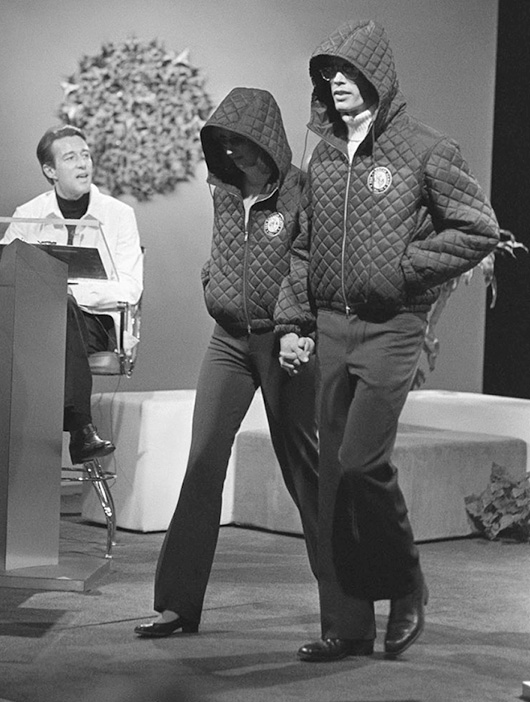
Halston introduces athletic uniforms, 1976
The five-part Netflix series Halston, released in May, follows the American designer as he transforms his name into an international fashion empire. Not mentioned in the biopic is that Halston volunteered to create the U.S. Olympic Team uniforms for both the summer and winter games of Centennial Year 1976. That kicked televised Olympics into a fashion showcase: Levi Strauss signed up to do the uniforms in 1980 and 1984, and Ralph Lauren has done it every year since 2008—and will again for 2022 (in recent years Lauren has done suits for the opening and closing marches, while Nike has provided uniforms for medal ceremonies).
As the website Fashionista notes, the designers “imbued elements of national identity into their uniforms, projecting idealized American aesthetics intended to make an impact on the world stage at crucial moments in the nation’s history.”
It wasn’t always that way. The first international Olympic Games in 1896, in Athens, featured athletes wearing their own clothes or uniforms from their athletic clubs. At the first winter games, at Chamonix in 1924, American skaters wore white pants and sweaters with a stars-and-stripes shield on the chest. Thereafter the winter teams had uniforms composed variously of navy-blue warm-ups, white sweaters and pea coats.
Montgomery Ward produced Halston’s 1976 uniforms, without the official insignia, and sold the Olympic line in its catalog. Halston pocketed a percentage. The uniforms weren’t universally admired. “Opening Ceremony uniforms for the winter games included simple dark navy jackets with hoods worn with plain loose trousers, while podium outfits looked like simple leisure suits with turtleneck tops,” Fashionista reported. A letter in the New York Times called them a “disgrace to the team and affront to the nation.”
“Despite mixed reviews, Halston is definitely worth the binge,” Forbes reports. “It’s fun to travel back in time throughout the 1970s and ’80s.”
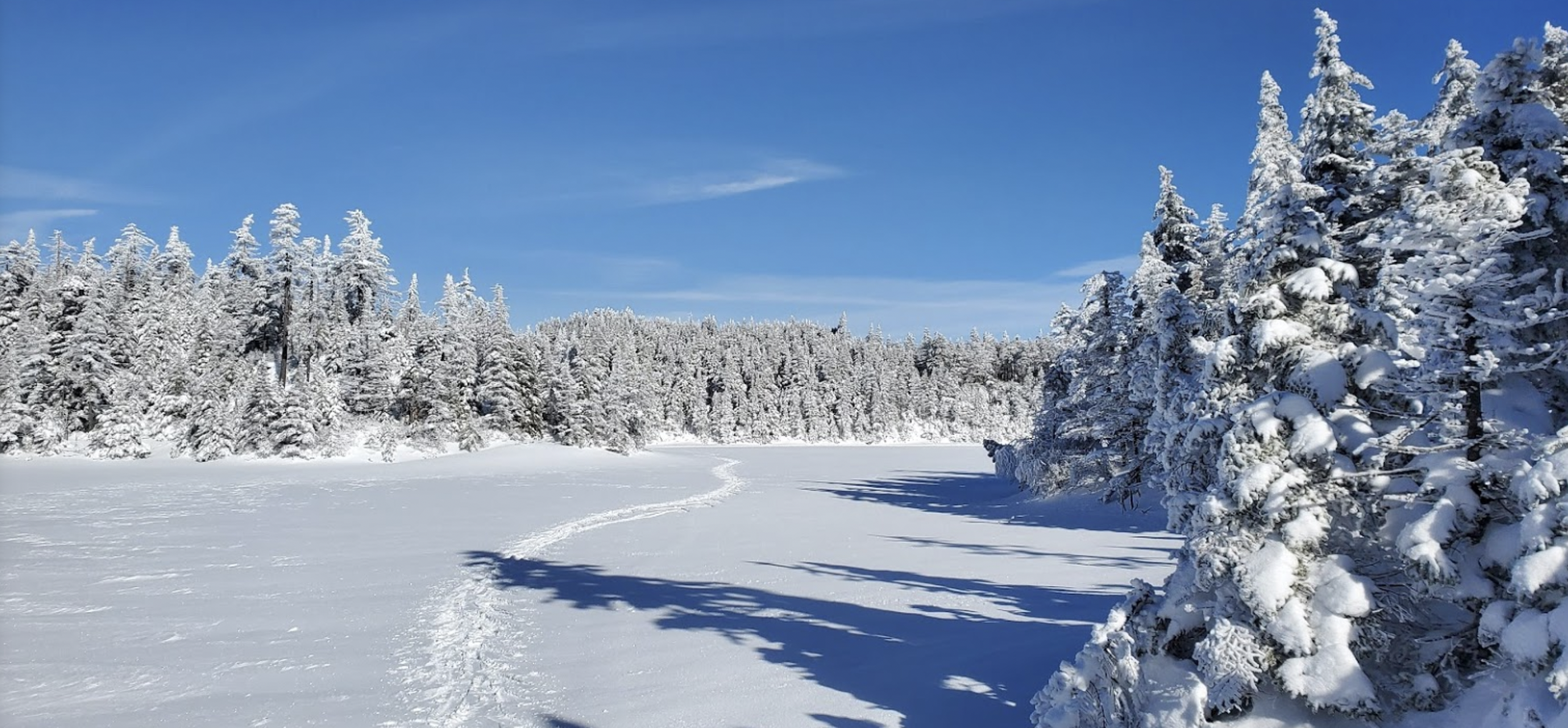
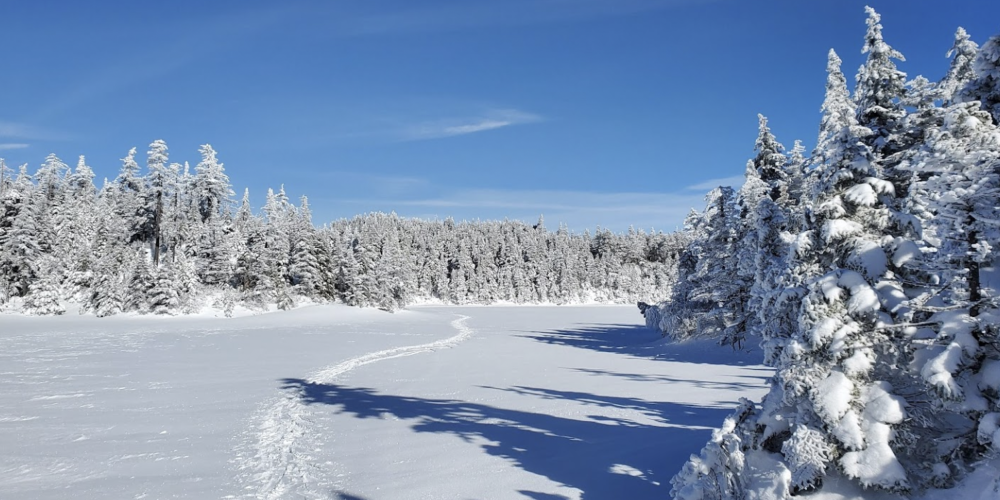
Photo above: Tracks across Sterling Pond show the way from Smuggs to Spruce. The reverse trip is all downhill.
For Alpine skiers, “interconnect” is a route connecting two separate lift networks. The granddaddy of all interconnects, created in 1956, may be the trail between the top of Stowe’s Spruce Mountain and the summit of Sterling Mountain at Smugglers’ Notch. It’s still possible to ski both resorts the same day, although the experience is no longer encouraged by the two Vermont ski areas.
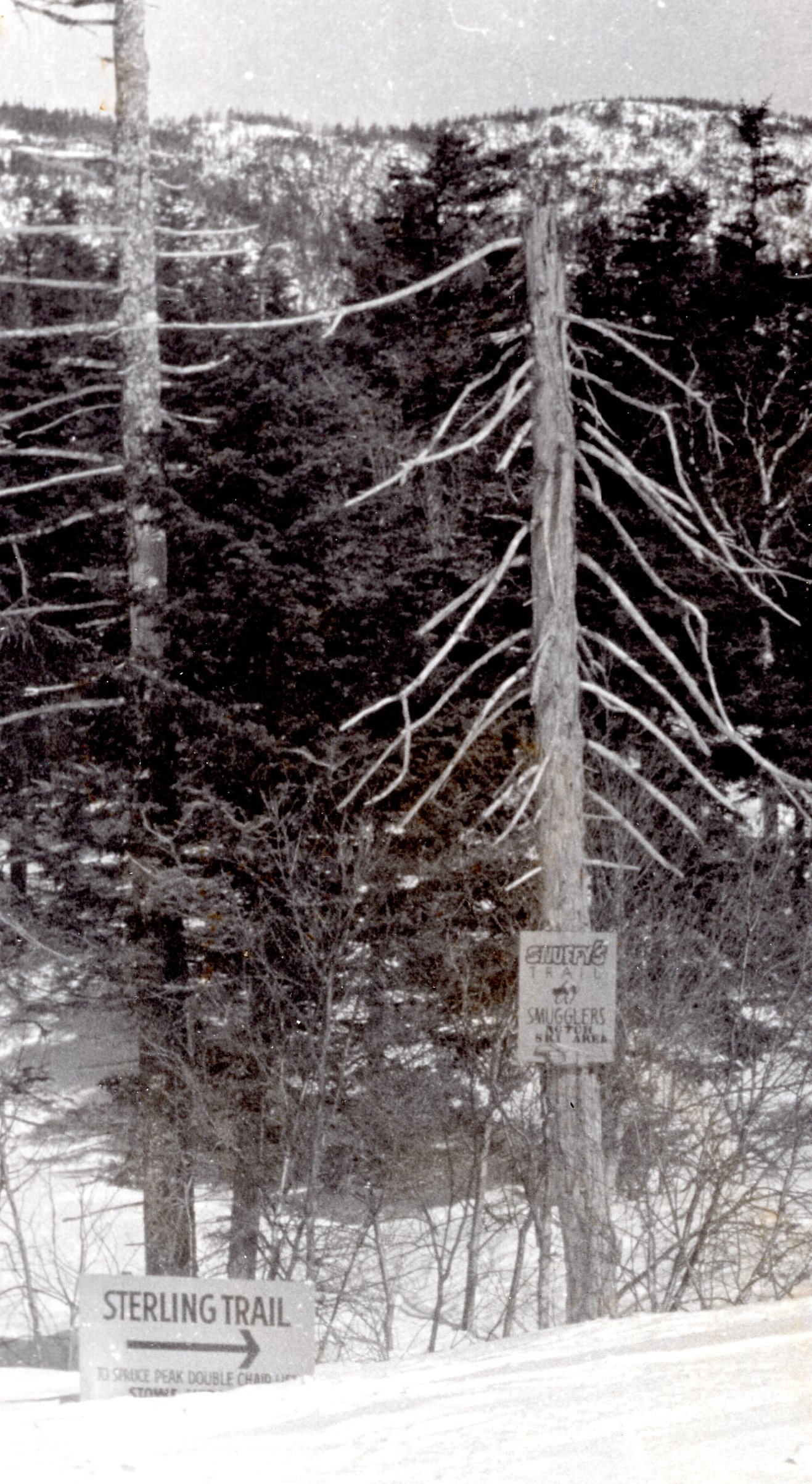
Undated photo shows interconnect trail signs. The route may no longer be posted.
It’s not marked, nor patrolled, and skiers are advised against trekking alone. Still, this little-known half-mile link between resorts continues to delight intermediate to advanced skiers with a taste of easily accessible backcountry that harkens back to when skiing was a true adventure pursued on rudimentary equipment.
Home to Colorful Characters
Smugglers’ Notch derives its name from a history filled with shady characters.
From 1807 until the War of 1812, the U.S. Congress placed an embargo on all British imports, which was a hardship for American farmers and merchants who needed manufactured goods. So “importers” smuggled British merchandise from Canada, through what is today called Smugglers’ Notch Pass. State Route 108 now follows that trail.
More than 100 years later, the Notch was again used for smuggling when the 18th Amendment to the United States Constitution prohibited the manufacture and sale of alcohol. Bootleggers moved booze through Smugglers’ Notch Pass and from there south to central and southern New England. Caverns in the Notch were ideal for storing alcohol at close to room temperature, while the smugglers avoided revenue agents. Visitors today can still visit the caves.
Alpine skiing came to Stowe with construction of downhill trails by the Civilian Conservation Corps in 1933. In 1935, the old 1919 Toll House was converted to a real base lodge. Sepp Ruschp supervised construction of lifts in 1937. Starting in 1949, Ruschp developed the sunny slopes of Spruce Peak, across the road from Mt. Mansfield, starting with a T-bar.
In 1954, Spruce constructed a double chair to access the Outlook Restaurant perched on the summit, with stunning views to the south.
Calling it a restaurant is being charitable: it had no running water, no electricity and no restrooms, according to Stowe ski area historian Brian Lindner, son of a forest ranger, whose bedroom was in the original base lodge.
Beginning in 1956, adventurous skiers who followed the Long Trail half a mile northward from the Spruce Peak patrol shack (elevation 3,250 feet, 991m) could cross frozen Sterling Pond (3,040 feet, 927m) and ski down the other side to the new Madonna Base Lodge at Smugglers’ Notch ski area. They could then ride a pair of Poma lifts back to the top of Sterling Mountain (3,080 feet, 939m) and reverse course back to Spruce.
Reciprocal Ticket Offered
In the 1990s, Stowe and Smuggs, as Smugglers’ Notch is still called by locals, offered a reciprocal ticket based on a multi-day ticket purchase, used to bolster non-holiday midweek vacations. It was an effective marketing novelty, but Smugglers’ Notch vice president of marketing Steve Clokey says, “They stopped promoting it due to the logistical headaches of grooming, patrolling, and the skill levels of those who were experiencing an intermediate-plus level experience.”
What’s more, when an accident occurred in the mid-1990s, Stowe and Smugglers’ executives became even less enamored with marketing off-piste skiing.
“A Stowe snowcat driver didn’t calculate the turn radius correctly and extended the cat too far onto the ice,” Clokey tells Skiing History. “The cat broke into shallow water and was stuck on the side of the pond. It was pulled out that night and the incident was reported to the proper authorities.”
SKI magazine writer Steve Cohen took his family across in 1998. In his story “Ski East: Going over the Top,” (Dec. 1998) he reports, “The two trails connecting Stowe and Smugglers’ are marked with green circles and require more in the way of conditioning than ski skills; parts of the traverse are so flat we needed to herringbone and skate. Still, the 15-minute jaunt has joined two very different worlds.”
Pretty Tame
Today, the Stowe-Smuggs Interconnect trail is only open when Sterling Pond is frozen—some seasons as early as the first week of December.
From Smuggs, it takes about 20 minutes to pole across Sterling Pond and then descend into a meandering narrow trail that rolls easily to the Sterling trail on Stowe’s Spruce Peak. Take that down. Then, from the base of Spruce, take the Sensation high-speed quad back up to the peak. Ski Snuffy’s trail to the peak of Sterling Mountain, then take Rumrunner to Smuggs base. You’re back where you started in less than an hour, roundtrip.
“The toughest part is having to trek the flat surface of Sterling Pond—a little work-out but then it’s all downhill to the base of Spruce,” says Clokey.
Adds Stowe resort historian Brian Lindner, “It’s a pretty tame trail, except for some drop-offs, and is as narrow as a one-lane road. It harkens back to the way skiing used to be when I started as a kid in the 1950s, but I certainly don’t miss that vintage ski equipment.
“During my first experience with the Stowe-Smuggs Interconnect, it was 1960 and I was around eight years old. The best gear available at the time was wooden skis and leather boots. I realize now skiing was much more dangerous back then. The improvement in gear has made skiing so much better and safer. “Don’t ever make me ski in beartraps again,” he jokes.
Apparently, that’s another kind of ski adventure entirely.
ISHA board member Jeff Blumenfeld, of Boulder, Colo., is president of the North American Snowsports Journalists Association (NASJA.org). He remembers skiing the interconnect as a kid in the 1960s. The trail seemed a whole lot scarier.
Snapshots in Time
1960 Ski Like a Girl
Pretty Penny Pitou is the likeliest American bet for an Olympic gold medal. But unlike the hapless U.S. men’s team, which lost all of its chances when Buddy Werner broke his leg, the women’s team could win with any of its six girls. —“Pretty girls of highly promising American Team get set for Winter Olympics,” which profiled Pitou, Renie Cox, Linda Meyers, Joan Hannah, Beverly Anderson and Betsy Snite before the 1960 Squaw Valley Games. (Life magazine, February 1960)
1969 Ski and Smell the Roses
“South Americans are like Europeans. It’s important to have fun and watch the scenery,” said Othmar Schneider, the former Olympic slalom champion who heads the 13-instructor ski school at Portillo, 55 miles northeast of Santiago. “Americans are more serious. They are too involved in skiing and don’t see the scenery.” —Enid Nemy, “Where Ski Buffs Migrate in Summer” (New York Times, August 31, 1969)
1971 Plowed into Oblivion?
Currently, the most widely taught method, The American System, can, in my opinion, be a woefully long process that starts the beginner in the venerable “snowplow” position and frequently leaves him there for life. —Stan Fischler, “The Ski’s the Limit” (New York magazine, November 1971.)
1985 Booting Up
By the time ski shops call it a season this year, they will for the first time have sold more rear-entry than traditional boots. Although this is no great surprise, it still represents a major shift in our boot-buying habits. Five years ago, rear-entry boots were still exotic footwear for skiers who wanted something different. This season, they’re commonplace. —John Henry Auran, “Rear Entry Redux” (Skiing magazine, Spring 1985)
1990 Fear Is My Copilot
Fear is a constant companion. The racers themselves admit freely that this is “the race of fear,” head and shoulders above any other test of concentration, skill and plain ordinary guts in the world. Dr. Sepp Sulzberger, who raced it long before it reached legendary status, reports that racers in his era would lose bladder and sometimes bowel control right at the start. —Serge Lang, “The World’s Toughest Race” on the Hahnenkamm downhill. (Snow Country magazine, January 1990)
2008 Skiing Real Estate Not Recession-Proof
After years of rising prices, ski-town real estate has cooled. Sales were down as much as 50 percent across all resort markets in the first half of 2008. “The resort market could not be sustained,” said James Chung, a New York real estate consultant for the ski industry. “People aren’t buying stupidly anymore.” —Paul Tolme, “Mountains of Real Estate” (SKI Magazine, October 2008)
2021 High-Class Aspen Caper
Thieves cut a hole in the storeroom wall of the Louis Vuitton store in downtown Aspen and stole as much as $500,000 worth of merchandise, police said. One man and one woman, along with two vehicles, were caught on surveillance video. The thieves entered an unlocked hallway at the back of the store and cut a hole in the drywall just large enough for one person to enter. —Jason Auslander, “Aspen’s Louis Vuitton store targeted in brazen $500k burglary” (Aspen Times, June 8, 2021)