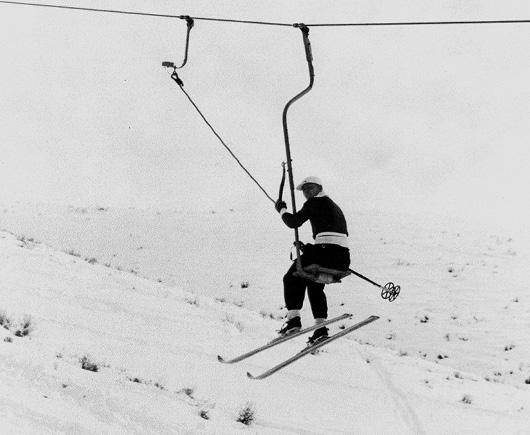
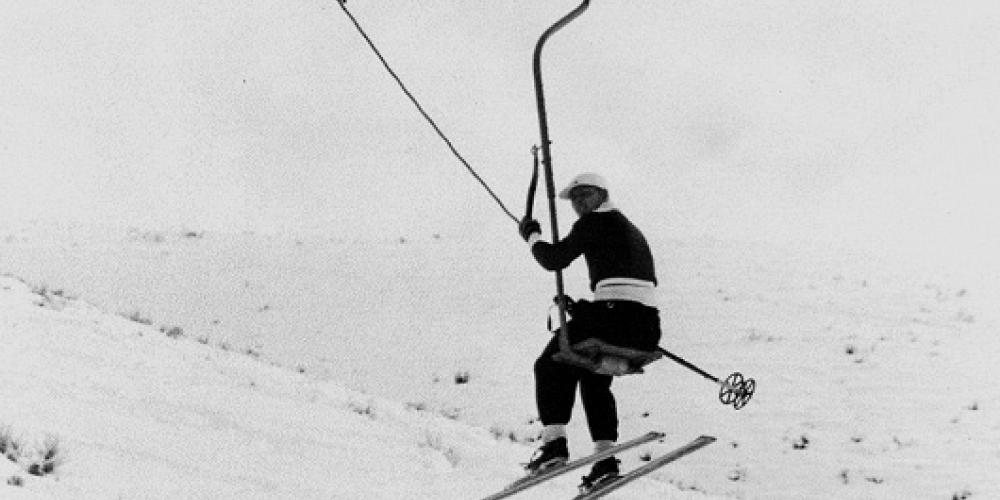
Photo: Alf Engen rides Sun Valley's Ruud Mountain chairlift, location of the jumping hill he designed with Sigmund Ruud, circa 1938. Photo by Charles Wanless, courtesy Alan Engen.
Alf Engen in Sun Valley (the saga continues...)
In a recent letter in Skiing History (May-June 2020), my colleague Kirby Gilbert raised several questions about Alf Engen’s role in Sun Valley’s early days. Kirby wonders whether Alf was in Sun Valley in 1936, since his presence was not mentioned in other accounts at the time.
In his 1985 oral history, Alf said he met Count Felix Schaffgotsch in Utah in early 1936, when the Count was searching for a place for Averell Harriman to build a destination ski resort. Alf showed the Count both Alta and Brighton, before the Count visited Ketchum in February 1936, and found the area that would become Sun Valley. According to Alf, “When I found out that he had picked this place [Ketchum], the Forest Service sent me up here just to see what he had actually picked out…There was lots of snow that year, and it was beautiful. And at the end of the road...of the railroad...there was only one building, there was Pete Lane’s store…I just came to see what he had picked out.”
From 1935 to 1942, Alf worked for the Forest Service as a technical advisor, assisting with planning and developing winter sports areas in four western states. Alf’s son Alan provided me with a list of 31 ski areas in which Alf played a role in planning or developing, which included Sun Valley’s Bald Mountain.
In January 1939, Sun Valley general manager Pat Rogers told Harriman that the Forest Service released Engen to work at Sun Valley. Count Schaffgotsch, Alf Engen, Dick Durrance and Friedl Pfeifer were on Baldy marking trees to be removed for a new downhill course designed by Durrance, the work would be rushed through, and the course would be ready for the 1939 Harriman Cup. Engen also supervised Civilian Conservation Corps workers stationed at a camp in the Warm Springs area, to clear new runs on Baldy to open the mountain for general skiing in winter 1940, after chairlifts were installed. In his oral history, CCC worker Fred Joswig described working with Alf on Baldy. Joswig said Pfeifer, who had a “good eye for a downhill course,” marked trees for removal, and Engen contributed “more than any one person to Bald Mountain’s development than anyone I know.”
As a part-time resident of Sun Valley, I appreciate interest in the history of our country’s first destination ski resort that Durrance said was “the most important influence in the development of American skiing ... Its concentrated and highly successful glamorization of the sport got people to want to ski in the first place.”
John W. Lundin
Seattle, Washington
John Lundin is the author of Early Skiing on Snoqualmie Pass (2018 ISHA Skade Award winner); Sun Valley, Ketchum and the Wood River Valley (Arcadia Press, June 2020); Skiing Sun Valley, a History from Union Pacific to the Holdings (History Press, publication date November 9, 2020); and Ski Jumping in Washington —A Nordic Tradition (History Press, publication date January 2021). John and Kirby Gilbert are both founding members of the Washington State Ski and Snowboard Museum (www.wsssm.org).
Engen’s Son Remembers
I received the latest Skiing History and was interested in the short piece by Kirby Gilbert that talked about my father in Sun Valley during the mid 1930s. I can’t comment much about my father’s early years at Sun Valley working for the Forest Service during summer months. I know he did some early trail cutting. He told me about encountering a wolverine face to face while cutting trails on Warm Springs. Dad backed away without incident, but it was a lasting memory.
I know my father played an important role in the design and construction of the Ruud Mountain ski-jumping hill near the old Proctor Lift. That would have been in 1936–1937 and he did have a good association with Averell Harriman during those years. I used my father’s blueprint design of the Ruud Mountain ski jump as a guide for the one I designed on a hill for Bob Barrett, original owner of the Solitude ski area, in the late 1950s. It was used for intercollegiate competitions for several years in the early 1960s, but was torn down and replaced with a regular run in later years.
Alan K. Engen
Salt Lake City, Utah
Where Grooming and Geometry Intersect
In his “Paradise Lost” article (Skiing History, May-June 2020), Jackson Hogen eloquently explained how carving represents the Nirvana of alpine skiing. I would add that carving stands at the confluence of two evolutions: ski geometry and slope grooming.
Ski designers began experimenting with new sidecuts back in the 1960s. For instance, Dynamic designers moved the waist back about 18cm to take advantage of new racing techniques. Two decades later, alpine races were still taking place on decently prepared but significantly wavy and irregular terrain, making carving choppy and imperfect. As trail grading and grooming improved, resorts created flawless and wide snow ribbons. When shaped skis came of age, they showed their magic power on these smooth new ski runs.
Do all skiers need to carve? I’m not convinced. Many are content with letting their boards skid into each turn. In fact, accomplished carvers account for a small portion of the skiing public. Besides, significant momentum is required to trigger carving. Its maximum efficiency promotes higher speed, but doesn’t allow for slow motion. And it often creates stress on the joints that can prove tiring after a full day on the snow.
If carving is one useful skiing skill, skidded turns are essential in countless circumstances like moguls, crud, steep spots, blue ice, deep snow, trees and out-of-bounds skiing. A skier who doesn’t master skidding will be ill at ease on surfaces that aren’t perfectly groomed. Skidding is in fact a progressive form of edge control while carving is binary; you either carve or you don’t. As a result, I use a variety of skills when I ski, depending on the terrain, the snow and the day: carving, skidding and stem-christies (yes, these too!).
Finally, about the danger of rocker and fat skis: Those are part of the ebb and flow of “cool trends” that we’ve seen come and go in skiing. As the industry pushes them, they grow, stay for a while and falter. Rocker skis are made for the elusive deep snow while fat skis are sluggish and heavy to carry, so when their heydays are gone, they might return to niche status.
J.F. Lanvers
Park City, Utah
Jean-Francois Lanvers, who capped his ski-teaching career with a stint on the French Demo Team, came to North America as a marketing executive, first with Look and then with Lange.
Notes on the New Northlands
I want to thank Jackson Hogen for his article in the May-June issue, which brings to light the concept that we built Northland Skis around. Wider rockered skis degrade the true ski turn.
We pride ourselves in making one of the finest all-mountain carving skis on the market. We went against the trend to go wider and rockered by creating dimensions and ski construction not seen in other skis in the industry. To do this, we went back to the original Northland design. The vintage skis were made from hickory that provided strength, snap and durability. With the new Northlands, we make the core from hickory and white ash, strong hardwoods with excellent performance characteristics. To that we add a full-length layer of Kevlar to quiet and dampen the ski bottom and add strength.
I applaud Hogen for stepping out and speaking his mind about products that the industry has dropped on the skiing public that diminish the ski experience.
Peter Daley
Steamboat Springs, Colorado

 The Jet Stix Story
 Positive ID: K2 Ad Was Shot in Seattle

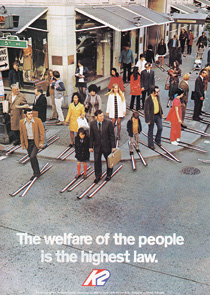 Who was in the K2 ad?