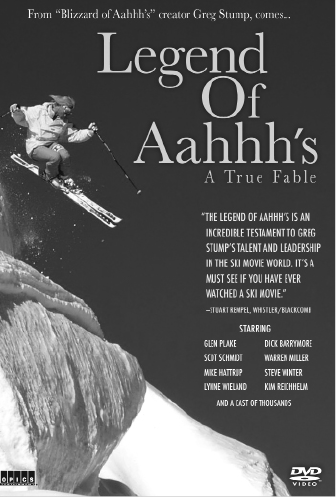
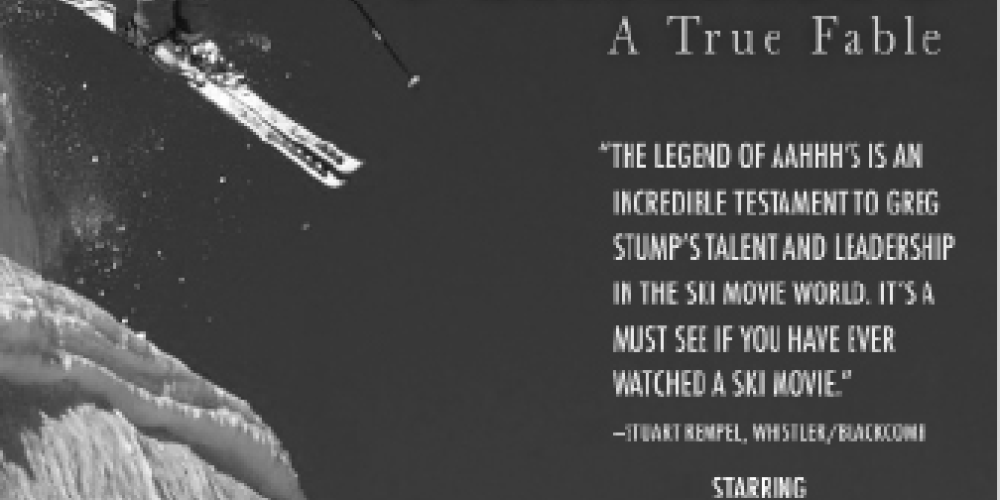
A new ski film by Greg Stump attempts to tell the history of the ski film.
Seldom has a new ski movie been awaited as impatiently
as Greg Stump’s Legend of Aahhh’s…at least not since skiers stood eagerly in line in 1949 to view John Jay’s new 16mm annual opus at high school auditoriums around the country. Stump’s film toured North America last fall and winter and is now available on DVD.
A former national junior freestyle champion from Maine, Stump is the cinematographer who in 1988 produced a stunning work that captivated the emerging freestyle, extreme and snowboard generation and its hitherto little-known stars. The movie was Blizzard of Aahhh’s.
Melding ski action hyped with cutting-edge music by Britain’s Trevor Horn, Blizzard is Stump’s best work. Two more action films followed. Then the well ran dry, or Stump feared for the lives of the risk-taking performers, or both. He turned to producing music videos and commercial work. More than 18 years have passed since he last made a significant extreme ski flick. And now we have the historical Legend of Aahhh’s.
Stump has spent the past couple of years trying different cuts and approaches to redact his film to a running length of 93 minutes. It was a struggle because the director found himself trying to make two films in one. Legend endeavors to tell the history of ski moviemaking, as well as the cultural history of extreme skiing, powerfully visible today on magazine covers and in equipment and resort advertising.
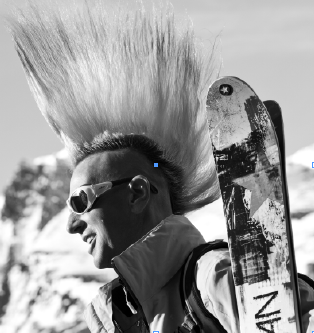
Extreme skiing—mastering the descents of precipitous couloirs and the world’s highest mountains—was born in the Alps, around Chamonix. The world first learned about “extreme” in the 1960s in the person of the skieur de l’impossible Sylvain Saudan, who made Chamonix his home. Chamonix is where Stump’s film characters—Scot Schmidt, Mike Hattrup and Glen Plake, with his 15-inch-high, bleached-blond Mohawk hair ensemble—established their extreme reputations. So it’s odd that Saudan is ignored in Legend of Aahhh’s. That is just the beginning of the historical omissions and factual errors that mar the film.
Frenchman Patrick Vallençant, who created the pedal-hop turn still used on the steepest terrain, goes unmentioned in Legend. Stump does include Bill Briggs, who made the first ski descent of Grand Teton.
In Legend, Stump suggests that Schmidt’s and Plake’s interview with Greg Gumbel on the Today Show in 1988 first drew mass media attention to extreme skiing. Correction needed. Japan’s 1975 theatrical film The Man who Skied Down Everest was viewed a dozen years earlier by hundreds of thousands of people around the world.
What is true is that a new genre of extreme skiing was pioneered 25 years ago by young Americans. That they came to be better known than extreme skiing’s founders is because a young, extraordinarily talented cinematographer—Greg Stump—displayed them in a spectacular, innovating way. Their notoriety is inseparable from Stump and filmmaking. 
In Legend of Aahhh’s Stump pays generous tribute to his filmmaking antecedents, beginning in the 1920s with Arnold Fanck, Leni Riefenstahl, and on to John Jay, Dick Durrance, Warren Miller, Dick Barrymore and Roger Brown. Inexplicably overlooked by Stump, however, is the work of Germany’s Willy Bogner, Jr., whose exotic filming, commencing in the 1960s, visually anticipated the 21st century ski movie. And who other than Bogner has made a ski movie for IMAX?
The apotheosis of the historical ascent of ski cinematography in Stump’s mind is Stump himself, buttressed by scores of admirers who tiresomely iterate that Blizzard of Aahhh’s is “the greatest ski movie ever made.” Added is the claim, made in the Denver Post, that Stump was the first ski moviemaker to cut his film to music. He wasn’t. The first was Barry Corbet who did it in his 1968 editing of Ski the Outer Limits.
At least half of Legends of Aahhh’s is devoted to Blizzard…rather like Alfred Hitchcock making a flattering movie to establish the claim that Psycho is the greatest suspense film ever made. It’s doubtful Hitch would have so indulged himself.
Of course, the best ski movie ever made, textured with a real story, was director Michael Ritchie’s Downhill Racer, starring Robert Redford and Gene Hackman, with screenplay by best-selling author James Salter. As much as anything, Downhill Racer owes its primacy over the years to the continued filming of ski flicks having plots, if any, that barely rise above the level of children’s nursery literature.
To his great credit, Stump proceeds toward the end of Legend to show the outstanding latter-day work of Teton Gravity, and notably of Matchstick Productions, the production quality and visuals of whose 21st century films largely exceed those of Stump, for reasons having a lot to do with advances in cinematographic technology. Stump was not a rival anyway. He withdrew from making films that exposed the actors to risk of death after two of his performers were almost killed in an avalanche in 1995. His was a wise, ethical, calculated decision, worthy of imitation, and partly inspired by his hero Barrymore.
Much of the visual in Legend of Aahhh’s consists of action-packed series of skiers leaping and streaming down spectacular, precipitous terrain. The viewer gets a full serving of cliff-jumping, steep gully turn sequences, triggering of avalanches, and high-speed straight shots that take the breath away. It reminds us, however, that the downside of ski movie-making over the past 30 years is its repetitive mindless, unlinked sequences of spectacular action accompanied by loud acid rock soundtracks.
Intermittently throughout Legend, Stump cuts to talking heads (Warren Miller’s appears most often) who offer their perspectives and recollections. Miller tells Stump that he would like to see one latter-day ski film “different from the other hundred and ninety-three that are identical.” Typically absent are human-interest stories about the performers themselves.
“You have no idea who they are,” comments former top freestyler John Clendenin. “You can only watch someone throw dirt off the cliff before you tire of watching.” But for the better part of an hour, it’s what Stump gives us in Legend, perhaps not unaware of the self-criticism. The culmination of some 75 years of ski films is going off a cliff.
But no, it’s not the culmination. The problem with ski filmmaking all along has been absence of story line, or the prevalence of inane, inconsequential plots scorched in negative reviews by critics.
Stump dedicates Legend to Barrymore, who defined why ski moviemakers have been unable to create works attractive to viewers living outside the ski world. The absence of intelligent or intelligible plot, Barrymore once told me, is due to the uncertainty of mountain weather. It limits the aspiring ski moviemaker’s ability to plan ahead. Story lines and scripts, thought out in detail in the office, are thrown out after the first week on location.
“With a normal motion picture,” said Barrymore, “you shoot a film about a story. With a ski film, you make a story about the film you’ve shot.” Legend of Aahhh’s is among the better ones.
John Fry was chief editor of SKI Magazine between 1965 and 1980, publishing multiple stories about early extreme skiers. His book The Story of Modern Skiing, published in 2006, contains an entire chapter devoted to the history of ski moviemaking and broadcast on television. For more information, go to johnfry.net
Legend Of Aahhh's, with a running time of 93 minutes, is available on DVD for $19.95. To order go to blizzardsnowstore.com and click on “Movies.”
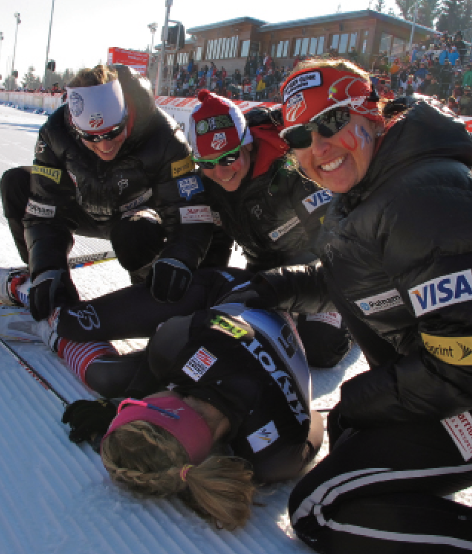
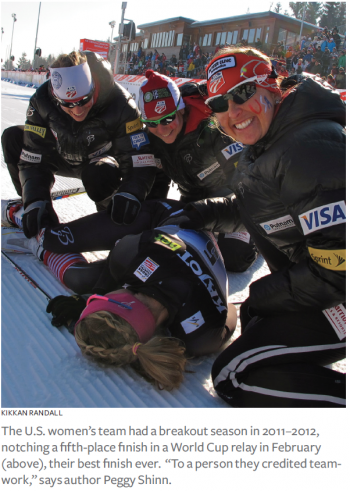
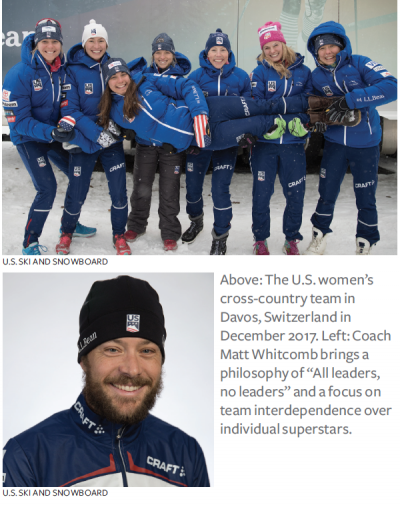 The U.S. victory was particularly interesting against the backdrop of Norway’s record 39 Olympic medals in Pyeongchang, accomplished with a mere 109 athletes (Team USA won 23 medals with 242 athletes). The buzzwords behind Norway’s success—culture and team—echo the values portrayed in World Class, a new book by Vermont author Peggy Shinn. They also stand in stark contrast to the dynamics that have evolved on the U.S. Alpine Ski Team in the past decade, where individual superstars have assembled private teams that cater exclusively to their needs. U.S. Alpine success in Pyeongchang was underwhelming, and U.S. Skiing could learn much from the success formula within its own organization. Through extensive research and interviews, Shinn recounts the history of the U.S. Nordic Ski Team, and details the team’s journey from the low point in 2005–2006—when the U.S. did not even name a women’s Nordic ski team for the World Cup season—to the spring of 2017, when a full team of medal-ready women stood poised to make history.