How one local saved the Borscht Belt’s last ski area.
For nearly 70 years, every southern tourist, every comic, every singer, every song-and-dance man in the Catskills has driven past a ski lift counterweight inscribed with “16 Tons,” just outside of Monticello, New York.
Though no longer in use, the weight remains along Route 17, the main artery linking New York City, 85 miles south, to the so-called Borscht Belt resort area (see Skiing History, “The Sour Cream Sierras,” May-June 2020). The otherwise mundane concrete block paid homage to the 1946 Merle Travis coal-mining song Sixteen Tons, popularized by Tennessee Ernie Ford in 1955.
The counterweight has been free advertising for a 440-vertical-foot municipal ski area called Holiday Mountain, situated between the Neversink River at its base and a divided four-lane highway up top. Although the lettering has since faded, this beloved ski hill, the last dedicated ski area in the southern Catskills according to the Facebook group Catskill Skiing History, is undergoing a multi-year renovation driven by a local entrepreneur who is also a lifelong skier and ski patroller.
Holiday Goes Private
The hill’s riverside terrain opened for skiing in November 1949, with three electric tows, rolling slopes, expert trails and a “Swiss Ski School” to bring authentic Alpine techniques to New York skiers. The original iteration of Holiday, developed by local businessmen Don Hammond, a department store owner, and Manny Bogner, a lumber dealer, also offered a warming hut and ski shop—but it was abandoned after a few years due to a lack of snow, according to Remembering the Sullivan County Catskills, by local historian John Conway.
In December 1957, when the town of Thompson parks commission purchased the property from local resident Maude A. Crawford for $5,000, the ski area reopened with two rope tows and a 900-foot platter-pull lift with an uphill capacity of 900 skiers per hour, according to the Conway book.
Holiday wasn’t as challenging as, say, Stowe’s Nosedive terrain, but in 1957 the New York Times gushed that the ski area will “more than suffice for the run-of-the-mill sports lover who wants to test his legs as well as enjoy the sport with a minimum risk of injury.” Trails and slopes sported holiday-related names, including Easter Parade, Birthday Schuss and Christmas Bowl. Forty years later, as losses mounted and local taxpayers grew tired of deficits ranging upward of $250,000 per year, town leaders decided to bail out of the ski business.
The ski area was purchased from the town in 2000 by Craig Passante, son of the late owner of the nearby Villa Roma Resort (which still offers skiing and snow tubing to guests). The younger Passante, a Hofstra University graduate with a degree in marketing and an honorary doctorate in hospitality, tried to pump new life into the aging facility by adding a family-activities park, motocross course and special events.
The adjacent Neversink River, known for world-class fly fishing, was a blessing for snowmaking but flooded the 1950s-era base lodge in April 2005. In summer 2011, Hurricane Irene and Tropical Storm Lee caused more damage, according to the Sullivan County Democrat (June 13, 2023). What’s more, low snowfall totals during those years did little to help Passante turn the struggling ski hill around.
Determined to prevent the land from being sold for a housing development, Monticello native Michael Taylor, a longtime ski patroller at nearby Plattekill Mountain and great-grandson of original landowner Maude Crawford, purchased the teetering ski area in May 2023.
No Holiday
“This ski area was about to drop dead,” wrote Stuart Winchester of The Storm Skiing Journal and Podcast in November 2024. “Then Mike Taylor bought it. … He has resources. He has energy. He has manpower. And he’s going to transform this dysfunctional junkpile of a ski area into something modern, something nice, something that will last. And everyone knows it wouldn’t be happening without him.”
Tayor, 58, is a successful businessman, the CEO of his family’s propane and heating-oil business in the New York Tri-State area. Still, preventing the ski area from becoming another entry in the directory of lost ski areas was no holiday.
Overcoming the reluctance of banks to loan to a modest ski area, Taylor spent $10 million in renovations, encountering enough bumps along the way to fill a World Cup mogul run. However, he remains dedicated and optimistic about Holiday’s future. “We’re 85 miles from 12 million people,” Taylor told the Sullivan County Democrat shortly after purchasing the area. “We can’t fail.”
Taylor and his team, often improvising on the fly, had to contend with snowmaking pumps and guns that clogged with river grass; a pump-house fire that caused $500,000 in damage; extensive soil erosion caused by the motorcross operation; a scarcity of chairlift parts; the cancellation of local after-school ski programs and the costly landscaping of the adjacent Bridgeville Cemetery, which dates back to the late 1700s. To add to the financial challenges of running a diminutive ski area, a fire damaged the attic of its new snowtubing lodge one week before opening this season, delaying the launch of this popular kids’ activity.
From Molehill to Mountain
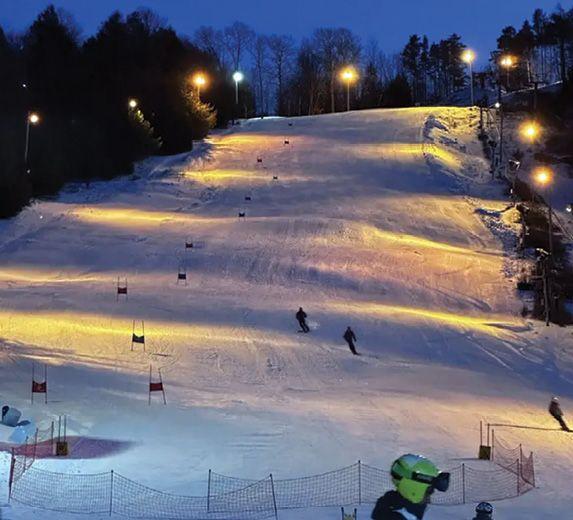
Today, it’s hard to imagine a small ski area—with just 40 skiable acres, a stingy 55-inch average annual snowfall and a 1,600-foot summit—doing so much with so little. This season the mountain opened with nine trails, anchored by a refurbished quad and triple chair. Other amenities include an 11-lane lighted snow-tubing park and a ropetow and conveyor lift overlooking the cemetery. An upgraded snowmaking system, including 200 new guns and towers and eight miles of snowmaking pipe, strive to compensate for the area’s typically modest snowfall. A true community ski area, Holiday is closed on Mondays. One benefit of its tiny footprint, Holiday is able to offer night skiing across all of its terrain—a staple amenity for a family area.
There’s also Mambo Night, a new trail that honors the Cuban-themed dance parties once held at now-defunct Catskill resorts, and Hackledam, named after a former tanning and lumbering community that existed nearby in the late 1800s. The double black, winch-groomed trail is said to be one of the steepest in the Catskills. “We’ve really rebuilt this ski area from the ground up,” says Taylor.
Fond Memories
News about Holiday’s resurrection was greeted by the region’s skiers like a powder forecast. Jeff McBride, 66, now of Las Vegas, Nevada, and a grandson of Don Hammond, lived within sight of the mountain and started skiing there at age four. “I loved skiing Holiday nearly every day of the season,” he says, “practicing Daffies, back scratchers and side-tucks almost daily for annual freestyle skiing contests.
McBride, who became a professional magician and has several entries in the Guinness Book of World Records, especially remembers drinking hot Dr Pepper with lemon in the base lodge. (Apparently “hot Doc” was a thing back then, according to the web channel Tasting History with Max Miller.)
Catskill skiing historian and native Barry Levinson, 65, who now resides in Gypsum, Colorado, recalls that as a kid, “I kinda hated this little rinky-dink 440-foot hill with a highway on top and a gravel pit on the bottom that did not look like the pictures I saw in SKI, Skiing and Powder magazines.” However, “now, with age and perhaps wisdom and a sense of nostalgia I look back on it and feel lucky to have had that hill in my backyard. Holiday Mountain [was] neither a holiday nor a mountain, but it was ours.”
Future Plans
The conversion of Route 17 to Interstate I-86 has been a long-term state project, with major upgrades planned to bring the section passing Holiday Mountain up to Interstate standards, according to the New York State Department of Transportation. Still several years away, this will reduce commuter congestion during weekday peak hours and mitigate weekend vacation traffic, hopefully leading to more ticket sales for Holiday.
Today Taylor is singularly focused on his mission, as determined as ever to answer the question of “How do we get kids off their phones and out recreating again?” As he told Storm Skiing, “You can’t make me happier than to see busloads of kids improving their skills and enjoying something they’re going to do for the rest of their lives.”
Jeff Blumenfeld grew up skiing at Holiday Mountain. A resident of Boulder, Colorado, Blumenfeld is vice president of ISHA and past president of the North American Snowsports Journalists Association. He chairs the Rocky Mountain chapter of the Explorers Club and has covered the adventure field in ExpeditionNews.com for 32 years.
Ayja Bounous has crafted a well-written and comprehensive biography of an iconic American skier and teacher, and a tender tribute to her grandfather.
Junior Bounous was born in 1925 in Provo, Utah, in the Wasatch Mountains, and taught himself to ski at age eight on self-fashioned skis. He became a renowned powder skier and was a favorite model for photographers like Fred Lindholm, appearing frequently in ski periodicals and Warren Miller films.
Bounous’s astounding ability to convey the secrets of navigating powder to other skiers brought students from afar to wherever he was teaching, and they returned year after year.
After explaining how he got the name “Junior,” Ayja Bounous recounts her grandfather’s life-changing encounter with Alf Engen at Alta, their instant rapport and how he fully absorbed Engen’s teaching philosophy. Bounous would later infuse Engen’s methods into the Professional Ski Instructors of America’s American Teaching System.
We learn how, with Engen’s urging, Bounous earned his Forest Service certification to teach skiing at age 23 and then became a full-time ski instructor at Alta, teaching there from 1948 to 1958. In 1958, he was lured 600 miles westward to Sugar Bowl, California, becoming one of the first American-born ski school directors in the country.
The author describes how her grandfather later returned to Utah, in 1966, to become part owner and ski school director of the Timp Haven ski area (on Mount Timpanogos). In 1968, Robert Redford acquired the resort and renamed it Sundance (after his character in Butch Cassidy and the Sundance Kid). Redford prevailed upon Bounous to stay on as ski school director, and the actor thereby became a Bounous-trained powder adept.
In 1970, Bounous was approached to design the trail system for the nascent Snowbird ski resort, which opened in 1971. He then served as ski school director there until 1991, when he was named director of skiing. At Snowbird, Bounous also inaugurated both a children’s and a disabled learn-to-ski program.
Bounous’s partner through all these adventures, from 1952 onwards, was his wife, Maxine (née Overlade), who became a master powder skier in her own right and for her off-piste speed became know as “Fast Max.” A BYU graduate, she became indispensable as an editor when SKI and Skiing magazines published Bounous’s ski tips and PSIA’s instructional ski books included his contributions. Together, they raised two boys (one, Steve, raced for the U.S. Ski Team).
This biography recounts the couple’s full life of world travel and recreation in the off-season, too. They visited more than a dozen countries, from a memorable journey to Bounous’s ancestral hometown in northern Italy to the South Pacific, and from Nepal to New Zealand.
Somehow, the couple also managed to fit in month-long trips with friends and family on Lake Powell, on a houseboat or camping with a ski boat. Bounous loved exploring the many canyons and hidden rock arches that line the immense reservoir. Both would waterski and wake surf well into their 80s. And they botanized with passion, seeking out the myriad wildflower species of the Wasatch Mountains and discovering how the schedule and abundance of their flowering depended upon the snowpack of the previous winter. Junior Bounous is still skiing at the age of 98.
Junior Bounous and the Joys of Skiing, by Ayja Bounous. Printed by Paragon Press, Inc. (2022), softcover, 283 pages. $38
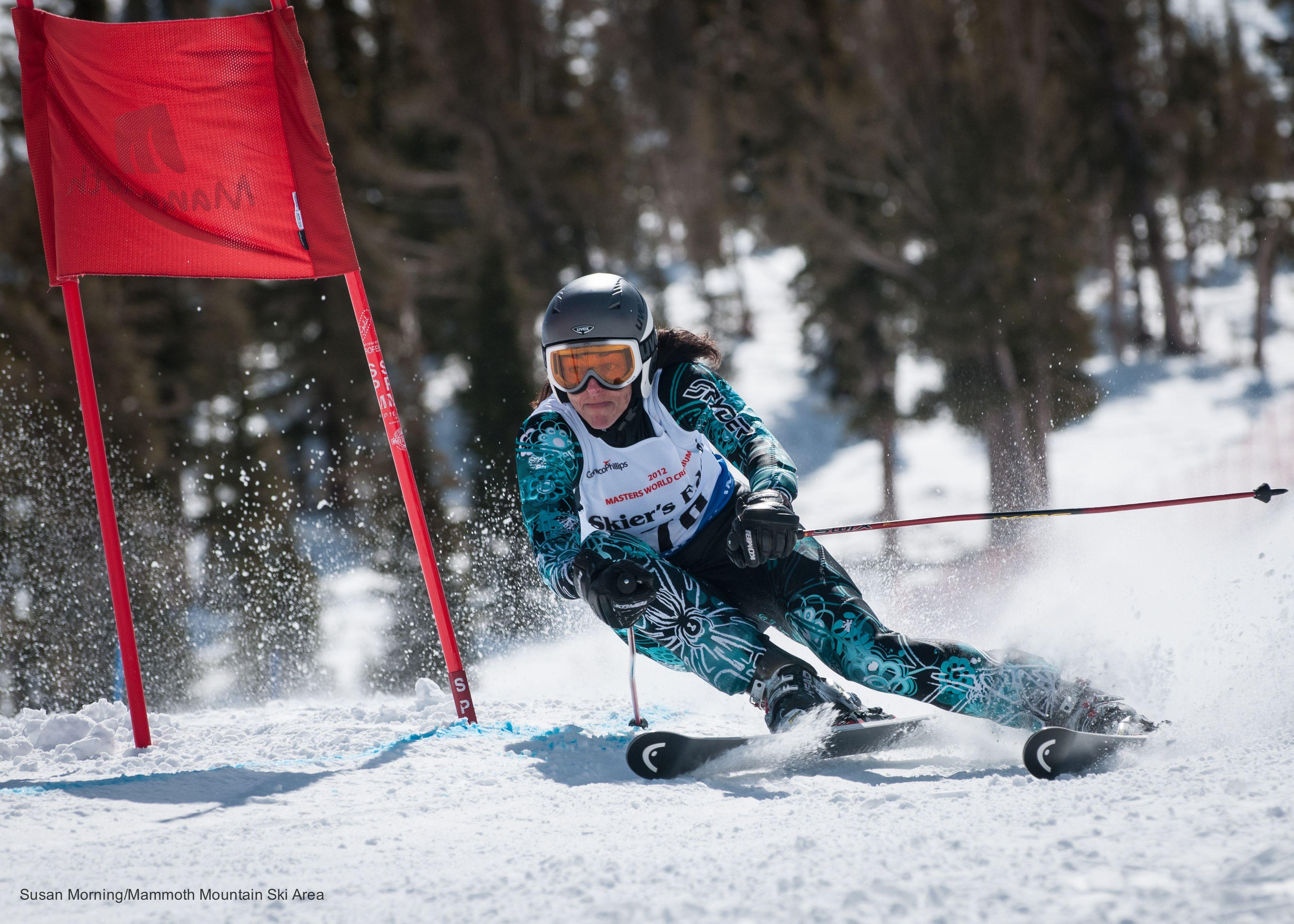
Photo top: Race face on, Ballard speeds through a Master's race at Mammoth.
Lisa Ballard grew up on skis and skates in Lake Placid, New York. She had the genes for it: Her dad, Phillip Feinberg, was an avid skier, racer and ski club official, and her mom, Phyllis Krinovitz, was a champion figure skater.
Ballard won her first ski race at age six, the Candy Bar Slalom at Mt. Pisgah, N.Y.—so called because the trophy was a candy bar. “That was great motivation for getting into ski racing,” she says. She both skied and skated until age 11, then had to pick one or the other. She picked racing because victory was determined by the clock.
During her sophomore year at Saranac Lake High School, Ballard transferred to Stratton Mountain School. Her fans in Lake Placid anticipated that she would make the 1980 Olympic Team, but Ballard broke her leg in a downhill at Killington, and that was that.
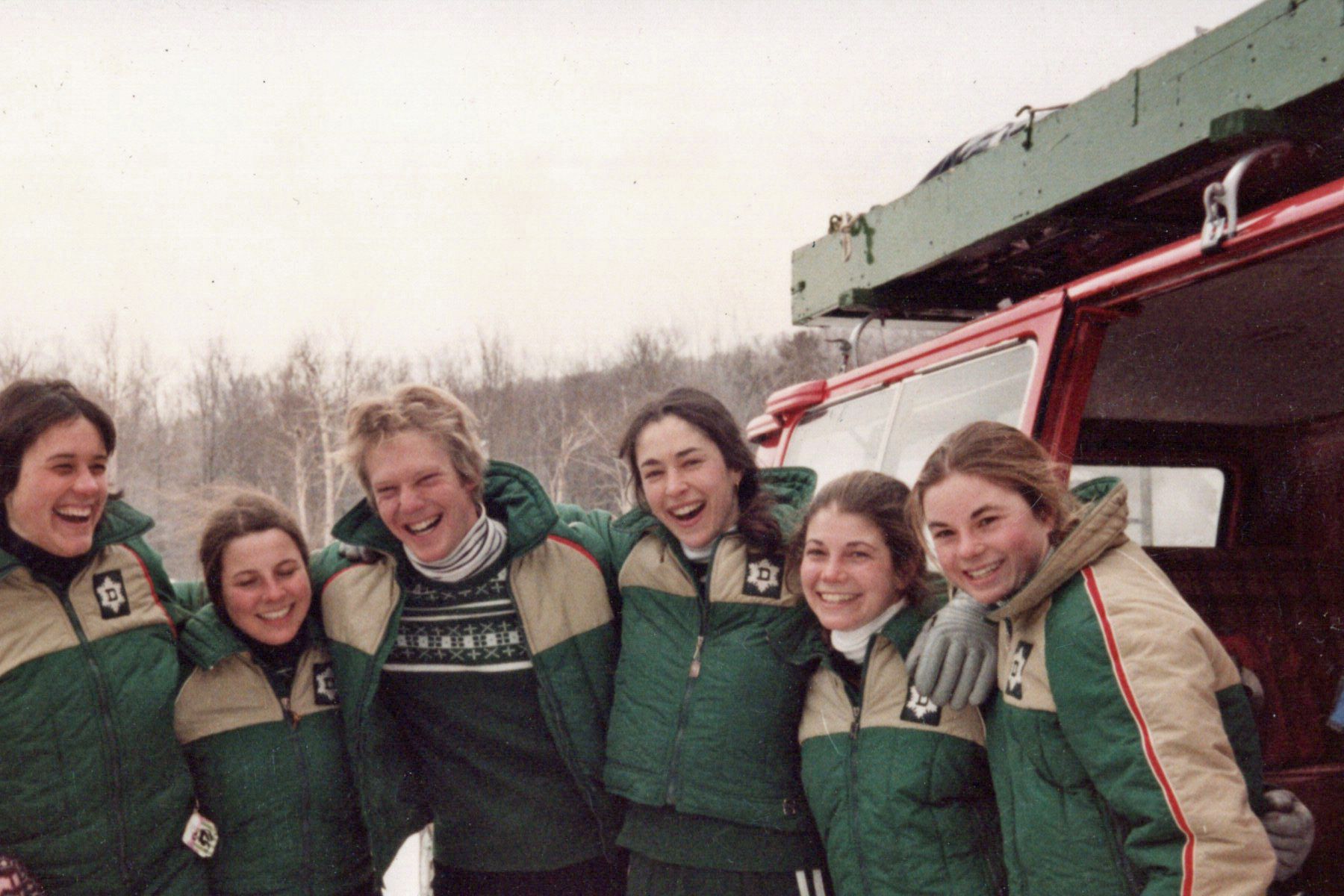
Ballard (center) with Dartmouth team, at the 1982 AIAW championships on her home hill, Whiteface, New York.
Instead, she went to Dartmouth. Back then, once you went to college, the U. S. Ski Team doubted your commitment to racing. Today, however, many athletes from college teams go to the World Cup. Ballard credits her Dartmouth teammate Tiger Shaw for making this breakthrough. He graduated to the U.S. Ski Team in 1985 and raced in the ’88 and ’92 Olympics. Ballard believes Shaw’s success created the change whereby college ski racers now have the chance to compete on the world stage.
Ballard graduated in 1983 and took a job at an investment bank on Wall Street. Disillusioned within a year, she was ready when Stratton teammate Kim Reichhelm invited her to a pro race at Okemo. Before heading to Dartmouth, Ballard says, “I knew at the end of college that if I wanted to keep racing, there was always the pro tour. It was very equivalent in the minds of the athletes in terms of racing competition and in some ways a better opportunity because you could win prize money and get direct sponsorships. This was the way to become a professional ski racer because back then, the World Cup, though elite, was still considered amateur.”
Reichhelm talked Ballard into entering the Okemo race, and she qualified for the round of 16, which guaranteed prize money. She had a blast and called her old coach Herman Goellner, saying “Herman, I want to quit my job and ski race again.” He put together a dryland conditioning and on-snow program for her. She quit her desk job and went to Europe to train.
Ballard raced on Jill Wing’s Women’s Pro Ski Racing Tour for six years. In 1989, en route to the pro tour’s world championships at Sierra Summit, California (now China Peak), the airline misrouted her racing skis to Japan, and she was not able to race. Instead, Hugh Arian of Echo Entertainment, the producer of the event’s television coverage, asked her to do guest commentary. She agreed and turned out to be a natural broadcaster.
When Ballard retired from the pro tour after the 1990 season, ready for a change but still wanting to stay involved in skiing, her agent, Fred Sharf, hooked her up with the Travel Channel, which hired her to host a new series, Ski New England. At the same time, ESPN brought her in as a commentator for women’s pro ski racing. This launched Ballard’s full-time career in broadcast television, which would continue over the next two decades.
She became a field producer as well as an on-camera host. During this time, she also did some writing and consulting; one project was helping Ski Industries America (now Snowsports Industries America) with its image work. John Fry brought her in as a fashion editor at Snow Country and as director of the National Skiwear Design Awards. After a year, she became the magazine’s instruction editor.
When shaped skis were introduced in the mid-’90s, Ballard helped the world learn how to carve on them. She joined the design team at Head, helping create its first complete line of women’s shaped skis, then a line of ski boots in which both the shell and the liner were lasted for a woman’s foot. “I named them the ‘Dream’ series because they were my dream ski boots,” she says.
But Ballard wasn’t done racing. In 1991, at age 29, she joined the Masters racing circuit as her first husband, Jason Densmore, was an avid Masters racer at the time. “I’m not much of a spectator, and it looked like a lot of fun,” she explains. However, as a pro, she had to regain her amateur status by petitioning the then-U.S. Ski Association. That year, at the U.S. Alpine Masters National Championships in Vail, Ballard raced downhill and won. She raced GS and won. And then she had the slalom—not her specialty. She remembers this race like it was yesterday. She had a good first run. The second run she almost crashed three times because she was so nervous, but she won and that set the hook for her future. She had a lot of friends who were racing on the circuit. It was fun, and a different type of ski racing.
From her home in Hanover, New Hampshire, Ballard spent 20 years racing on the New England Masters circuit and served on its board of directors. She went to the regional and national championships every year. After her son, Parker Densmore, was born in 1996, she kept racing, bringing him to her races and eventually attending his, too, as a coach for the Ford Sayre Ski Club.
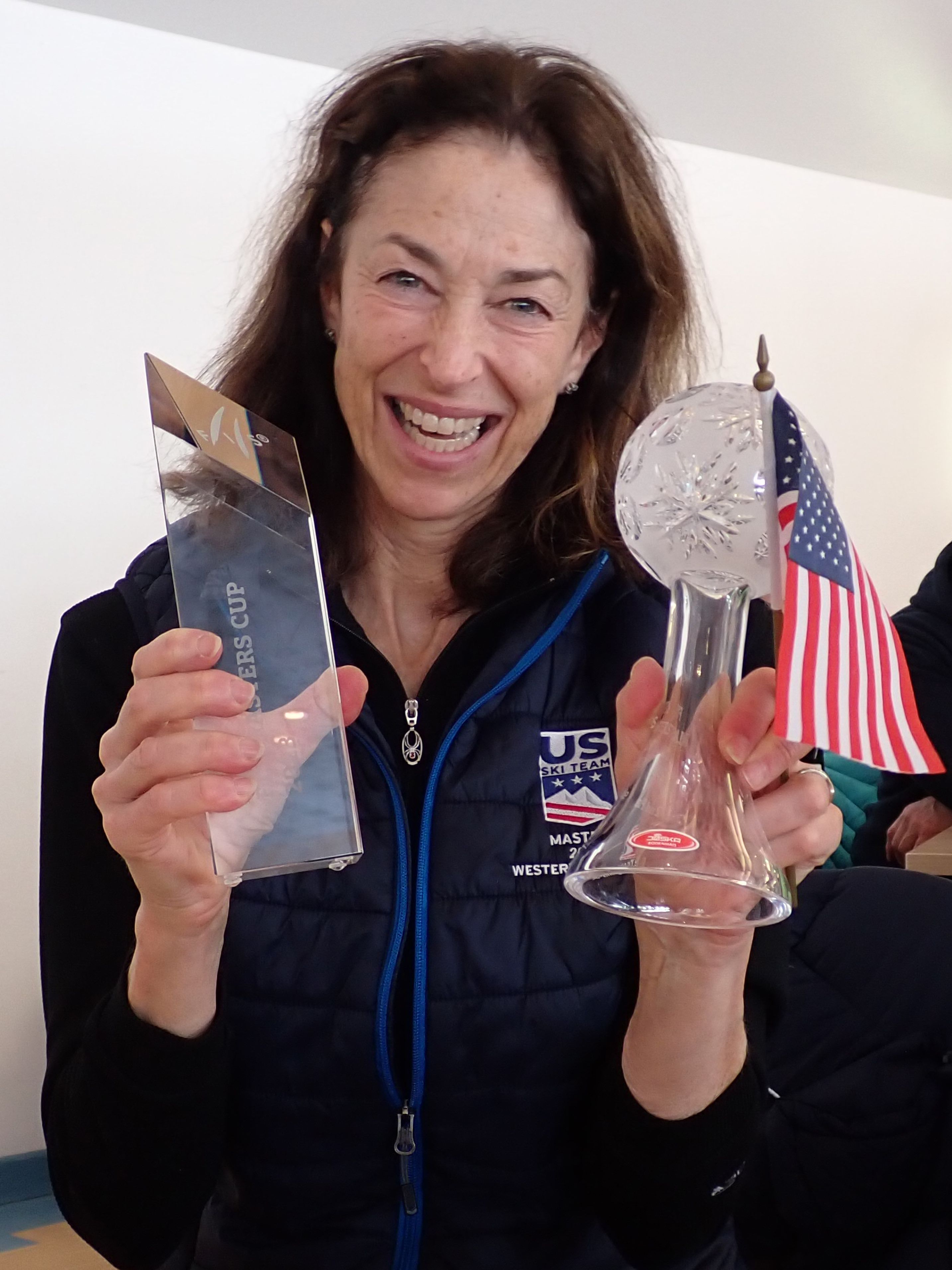
By the mid-2010s, Ballard had won more than a hundred national Masters’ titles and quit counting. After dabbling at the FIS Masters Cup—the World Cup of Masters racing—in 2016, she started racing more frequently on the international Masters circuit and has now garnered eight globes, more than any American, male or female. For the 2023–24 season, she’s the defending super G champion, second in GS and fifth in slalom among all women in all age groups.
Defending super G champ on the international Master's circuit.
Ballard is still involved with U.S. Ski and Snowboard, entering her sixth year as chair of the Masters working group. She calls herself a pied piper, trying to get folks back into ski racing or start ski racing as an adult. She hopes to make people understand that ski racing is a sport you can do your whole life, just like golf, tennis, swimming, track and field or mountain biking. “They all have Masters programs that keep you active and fit,” she says.
In a national survey, one of the barriers to Masters ski racing is the lack of training opportunities. Ballard has hosted women’s ski clinics around the country since 1991, and some 8,500 women have gone through her program. “I knew how to put ski instructional programs together, so why not Masters race camps?” she says. “It filled a need while helping raise money for local junior or Masters programs. She now directs Masters training programs and camps in the Rockies, the Northeast and in South America.
After Ballard met her second husband, the outdoor writer Jack Ballard, she moved to Montana in 2011. The family—Lisa, Jack, Parker and Jack’s kids Micah, Dominic and Zoe—live near Red Lodge Mountain, where Lisa coaches when she’s not travelling to races or hosting clinics elsewhere. “I never planned to be a ski coach, but I love every day on the hill,” she says. “I feel extremely rich in experiences, and to me that is really important. I tell my son, ‘You have to follow your heart and do what you care about most.’ I have met some amazing and wonderful people. I feel very fortunate, and the rest comes easy when you love something.”
Melinda Moulton wrote about Wini Jones in the July-August issue. In October, Lisa Ballard was elected to the ISHA board of directors.
An oral-history interview with Peter Miller, SKI Magazine writer/photographer, by Rick Moulton.
Open to Public?
On
Full Access Article for Public
In 2019, long-distance runner and ski mountaineer Kilian Jornet—with the goal of just testing “how his body will perform”—completed 51 laps on Tusten ski area in Molde, Norway, in 24 hours. He climbed 78,274 feet, crushing previous 24-hour records by a ridiculous margin. To be clear, Molde is at sea level. Jornet climbed 1,535 feet, 51 times, on roughly a one-mile piste. That works out to skinning up at about 2.25 mph for 25 minutes and resting a couple of minutes during a 36-mph schuss. Fifty-one times.
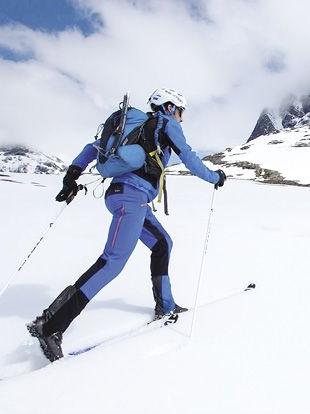
Photo above: Kilian Jornet has been rewriting the record books for ski mountaineering and high-altitude running for more than a decade, sometimes merely as a result of his training regimen. Right: An early ski-endurance competition, the 24 Hours of Aspen attracted elite athletes, television audiences and sponsorship dollars in the 1980s-1990s. YouTube photo
That’s nothing for the Catalan Jornet, who grew up in Chamonix. For more than 15 years he’s been methodically assaulting the records for high-altitude marathons and ski mountaineering. In his recent five-year “Summits of My Life” project, he set the fastest known times (or FKT) for the ascent and ski descent of major mountains including Kilimanjaro, Denali, Aconcagua, the Matterhorn and Mont Blanc, at times shaving hours off previous records. Some of his records have since been broken by Ecuadorian mountain guide Karl Egloff.
Climbing and skiing massive verticals has become a passion with today’s endurance athletes, who are repeatedly blowing by many of the world's best times. Which begs the question, when did vertical-feet-skied become a thing?
Before smart watches and phone apps made vertical-feet scorekeeping easy, it was possible to estimate your numbers from the number of runs completed. Heliski operators charged by the vertical foot, and kept accurate count. You could keep track of your bragging rights whether for 24 hours, a week, a season or a lifetime. Heliski operations certified guest accomplishments with pins and special million-foot prizes, like Mike Wiegele’s silver belt buckles and limited-edition powder suits at Canadian Mountain Holidays.
One of the first vertical-foot-based competitions was the late 24 Hours of Aspen. After 13 events in 16 years, declining television ratings scuttled the show in 2003. But it left behind a slew of records. Chris Kent of Canada did 83 laps for 271,161 feet for the men’s mark in 1991. That’s 216 miles of skiing at an average 66 mph. Kate McBride and Anda Rojs set the women’s vertical record of 261,360 feet in 1997.
Once the genie was out of the bottle, lift- and rotor-assisted records started to topple. In 1994, Canadian speed skier and Chamonix resident Mark Jones logged 212,000 vertical feet in just 12 hours at Les Grands Montets. Next, Dr. Mark Bennett racked up 294,380 feet in 14 hours in the Yukon in 1997 for a new “daylight” world record. Fourteen months later, former U.S. Ski Team racer Rusty Squires chartered a specialized high-altitude helicopter and recorded 331,160 vertical feet in 10 hours and 15 minutes at Big Sky, Montana.
In the meantime, the guides at Wiegele’s were determined to set a record based on the normal constraints of commercial heli-skiing, with a full group of skiers and a single machine. In 1998, Swiss extreme skier Dominique Perret, Chris Kent and Austrian guide Robert Reindl, with Edi Podivinsky and Luke Sauder of the Canadian Alpine Team, logged 353,600 vertical feet in 14½ hours.
Austrian Ekkehard Dörschlag owns the
24-hour record for vertical climbed.
By this point recognition was growing that assisted vertical-foot records were as much about money as skill and endurance. As ski mountaineering boomed (it’ll be a full medal event at the 2026 Milan Cortina Olympics) interest focused on self-powered athletes. In 2009, Austrian Eckhard Dorschlag set a 24-hour world record of 60,350 feet. Ultra-marathoner Mike Foote broke that in 2018 with 68,697 feet. A few months later Norwegian Lars Erik Eriksen took it to 68,697 feet. Then Jornet obliterated that.
Born in 1987, Jornet has captured more Skyrunner World Series and Skimo (ski mountaineering) World Championship medals than we have room to list. He still holds the mark for the Innominata ski traverse on Mont Blanc linking Chamonix and Courmayeur (8 hours 42 minutes), as well as the fastest ascent/descent of Mont Blanc from Chamonix (4:57) and of the Matterhorn from Breuil-Cervinia (2:52).
As for why all the fuss over vertical speed records advancing every season, Nick Heil, writing in Outside, quoted Foote: “How many push-ups can I do in a minute? How long can I hold my breath? How far can I ski in a day? In the end, it’s all arbitrary and contrived, but it gets people to ask, what am I capable of?”
Snapshots in Time
1958 Be Careful What You Wish For
A penetrating statistical study of the ski industry in Colorado and New Mexico has been published by the University of Colorado. Pointing out that a great many more tourists visit Colorado and New Mexico in June, July and August than in the other months of the year, the authors ask if it is not possible to develop the winter tourist industry so that tourist facilities can be used all year. — “Skiers Under Scrutiny in Colorado and New Mexico” (SKI Magazine, October 1958)
1970 The Continuing Death of the Ski Bum
Once upon a time, the ski bum was the ultimate ski insider. As neither an entrenched member of the ski-area management nor a local profiteer, he enjoyed a free-swinging life with lots of time to ski and unlimited access to the inner circles of the ski establishment. It is, therefore, ironic that as the need for ski workers grows, the reputation of the ski bum diminishes. Ski bums, industry management will tell you, are bad news; the title is now synonymous with “hippie.” Many employers won’t consider hiring ski bums, even for temporary jobs. As a result, there are fewer of the old-time ski-bum types than ever before. — Janet Nelson, “But They’re Employed” (SKI Magazine, January 1970)
1978 Risk v. Reward
I have been skiing o.b. for many years. Skiing out of bounds is extremely dangerous. Inevitably some crazy powder addicts (myself included) will continue to leave the “safe” confines of patrolled areas. After reading Lou Dawson’s account and subtle hints (“... how far can you crawl with a spinal fracture?”), I realized certain steps must be taken to ensure the safety or at least the survival of o.b. skiers. Education is what is needed on this topic. — Steven Harrison, Central Valley, New York, “Whistling in the Dark" (Letters, Powder Magazine, Spring 1978)
1981 Crowds and Crashes
The rapidly increasing skiing population has led to an alarming increase in inconsiderate and out-of-control skiers who are a serious menace. Last season, an out-of-control skier crashed into me. He never so much as asked if I needed help. I’ll have a scar I’ll carry for the rest of my life. For too long ski areas have allowed Bonzai Bombers to endanger others on the slope without adequate punishment. It’s time something was done to protect the rest of us from these slope-side criminals. —Thomas F. Warda, Rochester, N.Y., "Slope menaces" (Letters, Skiing Magazine, October 1981)
2007 Bode Rules
Call them the Bode Rules. This year every athlete on the U.S. Ski Team is required to stay in official team housing. Every racer on the team is also prohibited from having a celebratory drink with the coaches after a big win, because it’s a slippery slope from that to, say, being photographed carousing with Miss March 2002 draped on your arm during the Olympics. U.S. Ski Team chief Bill Marolt implemented the stricter guidelines after the strongest American squad in decades limped away from the 2006 Torino Games with only two medals—neither of them won by the phenomenally gifted Bode Miller. —Nathaniel Vinton, “Ski Fast but Party Slow”(SKI Magazine, February 2007)
2021 A Woman’s Place Is On Patrol
“When there are women on a team like this, it lends an important voice and perspective to the job. I can say that having women on patrol keeps everyone connected. Men muscle their way through the job and women do it with finesse,” said Addy McCord, 64, one of the longest-standing professional patrollers in the industry. — Shauna Farnell, “A Surge of Women in Ski Patrols, Once Nearly All Men” (New York Times, February 11, 2021)
Feature Image Media
Image
Article Date
Timestamp
In 2019, long-distance runner and ski mountaineer Kilian Jornet—with the goal of just testing “how his body will perform”—completed 51 laps on Tusten ski area in Molde, Norway, in 24 hours. He climbed 78,274 feet, crushing previous 24-hour records by a ridiculous margin. To be clear, Molde is at sea level. Jornet climbed 1,535 feet, 51 times, on roughly a one-mile piste. That works out to skinning up at about 2.25 mph for 25 minutes and resting a couple of minutes during a 36-mph schuss. Fifty-one times.
Photo above: Kilian Jornet has been rewriting the record books for ski mountaineering and high-altitude running for more than a decade, sometimes merely as a result of his training regimen. Right: An early ski-endurance competition, the 24 Hours of Aspen attracted elite athletes, television audiences and sponsorship dollars in the 1980s-1990s. YouTube photo
That’s nothing for the Catalan Jornet, who grew up in Chamonix. For more than 15 years he’s been methodically assaulting the records for high-altitude marathons and ski mountaineering. In his recent five-year “Summits of My Life” project, he set the fastest known times (or FKT) for the ascent and ski descent of major mountains including Kilimanjaro, Denali, Aconcagua, the Matterhorn and Mont Blanc, at times shaving hours off previous records. Some of his records have since been broken by Ecuadorian mountain guide Karl Egloff.
Climbing and skiing massive verticals has become a passion with today’s endurance athletes, who are repeatedly blowing by many of the world's best times. Which begs the question, when did vertical-feet-skied become a thing?
Before smart watches and phone apps made vertical-feet scorekeeping easy, it was possible to estimate your numbers from the number of runs completed. Heliski operators charged by the vertical foot, and kept accurate count. You could keep track of your bragging rights whether for 24 hours, a week, a season or a lifetime. Heliski operations certified guest accomplishments with pins and special million-foot prizes, like Mike Wiegele’s silver belt buckles and limited-edition powder suits at Canadian Mountain Holidays.
One of the first vertical-foot-based competitions was the late 24 Hours of Aspen. After 13 events in 16 years, declining television ratings scuttled the show in 2003. But it left behind a slew of records. Chris Kent of Canada did 83 laps for 271,161 feet for the men’s mark in 1991. That’s 216 miles of skiing at an average 66 mph. Kate McBride and Anda Rojs set the women’s vertical record of 261,360 feet in 1997.
Once the genie was out of the bottle, lift- and rotor-assisted records started to topple. In 1994, Canadian speed skier and Chamonix resident Mark Jones logged 212,000 vertical feet in just 12 hours at Les Grands Montets. Next, Dr. Mark Bennett racked up 294,380 feet in 14 hours in the Yukon in 1997 for a new “daylight” world record. Fourteen months later, former U.S. Ski Team racer Rusty Squires chartered a specialized high-altitude helicopter and recorded 331,160 vertical feet in 10 hours and 15 minutes at Big Sky, Montana.
In the meantime, the guides at Wiegele’s were determined to set a record based on the normal constraints of commercial heli-skiing, with a full group of skiers and a single machine. In 1998, Swiss extreme skier Dominique Perret, Chris Kent and Austrian guide Robert Reindl, with Edi Podivinsky and Luke Sauder of the Canadian Alpine Team, logged 353,600 vertical feet in 14½ hours.
Austrian Ekkehard Dörschlag owns the
24-hour record for vertical climbed.
By this point recognition was growing that assisted vertical-foot records were as much about money as skill and endurance. As ski mountaineering boomed (it’ll be a full medal event at the 2026 Milan Cortina Olympics) interest focused on self-powered athletes. In 2009, Austrian Eckhard Dorschlag set a 24-hour world record of 60,350 feet. Ultra-marathoner Mike Foote broke that in 2018 with 68,697 feet. A few months later Norwegian Lars Erik Eriksen took it to 68,697 feet. Then Jornet obliterated that.
Born in 1987, Jornet has captured more Skyrunner World Series and Skimo (ski mountaineering) World Championship medals than we have room to list. He still holds the mark for the Innominata ski traverse on Mont Blanc linking Chamonix and Courmayeur (8 hours 42 minutes), as well as the fastest ascent/descent of Mont Blanc from Chamonix (4:57) and of the Matterhorn from Breuil-Cervinia (2:52).
As for why all the fuss over vertical speed records advancing every season, Nick Heil, writing in Outside, quoted Foote: “How many push-ups can I do in a minute? How long can I hold my breath? How far can I ski in a day? In the end, it’s all arbitrary and contrived, but it gets people to ask, what am I capable of?”
Snapshots in Time
1958 Be Careful What You Wish For
A penetrating statistical study of the ski industry in Colorado and New Mexico has been published by the University of Colorado. Pointing out that a great many more tourists visit Colorado and New Mexico in June, July and August than in the other months of the year, the authors ask if it is not possible to develop the winter tourist industry so that tourist facilities can be used all year. — “Skiers Under Scrutiny in Colorado and New Mexico” (SKI Magazine, October 1958)
1970 The Continuing Death of the Ski Bum
Once upon a time, the ski bum was the ultimate ski insider. As neither an entrenched member of the ski-area management nor a local profiteer, he enjoyed a free-swinging life with lots of time to ski and unlimited access to the inner circles of the ski establishment. It is, therefore, ironic that as the need for ski workers grows, the reputation of the ski bum diminishes. Ski bums, industry management will tell you, are bad news; the title is now synonymous with “hippie.” Many employers won’t consider hiring ski bums, even for temporary jobs. As a result, there are fewer of the old-time ski-bum types than ever before. — Janet Nelson, “But They’re Employed” (SKI Magazine, January 1970)
1978 Risk v. Reward
I have been skiing o.b. for many years. Skiing out of bounds is extremely dangerous. Inevitably some crazy powder addicts (myself included) will continue to leave the “safe” confines of patrolled areas. After reading Lou Dawson’s account and subtle hints (“... how far can you crawl with a spinal fracture?”), I realized certain steps must be taken to ensure the safety or at least the survival of o.b. skiers. Education is what is needed on this topic. — Steven Harrison, Central Valley, New York, “Whistling in the Dark" (Letters, Powder Magazine, Spring 1978)
1981 Crowds and Crashes
The rapidly increasing skiing population has led to an alarming increase in inconsiderate and out-of-control skiers who are a serious menace. Last season, an out-of-control skier crashed into me. He never so much as asked if I needed help. I’ll have a scar I’ll carry for the rest of my life. For too long ski areas have allowed Bonzai Bombers to endanger others on the slope without adequate punishment. It’s time something was done to protect the rest of us from these slope-side criminals. —Thomas F. Warda, Rochester, N.Y., "Slope menaces" (Letters, Skiing Magazine, October 1981)
2007 Bode Rules
Call them the Bode Rules. This year every athlete on the U.S. Ski Team is required to stay in official team housing. Every racer on the team is also prohibited from having a celebratory drink with the coaches after a big win, because it’s a slippery slope from that to, say, being photographed carousing with Miss March 2002 draped on your arm during the Olympics. U.S. Ski Team chief Bill Marolt implemented the stricter guidelines after the strongest American squad in decades limped away from the 2006 Torino Games with only two medals—neither of them won by the phenomenally gifted Bode Miller. —Nathaniel Vinton, “Ski Fast but Party Slow”(SKI Magazine, February 2007)
2021 A Woman’s Place Is On Patrol
“When there are women on a team like this, it lends an important voice and perspective to the job. I can say that having women on patrol keeps everyone connected. Men muscle their way through the job and women do it with finesse,” said Addy McCord, 64, one of the longest-standing professional patrollers in the industry. — Shauna Farnell, “A Surge of Women in Ski Patrols, Once Nearly All Men” (New York Times, February 11, 2021)
The Vail-based entrepreneur revisits his World Cup and pro racing careers.
World Cup and pro ski racer Mark Taché has known Marco Tonazzi for 44 years. Nothing surprises him about the Italian’s achievements. “Nothing at all,” says Taché.
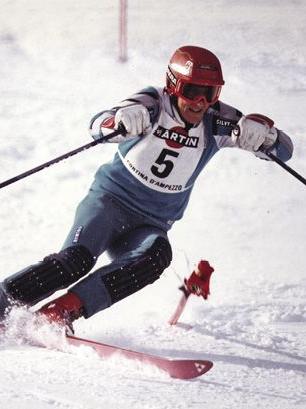
(Photo above: Tonazzi winning the 1985 Italian slalom championship)
Not that Tonazzi runs six businesses in Colorado and Italy with neither a business nor college degree. Not that Tonazzi was the 1990 World Pro Ski Tour Rookie of the Year without ever having made an Olympic appearance. Not that Tonazzi, a slalom specialist, made a World Cup podium in giant slalom—at Adelboden, Switzerland, the crown jewel of GS racing—marking the first one-two finish for the Italian men’s team in 10 years. Not that Tonazzi, who wasn’t even a downhiller, finished the 24 Hours of Aspen race (alone) after 11 knee surgeries.
Surprising or not, Tonazzi’s life has taken an incredible trajectory through three decades of pro and Italian ski racing history, overlapping with legends Gustavo Thöni, Alberto Tomba and more.
The story begins in Udine, a city of 100,000 in the northeast corner of Italy. Tonazzi was a city boy, but his family had a cabin in Valbruna, not far from the renowned ski club at Monte Lussari in the Julian Alps, near the Austrian and Slovenian borders. Back then, school came first, so after class Tonazzi would catch a ride from Udine to Lussari and ski for 90 minutes before the lifts closed.
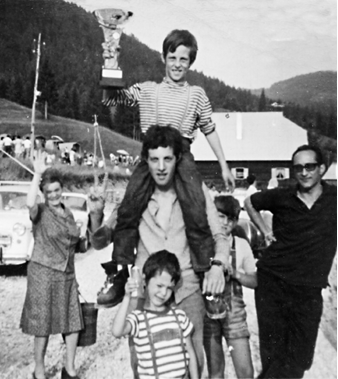
Tonazzi family celebrates
Marco's first victory, at age 9.
At age 9, he entered—and won—his very first race, on a plastic surface in Tarvisio. “The [ski] wax was diesel fuel, mixed with oil,” he says. “There was a little box with two rollers. You would roll your skis over the rollers to get them to run faster on plastic.”
In 1977, Tonazzi competed in the Italian junior championships, where he was the youngest by three years in his age group. He recalls, “I wasn’t a favorite. I didn’t have a uniform. I had a hand-knitted sweater by my grandmother. My brother was my coach.” Yet win he did, and at age 18, Tonazzi made Italy’s A team at the tail end of the Italian racers’ Valanga Azzurra (“Blue Avalanche”) heyday, becoming a teammate of Thöni and Piero Gros. “They were my idols,” he says. Eventually Thöni became his coach. “But I was a rebel,” adds Tonazzi. “They called me ‘Ragazzo Hippie,’ Hippie Boy, because I had long hair and the Sony Walkman was just invented so I would ski listening to music. It was wild! An athlete on the national team listening to the Beatles while training! I got fined by the federation for having the Walkman always on my head.” Listening to the Beatles, he claims, is how he learned to speak English.
Tonazzi made his World Cup debut in 1980, at age 19, with less than stellar results. “I sucked really bad in ’83, ’84,” he says. So he was put on the B team, and one day in Bulgaria, he was chasing a teammate between trees and through powder. The teammate stopped abruptly, Tonazzi caught him. “I was all happy and cheering, then I flew off an edge and fell about 25 to 30 feet from the top of a skier’s underpass,” he relates.
Had he not suffered a concussion and brain hematoma, says Tonazzi, “I would have been cut, I was doing so poorly. But because I was injured, they gave me another chance.” On the B team, he eventually won the 1985 Italian national championships and 1985 World University Games, both in slalom.
“I came back to the World Cup, and I don’t know how the secret of giant slalom revealed itself to me, but somehow I got it,” Tonazzi says. In December 1985, he finished eighth in Alta Badia, Italy, from the back of the pack. The next month, he placed second at Adelboden—the Kitzbühel of GS courses—wearing bib No. 40, behind Italian teammate Richard Pramotton. It was Tonazzi’s 25th birthday and time to cash in on a promise. “My dad declared that he would stop smoking if I ever made the top three,” he says. “He thought he was safe,” but his son called him on it in a TV interview.
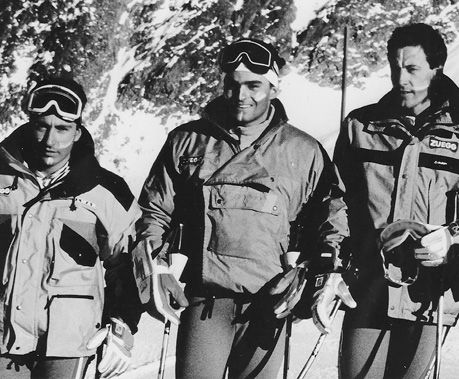
Squadra Italia training day: left
to right, Pramotten, Tomba,
Tonazzi.
On the World Cup, 1986 turned out to be Tonazzi’s best year. It also marked the arrival of a new roommate, Tomba. “I was kind of the old wise guy at 25, so they thought I’d keep him in check,” Tonazzi says. Tomba was a city boy, too, from Bologna, and when Tonazzi drove west to camps or races, Tomba’s father would drop off his son to carpool.
“The thing about Tomba,” Tonazzi says, “he didn’t change because of his success. His attitude, mannerisms, ideas, behavior remained the same—to his credit. That was the true Alberto from age 16—a crazy, talented, explosive athlete who thought he was the best in the world before he became the best in the world. I think that’s what made him the best. He really believed he was, knew he was and just went down that path.”
Tonazzi competed on the World Cup through 1989, but he was eager to get away from the confinement and politics of the national team. “I always thought the pro tour was a place where you make your choices,” he says. “I was dreaming of that. I was also dreaming of driving across America in a big car with the radio on. I wanted to do that so badly that when the team came back, I was still ranked 24th in the world in slalom, but I said, ‘I’m done.’ I did it on my terms, which was important to me.”
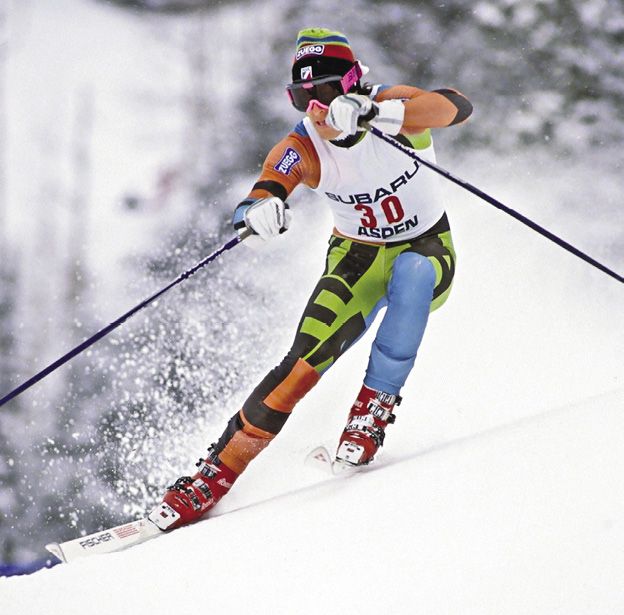
On the pro tour, in Aspen.
In his first season as a pro, he drove around the U.S. with two 1984 Olympians, Slovenian Tomaz Cerkovnik and Swede Gunnar Neuriesser, and competed head-to-head against Austrian powerhouses Bernhard Knauss, Mathias Berthold and Roland Pfeifer. Tonazzi loved it. “Someone said they would have to stop the tour to make Marco stop,” he recalls.
But that’s not how it ended. In 1997, says Tonazzi, “I was done. My knees were really not healthy. I was almost 37, super-old.”
He also wanted to do one more thing: the 24 Hours of Aspen race. “To me, it was as close as I could get in skiing to a survival situation,” he explains. “Ski racing is intense, but what’s so tragic about one minute, 20 seconds? There’s no survival. I was missing this idea of fighting with myself through pain, being tired and more than tired. That was the only thing I knew in ski racing that existed.”
To enter, Tonazzi had to be part of a two-person team from the same nation, so he recruited countryman Josef Polig, the 1992 Alpine Combined Olympic gold medalist. Tonazzi was recovering from knee surgery and now says he had “no clue” how to train for 80 runs down Aspen Mountain—a quarter-million vertical feet—at downhill speeds.
Every team had a support crew. Tonazzi’s included Taché, who had never done the event himself despite being a local. “It was a horrific event,” says Taché. “I mean, it’s gnarly. Your partner and you just tuck in behind each other and literally go straight down from the top to the bottom. The lighting wasn’t very good. There’d be totally dark spots. And it’s early season, so all the terrain was more pronounced.”
After about five hours, Tonazzi was flagging so Polig took the lead. Then at around 1 a.m. Polig said, “I’m done. I’m scared, I can’t hold on anymore.”
Responded Tonazzi, “One more. Stay behind me. We won’t push.” At the bottom, they got on the gondola and Polig reiterated, “Marco, I can’t do it.”
“One more,” Tonazzi said,
At the top of the gondola, the competitors ran and jumped into the skis awaiting them, the way they started each lap. “I run out, look at the skis next to me and nobody’s there,” Tonazzi says now. “I turn around and see Joe in the gondola riding back down. So that’s it. I was disqualified.” He skied down alone.
“At the bottom, I asked, ‘What do I do?’” Tonazzi says. “Someone said, ‘Keep going. You won’t be ranked, but who cares?’”
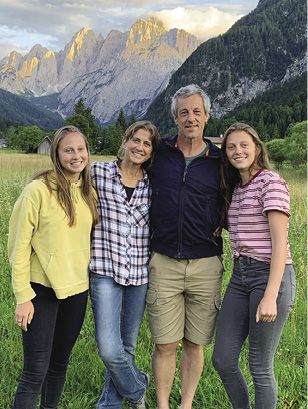
At home with (left to right)
Isabella, Amy and Liliana.
The event raised money for charities, one of which supported children with terminal illnesses. Eventually, after about 15 hours of skiing, Tonazzi stumbled again into the gondola. This time, three kids—beneficiaries of the fundraising who were “paired” with the Italian team during the race—peered into his car and yelled, “Marco! Don’t stop!”
The moment is as vivid and raw as it was 25 years ago. “The doors closed to those three kids that are probably long gone now,” he recalls. “So I skied through the night by myself and finished at noon the next day. It was a great memory. It gave me even more than I expected. I did everything I wanted to do in skiing.”
Tonazzi returned to Vail, where he was living with Amy Wheeler, a ski model known for action shoots for films and magazines. In 1999, they married and now have two daughters: Isabella, 20, a freshman at Montana State University, and Liliana, 17, who plays volleyball in high school. Neither one ski races.
These days, Tonazzi runs six businesses. In Colorado, he owns the Minturn Inn (a bed and breakfast between Vail and Beaver Creek); the Hotel Minturn a few blocks away; Mangiare, an Italian food market farther down the road; and the Valbruna clothing store in Vail. He also co-owns the Valbruna Inn in Italy and runs Valbruna Travel, which enables him to guide at least one summer and one winter trip to his hometown. More recently, he bought half of Astis, a company that makes distinctive leather ski mittens featuring beaded patterns and fringe.
Thanks to Tonazzi’s willingness to empower his staff and delegate work, all of the businesses appear to be thriving. “I try to [hire] people who are better than I am at what they do and give them room to do what they like, to the best of their ability,” he says. “I tell a lot of stories and sometimes they look at me like I’m a lunatic, but I think if they know who I am—my values, morals and ethics—I don’t need to run the business myself. They will make the decisions and run the business like I would, no matter where I am.”
As for why he has so many businesses, the answer is in his nature. “Even while racing, I was always easily distracted by other passions,” Tonazzi explains. “When there’s something I like, I cannot say no. It’s like a missed opportunity. So I kind of take on too much and juggle and try not to drop anything.”
New York-based sportswriter Aimee Berg wrote about freestyle champ Kari Traa in the September-October, 2021 issue.
To elaborate on “Better Than Wool” (March-April 2021), Polarfleece was an evolutionary product. The first polyester fiber insulations were created in the mid-1960s by compressing nonwoven Dupont Dacron and Celanese Fortrel, used in quilted outerwear. Later, nonquilted jackets used a tougher version made on a needle-punching machine. I made this stuff for the skiwear industry at our Seattle factory beginning in 1975; a competing factory made it in New England.
In 1978, 3M began manufacturing and selling Thinsulate in Asia. That disrupted North American insulation manufacture. U.S. skiwear makers had to compete with China. We needed a new U.S.-made synthetic insulation.
At Malden Mills, where I worked selling synthetic pile fabrics, we knew how to make sweatshirt fleece from cotton-polyester blends. In 1980, I asked Malden to make a blanket fleece fabric using a special Fortrel polyester fiber. This was fleece. It gave us a competitive product to the stuff made in Asia, and allowed skiwear brands to keep their sewing factories here in the U.S.A.
I need to add an environmental note: North American mills operate under strict EPA guidelines. Asian mills often poison their rivers. The more American products you buy, the cleaner the planet.
Doug Hoschek
Seattle, Washington
The Musical Origin of the Jim Dandy Ski Club
I enjoyed reading the article by Charlie Sanders, “A History of Ski Music and Song” (September-October 2021). . . . The nation’s first Black ski club, the Jim Dandy Ski Club, was formed in 1958 in Detroit, Michigan, named after the rhythm and blues song “Jim Dandy,” written by Lincoln Chase and first recorded by American singer LaVern Baker in 1956.
The song was recognized by the Rock and Roll Hall of Fame and included in Rolling Stone’s Greatest Songs of All Times. The song is about a man named Jim Dandy who rescues women from improbable situations. The lyrics begin with the phrases, “Jim Dandy to the rescue” and “Go, Jim Dandy,” and go on to describe the predicament: “I was sitting on a mountain top, 30,000 feet to drop.”
The ski club, which boasts 300 to 400 members, added to the song, “Jim Dandy does the hockey stop.” Members ski to the beat of the song. I would like to see more articles in the journal that reflect the contributions made by Black skiers, including African Americans, to skiing history.
Naomi Bryson
Chandler, Arizona
Give Skiing History for the Holidays
Skiing History magazine is the perfect gift for the holidays. Go to skiinghistory.org/join to send a subscription to a friend, at a discounted gift rate.
Shop at smile.amazon.com and Amazon will donate .05 percent of your purchases to ISHA, at no cost to you.
Sign up at smile.amazon.com/ch/06-1347398. This link takes you directly to ISHA’s new AmazonSmile account, where you can make your usual Amazon purchases while providing a new funding source for ISHA. Just select Sign-in at the upper right corner of the page.
In the early ’80s, skiers finally learned to stay dry and warm.
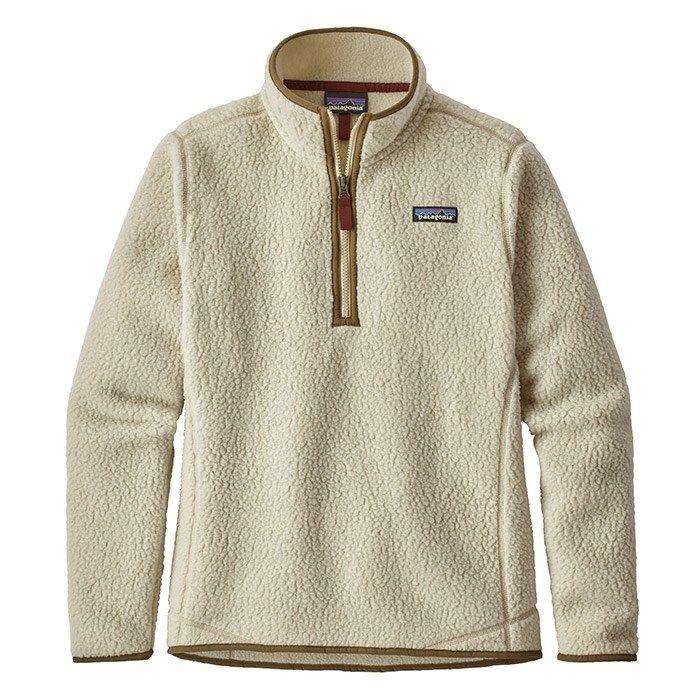
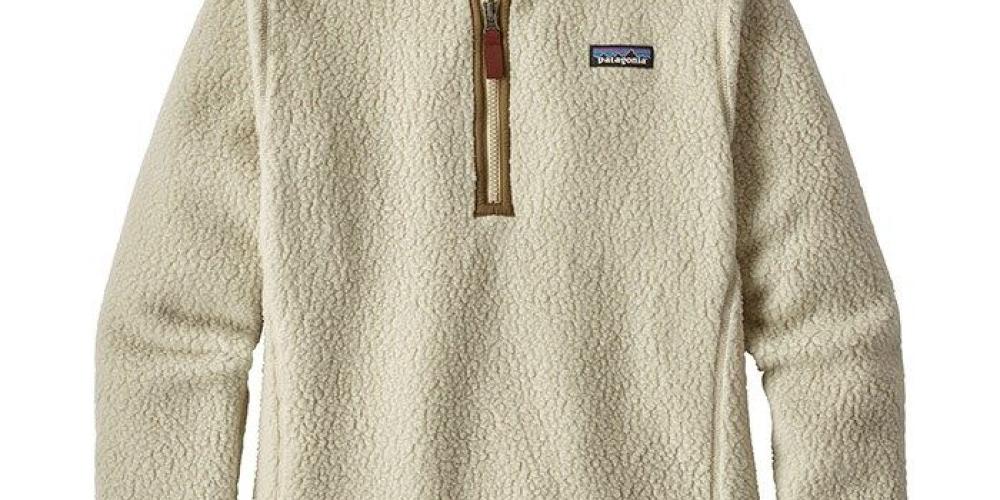
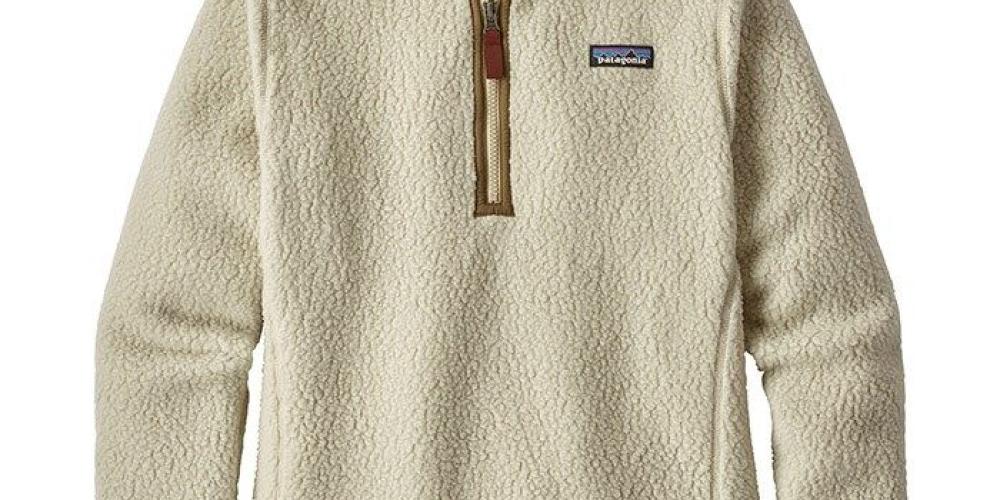
Photo above: In the 1980s, Patagonia's fleece top helped launch the technical skiwear category.
Those of us who began skiing before 1980 remember bundling up in layers of nylon, wool and down. In dry weather we were warm. In wet weather we shivered and headed for the lodge, then waited overnight for the soggy insulation to dry out. Around 1970 a lot of ski parkas were made with synthetic fiberfills, which dried more quickly—but they still soaked up cold rain and wet snow, driving us indoors.
Forty years ago, in 1981, everything changed. We got polyester fleece, which resisted moisture unless submerged, and waterproof/breathable shells to protect the fleece from wind and wet. Skiwear companies educated us to layer. It helped that high-speed detachable chairlifts, introduced that same year, cut in half the time we spent in the rain. Over the next five years, skiers discovered they could get in a dozen runs even in a Sierra blizzard.
First popular with Norwegian fishermen,
thick synthetic pile sweaters were
updated around 1975 by Patagonia
(original version here). This evolved into
the fleecy insulator that the company
marketed as Synchilla in the early 1980s.
The skiwear revolution, of course, has a backstory. In 1941, Dupont laboratories invented nonporous acrylic and polyester fibers, introduced commercially after World War II as Orlon and Dacron. As fabrics, they resisted soaking and staining, especially when treated with water-repellent chemicals. They became popular for upholstery, carpeting and clothing. In 1961 the 90-year-old Norwegian company Helly Hansen, a maker of foul weather gear for seamen, partnered with the firm Norwegian Fiber Pile to create a thick acrylic pile sweater that became popular with Swedish lumberjacks and Norwegian fishermen.
Ten years later, Patagonia founder Yvon Chouinard began looking for something better than wool and down for mountaineering gear. As he wrote in his book Let My People Go Surfing:
We decided that a staple of North Atlantic fishermen, the synthetic pile sweater, would make an ideal mountain layer, because it would insulate well without absorbing moisture.
But we needed to find some fabric to test out our idea, and it wasn’t easy to find. Finally, Malinda Chouinard, acting on a hunch, drove to the Merchandise Mart in Los Angeles. She found what she was looking for at Malden Mills, freshly emerged from bankruptcy after the collapse of the fake fur-coat market. We sewed up samples and field-tested them in alpine conditions. It had a couple of drawbacks: a bulky, lumbering fit and a bad-hair-day look, thanks to fibers that quickly pilled. But it was astonishingly warm, particularly when used with a shell. It insulated when wet, but also dried in minutes, and it reduced the number of layers a climber had to wear.
Those first thick pile sweaters were boxy, but Chouinard worked with Malden owner Aaron Feuerstein and product manager Doug Hoschek to adapt the mill’s polyester baby-bunting material into a soft fleecy insulator that Patagonia marketed, in 1981, as Synchilla. Malden sold it with great success, under the name Polarfleece, to other outdoor clothing makers, including skiwear companies. In 1986 Malden changed the fabric’s name to Polartec.
In combination with waterproof/breathable shell materials like Gore-Tex, fleece kicked off a trend called “technical skiwear.” Stretch pants were exiled to the high-fashion corner of fine-weather skiing, and technical skiwear makers celebrated their boom at “poly parties.” (see “Crazy Ski Promotions,” January-February 2021 issue.)
By the mid-90s, Malden figured out how to make polyester fiber from recycled soft-drink bottles. In 1995, Malden’s factory in Lawrence, Massachusetts, burned to the ground. Over the next two years Feuerstein rebuilt the company, but the interruption opened the fleece market to competing firms. Feuerstein lost control of the company in 2001, and after an ownership change, Malden Mills became Polartec Inc. in 2007.
Seth Masia is president of ISHA. His last article for Skiing History was “Alpine Revolution: Three Years that Shook the Ski World,” in the January-February 2021 issue.
Feature Image Media
Image
Timestamp
Author Text
By Seth Masia
In the early ’80s, skiers finally learned to stay dry and warm.
Photo above: In the 1980s, Patagonia's fleece top helped launch the technical skiwear category.
Those of us who began skiing before 1980 remember bundling up in layers of nylon, wool and down. In dry weather we were warm. In wet weather we shivered and headed for the lodge, then waited overnight for the soggy insulation to dry out. Around 1970 a lot of ski parkas were made with synthetic fiberfills, which dried more quickly—but they still soaked up cold rain and wet snow, driving us indoors.
Forty years ago, in 1981, everything changed. We got polyester fleece, which resisted moisture unless submerged, and waterproof/breathable shells to protect the fleece from wind and wet. Skiwear companies educated us to layer. It helped that high-speed detachable chairlifts, introduced that same year, cut in half the time we spent in the rain. Over the next five years, skiers discovered they could get in a dozen runs even in a Sierra blizzard.
First popular with Norwegian fishermen,
thick synthetic pile sweaters were
updated around 1975 by Patagonia
(original version here). This evolved into
the fleecy insulator that the company
marketed as Synchilla in the early 1980s.
The skiwear revolution, of course, has a backstory. In 1941, Dupont laboratories invented nonporous acrylic and polyester fibers, introduced commercially after World War II as Orlon and Dacron. As fabrics, they resisted soaking and staining, especially when treated with water-repellent chemicals. They became popular for upholstery, carpeting and clothing. In 1961 the 90-year-old Norwegian company Helly Hansen, a maker of foul weather gear for seamen, partnered with the firm Norwegian Fiber Pile to create a thick acrylic pile sweater that became popular with Swedish lumberjacks and Norwegian fishermen.
Ten years later, Patagonia founder Yvon Chouinard began looking for something better than wool and down for mountaineering gear. As he wrote in his book Let My People Go Surfing:
We decided that a staple of North Atlantic fishermen, the synthetic pile sweater, would make an ideal mountain layer, because it would insulate well without absorbing moisture.
But we needed to find some fabric to test out our idea, and it wasn’t easy to find. Finally, Malinda Chouinard, acting on a hunch, drove to the Merchandise Mart in Los Angeles. She found what she was looking for at Malden Mills, freshly emerged from bankruptcy after the collapse of the fake fur-coat market. We sewed up samples and field-tested them in alpine conditions. It had a couple of drawbacks: a bulky, lumbering fit and a bad-hair-day look, thanks to fibers that quickly pilled. But it was astonishingly warm, particularly when used with a shell. It insulated when wet, but also dried in minutes, and it reduced the number of layers a climber had to wear.
Those first thick pile sweaters were boxy, but Chouinard worked with Malden owner Aaron Feuerstein and product manager Doug Hoschek to adapt the mill’s polyester baby-bunting material into a soft fleecy insulator that Patagonia marketed, in 1981, as Synchilla. Malden sold it with great success, under the name Polarfleece, to other outdoor clothing makers, including skiwear companies. In 1986 Malden changed the fabric’s name to Polartec.
In combination with waterproof/breathable shell materials like Gore-Tex, fleece kicked off a trend called “technical skiwear.” Stretch pants were exiled to the high-fashion corner of fine-weather skiing, and technical skiwear makers celebrated their boom at “poly parties.” (see “Crazy Ski Promotions,” January-February 2021 issue.)
By the mid-90s, Malden figured out how to make polyester fiber from recycled soft-drink bottles. In 1995, Malden’s factory in Lawrence, Massachusetts, burned to the ground. Over the next two years Feuerstein rebuilt the company, but the interruption opened the fleece market to competing firms. Feuerstein lost control of the company in 2001, and after an ownership change, Malden Mills became Polartec Inc. in 2007.
Seth Masia is president of ISHA. His last article for Skiing History was “Alpine Revolution: Three Years that Shook the Ski World,” in the January-February 2021 issue.