Resorts

Open to Public?
Off
Feature Image Media
Image
Timestamp

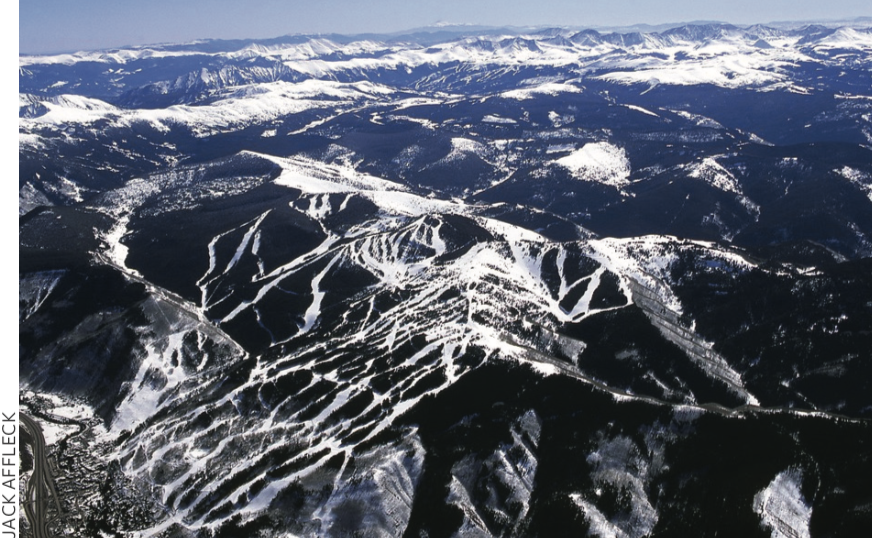
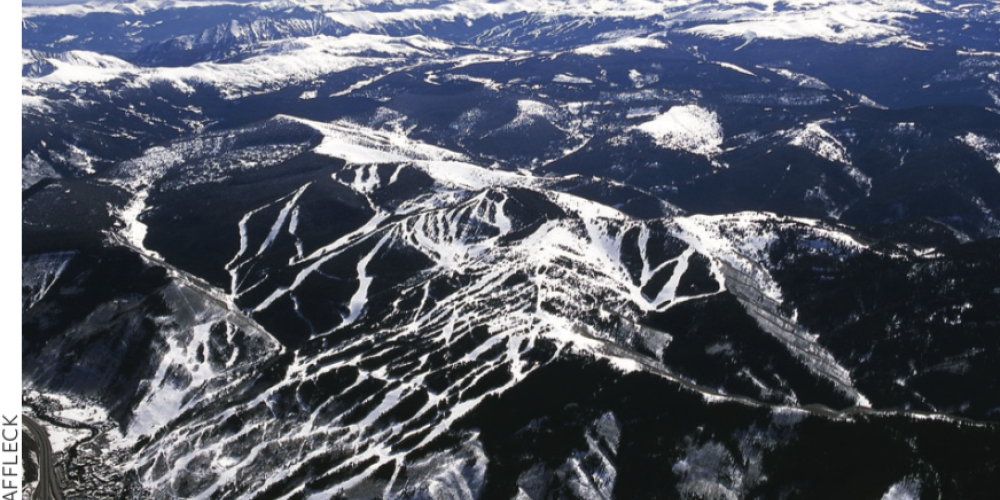
Skiing has always been a perilous journey for public companies.

By SETH MASIA

If you had put $1,000 into Vail Resorts stock in 2004, your investment would have grown to $14,000 by August 2018. Vail, a supernova of skiing investments, now faces its most daunting competition ever in the nascent, privately held Alterra Mountain Company.

In truth, Vail is the only public company in the history of North American skiing to have shown long-term health. Other than Vail, the stock market has been a bad marriage for skiing. S-K-I  Ltd. was a steady if unspectacular stock for many years, until purchased by Les Otten. Peak Resorts returns a modest dividend and has shown no price growth.

Sometime in the late 1970s, commenting on a ski-equipment anti-dumping action, Fortune Magazine noted that “Skiing is an odd little segment of industry better left to people who understand it and deeply care about it.” For many years those have been words to live by, especially for investors from outside the peculiar business...

Read full article, pages 10-11.

investing
Category
Open to Public?
On
Full Access Article for Public

In 1943, Manhattan Project scientists took to the snow. They’ve never quit.

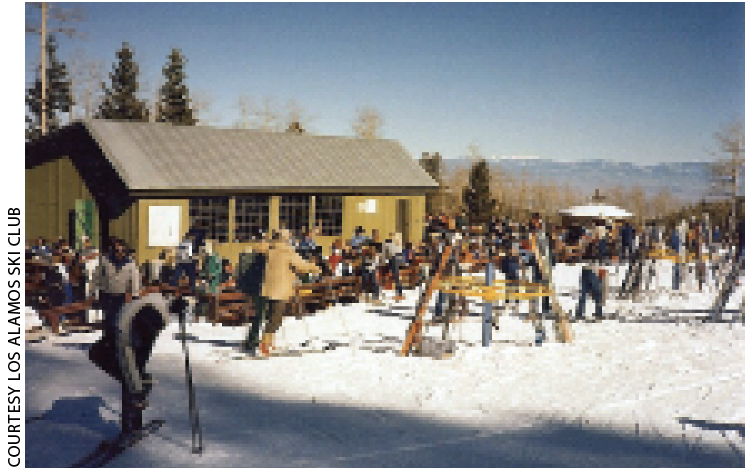
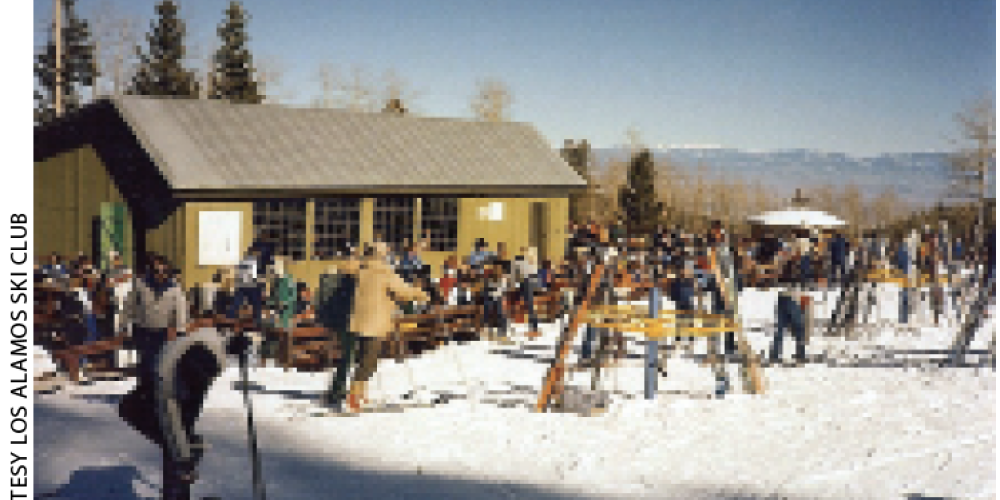
In July, 2018, newspapers around the American Southwest noted the 75th anniversary of the founding of Los Alamos National Laboratory, in 1943 code-named the Manhattan District. Less widely reported, in November: the 75th anniversary celebration of the Los Alamos Ski Club, owner and operator of the nonprofit Pajarito Mountain ski area.

The Los Alamos club, as far as is known, is the only ski club founded by nuclear physicists. Many of the young scientists recruited to develop a British-American atomic bomb were Central European refugees from Nazi-occupied lands – men and women who, in their university days, spent holidays climbing and skiing in the Alps, and some who escaped literally under fire. The rest were PhDs and grad students recruited from physics and chemistry departments across the United States, Canada and Great Britain. According to Deanna Morgan Kirby, in her excellent history Just Crazy to Ski, average age of the new population was 26. If there ever was a demographic destined to ski, it was this population of fit intellectual adventurers.

The new laboratory inhabited the campus of the Los Alamos Ranch School, a college-prep academy for boys that emphasized rugged outdoor living. At 7,320 feet elevation, the school got snow in winter. The kids played ice hockey on Ashley Pond (named for the school’s founder, Detroit businessman Ashley Pond), and skied up 10,440-foot Pajarito Mountain, seven miles to the west. The U.S. Army’s Manhattan Project, under the command of General Leslie Groves, chose the site because its dormitories and classroom buildings offered suitable office and laboratory space in splendid isolation from population centers of any description. The Army then bulldozed much of the site to build new labs, workshops and temporary housing for hundreds of young families, and dormitories for the unmarried folk of both sexes. Scientists arriving at this secret destination in the summer of 1943 found a dusty construction site surrounded by the scenic splendor of high desert. Everyone worked long days, but had Sundays free to hike, climb, ride horses and otherwise recreate in the mountains. Winter brought skating parties and, of course, skiing.

The new arrivals included a number of keen cross-country skiers and mountaineers, including Enrico Fermi (Nobel laureate, 1938) and his longtime associate Emilio Segrè (Nobel 1959); Cornell professor Hans Bethe (Nobel 1967); Niels Bohr (Nobel 1922); Harvard professor George Kistiakowsky and his explosives-lab partner Walter Kauzman; Berkeley grads Ben and Beckie Diven; and several grad students drafted into the Army’s Special Engineering Detachment. By November, 1943, as the first snows of a heavy winter descended on the Los Alamos plateau, the skiers, most equipped with the Army’s ponderous hickory skis, toured into the surrounding highlands.

In April, 1944, one of these trips turned into a grueling four-day rescue when University of Chicago physicist James Coon sustained a spiral fracture of the tibia. None of his seven colleagues had first-aid training, there were no communication facilities, and none of the local doctors knew how to ski. By the time Coon could be loaded into an ambulance, it was clear that the Los Alamos ski group needed a trained ski patrol – which implied a more formal level of organization.

That summer, the skiers began widening the Ranch School’s ski trails on Sawyer’s Hill, a few miles west of the security fence (the Army controlled thousands of acres, free of supervision by county and state authorities). The lightweight one-man chain saw would not reach the market until 1960. To speed the work, George Kistiakowsky, developer of the shaped explosives used to compress the bomb’s plutonium core to critical mass, came up with a “necklace” of plastic explosive meant to blast through each tree trunk near the ground. It worked.

Then three of the enlisted engineers, headed by John Rogers (a future pioneer of cryogenic physics), assembled components for a rope tow. At a junkyard in Albuquerque they scored a 1932 Chrysler engine and some Ford Model A wheels to use as pulleys. Kistiakowsky organized a nonprofit club to pay for the rope tow, and by November 10, 130 people paid dues. The volunteers went back to work, blasting a route for the rope. The Army agreed to plow four miles of road, send a bulldozer to level a parking area, and provide gasoline for the tow. On November 13, the club voted itself into formal existence as the Los Alamos Sawyer’s Hill Ski Tow Association.

The Navy had taken all the new manila rope so the three engineers scavenged short lengths of worn-out rope from a circus tent and spliced them together, enough for a 400-foot run. In operation, the rope shredded going around the Model A bullwheel, and had to be respliced several times a day. And – a serious design flaw – the Chrysler engine sat at the top of the tow, forcing lifty Harry Snowden to drive up an icy road, hauling cans of fuel, to the upper terminus just to start the machine each morning.

With the tow in operation, dozens of nonskiers showed up to learn the sport. Experienced skiers got bored with the short runs. Enrico Fermi began leading ambitious ski tours. Kistiakowsy scrounged up a couple of M29 Weasels that could tow skiers to runs well above the top of the rope.

No one stepped forward to teach beginners, but Kistiakowsy, a Ukrainian Cossack educated in Berlin, skied an elegant feet-together Arlberg style that served as an model for aspirants. Best skier in the group, by far, was the powerful Joan Hinton, who learned to ski at the Putney School in Vermont – so well that she’d been named to the 1940 Olympic squad. Without the distraction of ski racing, she earned a PhD in physics from the University of Wisconsin and went straight to Los Alamos.

As the ski season wound down in the spring of 1945, work on the bomb accelerated and the scientists had little time for recreation. In August the Trinity test, followed by the attacks on Hiroshima and Nagasaki, marked the success of the enterprise. Before snow fell again, two-thirds of the Los Alamos population departed to resume science elsewhere. The ski club entered peacetime with access to 2,000 feet of brand new rope, and a high-tech bullwheel engineered in the atomic-bomb shop. The skiers built a second, longer tow – this time with a new International Harvester diesel engine located at the base. Kistiakowsy, with his explosives-lab colleague Les Seely, was on hand to blast trees off the new lift line and some longer trails.

Snow came late that winter, the ski tows had a short season, and by the spring of 1946 club members began exploring Pajarito Mountain for higher terrain and more reliable snowpack. Peacetime also brought much free time to the remaining Los Alamos population, and the club transformed. With Seely as president, the newly-incorporated, nonprofit Los Alamos Ski Club formed a five-man chapter of the National Ski Patrol, led by Purdue physicist John Orndoff, and a two-man ski school.

The winter of 1947-48 came early and the snow fell deep. More new skiers came out, and the rope tow engines, which had to be pre-heated and hand cranked to start each frigid morning, were worked hard. On February 29, 300 celebrants turned out for the club’s first Skiesta party, beginning a 70-year tradition. That summer, the Atomic Energy Commission – which now owned and ran the Los Alamos lab and all its supporting infrastructure – authorized $6,800 to build an 800-square foot base lodge. Seely blew up more trees, to make new trails and supply the lodge with firewood.

In fact, the next five winters brought excellent snow, and skiing boomed at Sawyer’s Hill. The club invited Buzz and Jean Bainbridge, from Santa Fe Ski Basin, to take over the ski school. Whole families turned out to cut new trails, armed with cross-cut saws instead of plastic explosives. But 1956 brought drought. In March, 1957, 13 club members set out in a couple of jeeps to find better conditions on Pajarito Mountain, where, years earlier, Ranch School instructor Hup Wallis had cut a short ski trail. When the jeeps bogged down in the four-foot snowpack, the party climbed to the summit on skis. The club quickly voted to move the whole operation to the big hill. The Pajarito terrain – 1,400 vertical feet of it – faced north (Sawyer’s Hill faced east). In every respect Pajarito promised better skiing. But the seven-mile road in was impassable, the nearest electrical supply was at the lab and, of course, everything from trail clearing to lift construction would have to be done – and financed – by volunteer crews.

By this time Los Alamos constituted its own county. The county and the ski club together designated $15,000 for road improvement. Half that went to a construction company to grade the road, $1,200 for gravel, and the rest went to pay local teenagers to do the manual labor. The road opened in September – still a hairy drive but doable by rear-wheel-drive cars and busses, most days. Meanwhile dozens of volunteers devoted weekends to clearing trails through the rainiest, muddiest August anyone could remember. Not all the felled timber could be cleared out before heavy autumn snows, so skiers skittered over deadfall all winter on the trail they called Lumberyard. In October, volunteers crews moved an Army surplus building to the site, through three feet of new snow, to serve as the base lodge.  In November, one of the Sawyer Hill rope tow engines moved to Pajarito, where it powered a 2,300 foot tow rising 600 feet – possibly the longest rope tow in the world. The tow opened for business on November 12. The beginner tow moved in for Christmas, using sheaves machined from solid plate in the Los Alamos government shop. That winter, 365 club members enjoyed 38 days of weekend and holiday skiing, with 14 feet of snow. The following summer, Rope Tow 3 rose 485 feet to the summit.

By now, with H-bomb development finished, security had loosened at Los Alamos and in the years to follow the club could sell passes to the general public. The upper rope was far too steep for all but the strongest skiers, and the club began to plan for installation of a T-bar to the East Summit, with its own complex of trails. The new lift required a four-mile power line. The club raised $60,000 by selling 10-year season passes, and over the summer of 1962 the volunteers dug footings for the power poles and lift towers. The 3,300-foot Hall T-bar ran that winter, carrying 800 skiers per hour to the summit. At the same time, the club built a larger base lodge, complete with cafeteria.

Skiing grew more popular still, and crowding became a problem on the trails, lifts, lodges and parking lot. The steeper trails grew giant moguls. The club acquired 400 additional acres from the Atomic Energy Commission, and by 1965 cleared more trails (finally using modern chain saws), expanded the base lodge, and bought a John Deere 350 bulldozer for contouring and mogul-cutting. As a snow-grooming machine the bulldozer left much to be desired – after it rolled several times, it was replaced with a real snow-cat. The first chairlift went in over the summer of 1969, with more chairs, and new terrain, following in 1976, 1981, 1982 and 1994, with a new base lodge in 1987.

Today, the trail network extends across two miles of Pajarito’s north aspect. Following several snowless winters in the 1990s, club membership fell from its peak of 4,000, leading to financial crisis. After putting in a snowmaking system for the 2010 season – and after a couple of disastrous forest fires -- the club ran out of funds. Over the next several years the club negotiated transfer of the facilities to a public-private partnership between the county and a private management company now called the Pajarito Recreation Limited Partnership, which operates three other New Mexico ski areas. The club still owns the land.

This story is based on Deanna Kirby’s book Just Crazy to Ski: A fifty-year history of skiing at Los Alamos (Los Alamos Historical Society, 2003); “A Short History of the Los Alamos Ski Club” by Paul Allison and George Lawrence (LASC, 2018); and The Making of the Atomic Bomb by Richard Rhodes (Simon & Schuster, 1987).


Pajarito Facts

Base elevation: 9,000 feet

Summit elevation: 10,440 feet

Skiable acres: 750

Trails: 44 (20% easy, 50% intermediate, 30% difficult)

Lifts: 5 (1 quad, 1 triple, 3 double, 1 Magic Carpet) 

Terrain Parks: 2

Average winter season: mid-November to mid-March

On-mountain facilities: Rentals, Snowsports School, Retail, Pajarito Mountain Cafe

Feature Image Media
Image
Timestamp

In 1943, Manhattan Project scientists took to the snow. They’ve never quit. By Seth Masia

In July 2018, newspapers around the American Southwest noted the 75th anniversary of the founding of Los Alamos National Laboratory, in 1943 code-named the Manhattan District. Less widely reported, in November: the 75th anniversary celebration of the Los Alamos Ski Club, owner and operator of the nonprofit Pajarito Mountain ski area in New Mexico.

The Los Alamos club, uniquely, was founded by nuclear physicists. Many of the young scientists recruited to develop a British-American atomic bomb were Central European refugees from Nazi-occupied lands—men and women who, in their university days, spent holidays climbing and skiing in the Alps. The rest were recruited from physics and chemistry departments across the United States, Canada and Great Britain. According to Deanna Morgan Kirby, in her excellent history Just Crazy to Ski, average age of the new population was 26. If ever there was a demographic destined to ski, it was this population of fit and intellectual adventurers.

The new laboratory inhabited the campus of the Los Alamos Ranch School, a college-prep academy for boys that emphasized rugged outdoor living. At 7,320 feet elevation, the school got snow in winter. The kids played ice hockey on Ashley Pond (named for the school’s founder, Detroit businessman Ashley Pond), and skied up 10,440-foot Pajarito Mountain, seven miles to the west. The U.S. Army’s Manhattan Project chose the site for its splendid isolation from population centers of any description. The Army then bulldozed much of the site to build new labs, workshops and housing. Scientists arriving at this secret destination in the summer of 1943 found a dusty construction site surrounded by the scenic splendor of high desert. Everyone worked long days, but had Sundays free to hike, climb, ride horses and otherwise recreate in the mountains. Winter brought skating parties and, of course, skiing.

The new arrivals included a number of keen cross-country skiers and mountaineers, including Enrico Fermi (Nobel laureate, 1938) and his longtime associate Emilio Segrè (Nobel 1959); Cornell professor Hans Bethe (Nobel 1967); Niels Bohr (Nobel 1922); Harvard professor George Kistiakowsky and his explosives-lab partner Walter Kauzman; Berkeley grads Ben and Beckie Diven; and several grad students drafted into the Army’s Special Engineering Detachment. By November 1943, inspired by the first snows of a heavy winter, they toured into the surrounding highlands.... 

Pajarito Mountain
Category
Open to Public?
Off
Feature Image Media
Image
Timestamp

By John Fry

For 35 years, the National Ski Areas Association (NSAA) has reliably measured the volume of winter visits at U.S. areas. The statistic—one skier or snowboarder on the slopes for one day with a lift pass—is not perfectly accurate, but it is the most consistent available to track the trend in participation over the years. Visits reached record highs of over 60 million-plus days in 2008 and 2011. Last season, however, at 53.3 million days, they were down 11 percent from the record highs. Ski area visits are back to the level of 30 years ago in 1987. 

Something else may have changed, too. According to the latest NSAA research, frequent skiers and snowboarders—people on lift-served slopes for six or more days a winter—now account for 70 percent of all visits. 

Put another way, only 28 percent of 9.2 million skiers and snowboarders account for 70 percent of all ski area visits. Anyone planning to be on the slopes more than six days a winter can be tempted to buy one of the many varied season passes, such as Epic, Ikon, or Mountain Collective, plus a myriad of passes offered by individual ski areas to reward frequent skiers. 

Roughly speaking, anyone willing to lay down between five hundred and a thousand dollars before the end of November is enjoying the lowest lift prices, adjusted for inflation, in the sport’s history. For everyone else, there’s a mixed bag of discounted passes throughout the season, too varied and numerous to describe here.  Infrequent or casual skiers and snowboarders unfamiliar with how to purchase discounted tickets in advance can be experiencing the highest-ever ticket prices. 

Last winter, the average U.S. weekend window lift ticket price was $122.30. That’s 30 times greater than it was a little over half-a-century ago when the 1965 weekend lift ticket sold on average for $4.18. Over the same period of time, U.S. disposable family income multiplied 2.75 times, rising from $14,174 to $39,155. In other words, the window lift ticket price grew 10 times faster than people’s income available to spend in a discretionary manner.  

During that time, obviously, the on-slope experience has been substantially improved by resort investments in grooming, snowmaking, faster lifts, new and upgraded day lodges.  But an economist who found that the cost of an industry’s product or service over a half-century had increased 10 times more than did disposable family income, would be unlikely to form an optimistic picture of the industry’s future.

Almost all of U.S. family income growth since 2008 has gone to just ten percent of Americans. That may be okay insofar as skiing correlates with higher incomes. But a prime component historically of the skier population, young college graduates, has been negatively impacted by this trend. NSAA notes a decline in visits of young men and women aged 13 to 24, coinciding with a downturn in snowboarding. 

College loan indebtedness has doubled in the last ten years. Paying interest on their loans has left men and women in their twenties with less money to spend on recreation. 

Of course, cost isn’t the only factor impacting ski area visits. People’s leisure time is being eaten up by social media and computer games. It has affected all outdoor sports. Compared to the decline in tennis and golf, ski participation has done well, merely by declining less.

A CLOUDED FUTURE

The late Jim Spring, who did consumer research in skiing over many years, found a high number of people who call themselves skiers not participating for a season. The most promising way to increase participation numbers, he concluded in 1995, was to convince people to ski every year. 

In similar thinking, the McKinsey consulting firm in 1989 concluded that the best prospect for increasing skier numbers lies with light skiers who’ve already made a commitment to the sport. McKinsey reasoned that heavy skiers held little additional potential to expand the market, though they are the easiest for ski areas to reach.

McKinsey didn’t highlight cost, rather the need to improve the experience. And there’s the problem. Skiing is a sport involving bodily injury risk, discomfort, possible fear of heights. While many ski areas offer attractive learn-to-ski/ride deals, the newcomer must have suitable clothing, stand in lines to buy a ticket and rent equipment, and pay a ski school to learn how to slide down a hill without risking a fall or collision. According to research conducted by NSAA, more than four out of five newcomers exposed to this experience eventually decide not to take up the sport. 

If the experience remains unaltered, and ski areas offer their best pricing to people already committed heavily to the sport, it’s difficult to see, with snowboarding participation in decline, and global warming, how measurable downhill skiing activity will grow in the years ahead, or avoid declining. 

Smart minds are at work, and the business model adopted by the mega-resort companies like Vail and KSL Partners may attract the interest of  investors. Pre-season sales of season passes are bringing them millions of dollars of cash flow before the snow has even fallen. But it remains to be seen if their financial interest will ultimately serve the best interest of the sport. 

The ski industry is not synonymous with the sport, as if we needed reminding. The cross-country ski and freestyle crazes of the 1970s, and later snowboarding, which attracted hundreds of thousands of new participants, were not ski industry marketing programs designed to increase participation. They arose out of the sport’s heart, and in some cases the “industry” didn’t initially respond well to them. 

In the long run, the ski industry exists because of the sport, and not the other way around. 

John Fry is the author of the award-winning The Story of Modern Skiing: The revolution in equipment, technique, competition, resort design, and media after World War II. The book is available in paperback and on Kindle. Fry is the chairman of the International Skiing History Association.

Season pass sales
Category
Open to Public?
Off
Feature Image Media
Image
Timestamp

When it comes to trail monikers, no lions and tigers, but plenty of bears—not to mention resort founders, historic events and death threats.


By Jeff Blumenfeld

I remember December 1973 like it was yesterday.

While on Christmas break from Syracuse University, a buddy and I decided to fly cross-country, stay at Utah’s Snowbird Cliff Lodge, and ski something bigger than what we were used to in Central New York. 

It didn’t work out that way.

Instead of skiing, we spent three days shuttling between our hotel room and the basement as ski patrollers used explosives to trigger controlled avalanches. It sounded like we were under attack. Little Cottonwood Canyon was closed and wealthier guests were renting choppers to descend to Salt Lake City.

One avalanche gained more power than the patrol expected. It damaged Alta Lodge, filled four rooms with snow and severely injured a lodge employee. It also partially buried a housing trailer where two co-workers were caught in flagrante delicto. Today that slide zone is colloquially referred to as Valerie’s Climax among those who were there. 

All these onomastics got me wondering: Where do trails derive their idiosyncratic names? An informal Skiing History poll of resorts indicates that trail names generally honor founders, long-serving employees and historic events; a unique mountain feature or fauna; or warn that you just might die on the descent. 

Honoring History
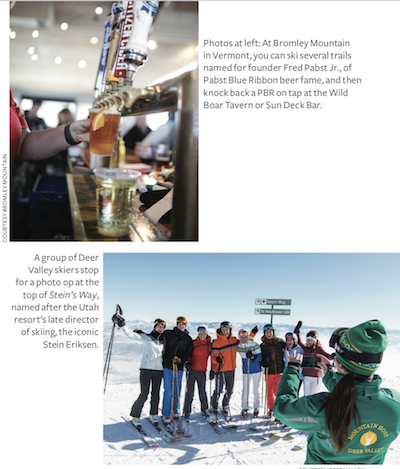
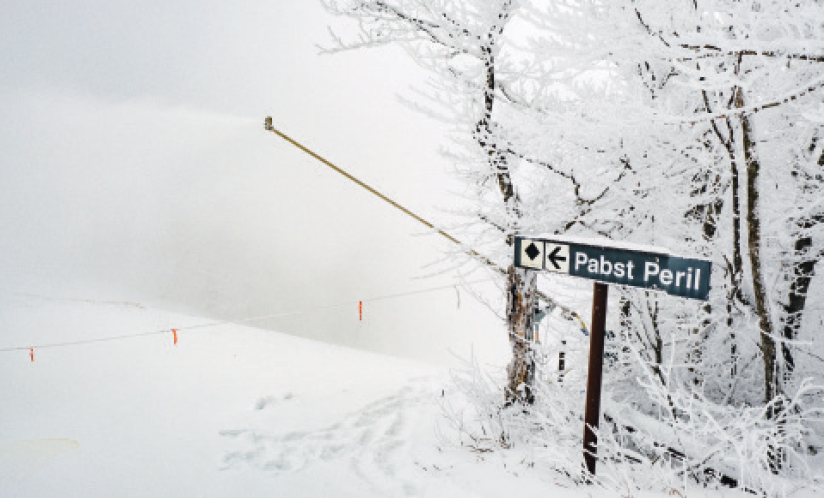
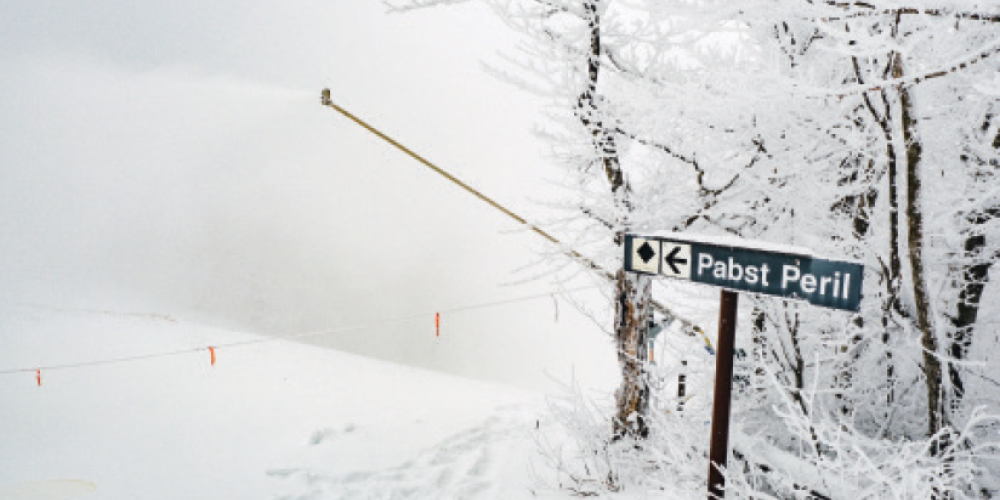
Several trails at Vermont’s Bromley Mountain commemorate the late Fred Pabst Jr., of Pabst Blue Ribbon beer fame, who opened the ski area in the late 1930s as part of his growing Ski Tows, Inc. empire. After you ski Pabst Panic, Pabst Peril and Blue Ribbon, you can knock back a PBR on tap at the Wild Boar Tavern or Sun Deck Bar.

Just up the road at Pico Peak, the late Karl Acker, who served in the U.S. Army’s 10th Mountain Division for three years during World War II, was a downhill and slalom champion, and as ski school director would later purchase the ski area with his wife, June Acker. He’s remembered by an expert summit trail called Upper KA, which turns into an intermediate run lower on the mountain. 

Utah’s Deer Valley has Stein’s Way, named after its late director of skiing, Stein Eriksen. The resort’s late founder, Edgar Stern, is honored with Edgar’s Alley. And if you ski or ride Colorado’s Copper Mountain, you get a sense of the reverence placed upon Charles D. Lewis, former executive vice president and treasurer of the then-fledgling Vail Ski Corporation. In 1969, as founding CEO of Copper, he developed the ski area “from the ground up,” according to the Colorado Ski & Snowboard Museum Hall of Fame. The CDL trail is off the Excelerator chair in Spaulding Bowl.

Back at Utah’s Snowbird, Junior’s Powder Paradise pays homage to Junior Bounous, the resort’s first ski school director and a pioneer in the ski industry who was inducted into the U.S. Ski and Snowboard Hall of Fame. Alice Avenue is named for founder Dick Bass’s wife, whom he called “sweet Alice from Dallas.” Bassackwards is named for Bass himself.

The list goes on and on. Want a ski trail named after you? Clearly, it helps to start a ski area. 

And with so many U.S. ski areas founded by veterans of World War II, it’s not surprising to learn of trails commemorating that conflict. Riva Ridge on Colorado’s Vail Mountain, for example, is named after the site of the 10th Mountain Division’s first victory, a surprise 1945 night climb and dawn attack on the steep Apennine plateau north of Florence in north-central Italy.
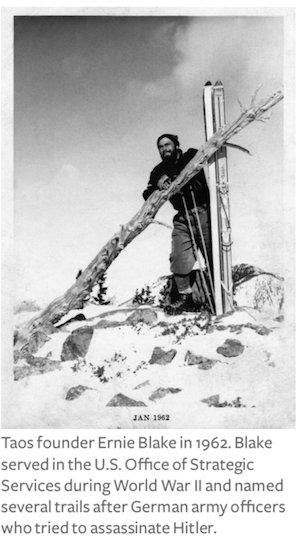
At Taos Ski Valley in New Mexico, the Stauffenberg trail is named for German army officer Claus von Stauffenberg, who unsuccessfully tried to assassinate Adolph Hitler on July 20, 1944. The story of that effort to change the course of history was depicted in the 2008 film Valkyrie, with Tom Cruise in the lead, and the 1951 film The Desert Fox. Other trails, some of Taos’ most challenging, commemorate the roles of three additional anti-Nazis—would-be assassins Hans Oster, Fabian von Schlaberndorff and Henning von Treskow. A bit lower down, Walkyries Bowl and Walkyries Gulch are named for the assassination plot itself, Operation Valkyrie. 

Owner Ernie Blake (formerly Bloch, a Jewish Swiss Air Force vet) served in the U.S. Office of Strategic Services (OSS) during the war. Think of him when descending Ernie’s Run off Lift 5 from the base. When liftlines were long at Taos, he was known to distribute cookies to waiting skiers. 

The rich mining history of many western resorts is also reflected in trail names. At Snowbird, Big Emma is named for the beloved local madam of Alta’s mining days—back when brothels were euphemistically known as “sporting clubs.” Meanwhile, West 2nd South, an easy run, was named for the location of the red light district. 

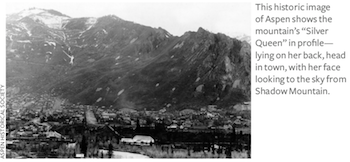
The Silver Queen run at Colorado’s Aspen honors the largest silver nugget ever mined (1,840 pounds). A massive statue made from the nugget traveled to the Chicago World’s Columbian Exposition in 1893 but mysteriously disappeared and never made it back to Aspen. The trail also pays homage to the imaginary profile of Aspen Mountain, first coined the “Silver Queen” in the 1880s, lying on her back, head in town, with her face looking to the sky from Shadow Mountain. In 1950, the trail was the site of the first GS race ever contested in a FIS World Championship. Ruthie’s Run was named for the wife of Aspen pioneer David R.C. Brown and also a piste for many hotly contested World Cup races and the 1950 FIS championships—the first held in North America.

Bears are Big

Bears are big at Vermont’s Stratton. The Algonquin name of the resort itself is Manicknung, which means “home of the bear,” and references to our ursine friends adorn the logo, trail signs, website and all sorts of swag. Stratton is also the location of a bear travel corridor, part of a six-year radio telemetry study that provides data important for land use planning across the state and led to conservation easements on more than 1,000 acres of prime habitat around the mountain, according to senior manager Myra Foster. 

There are trails named Bear Bottom, Bear Down, Black Bear, Dancing Bear, Polar Bear, and the Ursa Express lift. Sure to baffle any Millennial, Gentle Ben was named for the bear character created by author Walt Morey and first introduced in a 1965 children’s novel, a 1967 film, and a popular late 1960s U.S. television series of the same name. 
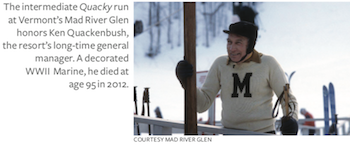
When you ski Vermont’s Mad River Glen, you’ll likely ski on an animal-themed trail such as the Beaver, Bunny, Ferret, Fox, Gazelle, Loon, Lynx and Wren. One trail performing double duty is an intermediate run named Quacky, which actually honors long-time general manager Ken Quackenbush, an iconic figure in MRG’s history and a decorated World War II U.S. Marine who died at age 95 in 2012. In her book A Mountain Love Affair: The History of Mad River Glen, author Mary Kerr calls Quackenbush the “glue and the conduit that have held Mad River Glen together for forty-five years under three owners.”
Abandon All Hope
There’s a signpost above the gates of Hell, writes Italian poet Dante Alighieri in the allegorical epic poem Divine Comedy, published in 1472. It says simply, “Abandon All Hope, Ye Who Enter Here.” An apt description of our final category of trail names, namely, those that predict imminent doom ahead. 
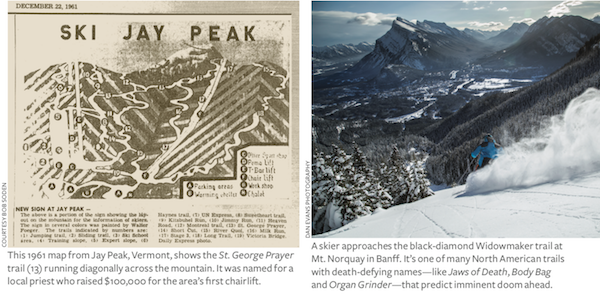
If you’re a happily married man, think twice before descending the black diamond Widowmaker trail, located at Mt. Norquay in Banff, Alberta, and accessible off the North American chair. It’s one of the last in-bound runs on the south side of the resort and offers jaw-dropping views of the town of Banff. 

“The trail has a very steep drop-off turn to the left, coming back over 90 degrees. If you missed that turn in a downhill race, you’d go airborne, probably hitting the trees about 10 feet above the ground,” says ISHA board member Wini Jones, who grew up skiing in Alberta and spent 30 years at Roffe Skiwear in Seattle as vice president for design and marketing. 

A former instructor at Zermatt and Innsbruck, Jones also remembers the mid-1980s day in the Selkirks out of Revelstoke, British Columbia, when Selkirk Tangiers Heli Skiing introduced her to a 2,000-foot fall line run called Holy Sh*t. 

“When you got out of the chopper and looked down at 2,000 feet of virgin powder, guess what everyone said?” she laughs. These days, sales manager Emma Mains says the run goes by the moniker Deep Sh*t.

Rather than face annihilation, you can hedge your bets by skiing the intermediate St. George Prayer trail at Vermont’s Jay Peak. Around 1960, after Jay had previously installed a pomalift and then a T-Bar, it was decided that to join the big leagues, Jay would need a chairlift, according to ISHA board member and ski historian Bob Soden, an engineering consultant from Montreal. Father George St. Onge, a priest from nearby Richford, Vermont, led the fundraising committee.

“Father George was no ordinary man of the collar—he drove a sports car with panache, wearing a large grin, a tweed cap and a flowing scarf. He was given one year to raise $100,000 for the lift,” Soden says. “He drove a tough bargain and left no stone unturned, held fundraiser after fundraiser and called in every favor owed—and he met the deadline.”

To honor his tenacity and faith in the project, Jay Peak’s then general manager, Walter Foeger, named the most prominent trail from the top of the Bonaventure chairlift St. George’s Prayer.

The list of death-defying names is endless in a sport that prides itself on safety initiatives. There’s Harakiri at Mayrhofen, Austria, named for the Japanese ritual samurai suicide by disembowelment; the sphincter-tightening Jaws of Death at Vermont’s Mount Snow; Organ Grinder and Exterminator at Sugarbush, Vermont; and Body Bag at Crested Butte in Colorado. 

Golf uses numbers to identify holes; the same with tennis, squash and racquetball courts. Bowling lanes are always numbered. How boring. Skiers and riders are born storytellers. Just visit any après ski bar: When a resort plays the name game, a creative trail moniker makes any day sound twice as epic.   
Jeff Blumenfeld, a resident of Boulder, Colorado, founded Blumenfeld and Associates PR, LLC, in 1980. He is chairman of the Rocky Mountain chapter of The Explorers Club and edits Expedition News, a monthly review of expeditions and adventures (expeditionnews.com).
Category
Open to Public?
Off
Feature Image Media
Image
Timestamp

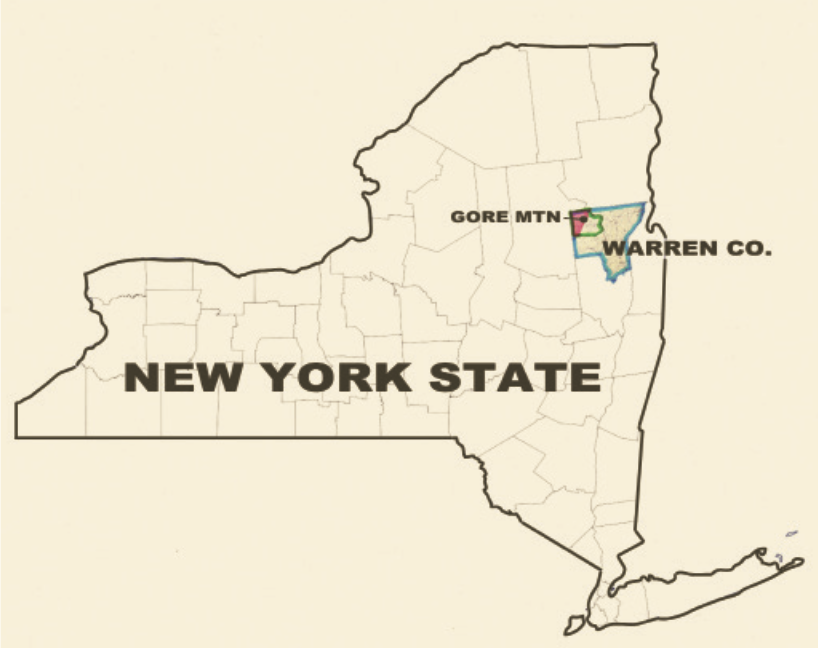
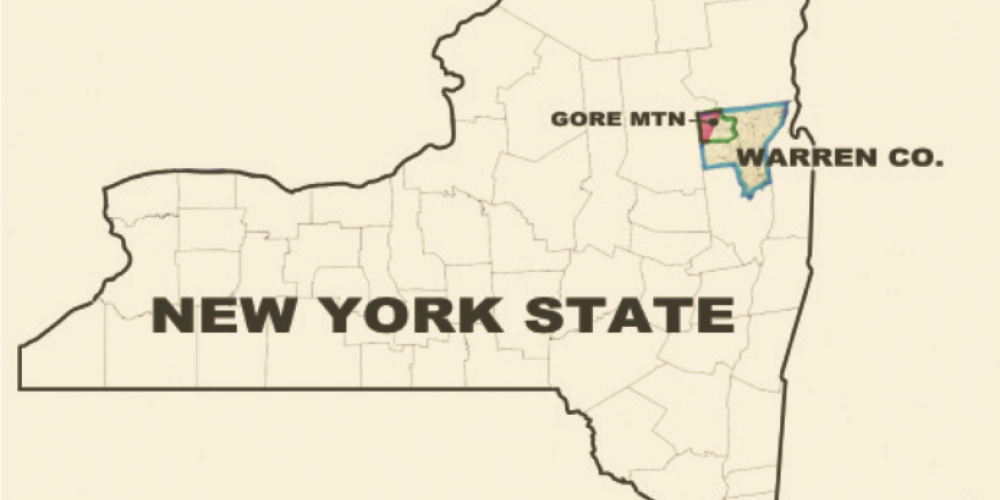
Skiing at Gore Mountain dates back to 1934. Located 235 miles north of New York City in the Adirondacks, it’s one of three ski areas operated by the State of New York. 

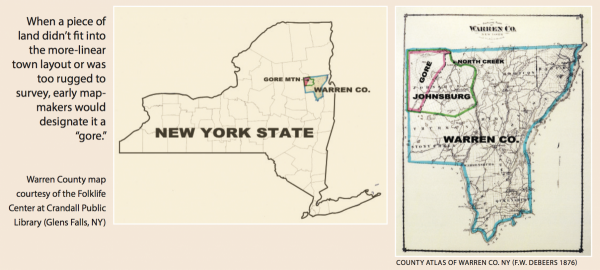
But why is it called Gore? After the American Revolution, mapping of the lands that made up the new United States began in earnest. States were divided into counties, and counties into towns. But what worked out on a surveyor’s drafting board didn’t always work out in the field. Sometimes the shape of a particular piece of land didn’t fit into a neat layout of square and rectangular towns. Or sometimes the land was too rugged to survey.

Under these circumstances, a surveyor would designate this odd-shaped piece of land between towns a “gore.” Similarly, in tailoring, a triangular or trapezoidal piece of cloth, used to make a pattern conform to a curved shape, is also called a “gore.” 

Back in the early years of the 19th century, the land to the west of North Creek, in Warren County, New York, was determined to be made up of a large number of steep mountains. Putting off closer inspection to a later date, the area was labeled the “Gore,” and the mountains found there were called the “Gore Range [of] Mountains.” 

—Bob Soden

Category
Open to Public?
Off
Feature Image Media
Image
Timestamp
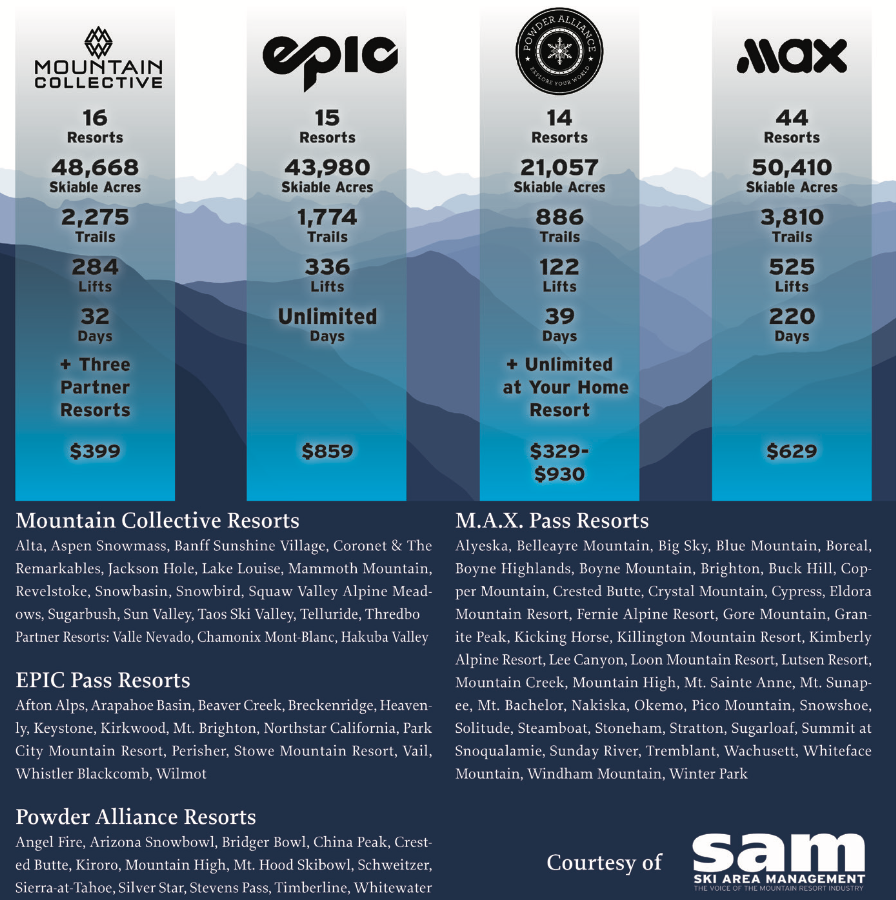
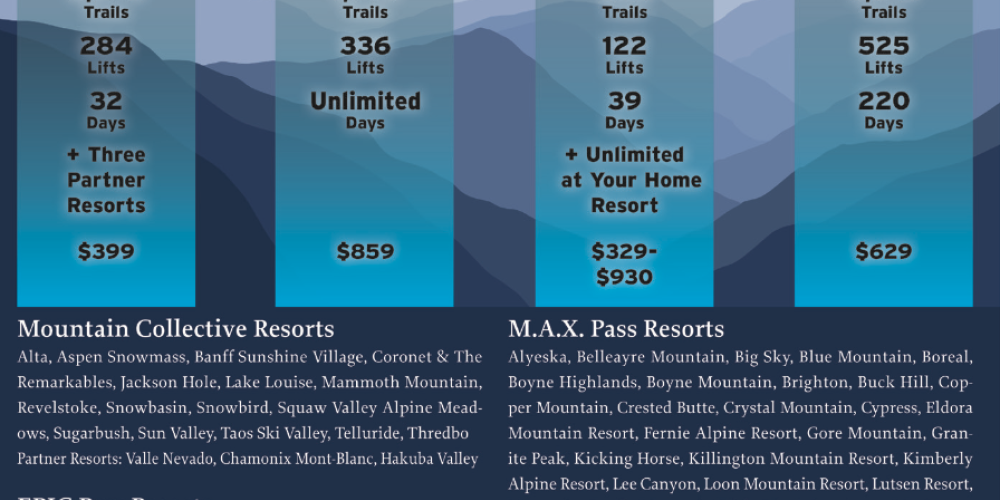
Photo Caption: This chart, compiled by the staff at Ski Area Management, shows the price of the nation’s leading multi-resort season passes. Adjusted for inflation, these passes provide high-frequency skiers with per-day prices that rival those of the early 1950s.
 
Multi-area season passes have brought back 1950s prices. By John Fry
 
Next winter the price of a season-long pass to ride an unlimited number of days on Stowe Mountain Resort’s lifts will be cut in half to $859. For someone skiing or snowboarding 20 days, for example, the per-day cost will be $43. Adjusted for inflation, that’s equivalent to $4.25 per day in 1951—about what a one-day ticket at Stowe’s Mount Mansfield cost 67 years ago. 
 
Mt. Mansfield could charge a premium then because it had a chairlift. The majority, hundreds of ski hills, offered only rope tows in 1951, and the average one-day ticket, nationally, cost only $2.50. Skiing has never been cheaper than that. But the experience was vastly different: Compare today’s high-tech snowmaking and high-speed lifts to the 1950s ordeal of grabbing onto a fast-moving rope, skiing on ice, crud over rocks, or maybe no snow at all. 
 
The Multi-Resort Season Pass
Between 1951 and 1965, ski areas jacked lift ticket prices at triple the rate of inflation so they could invest in chairlifts, snowmaking and grooming. Then came high-speed detachable chairs, more sophisticated snow management, and handsome day lodges with WiFi connections, and the one-day lift ticket at big resorts leaped to over a hundred bucks. 
 
Now something different is happening.  
A skier or snowboarder can avoid paying the lofty posted price of a daily lift pass by purchasing from a varied assortment of season passes. High-frequency skiers and snowboarders who buy Epic, Max and Mountain Collective season passes (see chart on the next page) are now paying miraculous 1950s and 1960s prices for a day on the slopes. 
 
At Squaw Valley, the California resort’s one-day lift pass over the past 37 years soared to $124. But for high-frequency skiers and riders who buy a season pass, that hyper-inflation is gone. Today Squaw Valley sells a pass with unlimited skiing for $899, which itself is 30 percent less than it would have cost in inflation-adjusted dollars 37 years ago.
 
A college student can now enjoy unlimited skiing at Squaw Valley, for the entire winter, for only $469. A kid who skis only 10 days is thus paying about the same amount as he would have paid using Squaw Valley’s day pass of the 1950s, adjusted for inflation.
Among skiers benefiting are more and more retired folks—Baby Boomers who caused the sport’s explosive growth in the 20 years after World War II. They have more time to ski. A 72-year-old skier averages 13 days per winter on the slopes, according to RRC Associates, which conducts on-slope interviews and research for the National Ski Areas Association (NSAA).
 
Aspen and Vail
The Mountain Collective Resorts group, whose 16 members include Aspen, Mammoth Mountain, Jackson Hole and Lake Louise, enables someone to ski or board two days at each resort for $429, according to Ski Area Management. Thus someone skiing only 12 days at six of the resorts would be paying $36 a day, compared with the resorts’ typical one-day lift pass price of over a hundred dollars. 
 
A season pass at Aspen costing $475 in 1988 more than quadrupled over the next 28 years to $2,119. That upward trend may have come to an abrupt halt. The Aspen Skiing Company has joined with KSL Capital Partners, owner of Squaw Valley, to acquire Mammoth Mountain and Intrawest’s ski areas, fully intent on competing against Vail’s bargain-priced Epic pass. 
 
Vail Resorts, now the owner of Whistler Blackcomb in British Columbia, recently purchased Stowe Mountain Resort, which allows skiers and snowboarders there to buy a local Epic pass. If purchased now, it would enable an adult to ride Mount Mansfield’s and Spruce Peak lifts only, for an unlimited number of days in 2017–18 for $639. Last winter, the same kind of pass would have cost $1,860. 
 
When Does a Season Pass Pay Off?
On average nationwide, how long does it take for a season pass to pay for itself . . .that is, be less than a ski area’s leading adult one-day pass price multiplied by number of days skied? According to RRC Associates, it took 17 days in 1997 for a season pass to pay off; in 2015–16 the number was cut by almost a half, to 9.2 days to payoff.
 
The result? Now 1.6 million out of 8.4 million U.S. skiers and snowboarders have the potential to save money buying a season pass, double the number 20 years ago. (The frequency statistic does not include skiing by resort employees). 
 
Dynamic Pricing 
That still leaves the majority of skiers subject to day and short-term lift pass prices. According to ski resort consultant and ISHA director Chris Diamond, more and more resorts are “dynamic pricing,” following the practice of Uber and airlines, which vary prices based on demand, and time in advance of purchase. Buy early, pay less applies to ski season passes as well. The later a skier purchases a pass, the higher the price. 
Ski areas are giving away with one hand, taking away with the other.   
 
ISHA chairman John Fry is the author of the award-winning The Story of Modern Skiing, newly  available as an e-book. In 1954, SKI Magazine paid him $75 for his first published article, worth $680 today.
Category
Open to Public?
Off
Feature Image Media
Image
Timestamp

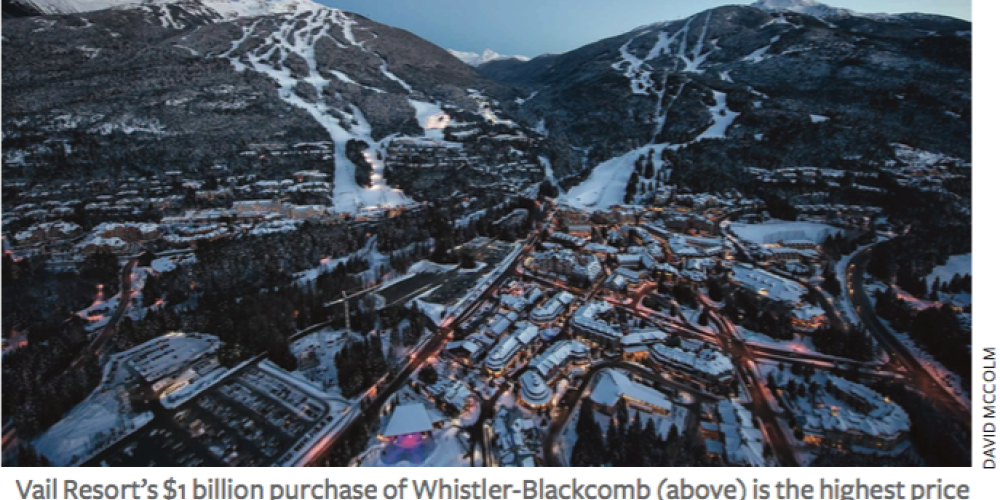
Vail’s purchase of Whistler/Blackcomb is historic: it makes the company twice as large, financially, as the number two ski resort operator. Vail is now poised to leap oceans.

By Seth Masia

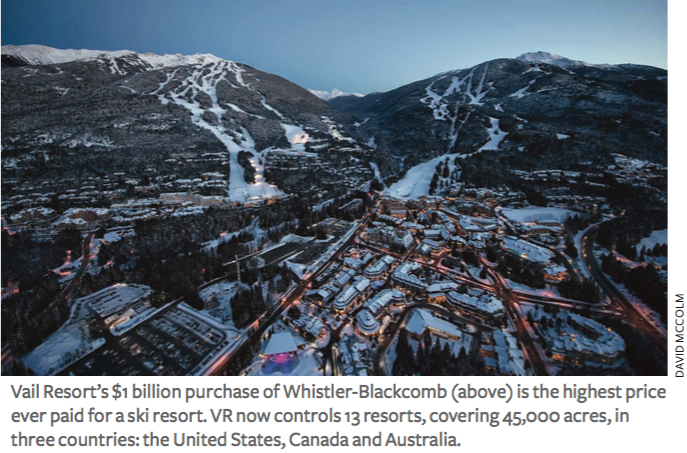
When, in August, Vail Resorts (VR) announced its $1 billion dollar purchase of Whistler-Blackcomb (WB), the company solidified its position as the largest ski resort operation in North America, the second-largest in the world by acreage—and by a long shot the largest in the world in terms of revenue. 

A billion dollars actually understates the scale of this deal. It’s the highest price ever paid for a ski resort, anywhere in the world. Because VR is buying a 75 percent stake (Nippon Cable holds the remaining 25 percent), WB is worth a bit over $1.3 billion. The resort has more than tripled in value since going public in 2010.
Whistler’s value to Vail is threefold,
according to Hugh Smythe, former WB president: WB is profitable all summer (unique among mountain resorts); it’s therefore a hedge against global warming; and it opens access to world markets, especially the fast-growing East Asia market.

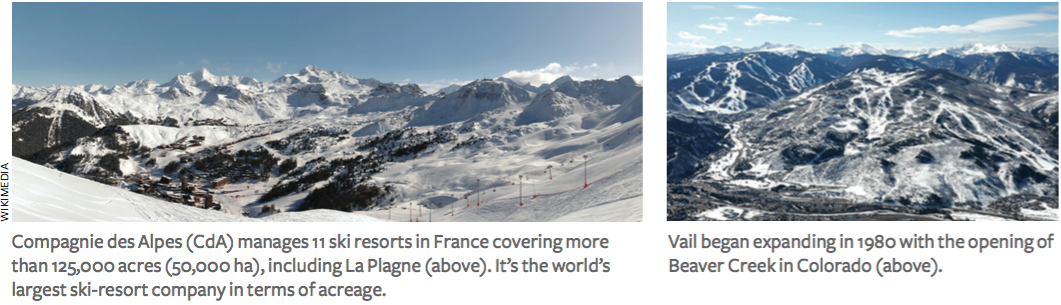
Vail began expanding in 1980 with the opening of Beaver Creek. With this acquisition, VR controls 13 resorts, covering about 45,000 acres (18,000 ha) in three countries—the United States, Canada and Australia. In extent, that’s second only to Compagnie des Alpes (CdA), which manages 11 ski resorts in France covering more than 125,000 acres (50,000 ha). 

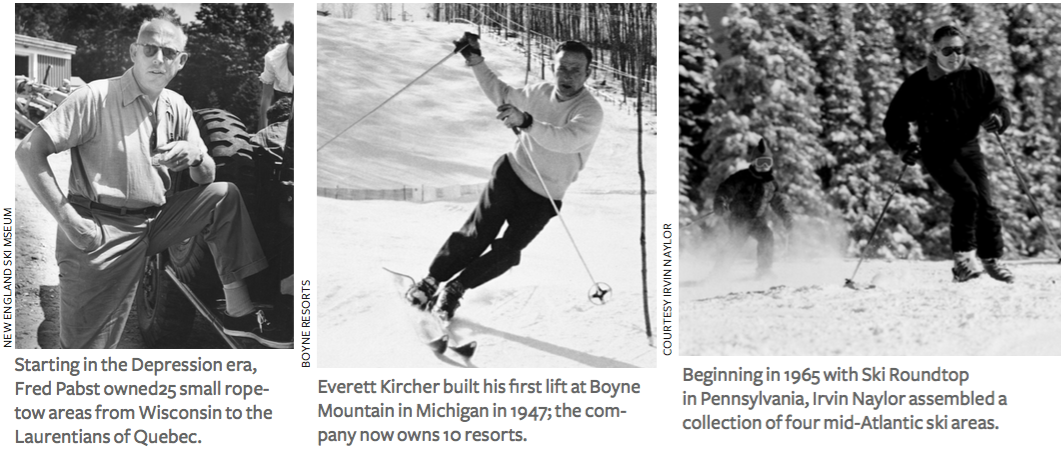
The story of ski-resort empires begins with Fred Pabst, who scattered rope tows about the northeastern quarter of North America during the Depression era. At one time or another, Pabst owned 25 ski areas, most using a single rope tow or T-bar, spread out between Wisconsin and Quebec’s Laurentians. During World War II, Pabst discovered he couldn’t personally supervise all his small fiefdoms, and consolidated at Big Bromley, Vermont. Since then, notable ski-empire entrepreneurs have included:

  • Everett Kircher, who built his first lift at Boyne Mountain, Michigan in 1947. Boyne Resorts now manages about 14,884 acres (5,953 hectares) of lift-served terrain at 10 resorts—including Big Sky, Montana; Crystal Mountain, Washington; and Sugarloaf, Maine.
  • Aspen Skiing Company, beginning in 1948, which today operates four neighboring lift networks on 5,306 acres (2,122 ha). 
  • Irv Naylor, who assembled a collection of four mid-Atlantic ski areas beginning with Ski Roundtop in Pennsylvania in 1965.
  • George Gillette, who morphed from owning Vail to operating the nine Booth Creek Resorts, including Waterville Valley and Grand Targhee. At its peak in 1997, the company operated on 9,431 acres (3,772 ha).
  • Powdr Corp., a.k.a. the Cumming family, which acquired Nick Badami’s properties (Alpine Meadows and Park City) and today operates seven resorts totaling 9,600 acres (3840 ha).
  • Charlie Locke, who built Resorts of the Canadian Rockies beginning in 1974. Today the company manages six resorts covering about 4,000 acres (1,600 ha).
  • Tim Boyle at Peak Resorts, with a string of small and mid-size ski areas from Missouri to Maine, including Attitash, Hunter and Mt. Snow.
  • Les Otten, who began with Sunday River in 1980 and by 1998 controlled about 23,000 acres (9,200 ha) through the American Skiing Company. The company folded in 2008.
  • And of course Joe Houssian’s Intrawest, which acquired Blackcomb in 1986 and at its peak, in 2003, ran lifts on 25,000 acres (10,000 ha) plus about 3.2 million acres (12,348 square kilometers) of heliski terrain through its subsidiary Canadian Mountain Holidays.

The newly expanded VR enters an entirely different realm in financial terms. With WB on board, the corporation is on track to post more than $1.65 billion in revenue for the 2017–18 season, on more than 10.6 million skier-days. It’s roughly 15 percent of all skier days in North America. 

And the revenue is twice what Compagnie des Alpes realizes (695.6 million euros, or $785 million) on fewer skier days (CdA reports 13.6 million). CdA gets only lift-ticket revenues, while VR also has profitable food service, ski school and retail/rental operations. But for a number of years, Vail also has pursued a savvy pricing strategy, pushing same-day ticket-window purchases steadily higher to make the company-wide season pass look more attractive. Faced with prices up to $175 for a day pass, even the ski-week customer feels obliged to spring for the $800 Epic Pass. Last year VR sold half a million season passes, valid at every resort within the realm. With Whistler in the mix, that’s likely to go past 700,000. A senior resort executive, declining to be identified, estimates that will be around 40 percent of all season passes sold in North America. According to Kelly Ladyga, VP of corporate communications at VR, the season pass program now constitutes 40 percent of the company’s ticket sales, and 15 percent of VR revenue. As the pass grows more attractive, that’s likely to go higher.

The strategy: Lock in the market share. Keep Epic Pass skiers travelling within the VR empire (VR commands about 43 percent of all Colorado skier days). Once you have the Epic Pass, how likely are you to pay the day-ticket price at Sun Valley or Jackson Hole or Telluride?  Seeking an answer to that question, those resorts—along with Alta, Snowbird, Aspen/Snowmass, Mammoth, Squaw Valley/Alpine Meadows, Stowe, Taos, Lake Louise, Sunshine, Revelstoke, Thredbo and Coronet/Remarkables—have ganged together to offer the $409 Mountain Collective Pass, which offers two days of skiing at each resort, plus a 50 percent discount on additional days. The Collective might try to match the Epic Pass value, by expanding the number of days at each resort while bumping up the price. The Vail-Whistler deal won’t close until the end of 2016 and Whistler won’t join the Epic Pass program until the 2017-18 season. So the rest of the industry has about 18 months to come up with an effective response.

Meanwhile, VR wants even more growth. It’s reaching market-share saturation in North America, not to mention testing the limits of the U.S. anti-trust laws. Europe beckons, as does Japan. And so, on September 1, the company announced that the Epic Pass will be good for two or three days of skiing at each of 31 ski areas in Europe, covering Austria’s Arlberg region (including St. Anton), the entire Vanoise region in France (Val d’Isère, Les Arcs/La Plagne and the Trois Vallées complex), the Verbier region in Switzerland, and the Dolomites in Italy (each resort has its own rules for Epic Pass access—check http://tinyurl.com/EpicEurope for details). Europe’s resorts customarily exaggerate their acreage, but a rough count puts the terrain at 170,000 hectares (425,000 acres). For the North American skier with airline miles to burn, that certainly amps up the value of the pass. And for European skiing, it looks like Vail has secured a beachhead.

Vail Buys Whistler/Blackcomb
Category
Open to Public?
Off
Feature Image Media
Image
Timestamp

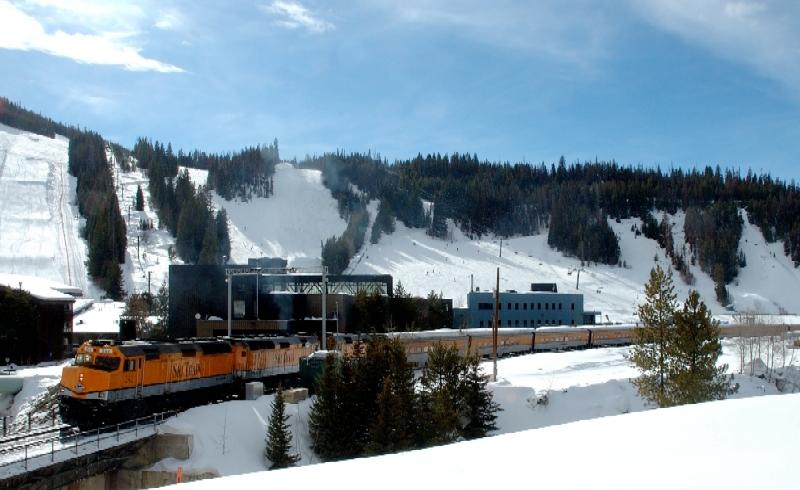
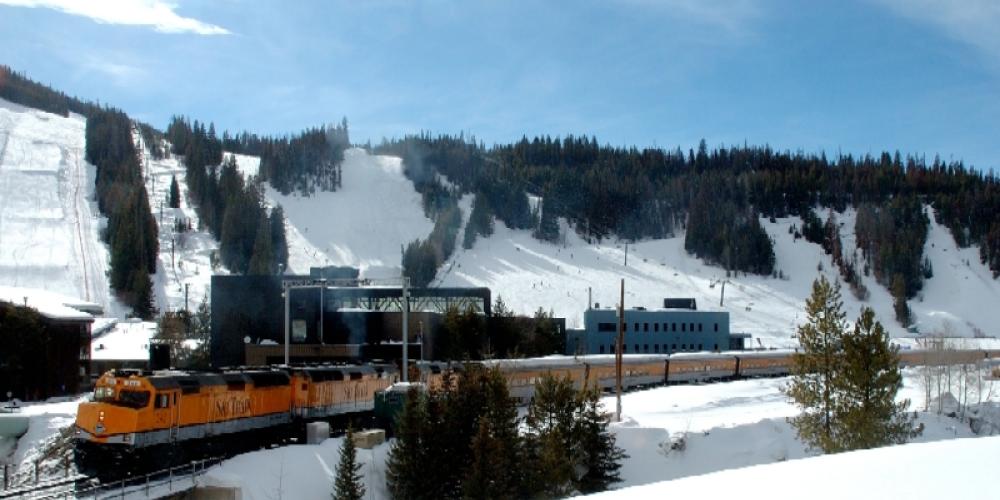
Last March, in celebration of Winter Park’s 75th anniversary, the resort revived the Denver ski train as a one-weekend experiment with Amtrak (see the March-April 2015 issue of Skiing History, page 7). Tickets sold out quickly, so for the coming season, Amtrak has scheduled regular weekend service, from January 7, 2017 to March 26.

The train will leave Denver’s Union Station at 7 a.m. each Saturday and Sunday (plus Martin Luther King Day and President’s Day), arriving at Winter Park at 9 a.m. The return run will leave Winter Park at 4:30 p.m., arriving Denver at 6:40 p.m.  Adult fare begins at $39, with half-price tickets for two kids kids 12 and under riding with an adult. One-way tickets are available to skiers planning a multi-day Winter Park vacation.

The train ran between Denver and Winter Park every ski season from 1940 to 2009 (see “Rails to Trails” in the December 2008 issue of Skiing History, or skiinghistory.org/history/ski-trains-history).

The Colorado Transportation Commission has provided a $1.5 million grant to help build an ADA-compliant boarding platform and rail improvements at Winter Park.

For more information, and to book tickets, see amtrak.com/winterparkexpress.

Winter Park Ski Train
Category
Open to Public?
Off
Feature Image Media
Image
Timestamp

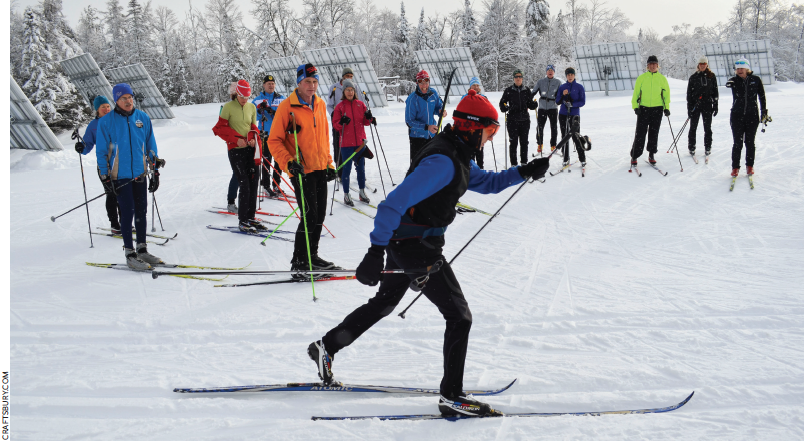
In northern Vermont, a “crazy idea” has become a world-class, award-winning cross-country and outdoor center. By Peggy Shinn

In February 2014, as the Olympic torch was lit in Sochi, Russia, the Craftsbury Outdoor Center in northern Vermont was having an opening ceremony of its own. Around a bonfire, locals raised glasses of cider and toasted Hannah Dreissigacker, Susan Dunklee and Ida Sargent, three of Craftsbury’s own who were competing in biathlon and cross-country skiing at the Winter Games. 
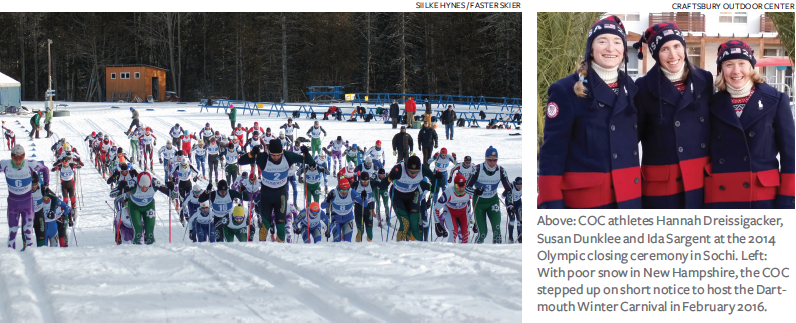
The three athletes, who grew up skiing at the Craftsbury Outdoor Center (COC) and went on to compete for its elite Craftsbury Green Racing Project, were the first of many Olympians that the COC hopes to celebrate. This past winter, Sargent scored several top 20s in World Cup sprint races, including a fifth in a team sprint with former Dartmouth teammate Sophie Caldwell. In biathlon, Dunklee earned her second World Cup podium, finishing second in a sprint race in Presque Isle, Maine. Teammate Dreissigacker competed in her third world championships, with her best result coming in the sprint race (she finished 18th). 

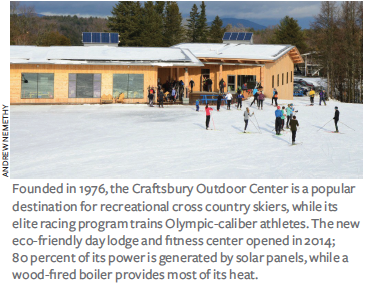
These three world-class athletes symbolize how far the COC has come from its humble beginnings. In 2015, Craftsbury Nordic was named the Cross Country Club of the Year by the U.S. Ski and Snowboard Association, honored for “stepping up to host national-level events” like the U.S. Masters National Championships and two USSA Super Tour weekends with nearly 800 starts each weekend. COC also won the 2015 John Caldwell Award, the highest honor given by the New England Nordic Ski Association. Both organizations lauded COC for its superior organizational skills, homologated race courses with snowmaking, its new eco-friendly day lodge and training facilities, and its commitment to developing the next generation of racers. It’s also a popular destination for recreational skiers, who stay for a weekend—or longer—in the dorm-style lodge, lakeside cottages and brand-new cabins.

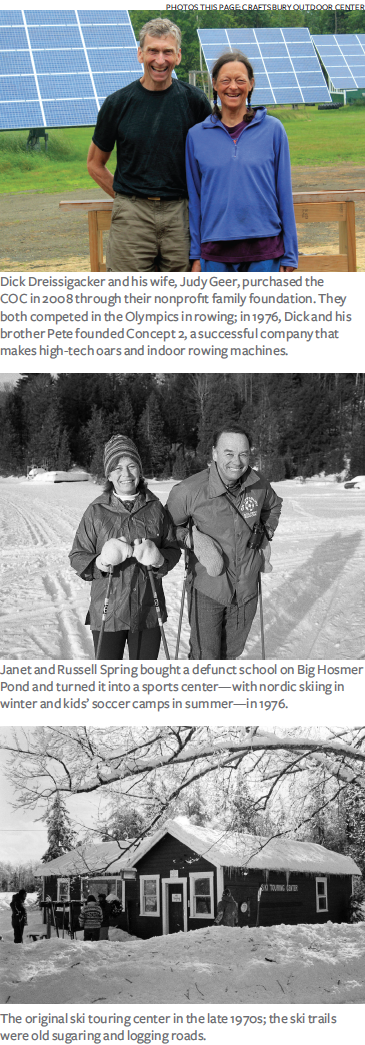
The story begins in 1973 when, as family lore goes, Russell and Janet Spring wanted to escape the “rat race” of Stowe, Vermont. After graduating from Yale, Russell—the brother of ski market-research pioneer and former ISHA chairman Jim Spring—had moved there to become an alpine ski instructor in 1950. A few years later, he met and married Janet. They started a family, and Russell became a stockbroker for F.I. DuPont in its Burlington office.

“He was driving back and forth to Burlington every day to lose lots of money,” says his son, Russ. “The market was doing poorly, and he got sick of it.”

So Russell and Janet bought half of a cattle ranch in Wyoming. But the deal fell through when their partner’s husband ran off with a hired hand. Instead, the Springs moved to Craftsbury, where Russell founded the Craftsbury campus of Windridge Tennis Camp. 

Driving back and forth to Windridge every day, Russell passed Cutler Academy, a defunct boys school on Big Hosmer Pond. He proposed an idea to his family: buy the property and start a sports center. “We all voted a resounding no,” remembers Russ with a laugh. “But in our family, it wasn’t really a democracy. [Dad] voted yes, and we obviously know what happened.”

With two partners, Arlen Smith and Dean Brown, Russell leased the property in 1975 and purchased it a year later. Thus was born the Craftsbury Sports and Learning Center, soon to be renamed the Craftsbury Outdoor Center. The center offered cross-country skiing in the winter and kids’ soccer camps in summer. Campers and skiers stayed in Cutler Academy’s former dorms and ate in the dining hall, where the Springs served famously delicious food.

“We started with one rickety snowmobile and one little piece of stuff to drag behind it,” said Russ. “I was the snowmobile driver, and Russell and Janet were the ski instructors.” 

The 25 kilometers of trails were mostly old sugaring and logging roads. But the trail layout and grooming were better than at other nordic centers at the time, and they had an experienced director, John Brodhead, to help maintain them. A former Middlebury College nordic combined skier, Brodhead started in 1980 and is retiring in December 2016. 

The operation saw very few guests in its early years. Undeterred, the Springs kept expanding the trail network. Russell also expanded the Center’s programs, including a summer sculling camp—the “crazy idea” of a long-time friend who saw Big Hosmer Pond as an ideal rowing venue. Two of their first sculling coaches were Olympic rowers Dick Dreissigacker and Judy Geer; Dick and his brother, Pete, had recently started an oar-building business in nearby Morrisville. They would soon come out with the Concept 2 indoor rowing machine that’s now ubiquitous in fitness centers across the country. 

In 1981, Brodhead started an event that’s now an annual institution at the COC: the 50-kilometer Craftsbury Marathon. The race now attracts around 500 skiers each year, including some of the nation’s top cross-country skiers, past and present. He also started nordic programs for both kids and adults that brought the community to the COC, including the Dreissigackers with their three kids, the Dunklees, and the Sargents. 

In 1994, Russell let his son Russ have a hand in running the COC. “He was still actively involved, but he stopped making all the decisions unilaterally, which was the only real difference,” says Russ. “I was allowed to make decisions as long as he agreed with them.” 

In 2007, Dreissigacker and Geer proposed buying the COC through a family foundation. Russ and his sisters thought it was a good idea. But Russell was opposed to it. “He was bound and determined to keep it in the family,” said Russ.
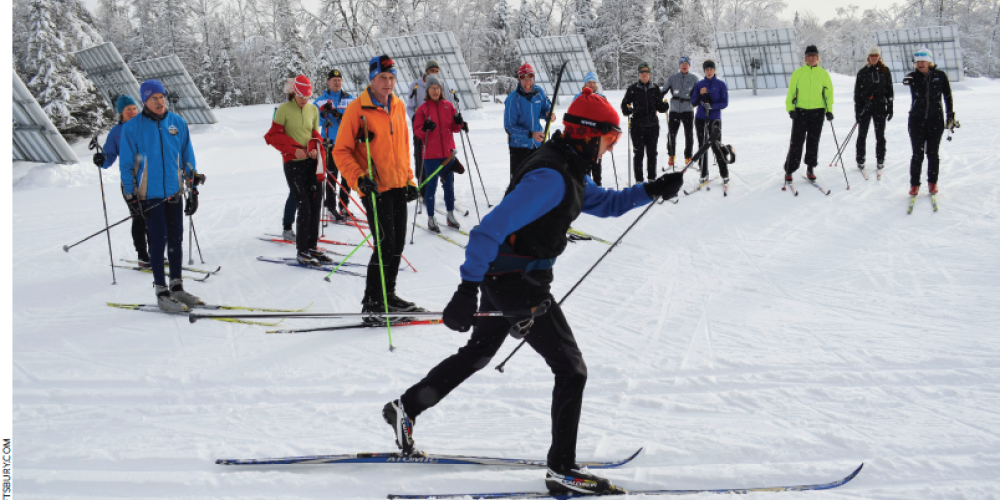
After a few years of conversation, Russell conceded when he realized that Dreissigacker and Geer believed in his original vision and wanted to improve it, not change it. They were all for simple, comfortable lodging and a focus on outdoor, human-powered sports. They also wanted to start a resident program for elite athletes and add more community fitness programming.

Dreissigacker’s and Geer’s nonprofit foundation purchased the COC in 2008. A year later, the Craftsbury Green Racing Project was born. Funded by the COC, Dick and Judy’s foundation, and corporate sponsors, the CGRP typically attracts NCAA Division I graduates who aspire to compete at the World Cup level in cross-country skiing and biathlon (as well as rowing). In addition to Hannah Dreissigacker, Dunklee, and Ida Sargent, CGRP’s Caitlin Patterson and Kaitlynn Miller have competed in World Cups. 

Conceived by Middlebury graduate Tim Reynolds, the CGRP allows athletes to train full-time while earning their keep by working at the COC. They teach fitness programs, coach kids in the popular Craftsbury Nordic Ski Club, and maintain the garden, among other chores. They also helped to design the new energy-efficient, spacious fitness center and ski lodge that opened in June 2014.

In 2012, the CGRP added a year-round rowing team, and CGRP rower Peter Graves (no relation to the well-known ski announcer) finished 13th in the quad scull at the London Olympics. Four CGRP rowers won 2016 Olympic Trials, but in the end, failed to qualify the men’s quad for the Rio Games.

While Olympians ski the trails and ply the water of Big Hosmer Pond, the Craftsbury Outdoor Center remains a community resource—and a community itself.

“Its success is primarily built on the vision and generosity of Dick and Judy, who are way too humble to tell you that,” says Lindy Sargent, Ida’s mom. “We call it our ski family, and it includes all the racers and parents of racers around New England and now the U.S. Ski Team. But it started with the club, and everyone who skis at Craftsbury is part of the family.”  

Category
Open to Public?
Off
Feature Image Media
Image
Timestamp

For a dozen years, Denver billionaire and Hollywood heavyweight Marvin Davis owned the Aspen Skiing Company, to the dismay of many locals.

By Jay Cowan

Some said that no one in Aspen had entertained like that since the silver baron days. Others said it depended on what you found entertaining. Either way, when Twentieth Century Fox owner Marvin Davis threw big annual New Year’s parties at his Little Nell Hotel in the late 1980s, “It was just over, over, over the top, with stars and important people and lavish entertaining,” recalls longtime Aspen socialite and owner of The Residence hotel, Terry Butler. “He loved what money could buy. The centerpieces on every table were three feet high, the décor was jewels and flowers and flash.” 

It was impressive for the time, in an old school kind of way. Glamorous guests included Sean Connery, Sly Stallone and Barbra Streisand, mingling with Oprah Winfrey, Steve Ross and Lee Iacocca, being served champagne, caviar and flambés in the increasingly Stoli, sushi and cocaine world of Aspen. Locals had grown accustomed to extravagant lifestyles and partying on a level that made Davis seem almost anachronistic by the time he arrived. The community was less concerned about his social life than by his business tactics, and had reacted with nearly unanimous horror when he bought Fox and the ASC in 1981.

Formed in 1946 by Chicago businessman Walter Paepcke and Austrian ski star Friedl Pfeifer, the Aspen Skiing Corporation opened business on Aspen Mountain on December 14 of that year with what was called the world’s longest chairlift, stretching 6,800 feet. But it struggled to make money for years and only finally succeeded after native Aspenite D.R.C. “Darcy” Brown, an original investor in the corporation, took over as president and general manager in 1957. 

Twenty years later, business was golden and when Brown received an offer to sell in December 1977, he recommended it to his board. Twentieth Century Fox would buy all the shares at a hefty price, offering the first-ever return on investment to shareholders. Fox, cash-heavy from its first Star Wars film, was diversifying as it made other real estate buys that included Pebble Beach Resort, and Brown felt they would be a good fit for the ASC. The man who replaced longtime Aspenite Tom Richardson as CEO, Harry Holmes, lived in and also ran Pebble Beach, but left the ASC board of directors intact and poured money back into its operations.

Enter Marvin Davis, a Denver-based, billionaire wildcatter who was the basis for his friend Aaron Spelling’s hit TV show Dynasty. Davis sold his oil business for $600 million, morphed into a corporate raider and with a partner, oil-trader and financier Marc Rich, bought Fox for $720 million in 1981. Word immediately circulated around Aspen that Davis would be selling and spinning off Fox assets such as the ASC, Pebble Beach and others. The ASC brass was told it wasn’t true, but it was.

Darcy Brown later said in an interview that, “My only real regret is selling to Twentieth Century, not knowing that Twentieth Century was going to be taken over by Marvin Davis.” He accused Davis of “milking the company” by selling assets and pocketing the profits instead of returning them into the company. 

For his part, Brown hadn’t been universally beloved. He could seem patrician and distant and didn’t always care what locals thought. Most assumed it was because he didn’t have to, as he guided the ASC into unpopular ticket price hikes and support for local projects (such as expanding the airport) that weren’t well received. With all of that, however, he was “one of us” to many in the community, which Davis definitely was not. The curmudgeonly Brown began to seem not so bad compared to the new ruling order, a consequence he probably enjoyed. 

Davis once said of the entertainment industry, “I love this stuff, the people and the glamour. This isn’t just a business. It’s a helluva lot of fun.” He didn’t feel the same about other Fox assets and quickly began unloading them, including the ASC purchases of Breckenridge ski area, a substantial interest in Whistler Blackcomb, and several Aspen lodges ASC owned for employee housing. Davis ignored any long-term strategy in favor of a quick return on his Fox acquisition.

In 1983, Davis’s Fox partner Marc Rich was indicted by the U.S. Justice Department on 65 criminal counts for violating the Iranian oil embargo during the 1980 hostage crisis. Rich, whose ex-wife Denise still owns a home in Aspen, fled to Switzerland to avoid extradition. Davis bought out Rich’s interest for $116 million and flipped it for $250 million to Rupert Murdoch in 1984.

Aspen meanwhile was deep in an ongoing bout of existential angst centered on how much of its soul it was willing to sell to further its success. For many it seemed as if suddenly an entire way of life, not just the SkiCo, had been auctioned off with no local input and was at the mercy of all those forces they had spent years fighting. Davis’s ethics were much more in tune with making money than making a community. Marc Rich was apparently a major-league criminal. And Murdoch was infamous for his string of sensational tabloid newspapers in Australia, New Zealand and the UK.

Davis spun off the ASC to a subsidiary of Aetna Life and Casualty in 1983, and then to a limited partnership of his called Miller, Klutznick, Davis and Gray, as a string of disgruntled local executives quit along the way, citing the ongoing changes of ownership. The ASC had begun to seem like just another commodity, destined to be constantly traded like so many pork bellies. Then it was taken private for the first time since 1946 and rechristened the Aspen Skiing Company. The Davis partnership kept a 51% interest and sold the rest to the Lester Crown family in 1985. But they continued to hemorrhage managers with Jerry Blann—who had taken over as CEO from Harry Holmes—quitting at the end of 1987, feeling betrayed by ownership over a ticket-pricing controversy.

In a later Vanity Fair story, Marvin Davis recalled, “It took us about six months to figure out what we wanted to do,” with the ASC when he bought Fox. “We decided to build a beautiful hotel, the Little Nell. Then some French firm came to me with the idea of having gondolas so a guy didn’t have to freeze his ass off going up the hill. We wanted to make it one of the best places in America and I think we did.” The Silver Queen gondola debuted in December 1986, transforming the ski experience on Aspen Mountain, while the luxury Little Nell Hotel broke ground that year and opened in 1989.

Putting aside the hubris of Davis claiming to have made the already top-ranked Aspen “one of the best places in America,” some important upgrades were accomplished during his tenure. Current SkiCo president and CEO Mike Kaplan, who wasn’t with ASC during the Davis years, says, “I think they were responsible for focusing the company in Aspen and selling off assets outside of the Roaring Fork Valley, building the Nell and the gondola, and ushering in the era of high-speed quads.”

Perhaps the most telling aspect of the Marvin Davis years in Aspen is that, though people remember the lavish New Year’s parties and all the wheeling and dealing he did with the ASC, there are no stories about him personally. At 6’4” and 300 pounds, he was a large man and sometimes caricatured as the typical American fat cat. So he didn’t go unnoticed in Aspen as much as he simply wasn’t often there, preferring to spend time at the family’s home in Los Angeles. And when he was in Aspen, he didn’t hang out or party with the locals. His relationship with the community was purely professional.

Davis’s other inescapable impact was to dial up Aspen’s visibility as “Hollywood in the Rockies.” It would have seemed almost impossible to do in a town that had been awash with stars since the early 1950s. But the Davis influence, like Davis himself, was big. He and his wife Barbara were generous philanthropists who hosted extravagant charity events, and Fox as well as Warner Brothers owned large houses in Aspen for entertaining their talent. A-list stars including Kevin Costner, Arnold Schwarzenegger, Melanie Griffith, Sally Field and Don Johnson soon arrived along with power players the likes of Michael Eisner and Michael Ovitz. 

“The news spread fast in Hollywood that Marvin Davis’s Aspen was the place to play,” the Vanity Fair story breathlessly reported. “You name ’em, they were there,” said Davis.

“Davis definitely encouraged more of Hollywood to come here,” says Terry Butler. “And after the gondola was built, they started bringing planeloads of stars in. They could wear their pretty clothes and go to the top of the mountain and didn’t even have to know how to ski that well, since they could ski the top, which was easier terrain, and download on the gondola. The mountain changed and the town changed.”

In 1993, the Crown family of Chicago bought out Davis, assuming 100% ownership of the ASC. They retained Bob Maynard, who had replaced Blann in 1988; Maynard had run Keystone and Robert Redford's Sundance. Since then, there has been none of the executive turmoil that marked the Davis reign—only two CEOs have held the post, each for at least a decade, since Maynard retired in 1996. The Crowns' long-term commitment to the company and genuine involvement in the local community have been widely acclaimed as the best thing that could have happened to Aspen. The Davis era was a wild ride no one wanted to repeat and ultimately, many felt his greatest contribution to town was selling the ASC to the Crowns.  

When Hollywood Owned Aspen
Category